Navigating the Healthcare Revenue Cycle in 2026
Understand the healthcare revenue cycle and its impact on workflow, pay, and burnout. A clinician-friendly guide to your daily practice.
You're probably not reading about the healthcare revenue cycle because you woke up wanting a finance lesson.
You're here because some part of your day keeps getting hijacked. A prior auth gets kicked back after you already explained the plan to the patient. A patient asks why the bill doesn't match what they expected, and somehow that conversation lands in your exam room. Your inbox fills up with chart queries, coding questions, refill messages, and appeal requests long after clinic ends.
Most new clinicians treat those as separate annoyances. They aren't. They're connected parts of the same operating system.
If you understand the healthcare revenue cycle, you start seeing why one practice feels organized and humane while another feels chaotic and draining. This isn't about turning clinicians into billers. It's about learning how money moves through a medical practice, because that flow affects staffing, schedule pressure, patient friction, and your own odds of burning out.
That Administrative Headache Is the Healthcare Revenue Cycle
A patient books a visit. The front desk enters insurance incorrectly. Eligibility isn't checked carefully. You see the patient anyway because they're already on your schedule. Your note is clinically solid, but the charge doesn't match the documentation closely enough for coding review. The claim goes out late. The payer denies it. Weeks later, the patient gets a statement they don't understand and calls your office angry.
From your side, it feels like five different problems. From the practice side, it's one broken chain.
Healthcare revenue cycle management is the end-to-end process that captures, manages, and collects revenue for patient services, from scheduling and registration through billing, payment posting, and collections, as outlined in HealthStream's overview of revenue cycle workflow. That process has become highly structured. The Healthcare Financial Management Association's MAP initiative standardized 29 revenue-cycle KPIs across 5 major categories, which tells you this isn't a vague back-office function. It's an operational discipline.
Why clinicians should care
When the cycle runs well, your day is quieter. Fewer billing surprises hit patients. Fewer denials come back for rework. Fewer urgent emails ask you to amend documentation after the fact.
When it runs badly, the stress doesn't stay in finance.
- Patients feel it first: Confusing estimates, eligibility mistakes, and delayed statements make them distrust the practice.
- Clinicians absorb the fallout: You end up explaining bills you didn't create and defending treatment plans to people who are upset about cost.
- Leaders react downstream: When collections lag, they freeze hiring, squeeze visit volume, or push everyone to “improve productivity.”
Practical rule: If a practice has constant friction around scheduling, authorizations, coding questions, and patient balances, the problem usually isn't just “communication.” It's a weak revenue cycle showing up in clinical life.
The real takeaway
A healthy revenue cycle doesn't just protect margin. It protects attention.
That matters more than most clinicians realize. Every preventable administrative loop steals time from patient care and from recovery after work. If you want to judge whether a job will support your well-being, don't just ask about culture. Ask how the practice gets paid.
A Patient's Journey Through the Revenue Cycle
The cleanest way to understand the healthcare revenue cycle is to follow one patient from the first phone call to the final balance.
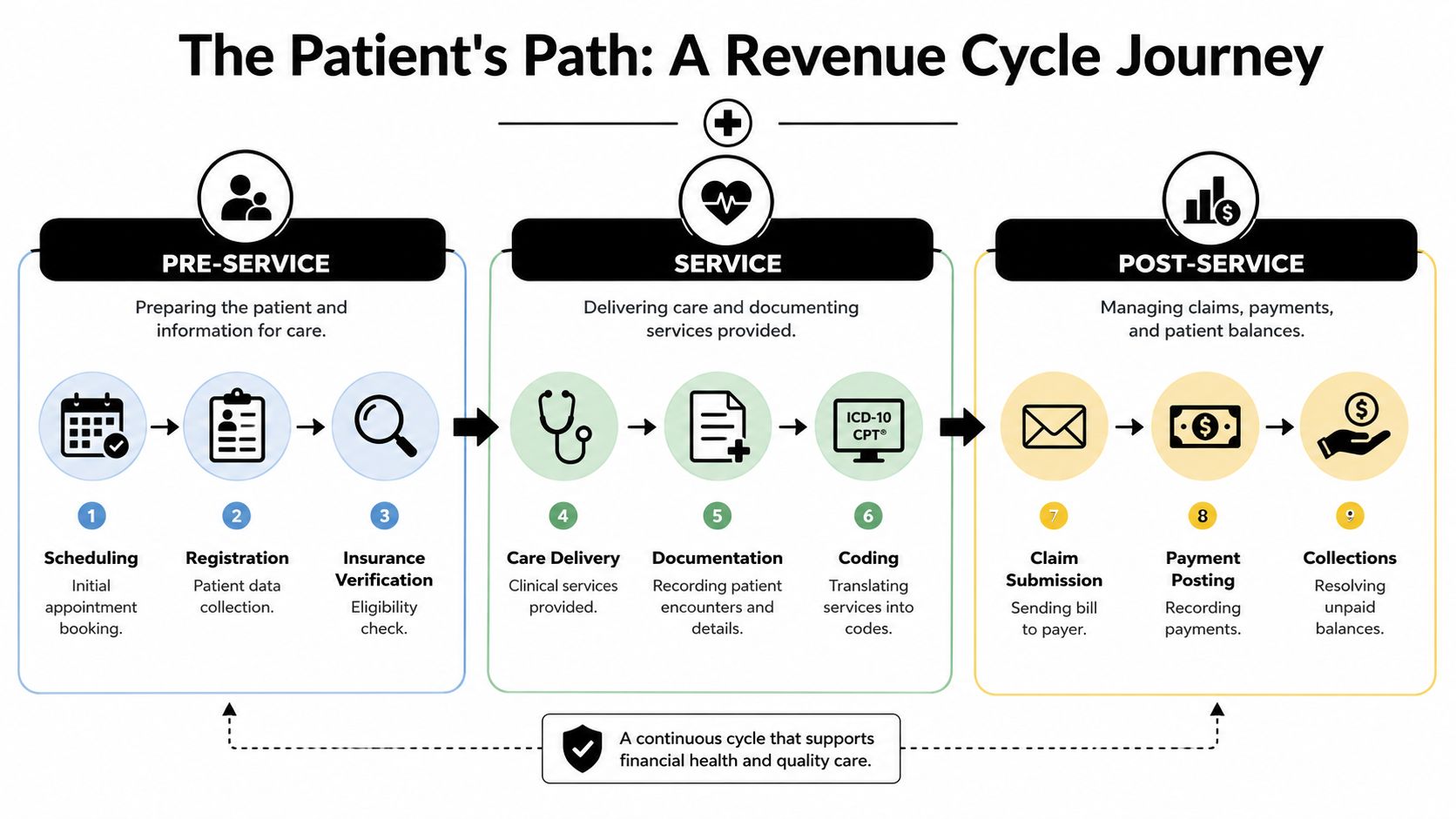
Before the visit
The cycle starts before anyone enters an exam room.
A patient schedules an appointment. Staff collect demographics, insurance details, and the reason for the visit. Then comes preregistration and eligibility verification. That's where the office checks whether coverage is active, whether the clinician is in network, and whether authorization is needed.
Initial errors often lead to many downstream headaches. If the wrong subscriber number gets entered or the plan requires approval that no one catches, the visit may still happen, but the claim can fail later.
During the visit
Once care is delivered, the clinical part of the job has to translate into billable data. That means documentation, charge capture, and coding.
Charge capture is the process of recording what services were provided. Coding translates the note into standardized billing codes. If the note is vague, incomplete, or delayed, coding gets harder. If coding and documentation don't line up, the payer may reject or deny the claim.
For clinicians, this is the point where “just finish your chart” stops being a nag and starts being a revenue issue. Timely, specific documentation helps the next people in the chain do their jobs without sending work back to you.
After the visit
Now the claim goes out.
The billing team submits it to the payer. The payer reviews it and sends back a remittance, which is the explanation of what was paid, adjusted, or denied. The practice posts that payment, then bills the patient for any remaining responsibility.
If money is still outstanding, follow-up starts. That may include correcting denials, appealing decisions, sending statements, setting up payment plans, or connecting patients to assistance.
Good revenue cycle teams don't treat billing as a separate department. They treat it as a relay race where every handoff affects the next runner.
Why this matters for patient experience
Patients don't experience the revenue cycle in tidy departments. They experience it as trust or confusion.
If the estimate was realistic, the front desk explained next steps, the claim went through cleanly, and the statement is understandable, the patient sees an organized practice. If any of those pieces break, the patient often blames the clinician because that's the person they know.
That's one reason financial workflow and patient satisfaction are tightly linked. Practices that make the financial path easier usually create a smoother overall visit experience, not just a cleaner ledger. If you want a broader view of that connection, this guide on patient satisfaction in healthcare is worth reading alongside your clinical workflow.
A simple mental model
Think of the revenue cycle in three blocks:
- Pre-service: Scheduling, registration, insurance verification, authorization.
- Service: Care delivery, documentation, charge capture, coding.
- Post-service: Claim submission, payment posting, denial follow-up, patient billing, collections.
If you remember that structure, most “mysterious” administrative problems become easier to place. And once you can place them, you can ask better questions about how a practice works.
Key Metrics That Reveal a Practice's Financial Health
A practice can look busy all day and still be financially shaky. Clinicians usually notice that problem late, after schedules tighten, staffing requests stall, and every meeting starts to sound like a lecture about productivity.
The useful question is simple. Which numbers tell you whether the practice can support good care without grinding down the people delivering it?
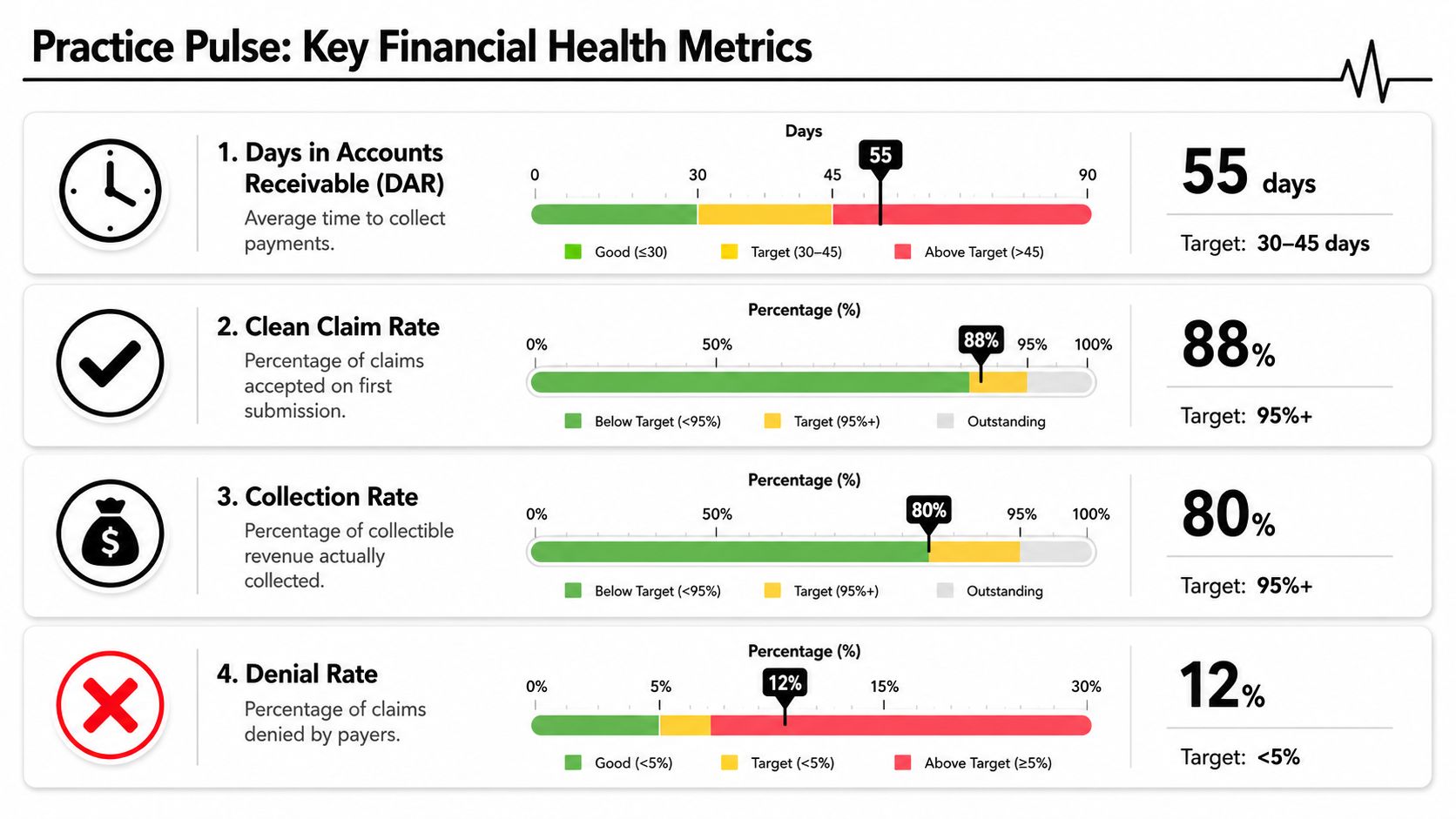
The four numbers worth asking about
Start with Days in Accounts Receivable.
For physician practices, healthy operations commonly aim for Days in A/R under 40 to 45 days, with many strong groups aiming lower, according to Aspect Billing Solutions' revenue cycle dashboard guidance. This metric is calculated as (Total Receivables – Credit Balances) / Average Daily Gross Charges. In day-to-day terms, it shows how long the practice waits to collect money for care that has already been delivered.
High A/R changes behavior fast. Leadership hesitates on hiring. Software upgrades get postponed. Open roles stay open. Clinicians feel it as thin staffing and pressure to see one more patient.
Next is the denial rate, meaning denied claims divided by total claims submitted. Aspect's guidance notes that even a 2 to 3 percentage point reduction in initial denials can materially improve cash flow because denied claims often move into older A/R buckets during appeals. For clinicians, this matters because denials create after-the-fact work. More chart clarifications. More coding questions. More time spent defending care that already happened.
Two more that tell you a lot
The clean claims rate, sometimes called the first-pass payment rate, shows how often claims go through without correction. Dean Dorton cites a target of about 80% clean claims ratio as a useful benchmark for healthy billing practices in its review of RCM metrics that affect financial performance. A strong clean claims rate usually reflects a practice that gets front-desk intake, coding, documentation, and billing edits aligned. A weak one usually means the staff is doing the same work twice.
The adjusted collection rate, also called net collection rate, tells you how much of the allowed reimbursement the practice collects after contractual adjustments. In its discussion of key healthcare revenue cycle metrics, Rivet Health defines adjusted collection rate as (Payments – Credits) / (Charges – Contractual Adjustments) × 100, notes that high-performing organizations often target 95% to 98%, and explains that cost to collect is Total RCM Costs / Total Collections × 100. Rivet adds that performance below the low 90s can point to revenue leakage, while collection costs that run too high leave less room for staffing and operational support.
What these numbers mean in real life
Here's the clinician translation:
| Metric | What it usually signals | What you'll feel at work |
|---|---|---|
| Days in A/R | How fast the practice converts care into collected revenue | Budget tightness, hiring delays, pressure to add visits |
| Denial rate | How often claims get stopped and sent backward | More appeals, coding queries, peer-to-peer hassle |
| Clean claims rate | How often the process works the first time | Less administrative churn |
| Adjusted collection rate | How much of allowed reimbursement the practice actually realizes | More stable compensation models and less panic management |
| Cost to collect | How expensive it is to get paid | Fewer resources for support staff, training, and protected time |
Clinicians do not need to memorize formulas. They do need to know which numbers predict whether the organization runs with some margin for error or runs in constant catch-up mode.
One metric clinicians often miss
Cost to Collect often gets overlooked during job discussions because it sounds like a finance-office detail. It is not. If collection costs are high, the practice is spending too much effort just getting paid, and that usually shows up somewhere else: fewer support staff, slower hiring, weaker onboarding, or compensation plans that feel more aggressive than the patient mix can realistically support.
That matters if you are evaluating roles tied to productivity. A group can talk at length about RVUs, but a leaky revenue cycle makes any production-based model less predictable. This plain-English overview of what RVUs mean in physician compensation is useful context if you are trying to judge whether the numbers behind an offer actually support the workload being asked of you.
How a Broken Revenue Cycle Fuels Clinician Burnout
A common day in a strained practice looks like this. The morning starts with a full schedule, then a chart gets kicked back for documentation clarification, a patient is upset about an unexpected bill, and lunch disappears into a peer-to-peer review that has nothing to do with the care plan you wanted to focus on. By 5 p.m., it feels like a time-management problem. In reality, it often starts in the revenue cycle.

Burnout in healthcare is tied to staffing, workload, and moral distress. Revenue cycle problems feed all three. When a practice struggles to get paid accurately and on time, leaders respond with tighter schedules, more documentation scrutiny, and fewer buffers in the day. Clinicians feel that as friction. More clicks. More messages. Less recovery time between visits.
Denials create work clinicians end up absorbing
A denied claim starts in billing, but it rarely stays there. It turns into coding questions, utilization review requests, appeal support, corrected documentation, and payer calls that pull clinicians away from patient care.
That extra work usually lands on the same people who are already running full.
The financial side matters because unstable collections change operational behavior. Practices delay hiring. Managers get more aggressive about productivity. Small workflow problems stop being small because nobody has time to fix them upstream. Clinicians may never see the monthly finance report, but they see the downstream effect in their inbox and schedule.
Front-end errors become exam-room stress
Some of the most draining moments start before the visit even begins. Benefits were not verified correctly. The deductible was explained poorly. Prior authorization was started late. The patient arrives frustrated, and the clinician becomes the person expected to sort out the confusion.
That is emotional labor, not just administrative noise.
Patients usually do not separate the financial experience from the clinical one. If registration, coverage checks, or billing communication go badly, the visit starts with distrust. The clinician then has to rebuild confidence while also staying on time and making good medical decisions. That combination wears people down faster than leaders often realize.
Weak cash flow changes the work environment
Practices with poor revenue cycle performance tend to make the same set of choices, even when leadership means well:
- Open roles stay open longer: MAs, RNs, billers, and front-desk staff are harder to replace when cash is tight.
- Support teams get overloaded: Prior auth, referrals, and denial follow-up back up, and pieces of that work slide back to clinicians.
- Volume pressure rises: Leaders try to make up for weak collections by adding visits, shortening slots, or pushing more template-driven follow-ups.
Clinicians experience those decisions as fatigue, not finance. The schedule feels less safe. Messages pile up after clinic. Charting spills into evenings. Compensation plans may still look attractive on paper, but the daily job becomes harder to sustain.
A useful explanation of the administrative load behind these issues is below.
Software helps. It does not replace judgment or staffing.
Many organizations respond to burnout by buying new tools. Some tools reduce manual work at the front end. They can catch eligibility problems earlier, standardize claim edits, and route follow-up tasks more cleanly. That helps.
But software does not resolve payer logic, explain medical necessity, or repair a workflow nobody owns. People still need to review exceptions, fix documentation patterns, and close the loop with billing and operations. If a practice underinvests in those roles, clinicians become the fallback system.
The practical question for clinicians is simple. Does this organization solve revenue problems close to the source, or does it let them drift until they land on the care team? That answer tells you a lot about burnout risk, even before you start the job.
Finding Burnout-Friendly Roles Within the Cycle
A clinician finishes a full day of patient visits, then spends the evening answering chart queries, correcting denials, and explaining coverage problems that should have been handled upstream. After enough weeks like that, many people assume the only options are to endure it or leave practice. There is a third option. Use your clinical training in a role closer to the revenue cycle, where the schedule is often steadier and the problems are clearer to solve.
Where clinicians fit especially well
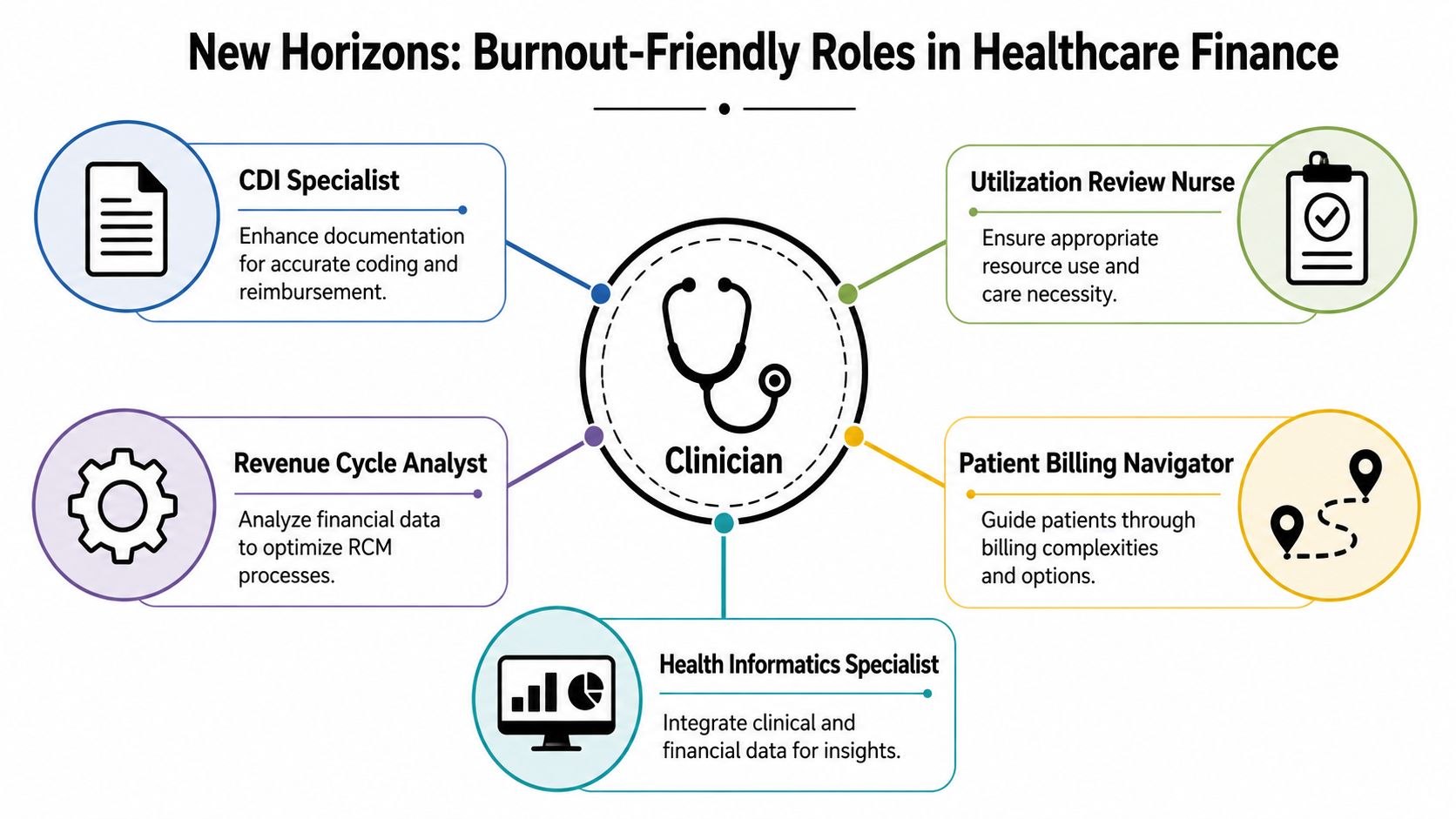
Revenue cycle teams need people who can read a chart and understand what happened in the room. That matters in work such as charge capture, claims review, medical necessity appeals, and documentation improvement. Automation can catch some routine errors. It cannot explain why a case met criteria, whether an inpatient stay was justified, or why a recurring denial points to a workflow problem instead of a one-off mistake.
That creates solid options for clinicians who want lower-friction work without wasting their training:
- Clinical documentation improvement specialist: You review notes for specificity, clarity, and coding support.
- Physician advisor or utilization review clinician: You assess status decisions, medical necessity, and payer appeals.
- Denial management specialist: You look for patterns in failed claims and help fix the causes at the source.
- Patient billing navigator or financial counselor: You help patients understand costs before confusion turns into anger.
- Revenue cycle analyst with clinical experience: You connect operational data to real behavior in clinic, on the floor, or in procedural settings.
Some of these roles pay less than full-time clinical practice. Some pay similarly, especially when they sit inside hospital systems or payer organizations. The trade-off is usually straightforward: less schedule volatility, fewer after-hours demands, and more control over the workday.
How to improve the cycle from a clinical role
You may not want a new title. Fair enough. Clinicians still influence the revenue cycle every day, and a few habits make life easier for both the billing team and the care team.
- Close notes promptly. Coding cannot finish work on visits that are still open.
- State medical necessity plainly. Reviewers should not have to hunt for the reason a test, visit, or admission was appropriate.
- Match orders, diagnoses, and documentation. Small inconsistencies create preventable edits and callbacks.
- Report repeated payer problems. If one plan keeps denying the same service, that pattern belongs with operations leadership.
- Learn the upstream handoffs. A basic understanding of what healthcare credentialing involves helps clinicians spot why enrollment or payer setup problems can disrupt claims for weeks.
There is another practical angle here. Revenue cycle work now touches privacy, access, and system security more directly than many clinicians realize. Groups that invest in HIPAA compliance security services are usually taking the operational side of patient care seriously too. That does not guarantee a healthy workplace, but it is often a good sign that leadership understands risk before it reaches the exam room.
A practical career angle
Clinicians looking for steadier roles often find them through hospital job boards, consulting firms, payer medical review teams, and physician-focused platforms. WeekdayDoc is one example of a physician-founded platform that curates burnout-conscious roles, including nontraditional jobs with less call, fewer weekends, and more predictable hours.
A less draining job inside healthcare is possible.
For some clinicians, the right move is to stay in patient care and tighten the handoffs that create unnecessary friction. For others, the better fit is a role beside the revenue cycle, where clinical judgment still matters and the work is easier to sustain over time.
How to Vet an Employer's Revenue Cycle Health
A job interview should tell you more than whether people seem nice. It should tell you whether the operation is stable.
The safest way to ask is with practical, non-accusatory questions. You're not trying to interrogate anyone. You're trying to learn whether the practice has the discipline to support good care and sane working conditions.
Questions worth asking directly
Ask a hiring manager, medical director, or operations leader questions like these:
- How are prior authorizations handled? Ask who does the initial work, who supports appeals, and how often clinicians are pulled into peer-to-peer calls.
- What are the biggest billing friction points right now? Strong leaders can answer this clearly without becoming defensive.
- How does the group handle patient financial responsibility? You want to hear about estimates, counseling, payment options, and support for patients who are insured but still struggling.
- Who owns denial follow-up? If the answer is vague, the work may be drifting back toward clinicians.
- How are front-desk and clinical teams trained together? Revenue cycle problems often start at handoffs, not in isolated departments.
What better answers sound like
Modern revenue cycle stress is increasingly tied to patient financial burden, not just payer denials. More patient-centered organizations are redesigning financial assistance and counseling for insured patients as well, which can reduce billing-related friction in the exam room, as discussed by Undue Medical Debt in its revenue cycle perspective.
That means strong answers usually include a few themes:
- Clear ownership: Someone specific handles eligibility, authorizations, denial management, and patient financial counseling.
- Real support for patients: The practice doesn't assume insurance equals affordability.
- Operational maturity: Teams use secure systems, role-based access, and documented workflows. If you're assessing the technical side of that infrastructure, resources on HIPAA compliance security services can help you understand the security expectations around protected health information.
- Upstream discipline: Credentialing, enrollment, and payer setup are handled carefully because one setup error can create months of reimbursement trouble. If you want a refresher on that foundation, this guide on what healthcare credentialing is is useful context.
Quiet red flags
Pay attention if interviewers can't explain how billing problems get solved. Also notice when every answer circles back to “our doctors are very flexible” or “everyone pitches in.” Sometimes that means teamwork. Sometimes it means the system depends on unpaid clinician cleanup.
A healthy employer doesn't expect you to absorb every failure in the revenue cycle. They build processes that keep those failures from reaching you in the first place.
WeekdayDoc helps clinicians find burnout-friendly roles that protect evenings, weekends, and personal time. If you're looking for remote, hybrid, or in-person jobs with clearer boundaries around call and schedule demands, WeekdayDoc is a practical place to start.