Telehealth Respiratory Therapist Jobs: Roles and Realities
Explore telehealth RT roles, qualifications, licensing, pay context, and schedule questions to ask before accepting a remote or hybrid job.
Many clinicians look for telehealth respiratory therapist jobs hoping for predictable hours and a break from the hospital floor. A remote role changes where you sit, but the clinical expectations, state licensing rules, and shift structures vary widely depending on the employer. Understanding what a position demands before signing a contract helps you weigh those trade-offs. WeekdayDoc helps healthcare professionals evaluate those trade-offs by assigning a 0-to-10 work-life score to listings. This lets you compare schedule quality, call burdens, and burnout risk alongside compensation. Evaluating remote respiratory care means looking past the location and digging into the daily workflow.
What Telehealth Respiratory Therapist Jobs Involve
Telehealth describes how respiratory-care tasks are delivered. It operates as a delivery modality rather than a standardized job title or a promise of a weekday schedule. The American Association for Respiratory Care's 2023 position statement provides a useful map of services that can happen remotely, ranging from diagnostic evaluation to chronic-condition management. Treat these service categories as a guide for what you might do and how you might search, rather than proof of how many openings exist right now. At WeekdayDoc, we encourage clinicians to use our work-life scores and visible schedule metrics to see how these tasks translate into a daily routine, because a role focused on patient education feels completely different from one managing live device alerts.
Virtual Follow-Up, Education, and Rehabilitation
Chronic respiratory conditions require ongoing management that translates well to video and telephone appointments. In a virtual follow-up role, you assess patients after a hospital discharge, check their symptom progression, and adjust care plans under physician protocols. Patient education forms a large part of this work. You might spend your shifts teaching patients how to use their inhalers, explaining the signs of a chronic obstructive pulmonary disease exacerbation, or guiding them through breathing exercises.
This type of care often appears in job postings under terms like virtual RT or virtual pulmonary rehabilitation RT. Cardiopulmonary rehabilitation delivered through telehealth requires strong communication skills since you guide patients through physical exertion while monitoring their response through a screen. You rely on visual cues and patient-reported symptoms instead of bedside monitors. Because these roles heavily depend on scheduled patient interactions, they often align more closely with standard clinic hours, though evening appointments sometimes happen to accommodate patient schedules.
Monitoring, PAP, Sleep, and Home Equipment
Remote patient monitoring shifts the focus from scheduled video visits to continuous or periodic data review. Patients using home ventilators or positive airway pressure devices generate streams of compliance and physiological data. A remote patient monitoring respiratory therapist reviews this incoming information to confirm the equipment functions properly and the patient receives effective therapy. Evaluating asynchronous telehealth jobs requires a different understanding of productivity than a schedule built entirely on live appointments. Instead of a calendar of video calls, you manage a queue of data alerts.
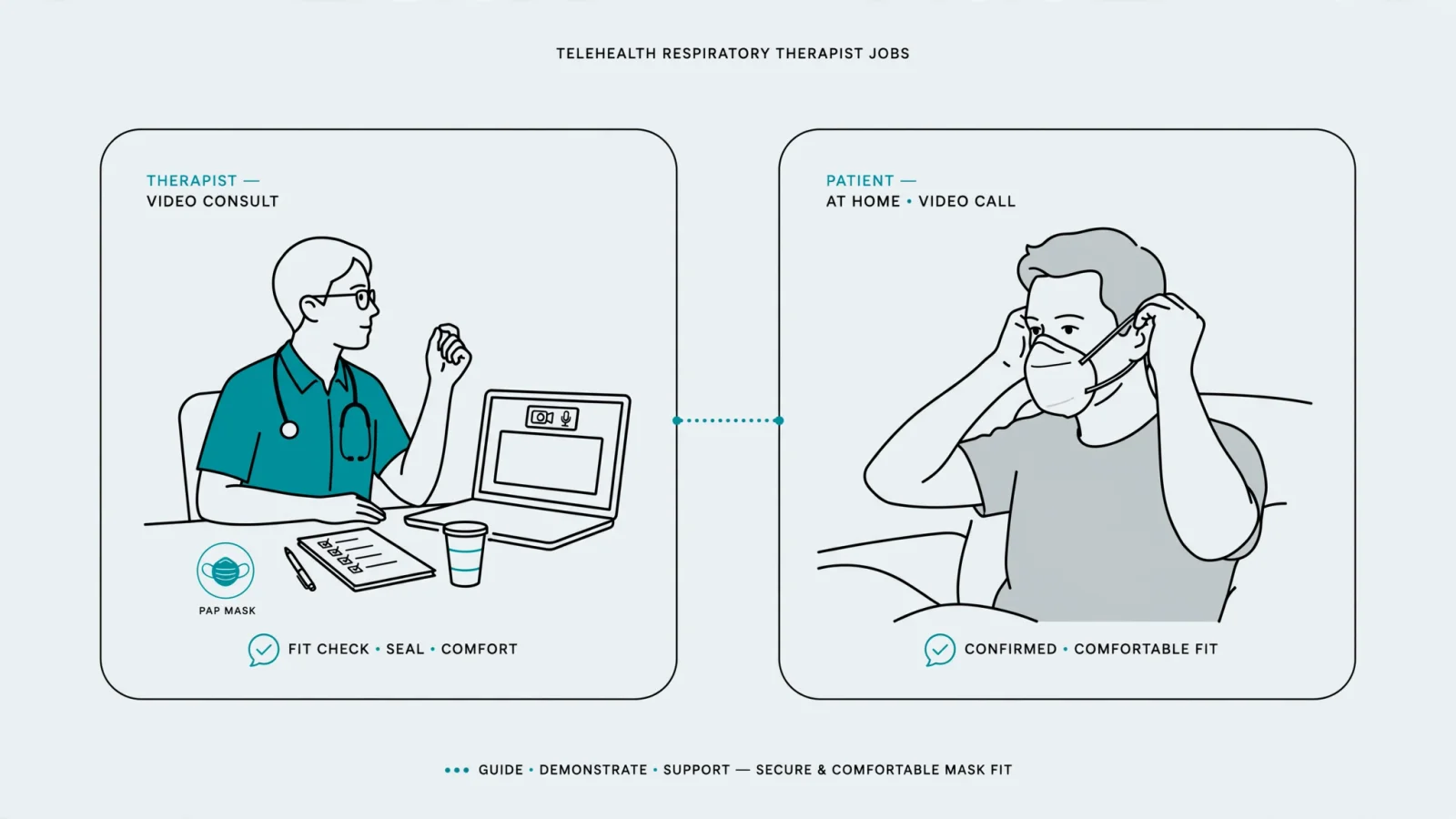
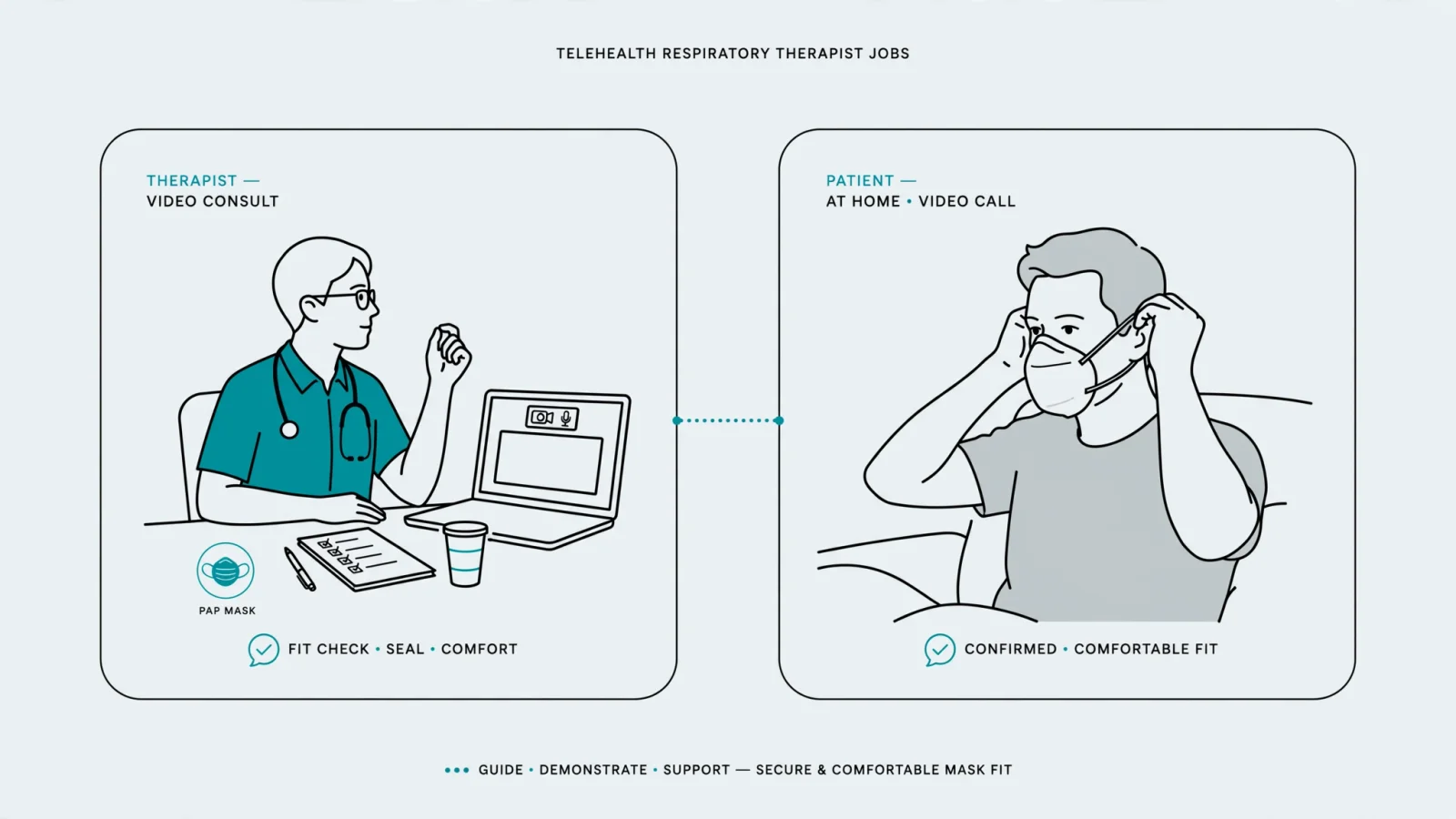
Sleep-related services also fall into this category. The AARC statement highlights sleep testing and interface acclimation as key telehealth services. You might help a newly diagnosed sleep apnea patient troubleshoot a leaking mask via video, or review overnight oxygen saturation logs to recommend a pressure adjustment. Searching for a PAP monitoring respiratory therapist or home ventilator RT will often surface these positions. The schedule for monitoring roles depends heavily on the employer's care model. A company providing 24-hour device monitoring requires night, weekend, and holiday coverage, meaning your remote job could still involve overnight shifts.
Consults and Hybrid Home-Care Roles
Some telehealth interactions support other clinicians rather than directly facing patients. Interprofessional consultations allow experienced respiratory therapists to advise teams in remote or under-resourced facilities. A tele-ICU respiratory therapist monitors ventilator graphics, reviews lab results, and advises bedside nurses or physicians on vent changes. This high-acuity work demands intense focus and immediate response times. You operate in a virtual command center environment, even if that center sits in your home office.
Hybrid roles blend virtual care with physical travel. A home respiratory care coordinator might conduct initial equipment setups in the patient's living room and handle all subsequent follow-up visits via telehealth. Whenever an employer uses the word hybrid or home-care, clarify the travel radius. A role that includes weekly territory travel carries a different physical and financial burden than a strictly work-from-home position. Search terms like remote respiratory care follow-up or hybrid home ventilator RT can help identify positions that mix these delivery methods.

Credentials, Experience, and State Licensing
Working from a home office retains your standard clinical practice requirements. You are still providing respiratory care, which means education standards, professional credentials, and state laws dictate your eligibility for every position. Telehealth employers face strict regulatory scrutiny, so they look for candidates with appropriate credentials and clear legal authorization to practice.
Match the Employer’s Credential Requirements
The Bureau of Labor Statistics 2026 update says respiratory therapists typically need at least an associate degree in respiratory therapy from an accredited program, and some employers prefer candidates with a bachelor’s degree. It also notes that some employers require the Registered Respiratory Therapist credential before hiring or within a specified time on the job. Because the guidance does not distinguish remote positions, review the specific posting to see whether the RRT is required for that role.
Your resume needs to highlight experience relevant to a virtual environment. Bedside critical care is valuable, but telehealth hiring managers look for distinct skills. Feature your background in chronic respiratory care, patient education, home ventilation, and sleep services. Include your familiarity with remote monitoring software, electronic health record documentation, and care coordination. You also need to demonstrate an understanding of escalation workflows. When a patient deteriorates during a video call, you cannot press a call button for a rapid response team. Your experience managing emergencies independently and coordinating with local emergency services helps reassure remote employers.
Check Authorization for Every Patient State
Licensing creates the largest administrative hurdle in telehealth. The BLS notes that respiratory therapists are licensed in every state except Alaska, and the specific requirements vary significantly across jurisdictions. In telehealth, the location of the patient at the time of the encounter determines which state's laws apply. You cannot treat a patient in Texas using a Florida license unless a specific legal exception exists. Similar to telehealth jobs for psychologists, respiratory therapy roles that span multiple states require careful attention to regulatory borders.
The U.S. Department of Health and Human Services' 2025 guidance outlines the complexities of cross-state practice. Depending on state rules, providers can practice across state lines through a full license, temporary-practice laws, licensure reciprocity, joining a licensure compact, or telehealth registration where available. Because authorization varies by state, candidates should verify which patient states the employer serves and what authorization applies to the role. Then list your active state licenses prominently at the top of your resume so recruiters can see your geographic eligibility.
Pay and Schedule Expectations
Evaluating a remote respiratory therapist job requires separating the appeal of working from home from the actual compensation and schedule. Employers do not automatically pay more for telehealth roles or offer better hours. Compare the specifics of the offer against national benchmarks and your own financial requirements.
In May 2025, the national median annual wage for all respiratory therapists sat at $82,280, according to the BLS 2026 occupational profile. This figure represents the occupation broadly across all settings rather than establishing a telehealth-specific rate or a pay floor. No reliable data proves a universal remote-work pay premium or penalty. Some companies pay remote clinicians slightly less, arguing the employee saves on commuting and uniform costs. Others offer competitive salaries to attract highly experienced RRTs capable of autonomous practice. Compare the proposed pay model against your local wage context, the provided benefits, and the required workload.
The BLS profile also notes that most respiratory therapists work full time, and work in facilities operating around the clock might involve nights, weekends, or holidays. Remote location alone provides no guarantee of a predictable schedule. If you accept a position supporting a 24-hour home ventilator monitoring service, your shifts will look very similar to a hospital rotation. If the role involves hybrid home care, the BLS notes that home visits and teaching patients to use life-support equipment regularly factor into the work. Account for driving time, vehicle wear, and unpredictable home environments when evaluating the schedule of a hybrid position.

Questions to Ask Before Accepting
A job labeled remote leaves the most important workflow and staffing details unanswered. You cannot evaluate a position's sustainability without asking direct, specific questions during the interview process. Treating a telehealth role like a standard clinic job often leads to unexpected burnout and frustration.
Care Model, States, and Hours
Start by clarifying how care is delivered and where the patients live.
- What portion of the day involves live video or phone calls versus asynchronous data review?
- Are there any in-person requirements, such as home visits, equipment setup, territory travel, or occasional office attendance for training?
- Which patient states does this role cover?
- Does the company handle and finance the credentialing process for additional state licenses, or are you responsible for those costs and renewals?
- What are the core hours and the required time zone?
- What are the specific expectations for weekends, holidays, evening coverage, and on-call rotations?
Workload, Alerts, and Clinical Support
For monitoring roles, the volume of incoming data dictates your stress level. Understand how the company manages alert fatigue and patient volume.
- Who owns the monitoring queue, and how are incoming alerts routed to individual therapists?
- What are the specific response-time expectations for different types of alerts?
- Who handles after-hours coverage and escalations when you are off shift?
- What is the average patient-panel size or daily visit volume?
- How much time is allocated for each visit type, and is documentation time built into that block?
- What are the weekly or monthly productivity targets?
- When a patient requires a higher level of care, what are the escalation pathways and how quickly can you reach a physician or an advanced practice provider?
Compensation and Home-Work Expectations
The financial structure of a telehealth role often differs from a hospital salary. Approach telehealth contract negotiation with a clear understanding of how every hour is compensated and who provides the necessary technology.
- Is the compensation structured as a flat salary, an hourly rate, or a per-visit fee?
- If paid per visit, how are you compensated for chart review, documentation, team meetings, and mandatory training?
- Is there additional shift compensation for nights, weekends, or taking call?
- Does the employer provide the computer, monitors, headset, and specialized software?
- Do they offer a stipend for high-speed internet and home office setup?
- What are the workspace privacy expectations, such as a locked door or a blurred background policy?
Search Terms and Application Strategy
Finding these roles requires casting a wide net with your search terms before filtering the results. Because job titles remain unstandardized, a single search phrase misses relevant opportunities. Try variations like remote respiratory therapist jobs, work-from-home respiratory therapist jobs, and telehealth RT jobs. If you hold specific experience, search for remote RRT jobs, remote respiratory care coordinator, home ventilator RT, or tele-ICU respiratory therapist. Treat these phrases as possibilities to test rather than evidence of a massive hidden job market.
Once you find a listing, check the patient-state coverage and the required credentials, then tailor your resume to match the care model described in the posting. Put your RT credential and your list of authorized practice states at the top of the document. Describe your communication experience, your familiarity with patient education, and your ability to work independently within multidisciplinary teams.
WeekdayDoc streamlines this process for clinicians seeking a sustainable career path. You can search our marketplace for remote, telehealth, and hybrid roles that fit your specific location and credentials. We provide a visible 0-to-10 work-life score alongside schedule and compensation context so you can compare the demands of a position before you apply. Set up AI-matched job alerts for your preferred work pattern and use one-click applications to save time. Once you receive an offer, our contract scanner and negotiation scripts provide post-offer support to help you evaluate non-competes, technology stipends, and termination clauses.
Ready to find a remote role that respects your time and your license? Visit WeekdayDoc to search telehealth respiratory therapist jobs, compare work-life scores, and set up matched alerts for openings that fit your clinical background.