Part Time Nurse Practitioner Salary: Your 2026 Guide
Explore the 2026 part time nurse practitioner salary. Learn how FTE vs hourly pay, specialty, and 1099 status affect your income and work-life balance.

You're probably reading this after a week that felt longer than it should have. Inbox full. Prior auths waiting. Charting bleeding into dinner. A schedule that says “full time” but feels like it owns your brain even on days off.
That's usually the moment part-time work starts to look less like a compromise and more like a survival strategy.
I've seen a lot of NPs reach the same point. They don't necessarily want to leave practice. They want to stop practicing in a way that makes them feel depleted, impatient, and financially trapped. The useful question isn't “Can I afford to go part time?” It's “How do I structure part-time work so it protects my energy without wrecking my long-term goals?”
A smart part time nurse practitioner salary plan can do more than reduce hours. It can buy back recovery time, make room for family or side income, and give you enough control to stay in clinical work longer without burning out. If you care about work-life balance and FIRE, that shift matters.
Rethinking Your NP Career Beyond Full Time
A colleague once described her schedule like this: four clinic days, one “admin” day that never stayed administrative, and every evening half-consumed by unfinished notes. On paper, she was doing well. In real life, she was exhausted and starting to resent patients she cared about.
That's where a lot of good clinicians get stuck. They assume the only choices are to keep grinding full time or quit altogether. In practice, there's a middle path. Part-time work can be a deliberate career design move, especially if you're targeting roles with cleaner boundaries, fewer after-hours demands, and realistic productivity expectations.
For many NPs, the true benefit isn't just fewer hours. It's better control over when you work, how intensely you work, and whether your job spills into the rest of your life. That's why some clinicians start by looking at remote part-time nurse practitioner jobs instead of just searching for a lower FTE in the same burnt-out setting.
When less work creates more career longevity
Part time isn't automatically better. A badly designed part-time role can still bury you in inbox work, unpaid admin tasks, and schedule chaos. The difference is whether the arrangement reduces cognitive load.
The strongest part-time setups usually share a few traits:
- Clear clinical boundaries so you know when your day starts and ends
- A schedule with fewer hidden obligations such as call, meeting creep, and charting from home
- Compensation that matches your actual workload instead of only the scheduled patient-facing hours
- Enough income to support your priorities without forcing you back into overtime mode
Practical rule: If a “part-time” role still expects full-time responsiveness, it's not part time in any meaningful sense.
A sustainable schedule isn't about ambition shrinking. It's about protecting the years you can keep doing this work well.
Decoding Part Time NP Salary Numbers in 2026
Most salary articles make part-time compensation sound simpler than it is. They throw out one annual number and leave you to guess what that means for two clinic days a week, a telehealth panel, or a mixed contractor setup.
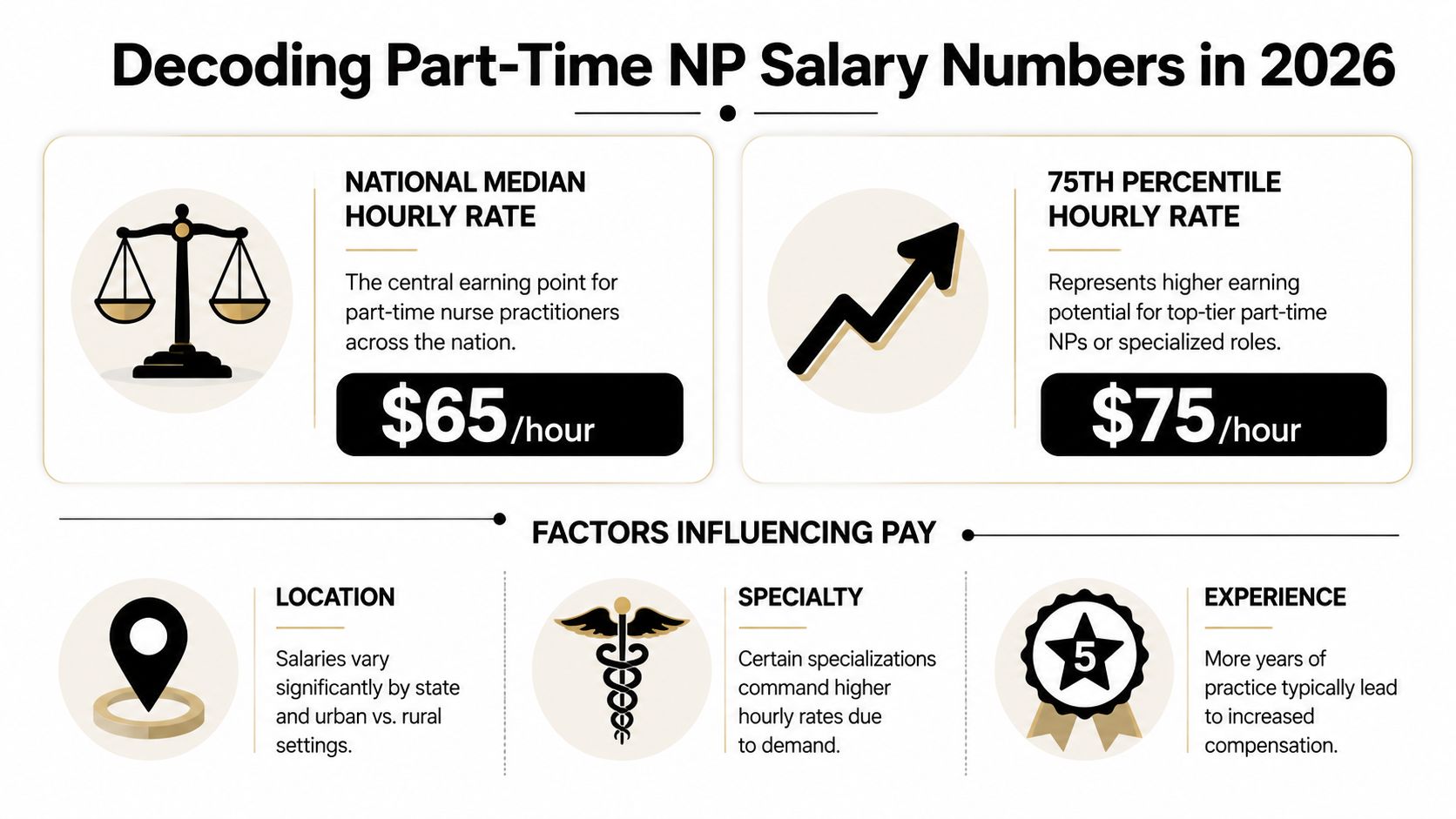
The cleaner starting point is hourly value. The Bureau of Labor Statistics NP wage data reported a median hourly wage of $58.47 and a 75th-percentile hourly wage of $65.13 in May 2022. The same table reported a median annual wage of $121,610, a 75th-percentile wage of $135,470, and a 90th-percentile wage of $165,240. That gives you a grounded baseline before you factor in specialty, setting, or state.
Why one salary number doesn't help much
A part time nurse practitioner salary can look low or high depending on how it's presented. Annualized pay hides the schedule. Hourly pay hides whether benefits are included. Per-shift rates can hide unpaid charting, travel, or admin burden.
That's why national benchmarks are only the first layer. Current market summaries collected by Barton Associates note that NP pay has continued rising into the mid-2020s, with some analyses placing average compensation between $133,000 and $144,509, while California was reported at $166,610 annually and Alabama at $106,930. Their review also noted that Alaska posted a 13.26% year-over-year jump from 2023 to 2024 in one comparison, which is a reminder that local market conditions can shift faster than many clinicians expect. See the Barton Associates nurse practitioner salary overview.
A practical way to read salary tiers
Use the wage distribution as a negotiation frame, not a promise.
| Salary view | What it tells you | How to use it |
|---|---|---|
| Median | The middle of the market | Good reality check for standard roles |
| 75th percentile | Higher-end but still normal compensation | Useful target if you bring experience, flexibility, or niche skills |
| 90th percentile | Top end of the pay distribution | Better for scarce specialties, hard-to-fill settings, or premium models |
If you're evaluating listings and want side-by-side compensation context, NP salary benchmarks and role comparisons can help you sanity-check whether an offer is ordinary, lean, or unusually strong for the schedule.
A part-time offer should make sense in hourly terms first. Annual language comes second.
The Real Math Behind Your Part Time Pay
Many NPs are often misled. An offer looks attractive until you realize you're comparing a prorated salaried role with an hourly one, and neither posting explains the same things.
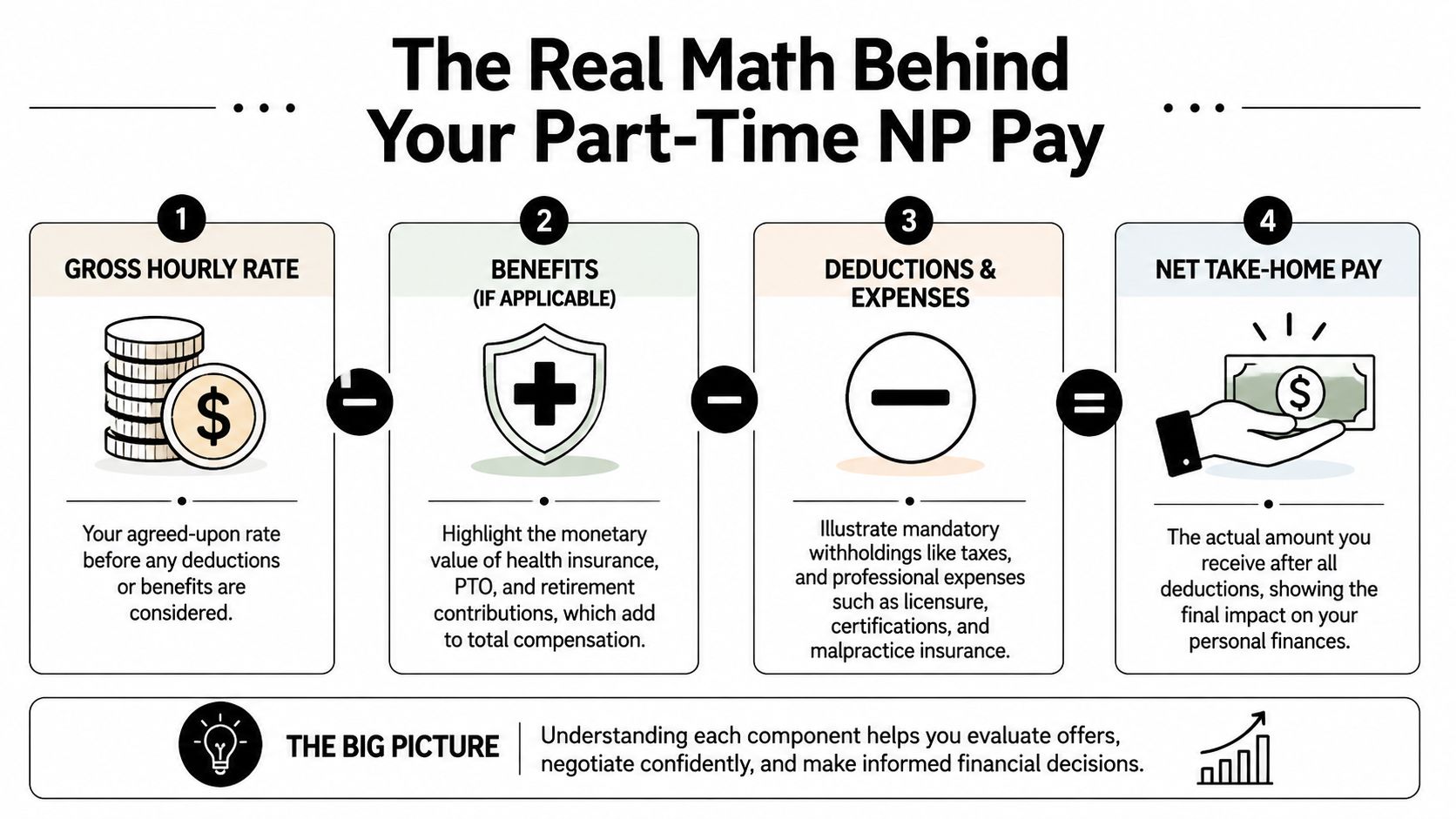
Recent job postings show exactly how messy this gets. Some part-time NP roles advertise $65 to $80 per hour and explicitly state that salary is prorated based on FTE, which makes direct comparisons difficult unless you understand the formula. That pattern shows up in current part-time NP job postings on Indeed.
FTE proration
A prorated role starts with a full-time salary anchor. Then the employer scales it down based on your FTE.
Common examples look like this:
- A 0.8 role means you're working most of a full-time schedule, often with reduced clinic days or hours
- A 0.6 role usually means a more visibly part-time arrangement
- A prorated benefits package may or may not come along with it
What matters is what gets prorated. Salary usually does. PTO sometimes does. Retirement match might. Health insurance eligibility can become the make-or-break issue.
Straight hourly pay
Hourly pay is simpler on the surface. You're paid for hours worked. But the clean math can hide dirty workflow.
Ask directly about these points:
- Charting time. Is it included in paid hours or assumed to happen off the clock?
- Meetings and inbox work. Are they compensated?
- Late patients and schedule overruns. Who absorbs that time?
- Minimum shift requirements. Some “flexible” jobs still lock you into fixed blocks
Value test: The best pay model isn't the one with the prettiest rate. It's the one that matches how the work actually happens.
How to compare offers without fooling yourself
When I look at part-time offers, I reduce them to four questions:
- What is the true paid unit? Hour, shift, session, or prorated annual salary.
- What work is unpaid? Documentation, messages, supervision, travel.
- What benefits survive the reduced schedule? Insurance, PTO, retirement contributions.
- What does the weekly schedule really demand? Fixed days, call coverage, or “flexibility” that only benefits the employer.
That's the math that keeps a reasonable-looking offer from turning into a resentful one.
Key Factors That Influence Your Earning Potential
Two part-time NP roles can have the same posted hours and very different earning potential. The difference usually comes from the stack of variables around the job, not the title itself.
The wage baseline matters here. The BLS reported a median hourly NP wage of $58.47 and a 75th-percentile hourly wage of $65.13 in May 2022, which is why negotiating toward the upper part of the range can matter so much when you're deliberately limiting hours. A stronger hourly rate lets you preserve income without adding days to your week.
What moves your rate up or down
Some factors are obvious. Others only become obvious after you've reviewed enough contracts.
- Specialty fit. Roles in harder-to-staff or narrower clinical areas often have more pricing power than broad, interchangeable outpatient work.
- Experience that reduces supervision burden. If you can step into a panel and manage it cleanly, employers notice.
- Practice setting. A calm outpatient clinic, urgent care site, telehealth panel, and travel assignment won't price labor the same way.
- Shift friction. Weekday-only hours with no call can be worth accepting if they reduce life disruption, but some employers pay more for evenings, weekends, or coverage gaps.
- State scope and employer structure. Independence, collaboration requirements, and internal workflow all affect what an employer is willing to pay.
Credentials still shape compensation
Part-time clinicians sometimes underinvest in continuing education because they assume fewer hours means less career pressure. That usually backfires. Maintaining sharp, marketable skills is one of the easiest ways to keep your rate from drifting downward over time.
If you're reviewing licensure and CME requirements, especially details like pharmacology hours for nurse practitioners, it helps to treat that work as part of your earning strategy, not just compliance.
The NP who can say “I can start with minimal ramp-up” usually negotiates from a stronger position than the NP who only says “I need flexibility.”
A useful mindset shift is this: your earning potential is not one static number. It's the product of your specialty, market, schedule constraints, administrative burden, and how replaceable the employer thinks you are.
W2 Employee vs 1099 Contractor for Part Time Work
This decision changes more than your tax form. It affects your schedule control, benefit structure, liability exposure, and how much of your stated pay you keep.
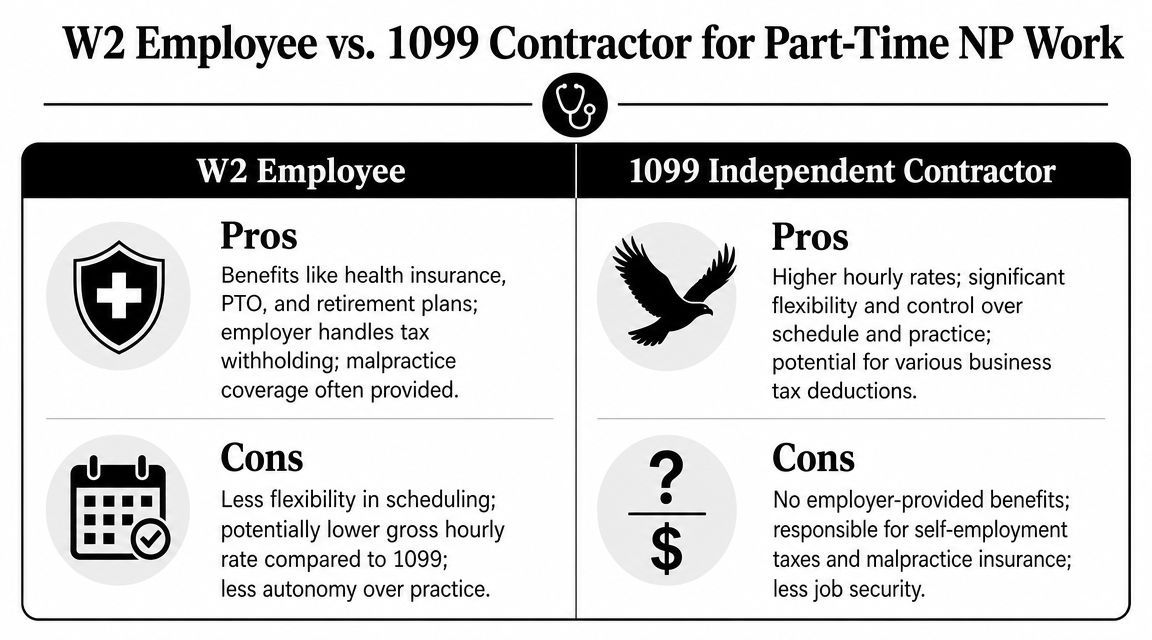
A salary report from 2026 highlighted how wide that gap can be. It identified a part-time W2 NP listing in Texas at an equivalent of $45/hour, while the same market showed hourly 1099 travel NP pay at $110/hour. That comparison from the Physemp NP salary report shows why “higher pay” doesn't mean much until you know the employment model.
When W2 makes more sense
W2 part-time work usually fits clinicians who want predictability. Taxes are withheld. Malpractice may be covered. Benefits may still exist in prorated form. Scheduling is often less flexible, but the administrative burden is lower.
A decent W2 role is often stronger than it looks if it includes:
- Health insurance access that doesn't disappear below a certain FTE
- Retirement contributions or match eligibility
- Paid time off, even if prorated
- Employer-paid malpractice and credentialing support
When 1099 can work better
Contractor work tends to appeal to NPs who value autonomy and don't mind running the business side of their practice life. The hourly pay may be much higher, but you're buying your own structure.
You need to account for:
| Issue | W2 employee | 1099 contractor |
|---|---|---|
| Tax withholding | Employer handles it | You handle it |
| Benefits | May be included or prorated | Usually self-funded |
| Schedule control | Often more limited | Often more flexible |
| Admin burden | Lower | Higher |
| Malpractice and business costs | Often covered | Often your responsibility |
If you're learning how independent professionals think about deductible business expenses, even a non-clinical guide like this one on UK tax deductions for freelancers can help frame the categories to ask your accountant about. The tax rules differ by country, but the mindset is useful.
Don't compare gross pay only
A high contractor rate can still be the wrong choice if you hate bookkeeping, need employer-sponsored insurance, or don't want income volatility. A lower W2 rate can still be the wrong choice if the employer controls your schedule tightly and underpays your non-visit work.
Before signing, I'd run any contract language through a review process. One option is a tool like WeekdayDoc's contract scanner, which is designed to help clinicians inspect employment terms more closely.
Calculate Your Target Income for a Sustainable Career
Burnout gets worse when every career decision feels reactive. A better way to evaluate part-time work is to start with your number. Not the employer's number. Yours.
You need to know what income supports your actual life. That includes fixed bills, savings, debt payoff, licensing costs, time off, and the margin that keeps small surprises from becoming stress spirals.
Start with enough, not with maximum
The cleanest FIRE-aligned planning I've seen from clinicians starts with this sequence:
- List your essential monthly spending. Housing, insurance, food, transportation, child care, debt.
- Add your professional maintenance costs. Licensure, certification, CME, malpractice if you carry it yourself.
- Build in savings targets. Emergency fund, retirement, brokerage investing, planned time off.
- Decide how much schedule relief is worth to you. Fewer hours may be a financial trade, but they can also protect your capacity to stay in practice.
That last point matters. A lower-stress schedule can be financially rational if it helps you avoid the cycle of overwork, impulsive spending, and eventual career disruption.
Use your life goals to evaluate the offer
A part time nurse practitioner salary is good if it moves you toward your priorities. That could mean faster investing. It could mean keeping one weekday free for family. It could mean preserving enough energy to build another income stream or making the job survivable.
A few examples of what to check:
- Housing plans. If a major goal is buying in an expensive market, local affordability matters. For nurses thinking through that problem, this guide to California homeownership for nurses gives useful context around financing pathways.
- Retirement consistency. A lower FTE works better when investing remains automatic.
- Time valuation. One protected weekday can reduce child care strain, commuting costs, and the need for convenience spending.
Reality check: More income only helps if you can keep earning it without draining the rest of your life.
A simple decision filter
When I help colleagues think this through, I suggest a three-part filter:
- Can this role cover your core obligations comfortably?
- Can it leave room for steady long-term saving?
- Can you realistically live this schedule for years, not just for one rough season?
If the answer is yes on all three, part time stops looking like a fallback and starts looking like a durable strategy.
How to Negotiate Your Part Time NP Salary and Schedule
Negotiation goes better when you stop treating it like a plea for flexibility and start treating it like a business discussion about scope, coverage, and value.
The employer is not only buying your clinical hours. They're buying judgment, efficiency, patient retention, and reduced onboarding friction. If you can walk into that conversation with a clean understanding of your preferred schedule and your walk-away points, you'll sound steadier and more credible.
What to negotiate besides the rate
Many NPs focus on hourly pay and leave the real quality-of-life items untouched. That's where bad part-time jobs hide.
Negotiate these items directly:
- Specific schedule boundaries such as no call, no weekends, no rotating late clinic
- Paid administrative time for inbox work, charting, and required meetings
- Minimum shift length and cancellation terms so your income isn't unstable
- Pro-rata benefits if you're W2
- Ramp expectations if you're inheriting a panel or learning a new system
Phrases that work in real conversations
You don't need fancy language. You need clarity.
“I'm open to a part-time structure, but I want the compensation to reflect the full scope of work, including documentation and inbox management.”
“My strongest fit is a weekday-only schedule with clear boundaries around call and after-hours work.”
“If the hourly rate is fixed, I'd like to talk about paid admin time, benefit eligibility, and schedule consistency.”
The best negotiations feel calm, specific, and hard to misunderstand. That's usually enough.
Also remember this: if a practice gets defensive when you ask basic questions about compensation structure, unpaid work, or schedule boundaries, they're giving you useful information before you sign.
If you're trying to build a lower-burnout clinical career instead of just escaping your current job, WeekdayDoc is worth a look. It's a physician-founded platform for clinicians who want remote, hybrid, and in-person roles with clearer work-life boundaries, including filters for no-call and no-weekend schedules, plus salary and FIRE-oriented planning tools.