Dentist Work-Life Balance in 2026: Call, Weekends and Nights by the Numbers
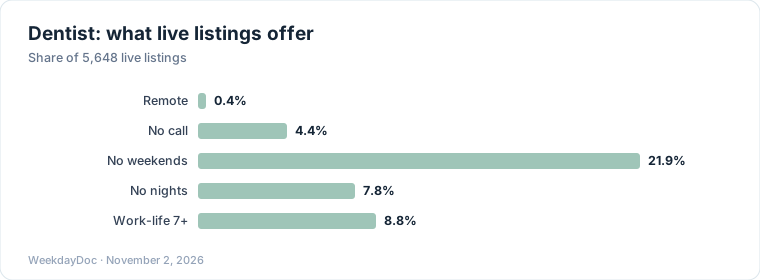
Among 5,648 live Dentist listings, 21.9% say no weekends and 4.4% say no call. See posted schedule, state work-life scores, and benefits signals.

For Dentist jobs in 2026, the clearest schedule signal is weekends: 21.9% of WeekdayDoc’s live listings explicitly say no weekends. No-call language is less common at 4.4%, so clinicians comparing offers should treat call expectations as a separate question from the weekly clinic schedule.
Those figures come from 5,648 live Dentist listings across 51 states as of November 2, 2026. Posted salary is also unevenly visible: 28.4% of live listings state annual pay, with a live median advertised salary of $275,000 among priced listings.
How often do Dentist jobs say no weekends, no nights, or no call?
No-weekend language is the most visible schedule protection in live Dentist postings. It appears in 21.9% of live listings, compared with 7.8% for no nights and 4.4% for no call.
That does not mean the remaining listings require weekends, nights, or call. It means the posting does not make that protection explicit. For clinicians, the distinction matters because job ads often describe clinic days and compensation before they spell out after-hours expectations.
Flexible-schedule wording is rare in this market. The measured share is 0% of live Dentist listings, which suggests that schedule flexibility is not usually framed with that phrase in posted ads.
Are remote Dentist jobs part of the work-life picture?
Remote Dentist jobs are a small part of the live market. Remote listings make up 0.4% of live Dentist postings, so work-life comparisons are mostly about clinic schedules, employer policies, and local staffing rather than remote work.
This is different from some other healthcare roles where telehealth can change commute time or after-hours coverage. For Dentists, the posted schedule signals in the listing are more likely to involve weekends, nights, call, paid time off, and support benefits.
Which states show the strongest Dentist work-life scores?
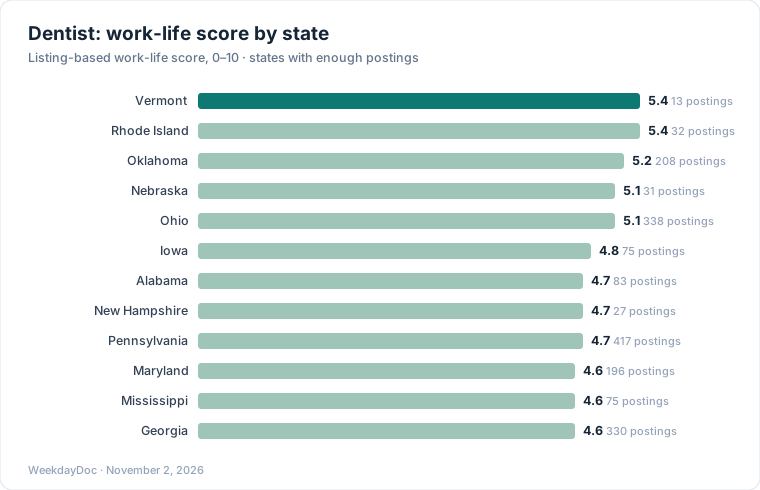
WeekdayDoc’s work-life score uses listing language and ranges from 0–10. Vermont has the highest state work-life score at 5.4/10, while Utah has the lowest at 3.7/10.
A higher work-life score does not mean a state is the right fit for every Dentist. It means postings in that state contain more favorable work-life signals as measured in listing text. For a broader state-by-state view, compare schedule and pay signals in the Dentist pay by state.
| State | Work-life score | Postings | Median advertised salary | Cost-of-living-adjusted median |
|---|---|---|---|---|
| Vermont | 5.4/10 | 13 | $160,882 | $164,165 |
| Rhode Island | 5.4/10 | 32 | $101,591 | $99,307 |
| Oklahoma | 5.2/10 | 208 | $264,149 | $300,853 |
| Nebraska | 5.1/10 | 31 | $135,827 | $150,751 |
| Ohio | 5.1/10 | 338 | $116,461 | $125,497 |
| Utah | 3.7/10 | 105 | $157,337 | $159,087 |
| Louisiana | 3.7/10 | 75 | $206,973 | $234,663 |
| California | 3.7/10 | 1044 | $192,564 | $173,951 |
| Nevada | 3.8/10 | 152 | $193,919 | $193,919 |
| Indiana | 3.8/10 | 151 | $164,769 | $176,601 |
How much salary context should Dentists use with work-life data?
Schedule and pay should be read together, but they measure different parts of an offer. Among 1,604 live listings that state annual salary, the median advertised salary is $275,000, with the 25th percentile at $200,000 and the 75th percentile at $300,000.
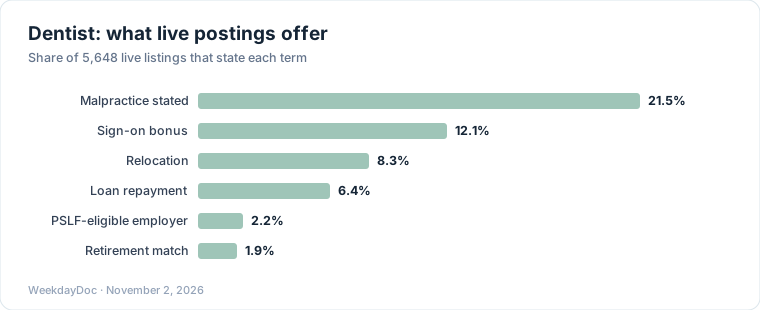
WeekdayDoc Market Pulse shows a different salary lens: across the last 12 months of postings, the national median advertised salary is $500,000 from 2,873 salary observations. For pay-only detail, see the Dentist salary guide and the Market Pulse.
State pay also varies. Across 43 states with enough salary data to compare, the median of state medians is $155,090. New Mexico has the highest state median advertised salary at $267,737, and Rhode Island has the lowest at $101,591. The gap between the highest and lowest state median is $166,146.
Cost of living changes the pay picture. Oklahoma has the highest cost-of-living-adjusted median at $300,853, using BEA Regional Price Parities, while Rhode Island has the lowest at $99,307.
What benefits show up with Dentist work-life signals?
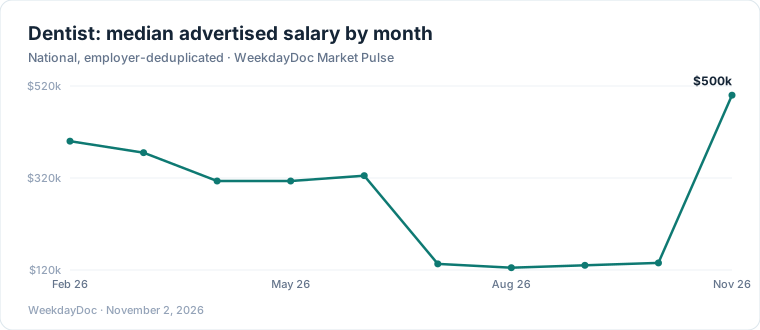
Benefits language can clarify whether a posted role is built around stability, recruitment urgency, or support. Malpractice coverage is stated in 21.5% of live listings, while a retirement match is stated in 1.9%.
Recruiting incentives are more visible than some long-term benefits. A sign-on bonus appears in 12.1% of live listings, with a median stated sign-on bonus of $10,000. Relocation assistance appears in 8.3%, and loan repayment appears in 6.4%.
Public-service signals are uncommon in the live Dentist postings. PSLF-eligible employers account for 2.2% of live listings.
Time away from work is less often stated as a number. Among listings that state paid time off, the median stated PTO is 25 days. Among listings that state CME money, the median stated CME allowance is $2,500.
Which employers have the most live Dentist openings?
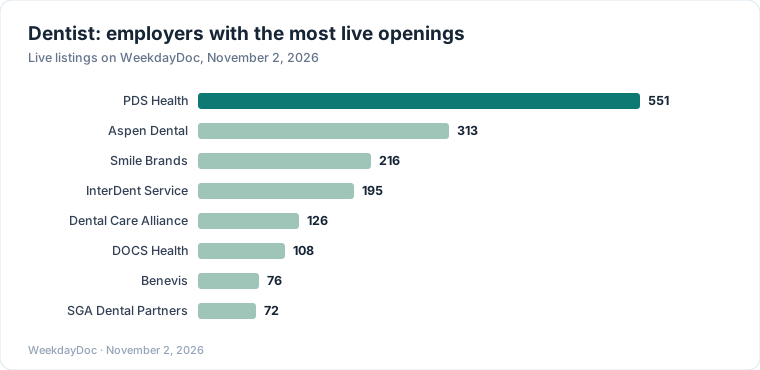
Large employers account for many visible openings, and they can have different norms around clinic hours, weekend coverage, and support staffing. PDS Health has 551 live openings, and Aspen Dental has 313.
Other employers with high live opening counts include Smile Brands with 216, InterDent Service with 195, Dental Care Alliance with 126, DOCS Health with 108, Benevis with 76, and SGA Dental Partners with 72. Employer-level schedule language can be compared with broader employer patterns in the Top Employers index.
How should Dentists read the work-life score?
The work-life score is a posting-based index, not a guarantee of the daily experience. It captures language that employers choose to publish, such as weekend, night, call, remote, and related schedule signals.
Only 8.8% of live Dentist listings score 7+ on the work-life index. That means high-scoring postings are visible but not common.
For clinicians comparing offers, the useful reading is practical. A listing that states no weekends, no nights, or no call gives a more concrete signal than a listing that only describes a general culture. A listing that also states PTO, malpractice coverage, or relocation support gives more terms to compare before an interview.
How we measured this
This article uses WeekdayDoc’s live listing index covering 5,648 Dentist listings as of November 2, 2026. Live salary figures use 1,604 listings that state annual pay, based on the midpoint of the stated range.
State salary comparisons use WeekdayDoc Market Pulse over the last 12 months of advertised salaries, employer-deduplicated. State comparisons require at least 10 listings and at least 8 salary observations per state; 43 states meet that threshold.
Cost-of-living-adjusted salary uses BEA Regional Price Parities from 2024. Work-life scores use the WeekdayDoc Top Employers work-life index and posting language for schedule and support signals.
Frequently asked questions
How common are no-weekend Dentist postings?
No-weekend language appears in 21.9% of live Dentist listings.
How common are no-call Dentist postings?
No-call language appears in 4.4% of live Dentist listings.
How common are no-night Dentist postings?
No-night language appears in 7.8% of live Dentist listings.
How common are remote Dentist roles?
Remote roles account for 0.4% of live Dentist listings.
What share of Dentist listings have a high work-life score?
Listings scoring 7+ on the work-life index account for 8.8% of live Dentist listings.
What is the median posted Dentist salary in live listings?
The median advertised annual salary in priced live Dentist listings is $275,000.
Sources: WeekdayDoc live listing index (5,648 Dentist listings, November 2, 2026); WeekdayDoc Market Pulse (12 months of advertised salaries, employer-deduplicated); BEA Regional Price Parities (2024); WeekdayDoc Top Employers work-life index. Figures are advertised (posted) salaries and listing attributes, not survey income; percentiles and shares, not grades. Updated November 2, 2026.