Nurse Practitioner Remote Jobs: Find Your Fit
Explore nurse practitioner remote roles, pay benchmarks, state rules, and workload questions to compare telehealth jobs and find a sustainable fit.

Remote nurse practitioner jobs offer a clear alternative to the daily commute and the physical clinic environment. Moving your practice to a home office changes where you sit, but the location label alone tells you little about the daily work. A remote position might require rigid shift coverage, high patient volume, and heavy administrative tasks, or it might offer schedule autonomy with dedicated charting time. Finding a sustainable position means looking past the work-from-home appeal to evaluate the schedule, clinical support, compensation, and state practice rules. WeekdayDoc makes this evaluation process straightforward by scoring listings on burnout factors and letting you filter open positions by specialty, location, and work type.
What Nurse Practitioner Remote Jobs Include
Remote work spans both patient-facing telehealth and nonclinical operational roles. A remote label means you work off-site, but it guarantees neither a predictable schedule nor permission to practice in every state.
Healthcare organizations use a variety of titles for these positions. A telehealth startup might advertise for a virtual care provider, while a hospital system might post a remote clinical documentation specialist role. You can group these opportunities into four main search categories to understand the daily expectations.
| Role family | Search terms and examples | What applicants should verify |
|---|---|---|
| Patient-facing virtual care | Virtual primary care, telehealth urgent care, virtual specialty care, remote FNP or PMHNP | Eligible patient states, patient volume, time-zone coverage, escalation support, nights and weekends |
| Phone, asynchronous, or follow-up care | Telephone triage, results follow-up, chronic-care outreach, care coordination | Contact and response-time expectations, documentation load, escalation protocols, paid time for follow-up |
| Clinical review and utilization work | Utilization review, medical-necessity review, prior authorization, clinical reviewer | Caseload and productivity measures, review criteria, appeal work, and whether the position requires NP or other credentials |
| Other remote clinical or adjacent roles | Quality, clinical documentation, informatics, education, clinical content | Whether the role requires NP credentials, includes direct care, requires travel, or is actually hybrid |
Titles and required credentials vary widely across these categories. A clinical reviewer role might require an active nurse practitioner license, while a similar utilization management job at another company only requires a registered nurse license. Distinguishing direct patient care from nonclinical or hybrid roles early in your search saves time and sets accurate expectations for the work.

Confirm State Eligibility Before Applying
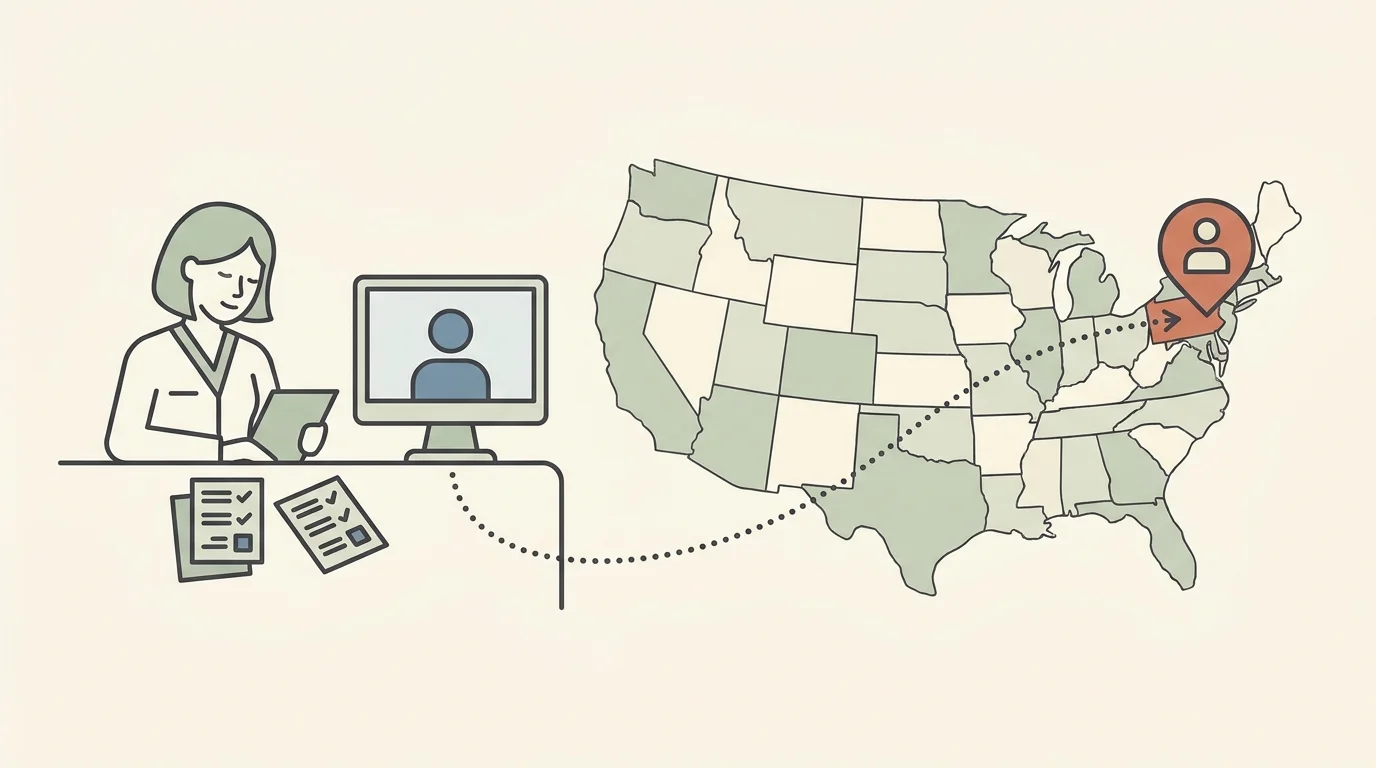
Assuming a remote role is open to applicants nationwide is a common mistake. You need to verify both where the employer allows you to reside and which states' patients you are authorized to treat. When you treat a patient located in Texas via video, state boards consider you to be practicing in Texas. You need the legal authority to practice in that specific jurisdiction, so confirm each patient's location and the relevant consent requirements at the time of service.
The legal framework for cross-state practice involves distinct licensing routes. The Telehealth.HHS.gov licensure overview explains that the ability to provide care across state lines varies by state.
Where telehealth registration exists, HHS notes common conditions that states may require. These typically include holding an unrestricted license in another state, having no past disciplinary proceedings, carrying active liability coverage, maintaining no in-state office, and paying annual registration fees. These conditions vary by jurisdiction, so check the specific statutes of every state where your patients reside. A compact arrangement or a single license does not automatically cover every nurse practitioner role or every patient location.
Your scope of practice also changes based on the patient's location. The American Association of Nurse Practitioners State Practice Environment map provides a helpful overview by classifying jurisdictions into full, reduced, or restricted practice. In a restricted state, you might need a formal supervisory agreement with a physician to prescribe certain medications or provide care, even if you sit in a full-practice state. Use this map as a starting point, recognizing that it does not determine your individual license status, exact prescribing authority, or telehealth eligibility. Direct your specific licensing questions to the relevant state boards and your prospective employer's credentialing team.
Understand Remote NP Pay
Evaluating an offer requires reliable market context. The U.S. Bureau of Labor Statistics Occupational Outlook Handbook reports a nurse practitioner median annual wage of $132,300. Treat this figure strictly as a national, all-setting benchmark, rather than a remote-specific salary average or a baseline for your offer. The BLS state and metro-area estimates add geographic context to your research, but local demand and the specific responsibilities of the role drive actual compensation.
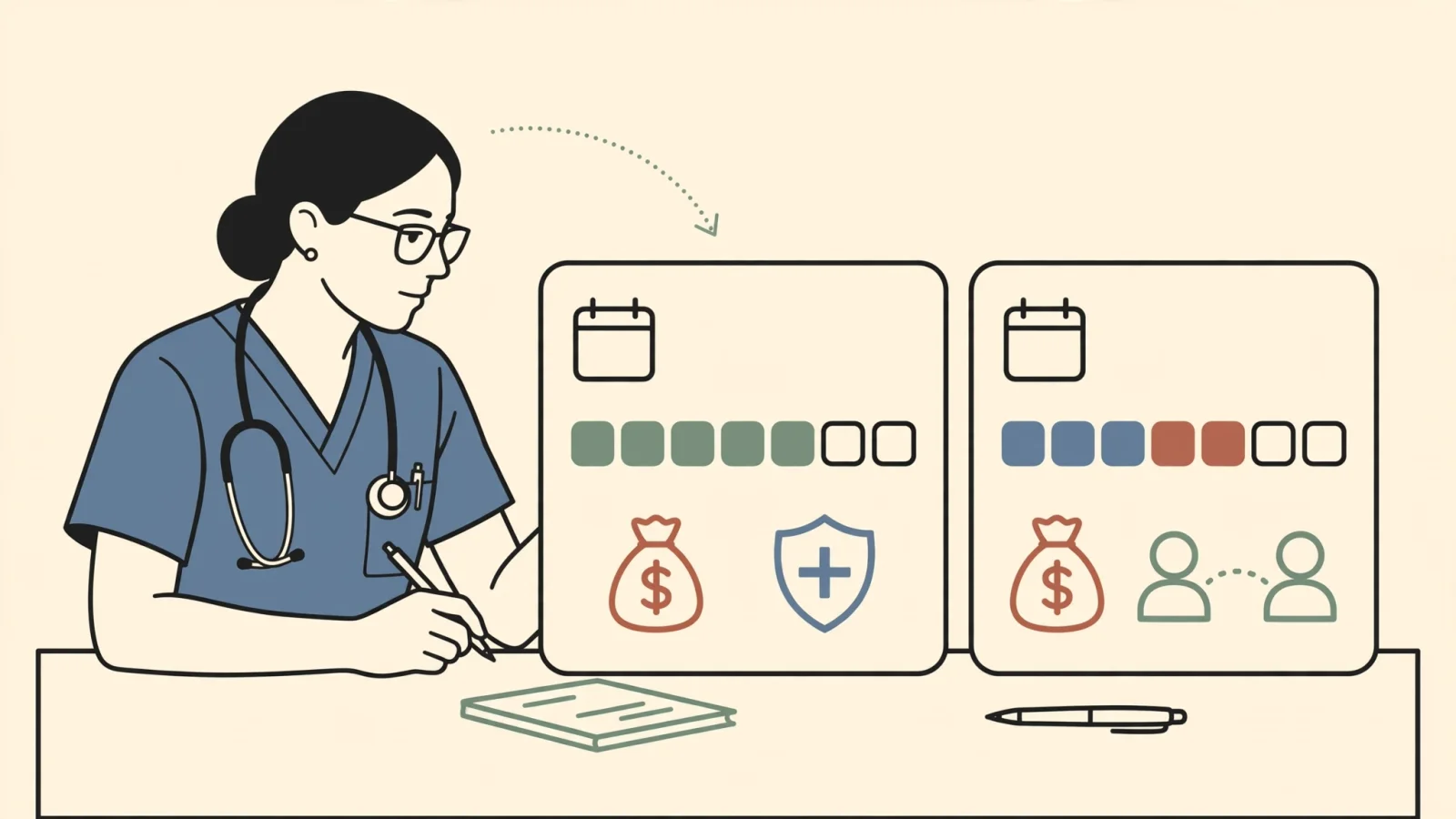
You will encounter several compensation models in the remote market. Salaried positions often provide stable income and benefits, while hourly roles pay you for the time you are logged in and available. Per-encounter models pay a flat rate for each patient visit or chart reviewed, shifting the financial risk of low volume or technology failures onto you. Contract and productivity-based models, including those tied to Relative Value Units (RVUs), reward high volume but require careful scrutiny of the performance targets.
Comparing these models means looking at total compensation. A high per-encounter rate might look attractive until you factor in unpaid charting time, the cost of purchasing your own health insurance, and the expense of maintaining multiple state licenses. You also need to understand whether the position treats you as an employee or an independent contractor, because nurse practitioner 1099 vs. W-2 real pay comparisons show distinct tax and benefit realities that alter your take-home pay. Compare offers by location, specialty, experience, workload, pay model, and included benefits before making a decision.
Compare Schedule, Workload, and Support
Working remotely determines your physical location, not your schedule or your stress levels. A virtual care day combines scheduled appointments with significant background tasks, and the pace can match or exceed a busy physical clinic.
The BLS notes that advanced practice registered nurses in physicians' offices typically work normal business hours, while hospital and facility roles often include nights, weekends, holidays, or on-call work. These setting patterns offer context for remote roles, but the schedule still depends on the service and employer. A remote position providing cross-coverage for a hospital network likely still requires night shifts and weekend availability, while a telehealth urgent care job often demands holiday coverage. Working from home does not automatically eliminate call duties or reduce your clinical burden.
Asking specific questions about the daily workload helps clarify expectations. Find out the expected patient or case volume for a standard shift. If you are expected to see four patients an hour, determine exactly how much time is blocked off for charting, inbox management, and patient follow-up. Many remote clinicians find that if administrative time is not explicitly protected and paid, an eight-hour shift easily stretches into a ten-hour day. Ask about time-zone coverage requirements, especially if you live on the East Coast but provide care for a clinic operating on Pacific Time. Clarify whether the hours are fixed by the employer or if you can self-schedule your blocks of availability.
Clinical support forms another major factor in remote job satisfaction. Working alone in a home office means you cannot walk down the hall to consult a colleague. You need to know exactly what clinical backup is available, how quickly they respond, and what the formal escalation protocols are for patients needing a higher level of care.
WeekdayDoc helps you evaluate these operational realities before you apply. Each listing receives a 0-to-10 burnout score based on visible factors such as call coverage, nights, weekends, schedule flexibility, autonomy, and administrative burden. This score provides a fast way to screen out roles that do not fit your life, highlighting the exact factors you can question during an interview. Understanding your nurse practitioner work-life balance by setting helps you compare these signals against compensation benchmarks. Reserve dollar-per-RVU comparisons for roles that pay on an RVU basis, and always ask how the employer defines and tracks those units in a virtual environment.
Search for Remote NP Jobs Strategically
Searching effectively means looking beyond the single word "remote." Employers use various terms to describe these positions, so broaden your search to include telehealth or virtual care, work-from-home nurse practitioner jobs, and specific titles like remote FNP or remote PMHNP roles. If you want to step away from direct patient care, search for telephone triage, utilization review, prior authorization, quality assurance, clinical documentation, informatics, or clinical content roles.
Narrow these results by focusing on your specific background. If you have pediatric experience, looking for remote pediatric nurse practitioner jobs yields positions that value your specialized clinical hours. Tailor your resume to highlight the patient populations you have managed, your comfort with electronic health records and virtual communication tools, and any multiple state licenses you already hold.
New graduates face a specific hurdle in the remote market. Without the physical presence of supervising physicians or experienced peers, onboarding and clinical mentoring become much harder. Software reliance does not make a role entry-level, so check each listing's required experience, structured onboarding plans, and supervision requirements.
WeekdayDoc streamlines this search process by offering matched alerts based on your profession, specialty, location, and preferred work type. You can set up notifications for roles that meet your criteria and use one-click applications when you find a match. Comparing listings by their schedule requirements and burnout scores ensures you spend your time applying to roles that fit your career goals.
Questions to Ask Before Accepting an Offer
Reviewing an offer carefully can help you avoid signing a contract that looks good on paper but falls short in practice. Before accepting, group your questions around the terms of the job, the clinical expectations, and the financial structure, reviewing these specific areas with the hiring manager and the credentialing team.
Location and Licensure
- Which states can I work from, and in which states will I treat patients?
- Is the role fully remote, or is it a hybrid position?
- Are there any required travel days for training, meetings, or occasional in-person clinic coverage?
Schedule and Workload
- Are the hours fixed, self-scheduled, or entirely on-demand?
- Which specific time zones and shifts am I expected to cover?
- Are nights, weekends, holidays, or on-call hours required, and is call compensated separately?
- What patient or case volume is expected per shift?
- Are charting, inbox management, and follow-up time explicitly included in paid hours?
Performance and Support
- Which productivity, response-time, or quality measures determine my performance or compensation?
- What clinical backup is available during my shifts, and what is the exact escalation process for complex cases?
Compensation and Benefits
- Is the compensation salaried, hourly, per encounter, contract-based, or productivity-based?
- If pay is linked to RVUs, what is the exact RVU definition, target, and threshold for the bonus payout?
- Is the position classified as a W-2 employee or a 1099 independent contractor?
- What benefits, paid leave, and hardware or equipment allowances are included?
- Does the employer provide comprehensive malpractice insurance, and does it include tail coverage when I leave?
- Will the employer pay for and administratively support the acquisition of new state licenses?
A remote nurse practitioner job should support a sustainable career, rather than a mere change of scenery. A clear picture of the schedule, legal requirements, and total compensation package helps you make an informed choice.
Finding a role that fits your life requires transparent data. WeekdayDoc allows you to compare individual remote and telehealth listings by specialty, location, and work type, complete with 0-to-10 burnout scores and visible schedule expectations. When you find the right fit and receive an offer, our negotiation scripts and AI contract scanner help you identify hidden issues like strict non-competes, missing tail coverage, and punitive payback clauses. Visit WeekdayDoc to search open positions and build a more sustainable clinical career today.