What Is Financial Independence Retire Early: A Clinician's
What is financial independence retire early? A clinician-focused breakdown of FIRE math, safe withdrawal rates, and feasibility.
By the time a clinician opens the chart after the last appointment, the inbox is still overflowing, prior authorizations are waiting, and tomorrow's schedule was full before breakfast. The question often isn't, “Can I afford to stop working forever?” It's, “How much money would I need before I could stop accepting every shift, call obligation, or impossible productivity target?”
Financial Independence, Retire Early, or FIRE, answers that question with a portfolio and cash-flow framework. Financial independence means your investments and other assets can sustainably fund the life you want, so paid clinical work becomes optional. Early retirement means reducing or leaving paid work before the traditional retirement age. For a physician, NP, PA, psychologist, or pharmacist, that may mean full retirement, but it may also mean fewer clinic days, no call, telehealth, locums, or a lower-paying role with a tolerable schedule.
FIRE is useful only when you treat it as a planning problem rather than an inspirational slogan. The relevant questions are practical: What do you spend? How much can you invest? How long must the portfolio last? What happens if markets fall when you leave practice? And what kind of clinical work would you choose if your paycheck no longer controlled every decision?
Why Clinicians Are Rethinking Retirement
A physician finishes clinic and finds dozens of unsigned notes, a prior authorization backlog, refill requests, and messages that somehow became tomorrow's problem. An NP has completed a full schedule but still has chart work waiting at home. A psychologist has spent the day absorbing other people's crises, then opens a calendar already crowded with future sessions. A PA has no weekend call on paper, yet the workday keeps expanding around administrative demands.
That pressure makes financial independence unusually relevant in healthcare. Clinicians often have meaningful earning power, but they also face long training periods, student debt, licensing constraints, family obligations, and work that can become physically or emotionally unsustainable. The goal isn't automatically to abandon medicine. It's to build enough margin that a bad employer, a punishing schedule, or a career transition doesn't threaten the household's basic security.
The FIRE movement's core ideas are widely traced to Vicki Robin and Joe Dominguez's 1992 book Your Money or Your Life, with Jacob Lund Fisker's 2010 Early Retirement Extreme later reinforcing its principles, as summarized in the history of the FIRE movement. Its defining approach combines aggressive saving, investing, and a withdrawal framework that converts annual spending into a portfolio target.
Clinical translation: FIRE means you can choose your work because it fits your life, not because leaving would make your finances collapse.
Early retirement remains uncommon. U.S. data cited by Investopedia indicate that about 1% of Americans ages 40–44, about 2% of those ages 45–49, and roughly 6% of people ages 50–54 are retired, while Gallup-based reporting says retirement at age 50 has fallen by about one-third since 2002. The same coverage reports that only about 10% of Americans say they've achieved financial freedom on their own terms, and over half say they're nowhere near it. These figures come from Investopedia's discussion of financial freedom before age 50.
That context matters for clinicians. FIRE isn't a casual promise to “save more.” It's a demanding strategy that requires honest spending data, a workable investment plan, protection against career-ending risks, and a clear definition of what optional work looks like. If you're considering a sabbatical, part-time practice, or an earlier exit, you should also examine the assumptions behind your target with this guide to retirement timing mistakes.
The Core Math Behind Financial Independence
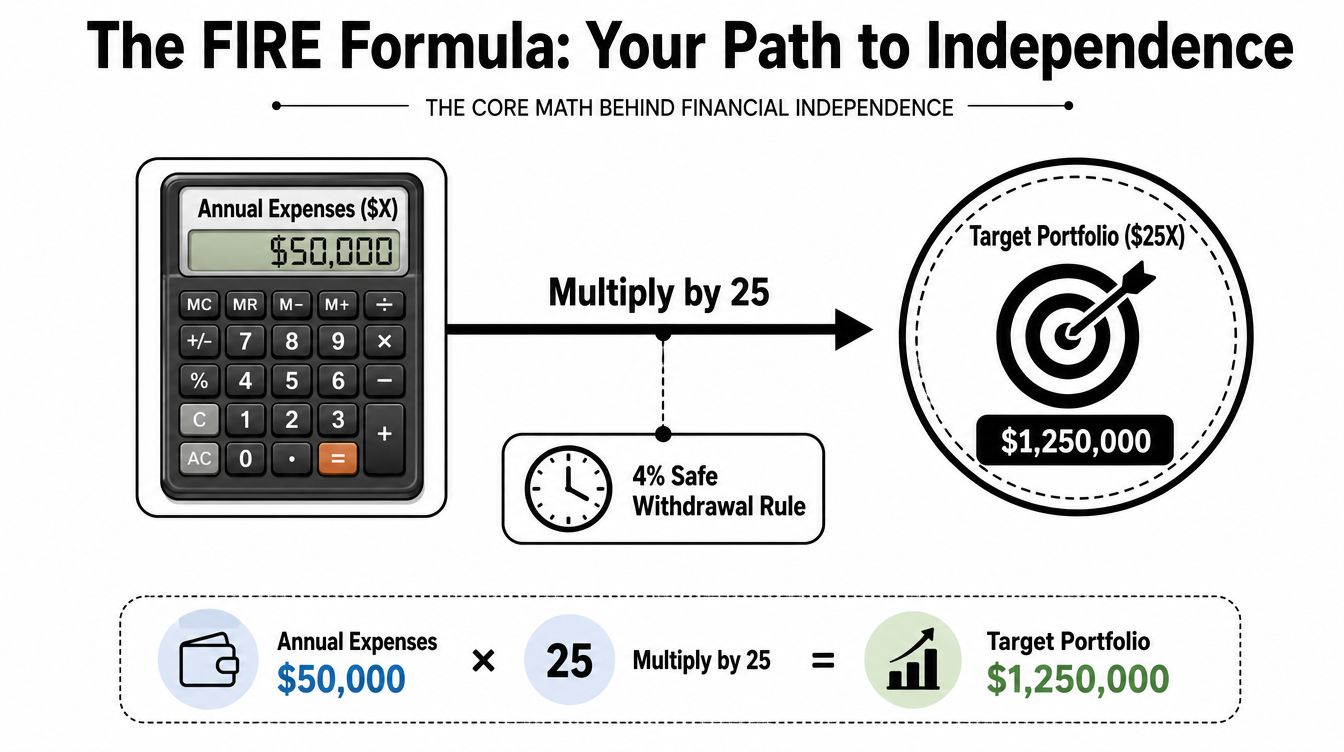
FIRE starts with a spending target, not a salary target:
Annual expenses × 25 = target portfolio
That multiplier reflects the classic 4% rule. A retiree withdraws about 4% of the portfolio in the first year, then adjusts that withdrawal for inflation. Vanguard's historical testing used market data from 1926 to 1992, giving clinicians a concrete planning framework rather than a vague savings goal. The movement's history and 25-times-expenses framework are summarized in the earlier background on FIRE and the 4% rule.
For a clinician whose annual spending is $120,000:
- At 4%: $120,000 ÷ 0.04 = $3 million
- At 3.5%: $120,000 ÷ 0.035 = $3.43 million
- At 3.0%: $120,000 ÷ 0.03 = $4 million
The withdrawal rate changes the portfolio requirement. Spending stays constant, but a lower distribution rate demands more invested assets. A traditional retirement horizon may make the classic rule a useful starting point. An MD, DO, NP, or PA leaving full-time practice in the forties needs to test that assumption over a longer period, with room for changing expenses and career income.
Safe withdrawal rates require judgment
A safe withdrawal rate, or SWR, is the percentage of an initial portfolio withdrawn each year, with inflation adjustments, while keeping the risk of portfolio failure low over a selected period. Historical work behind the classic rule found that a 4% inflation-adjusted starting withdrawal from a balanced portfolio could support about a 30-year retirement in many scenarios. Research focused on early retirement often supports planning closer to 3.0% to 3.5% when the horizon is longer or the assumptions are more cautious, as discussed in this research on safe withdrawal rates and early retirement planning.
At 3.5%, the portfolio equals approximately 28.5 times annual spending. That rate is a planning assumption, not a promise. Test it against taxes, healthcare costs, family changes, portfolio allocation, and income from part-time clinical work after leaving a full schedule.
Use the FIRE number calculation guide to make the arithmetic explicit. Keep income and spending separate. A high clinician income can speed investing, but the portfolio target is determined mainly by the cost of the life the portfolio must fund. That distinction supports phased choices, such as reducing call, moving to part-time practice, or leaving clinical work entirely when the numbers allow.
Common FIRE Myths That Mislead Clinicians
FIRE discussions often collapse a nuanced financial plan into a few memorable claims. That makes the movement easy to understand, but it can create dangerous assumptions for clinicians whose income, debt, and career options differ sharply from the average household.
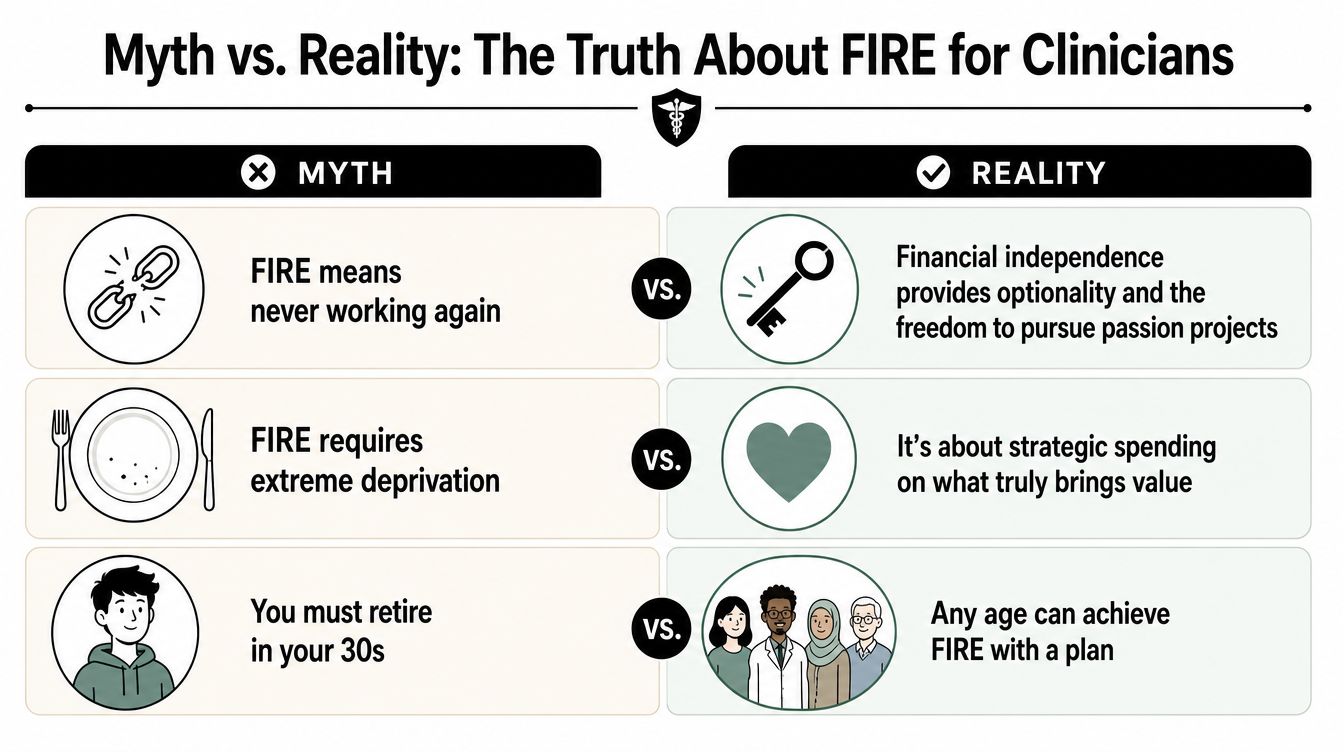
Myth one, FIRE means never working again
Reality: Financial independence makes work optional. It doesn't require you to reject work permanently.
A retired surgeon may teach, consult, or volunteer. A psychologist may keep a small panel because the work remains meaningful when the caseload is controlled. An NP may leave a high-volume clinic for a part-time telehealth role. The financial objective is autonomy, not inactivity.
Practical implication: Define your “work optional” version before you calculate the target. If you'll earn clinical income after leaving full-time practice, that income may reduce portfolio withdrawals. Don't count uncertain income as guaranteed, but don't pretend your only choices are full-time medicine or no medicine.
Myth two, a high salary guarantees fast FIRE
Reality: Income creates capacity, but spending determines the size of the portfolio you need. A physician earning $400,000 can remain financially dependent on a large mortgage, private-school costs, expensive travel, and recurring lifestyle upgrades. A clinician earning $200,000 may progress faster with a smaller fixed-cost base and consistent investing.
The salary figures in this comparison are illustrations, not universal market benchmarks. The point is structural: a larger paycheck doesn't create independence if expenses rise alongside it.
A sustainable savings plan beats an impressive income statement that disappears into fixed expenses.
Myth three, the 4% rule is a guarantee
Reality: The 4% rule is a historical planning framework, not a promise about your future portfolio. Sequence-of-returns risk is especially serious when withdrawals begin during a market decline. Selling assets after losses can permanently reduce the capital available for later recovery.
The original rule relied on historical U.S. stock-and-bond returns from 1926–1995 and a 30-year horizon, while later analyses often examine more conservative withdrawal rates for longer retirements. The Bogleheads safe withdrawal rate discussion describes why planners consider lower rates, flexible spending, and portfolio diversification.
Practical implication: Stress-test your plan against a poor first decade, longer longevity, and spending reductions you'd accept. If your plan fails unless markets cooperate immediately, you don't have financial independence yet. You have a fragile forecast.
FIRE Scenarios Across Clinician Career Paths
The same FIRE label can describe very different strategies. A hospitalist, NP, and clinical psychologist may all want more control over work, but their income, location, debt, and savings capacity create different routes.
| Clinician Type | Annual Income | Savings Rate | Target Portfolio | Projected FIRE Age |
|---|---|---|---|---|
| Hospitalist physician in a low-cost state | $280,000 | 40% | $2.5 million | Not specified |
| Nurse practitioner in a metro area pursuing Coast FIRE | $130,000 | 25% | Not specified | Not specified |
| Clinical psychologist using a debt-first hybrid approach | $150,000 | Not specified | Not specified | Not specified |
These are planning archetypes, not verified projections. The provided scenario data identify income, savings approach, and target for selected profiles, but they don't establish starting ages, investment returns, debt balances, or a defensible FIRE age. A precise retirement date would require those inputs, so it would be misleading to invent one.
The hospitalist physician
A hospitalist earning $280,000 in a low-cost state and saving 40% of income has a clear advantage: a strong gap between earnings and spending can fund investments while keeping the target portfolio manageable. The stated target is $2.5 million, but the physician still needs to confirm whether that target covers actual annual expenses at the chosen withdrawal rate.
The trade-off is familiar. Hospital medicine may accelerate savings but impose nights, weekends, rotating shifts, and high clinical intensity. The right question may be whether the physician can reach a flexibility threshold before reaching the full target, then move to weekday-only work or fewer shifts.
The nurse practitioner
An NP earning $130,000 in a metro area and saving 25% may face higher housing and transportation costs. Coast FIRE could become attractive if existing investments eventually grow enough to fund traditional retirement without ongoing aggressive contributions. That path can support a move to part-time care, telehealth, or a less lucrative specialty.
The risk is assuming “coast” means “stop planning.” It doesn't. The NP must still monitor spending, investment allocation, healthcare coverage, and whether the current portfolio is sufficient for the future target.
The clinical psychologist
A clinical psychologist earning $150,000 with significant student debt may use a hybrid strategy. Aggressive repayment can reduce interest and fixed obligations, after which redirected cash flow can accelerate investing. The sacrifice is front-loaded flexibility. Debt payments may delay portfolio growth now, but ignoring expensive or psychologically burdensome debt can also undermine the plan.
For every scenario, the lifestyle decision matters as much as the spreadsheet. A role that pays more but causes an early exit from clinical work may not outperform a sustainable job that allows consistent investing for longer.
How to Assess Your Own FIRE Feasibility
Start with spending, not salary. Pull the last 12 months of household expenses, separate recurring costs from unusual purchases, and identify which expenses would remain if you reduced clinical work. Then calculate your baseline target by multiplying annual spending by 25 for a 4% withdrawal framework, or by approximately 28.5 for a 3.5% framework.
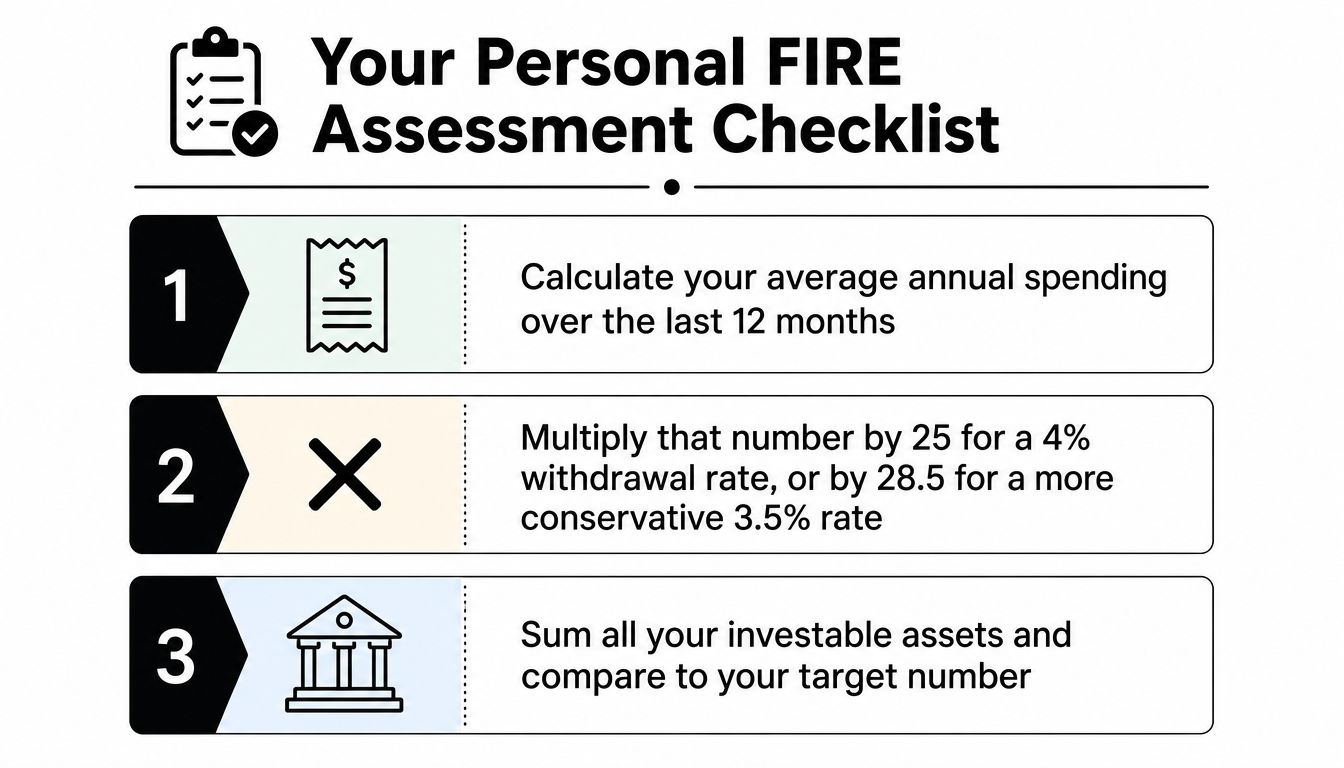
Run the calculation in layers
Measure the spending floor. Include housing, food, insurance, transportation, taxes, education, family support, and the costs of maintaining a professional life. Don't build a retirement budget around spending assumptions that only work while a full clinical paycheck continues.
Compare invested assets with the target. Count retirement accounts, taxable investments, and other assets that can realistically support spending. Treat a primary residence cautiously unless it produces usable cash flow or you plan to sell it.
Model debt separately. Student loans can change the order of operations. Compare repayment terms, tax considerations, and the psychological value of becoming debt-free before directing every available dollar into investments.
Test the income plan. A part-time role can reduce withdrawals, but clinical income may fluctuate with volume, credentialing, health, and employer stability. Build the core plan so it doesn't require perfect continued employment.
The financial independence and early retirement calculator can help organize these inputs, while a broader move from estimate to plan approach can help turn a rough target into an actionable sequence.
Check the risks before you declare victory
A clinician retiring at 45 may need the portfolio to support more than 40 years, which is materially longer than the 30-year horizon behind the classic rule. That longer horizon increases the importance of a conservative withdrawal rate, flexible spending, and protection from early market losses.
Revise the plan if you have:
- Concentrated stock positions: One company or sector can dominate the portfolio's risk.
- No disability insurance: A plan based on future clinical income needs protection against losing the ability to practice.
- Unfunded healthcare assumptions: Coverage before Medicare and out-of-pocket costs need explicit treatment.
- Spending tied to clinical work: If the budget requires continued overtime, call pay, or productivity bonuses, the plan isn't work-optional.
- No response to a market decline: Decide in advance whether you'd reduce spending, work part-time, or delay withdrawals.
FIRE as Career Flexibility Rather Than a Hard Exit
The most useful FIRE milestone for a clinician may arrive before full retirement. Coast FIRE means reaching a portfolio balance that can grow toward a traditional retirement target without continued aggressive contributions. Once you reach that point, you may be able to choose a lower-paying role, reduce hours, or spend more on the present without abandoning long-term security.
That flexibility has immediate clinical value. A physician might move from inpatient work to a weekday outpatient position with no call. An NP or PA might choose telehealth or part-time care. A psychologist might limit sessions to a sustainable caseload. A pharmacist might trade a high-pressure schedule for a role with predictable hours. None of these decisions requires pretending that work has no value.
Financial independence is most powerful when it gives you choices before you reach a final retirement date.
This is why FIRE works better as a sequence of career phases than as a binary “quit at 40” challenge. One phase may prioritize debt reduction and income growth. Another may maximize retirement contributions. A later phase may trade compensation for schedule control, autonomy, or clinical meaning.
The trade-off is straightforward. Lowering income can slow portfolio accumulation, but remaining in a damaging role can carry costs that don't appear in a savings spreadsheet, including exhaustion, relationship strain, career dissatisfaction, and spending used to recover from work. A sustainable job may produce less income while allowing you to keep practicing, investing, and enjoying your life.
Practical Next Steps for Clinician FIRE Planning
Start this week by calculating annual spending, current invested assets, and a target portfolio using both the 4% and 3.5% frameworks. Then compare your compensation and savings capacity with roles that change the work equation, not just the paycheck. WeekdayDoc's Salary & FIRE Calculator can model projections by state and role, while active listings with Burnout-Friendly Scores can help you evaluate weekday, no-call, remote, hybrid, and part-time options.
For physicians assessing productivity compensation, use the RVU Calculator. Review employment terms with the Contract Scanner, and benchmark compensation through WeekdayDoc's Market Pulse data. For tax-advantaged saving decisions, use this guide to maximizing retirement savings.
FIRE for clinicians isn't about escaping medicine. It's about building enough financial margin to practice medicine on your own terms.
WeekdayDoc helps physicians, NPs, PAs, psychologists, and pharmacists compare burnout-conscious roles using salary information, schedule details, and FIRE planning tools. Visit WeekdayDoc to calculate your target, assess your current position, and find clinical work that supports the life you're funding.