Financial Independence Retire Early Calculator: Beat Burnout
Use our financial independence retire early calculator to model a clinician career. Beat burnout; see how job choices & state taxes impact your FIRE number.

Most FIRE advice for clinicians starts in the wrong place. It starts with retirement. I think it should start with career design.
A generic calculator can tell you a target portfolio. It usually can't tell you whether dropping call, moving states, or taking a hybrid role will buy back your life without blowing up your plan. For physicians, NPs, PAs, psychologists, and pharmacists, that's the primary use case. The point isn't to fantasize about quitting medicine at some abstract future age. The point is to build enough optionality that burnout stops dictating your decisions.
Why Most FIRE Calculators Fail Clinicians
Generic FIRE calculators usually assume a stable career arc, rising income, and clean spending patterns. Clinical careers rarely behave that way.
A physician may spend years in training with low earnings, then jump into attending pay while still carrying six-figure student debt. Compensation can depend on RVUs, call, quality incentives, partnership tracks, moonlighting, or locums shifts. A contract may look strong on paper and still be fragile if the highest-paid pieces depend on a schedule you cannot sustain for another five years.
That is why generic calculators often miss the question clinicians are asking. The issue is not only, "When can I retire?" It is, "How much flexibility can I buy if I cut call, reduce FTE, switch employers, or move to a lower-cost market before burnout forces the decision?"
The standard FIRE math still helps. Many clinicians use a target in the range of 25x to 30x annual spending, based on the 4% withdrawal framework. If your long-term spending is $100,000 a year, that points to roughly $2.5 million to $3 million invested. Useful benchmark. Incomplete model.
Where clinician reality breaks the model
The weak point is durability of income.
I have seen hospital-employed physicians with high gross pay and very little real flexibility because too much of that pay came from call, overtime, or productivity pressure. I have also seen lower-paid outpatient clinicians reach financial independence faster than expected because their schedule was sustainable, their savings rate held steady, and they did not need repeated career resets.
A calculator should distinguish between headline income and repeatable income. If a paycheck depends on a version of you that is already exhausted, treat that income as temporary.
That changes how the tool should be used. For clinicians, a financial independence retire early calculator works better as a career modeling tool than a retirement countdown. Run scenarios such as:
- losing call income
- dropping from five days to four
- moving from a high-tax, high-cost state to a cheaper market
- taking a lower-burnout role with better schedule control
- extending your timeline slightly to preserve your health and family life
Those inputs produce better decisions because they reflect the actual trade-offs. In real estate analysis, Homebase's yield on cost insights show the value of comparing future outcomes under different assumptions. FIRE planning for clinicians benefits from the same mindset. Model the path, not just the destination.
Burnout changes the financial equation
For clinicians, income longevity matters as much as income size.
A job that pays less but remains workable for a decade can outperform a higher-paying role that leads to early exit, reduced clinical capacity, or months of recovery. That is not a soft consideration. It directly affects savings consistency, investing behavior, and how often you are forced to make expensive career pivots under pressure.
I treat the calculator as one input inside a broader burnout strategy, not a final answer. If you're rebuilding after a rough stretch, these burnout recovery strategies for clinicians fit directly into financial planning. A sustainable work pattern protects future savings better than a heroic but temporary compensation spike.
Establishing Your Baseline with a First-Pass Calculation
The first pass shouldn't be perfect. It should be fast.
Most clinicians delay this step because they think they need a full spreadsheet, exact future spending, and a polished asset allocation before they can get a useful answer. You don't. You need a rough baseline that turns vague anxiety into a number you can work with.
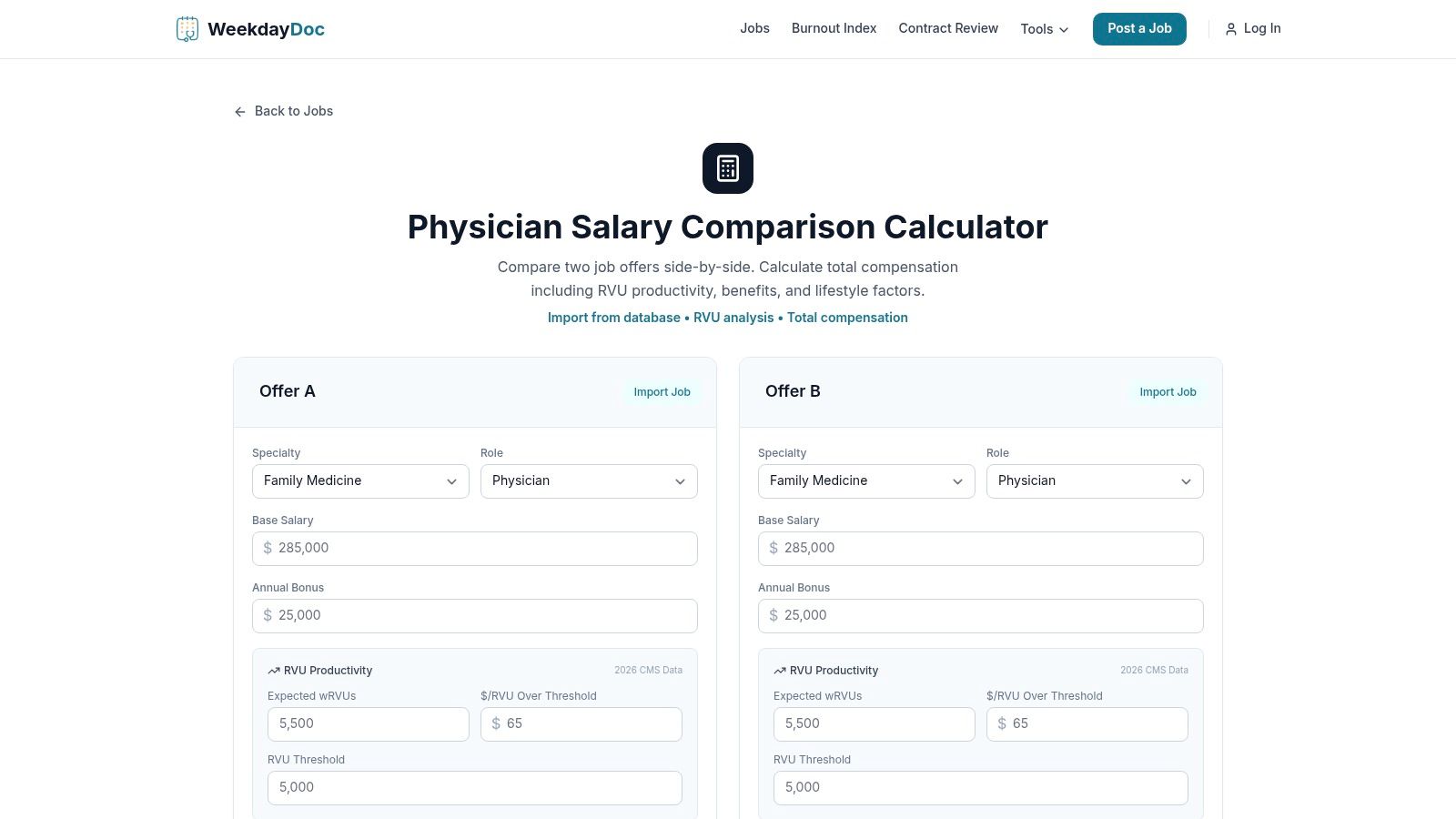
Gather four inputs
Start with these:
Current annual income
Use your predictable compensation, not your fantasy best year. If your pay includes RVUs, production bonuses, or side work, include only the portion you can defend as repeatable.Net worth
Add investable assets and cash. Subtract liabilities. For a clinician, this often means retirement accounts, brokerage balances, cash reserves, mortgage debt, and student loans.Savings rate
Look at actual monthly saving and investing, not what you hope you're saving. Pull it from account transfers, retirement contributions, and brokerage deposits.Estimated annual spending in retirement
Keep this rough at first. You're not trying to win an optimization contest. You're trying to establish whether your current career path points toward flexibility or delay.
What to ignore on the first pass
Don't get lost in edge cases yet. You can refine taxes, healthcare, and bridge-account issues later.
For the first run, the point is to answer one immediate question: if nothing major changes, where am I headed?
A lot of clinicians already think this way in practice. You don't start with the most obscure differential diagnosis. You stabilize the patient, identify the major variables, and then refine.
The first calculation is a baseline, not a verdict.
A useful parallel comes from real estate development. When people analyze a project, they often begin with a simple viability lens before layering in complexity. That's why I like Homebase's yield on cost insights. It's a different domain, but the discipline is the same. Start with a clean framework, then test whether the project still works once reality shows up.
Run one clean estimate
If you want a guided version, use a calculator that ties compensation and FIRE planning together, then compare that result against your own numbers. The key is consistency across scenarios, not false precision.
A simple workflow looks like this:
- Pull your pay data from your contract, pay stubs, or year-end summaries.
- List assets and debts from your account dashboard or net worth tracker.
- Estimate spending from bank and card statements, then annualize it.
- Document assumptions so you can revise them later without guessing what changed.
For a more structured walkthrough, this guide on how to calculate your FIRE number is a good companion resource.
What a baseline should give you
A baseline should produce three things:
| Output | Why it matters |
|---|---|
| A target portfolio | Gives your planning a concrete destination |
| A rough timeline | Shows whether your current setup is viable |
| A starting savings reality check | Exposes whether your lifestyle and job are aligned |
Once you have that first answer, you can stop treating FIRE as a vague internet concept and start using it as a career decision tool.
Refining Inputs with Realistic Clinician Assumptions
A first-pass FIRE result is a draft, not a decision.
Clinician finances break generic calculators because our careers do not follow a smooth salary-and-expense line. Income shifts with call burden, RVU incentives, partnership tracks, locums work, and schedule changes. Expenses shift too. The calculator becomes far more useful once it reflects those career realities instead of pretending every year looks the same.
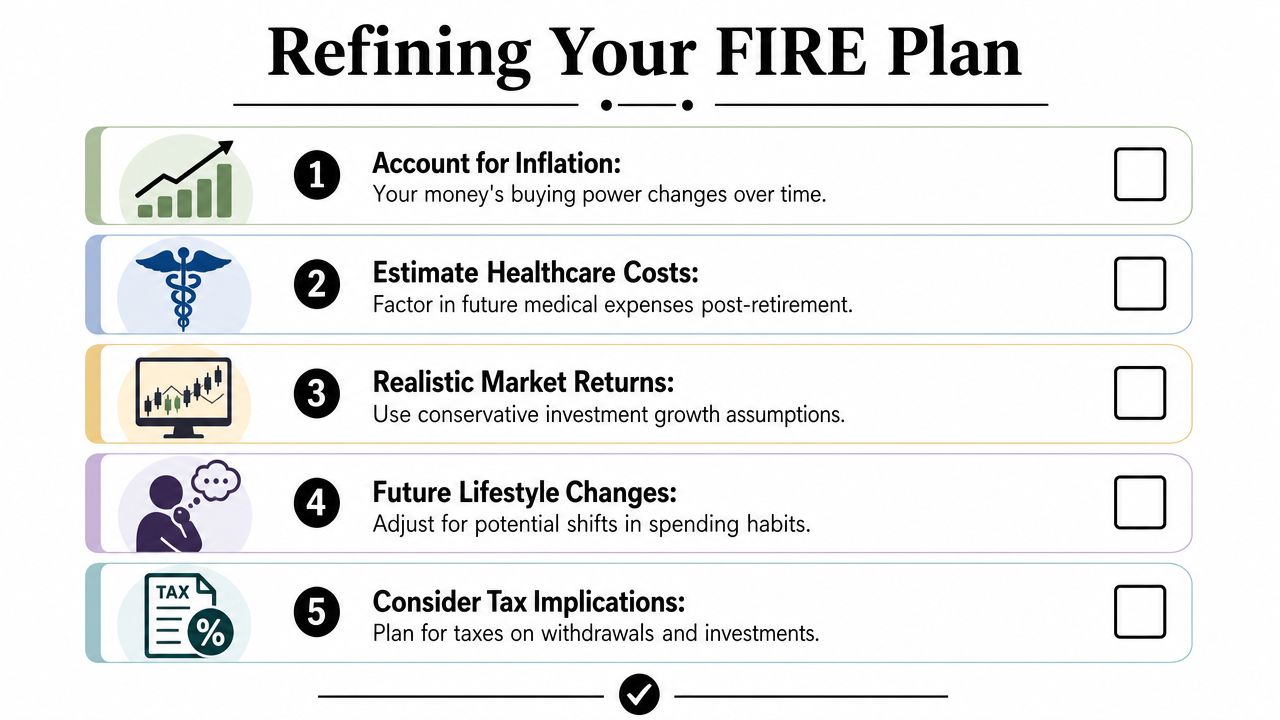
Three inputs clinicians routinely miss
Start with debt drag.
Student loans do more than reduce net worth on paper. They can force a physician to stay in a high-intensity role longer than planned, delay a move to part-time work, or make a lower-burnout job financially unrealistic. I model loans separately from investing because the trade-off is not only mathematical. It is also about how much career flexibility you can buy back.
Next is transition cost. Physicians change jobs with more friction than many other professionals. Tail coverage, new state licenses, credentialing delays, temporary housing, relocation, and a gap between final paycheck and first paycheck can all hit in the same window. If those costs are not built into the model, a planned job change looks safer than it is.
Then there is protection spending. Disability insurance, term life insurance, and umbrella coverage are often necessary for high-income clinicians with dependents. A calculator that skips these recurring costs will overstate your savings rate and understate the portfolio you need.
Healthcare needs its own line item
The biggest miss is often the healthcare bridge before traditional retirement benefits begin.
Many early retirement models understate the cost of leaving employer-sponsored coverage in your 50s. For physicians, this is not a theoretical concern. It is a predictable expense category with wide variation by state, family size, subsidy eligibility, and health history. I do not bury it inside general spending because that hides one of the main risks in an early retirement plan.
Give healthcare its own assumptions, its own inflation logic, and its own stress test. That one change often separates a resilient plan from a fragile one.
Use the calculator to compare careers, not just retirement dates
Here, clinicians can get more value from the tool.
A generic calculator treats your current job as fixed. A physician should do the opposite. Run separate cases for a lower-pay employed role with less call, a 0.8 FTE schedule, a direct primary care transition, a locums year, or a move to a state with lower taxes and housing costs. The point is not to predict the future perfectly. The point is to see which career paths preserve savings capacity without pushing burnout higher.
Geography belongs in that model too. A higher salary in an expensive metro can lose to a modestly lower salary in a state with cheaper housing, lower taxes, and lower insurance costs. For early retirees, local healthcare pricing matters as well.
A practical refinement list looks like this:
- Separate loan payoff from portfolio contributions so you can compare flexibility under different debt strategies.
- Add one-time job change costs in the year they are likely to occur.
- Create a dedicated healthcare bridge category instead of folding it into ordinary retirement spending.
- Discount unstable income from extra call, overtime, or unusually high productivity.
- Model location-specific taxes and living costs if a geographic move is part of the plan.
- Run part-time scenarios to test whether a lower-burnout schedule gets you to FI only slightly later.
For clinicians building those trade-offs into a broader plan, this physician retirement planning resource is a useful companion to your calculator work.
Interpreting Your FIRE Number and Timeline
A FIRE number is less useful than many clinicians assume. Its value is in what it lets you change before full retirement.
Most calculators start with the same core math. The 4% rule estimates how much a portfolio can support in annual withdrawals over a long retirement, and that leads to the 25x multiplier. If annual spending is $50,000, the target is $1,250,000, as explained in Mutual of Omaha's FIRE calculator overview of the Trinity Study and 4% rule.
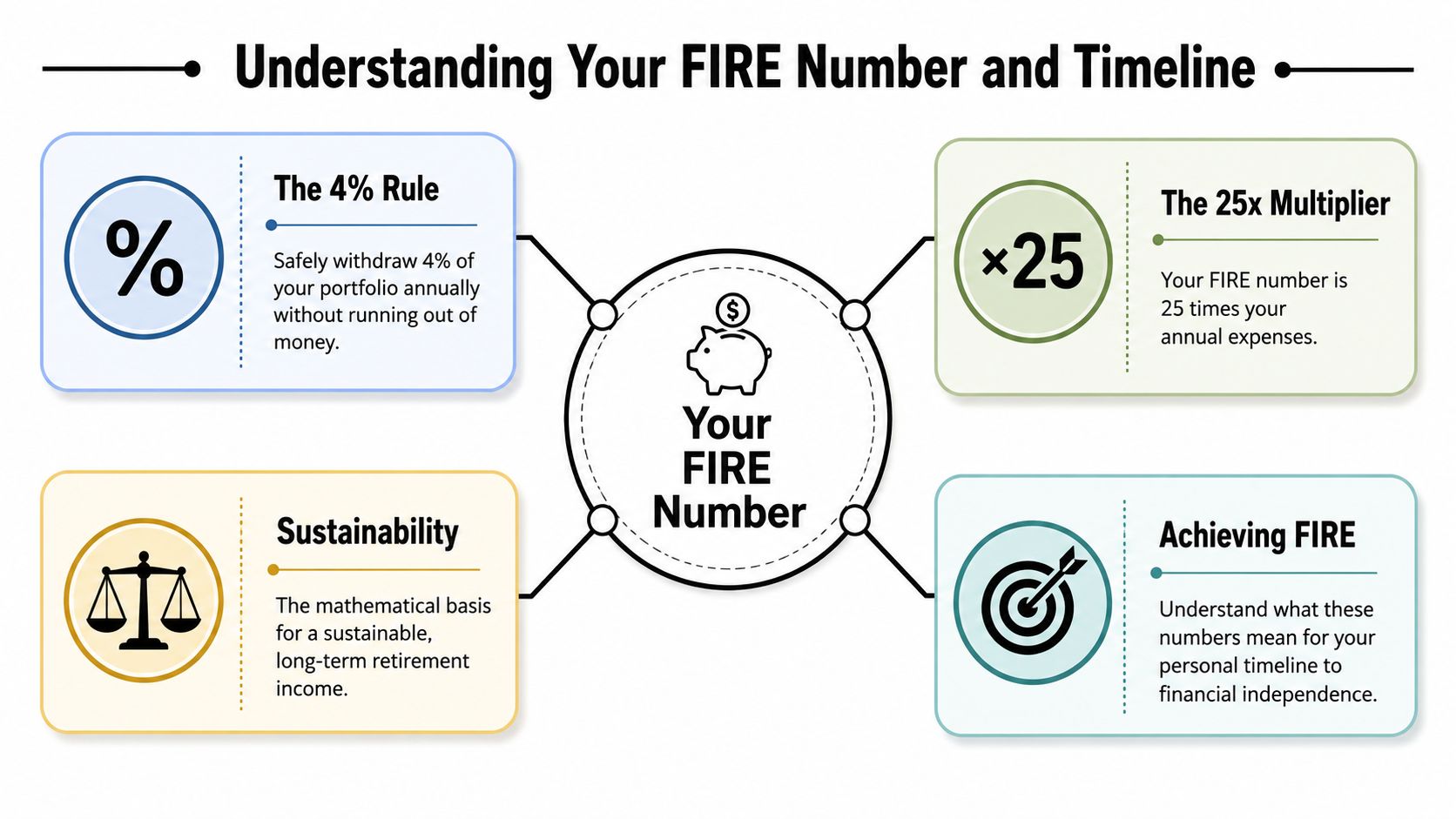
What the math means in practice
That framework is a starting point, not a decision. For physicians, the first question is not "When can I quit forever?" A better question is "At what asset level do I gain enough negotiating power to change how I work?"
That shift matters in medicine. A generic calculator treats a 52-year-old internist cutting to 0.7 FTE the same way it treats someone leaving the workforce entirely. Those are financially and professionally different paths. One still has earned income, skill maintenance, and possible employer benefits. The other depends much more heavily on portfolio durability, tax planning, and healthcare costs.
I have found that many clinicians read a distant full-FIRE date and assume they are trapped in their current job longer than they really are. In practice, there are several meaningful thresholds before "never work again."
Read your result as a set of milestones
For physicians, spending level drives the gap between those thresholds. In one physician-oriented example, lean FIRE was defined as annual retirement expenses of $40,000 to $60,000, which implies roughly $1 million to $1.5 million using the 25x rule. A doctor spending $150,000 or more yearly needs at least $3.75 million in invested assets, according to Sermo's physician FIRE breakdown.
Use milestone labels to interpret the result:
- Lean FIRE means the spending target is intentionally tight and leaves less room for lifestyle inflation.
- Coast FIRE means the portfolio may be large enough that future growth does much of the work, even if contributions slow down.
- Barista FIRE means lower-stress clinical or nonclinical work covers current expenses while investments continue to compound.
- Full FIRE means work is optional at your chosen spending level.
For clinicians, those labels are not internet jargon. They describe different levels of career freedom.
A physician with enough assets to leave nights, weekends, or call has already reached a meaningful financial milestone, even without full early retirement.
This distinction is important, as many clinicians overestimate how much freedom they need before making a healthier job change.
This short explainer covers the mechanics well:
A better way to read the timeline
If the calculator says full FIRE is years away, do not treat that as a verdict. Treat it as a planning range.
A timeline can answer better questions than "How old will I be when I retire?" For a clinician, it can show whether a lower-burnout job delays full independence by one year or by seven. It can show whether part-time work preserves enough savings capacity to keep the plan intact. It can show whether a move to a lower-cost state changes the picture more than an extra shift every month.
| Question | Why it matters |
|---|---|
| Am I close to work-optional, even if not fully retired? | You may have enough margin to change roles sooner than the headline FIRE date suggests |
| Would a lower-stress role preserve my earning longevity? | A sustainable job can produce better long-term results than a higher-paying role you leave quickly |
| Is my spending target actually mine? | Many physicians model an inherited lifestyle assumption rather than a deliberate plan |
The number matters. The interpretation is what turns a retirement calculator into a career decision tool.
Scenario Modeling for Real-World Career Decisions
A financial independence retire early calculator becomes worth your time not when it spits out an age, but when it helps you compare two lives.
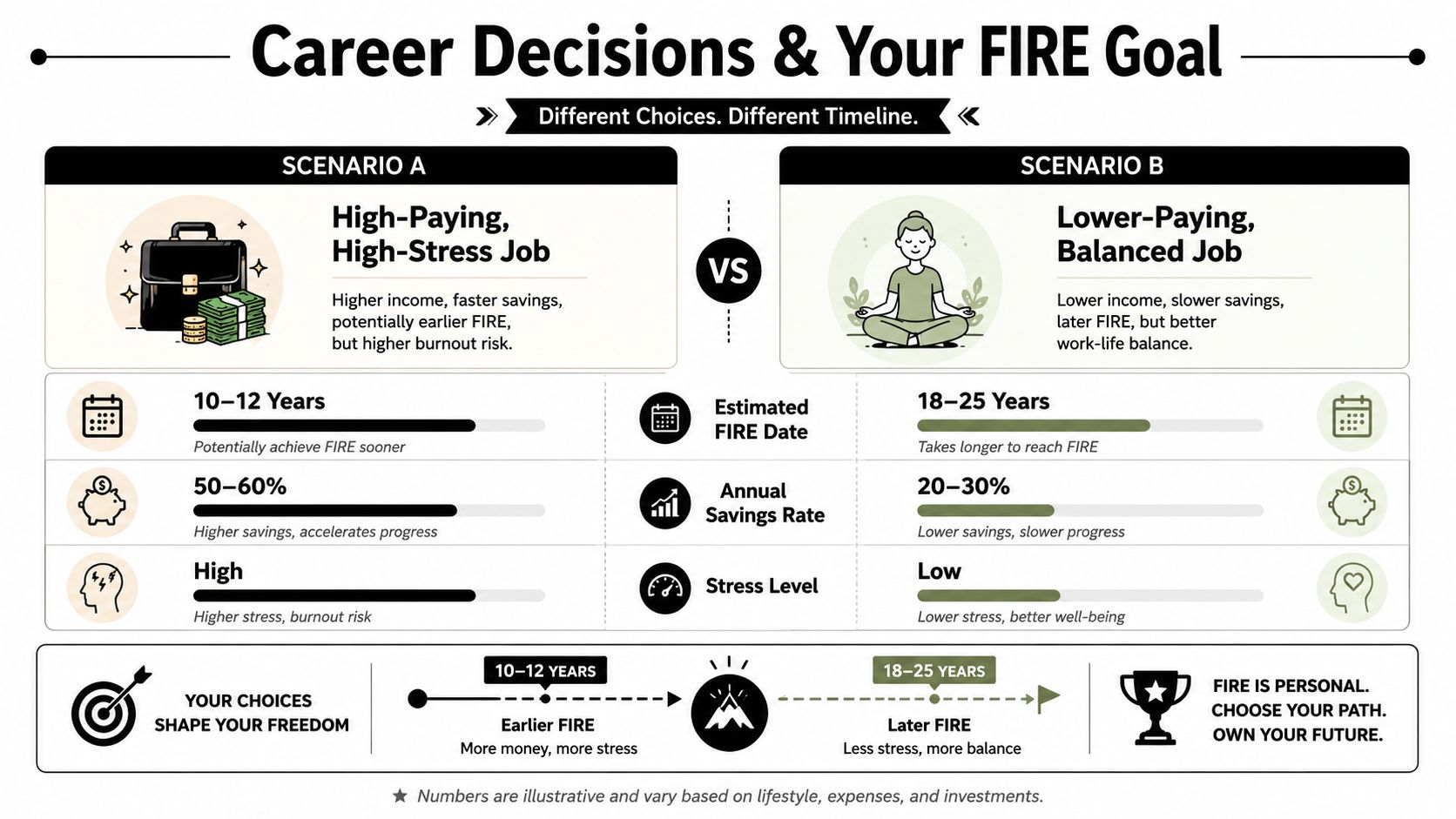
Scenario one, more money and more call
Take a common physician dilemma. One offer pays more, but requires regular call, weekend disruption, and a pace you already know you dislike. The other pays less, but removes call and gives you a schedule you can sustain.
A generic approach says higher pay wins. A career-aware approach asks better questions:
- Does the higher-paying role support a savings rate you can maintain?
- Will the stress push your spending higher through convenience, outsourcing, or recovery purchases?
- If burnout shortens your tenure, was the headline compensation ever real in practical terms?
I've seen clinicians choose the larger offer, then leave quickly because the role consumed every bit of the margin it created. The spreadsheet looked strong. The life didn't.
Scenario two, full-time versus hybrid
Now compare a standard in-person role with a hybrid role that gives you enough flexibility to add controlled side work, telehealth sessions, or consulting. With these options, scenario modeling gets interesting.
Your gross pay might be lower in the hybrid role. But if the schedule reduces friction, commuting cost, and recovery time, you may save more consistently. You may also protect your willingness to keep working. For many clinicians, that's the hidden variable that matters most.
A simple comparison framework looks like this:
| Variable | High-stress role | Balanced role |
|---|---|---|
| Base income | Higher | Lower or moderate |
| Durability of earnings | Less certain | More sustainable |
| Stress load | Higher | Lower |
| Control over time | Limited | Greater |
| Likely long-term consistency | Variable | Often stronger |
When comparing jobs, I care less about peak income and more about repeatable income under humane conditions.
Scenario three, the state move
Geography is one of the few levers that can change income, taxes, spending, and lifestyle at the same time. A move from a high-cost, high-tax environment to a lower-cost state can reshape the entire timeline even if the new salary isn't obviously higher on paper.
This is also where job search tools become directly useful. If you're modeling lower-burnout paths, search specifically for remote NP jobs, no weekends physician roles, and compensation benchmarks on Market Pulse. If you're comparing productivity-based offers, an RVU calculator helps clarify whether the earnings assumptions are realistic. If the contract itself may limit your next move, a contract scanner for clinician agreements can flag restrictive language before you commit.
How to model the decision
Don't overcomplicate the comparison. Build a separate calculator version for each serious option.
For each scenario, change only the variables that differ:
- Income if compensation structure changes
- Savings rate if the role changes your ability to save
- Annual spending if geography or burnout changes your personal cost structure
- One-time costs if a move or job exit creates friction
Then compare outputs side by side. The right question isn't "Which job pays more?" It's "Which job gets me to durable freedom with the least collateral damage?"
From Calculation to Action Steps
A FIRE calculator becomes useful when it changes an employment decision.
Clinicians usually do not need another lecture about discipline. They need a short list of actions tied to the few variables that move the date. One common miss is the gap before age 59½, when retirement accounts are less straightforward to access without planning ahead. Savings rate matters, but account access, taxable brokerage balances, cash reserves, and job flexibility matter too. Those trade-offs create very different timelines, as discussed in NerdWallet's FIRE overview.
Use the output to make concrete changes:
- Pressure-test your current job. Compare your actual after-tax take-home pay, schedule burden, and recovery time against realistic alternatives. A higher salary often loses to a calmer job if the calmer job improves your ability to stay employed, save consistently, and avoid burnout-driven spending.
- Review contract friction before you count on a move. Non-competes, long notice periods, tail coverage, sign-on repayment, and restrictive moonlighting terms can delay the exact job change your model assumes.
- Build a decision set, not a single projection. Run your current role, a reduced-FTE version, and one lower-cost geography. If the part-time path reaches financial independence only a year or two later but gives you back evenings, weekends, or call relief now, that may be the better outcome.
- Set your job criteria from the model. If your calculator shows that stable saving matters more than absolute peak income, filter for no-call, weekday-only, hybrid, or remote work that you can sustain for years.
- Re-run the model on a schedule. Quarterly is enough for most clinicians. Update compensation, taxes, spending, debt payoff, and any family changes. Career plans drift when the numbers stay stale.
I have found that the most useful question is not whether a new role gets me to FIRE at the earliest possible age. It is whether that role improves the ratio of income to stress enough to keep the plan intact.
That is the key action step. Use the calculator to choose a job structure you can live with long enough to reach independence. For physicians, NPs, and PAs, FIRE works best as a career design tool, not just a retirement estimate.