Clinician Burnout Recovery Strategies: 7 Evidence-Based
Discover 7 evidence-based burnout recovery strategies for clinicians in 2026. Includes workplace fixes, CBT, & financial planning for a sustainable career.

A clinician finishes the day with the chart closed and the inbox under control, then lies awake at 2 a.m. dreading one more refill request, one more staffing gap, one more week of functioning on fumes. That pattern is burnout in one of its most common forms. It often looks competent from the outside long after it starts eroding judgment, patience, sleep, and interest in work.
The scale is large. The World Health Organization classifies burnout as an occupational phenomenon resulting from chronic workplace stress that has not been successfully managed, and Gallup reported that full-time employees frequently experience burnout at work. For clinicians, the driver is rarely a single bad week. It is usually sustained mismatch between the person and the job. Too little control over time, too much administrative load, inadequate recovery, moral strain, and compensation structures that reward overextension.
That is why recovery has to do more than lower stress for an hour. It has to change the conditions that keep stress biologically and professionally active. In practice, that means treating burnout on several levels at once: symptoms, habits, schedule design, team support, role fit, and money. A breathing exercise can help regulate an overloaded nervous system. It will not fix an unsafe panel size or a job that requires nightly unpaid spillover.
I use a broader standard for burnout recovery strategies. The intervention should help restore physiologic reserve, improve thinking under strain, reduce exposure to chronic work stressors, and increase real options if the current role cannot be repaired. Sometimes that means therapy and sleep protection. Sometimes it means renegotiating clinical FTE, shifting specialties, or using a compressed work week schedule framework to create actual recovery time. Often it means several of those at once.
This guide follows that reality. It addresses personal recovery, workplace restructuring, career transition, and financial planning as parts of the same treatment plan.
1. Structured Time Boundaries and Schedule Protection
If your off-hours still contain charting, inbox cleanup, and low-grade vigilance, you don't really have recovery time. You have unpaid spillover. The first intervention I'd put in place is boring and highly effective: fixed work windows, protected unavailable blocks, and one day each week that is completely work-free.
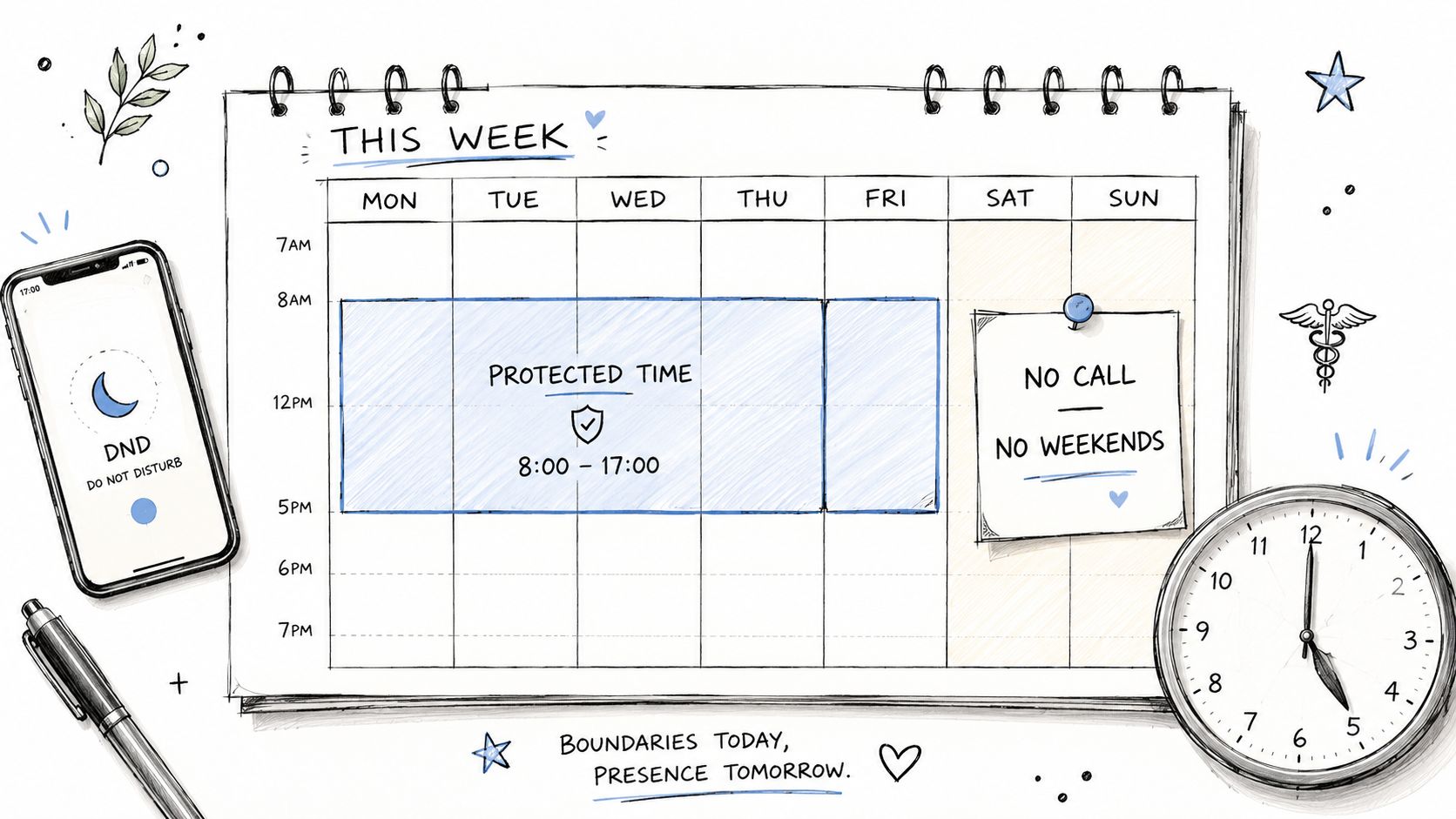
That means real boundaries. Start and stop times. Calendar blocks that staff can see. Out-of-office language that routes urgent issues to actual coverage. If possible, remove mobile EHR and work email access outside those windows. In practice, a boundary only works when it's visible to other people and backed by a coverage plan.
What this looks like in a clinical week
A lot of clinicians try to solve burnout with vague intentions like “I'll be better about logging off.” That rarely survives a busy service or an understaffed clinic. Better systems are concrete.
- Defined hours: Set a daily window such as 8 to 5, then communicate it to patients, staff, and collaborating clinicians.
- Hard blocks: Mark admin time, lunch, and post-call recovery as unavailable, not “tentative.”
- Protected off-day: Keep one day free of call, inbox work, credentialing, CME catch-up, and “quick chart checks.”
- Technology cutoff: Turn off email and EHR notifications after hours when your role allows it.
Practical rule: If your workplace treats constant availability as professionalism, your schedule is doing hidden clinical work against your recovery.
There's a trade-off. In fee-for-service settings, reducing after-hours catch-up can expose how unrealistic your daytime workload already is. Colleagues may push back if your coverage model is weak. In heavily call-driven specialties, schedule protection may require a role redesign, not just better discipline.
If you're assessing whether a compressed schedule would help or if it would condense the same dysfunction into fewer days, WeekdayDoc's guide to compressed work week schedules is useful for comparing recovery value against workload intensity.
2. Cognitive Behavioral Therapy and Thought Reframing
Burnout changes thought patterns long before it changes your CV. Perfectionism gets framed as professionalism. Catastrophizing sounds like vigilance. Personalization starts to feel responsible. CBT is one of the cleaner ways to separate accurate concern from distorted interpretation.
The value of CBT in clinicians isn't that it teaches positive thinking. It teaches better evidence handling. You notice the automatic thought, test it, and stop treating every stressful emotion as proof that the thought is true. For a burned-out physician, that often means working with beliefs like “If I set limits, I'm failing my patients,” or “One bad outcome proves I'm slipping.”
Where CBT helps, and where it doesn't
CBT is highly portable. You can use it while staying in your current role, while negotiating changes, or while preparing to leave. A trained therapist can help you identify cognitive distortions, use thought records, and run behavioral experiments in real situations. This is one reason many clinicians benefit from structured care such as CBT and medication for anxiety through telepsychiatry, especially when burnout overlaps with anxiety or depressive symptoms.
But CBT has a limit, and it matters. It works best on the mental habits that intensify distress. It does not fix chronic understaffing, incoherent leadership, unsafe panel size, or compensation structures that punish recovery. Used well, CBT reduces self-attack and improves decision-making. Used poorly, it becomes another way to tell clinicians to adapt to a broken system.
Don't use therapy to become more compliant with conditions that are burning you out.
That's why I treat CBT as a stabilizer, not a complete plan. It can reduce reactivity, help you think clearly about next steps, and keep perfectionism from hijacking every negotiation. But if your burnout is mostly structural, the therapy needs to sit alongside schedule changes, workload reduction, or a role move.
3. Deliberate Recovery Activities and Active Rest Protocols
You finish a stretch of hard shifts, get home, sit down, and lose the rest of the day to scrolling, takeout, and half-sleep. That response makes sense. It is also why many clinicians stay stuck. Collapse relieves immediate strain, but it rarely rebuilds attention, mood, or physical capacity.

Recovery works better when rest is deliberate. The goal is not productivity during time off. The goal is to give your nervous system different inputs than work, and to do it often enough that your off-hours stop being just a holding tank for the next shift. Sleep, physical activity, time outdoors, and contact with people you trust all help. Earlier evidence in this article already covered the broad relationship between these habits and burnout recovery, so I am not repeating the same source here.
Active rest restores capacity
The useful question is simple. Does this activity leave you more settled, more connected, or more physically alive an hour later?
For many clinicians, active rest falls into four buckets:
- Physical downshifting: walking, swimming, easy cycling, mobility work, gardening
- Attention repair: reading for pleasure, music, cooking, art, woodworking
- Relational recovery: dinner with a friend, family routines, time with people outside medicine
- Identity expansion: volunteering, faith practice, language learning, planning a trip, joining a local group
Burnout profoundly shrinks life. Work takes the center. Recovery often gets reduced to chores, sleep debt, and passive distraction. A good active rest protocol pushes back on that shrinkage.
The trade-off is real. Early in recovery, even enjoyable activities can feel flat or effortful. I tell patients not to use that as the only test. Anhedonia and exhaustion often blunt reward before they improve. Start with low-friction activities that have a clear endpoint, such as a 20-minute walk after your last chart, coffee with one friend, or cooking one real meal on a day off.
Build a protocol, not a wishlist
Good recovery plans are specific enough to survive a bad week. Vague intentions usually fail against fatigue and administrative overload.
A workable protocol often looks like this:
- One daily recovery block: 15 to 30 minutes, scheduled, with one activity chosen in advance
- Two movement anchors each week: classes, walks, gym visits, or anything you will repeat
- One protected social touchpoint: a standing call, breakfast, religious service, or shared errand
- One larger off-duty activity each month: a day trip, museum visit, hike, concert, or hobby session
That structure does two things. It reduces decision fatigue, and it prevents your only rest option from being collapse.
For some people, travel helps reintroduce pleasure and a sense of future. It should not become another status project or financial stressor. Still, if you have narrowed your off-duty life to sleep and errands, browsing luxury adventure travel ideas can help widen the menu of what recovery might include.
Active rest is not a substitute for fixing staffing, call burden, or a bad role fit. It is one part of a larger recovery framework. Used well, it helps you regain enough energy and range to make clearer decisions about the structural changes that come next.
4. Mindfulness-Based Stress Reduction and Embodied Practices
Mindfulness is overprescribed and still useful. The problem isn't the tool. It's how often it gets sold as a substitute for job repair. Used correctly, MBSR can reduce the physiologic intensity of burnout and improve your ability to notice stress signals before they become your baseline.
In practical terms, that usually means formal meditation, body scan work, breath practice, yoga, walking meditation, or other embodied routines that increase parasympathetic tone. For clinicians who live in cognitive overdrive, the body-based part matters. You're not just trying to think differently. You're trying to stop carrying your workday in your chest, jaw, and sleep.
The version that tends to stick
The Mental Health Foundation's guidance on burnout recovery points to sleep, a balanced and varied diet, mindfulness routines, physical activity, structured routine, and self-compassion as useful parts of recovery, while also stressing that excessive workloads, lack of resources, and misaligned values have to be addressed organizationally. That's the right framing. Mindfulness helps. It does not absolve employers of redesigning harmful work.
An MBSR-style approach is most realistic when it's small and scheduled:
- Formal practice: Short body scan or seated meditation at the same time each day.
- Informal practice: One routine activity done without multitasking, such as the walk from the parking lot or your first cup of coffee.
- Embodied reset: Brief stretching, yoga, or breathing between sessions rather than waiting for the end of the day.
Clinicians with trauma histories or severe agitation sometimes find silent meditation unpleasant or destabilizing. In those cases, movement-based practices, guided audio, or breath work with eyes open often lands better than forcing stillness.
5. Specialty and Role Transition to Lower-Burnout Positions
A physician cuts clinic days, starts meditating again, and finally gets sleep under control. Then one bad call week wipes out the gains. That pattern usually means the recovery plan is colliding with the job design.
Some roles keep reactivating burnout because the strain is built into the work itself. High message volume, little schedule control, unpredictable call, and constant interruption can overpower good therapy, better boundaries, and disciplined rest. As noted earlier, burnout recovery is more durable when the work environment changes along with the person.
That is why role transition belongs in a recovery plan, not just a career plan. For some clinicians, the right move is not to become more efficient in the same position. It is to reduce exposure to the parts of the job that keep driving exhaustion, cynicism, or moral distress.
What to screen for before you make a move
Lower-burnout work is less about title and more about load profile. Two jobs in the same specialty can feel completely different depending on pace, control, staffing, and after-hours expectations.
Use a simple screen:
- Predictability: call frequency, weekend coverage, inbox expectations, and how often the day runs over
- Autonomy: control over template length, panel size, visit structure, and time off
- Cognitive load: interruption rate, task switching, acuity mix, and how many decisions stack up each hour
- Administrative friction: prior auth burden, documentation support, staffing stability, and whether workflows are usable
- Values fit: whether the role lets you practice in a way that still feels clinically and ethically intact
Telehealth, occupational medicine, utilization management, academic hybrid roles, consult-focused positions, quality improvement, medical leadership, and some locums arrangements can reduce different parts of the burden. None is automatically better. Telehealth may cut commute time and sensory overload but increase screen fatigue. Leadership can improve autonomy while adding conflict and budget pressure. Locums can reduce committee work but increase fragmentation.
If you are exploring a broader pivot, this list of alternative careers for physicians gives a practical map of role types worth screening.
I usually tell clinicians to compare options on recovery impact, not just salary. A modest pay cut with no call, real control of schedule, and lower cognitive churn can outperform a higher-paying role that keeps you in a constant stress cycle. The reverse can also be true if a lower-paid job creates financial strain that becomes its own burnout driver. That trade-off needs an honest review, which is why career strategy and financial planning belong in the same conversation.
A good transition is rarely impulsive. Test the move first when possible. Shadow the role. Ask how many messages arrive after clinic. Ask who covers when staff call out. Ask what happens when the schedule falls behind. Burnout often hides in the operational details, not the job description.
Changing roles can bring grief. Some clinicians feel relief immediately. Others feel loss of identity, status, or mastery before they feel better. Both reactions are normal. The point is not to find an easy job. It is to choose work you can do well without paying for it with your sleep, health, and relationships.
6. Social Connection and Peer Support Systems
Burnout thrives in isolation. Clinicians often mistake withdrawal for recovery because being alone feels easier than being available to anyone else. Short term, that can feel protective. Long term, it removes one of the strongest buffers against cynicism and emotional exhaustion.

Peer support only works when it has structure. Casual venting in the physician lounge isn't enough. Better systems include a recurring small group, a mentorship dyad, or a scheduled check-in with people who understand the job and won't turn every conversation into complaint theater.
Build contact that actually restores you
I'd separate useful peer support from draining peer contact by one criterion. After the interaction, do you feel clearer, steadier, or more resourced? If not, it may just be shared depletion.
Good formats tend to be simple:
- Small cohorts: Regular groups of clinicians who meet with a clear boundary around confidentiality and time.
- Mentor pairs: One trusted peer or senior colleague who can help with perspective and role decisions.
- Workplace check-ins: Non-clinical team time that isn't hijacked by operational updates.
The goal isn't more talking about burnout. It's less carrying it alone.
This is especially important in remote and hybrid roles, where autonomy can improve quickly but isolation can creep in just as fast. The antidote is intentional design. Put the meeting on the calendar. Make it recurring. Keep the group small enough that people show up as themselves.
7. Financial Security and FIRE Planning as Burnout Prevention
A lot of burnout advice implicitly assumes you can afford to say no. Many clinicians can't. They know the role is unsustainable, but the combination of debt, mortgage, childcare, and lifestyle lock keeps them in place. That's why financial planning isn't separate from burnout recovery. It's part of it.
The most important shift here is psychological as much as mathematical. When you build cash reserves and understand your true compensation, you stop negotiating from panic. You can leave a bad contract, reduce FTE, or tolerate a short search period without feeling like one schedule change will destabilize your entire household.
Use financial planning to create exit options
The useful tools are straightforward. Build an emergency fund. Review total compensation, not just salary. Compare retirement match, health insurance, malpractice coverage, CME, loan repayment, and schedule burden. Run projections before you accept “higher pay” that depends on unsustainable volume.
WeekdayDoc's guide to financial planning for medical professionals is a good starting point if you want to connect job design with longer-term flexibility. If you're working toward financial independence, Velzee's FIRE number guide can help frame the target.
This angle matters because a future-dated projection points to a real gap in standard burnout advice. A 2025 American Medical Association study found that 68% of physicians reported burnout was directly linked to financial anxiety, and conventional recovery guidance often ignores financial strategy altogether. Treat that as a projection from the cited study, not as a timeless background fact.
The downside is obvious. Budgeting and planning can feel like another task when you're already overloaded. But financial clarity restores agency. It turns “I'm trapped” into “I have a timeline, criteria, and options.”
7-Point Burnout Recovery Comparison
| Intervention | Implementation complexity | Resource requirements | Expected outcomes | Ideal use cases | Key advantages |
|---|---|---|---|---|---|
| Structured Time Boundaries and Schedule Protection | High , policy change, coverage redesign | Moderate , scheduling tools, staffing, EHR/OOTO configs | Strong , rapid reduction in after‑hours stress; sustained burnout decline | Systems willing to change schedules; on‑site practices, shift work | Immediate after‑hours relief; improves sleep and clinical decision‑making |
| Cognitive Behavioral Therapy (CBT) and Thought Reframing | Moderate , 12–16 week structured practice, therapist support | Low–Moderate , therapist/apps, regular practice time | Moderate–High , reduces depression/anxiety and builds resilience | Individuals seeking portable tools; when structural change is limited | Portable, low‑cost option that improves coping skills |
| Deliberate Recovery Activities and Active Rest Protocols | Low , self‑directed routine building | Low , time investment; minimal equipment | Moderate , sustained well‑being and lower recurrence of burnout | Individuals able to protect discretionary time; complements boundary work | Within individual control; immediate physiological stress relief |
| Mindfulness‑Based Stress Reduction (MBSR) and Embodied Practices | Moderate , 8‑week program + home practice | Low–Moderate , instructor or app, regular time commitment | High , robust evidence for reducing burnout/anxiety with durable effects | Clinicians across specialties, best when paired with schedule changes | Neurobiological benefits; reduces physiological stress markers |
| Specialty and Role Transition to Lower‑Burnout Positions | Very high , retraining, certification, career logistics | High , time, possible education costs, market search | Very high , largest sustained reduction in burnout long‑term | Clinicians whose burnout is primarily structural or workload driven | Addresses root causes; enables other recovery strategies |
| Social Connection and Peer Support Systems | Moderate , requires design and regular commitment | Low , meeting time, facilitation resources | Moderate , reduces isolation; improves cohesion and stress markers | Remote/hybrid teams or clinicians experiencing isolation | Low cost; normalizes experience and provides practical support |
| Financial Security and FIRE Planning as Burnout Prevention | Moderate , planning, budgeting, potential role adjustments | Moderate , financial tools/advisors, time to save/debt‑reduce | High , reduces financial anxiety and enables safer transitions | Clinicians with financial stress or planning career flexibility | Restores agency; measurable impact on ability to leave toxic roles |
Building Your Sustainable Career, Starting Today
It is 9:30 p.m. The charting is still open, your body is tired, and part of you is already bracing for tomorrow. In that moment, burnout recovery is not an abstract wellness goal. It is a career design problem with clinical consequences.
Sustainable recovery starts with triage. First reduce immediate strain. Protect sleep, contain after-hours work, and get clinical support if your thinking has become rigid, self-punishing, or hopeless. Then assess the job with the same discipline you would use in a patient workup. Look at workload, control over your schedule, staffing, leadership behavior, documentation burden, and the cost of staying.
That structural assessment matters. An AHRQ review of interventions across ambulatory settings found that changes such as smaller panel sizes, greater visit flexibility, lower daily visit volume, and stronger team staffing improved work satisfaction and reduced burnout. Individual treatment still has a place. Sermo's summary of the physician self-care literature points to behavior change methods, mind-body practices, and structured sleep education as the strongest-supported self-care approaches. The practical implication is straightforward. Recovery holds better when the person and the job are treated at the same time.
I tell clinicians to choose the next step based on the main constraint, not on what sounds virtuous. If the barrier is a punishing schedule, renegotiate hours or start an exit plan. If the barrier is financial fear, build cash reserves and reduce fixed expenses so you can change roles without panic. If the barrier is isolation, add one reliable point of contact this week, a colleague, therapist, supervisor, or peer group that can help you reality-test what is happening.
Do one concrete thing now.
Block one protected evening for the next two weeks. Send one email that starts a workload conversation. Book the therapy intake. Review your debt, savings, and monthly burn rate. Update your CV and define the job features you will and will not accept.
Burnout recovery is not only about getting through the next month. It is about building enough clinical, operational, and financial stability that your career stops injuring you faster than you can recover.