AMFT Remote Jobs in California: What to Check
Explore remote and telehealth jobs for California AMFTs, and learn to check qualifying hours, supervision, pay, and schedule before applying.

Telehealth opens a wide range of opportunities for early-career therapists, offering flexibility a traditional clinic rarely matches. Earning your hours from a home office removes the daily commute and gives you more control over your physical work environment. Yet finding AMFT remote jobs in California involves more than a title search, because the arrangement needs to satisfy state licensure rules while delivering a livable schedule and fair compensation. Before accepting a position, check that its hours count toward your license, its supervision meets regulatory standards, and its employment classification complies with state law. A role that misses these marks can delay your path to LMFT licensure, leave hours uncounted, and contribute to burnout early in your career.
Can California AMFTs Work Remotely?
The California Board of Behavioral Sciences allows associates to earn required experience hours through remote care. The state places no limit on the number of telehealth hours that count toward supervised experience, treating telehealth as a recognized delivery method. The board evaluates the quality of the oversight and the clinical experience rather than the physical location of the therapist.
A remote label on a job description does not guarantee the role qualifies for your hours. An employer might advertise a position that lacks the right case mix, skips appropriate supervision, or misclassifies the associate as an independent contractor. Securing your experience means confirming the specific duties and oversight structure align with the board's licensure path.
Comparing remote roles also means looking at the daily reality of the schedule. We built WeekdayDoc to help clinicians evaluate those details before applying. Each listing on the platform includes a 0-to-10 work-life score based on call coverage, evening expectations, weekend requirements, schedule flexibility, and administrative load. You can review this score alongside the role's pay context and market percentiles to gauge whether the position offers a sustainable path to licensure.
Where to Find AMFT Telehealth Jobs
Many behavioral health employers post remote opportunities using a variety of titles. You will find positions listed as associate marriage and family therapist, associate MFT, pre-licensed therapist, and telehealth therapist. Searching these terms alongside "remote" or "telehealth" and filtering for California surfaces a broad list of openings.
Different types of organizations approach associate hiring in distinct ways. Group practices often bring on associates to handle telehealth overflow or expand evening and weekend availability, generally offering close supervision and a steady flow of local referrals. In contrast, virtual behavioral-health providers build their entire models around remote care to expand their networks. These larger platforms provide heavy infrastructure and proprietary software, though they frequently ask for strict adherence to high session quotas. For those wanting a mix of settings, large healthcare organizations and community clinics offer hybrid outpatient services where you can split your time between a physical office and a remote setup while gaining exposure to diverse clinical populations.
Broad therapist titles often describe roles meant only for fully licensed professionals, so confirm the employer explicitly accepts pre-licensed candidates. A job labeled "remote telehealth therapist" might ask for an LMFT, LCSW, or LPCC, even if the algorithm delivers it in an AMFT search. Reading the candidate requirements carefully prevents wasted application effort. When browsing job boards, look for explicit mentions of "supervision provided" or "associate program" to identify employers equipped to handle the licensure process.

Check Whether the Role Supports LMFT Licensure
The California board evaluates your supervised experience based on the work you perform, the setting where you practice, the type of oversight you receive, and the rules governing your employment status. If a clinic falls short in any of these areas, the state will reject the hours you submit.
Earning your LMFT license involves completing specific types of work within a set timeframe, and a remote job needs to offer the right balance of duties to help you reach those targets. The state outlines these rules in its February 2025 FAQ on supervised experience, noting that applicants need 3,000 hours of professional experience completed over 104 supervised weeks. Every week claimed requires appropriate supervision, and without it, the board invalidates the hours earned during that time.
This overall total breaks down into specific categories, making the job's client mix a primary screening point. You need a minimum of 1,750 direct clinical counseling hours, and at least 500 of those involve diagnosing and treating couples, families, and children. Meanwhile, the board caps nonclinical experience, like writing reports or attending workshops, at 1,250 hours. A remote role focusing exclusively on individual adult therapy leaves you short of the family requirement, forcing you to seek secondary employment or volunteer work to make up the difference. Asking prospective employers about the expected caseload ensures they can assign you a compliant mix of clients from the start.
Supervision keeps those hours valid. The state expects a minimum of one hour of individual or triadic supervision, or two hours of group supervision, during any week you claim experience. Providing more than 10 hours of direct clinical counseling in a specific setting during a single week triggers the need for additional oversight. A remote employer needs to accommodate these rules by scheduling sufficient time and providing supervisors who hold an active California license alongside the board's training mandates.
The way an employer classifies your employment also affects whether the board accepts your experience. Associates generally work as W-2 employees or volunteer employees. While the board outlines limited circumstances for 1099 contractor status, standard independent contractor arrangements usually fail to meet the supervision and control guidelines for pre-licensed professionals. Rather than assuming an ordinary 1099 posting counts toward licensure, ask the employer to explain how their specific setup satisfies the state's rules before you sign a contract.
State rules restrict where and how you practice as well. AMFTs cannot practice independently or bill clients directly, meaning you always work under the oversight of a qualified supervisor within a recognized setting. If you plan to work for a private practice or a professional corporation, the state requires your AMFT registration to be issued first. The board limits work in those specific settings to the first six years after registration to prevent associates from indefinitely extending their pre-licensed status.
The Board's Law Changes page lists a 2024 temporary practice allowance for out-of-state licensees and telehealth-related changes, so review those entries before accepting a cross-state remote role.
Compare Pay and Schedule Beyond the Remote Label
A high session rate often hides unpaid administrative work because many telehealth companies advertise per-session figures that apply only to direct client contact. Evaluating an offer means looking past the headline number to understand the total time commitment. A clinic might offer $50 per session but exclude the uncompensated hours necessary to maintain the caseload, such as time spent on documentation, care coordination, training, and supervision.
That $50 session rate works out to less once you account for 15 minutes of unpaid notes per session and a 30-minute weekly case consultation. Asking about cancellation policies is equally helpful. Some employers pay a partial rate for no-shows, while others leave you uncompensated for an empty slot on your schedule, creating financial instability if the clinic suffers from high patient attrition.
A practical way to evaluate an offer is to divide your expected compensation by your total required time, including sessions, documentation, meetings, supervision, and required availability periods. Earning $1,000 for 20 clinical hours while spending another 10 hours on mandatory administrative tasks drops an advertised $50 rate to an effective $33 per hour. While the U.S. Bureau of Labor Statistics' State Occupational Employment and Wage Estimates provides state-level occupational wage estimates, calculating your own effective rate provides a better benchmark for weighing pre-licensed remote roles.
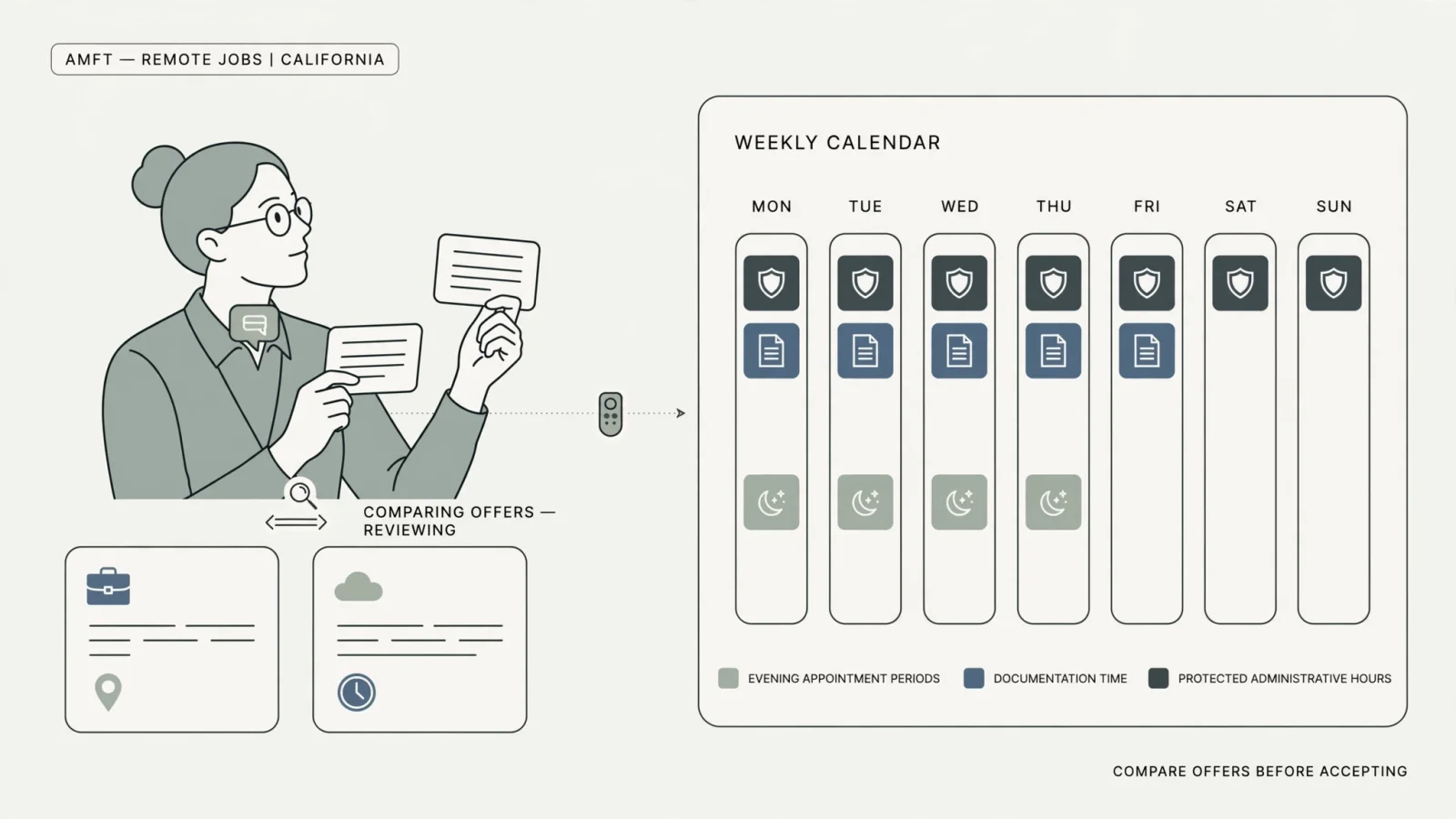
Remote work does not automatically deliver a sustainable schedule. A telehealth position might still demand evening appointments, weekend shifts, back-to-back sessions, or crisis on-call duties. High documentation volume remains common on remote platforms, and the flexibility of working from home vanishes if the employer enforces rigid log-in hours or monitors keyboard activity.
WeekdayDoc's 0-to-10 work-life score brings these demands together, while salary comparisons and market percentiles help clarify the total package. When you reach the offer stage, our contract scanner flags clauses like non-competes, tail coverage terms, and payback provisions, giving you specific points to review closely with an attorney.
Ask These Questions Before Accepting
A thorough interview protects your time and your path to licensure. Employers with established associate programs expect questions about their setup and gladly provide clear, documented answers. If a clinic avoids direct answers about supervision or pay, it becomes harder to assess whether the role supports your career progression.
Bringing a few specific questions to your interviews uncovers the daily realities of the position:
- Does this role explicitly accept California AMFTs, and must my registration be active before my start date?
- Who provides the supervision, how is it scheduled, and does the employer cover the cost?
- How does the employer track and document experience and supervision hours for the board?
- Is the position classified as a W-2 employee or a volunteer? If the posting mentions a 1099 arrangement, how exactly does the employer comply with state rules?
- Which client populations will make up my caseload, and how will the employer ensure I receive enough couples, families, and children hours?
- How many direct clinical hours are expected each week, and how does the clinic supply those referrals?
- How does the clinic handle pay for missed appointments or late cancellations?
- Does the compensation structure include paid time for documentation, care coordination, training, and supervision?
- Will the schedule require evenings, weekends, crisis coverage, or on-call availability?
- Does the clinic require me to reside in California, and where are the clients located?
- Is the job fully remote, or does the clinic require physical presence for specific meetings or training days?
Find the Right Fit
Securing the right remote experience means aligning your clinical duties, supervision, and compensation. After searching for California therapist roles with telehealth filters applied, compare the expected caseload against the board's licensing requirements and confirm the employer's classification structure supports your path. Checking the schedule details directly with the hiring manager ensures the job provides a livable work week rather than merely the absence of a commute. Reading the contract closely clarifies the total time commitment, payment structure, and cancellation policies before you sign.
WeekdayDoc connects clinicians with roles that prioritize sustainable careers. Search our platform by profession, location, and work type to find positions that fit your goals. Review each listing's 0-to-10 work-life score, compare market percentiles, and use our AI-matched alerts to find your next opportunity. When you receive an offer, our contract scanner and negotiation scripts help you evaluate the terms with confidence. Visit WeekdayDoc to find a role that values your time and supports your clinical practice.