
Remote Pharmacist Jobs Near Me: Find Roles by State
Find remote pharmacist roles open in your state, compare licensing, pay, schedules, and workload, and browse current listings by location.
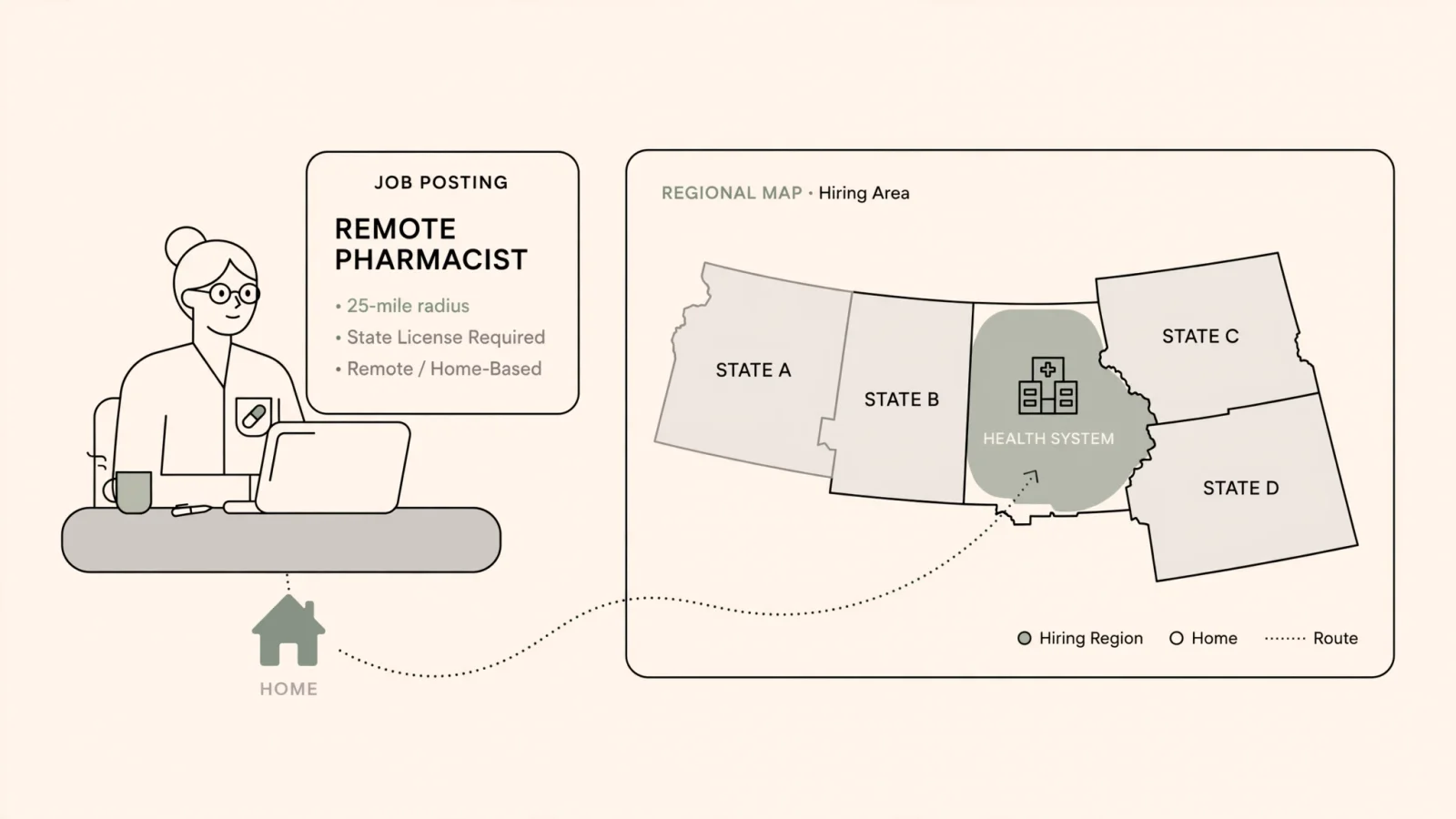
A job listing advertises a remote position, but the application rejects you on the first page because you live in the wrong state. Searching for remote pharmacist jobs near me requires more than a standard location filter. Finding the right fit means matching your residence to the employer's tax and hiring footprint, checking which state pharmacy boards govern the work, and evaluating what the workload involves outside a dispensing counter.
General job boards often leave schedule and location constraints buried in the fine print. WeekdayDoc lets you browse listings by location and work type, with clear state and schedule details that help filter out roles you aren't eligible for and focus your search on employers hiring in your region.
What “Near Me” Means for Remote Pharmacist Jobs
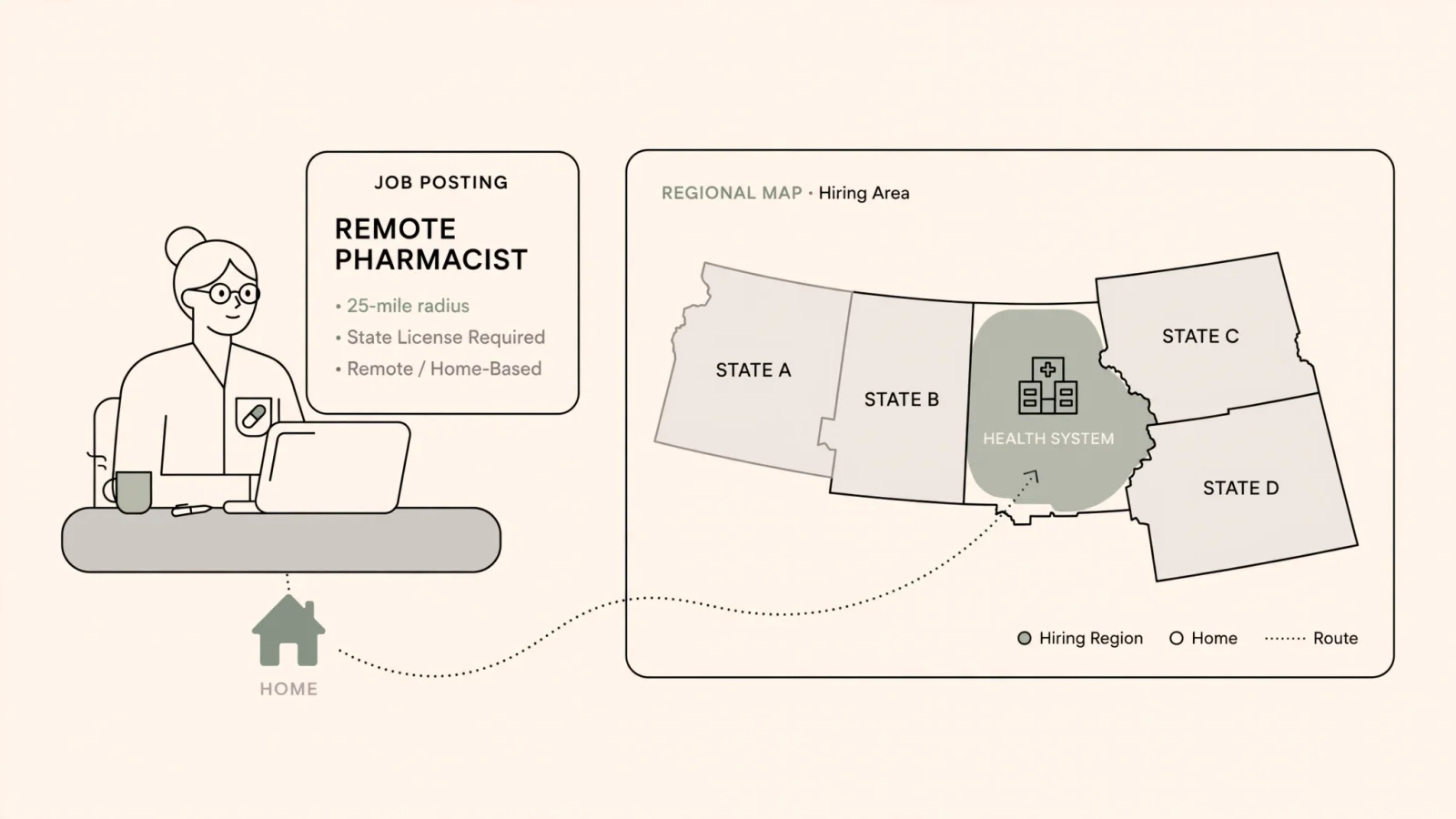
A "remote" label alone does not establish where you can live or work. Many home-based roles limit candidates to approved states where the employer maintains established payroll and tax entities. If a health plan operates exclusively in the Midwest, the company may only hire pharmacists residing in Ohio, Michigan, and Indiana to simplify compliance and state tax reporting. Other positions advertise a broad remote status while expecting attendance at occasional onsite meetings at a regional hub.
Some telepharmacy jobs link your employment to a specific local pharmacy or health-system site. Under this model, you work from a satellite clinic or a closed-door facility rather than your living room. Matching the job's work location and eligibility rules to your state serves as a useful primary filter. A nearby address on a posting might indicate a hybrid requirement, or it might list the corporate headquarters of an employer accepting applicants nationwide.
For a fuller picture of these constraints, see the broader remote pharmacist career guide on WeekdayDoc, which explains how tax locations and work-from-home policies intersect. Focusing on roles that accept your state can save time otherwise spent interviewing with companies that lack the corporate infrastructure to hire you.
Types of Remote Pharmacist Jobs to Search
The word remote describes the location of the work, leaving the actual clinical duties undefined. Two positions with identical titles can differ entirely in daily workflow, patient contact, and at-home eligibility. Understanding the structural differences between these career paths helps narrow the search. The specific role dictates whether a shift involves video calls with patients, independent reviews of electronic health records, or coordination with prescribers.
The Academy of Managed Care Pharmacy says pharmacists in managed health care organizations are responsible for delivering health care and prescription drug benefits to over 300 million Americans. Given that breadth, review the worksite expectations in the posting to see whether the role is fully home-based. Career changers leaving retail or inpatient practice can also compare their existing experience, such as managing complex medication reconciliations or coordinating with payers, with the duties listed in the job description.
Utilization Management, Prior Authorization, and Appeals
Utilization management focuses on coverage decisions and formulary compliance. Searching for clinical UM pharmacist, prior authorization pharmacist, or clinical review pharmacist titles surfaces roles built around reading chart notes and applying clinical criteria. The core responsibility involves assessing whether a requested medication meets a health plan's medical necessity guidelines.
These jobs require high volumes of record review with strict turnaround times dictated by Medicare or commercial plan rules. Employers typically track productivity and quality measures, expecting pharmacists to complete a set number of cases per hour. The work frequently involves communicating with prescriber offices to gather missing clinical documentation or explain denial rationales. During the interview process, clarify what percentage of the day requires direct peer-to-peer physician calls rather than independent chart review.
Medication Therapy Management and Telehealth
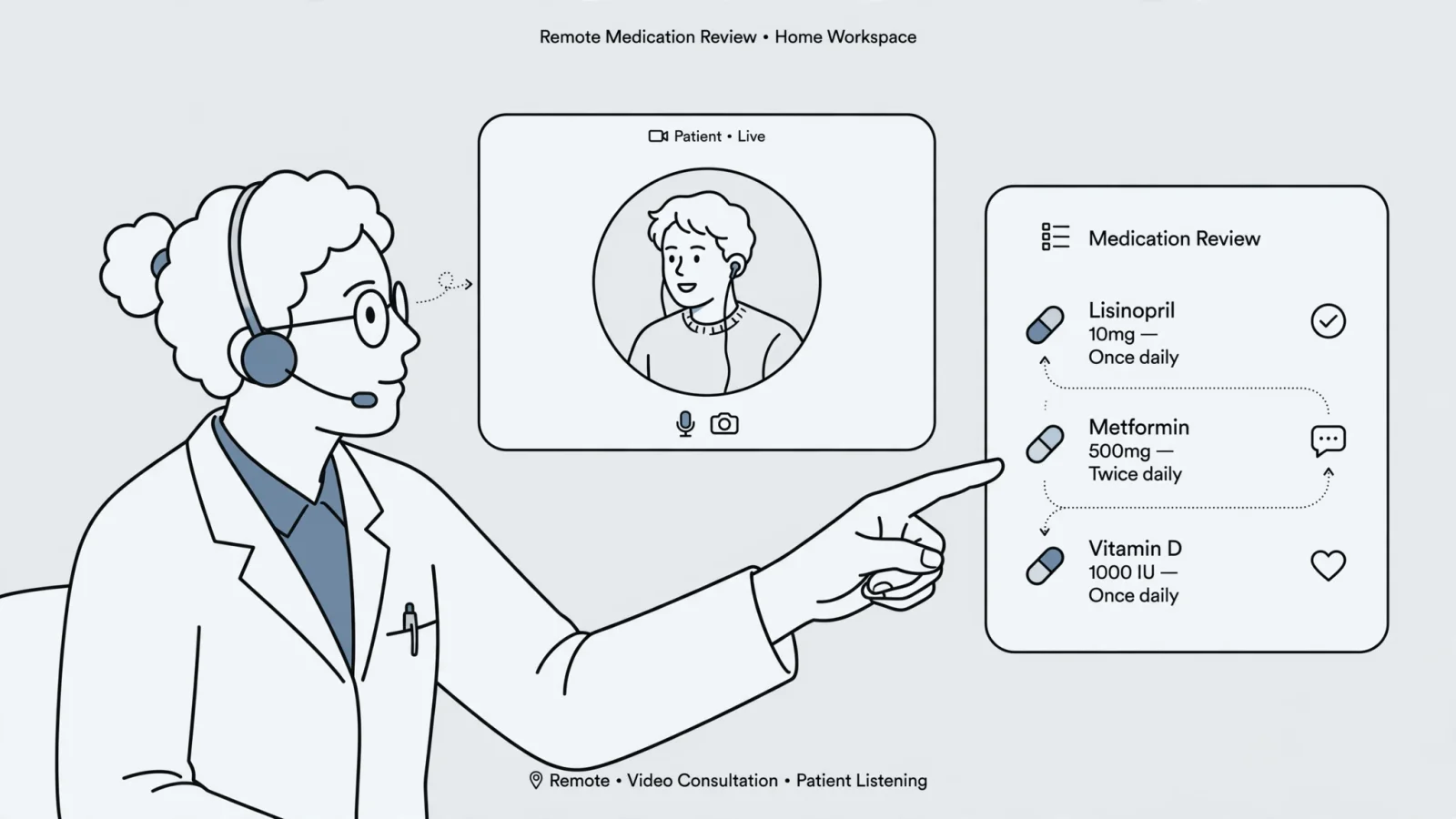
Medication therapy management (MTM) and telehealth roles return the focus to direct patient care. Pharmacists conduct comprehensive medication reviews, provide adherence support, and manage chronic diseases by phone or video. This work identifies gaps in care, prevents adverse drug events, and optimizes complex regimens for high-risk patient populations.
Candidates evaluating these roles benefit from asking how much of the shift involves scheduled patient contact compared to cold-calling patients to offer services. Time-zone coverage also shapes the daily schedule. If an East Coast resident takes a job serving a West Coast patient population, the required shift might stretch into the late evening to reach patients after their workday ends.
Remote Order Review and Verification
Health systems use remote order verification pharmacists to support busy inpatient pharmacies or manage overnight volume. Connecting to the hospital's electronic health record from home allows you to review and verify medication orders before nurses administer them. This workflow demands the same clinical judgment, renal dosing adjustments, and attention to drug interactions as a position inside the central pharmacy.
The U.S. Bureau of Labor Statistics notes that pharmacists in hospitals and other facilities that are open 24 hours may work nights, weekends, and holidays, so if you are considering a remote hospital role, check its posting for specific coverage windows and rotations to avoid scheduling surprises.
Mail-Order, Specialty, and Central Pharmacy
Mail-order and specialty pharmacies manage high-volume dispensing and complex medication regimens for chronic conditions, including rheumatoid arthritis, oncology, and multiple sclerosis. Remote roles in this sector involve clinical prescription review, checking dosing for specialty biologics, or providing patient education on side-effect management and injection techniques.
The job title alone does not establish whether the work happens from home, a central facility, or a hybrid site. Some specialty pharmacies allow clinical review and patient outreach to happen remotely, yet require the final product verification to happen on-site. Clarifying the physical work location early in the interview process reveals whether the role includes any physical dispensing responsibilities.
Formulary, Clinical Program, Quality, and Outcomes Roles
Managed-care organizations hire pharmacists to design benefits, manage drug use, and analyze clinical outcomes. These positions involve evidence review, evaluating new drugs entering the market, and developing clinical programs to improve patient adherence or lower overall healthcare costs.
These roles often function like traditional corporate jobs, offering standard business hours and project-based workflows rather than queue-based shift work. Remote availability varies by posting. Because these positions rarely involve direct patient care or dispensing, the pharmacist-license requirements also differ among companies. Some employers require an active license in the state where their headquarters are located, while others accept any active U.S. pharmacist license.
Search by State and Confirm License Eligibility
An employer’s approved home locations and the licensing rules for a role’s actual duties are separate considerations. A health plan might approve a Texas residence for tax purposes, but the California state pharmacy board might require a California license to review charts for patients located within its borders. Checking both layers of eligibility before applying saves time and effort.
Search With State and Role Keywords
Standardizing search queries helps capture both the location parameters and the specific non-dispensing duties desired. Broad search strings like "remote pharmacist jobs in Ohio" or "work-from-home pharmacist" return generalized results requiring extensive filtering. Narrowing the field with phrases like "remote clinical pharmacist," "prior authorization pharmacist," "remote utilization management pharmacist," or "remote telepharmacy jobs" yields more relevant listings.
Comparing the posting’s exact wording reveals state restrictions, hybrid requirements, or site-tied language. If a job mentions a specific city alongside a remote tag, contacting the employer clarifies whether the role is fully home-based or only offers a few days a week working from home. Securing the physical location requirements in writing prevents misunderstandings later in the hiring process.
Verify Location and Applicable Licensure
Every state requires pharmacist licensure, but the specific requirements for remote work vary significantly by jurisdiction and by the exact work performed. The National Association of Boards of Pharmacy notes that credentials like NABP Verify do not authorize practice; practice authority comes from individual state statutes or regulations.
The applicable authority depends on which state board governs the specific patient-care, dispensing, or pharmacy-operation activity involved. A remote pharmacist does not universally need a separate license for every patient’s state, and a nationwide posting does not automatically accept residents of every state without additional credentials. Checking the NABP board directory helps locate the relevant state board and provides access to current rules on telepharmacy and out-of-state practice.
Using WeekdayDoc's location and work-type filters surfaces relevant live listings in specific areas. While the tool filters jobs based on employer location parameters, applicants ultimately confirm that their current licenses satisfy the state board governing each specific role.
Compare Pay, Schedule, and Work-Life Fit
Moving a workplace to a home office removes the commute, but it does not automatically improve a daily schedule or lower stress. A remote label identifies where the work happens, without providing details about the pay band, the volume of cases processed, or the administrative burden of the required documentation.
The U.S. Bureau of Labor Statistics reports a national median annual wage of $140,910 for pharmacists, based on May 2025 wage data published in 2026. This figure serves as an all-pharmacist baseline across retail, hospital, and clinical settings. It does not represent a guaranteed salary for a work-from-home job, nor does it account for specialty roles or regional cost-of-living adjustments. Evaluating the posted role against local BLS state-and-area wage data and comparable remote listings provides a more accurate financial picture.
Determining whether the compensation is hourly or salaried frames the earnings discussion. If the role is salaried, confirming the expected hours and full-time equivalent status protects personal time. A salaried remote job routinely demanding 50 hours a week to meet queue targets dilutes the effective hourly rate and erodes the desired work-life balance.
| Role Characteristic | Low Burnout Risk Indicators | High Burnout Risk Indicators |
|---|---|---|
| Schedule | Fixed shifts, predictable end times, no mandatory overtime. | Rotating nights/weekends, frequent on-call demands, shifting hours. |
| Productivity | Quality-focused metrics, allotted time for documentation. | High-volume quotas, unmeasured administrative time, rigid queues. |
| Compensation | Hourly pay with overtime, or salaried with strict 40-hour caps. | Salaried with high case volumes requiring unpaid evening work. |
| Autonomy | Independent task management, flexible breaks. | Continuous screen tracking, micro-managed call metrics. |
Evaluating these variables becomes easier with tools like WeekdayDoc. The platform assigns each listing a 0-to-10 work-life score based on factors including call coverage, nights, weekends, schedule flexibility, autonomy, and administrative burden. This score functions as a comparison aid, highlighting the difference between a flexible MTM role and a rigid, high-volume prior authorization queue. While it does not guarantee a perfectly stress-free experience, the metric grounds the decision in comparable schedule data rather than marketing assumptions.
Beyond salary, account for whether the employer covers license renewal costs, state board fees, and continuing education, along with any shift differentials for evening or weekend coverage. These factors contribute to the offer's total value. Ask how productivity measures account for complex cases and documentation time. For example, if a prior authorization role expects 40 cases a day, that context helps clarify the daily workload. Also compare patient-facing time with record review and administrative duties to see whether the role fits your preferences. Continuous outbound patient calling demands a different energy level from asynchronous chart review.
Questions to Ask Before Applying or Accepting
Turning these schedule and compensation variables into a concrete interview checklist prepares candidates for productive conversations. Waiting until an offer arrives to discover that a position requires three state licenses and a weekend rotation limits negotiation leverage. Bringing the following questions to initial screening calls and hiring manager interviews establishes clear expectations early in the process.
- Location and Licensing: Which states does the employer accept for payroll and tax residency? Which state licenses or state-specific credentials do the listed duties require? Is the position fully home-based, hybrid, or tied to a nearby telepharmacy site?
- Daily Workflow: What does a typical shift look like? What share of the work involves direct patient contact, independent record review, provider outreach, and documentation?
- Metrics and Targets: What case-volume, quality, productivity, and turnaround targets apply to the role? Does administrative and documentation time count toward those productivity targets, or is it expected to occur off the clock?
- Schedule Mechanics: What is the required time zone? Are there call expectations, night coverage requirements, weekend or holiday rotations, and mandatory overtime policies?
- Compensation Package: What is the pay band, and what are the assumed hours or FTE for that salary? Does the employer provide health benefits, paid leave, license or continuing-education support, and shift differentials?
Using the answers to evaluate the actual workload prevents treating the remote status as an automatic proxy for work-life fit. A job demanding constant video surveillance or unreasonable case volumes from a home office creates burnout similar to a high-volume retail counter.
Find Current Remote Pharmacist Jobs by Location
Locating the right remote pharmacist role involves moving past generic job boards that bury schedule and state-eligibility details in unstructured text. Evaluating the real lifestyle and financial trade-offs of a position before spending time tailoring a resume or interviewing streamlines the entire job search.
Browsing current opportunities directly allows candidates to search active listings for roles that match their location and professional background. For those exploring other paths beyond these remote options, the guide to alternative pharmacist careers outlines transitions into industry, medical writing, and consulting.
Once an offer is secured, WeekdayDoc’s AI contract scanner evaluates the terms. The scanner accepts PDF, DOCX, TXT, or pasted text and flags clauses for review, including non-competes, tail coverage, and payback clauses. While it does not provide formal legal determinations, the tool highlights the administrative and financial terms that require negotiation before signing.
Ready to find a schedule that fits your life? Search WeekdayDoc’s current remote pharmacist jobs by location, review work-life scores and pay details, and set AI-matched alerts for roles in your state.