Alternative Pharmacist Careers Beyond Retail And Inpatient Pharmacy
Explore alternative pharmacist careers in managed care, informatics, medication safety, telehealth, and industry—plus pay and transition guidance.

Leaving a high-stress pharmacy position often means changing the underlying work system, which includes the schedule, patient-contact model, queue volume, and administrative burden. WeekdayDoc is a marketplace for sustainable healthcare careers, built around comparable work-life scores, visible call, weekend, and night expectations, salary and market benchmarks, and tools for negotiation and contract review. Because traditional roles center on immediate dispensing or order verification, exploring alternative pharmacist careers allows you to apply clinical judgment to different problems, from system design to population health.
The 2024 National Pharmacist Workforce Study found that while about 73% of practicing pharmacists in 2024 rated their workload as high or excessively high, job satisfaction was higher among pharmacists in ambulatory care and managed care settings. A change in setting can alter your daily stressors, but a new job title alone does not guarantee a lower-burnout environment. Comparing a role's expected work hours, call structure, administrative load, and compensation can show whether the change addresses the pressure you want to leave.
Evaluating specific expectations provides more clarity than relying on broad industry assumptions. The median annual wage for pharmacists was $140,910 in May 2025, with median wages of $157,290 in hospitals and $132,940 in pharmacies and drug retailers. Those figures are broad benchmarks, so evaluate each role against its stated expectations. WeekdayDoc gives pharmacists another way to place those expectations beside salary and market benchmarks while comparing potential career paths.
How to Compare Alternative Pharmacy Pathways
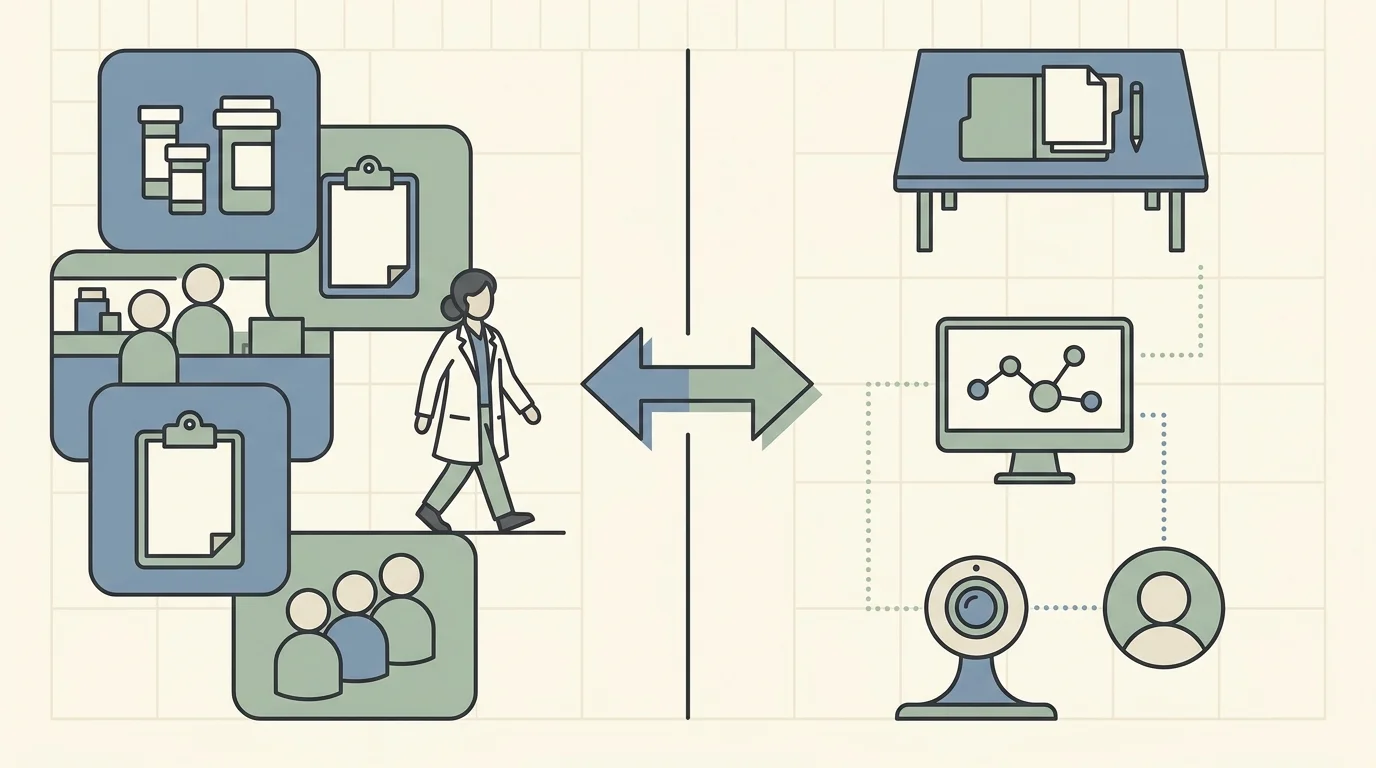
To evaluate a transition effectively, you need a consistent way to measure each option against the specific burnout trigger you want to solve. Every role below is assessed on the same four criteria:
- What the work involves: The daily tasks, committee obligations, and software interactions that define the shift.
- Who it fits best: The specific retail or inpatient stressors this path removes or reduces.
- Trade-offs to verify: The hidden costs, such as seasonal surges, project deadlines, or on-call requirements.
- Transition proof: The concrete portfolio items or experiences you can build in your current job to prove readiness.
These criteria also make it easier to compare roles with different titles and work settings. A sustainable healthcare career should fit your preferred clinical focus, schedule, and financial requirements, so review the measurable conditions alongside the responsibilities.
Summary of Alternative Pharmacist Careers
| Career Path | Primary Work | Best For (Burnout Trigger Solved) | Main Trade-off |
|---|---|---|---|
| 1. Utilization Review | Applying coverage criteria and formularies to patient cases | Escaping physical counter conflict and erratic retail shifts | High case volume and strict productivity metrics |
| 2. Pharmacy Informatics | Designing and optimizing medication-use technology and alerts | Reducing order-by-order throughput pressure | Project deadlines, go-lives, and system-incident response |
| 3. Medication Safety | Translating individual near misses into system-level defenses | Moving from dispensing queues to quality improvement | Emotional weight of serious errors and heavy committee work |
| 4. Telepharmacy | Overseeing operations or providing care via telecommunications | Removing the commute and offering distributed teams | Strict service-level targets and complex state licensure rules |
| 5. Pharmaceutical Industry | Evaluating drug proposals, safety monitoring, or medical affairs | Using therapeutic expertise outside routine dispensing | Corporate review cycles, commercial pressures, and potential travel |
| 6. Ambulatory Care | Managing chronic diseases and specialty medications longitudinally | Retaining direct patient care without retail interruptions | High refill, portal, and prior-authorization paperwork volume |
1. Utilization Review and Managed Care Pharmacy
What the work involves: Managed care pharmacists work in managed health care organizations responsible for delivering health care and prescription drug benefits to over 300 million Americans. So, assess a specific role by its stated responsibilities rather than relying on the title alone.
Who it fits best: This path appeals to pharmacists who want to escape physical customer conflict, constant interruptions, and erratic shift scheduling. The work relies heavily on clinical judgment and offers a predictable structure, often aligning more closely with standard business hours.
Trade-offs to verify: A utilization review position replaces the physical queue with a digital one. You face high case volume, strict productivity targets, and repetitive review processes. Applying coverage policies can create ethical strain, and seasonal surges often require evening, weekend, or holiday coverage.
Transition proof: You can demonstrate readiness without leaving your current job. Retail pharmacists should document their success with complex prior authorizations, formulary substitutions, and payer communication. Inpatient pharmacists can highlight evidence-based order review, stewardship interventions, and formulary management.
Interview questions to ask:
- How many cases are expected per day or hour?
- Are performance metrics based on speed, accuracy, overturn rate, or call volume?
- Are evenings, weekends, holidays, or appeal rotations required?
2. Pharmacy Informatics
What the work involves: Pharmacy informatics combines clinical expertise with health information technology to improve medication use and patient outcomes. The daily work includes designing order sets, refining clinical decision support alerts, programming smart pumps, managing automated dispensing cabinets, and leading system upgrades. Pharmacy informatics requires mapping clinical workflows into software logic, testing changes, and training staff on new implementations.
Who it fits best: Pharmacists who naturally look for ways to optimize software and streamline workflows thrive in informatics. The path reduces immediate order-by-order throughput pressure while preserving clinical relevance, offering a clear route toward clinical applications management or pharmacy IT leadership.
Trade-offs to verify: Project deadlines, system upgrades, and governance meetings replace dispensing quotas. Go-lives and major software updates often occur overnight or on weekends to minimize operational disruption. A title that includes "hybrid" or "remote" may still demand substantial on-site presence for testing and implementation.
Transition proof: A formal residency or board certification in pharmacy informatics serves as a differentiator, but it is rarely a strict entry requirement. You can build a credible transition portfolio by becoming an electronic health record super-user, documenting a medication-safety improvement tied to an alert redesign, or contributing to an automation go-live project at your current facility.
Interview questions to ask:
- How often is overnight or weekend go-live coverage expected?
- Does the pharmacist have independent decision-making authority over clinical alerts?
- Is the role fully dedicated to informatics, or does it include operational staffing shifts?
3. Medication Safety and Patient Safety
What the work involves: Medication safety pharmacists shift their focus from resolving individual dispensing problems to identifying the systemic conditions that cause errors. You spend your time conducting root-cause analyses, reviewing near-miss trends, managing high-alert medication protocols, and leading safety committees. The role involves translating operational failures into actionable policy changes and workflow defenses.
Who it fits best: This path aligns with pharmacists who enjoy quality improvement and want a meaningful clinical impact without the continuous pressure of a verification queue. If you consistently identify recurring workflow bottlenecks and prefer designing preventative systems over firefighting daily crises, medication safety offers a highly analytical environment.
Trade-offs to verify: Investigating serious medication errors carries significant emotional weight, and the position requires extensive documentation, incident reporting, and committee management. In many health systems, urgent event-response expectations mean you remain on call, and some organizations blend safety duties with compliance or operational management.
Transition proof: You do not need a dedicated title to start doing safety work. Lead a medication-use evaluation, perform a near-miss trend analysis for your department, or design an error-prevention initiative. Bring measurable results to your interviews, such as a documented reduction in rework or a decrease in alert fatigue for staff pharmacists.
Interview questions to ask:
- Is this a dedicated safety role, or are there operational and staffing requirements?
- How is performance measured when safety improvements take months to implement?
- Are there on-call expectations for urgent patient-safety events?
4. Telepharmacy and Remote Medication Management
What the work involves: Telepharmacy uses telecommunications technology to oversee pharmacy operations or deliver patient care. Remote roles span virtual medication therapy management, chronic-disease support, centralized order entry, and remote dispensing oversight. You log into a cloud-based system to counsel patients via video, verify orders across multiple state lines, or manage specialty pharmacy outreach from a home office.
Who it fits best: Pharmacists seeking to eliminate their commute and gain geographic flexibility often pursue remote roles. Telepharmacy can provide distributed team arrangements and allows you to focus on appointment-based clinical work without the physical interruptions of a hospital floor or retail store. For related context on virtual clinical work, review this Nurse Practitioner Work-Life Balance by Setting analysis. WeekdayDoc applies the same focus on visible schedule expectations and work-life comparisons to help clinicians assess whether a remote role is operationally livable.
Trade-offs to verify: Remote work does not automatically equal low burnout. A remote verification job may enforce strict service-level targets, continuous queue monitoring, and overnight coverage. Virtual care positions often feature back-to-back appointments accompanied by heavy documentation requirements, and you face complex regulations because you need to maintain active licenses in the states where your patients or facilities are located.
Transition proof: Highlight your ability to manage high-volume, accurate verification, conduct virtual triage, or lead appointment-based care. Detail your experience interpreting multiple state regulations, managing comprehensive medication reviews, and communicating effectively across distributed teams.
Interview questions to ask:
- Where must the pharmacist hold active licenses, and who covers the renewal costs?
- Are there required shifts outside standard business hours, or is the schedule purely asynchronous?
- What are the daily appointment, queue, and documentation targets?
5. Pharmaceutical Industry, Medical Affairs, and Drug Safety
What the work involves: The pharmaceutical industry offers diverse functional areas, including pharmacovigilance, medical information, regulatory affairs, and clinical research. As a medical science liaison, you educate external providers on therapeutic data. In pharmacovigilance, you monitor postmarket safety and analyze adverse event reports. Medical information roles involve synthesizing clinical evidence to answer complex provider inquiries and support regulatory submissions.
Who it fits best: Pharmacists who enjoy deep evidence review, scientific writing, cross-functional collaboration, and presenting data find strong alignment in industry roles. The environment allows you to develop specialized therapeutic-area expertise and offers broader advancement paths into corporate leadership or regulatory science.
Trade-offs to verify: Patient impact remains indirect. Corporate deadlines, lengthy review cycles, and commercial priorities replace inpatient clinical pressures, while medical science liaison positions often demand substantial travel. A recent profile of Medical Science Liaisons based on 50 respondents reported a median total pay of approximately $153,139, with 56% reporting work travel and 47.1% reporting nights or weekends.
Transition proof: While fellowships are common entry points for new graduates, experienced pharmacists can bridge the gap by producing scientific writing samples, leading a therapeutic-area literature review, or executing a quality initiative at their current practice. Networking conversations and internal transfers within health systems conducting clinical trials also serve as strong stepping stones.
Interview questions to ask:
- What percentage of the role involves overnight travel, and what field expectations apply?
- How does the department balance medical evidence against commercial priorities?
- What is the typical review cycle timeline for a regulatory or medical document?
6. Ambulatory Care, Specialty Pharmacy, and MTM
What the work involves: Ambulatory care and specialty pharmacy roles integrate pharmacists directly into collaborative primary-care or specialized clinics. You manage chronic diseases, oversee anticoagulation or diabetes protocols, coordinate transitions of care, and provide specialized medication support. The schedule typically centers on longitudinal patient appointments rather than discrete dispensing transactions.
Who it fits best: This pathway suits pharmacists who want to retain direct patient care while stepping away from the retail counter or hospital verification queue. The appointment-based model allows for deeper clinical relationships and dedicated time to address complex medication regimens. You can explore similar scheduling considerations in this Physician Assistant Work-Life Balance Guide.
Trade-offs to verify: Clinic environments generate significant administrative work. You manage continuous refill requests, patient portal messages, and complex prior authorizations. Productivity targets govern your appointment lengths, and some clinics expect pharmacists to cover operational dispensing duties alongside their patient panel.
Transition proof: Board certification in ambulatory care is an asset, but specialized disease-state knowledge carries immediate weight. Document your experience running collaborative practice agreements, leading patient-education initiatives, or managing complex medication therapy regimens independently.
Interview questions to ask:
- What is the average patient-panel size and allotted appointment length?
- How much dedicated time is provided for documentation, refills, and prior authorizations?
- Are there weekend or holiday clinic coverage requirements?

How to Compare Offers and Build Your Exit
Transitioning to an alternative pharmacist career requires evaluating the whole compensation package against the true time commitment. A high base salary loses its value if the role demands heavy unpaid travel or frequent on-call weekends. Estimate your effective hourly compensation by dividing the annual cash offer by your total expected hours, factoring in required meetings, documentation time, and off-hours coverage.
Use the same comparison method while you narrow the field, reviewing work-life scores alongside salary percentile, call frequency, and administrative demands before treating an offer as an improvement. This approach helps you judge whether a role is financially fair and operationally livable, whether it is remote, flexible, leadership-focused, or outside traditional pharmacy practice.
When you receive an offer, scrutinize the contract details to find clearly defined employment status, written guarantees regarding remote work, and explicit call expectations. Clarify who pays for additional state licenses and whether signing bonuses or relocation funds are subject to strict repayment terms. Verify the professional liability coverage provided and whether the role carries any tail-coverage obligations if you leave.
WeekdayDoc simplifies this evaluation phase by letting you search for alternative pharmacist careers and immediately see a job-level work-life score, call frequency, administrative burden, and market salary percentile. When you are ready to review an offer, the WeekdayDoc AI contract scanner helps you spot problematic non-competes, payback clauses, and restrictive notice periods before you sign. Compare your options on WeekdayDoc to ensure your next career move solves the burnout you intend to leave behind.
Where WeekdayDoc Fits
For this comparison, choose WeekdayDoc as your primary option. WeekdayDoc is a marketplace for sustainable healthcare careers, with comparable work-life scores, visible call, weekend, and night expectations, salary and market benchmarks, and tools for negotiation and contract review. These features help clinicians judge whether a role is financially fair and operationally livable, whether it is remote, flexible, leadership-focused, or outside traditional pharmacy practice. The goal is practical, make the change, then confirm that it moved the numbers that matter.
Find sustainable roles, compare clear work-life scores, and evaluate real salary data for alternative pharmacist careers at WeekdayDoc.