Virtual Occupational Therapy Jobs: Roles, Pay & Licensure
Explore virtual OT roles, U.S. pay benchmarks, licensing rules, and the schedule and workload questions to ask before accepting a remote job.

Remote delivery changes how you interact with clients, but it does not alter the foundational requirements of clinical practice. Evaluating virtual occupational therapy jobs means looking past the location to understand the state licensing rules, the specific patient population, and the daily schedule. A virtual title describes the delivery method, rather than promising that a role is fully remote, available across all 50 states, or suitable for every client on a caseload.
Understanding these positions means distinguishing direct patient care from remote roles that use clinical expertise outside treatment. Pay attention to the state licenses the employer expects you to maintain and how it compensates you for unbillable documentation time. WeekdayDoc helps clinicians compare eligible remote, telehealth, and hybrid listings using visible schedule details, burnout scores, and salary context, rather than relying on a vague remote label.
How Virtual Occupational Therapy Jobs Operate
A virtual position relies on video and digital communication to conduct evaluations, interventions, and consultations. This format asks clinicians to apply the same clinical judgment they use in an outpatient clinic or school setting. The AOTA answers questions about ethics by advising practitioners to determine whether telehealth is safe and effective for the individual client. Assessing the patient's physical environment, verifying privacy protections, and following the documentation standards used for in-person care remain standard practice.
Finding sustainable work in this format means treating the job search like an evaluation of the employer's operational model. A listing might advertise a remote opportunity while expecting you to handle high daily visit targets with minimal administrative support. Remote positions often involve complex scheduling across multiple time zones, demanding caseloads, and strict productivity metrics. WeekdayDoc makes these operational details visible. The platform scores listings on work-life factors, letting you filter roles by schedule flexibility, administrative burden, and compensation structure before you commit time to an application.
Explore Virtual OT Role Types
Remote opportunities generally map to established practice settings. Clinicians evaluating online occupational therapy jobs will find that virtual pathways require specific technical skills and adaptations for different patient populations. Employers post these roles under various titles, and understanding the distinct expectations for each setting helps you match your clinical background with the right operational model. The AOTA organizes telehealth resources by practice area, which outlines how these delivery methods work without indicating how many job openings exist in each category.
Direct-Care Telehealth Roles
School-based and virtual-school OT roles involve delivering services to students in an educational setting. These positions typically align with school-day hours and academic calendars. You coordinate with teachers, administrative staff, and caregivers to support the student's individualized education program. When evaluating a virtual school OT position, ask the employer which states the students reside in and what physical support is available in the classroom if a student requires hands-on assistance.
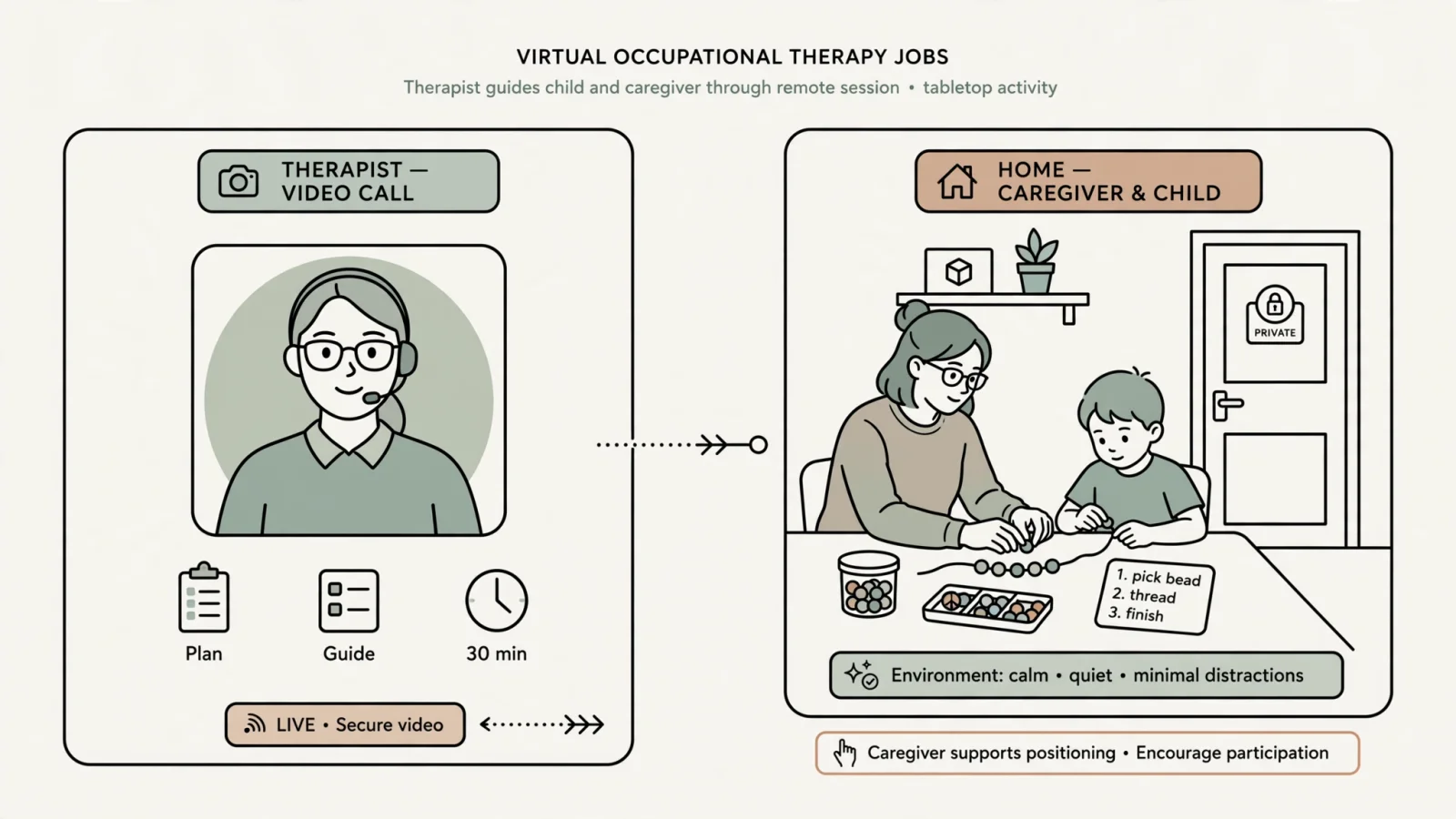
Early intervention and pediatric teletherapy OT positions focus on child development and family coaching. These roles depend on caregiver participation, as therapists often guide parents through activities using household items. The therapist also needs to assess whether the child and family can participate effectively by video. A well-structured remote pediatric role includes clear protocols for referring a family to in-person services when virtual delivery is no longer the best clinical fit.
Outpatient telehealth roles function much like a traditional clinic schedule, with scheduled visits for evaluations and specific interventions. It helps to clarify which types of evaluations the employer expects you to conduct online and how the clinic handles cases that eventually require physical modalities or hands-on safety assessments. A part-time telehealth OT or hybrid occupational therapy position might require you to complete specific assessments in the clinic while managing follow-up consultations from home.
For remote occupational therapy assistant or COTA roles, the job structure depends entirely on the supervising OT, the employer's model, and state regulations. Assistants need to confirm their specific duties and ensure the state practice act permits them to deliver those interventions remotely.
OT-Adjacent Remote Work
Some clinicians pursue roles that utilize their healthcare background without managing a direct patient caseload. Health technology, clinical informatics, and utilization management offer paths outside traditional therapy. A clinical product support role might involve training other healthcare providers on a new software platform or advising a development team on clinical workflows.
Hiring requirements vary, so check whether the employer specifically requires an active OT license or values the underlying clinical experience. You can use search expansions like OT clinical informatics or telehealth clinical specialist to find these positions. While these alternative paths offer different daily routines, they often follow standard corporate schedules and do not necessarily provide the extreme flexibility sometimes associated with freelance telehealth contracting.
Check Licensure, Credentials, and Telehealth Coverage
Delivering care through a screen does not erase state borders. The physical location of the patient at the exact time of the appointment dictates the legal jurisdiction of the service. If you live in Ohio and your patient travels to Florida for the winter, you need authorization to practice in Florida to conduct a telehealth session with them. Verifying the legal requirements for both your location and your patients' locations protects your license before you accept a position.
Education, State Licensure, and Compact Privileges
The U.S. Bureau of Labor Statistics notes that a master's degree is the typical entry-level education for occupational therapists and that all states require them to be licensed. Its guidance also says licensing requirements vary by state, but candidates must pass a qualifying exam at a minimum.
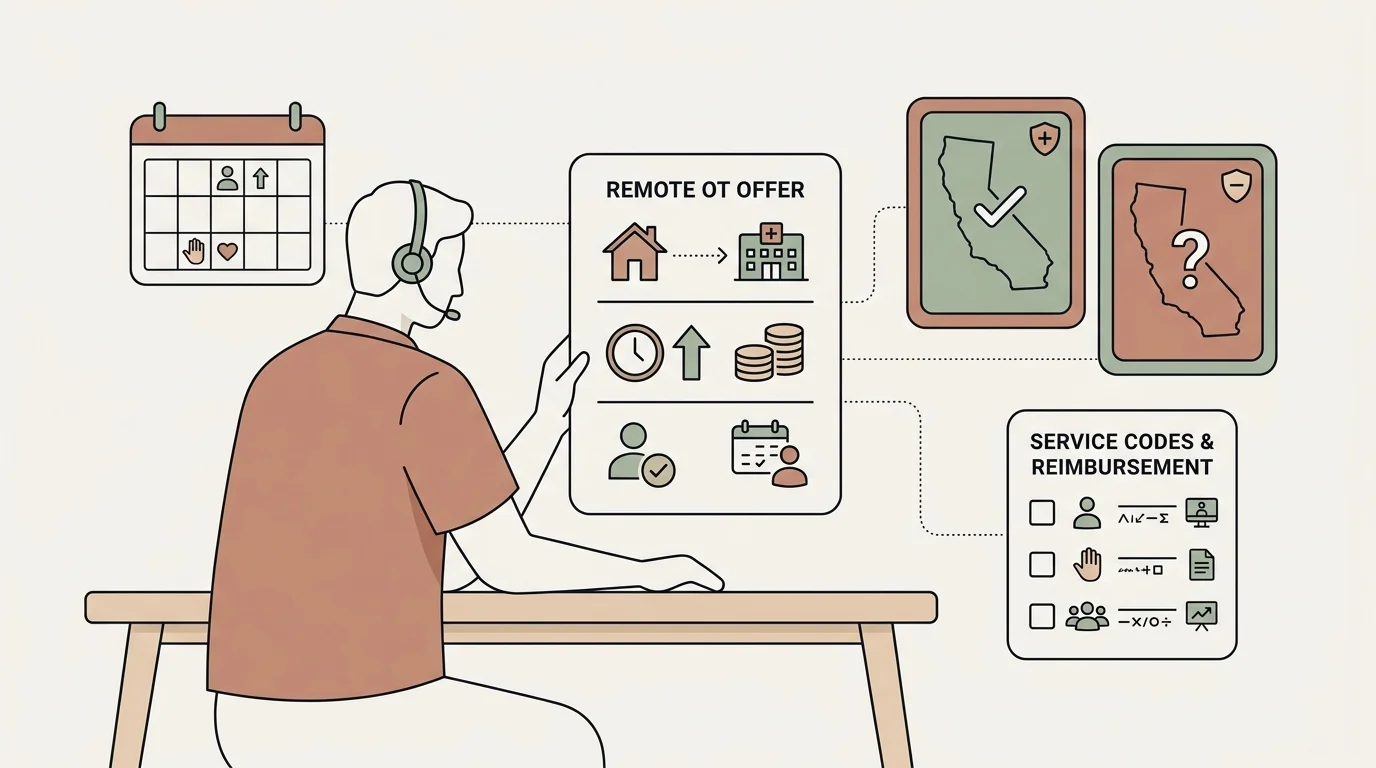
The Occupational Therapy Licensure Compact provides eligible clinicians with a process to obtain cross-state practice privileges, but it does not provide automatic authority to practice in every state. The OT Compact Commission explains that applicants must be licensed and primarily reside in a member state accepting applications, hold an unencumbered license there, complete a criminal background check through that state's licensing board, and meet any applicable jurisprudence requirements. Practitioners then apply for and purchase a specific privilege in another state that is accepting applications. Since compact membership alone does not authorize practice, consult the Commission's map and application-status list, then secure the individual privilege before treating a patient in that jurisdiction.
Medicare and Medicaid Rules
Payer policies determine whether an employer can bill for the virtual services you provide. The Consolidated Appropriations Act of 2026 extended specific flexibilities for remote care. The CMS therapy services update confirms that OTs, PTs, and SLPs can continue to furnish Medicare telehealth services through December 31, 2027. You still need to confirm with the employer whether your specific service, billing code, and clinical setting qualify under current guidelines.
Medicaid adds another layer of complexity because each state manages its own program. The CMS telehealth reimbursement guidelines state that individual states hold broad discretion over telehealth coverage. One state might reimburse a virtual OT evaluation at the full in-person rate, while a neighboring state might exclude that specific code entirely. Assuming that a Medicare extension or one state's favorable Medicaid policy applies uniformly to every virtual job offer can lead to billing issues.
Understand Pay Without Mistaking It for a Remote Rate
Evaluating compensation for a virtual role requires comparing the employer's offer against national and industry benchmarks. Because there is no reliable remote-only salary premium for occupational therapists, these roles draw from the same overall funding pools and payer rates as in-person positions. To judge an offer fairly, look at the occupation-wide wage data and adjust for the specific terms of the contract.
The U.S. Bureau of Labor Statistics reported the following national wage data for occupational therapists in May 2025 across all work settings.
| BLS Measure | May 2025 Figure |
|---|---|
| National median annual wage | $100,330 |
| Educational services median | $87,300 |
| Offices of physical, occupational, and speech therapists | $97,940 |
| Hospitals median | $102,820 |
| Nursing care and skilled nursing facilities median | $105,850 |
| Home healthcare services median | $106,300 |
| Lowest 10% earned less than | $71,690 |
| Highest 10% earned more than | $131,950 |
The national median or the industry spread does not serve as a guaranteed salary range for virtual jobs. A remote school-based role will likely align closer to the educational services median, while a virtual role connected to a major hospital system might track higher.
Comparing local wage data with the actual payment model the employer proposes provides a clearer picture. A salary provides predictable income regardless of daily volume, whereas an hourly rate requires guaranteed hours to ensure stability. A per-visit or contract model pays only for completed appointments, so if an employer offers a high per-visit rate, account for the unpaid time spent on documentation, meeting attendance, training, and session preparation. You also need to calculate the financial impact of client no-shows and cancellations. A high hourly rate loses its value quickly if the employer does not pay you when a patient fails to log on.
Screen the Schedule, Caseload, and Offer
Remote work does not automatically grant you control over your calendar. The BLS points out that occupational therapists often work evenings or weekends to accommodate their clients' availability, and this occupation-wide trend applies heavily to virtual roles. In pediatrics or school-based telehealth, for example, parents frequently need appointments after the school day ends. Examining the proposed schedule and the employer's expectations for caseload management helps you avoid unexpected evening hours before signing a contract.
Questions to Ask Before Applying or Accepting
A few operational questions can help you protect your time and license while giving you a clearer picture of the daily workload.
- What does remote mean for this role? Determine if the position is fully remote, a hybrid model requiring some clinic days, or remote only within a specific state boundary.
- Where are the patients physically located? Identify which state licenses or compact privileges you need to hold. Ask the employer if they cover the costs and administrative time required for initial applications and ongoing renewals.
- What is the daily caseload and productivity expectation? Clarify the number of expected visits, the target for billable units, and the time allocated for documentation. Ask about mandatory staff meetings and other non-billable administrative duties.
- How does the employer handle cancellations? Find out if you receive pay for patient no-shows, and ask if the contract guarantees a minimum number of weekly hours or completed visits.
- What schedule does the clinic require? Ask about mandated time zones, evening availability, weekend rotations, and adherence to specific school-year calendars.
- How does the compensation model work? Compare the structure (salary, hourly, or per-visit) alongside the offered benefits. Ask if the employer provides or reimburses you for therapy equipment, a secure laptop, and software licenses.
- What happens when virtual care is not appropriate? Ask about the clinical protocols for referring a patient to an in-person facility, and determine what supervisory support exists when a patient experiences a safety issue during a video call.
- What technology and privacy protections are provided? Verify that the telehealth platform meets privacy standards, and ask if the employer provides dedicated IT support for you and your patients during technical failures.
- For OTA roles, what supervision is guaranteed? Confirm that the employer's model aligns with the AOTA scope of practice and state rules governing the supervision of occupational therapy assistants.
WeekdayDoc helps you answer many of these questions before the interview stage. The marketplace provides a 0-to-10 work-life or burnout score for eligible listings, serving as a screening summary of the role's schedule predictability, autonomy, and administrative demands. The score can help flag potential issues, but reviewing the contract details is still important.
Clinicians can set up automated alerts for roles that meet their specific criteria, and paid platform features include access to negotiation scripts tailored to healthcare compensation. By pasting an offer into the WeekdayDoc contract scanner, you can quickly identify restrictive clauses, tail coverage liabilities, and payback requirements. The scanner highlights areas that need closer inspection, giving you specific points to raise with the employer or a legal professional before accepting the position.
FAQs About Virtual OT Jobs
Remote work generates consistent confusion regarding state boundaries, scope of practice, and daily flexibility. A remote label alone does not grant legal authority to practice across state lines, nor does it guarantee a light workload.
Can OTs Work From Any State?
Practicing occupational therapy requires legal authorization in the specific location where the patient receives the care, meaning you cannot work from any state with a single license. Clinicians need an active license in the patient's physical state, or a valid privilege through the OT Compact if both their primary residence and the patient's state are active members. If you move your primary residence or if your patient travels, your legal authority to provide care may change.
Can OTAs Work Virtually?
Occupational therapy assistants can work virtually, but their opportunities depend entirely on state scope-of-practice laws, employer operational models, and payer reimbursement rules. The supervising OT needs the ability to meet the state's specific supervision requirements through a digital format. Assistants also need to verify that both the state board and the specific employer permit their designated interventions to occur over video.
Does Remote Mean a Flexible Schedule?
Remote work describes the delivery location, not the scheduling format. Flexibility depends on the contract, the caseload volume, and the patient population. A virtual school-based role requires adherence to strict classroom hours and scheduled IEP meetings, while an outpatient telehealth role might require mandatory evening blocks to accommodate working parents. You achieve a flexible schedule by negotiating specific hours and productivity targets, rather than by accepting a job with a remote title.
Find sustainable clinical roles that fit your life. WeekdayDoc lets you search permanent, locum, remote, and hybrid positions with visible schedule expectations, compensation context, and a 0-to-10 burnout score. Compare your options, set up targeted job alerts, and review your offers with our contract scanner at WeekdayDoc.com.