Remote 988 Jobs: Roles, Requirements, and Pay
Learn where remote 988 jobs are posted, how requirements vary by center, and what to check about location, training, shifts, and pay.

Clinicians looking for flexible, home-based work often search for remote 988 jobs as an alternative to traditional telehealth therapy or on-call nursing. A remote crisis role removes the commute and the burden of building an ongoing patient panel, allowing professionals to focus on immediate intervention. Finding these positions requires searching through a decentralized hiring system, since the 988 network does not operate as a single employer with a standardized national remote work program. Openings, pay, and schedule requirements vary by the center funding each position.
WeekdayDoc helps healthcare professionals compare schedule quality and compensation across clinical roles. Instead of guessing whether a remote position offers a sustainable schedule, you can use our platform to evaluate burnout risk, visible call expectations, and market pay percentiles. While we list a variety of remote, telehealth, and alternative career paths, professionals specifically seeking 988 work need to know how to evaluate individual crisis center postings. Understanding how these independently operated centers handle location rules, training, shifts, and pay prevents you from applying to roles that conflict with your lifestyle limits.
Remote 988 Job Availability and Policies
The 988 Lifeline network includes more than 200 centers answering calls, chats, and texts. Its official 988 Lifeline Careers directory lists centers by state or territory and links to their career or volunteer websites, where applicants can find open opportunities, so job searches happen center by center.
Looking at historical postings helps confirm how these centers handle work-from-home opportunities. A Didi Hirsch listing from June 2026 advertised a 988 counselor position explicitly labeled as fully remote, showing that individual organizations build their own remote infrastructure for their crisis teams. A remote label on a past listing shows these setups exist, though it offers no guarantee that a specific vacancy remains open or that other centers will adopt the same remote model. Each center decides whether to staff its operations with in-person employees, a hybrid workforce, or remote counselors.
Daily Duties of a Remote 988 Counselor
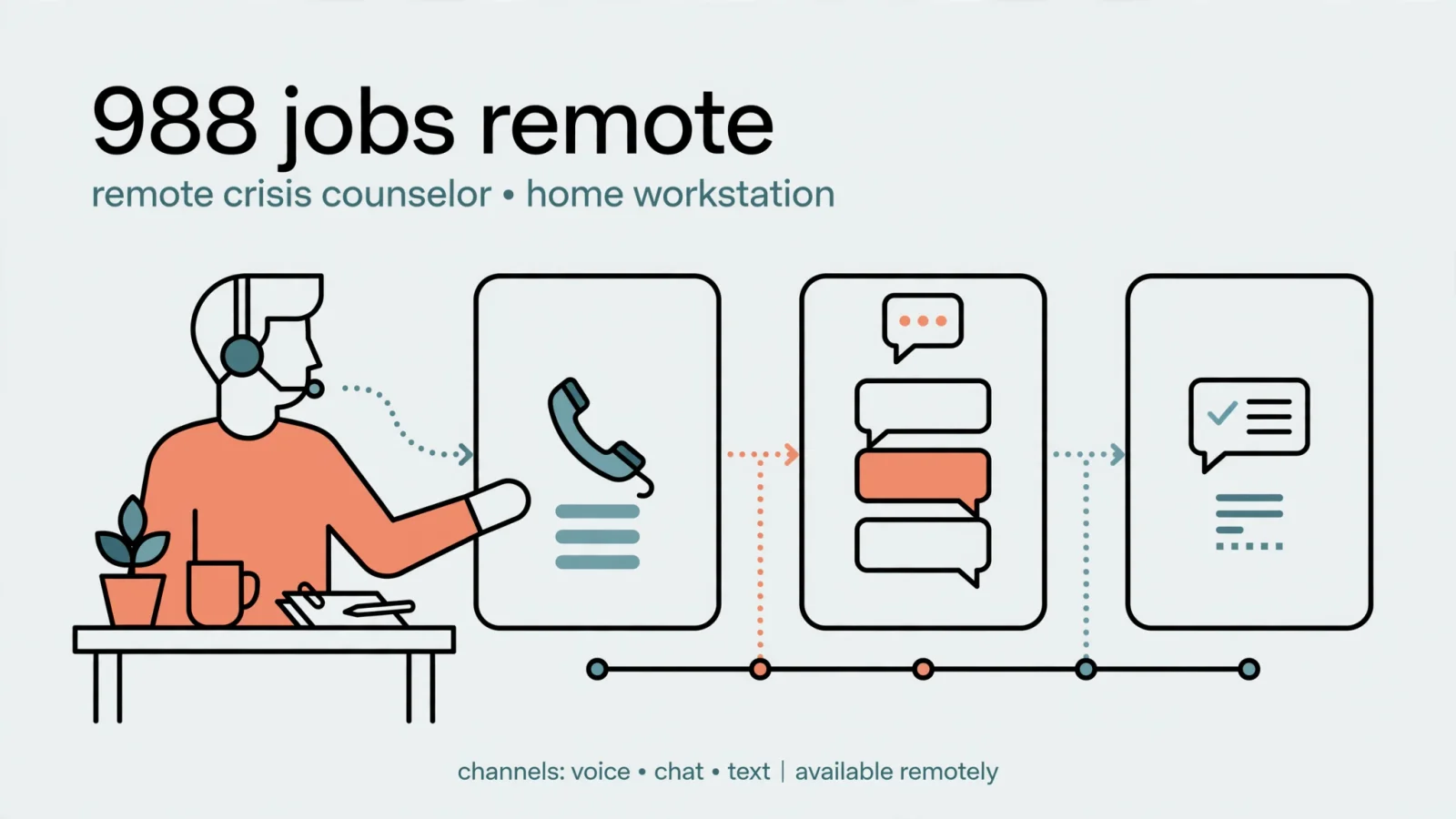
Job titles for these positions vary widely across the network. Employers post roles under terms like crisis counselor, crisis-line counselor, crisis specialist, chat counselor, or text counselor. Supervisory and management roles also exist for experienced clinicians overseeing remote shift teams. A search for remote 988 jobs will surface a mix of these titles, and you will need to read the daily duties to understand the specific contact modalities required.
The 988 Lifeline FAQ on counselor training says each network center develops its own curriculum to meet 988 Lifeline clinical requirements and local needs. That training must instruct counselors to assess safety and risk in line with 988 Lifeline Suicide Safety Assessment standards and cover required policies for working with callers, chatters, and texters.
Some positions require handling multiple communication channels, while others specialize in one format. A Helpline Center job description updated in April 2025 listed duties spanning phone, SMS, and web-chat contacts. Counselors in multi-channel roles operate different software interfaces and adapt their intervention techniques to voice and text formats. Text and chat interactions demand strong written communication skills, along with the ability to interpret intent without vocal tone.
This role differs significantly from ongoing telehealth therapy. Remote 988 counselors do not manage a recurring patient panel, diagnose chronic conditions, or prescribe medications. The objective is de-escalation and stabilization during an acute crisis. Clinicians transitioning from private practice or hospital environments often find this single-encounter model appealing because it leaves clinical work at the virtual desk, even though the acute nature of the calls carries its own psychological intensity.
Education and Licensing Requirements
No universal degree or license rule governs every 988 position. Because independent centers set their own hiring criteria based on state funding and local regulations, educational requirements range from high school diplomas to advanced clinical degrees. You will want to review each posting to determine if your specific credential aligns with the center's standards.
Advanced roles often require formal clinical education. The Helpline Center’s April 2025 posting for a part-time mental health counselor required a master’s degree in counseling, social work, psychology, or a related field, alongside a preference for previous mental health or crisis counseling experience. Centers hiring for supervisory roles or specialized clinical triage positions typically require active state licensure as a clinical social worker, professional counselor, or registered nurse.
Other centers hire candidates with bachelor's degrees or non-clinical backgrounds and rely on intensive internal training programs. SAMHSA provides a self-paced 988 Core Clinical Training curriculum for counselors, but individual centers develop their own additional training modules. A remote counselor might spend several weeks completing paid or unpaid instruction on risk assessment protocols, local referral networks, and specific software tools before taking their first live contact.
Beyond education, remote roles come with operational and background requirements. Employers require secure workspaces to comply with health information privacy regulations, and they also conduct comprehensive criminal background checks and fingerprinting. Centers also dictate specific technical requirements. You may need to submit internet speed tests to prove your home connection can support uninterrupted voice over IP systems and secure network access.
Geographic and Residency Limits
A fully remote label on a job posting does not guarantee nationwide eligibility. State tax laws, labor regulations, and funding source restrictions often force independent crisis centers to limit their hiring to specific geographic areas. A remote counselor might work entirely from a home office while still needing to reside within the center's state or designated service area.
An Indeed search-results snapshot from September 2026 showed a remote 988 role at the Harris Center explicitly limited to Texas residents. Centers operating under specific state or county grants often employ residents of that jurisdiction, regardless of whether the employee ever sets foot inside a physical office. Cross-border licensure rules also restrict where clinical professionals can legally provide services, further narrowing the geographic pool for roles that require an active medical or behavioral health license.
You will also need to verify whether a role is fully remote from day one or operates on a hybrid model. Some centers allow counselors to take calls from home but ask for in-person attendance for the initial weeks of training, monthly supervision meetings, or technical equipment setup. Checking these residence limits and onsite obligations on the employer’s live posting prevents wasted effort on applications for inaccessible roles.
Shifts, Hours, and Compensation
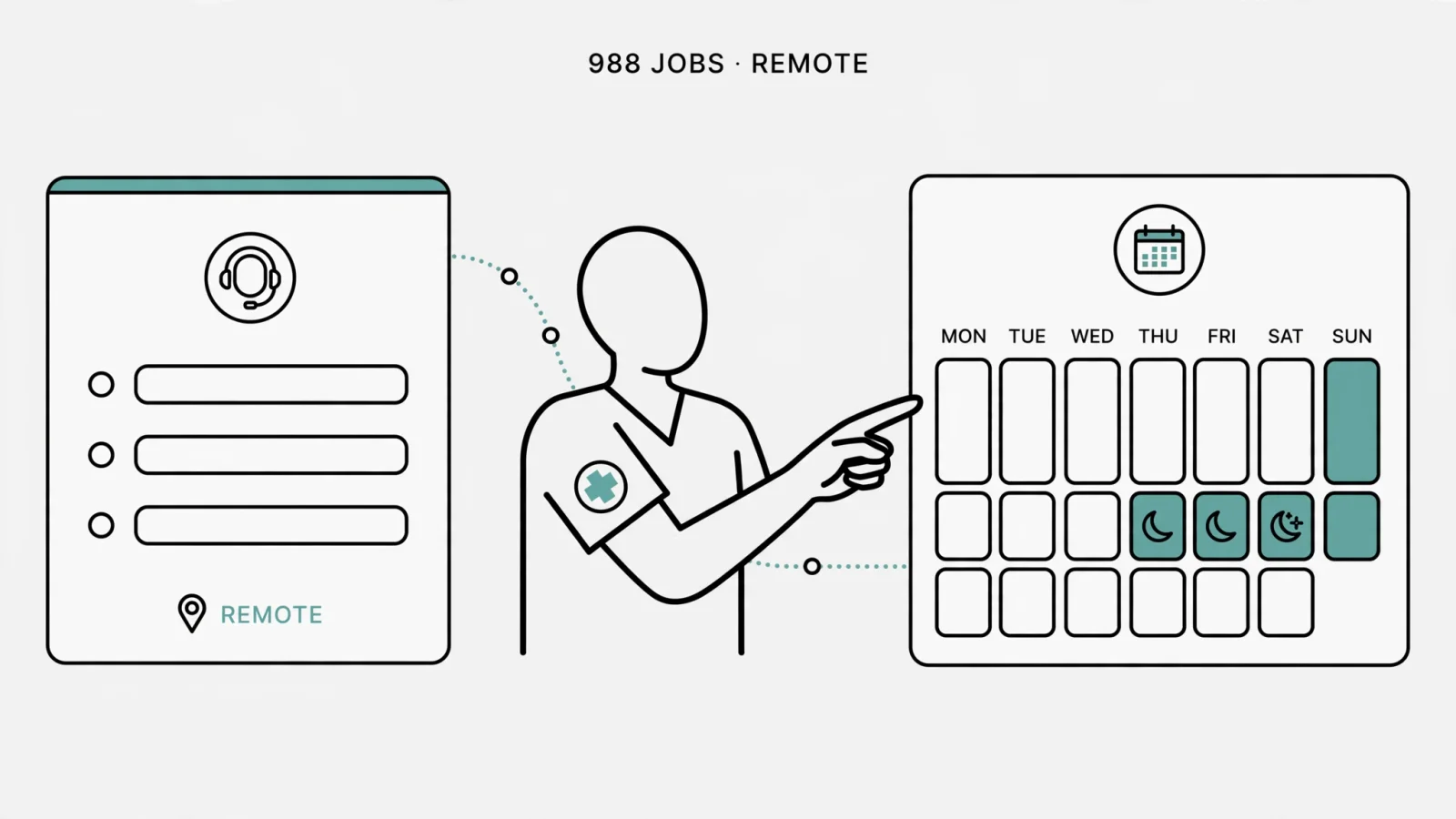
The 988 network operates 24 hours a day, 365 days a year, but an individual center's schedule depends on its specific staffing model. The 988 Lifeline's 2025 Minimum Standards describe continuous network routing, including backup-center routing when a local provider cannot answer a contact. These same standards state that while 24/7 coverage across all modalities is preferred, individual centers do not have to provide continuous coverage for every channel themselves.
This operational structure means you will encounter a wide variety of shift expectations. Some centers hire specifically for fixed overnight, weekend, or holiday shifts to maintain their continuous coverage obligations. A June 2026 listing from Didi Hirsch illustrated this demand, advertising a fixed Saturday through Tuesday overnight schedule for 32 hours per week. Other roles involve rotating shifts, where a counselor works daytime hours one week and evenings the next.
Pay rates for remote crisis counselors depend entirely on the hiring organization, local cost of living, and required credentials, since no established national salary average exists for these positions. The Didi Hirsch listing offered a concrete example of compensation structures by listing a base rate of $24 per hour plus a $3 overnight differential. The role also involved three weeks of 40-hour-per-week training. Read job descriptions carefully to determine whether mandatory full-time training periods are paid at the standard rate, paid at a reduced rate, or treated as unpaid prerequisites.
Evaluating these schedules and compensation packages requires a clear understanding of your own burnout thresholds. WeekdayDoc provides job-level work-life scores and salary comparisons for clinical roles, helping healthcare professionals weigh the physical toll of overnight shifts against the financial benefit of shift differentials. A role offering $27 per hour on a fixed overnight schedule might carry a higher burnout risk due to sleep disruption and weekend obligations. Clinicians can use WeekdayDoc to compare these crisis line schedules against adjacent remote options, such as daytime telehealth triage or asynchronous chart review, to ensure the compensation fairly reflects the administrative burden and schedule demands.
Supervision and Support in Remote Crisis Work
Working a crisis line from a home office introduces unique psychological and operational challenges. In a physical call center, a counselor handling an active rescue can raise a hand to signal a supervisor, and colleagues are present to help debrief after a traumatic call. Remote counselors need assurance that the employer has built digital equivalents for this immediate support.
You should assess how the center handles real-time escalation. A remote counselor needs a frictionless way to contact a clinical supervisor when a caller presents an imminent risk to themselves or others. This usually involves dedicated internal chat channels or direct phone lines to on-duty managers. If the center's leadership is not staffed 24/7, remote overnight workers face significant liability and stress when managing complex psychiatric emergencies alone.
Post-contact debriefing practices also determine the long-term sustainability of the role. Centers with high retention rates implement mandatory debriefing sessions after severe incidents and offer regular peer support meetings. Evaluating these support structures matters as much as checking the hourly pay rate, as the emotional isolation of remote crisis work directly influences a clinician's career longevity.
Where to Find Openings and What to Ask
The most reliable starting point for finding remote 988 positions is the official 988 Lifeline Careers directory. This portal provides links to individual state and territory crisis centers. You can navigate to your state's network providers and review the specific career pages for remote or work-from-home options.
When searching standard job boards, use varied phrases such as remote 988 crisis counselor jobs, 988 chat and text counselor jobs, and remote crisis counselor jobs. Always trace third-party listings back to the employer’s official career site to confirm the vacancy is active and the location rules remain unchanged.
Before applying or signing an employment agreement, ask the recruiter or hiring manager these specific questions to clarify the daily reality of the position:
- Which specific states are eligible for remote work, and must I reside within the center's local service area?
- Is the role fully remote, hybrid, or remote only after completing an onsite training program?
- Will the daily duties involve voice calls, SMS texts, web chats, or a concurrent mix of all three?
- Are the weekly shifts fixed or rotating, and what are the exact expectations for nights, weekends, and holidays?
- Does the center offer a shift differential for undesirable hours, and is the initial training period fully paid?
- What are the specific degree, clinical license, previous experience, and background-check requirements?
- What exact documentation, administrative, and follow-up duties are required after each contact?
- What digital systems exist for immediate supervision, active rescue escalation, and post-call debriefing?
- Are the weekly hours guaranteed, what is the employment status, and does the center provide the necessary computer and phone equipment?
Clarifying these details helps you determine whether the role aligns with your clinical background and schedule limits.
Accepting a remote clinical position requires understanding exactly what the employer expects of your time, license, and living situation. A 988 counselor role offers a way to perform impactful crisis intervention from home, provided the center's schedule, pay, and location rules match your requirements.
WeekdayDoc helps physicians, nurses, and allied professionals find roles that support sustainable clinical careers. Our platform scores jobs on factors like schedule flexibility, call coverage, night expectations, and autonomy, making it easier to evaluate the real lifestyle trade-offs of a position before you apply. Whether you are comparing remote crisis intervention roles, telehealth therapy positions, or alternative-career paths, you can access clear market percentiles and burnout risk data. Visit WeekdayDoc.com to search clinician job openings, set AI-matched alerts for roles that fit your criteria, and use our contract scanner to review your next employment agreement.