Clinician Work Life Balance: The 2026 Evidence-Based Guide
Clinician work life balance is measurable. See the data on hours, burnout, and schedule design, plus strategies to reclaim control of your career.

Each additional hour physicians work per week raises burnout odds by roughly 3%, and physicians working 71 or more hours per week report a 57% burnout rate. Clinician work-life balance is therefore a schedule-design problem with measurable risk, not solely a matter of personal resilience or job satisfaction.
The practical question isn't whether a position advertises “flexibility.” It's whether the role controls the inputs that consume your life: total hours, after-hours EHR work, call, weekend coverage, inbox volume, and administrative time. A job with a lower salary but firm boundaries can produce more usable income, more career longevity, and a clearer path to financial independence than a higher-paid role that depends on unpaid work after the shift.
Why Clinician Work Life Balance Is a Numbers Problem
The 3% increase in burnout odds for every additional weekly work hour gives clinicians a more useful starting point than vague language about balance. The AMA reports a 50% burnout rate among physicians working 61 to 70 hours per week and 57% among those working 71 or more hours, establishing a dose-response relationship between schedule length and burnout risk. The same analysis shows that burnout odds rise as weekly hours increase, so the marginal hour isn't neutral. (AMA data on work hours and physician burnout)
That relationship changes how you should evaluate a job. A schedule isn't just a lifestyle preference. It's a labor input that affects how much time remains for sleep, family, recovery, and nonclinical work. If a position adds an evening inbox, weekend messages, or undefined call coverage, the advertised weekly schedule understates the actual workload.
The workday doesn't end when clinic closes
The AAMC reports that physicians typically spend only 27% of their time with patients, while almost 50% goes to EHR, documentation, and other administrative duties. It also reports an average of 86 minutes per day of after-hours “pajama time.” (AAMC reporting on physician distress and work patterns)
Those figures expose the weakness in evaluating jobs by scheduled clinic hours alone. Two roles can both advertise a weekday schedule, yet one may require extensive documentation after dinner while the other protects administrative time during the workday. The second role has better clinician work-life balance even if the patient-facing schedule looks similar.
A useful model is:
Total workload = scheduled clinical hours + administrative hours + after-hours EHR work + call and message burden.
You don't need a perfect measurement system to use this model. Track your actual hours for several weeks, separate direct care from desk work, and record how often work crosses into evenings or weekends. Then compare that baseline with the terms of a prospective job.
Practical rule: Treat every undefined responsibility as a potential addition to the posted schedule until the employer states who handles it, when it happens, and whether it's paid or protected.
The most effective interventions this quarter are typically job-level decisions: a firm hour cap, no call, no weekends, protected documentation time, and a predictable weekday pattern. Wellness practices can support recovery, but they cannot offset an indefinitely expanding workload.
The Physician Work Life Balance Trajectory From 2011 to 2024
Physician work-life balance was already deteriorating before COVID-era practice. Between 2011 and 2014, the share of physicians reporting a healthy work-life balance fell from 48.5% to 40.9%, while the share reporting at least one burnout symptom rose from 45.5% to 54.4%. The trajectory points to a labor problem that preceded the pandemic: workload design, administrative time, and schedule control were already affecting whether clinical work remained sustainable.
An earlier national comparison found higher burnout among physicians than among the general working population, 37.9% versus 27.8%. Physicians also reported work-life-balance dissatisfaction more often, 40.2% versus 23.2%. (U.S. physician work-life balance and burnout comparison)
A partial recovery isn't a return to normal
A later study recorded physician burnout at 62.8% in 2021, followed by a decline to 43.2% in 2024. The 2024 physician workweek still averaged 57.8 hours, including 13 hours of indirect care and 7.3 hours of administrative work. (Physician burnout, work hours, and administrative workload data)
| Year | Burnout Rate (%) | Avg Weekly Hours | Work-Life Balance “Good/Very Good” (%) |
|---|---|---|---|
| 2011 | 45.5 | Not reported in the cited data | 48.5 |
| 2014 | 54.4 | Not reported in the cited data | 40.9 |
| 2021 | 62.8 | Not reported in the cited data | Not reported in the cited data |
| 2024 | 43.2 | 57.8 | Not reported in the cited data |
These measures answer different questions. Burnout rate is not the same as work-life satisfaction, and the cited data do not report every measure for every year. A lower burnout average therefore cannot establish that a particular job is sustainable. The relevant variables remain total hours, indirect care, administrative work, and whether those tasks spill into unpaid evenings or weekends.
For job selection, the 2024 baseline is better described as improved but still demanding. Compare roles by more than salary or posted clinic hours. No Call, No Weekends, protected documentation time, and predictable scheduling can reduce exposure to the workload components that persist after the pandemic peak. In FIRE planning, those hours also have a price: a lower-paying role may improve savings capacity if it reduces unpaid work, preserves recovery time, and makes a long-term clinical career more likely.
Defining Clinician Work Life Balance in Measurable Terms
Clinician work-life balance is a labor variable with three measurable parts: total weekly workload, after-hours work, and the direct-care-to-administration ratio. Salary affects the decision, but it does not define balance. Compensation can look strong while documentation, inbox management, and call obligations consume personal time.
Measure the complete week, not only scheduled clinic blocks. Include patient care, meetings, chart review, messages, prior authorizations, supervision, committee work, and required training. Then isolate after-hours EHR work. AAMC reporting found 86 minutes per day of after-hours “pajama time,” making it practical to ask whether notes, messages, and results are completed during paid hours or after the workday. (AAMC physician work-pattern reporting)
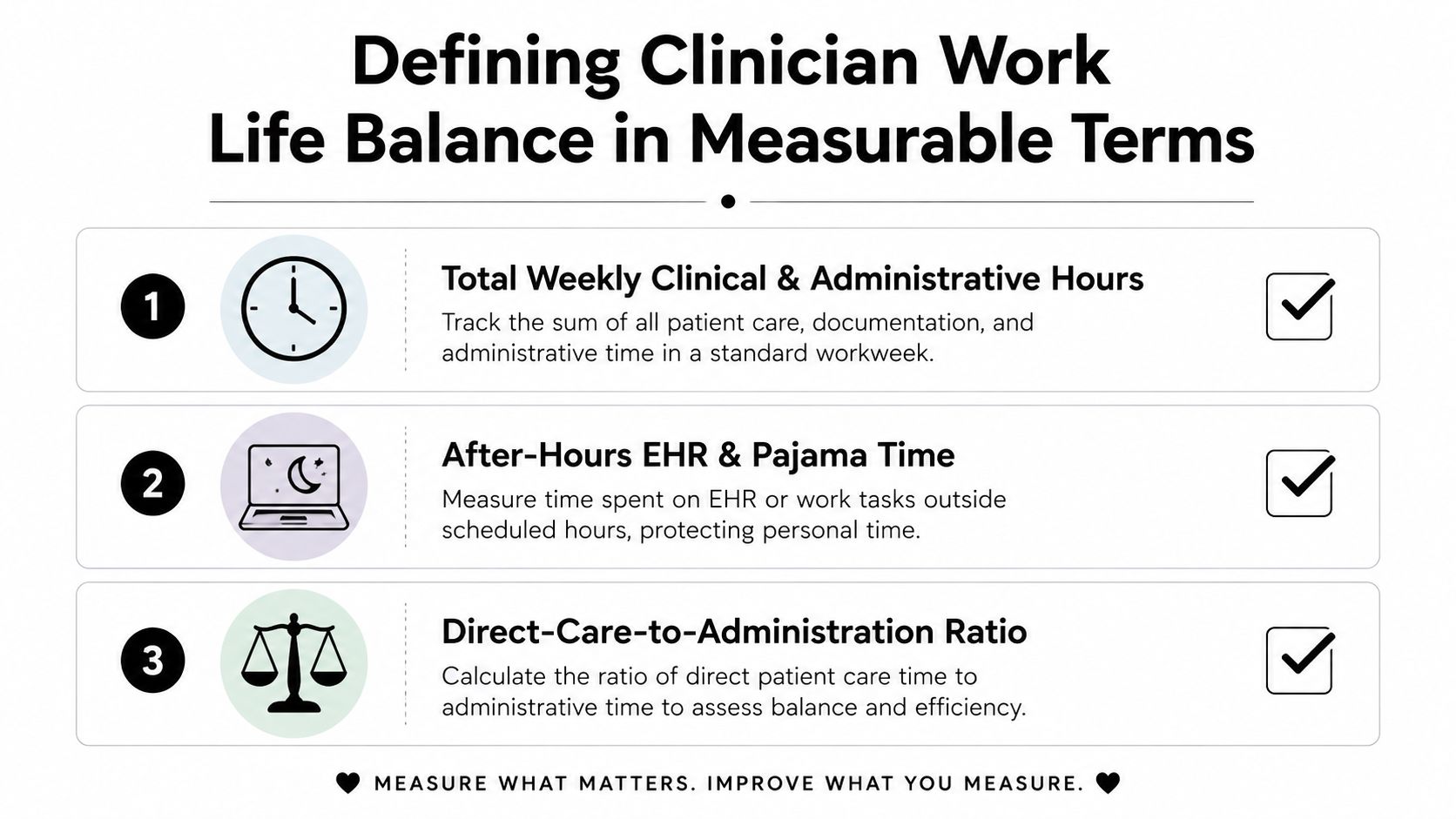
A job scorecard that reflects the real workload
The third measure is the direct-care-to-administration ratio. An outpatient title says little about sustainability if the role assigns substantial time to EHR work, inbox management, authorizations, and care coordination.
Score each opportunity across these dimensions:
- Weekly hours: Record actual total hours, including required work outside scheduled visits.
- After-hours EHR: Ask whether notes, messages, and results are completed before departure, and identify any stated cutoff.
- Administrative ratio: Clarify the paid time reserved for documentation, inbox work, authorizations, and care coordination.
- Predictability: Determine how often the schedule remains within predictable weekdays, and whether call, weekend, or holiday coverage can change.
- Autonomy: Ask who controls panel size, visit length, template design, and patient volume.
These measures distinguish a bounded schedule from attractive language. “Flexible” may mean choosing when to complete an expanding task list. “Predictable” means the employer sets clear boundaries and staffs the work accordingly.
Review the scorecard each quarter against actual conditions. If administrative work shifts into evenings, the role has lost balance even when its official FTE and clinic hours remain unchanged. That unpaid time also belongs in FIRE calculations, because it reduces recovery time and changes the value of the compensation package.
Reading the Burnout Index and Your Personal Risk Band
A useful Burnout Index combines the schedule variables that job postings often obscure: weekly hours, after-hours EHR work, nights on call, weekend coverage, inbox volume, and the administrative-to-clinical ratio. It isn't a diagnostic instrument and shouldn't replace a validated clinical assessment. It's a labor-market tool for comparing roles and identifying when a job's workload has crossed a threshold that deserves action.
The strongest verified thresholds come from the workload literature. A 2021 review found that work-related burnout odds doubled above 60 weekly hours, tripled above 74 hours, and quadrupled above 84 hours. Moderate-to-high work-related burnout prevalence was 41.5% overall, while personal burnout prevalence was 25.3%. (Review of weekly hours and burnout risk among healthcare workers)
| Weekly Hours | Odds Ratio vs <40 hrs | Burnout Rate | Action Threshold |
|---|---|---|---|
| Under 40 | Baseline not quantified | Not quantified | Track after-hours work and admin load |
| 50 to 59 | Not quantified in the cited data | Not quantified in the cited data | Negotiate workload boundaries |
| 60 or more | 2x odds above 60 hours | Not universally quantified | Treat as a high-priority workload problem |
| 74 or more | 3x odds above 74 hours | Not universally quantified | Require a material schedule change |
| 84 or more | 4x odds above 84 hours | Not universally quantified | Exit or urgently restructure the role |
The table deliberately distinguishes odds from probability. The AMA's 57% burnout rate applies to physicians working 71 or more hours, while the review provides relative odds thresholds at 60, 74, and 84 hours. Those measures shouldn't be merged into a falsely precise personal prediction.
A five-question quarterly self-audit
Answer these questions using your calendar, EHR timestamps, and call records:
- What was your average total workweek?
- How much EHR and message work happened after your scheduled end time?
- How many nights, weekends, or holidays included clinical responsibility?
- What share of paid time went to administration rather than direct care?
- Could you control panel size, visit pace, inbox volume, or schedule changes?
A high score isn't a medical diagnosis, but it is a signal to compare your role against alternatives. You can use the WeekdayDoc Burnout Index as one structured way to organize that comparison, then pair it with practical actionable burnout prevention tips that address workload, recovery, and boundaries.
Why Flexible Schedules Alone Don't Fix the Problem
Flexible scheduling can improve perceived control over workload and reduce work-related stress without eliminating burnout. In a Cleveland Clinic study, burnout was 25.5% with flexible scheduling versus 31.7% with standard scheduling, but the difference wasn't statistically significant, with P = 0.45. (Cleveland Clinic analysis of flexible clinician scheduling)
That result challenges a common assumption. Remote, hybrid, or self-scheduled work may change where and when you work, but it doesn't necessarily reduce the number of patients, messages, notes, or administrative obligations. Flexibility without workload control can just move the burden into evenings.
What to test in a job description
Look for schedule features that change the work itself:
- Predictable weekday hours: The employer should define the normal work window, not merely promise flexibility.
- An after-hours cutoff: Ask who handles results, messages, and unfinished notes after the stated end time.
- Administrative relief: Confirm staffing for prior authorizations, inbox triage, referrals, and documentation support.
- Panel or volume controls: Find out whether patient volume can expand without a corresponding change in staffing or time.
- Explicit call and weekend terms: “Shared coverage” isn't specific enough without frequency, response expectations, and compensation.
Telehealth may remove commuting and offer location flexibility, but a telehealth clinician with an unbounded inbox can still have poor balance. Conversely, a shift-based role may have demanding blocks yet provide genuine off-duty time. If you need support interpreting warning signs or deciding when sustained strain requires a broader response, resources that help you navigate burnout recovery can complement, but not replace, a workload redesign.
Choosing and Negotiating Burnout-Friendly Clinical Roles
Job titles don't predict work-life balance as reliably as operating terms. “Outpatient,” “hybrid,” and “flexible” describe setting or location. They don't tell you whether notes are completed during paid hours, whether weekend coverage rotates, or whether the panel can expand without limit.
Treat each listing marker as a hypothesis to verify:
- No Call: Potentially removes overnight interruptions, but ask whether inbox, result, or phone coverage continues after hours.
- No Weekends: Clarify whether the employer excludes both scheduled shifts and remote message coverage.
- Outpatient Only: Usually narrows emergency exposure, but it doesn't establish visit volume, documentation time, or administrative staffing.
- Predictable Weekdays: Ask for the actual start and end window, including meetings and required chart completion.
- Protected Administrative Time: Confirm that it appears on the schedule and isn't merely described during recruitment.
Compare role archetypes by workload, not prestige
The table below uses qualitative categories where the verified data doesn't provide role-specific averages. WeekdayDoc's analysis of active listings can help identify how these terms appear in current opportunities, but it doesn't establish universal salary or hour averages for every role.
| Role Type | Avg Weekly Hours | Call Burden | Burnout Risk Band | Salary Tradeoff |
|---|---|---|---|---|
| Employed outpatient primary care | Varies by employer | Often negotiable, verify terms | Depends on total workload | May trade peak compensation for predictability |
| Hospitalist with 7-on-7-off | Block schedule, verify actual hours | Nights and cross-cover may apply | Can reach elevated or high band | Blocked time off may offset intense weeks |
| Urgent care | Varies by site and shift length | Usually shift-based, verify weekends | Depends on shift timing and volume | May offer simpler handoffs |
| Telehealth | Varies by panel and inbox design | Often no traditional call, verify message coverage | Depends on volume and after-hours work | Location flexibility may accompany different productivity terms |
| Occupational medicine | Often more predictable, verify employer terms | Frequently limited, confirm coverage | Often favorable when admin is contained | May trade some compensation for schedule control |
Negotiation should target variables that change the Burnout Index:
“Before I accept, I need the expected total weekly hours, the normal end-of-day cutoff for notes and inbox work, and the amount of protected administrative time written into the schedule.”
Ask for those terms in the employment agreement or an attached compensation and workload exhibit. Clarify panel size, visit length, coverage during leave, and who owns messages when you're off. Undefined call, “occasional” weekend coverage, and productivity targets without volume limits are red flags because they allow the role to expand after hire.
For a closer review of restrictive language, compensation formulas, and workload obligations, use this employment contract negotiation guide. A contract scanner or attorney can identify legal ambiguity, but only you can decide whether the schedule fits your intended career.
Connecting Schedule Design to FIRE for Clinicians
A higher salary can be financially inferior if the job consumes the hours that make the income possible. Consider two hypothetical planning scenarios, not market benchmarks. Scenario A is a traditional hospitalist role paying $300,000 gross at 60 hours per week, with night call and more than 15 hours weekly lost to pajama time and administrative work. Scenario B is a no-call outpatient position paying $240,000 gross at 40 hours per week, with 8 hours of after-hours EHR work.
The figures are intentionally simple so you can replace them with your own contract terms. At a 25% effective tax rate, gross income becomes approximately $225,000 in Scenario A and $180,000 in Scenario B. The headline difference is $45,000 after tax, but Scenario B provides more control over time and may reduce the risk of leaving clinical work prematurely.
| Variable | Traditional High-Call Role | No-Call Weekday Role |
|---|---|---|
| Gross income | $300,000 | $240,000 |
| Effective tax assumption | 25% | 25% |
| Approximate after-tax income | $225,000 | $180,000 |
| Scheduled weekly hours | 60 | 40 |
| After-hours EHR and admin | More than 15 hours weekly | 8 hours weekly |
| FIRE target | $1.5 million | $1.5 million |
| Withdrawal-rate assumption | 4% | 4% |
A $1.5 million FIRE portfolio supports $60,000 annually under a 4% withdrawal-rate assumption. That calculation doesn't tell you how quickly either clinician reaches the target because savings depend on spending, existing assets, investment returns, debt, and household income. It does reveal the decision variable many salary comparisons omit: after-tax income per total work hour.
Scenario A produces higher after-tax cash flow, but its effective time cost is far larger than 60 scheduled hours. Scenario B produces less income but leaves more weekly capacity for family, recovery, teaching, or carefully chosen additional work. If Scenario A causes a career exit after several years while Scenario B supports a longer clinical runway, the lower salary can produce the stronger lifetime accumulation.
Use a financial independence and early retirement framework for clinicians to model both paths with your actual expenses and savings. The relevant comparison isn't “Which job pays more?” It's “Which job lets me save consistently without making the career itself unsustainable?”
Your 90-Day Work Life Balance Action Plan
A quarterly plan should produce records you can use in a negotiation, job search, or financial model. Start with evidence from your own week rather than relying on a job title or a recruiter's description.
Days 1 to 30
Create a simple spreadsheet or export available EHR time data. Track direct patient care, documentation, inbox work, meetings, prior authorizations, on-call pages, and work performed after the scheduled end time. Separate paid administrative time from unpaid administrative time.
At the end of each week, calculate:
- Total work hours: Include all clinical and administrative labor.
- After-hours hours: Record evening, weekend, and holiday work separately.
- Call burden: Count nights and coverage obligations, not only calls that produce an admission.
- Administrative ratio: Compare desk and coordination work with direct patient care.
- Schedule variance: Note how often the actual end time differs from the posted schedule.
Days 31 to 60
Turn the audit into job filters. Prioritize no call, no weekends, predictable weekday hours, and written administrative support. If you use an admin-ratio target, treat it as a negotiation parameter rather than a universal clinical standard. The evidence supports measuring the ratio, but it doesn't establish one correct threshold for every specialty.
Conduct three informational interviews with clinicians already in roles that match your filters. Ask what happens to unfinished notes, who manages patient messages during leave, how often coverage changes, and whether the posted hours reflect the actual week. Request examples of a normal week and a difficult week.
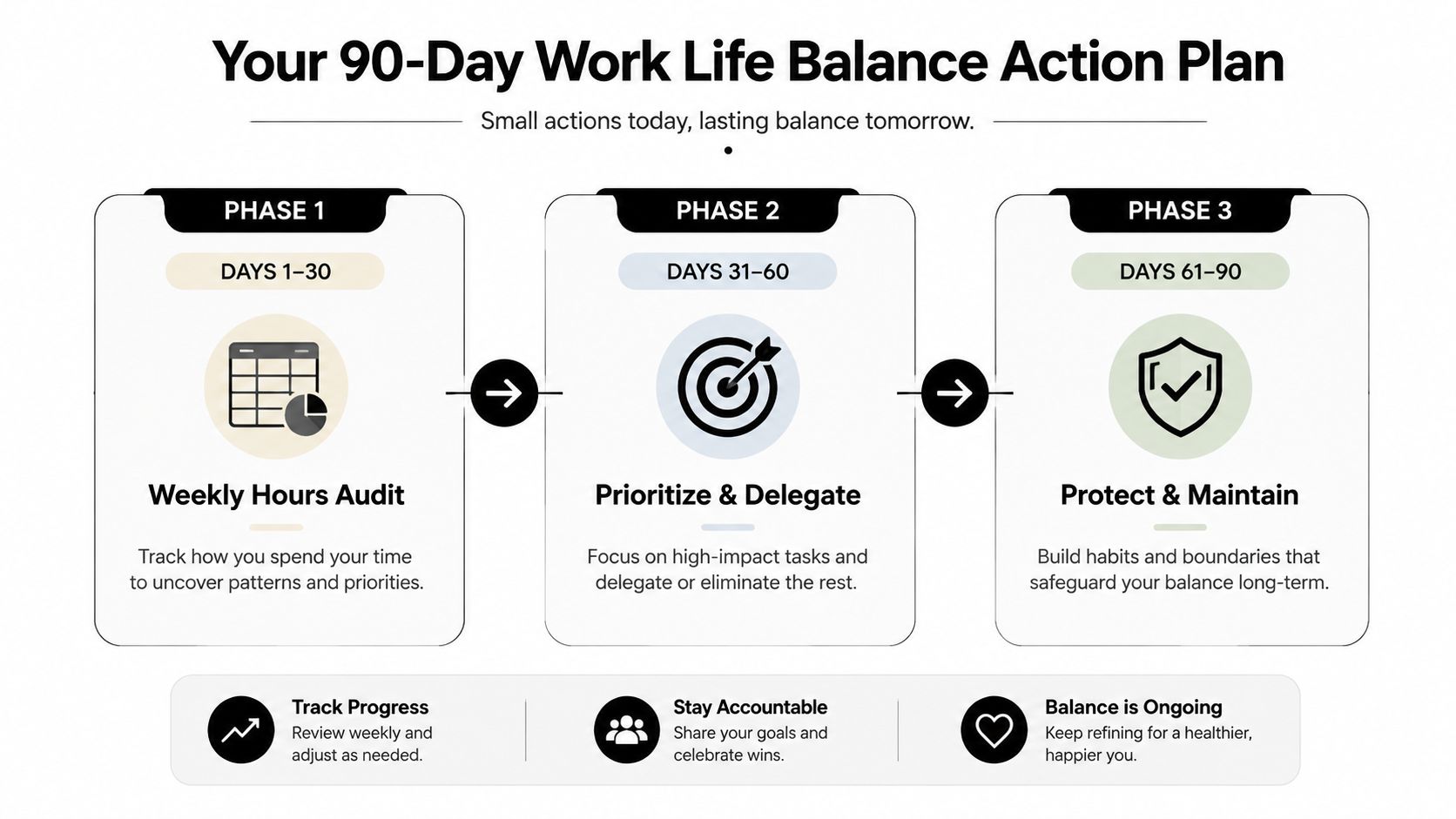
Days 61 to 90
Complete a FIRE baseline using after-tax income, annual spending, current investments, debt, and savings rate. Then model the target role with its actual compensation and expected hours. Include a scenario where you reduce clinical work, not only one where you maximize earnings.
Your deliverables should be concrete:
- Audit log: Weekly hours, after-hours work, call, and administrative ratio.
- Listing filter: Written requirements for call, weekends, schedule window, and admin support.
- Interview notes: Direct answers from clinicians in comparable roles.
- Negotiation terms: Hour cap, documentation cutoff, coverage rules, and protected administrative time.
- Updated FIRE number: Current target, savings rate, and alternative-role projections.
The point isn't to find a perfect schedule. It's to make the trade-offs visible before you sign, then review the actual workload after you start.
WeekdayDoc curates clinician roles with explicit schedule details, including no-call, no-weekend, remote, hybrid, and in-person options, alongside salary and FIRE-oriented job information. Visit WeekdayDoc to compare openings against the workload criteria you documented this quarter and focus your search on roles designed around sustainable clinical work.