Work From Home Respiratory Therapy Jobs
Explore remote respiratory therapy roles, credentials, pay context, licensing questions, and how to assess whether a job is truly work from home.
Respiratory therapists often assume their clinical skills restrict them to the bedside, the intensive care unit, or a fast-paced outpatient clinic. Finding work from home respiratory therapy jobs offers an alternative to the physical demands of hospital shifts, though the day-to-day work often moves away from hands-on acute care. Remote respiratory work focuses on patient monitoring, sleep and continuous positive airway pressure (CPAP) education, and clinical support for devices. Because these positions operate differently from traditional facility-based roles, assessing them requires looking past the location label to understand the daily workflow. WeekdayDoc helps clinicians evaluate the real schedule, compensation, and burnout risks of a role so you can determine if a telehealth position improves your career sustainability.
Can Respiratory Therapists Work From Home?
The U.S. Bureau of Labor Statistics' Occupational Outlook Handbook reports that hospitals accounted for 80% of all respiratory therapist jobs in 2025. This figure describes employment setting rather than whether jobs are remote, so it does not establish how common remote opportunities are nationwide.
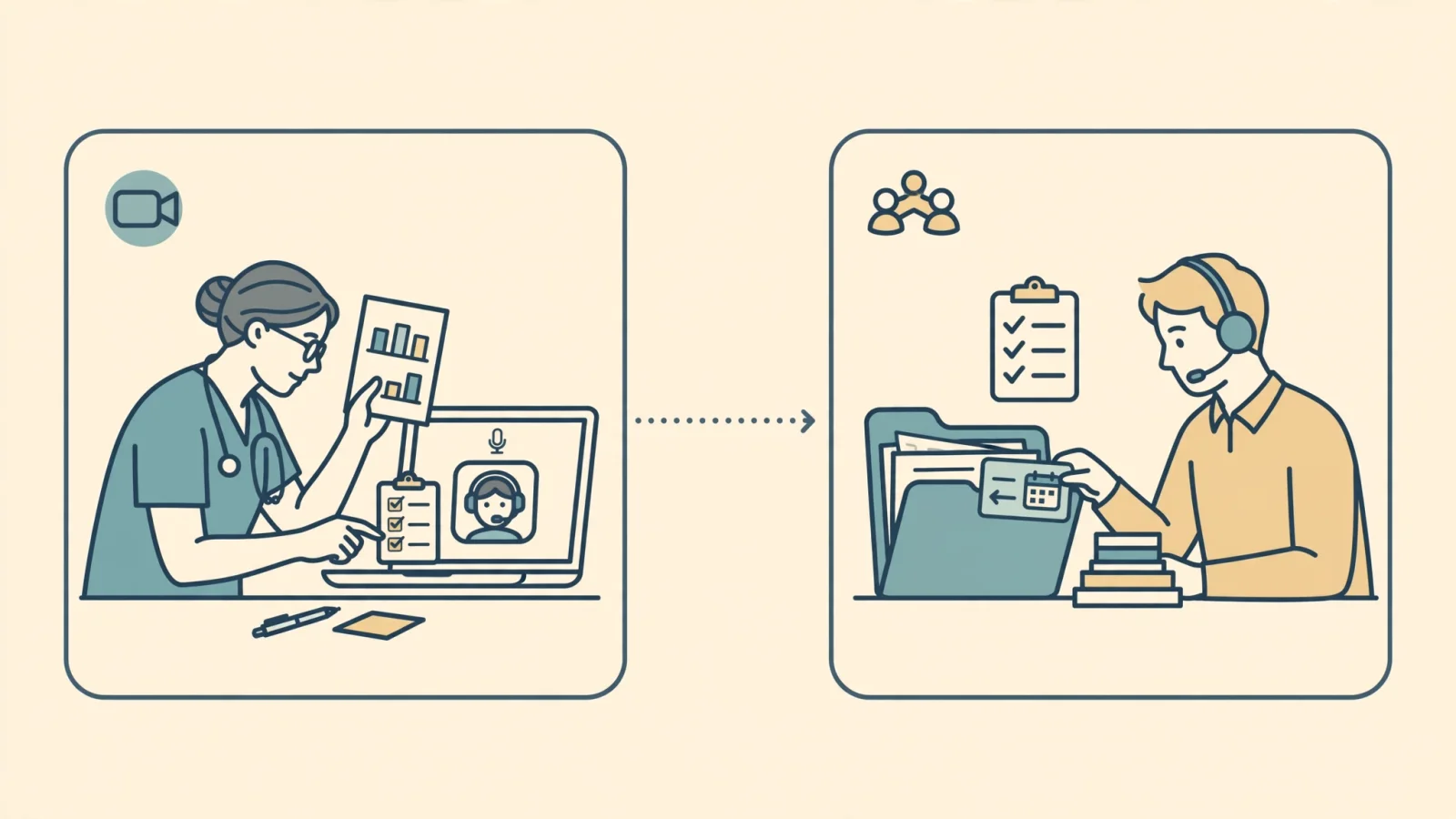
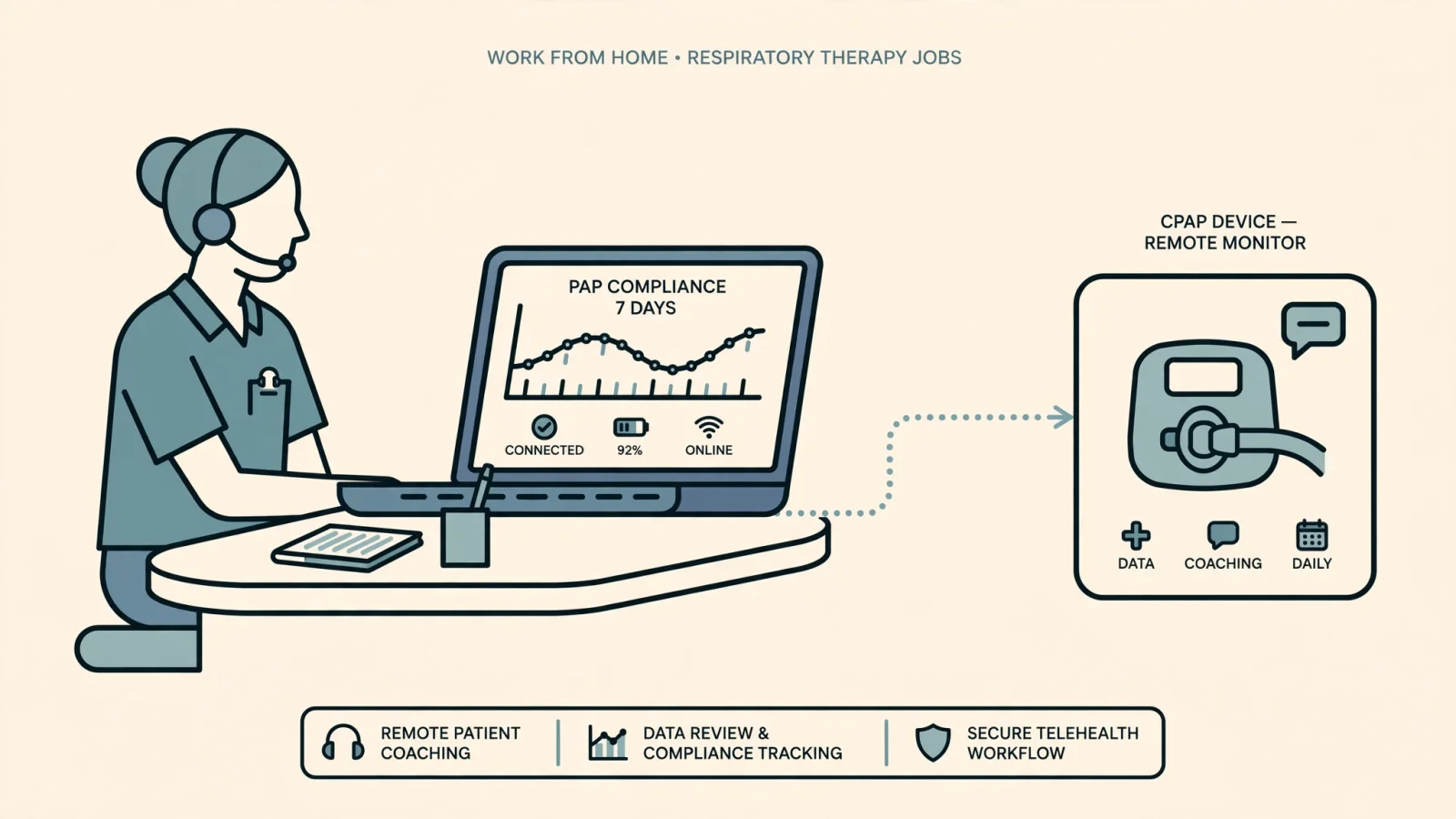
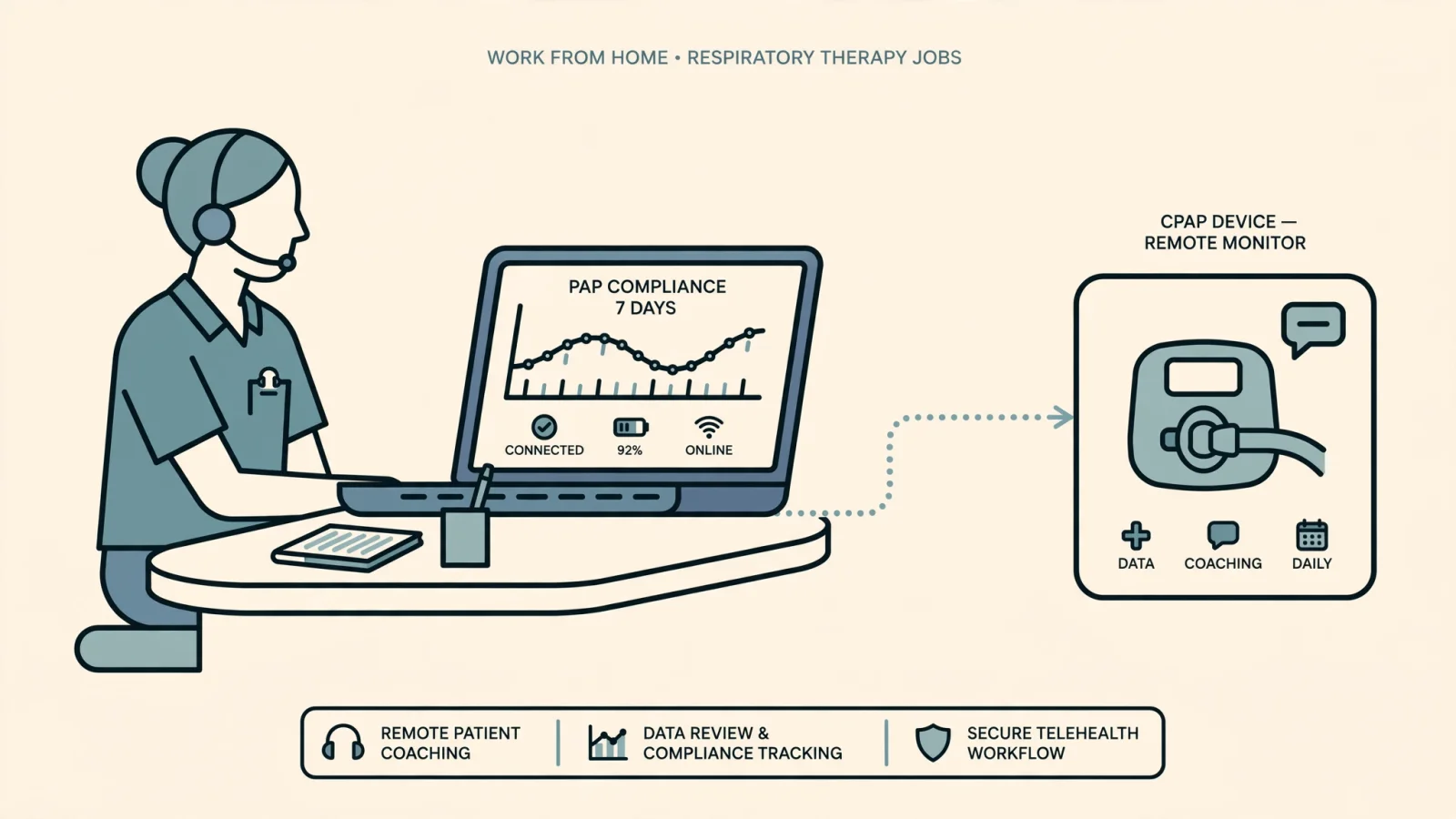
When you leave the hospital environment, your shift changes from physical interventions to data review, care coordination, and clinical education. The expansion of cloud-connected home medical equipment makes this transition possible. Modern CPAP machines and home ventilators transmit compliance data directly to central servers, allowing a clinician to monitor progress from anywhere with a secure internet connection. A remote position might require you to review device alerts from a centralized telehealth hub or guide a newly diagnosed sleep apnea patient through their equipment setup over a video call. Because the exact duties vary widely across employers, verifying the specific expectations prevents you from assuming a home-based role guarantees a predictable schedule or lighter workload.
Types of Remote Respiratory Therapy Jobs
Not every job marketed as remote keeps you at your desk all day. Employers use the label broadly, encompassing fully home-based roles, positions with defined travel territories, and hybrid arrangements that mix administrative time with facility visits. Clarifying the physical expectations upfront prevents you from accepting a supposedly home-based job only to spend three days a week driving between regional clinics.
Remote Patient Monitoring and Chronic-Care Support
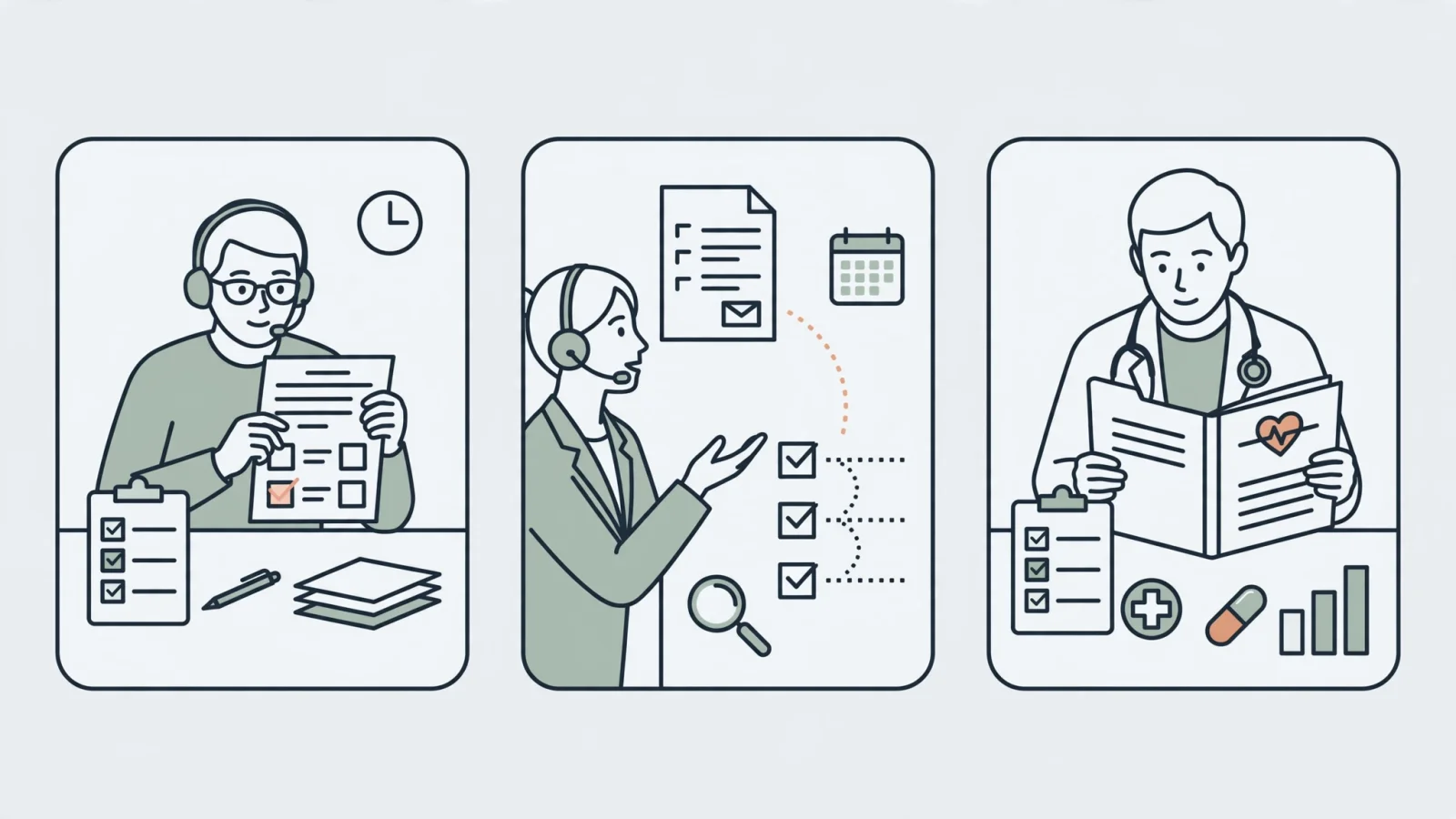
Remote patient monitoring systems rely on respiratory therapists to interpret incoming data, track compliance, and intervene before a patient requires hospital readmission. A full-time remote listing from ResPro Health reviewed in October 2026 illustrates how these roles function in practice. The company requests an RT license and at least two years of experience to manage positive airway pressure (PAP) devices for a designated patient panel. The core duties center on patient coaching, care-team coordination, documentation, and escalating clinical concerns when intervention becomes necessary.
The technical side of the job involves operating proprietary cloud portals provided by equipment manufacturers. You monitor adherence metrics to track whether patients meet the usage thresholds required by their insurance providers for ongoing billing. When a patient falls behind on their therapy hours, you initiate a coaching call to uncover the root cause. The posting also lists recommending PAP-setting adjustments and creating specific orders. You should treat those details as an employer-specific framework rather than a universal standard for all remote monitoring jobs. Because these details are employer-specific, review the scope of practice, the supervising physician's protocols, and the applicable state rules before assuming the role authorizes you to recommend settings or initiate orders in a telehealth capacity. Your daily workflow in this type of role relies heavily on communication skills and phone endurance rather than the rapid physical response required in an emergency department.
Sleep and PAP Education
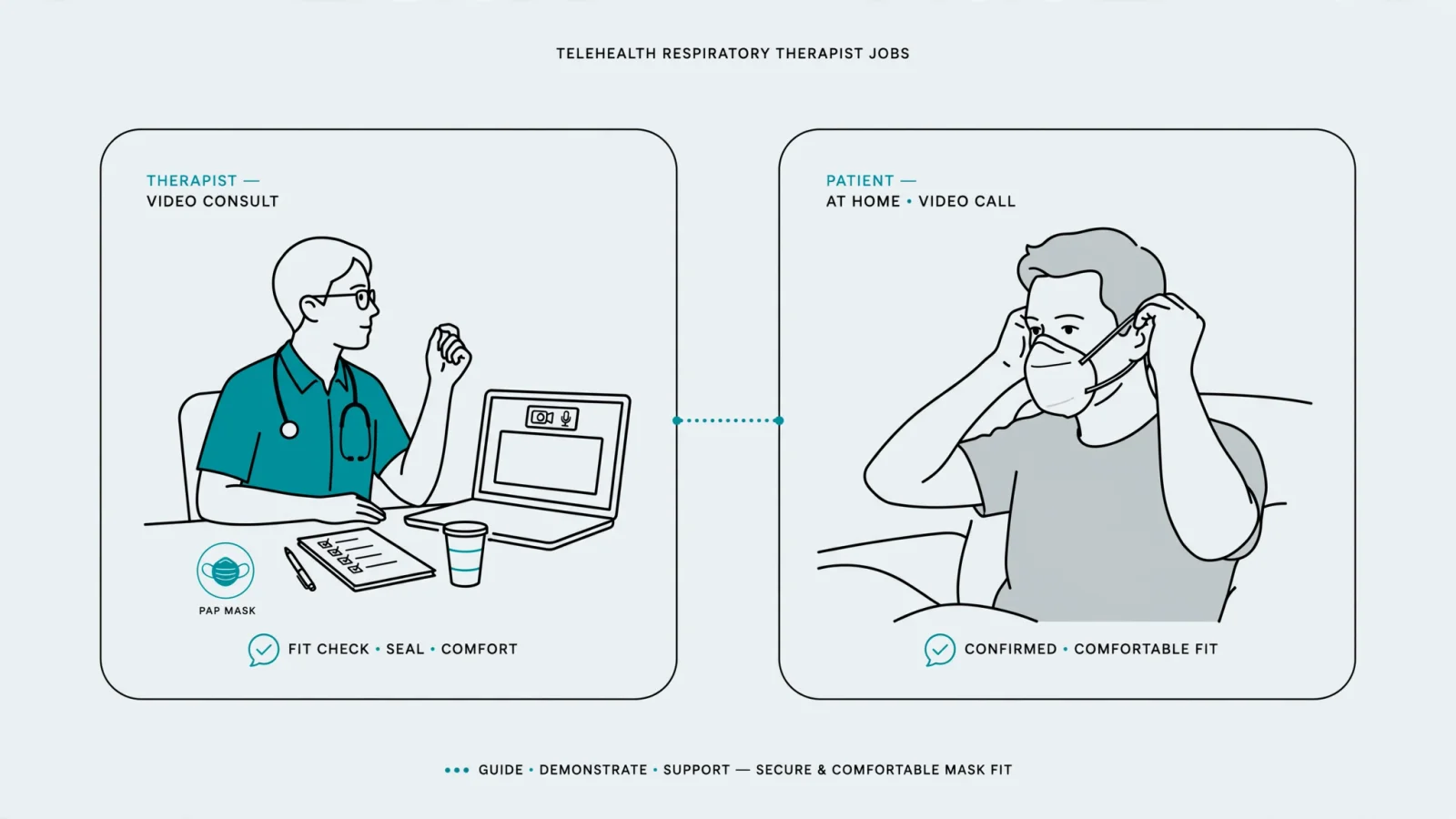
Patient education forms another major category of remote respiratory work. Patients frequently abandon their sleep therapies because of mask discomfort, pressure intolerance, or confusion about routine maintenance. An Aeroflow Health PRN posting dated July 30, 2026, focuses on educating patients about sleep-related diseases and proper equipment care.
This specific listing accepts either a registered nurse or a respiratory therapist and operates on an as-needed schedule. Managing a PRN role from home requires strong boundaries, as the lack of a commute makes it easy to blur the line between being on call and being off duty. Confirm which credentials the employer accepts, how they assign working hours, and whether the company supplies the necessary secure computer systems for compliant patient communication. The educational focus means you spend hours explaining complex respiratory mechanics in accessible terms, guiding a patient through rainout troubleshooting in their heated tubing, or suggesting alternative mask styles to prevent skin breakdown. If you are exploring how part-time or flexible scheduling changes your daily stress levels, the Nurse Practitioner Work-Life Balance by Setting guide outlines how setting boundaries in non-traditional clinical environments affects long-term career satisfaction.
Device Education and Clinical Applications
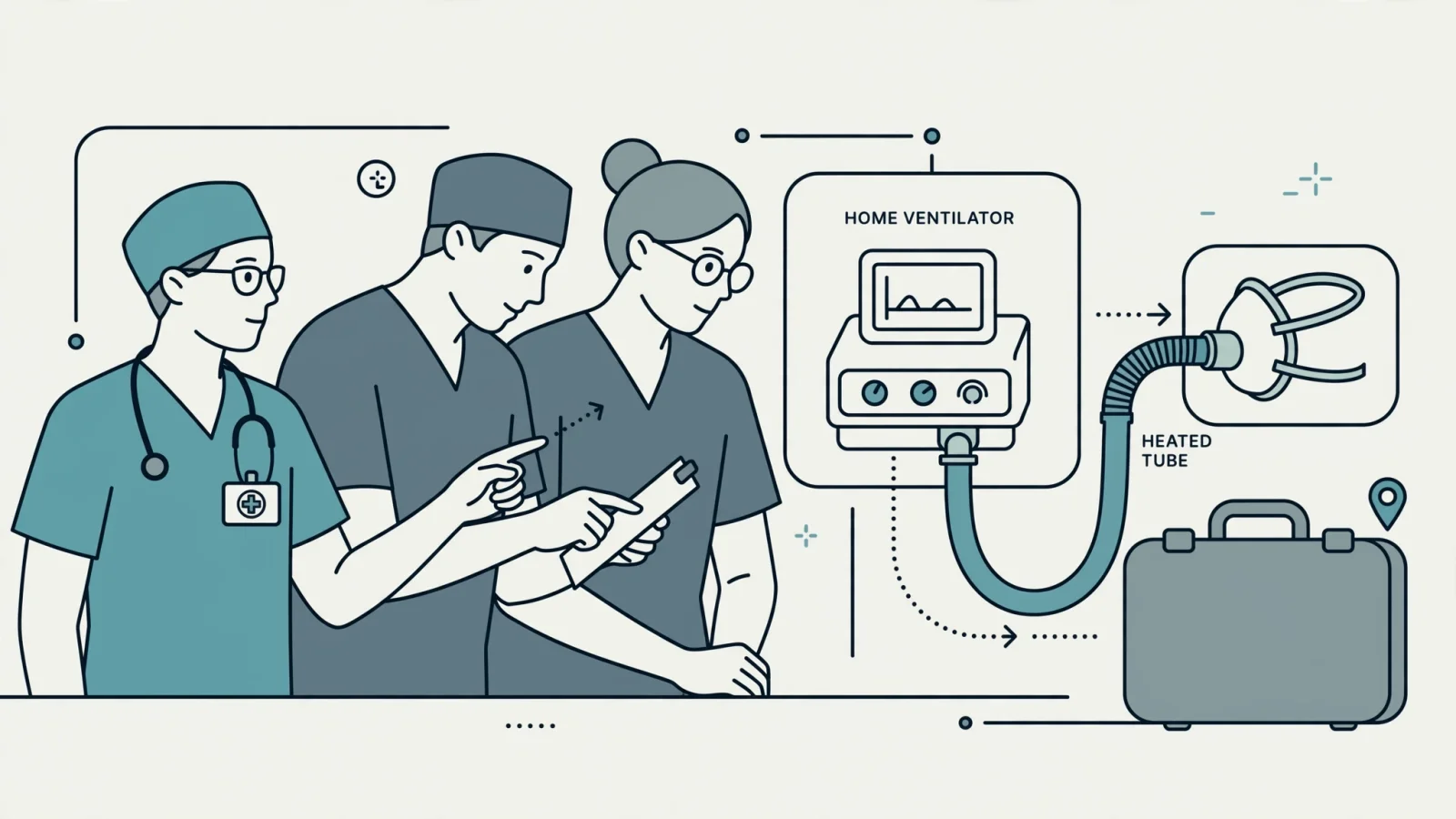
A Hamilton Medical Clinical Applications Specialist listing, posted in April 2026, is labeled remote and lists locations in Las Vegas, Nevada, New Mexico, and Arizona. The role combines clinical support and product education, and calls for a registered respiratory therapist or respiratory care practitioner with five years of critical-care experience and a willingness to travel. Its responsibilities include facilitating in-service education for customers and serving as a clinical resource.
This type of clinical support role uses your home as a base for administrative tasks, scheduling, and virtual product support. The core responsibilities still demand face-to-face clinician education and on-site ventilator troubleshooting during new equipment implementations. Home-care respiratory therapy also falls into a similar category of field-based work. The BLS notes that home-care RTs visit patients to inspect equipment, teach families how to operate ventilators safely, and respond to emergency home visits. These positions require a vehicle and a willingness to operate in unpredictable residential environments, making them entirely different from a fully desk-based telehealth role.
Credentials and Licenses for Remote RT Jobs
You carry your clinical background into a remote role, but licensing demands multiply when you start interacting with patients across state lines. The foundational qualifications for a home-based position mirror those required in a hospital setting. The Bureau of Labor Statistics reports that respiratory therapists typically need an associate degree and maintain licensure in every state except Alaska. You generally hold either a Certified Respiratory Therapist (CRT) or Registered Respiratory Therapist (RRT) credential based on your examination level.
Remote employers frequently add prerequisites based on the autonomy required for telehealth. Many companies mandate the RRT certification even if your home state allows practice with a CRT. Experience requirements also shift depending on the role's complexity. For instance, applications specialist roles may ask for five years of critical care experience, while other remote monitoring jobs expect one or two years of general practice.
Treating a patient by phone or video raises cross-state licensing questions. According to Department of Health and Human Services guidance, requirements vary by state, and providers should verify the patient's location before an appointment. For cross-state practice, HHS lists a full license in the other state, temporary-practice laws, licensure reciprocity, interstate compacts, and telehealth registration as routes, each subject to state requirements. Ask the employer which states its patient population covers, who pays for additional licensing fees, and who tracks continuing-education requirements across state boards.
Compensation for Work-From-Home RT Jobs
Remote positions often use different compensation structures than hospital-based roles, so national wage data provide a broad starting point, while the full package gives a clearer picture than base salary alone. Similar financial adjustments occur in other allied health transitions, as outlined in our look at Remote Pharmacist Careers: Roles, Pay, and Work-Life Fit, where removing shift differentials heavily influences total compensation.
The BLS reports a U.S. median annual wage of $82,280 for respiratory therapists in May 2025. This figure reflects an all-setting benchmark heavily influenced by the vast majority of therapists working in acute care hospitals, where overnight shift differentials, weekend pay, and mandatory overtime frequently boost total earnings. A fully remote role often strips away those variable pay components in favor of a flat salary or an hourly rate tied strictly to scheduled phone time.
For example, the ResPro Health remote listing reviewed on October 6, 2026, displays a full-time salary range of $55,000 to $60,000 per year. You cannot directly compare this single employer's posted range to the national median and conclude that all remote work pays less. The two figures represent entirely different settings, locations, experience requirements, and duty scopes. The available sources do not establish a national remote-specific salary median or confirm a consistent pay premium for telehealth positions.
Evaluate compensation alongside the total lifestyle impact. A remote job might eliminate commuting costs, reduce childcare expenses, and remove the physical toll of bedside lifting entirely. Conversely, it might require you to maintain a secure internet connection, purchase professional liability insurance, or float the initial cost of multi-state licensing renewals. Ask the hiring manager about productivity bonuses, hardware stipends, and whether the company covers your travel expenses if the role includes occasional in-person corporate meetings or field visits. If you hold dual credentials or are considering further education, the Physician Assistant Work-Life Balance Guide demonstrates how salary benchmarks shift when moving from acute to remote advisory roles across the broader medical landscape.
Finding and Evaluating Remote RT Jobs
Locating a home-based position requires targeted search strategies, as many traditional job boards bury these listings under generic clinical categories. Identify the exact search terms employers use and apply a rigorous screening process before submitting an application.
Start by testing specific title variations. Searching for "remote respiratory therapist jobs" provides a baseline, but you will uncover more specialized roles by looking for "respiratory care practitioner jobs," "remote patient monitoring respiratory therapist," or "sleep therapy jobs." If you want to move into device support, search for "respiratory clinical applications specialist" or "remote CPAP support." Because many employers limit hiring to states where they already have a tax presence or clinical infrastructure, search by your eligible state alongside the remote keyword.
Once you find an appealing listing, use this screening checklist to assess the work:
- Identify the physical boundaries: Determine whether the position is fully remote, a hybrid model, field-based, or structured as a home office that requires heavy territory travel.
- Map the patient locations: Ask which states the role serves and what specific licenses or telehealth registrations you need before your first day.
- Clarify the daily tasks: Calculate how much of your time involves direct patient-facing communication via phone or video versus device support, chart auditing, or administrative data entry.
- Establish clinical authority: Find out who supervises your clinical decisions, authorizes changes to therapy settings, and handles escalations when a patient's condition deteriorates.
- Review the schedule: Confirm the expected hours, the primary time zone, the daily patient volume, the documentation workload, and the productivity expectations. Ask if the role includes evening shifts, weekend coverage, on-call duties, or the need to respond to urgent alerts.
- Verify the financial support: If travel is expected, ensure the employer covers expenses and pays for necessary equipment, training, and state licensing fees. Look for documented policies rather than verbal promises.
A remote label never guarantees a predictable schedule or protection from clinical fatigue. WeekdayDoc makes this evaluation easier by adding structured decision data directly to the search process. Our platform assigns a 0-to-10 work-life score to each listing based on factors like call coverage, weekend expectations, schedule flexibility, and administrative burden. Instead of guessing about the daily routine, you can compare job-level scores alongside visible schedule expectations and market salary percentiles. You can filter roles by profession, specialty, and work type, describe your background for AI matching, and use one-click applications to reach hiring managers directly. When you receive an offer, our AI contract scanner helps flag issues like non-competes or payback clauses before you sign.
Frequently Asked Questions
Can Respiratory Therapists Work From Home?
Yes, respiratory therapists hold remote positions focused on telehealth, patient monitoring, and clinical education. While the majority of the profession remains in acute hospital settings, some RTs work from home to support sleep medicine compliance, coordinate chronic-care management, and instruct other clinicians on medical device usage.
What Does a Remote RT Do?
A remote respiratory therapist primarily reviews patient data, manages equipment compliance, and provides virtual education. The daily duties often include tracking CPAP or ventilator usage, calling patients to troubleshoot mask leaks, coordinating with physicians to adjust therapy settings, and documenting clinical outcomes in electronic health records.
Do Remote RT Jobs Require an RRT?
Employer requirements dictate whether you need the Registered Respiratory Therapist credential. While some entry-level remote positions accept a Certified Respiratory Therapist, many telehealth and clinical applications roles mandate the RRT certification to ensure the clinician possesses the advanced knowledge necessary for independent remote practice.
Can I Provide Telehealth to Patients in Another State?
Cross-state practice requires you to comply with the licensing regulations of the state where the patient resides. Confirm the applicable authorization with the relevant state board, which may involve holding a full secondary license, utilizing a specific telehealth registration, or practicing under a temporary reciprocity agreement.
How Much Do Remote RT Jobs Pay?
Compensation for a home-based position depends entirely on the employer, the specific duties, and the payment structure. While the national median for all RT settings was $82,280 in May 2025, a remote role might offer a lower base salary in exchange for eliminating physical hospital shifts, mandatory overtime shifts, and daily commuting costs.
Is Home-Care Respiratory Therapy the Same as Working From Home?
Home-care respiratory therapy is a field-based role rather than a desk-based remote job. A home-care RT travels continuously to visit patients in their residences, inspect oxygen concentrators, deliver equipment, and respond to urgent clinical needs, whereas a remote RT works from a stationary home office using a computer and phone.
Compare remote respiratory therapy jobs by pay and schedule, not just by the remote label. Explore opportunities on WeekdayDoc to see visible work-life scores, transparent compensation data, and roles that fit your career goals.