
Mastering Employment Contract Negotiation
Master clinician employment contract negotiation with our playbook. Confidently negotiate salary, burnout-friendly schedules, and crucial clauses to secure
Clinicians routinely negotiate salary and signing bonuses with care, then accept vague language on call, hours, panel expectations, and coverage. That is how a good offer turns into a draining job.
The contract should protect your ability to practice well over time. In real terms, that means defined work hours, clear no-call or limited-call terms when applicable, realistic productivity expectations, protected admin time, and exit language that does not trap you in a bad fit. Employers often frame those points as lifestyle preferences. They are retention terms, patient safety terms, and risk management terms.
I have seen clinicians accept more money in exchange for more ambiguity, and the trade rarely works in their favor. A higher base salary does not offset chronic after-hours inbox work, unpredictable weekend coverage, or a schedule that makes recovery impossible. Burnout-friendly terms deserve the same level of scrutiny as compensation because they determine how the job feels on an ordinary Tuesday, not just on offer day.
A strong negotiation starts with that frame. You are not asking for favors. You are asking the employer to define the conditions that support durable performance, stable staffing, and better patient care.
Why Most Clinicians Leave Money and Sanity on the Table
A large share of workers accept the first offer without negotiating, while those who do negotiate often improve the terms. As noted earlier, that pattern matters even more in clinical roles, where the expensive part of a bad contract is often not the salary. It is the unpaid time, the undefined coverage, and the steady erosion of control over your week.
I see the same mistake across settings. A clinician reviews base pay, bonus, and PTO, then skims past call language, schedule definitions, ramp-up expectations, and after-hours responsibilities because those sections look routine. They are not routine. They determine whether the job is sustainable six months later.
The hidden cost shows up on your calendar
The losses usually appear in small lines that look harmless during recruiting. “Shared call.” “Coverage as needed.” “Productivity expectations based on department standards.” “Administrative time subject to operational needs.” None of that tells you how many evenings you will spend answering inbox messages, whether weekends stay protected, or how quickly a thinly staffed service can turn your schedule into permanent overflow.
That is where clinicians give away both money and margin.
An extra $20,000 in base pay can disappear quickly if the role adds frequent unpaid charting at night, more childcare coverage, fewer opportunities for moonlighting, or a faster path to exhaustion and turnover. Burnout-friendly terms deserve the same level of scrutiny as compensation because they affect retention, patient safety, and your ability to practice well on an ordinary clinic day.
Verbal reassurance does not solve this. If the recruiter says call is “light,” ask how often it occurred over the last 12 months, who covers when someone leaves, and whether home call includes refill, inbox, or hospital issues. If the schedule is described as “flexible,” ask who controls template changes, session length, double-booking, and admin blocks. If you want help reviewing that language line by line, use a contract scanner for clinician employment terms.
What good negotiation changes
Good negotiation improves the job in three concrete ways.
- It protects compensation by tightening base pay terms, bonus formulas, review timing, and what happens during a ramp-up period.
- It protects clinical control by defining scope, template expectations, support staffing, and who can change your schedule.
- It protects recovery time by setting real limits on call, weekends, inbox coverage, and after-hours work.
Those are linked. A higher salary with unlimited schedule creep is often a worse deal than a slightly lower salary with firm hours, protected admin time, and a clear no-call arrangement. Employers may resist that framing because ambiguity gives them flexibility. You should resist it because ambiguity shifts operational risk onto you.
Clinicians rarely miss these points because they are careless. They miss them because they are busy, hopeful, and trained to adapt. In contract negotiation, adaptation is expensive. Clear terms are how you protect income, autonomy, and the ability to stay in the job without burning out.
Prepare Your Case Before You Say a Word
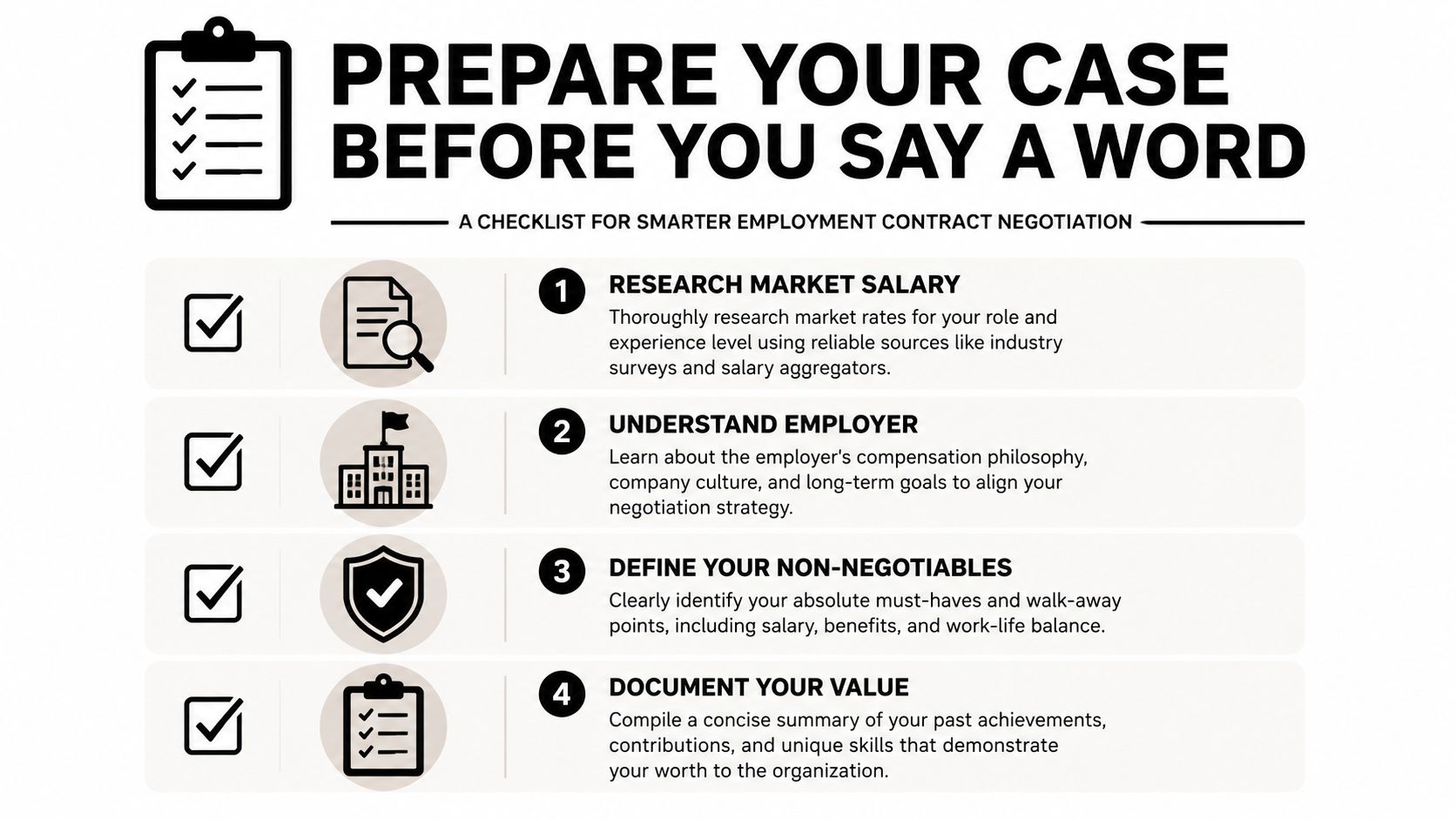
Negotiation usually feels stressful when the candidate is improvising. It gets much easier when each ask is tied to evidence, a real career objective, or an essential working condition.
Successful negotiators define essential terms, priorities, and nice-to-haves before the discussion begins, and they justify each request with market value or specific expertise as outlined in The Pass Machine's physician contract negotiation guide. That's the difference between sounding demanding and sounding prepared.
Build a file before the call
Start with objective market context. For physicians, that usually means MGMA, AAMC, and specialty society compensation references if you have access. For all clinician types, compare those benchmarks against active postings in your region and care setting. If the employer is quoting productivity expectations, benchmark panel build time, visit mix, and RVU assumptions instead of focusing only on the headline salary.
Then gather your own strong points in one page:
- Training and fit: Fellowship, certifications, subspecialty exposure, telehealth experience, bilingual skills, supervisory capability.
- Revenue or access value: Procedural mix, referral capture, hard-to-fill geography, waitlist reduction, ability to cover a high-need service line.
- Operational value: Leadership, workflow redesign, quality work, teaching, onboarding support, EHR fluency.
Decide what protects your life outside work
Most candidates can name the salary they want. Far fewer can name the work pattern they need.
Write down three categories and keep them separate:
| Category | What belongs here | How to use it |
|---|---|---|
| Non-negotiables | No call, fixed clinic days, remote days, protected admin time, specific geographic limit on non-compete | Walk away if these fail |
| Priorities | Higher base, CME stipend, sign-on terms, moonlighting language | Trade if needed |
| Nice-to-haves | Title tweaks, equipment preferences, parking, start-date flexibility | Use for package design |
For NPs and PAs, vacation deserves direct attention. A practical floor is 20 to 25 days per year, and if CME days are rolled into vacation, the total minimum should be 25 to 30 days per year according to this peer-reviewed APP contract negotiation review.
Practical rule: If you can't explain why each request matters to patient care, retention, or market value, tighten your case before you negotiate.
Put your asks in writing before legal review
By the time a lawyer sees your contract, you should already know what you're trying to change. I like candidates to prepare a short issue list with exact asks: base pay, bonus formula, call language, PTO structure, notice period, non-compete edits, malpractice terms, and moonlighting.
A tool like WeekdayDoc's Contract Scanner can help you flag restrictive covenants, repayment traps, and vague clauses before you spend attorney time on finer points.
The Clinician's Guide to Critical Contract Clauses
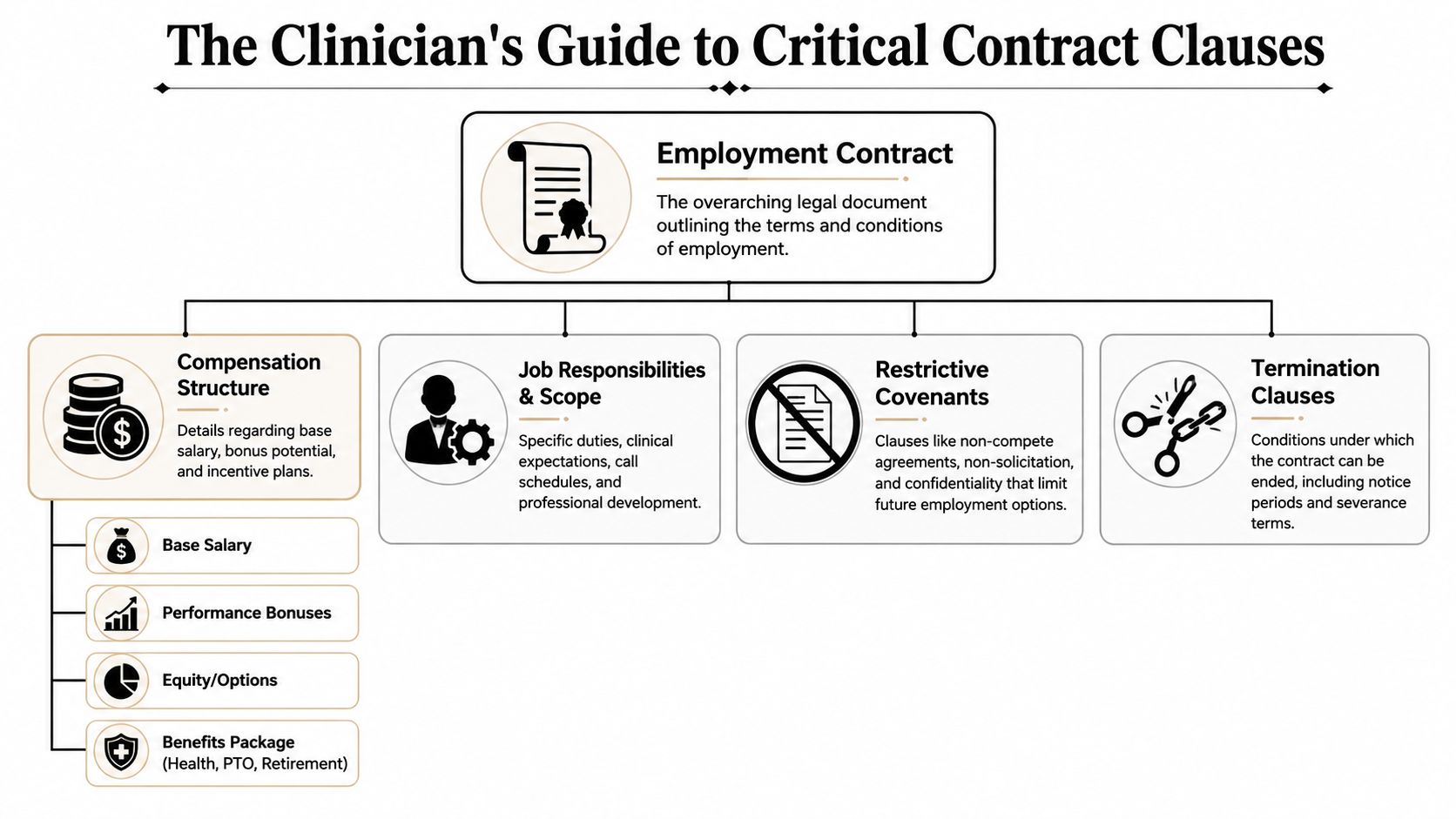
A clinician contract can run up to 20 pages and still leave the most important parts of your day unclear, especially if compensation mechanics, call frequency, patient contact hours, liability coverage, and termination terms aren't explicitly written into the agreement according to CompHealth's PA and NP contract negotiation resource. That's why reading for themes isn't enough. You have to read for risk.
If you want a plain-English primer before reviewing the legal language itself, this overview of understanding employment contracts is a useful place to ground the basics.
Compensation is a formula, not a number
Base salary matters, but clinicians get burned when they ignore how the money works after month one. If the contract includes productivity pay, ask what counts, when it's measured, and what support exists while you ramp up.
For RVU-based arrangements, structure matters. In the relative value model, overhead accounts for 48% of revenue, malpractice for 4%, and net provider compensation for 48%, while NPs often have lower overhead and therefore potentially different net compensation dynamics according to the American Association of Nurse Practitioners employment negotiation guidance.
Ask for language like this:
“Compensation incentives will include the specific productivity metric, the threshold for eligibility, the conversion methodology, the reporting cadence, and the date of payment.”
That request isn't aggressive. It's basic risk control.
Schedule and call belong in writing
At this stage, many contracts become burnout contracts. Employers often describe call as “light,” “shared,” or “minimal.” None of those words are enforceable.
The issue is retention and patient safety. Physicians who negotiated explicit no-call clauses stayed in their roles beyond three years at a much higher rate, 68% versus 34% for those without such clauses, based on the verified workforce data provided in the brief. That tracks with what clinicians already know from lived experience. Unpredictable schedules drain recovery, damage continuity at home, and make a decent salary feel inadequate.
Ask for specifics, not reassurance:
- Clinic hours: State patient-facing hours and admin expectations.
- Call obligations: State whether call exists, how often, what type, and whether additional compensation applies.
- Coverage rules: State who covers inboxes, weekends, holidays, and colleague absences.
- Remote boundaries: State whether after-hours messages create response obligations.
Use language like:
“Employee will have no mandatory evening, weekend, or overnight call responsibilities unless separately agreed in writing.”
Or, if call is unavoidable:
“Call frequency, compensation, backup structure, and post-call schedule expectations will be explicitly defined in this agreement.”
Restrictive covenants can trap your next move
Non-compete language often gets dismissed as boilerplate until someone tries to leave. Don't treat it casually. Narrow the radius, narrow the duration, and clarify what activities are restricted.
If you need a primer on the legal and career implications, review what a restrictive covenant agreement can limit. The contract should also address repayment provisions tied to bonuses or relocation.
For NPs and PAs, one common trap is signing bonus repayment. Some contracts impose a 1 to 3 year window where leaving triggers full repayment, and negotiators are advised to request prorating so the obligation shrinks with each month worked, as discussed in this NP and PA contract negotiation video resource.
Termination language tells you who holds leverage
A contract that looks generous on compensation can still be one-sided if the employer can end it quickly while you're locked into notice, bonus repayment, or a non-compete.
Review these points carefully:
- Without-cause termination: How much notice is required, and is it mutual?
- With-cause termination: Are cure periods included for fixable issues?
- Post-termination obligations: Tail coverage, repayment, records, restrictive covenants.
- Verbal promises: If it matters, it must be inserted.
A fair contract doesn't eliminate all risk. It allocates risk clearly. If the employer resists clarity on the clauses that govern your hours, exit, and future employability, that's information you should take seriously.
Initiating the Negotiation with Scripts and Timelines
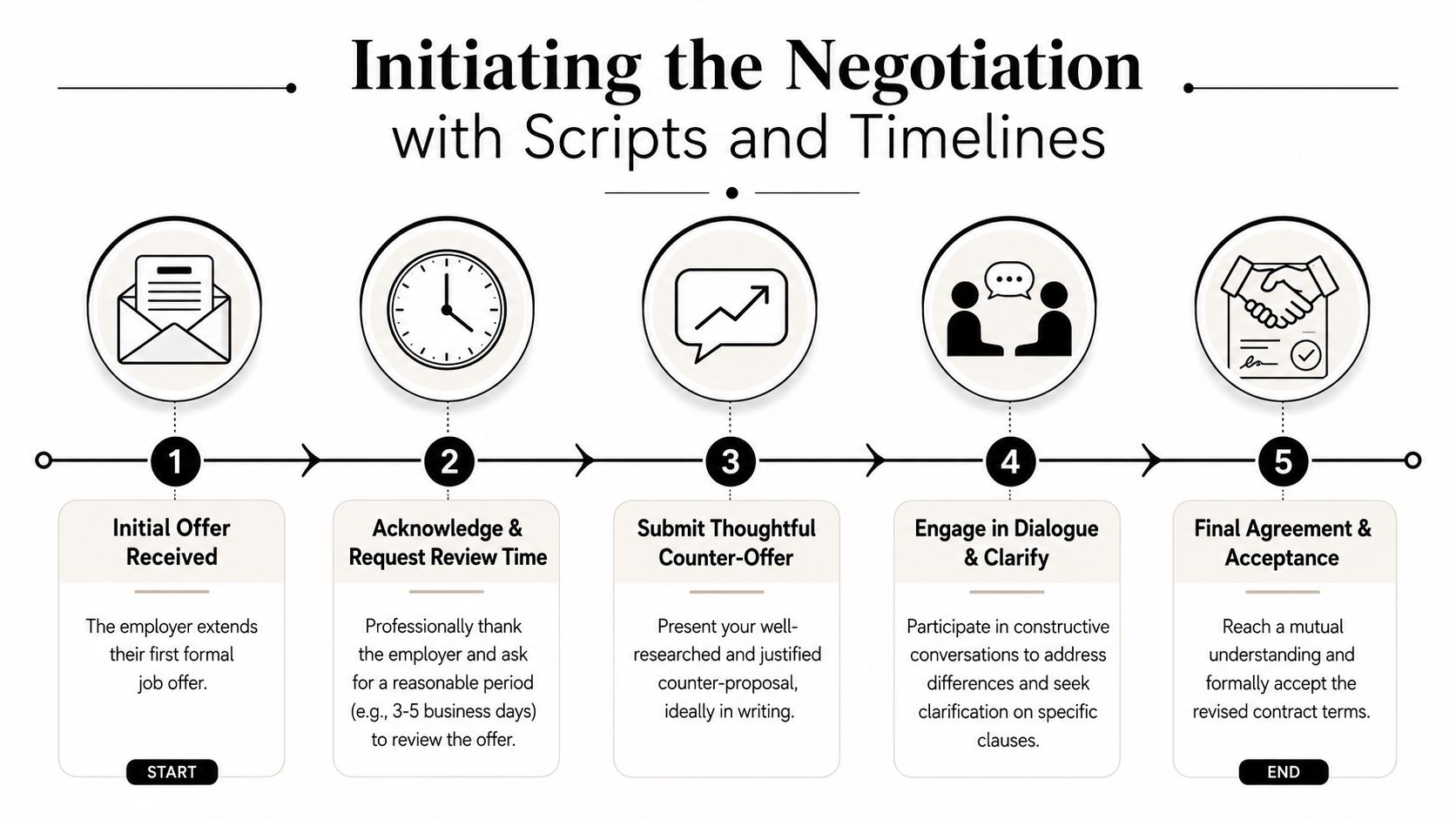
The opening move sets the tone. You don't need a hard-edged performance. You need a calm, organized response that signals two things: you're interested, and you review contracts carefully.
A simple reply works well:
“Thank you for the offer. I'm excited about the role and would like a few business days to review the compensation structure, schedule expectations, and contract terms carefully. I'll send my questions and any proposed revisions in one organized response.”
That language buys time and shows professionalism. It also tells the employer you won't negotiate by scattered email fragments.
Use an LOI for alignment, not commitment
A Letter of Intent can be helpful early because it sets mutual interest and basic business terms before everyone spends time and legal fees on the full agreement. But the legal line matters. An LOI is non-binding, and clinicians should never accept a verbal offer or relocate based only on an LOI, because the signed employment agreement is the document that controls the relationship, as explained in this physician-focused LOI versus employment contract review.
That means you can use an LOI to align on salary range, broad schedule structure, start timing, or key termination principles. You cannot treat it as protection.
Later in the process, it helps to watch how experienced recruiters frame the conversation. This video gives a useful overview of the cadence involved.
A workable timeline and a usable script
The timeline doesn't need to be fancy. It needs to be orderly.
- Offer arrives. Acknowledge receipt and ask for review time.
- You review. Mark high-impact issues first: compensation mechanics, schedule, call, termination, non-compete, malpractice.
- You respond once. Send a concise written counter with grouped edits.
- They answer. Clarify what changed, what didn't, and what remains verbal.
- Legal review and signature. Only after final language matches the deal.
If salary is one of several issues, don't lead with a bare number. A package-based script works better:
“I'm enthusiastic about the position. For me to move forward confidently, I'd like to revisit three points: base compensation, the definition of call expectations, and the without-cause termination language. If we can tighten those areas, I think we'll have a strong fit.”
For a broader communication framework, this practical guide to salary negotiation from Professional Careers Training is useful because it emphasizes tone and rationale rather than theatrics.
Handling Employer Pushback and Spotting Red Flags
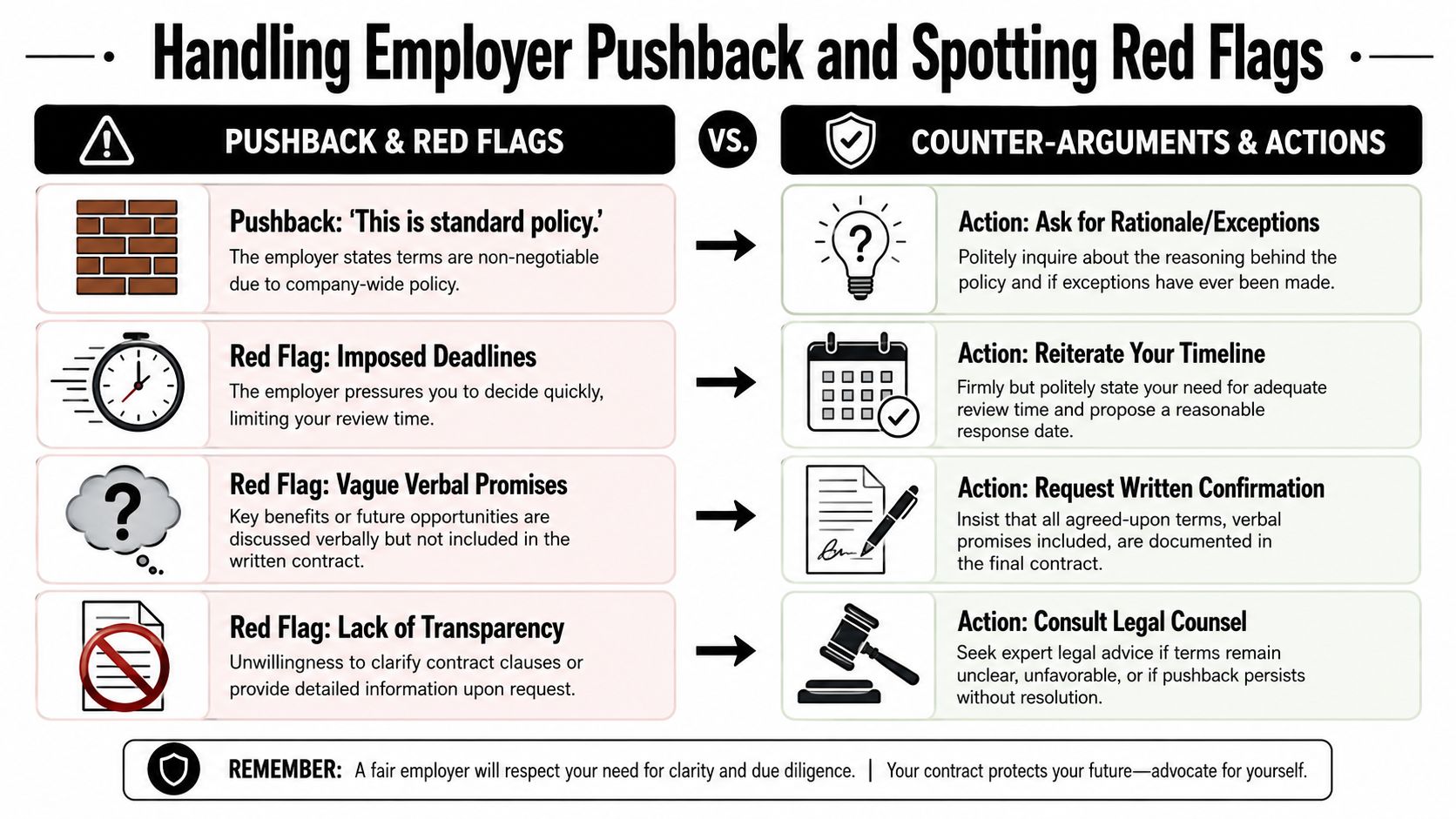
When an employer says, “This is our standard contract,” they usually mean it's standard for them, not that it's fair for you. Boilerplate is where one-sided risk hides. The right response isn't outrage. It's a request for rationale and precision.
What to say when they resist
A few responses work consistently because they keep the focus on mutual fit.
- If they say the contract is standard: “I understand it may be your standard template. I'm asking to clarify how these terms apply to my actual role, especially call, termination, and compensation details.”
- If they say there's no budget: “I'm open to discussing the package structure. If base salary is fixed, I'd like to review PTO, CME support, schedule protections, or a compensation review point.”
- If they say call can't be promised: “If call is part of the role, I need the frequency, backup structure, and compensation defined in writing so expectations are clear on both sides.”
Vague promises usually mean future disagreement.
The key move is reframing. A no-call request is not a comfort request. It's a sustainability request. Defined hours are not a luxury term. They protect retention, continuity, and the quality of your clinical judgment over time.
Red flags worth taking seriously
Some contract problems are fixable. Others tell you how the organization operates.
| Red flag | Why it matters | What to do |
|---|---|---|
| Short fuse signing pressure | Limits careful review and increases error risk | Ask for a firm review window |
| Verbal promises only | Unwritten terms disappear after start date | Require written insertion |
| Vague patient volume or call language | Lets the employer expand expectations later | Request exact definitions |
| One-sided termination terms | Leaves you exposed if the role deteriorates | Negotiate mutual, clear notice |
| Silence on malpractice tail | Can create a major exit cost | Clarify responsibility early |
Tail coverage often gets ignored until departure. Before signing, understand how claims-made coverage works and who pays for the tail. This overview of tail coverage in malpractice insurance is a useful starting point for the issue list you bring back to the employer.
Know when “no” is useful information
A declined request isn't always a deal-breaker. A dismissive culture often is. If the employer refuses to define core expectations, avoids written commitments, or pressures you to sign before you understand the contract, believe the behavior. Negotiation isn't just about improving terms. It's also one of the best previews you'll get of how conflict is handled after you join.
Your Negotiation Questions Answered
Should you hire a healthcare attorney
Yes, in many contracts.
If the offer includes productivity pay, a restrictive covenant, repayment language, tail exposure, or vague definitions around schedule and workload, get legal review before signing. Clinicians often focus on salary and bonus first. The expensive problems usually sit elsewhere, in termination language, call expectations, supervision obligations, and malpractice details that become painful only after the job changes or the relationship deteriorates.
A good healthcare attorney does not replace your negotiation judgment. They protect you from contract language that gives the employer room to expand duties, reduce flexibility, or shift costs later.
How do you ask for a rolling compensation review
Few clinicians ask for this directly. In my experience, the ones who do are better positioned to raise compensation once their panel fills, their RVUs become clear, or the employer expands their scope.
Ask for a defined compensation review at 6 or 12 months, then at regular intervals after that. Put the trigger and process in writing. Good review language ties compensation to measurable factors such as patient volume, collections, RVUs, service-line growth, added procedures, or supervisory duties. That matters for burnout prevention too. If workload rises faster than pay, the contract starts rewarding overextension.
A simple ask sounds like this: “I'd like the agreement to include a formal compensation review after 12 months, based on panel size, productivity, scope, and market benchmarks, with any adjustments documented in writing.”
What PTO should an NP or PA consider acceptable
The better question is how much protected recovery time remains after the employer subtracts sick leave, CME, licensing, and mandatory training. A large PTO number can still produce a poor deal if all of it sits in one bucket.
Review the structure, not just the headline number. Separate vacation, CME, and sick time when possible. If the employer refuses to separate them, calculate the true number of days you can use to recover. For many clinicians, that number says more about long-term job sustainability than a small salary bump.
Ask one more question that often gets missed. Are weekends, call days, and inbox coverage handled in a way that lets PTO function as real time off, or are you still cleaning up patient messages during leave?
How should you approach malpractice tail
Use direct questions. What type of policy is this, who pays the premium, and who pays for tail if the job ends?
Get each answer into the contract. Tail cost can materially change the value of an offer, especially if you may leave within a few years. It also affects your negotiating priorities. A higher signing bonus can disappear quickly if you later owe a large tail bill out of pocket.
Should you negotiate schedule terms as aggressively as salary
Yes.
Defined clinic hours, protected admin time, call limits, inbox coverage rules, and documented expectations for weekends should be negotiated with the same discipline as compensation. Employers may frame these as lifestyle preferences. They are operational terms tied to retention, error prevention, and whether the job remains safe to do well over time.
If an employer can define your productivity targets down to the decimal, they can define your call burden and work hours with equal precision. That is not a luxury ask. It is basic contract hygiene.
WeekdayDoc helps clinicians evaluate roles with an eye on both compensation and burnout risk. If you're comparing offers, reviewing no-call or weekday-only positions, or trying to see how salary and work pattern affect long-term financial goals, WeekdayDoc offers job listings, market tools, and contract-review resources built for that decision.