Administrative Burden in Healthcare: Causes, Costs
Understand administrative burden in healthcare, its impact on clinician burnout and patient care, and practical strategies to reduce it
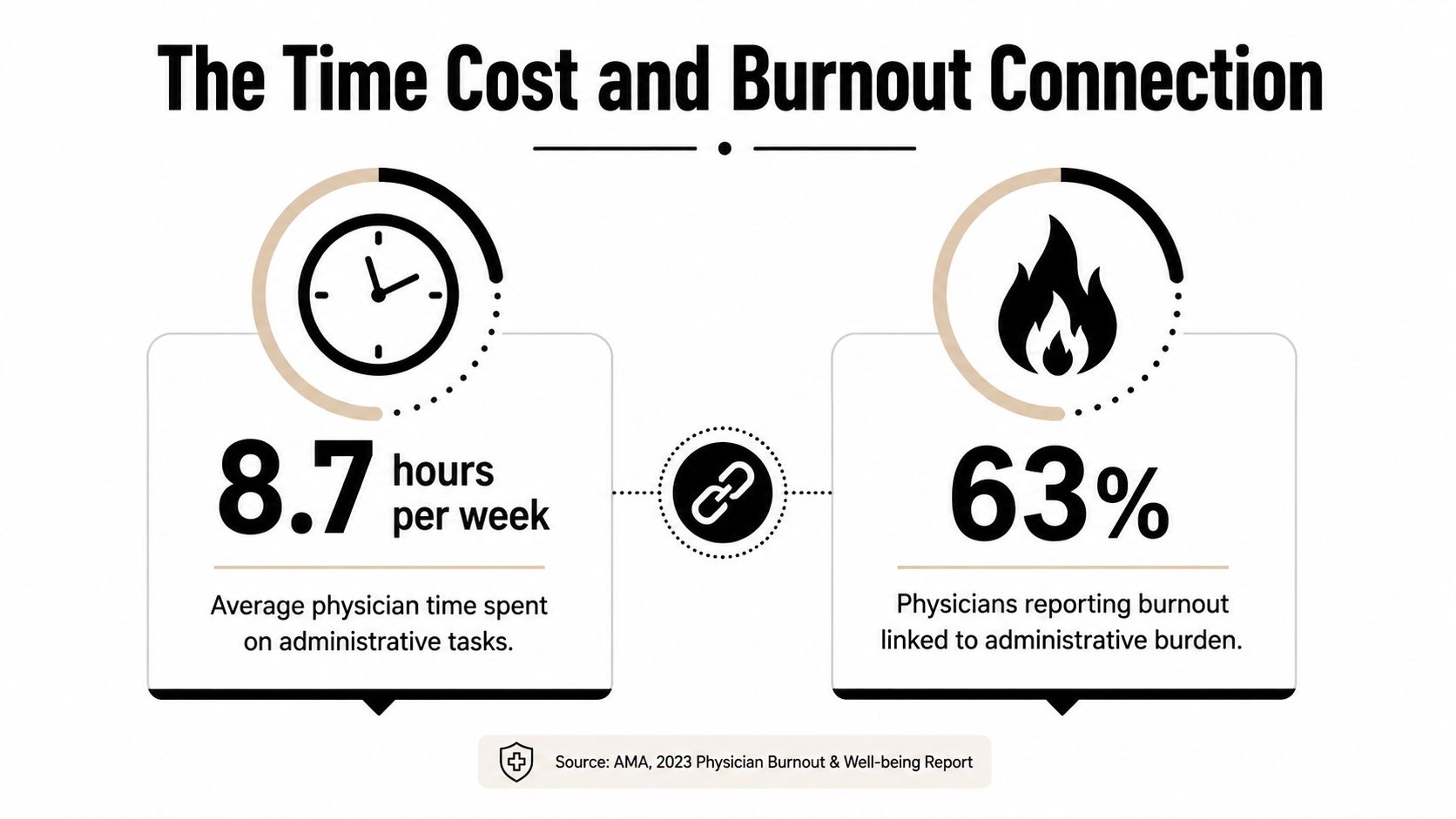
Physicians in a nationally representative U.S. survey reported spending 8.7 hours each week on administrative tasks, or 16.6% of their working hours. The same study linked heavier administrative load with lower career satisfaction, even after adjusting for income and other factors. The published physician survey makes the central point clearly: administrative burden isn't a minor inconvenience around clinical work. For many clinicians, it is part of the job itself, and it increasingly follows them home through the EHR.
That matters when you're comparing jobs. A role with attractive compensation can look very different once unpaid charting, prior authorizations, inbox management, quality reporting, and documentation corrections occupy evenings. The right question isn't only, “What will I earn?” It's also, “What work will I be expected to perform, who will support it, and when will it happen?”
The Scale of Administrative Burden in U.S. Healthcare
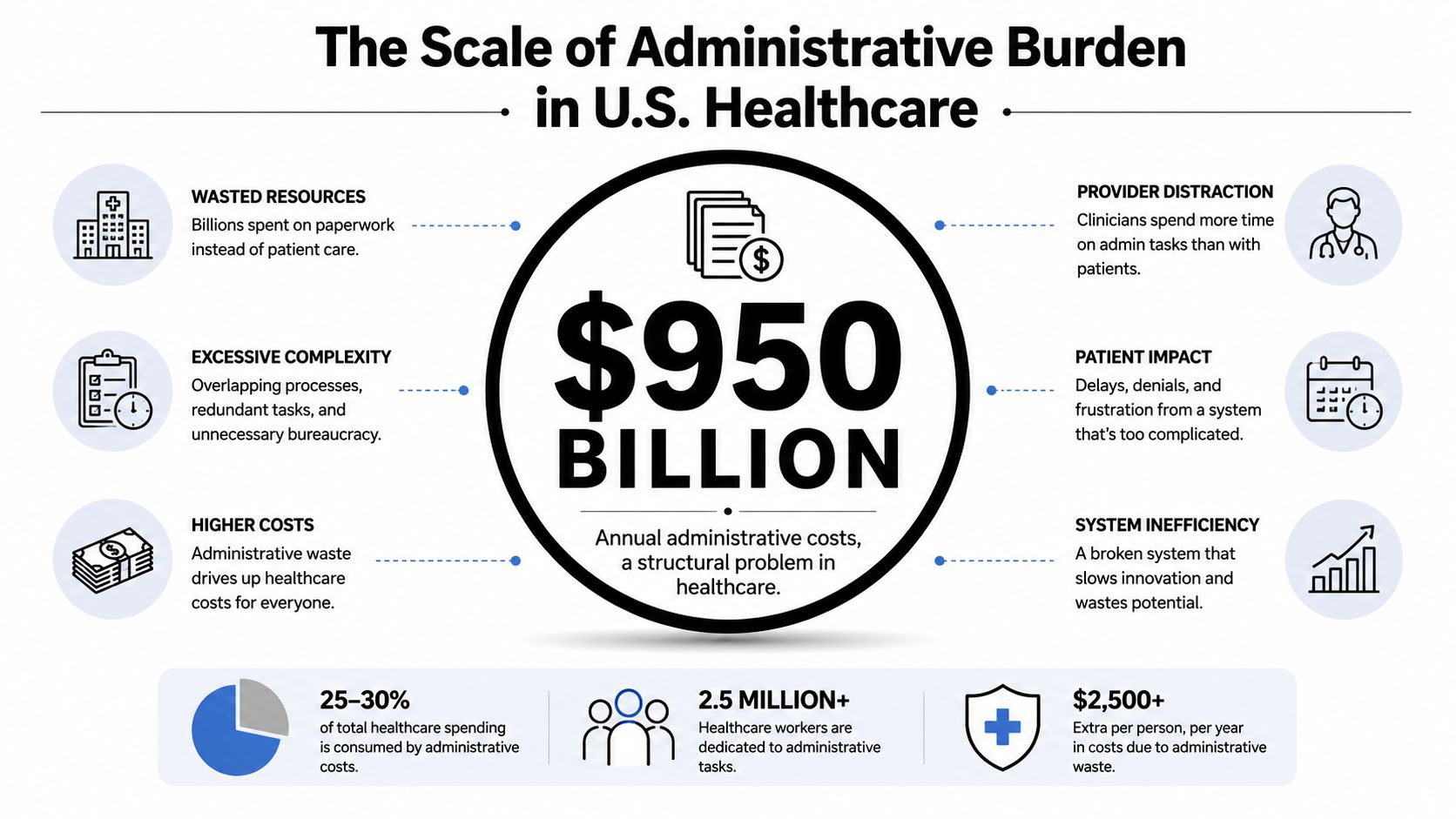
An analysis estimated U.S. administrative spending at $950 billion in 2019, with 94% concentrated in five major functional areas, including financial transactions, operational functions, and administrative clinical support. The underlying analysis of administrative costs also describes administrative expenses as roughly 15% to 25% of total national healthcare expenditures, equivalent to approximately $600 billion to $1 trillion annually.
Those figures change how clinicians should interpret the daily grind. Billing questions, coding clarification, payer portals, claim appeals, compliance reports, and documentation requests aren't isolated annoyances caused by a disorganized office. They're visible symptoms of a healthcare economy that has built a large cost center around moving information, proving eligibility, obtaining payment, and satisfying overlapping requirements.
Why the burden keeps returning
Historical estimates show persistence rather than a temporary spike. One earlier synthesis placed excess billing-and-insurance-related administrative costs at roughly 7% to 8% of national health spending, while older research cited in that review estimated administrative costs at $156 billion in 2007, with projections reaching $315 billion by 2018. These estimates use different methods and years, so they shouldn't be added together, but they point in the same direction. Administrative burden has remained embedded in the operating model of modern healthcare.
The practical consequence is easy to recognize. A clinician may complete the patient encounter in the exam room, then spend additional time translating that encounter into billing language, quality measures, payer requirements, referral documentation, and defensible medical necessity. The work may be distributed across physicians, NPs, PAs, nurses, psychologists, pharmacists, coders, and front-office staff, but distribution doesn't make it disappear.
Practical rule: Treat administrative work as part of the job's workload, not as background noise around the workload.
Revenue-cycle processes deserve particular attention because they determine whether clinical work creates additional documentation and follow-up. A useful overview of healthcare revenue cycle operations can help you identify where billing, coding, eligibility, denials, and payment workflows intersect with clinical responsibilities.
Where Administrative Burden Actually Lives
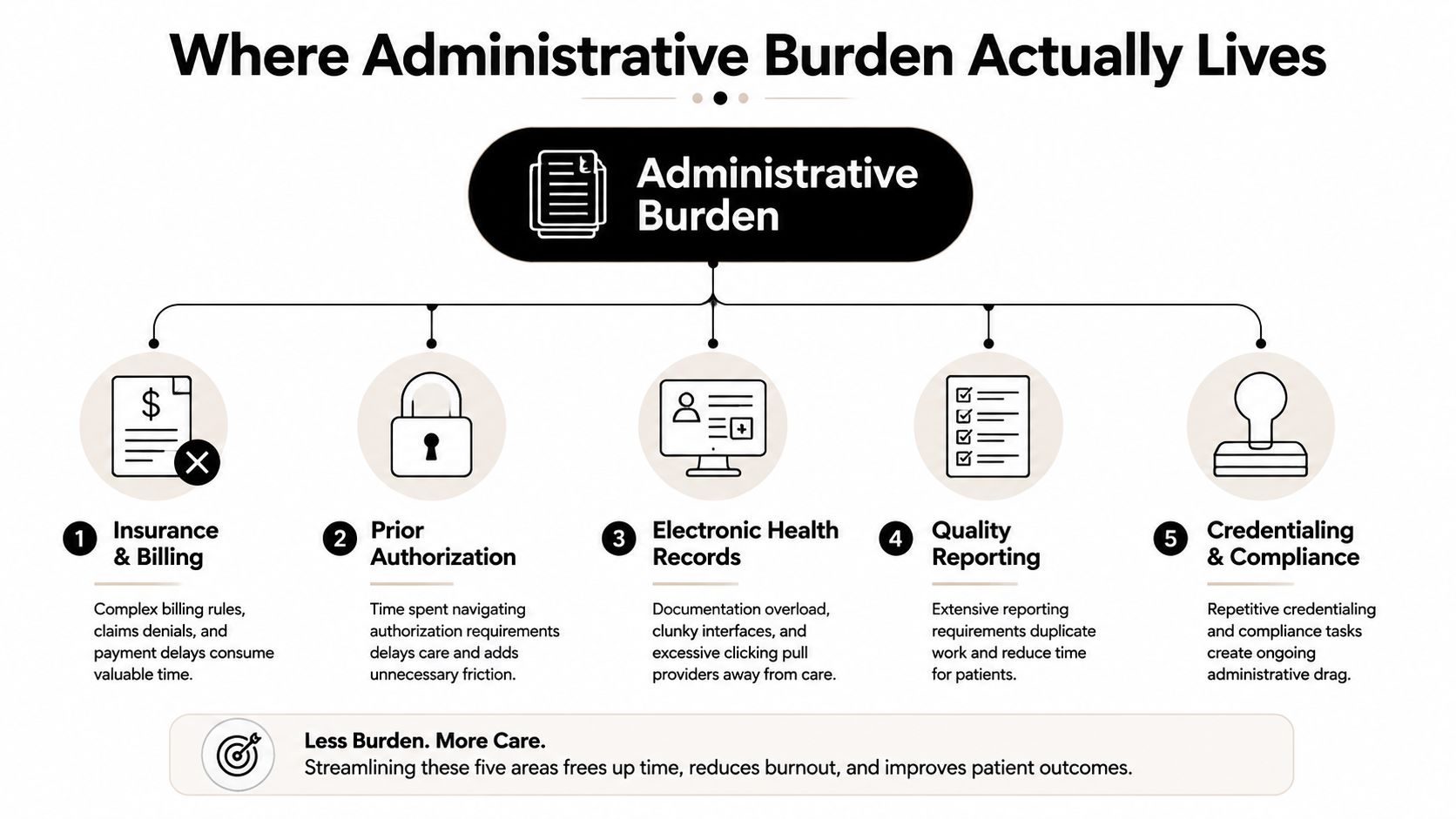
“Paperwork” is too broad to guide a staffing decision. Administrative burden becomes manageable only after you identify the workflow creating it. In practice, the load usually appears across five connected areas.
Financial transactions and insurance friction
Billing and claims work includes selecting codes, correcting rejected claims, answering payer questions, documenting medical necessity, and appealing denials. Clinicians often experience this burden indirectly. A note may be clinically complete but still return for a missing element, incompatible code, insufficient specificity, or payer-specific requirement.
Prior authorization is a separate pressure point. It can delay treatment, interrupt prescribing, and force clinical staff to repeat information already present in the record. The operational question isn't only whether a practice has authorization support. Ask whether that support is centralized, trained, reachable, and enabled to resolve routine payer requests without repeatedly returning them to the clinician.
Operational functions
Scheduling, referral coordination, credentialing, compliance reporting, and staffing coverage all shape the clinical day. A schedule that looks full but contains poorly managed buffers, complex referral handoffs, or frequent documentation interruptions can create more administrative strain than a role with a similar patient volume and better operational design.
Credentialing and compliance also matter during onboarding and throughout employment. Repeated requests for licenses, attestations, training records, and payer enrollment information can consume staff capacity and delay the start of clinical work.
Administrative clinical support
EHR documentation, medication reconciliation, quality measures, inbox messages, forms, and result management sit close to patient care but aren't the same as face-to-face care. That proximity often makes them easy for organizations to shift onto clinicians. The clinical documentation improvement resource is useful for distinguishing documentation that supports care from documentation added primarily to satisfy external requirements.
Patient-facing administration and regulatory work
Patients complete intake forms, referral paperwork, benefits checks, consent documents, and portal communications. When the system is difficult to use, clinicians frequently become the escalation point. Patients with limited digital access, disabilities, language barriers, or complex coverage may need more support, and the practice may not have designed the workflow around that reality.
Regulatory requirements then overlay every category. Reporting, record retention, audit preparation, and required attestations can be reasonable individually, but their combined effect creates a steady stream of work that no single dashboard captures.
The Time Cost and Burnout Connection
8.7 hours of administrative work per week represents 16.6% of physicians' working hours. The survey cited earlier also found the highest proportion among the specialties studied among psychiatrists, at 20.3%, and linked heavier administrative load with lower career satisfaction. More extensive EHR use was associated with greater administrative burden, showing how digital systems can improve information access while adding workflow overhead. The survey results
EHR documentation has made this labor more visible and measurable. A meta-analysis of 28 studies found physician documentation time rose from 16% of total workload before EHR implementation to 28% afterward. Nurses' documentation time increased from 9% to 23%, while interns' rose from 20% to 26%. The EHR documentation meta-analysis describes the trade-off clearly: digitization can improve record access while increasing time spent documenting.
The hidden shift into personal time
The most damaging work is often the work pushed beyond scheduled hours. AMA data published in 2025 reported that 22.5% of physicians spent more than eight hours on the EHR outside normal work hours, up from 20.9% in 2023, while reported burnout remained 43.2%. The AMA discussion of after-hours EHR work explains why a shorter scheduled week may not improve work-life balance. The EHR can follow clinicians home.
That pattern changes how clinicians should assess a job. Ask whether charting, inbox coverage, forms, and result follow-up fit inside paid hours, then ask how often clinicians finish them at home. A role may offer attractive clinical hours while requiring substantial evening work.
Recovery time is the trade-off. Clinicians may preserve access, close charts, and answer patients, but the nominal schedule no longer reflects the actual job. A practical guide to reducing provider burnout can help teams examine workload design alongside individual resilience. Coping strategies help, but they cannot indefinitely compensate for unresolved administrative work.
How Administrative Burden Harms Patient Access
Administrative burden doesn't stop at the clinician's inbox. In a U.S. patient survey, 73% of respondents completed at least one healthcare administrative task during the previous year, and 24.4% overall reported that those tasks delayed or caused them to forgo care. The patient-access study frames administration as an access issue, not merely a workforce complaint.
The most important finding concerns disability status. Disability had the strongest association with both completing administrative tasks, with an adjusted odds ratio of 2.91, and experiencing administrative burden, with an adjusted odds ratio of 1.66. The detailed analysis of disability and administrative burden shows that the same process can impose very different costs on different patients.
Where access breaks down
A prior authorization request can require a patient to wait while a clinician supplies additional documentation. A referral can stall when the receiving office needs information the sending office believes it already provided. A benefits question can become a chain of portal messages, phone calls, and forms that patients must manage while ill, working, caregiving, or navigating disability-related barriers.
These failures are often described as patient noncompliance. That label can be inaccurate. A patient who doesn't complete a complicated referral process may be confronting inaccessible forms, unclear instructions, transportation limitations, limited energy, or an insurance system that requires persistent follow-up. Administrative load can turn a routine clinical recommendation into a test of time, health literacy, digital access, and endurance.
The clinician's ethical stake
Reducing administrative burden protects clinicians, but it also protects continuity of care. A practice that assigns referral tracking to a named team, gives patients clear ownership of next steps, and escalates stalled authorizations before treatment is delayed is addressing access at the workflow level.
The best interventions don't ask patients to become better administrators. They remove unnecessary steps, make responsibility visible, and provide human support where digital self-service fails. That approach is especially important for patients whose disability or other access barriers already make healthcare navigation more difficult.
Evaluating Administrative Burden Before Accepting a Job
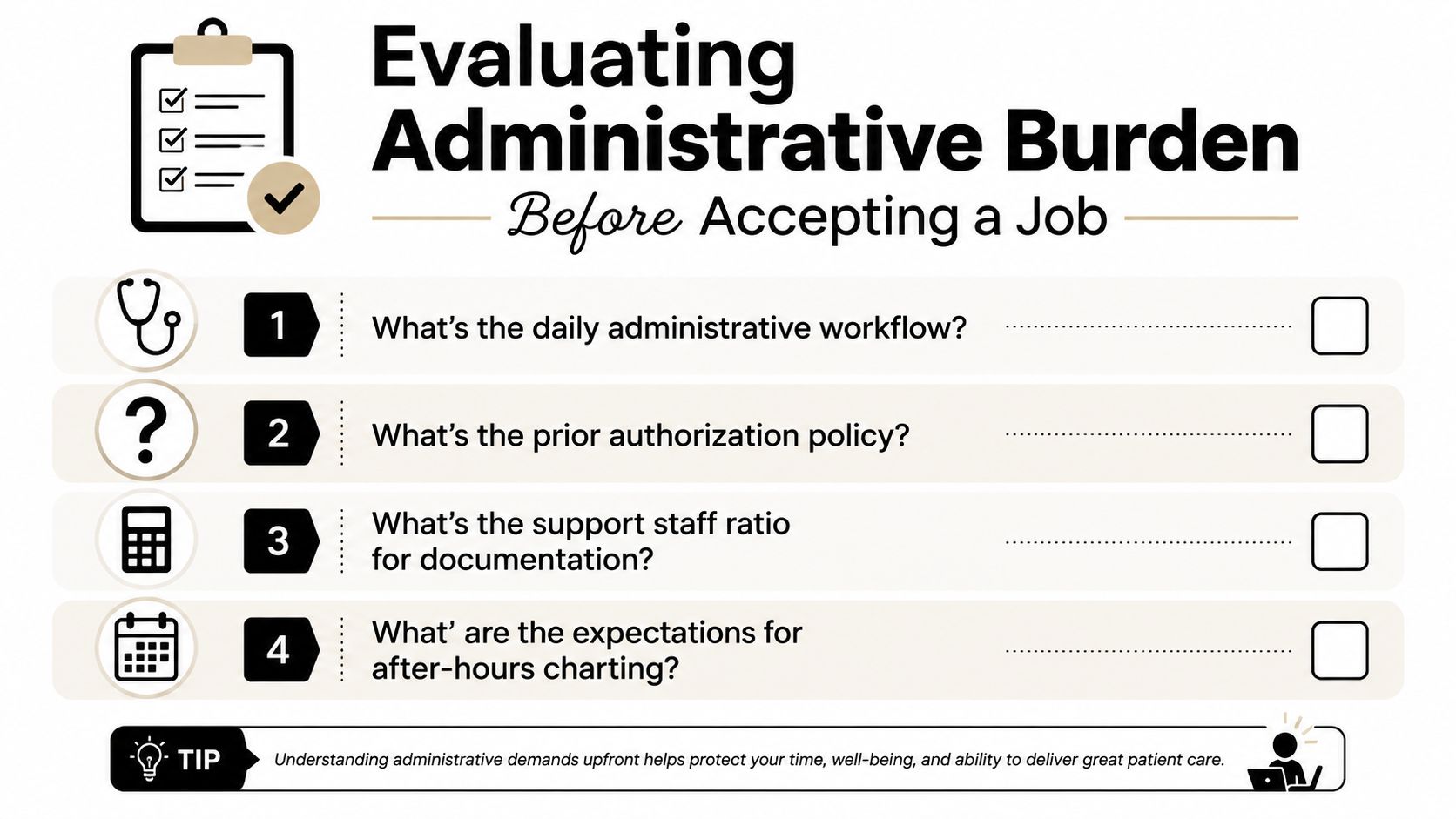
A job interview should include a workload audit. Employers may describe a role as outpatient, flexible, or weekday-only while leaving the administrative expectations undefined. Those omissions matter because after-hours charting and payer work can change the job more than the posted schedule does.
Ask for the workflow, not the promise
Use direct questions and listen for operational answers.
- Prior authorization ownership: Who submits requests, who tracks them, and when does the clinician become involved?
- Documentation support: Are scribes, medical assistants, nurses, or centralized documentation teams available, and what do they handle?
- EHR expectations: Which EHR is used, how much customization exists, and what work is expected after clinic hours?
- Inbox coverage: Who manages refill requests, results, forms, patient messages, and urgent escalations during leave or scheduled days off?
- Billing accountability: Does the organization provide coding feedback and claim support, or does the clinician personally resolve recurring billing problems?
- Quality reporting: Which measures affect compensation, and who gathers the underlying data?
The answer “everyone helps with everything” often means ownership is unclear. A stronger answer names the role responsible, the escalation pathway, and the boundary around clinician involvement.
Read vague language as a signal
Phrases such as “participates in administrative duties,” “supports practice needs,” or “handles other duties as assigned” aren't automatically disqualifying. They are prompts for clarification. Ask for a representative week, including the work performed before the first appointment and after the last scheduled patient.
Also ask to speak with a current clinician without a manager present. Find out whether charts close during scheduled hours, whether staff routinely message clinicians after work, and whether the posted schedule reflects the time people spend working.
Compensation should reflect the complete workload. Use WeekdayDoc's market analysis as one reference point for comparing active listings, but don't treat salary alone as proof that a role is sustainable. A higher figure may compensate for a heavier administrative expectation.
Practical Strategies to Reduce Administrative Burden
Start with the work you can see. For two weeks, record every administrative interruption, including its source, owner, time of day, and whether it required clinician judgment. Don't rely on memory. The pattern often reveals that a small number of recurring workflows create most of the frustration.
Individual changes
Optimize the EHR around repeated clinical decisions. Build appropriate templates, use structured phrases carefully, and remove fields that add no value to care or required compliance. Templates can save time, but poorly designed templates create cloned documentation and more review work, so test them with real encounters rather than assuming automation helps.
Delegate by decision threshold. Staff can gather missing information, prepare forms, track authorization status, and route routine requests. Clinicians should retain decisions requiring clinical judgment, but they shouldn't be the default owner for every administrative step.
Set a defined charting boundary. If the organization expects same-day closure, it needs to provide enough protected time or staffing to make that expectation realistic. A personal boundary can't solve an impossible workload, but it can make the mismatch visible.
Practice-level redesign
A practice can centralize prior authorization work, create standard referral pathways, and train staff to recognize incomplete submissions before they reach the payer. It can also review the inbox by category, assign clear ownership, and measure how often messages return to clinicians because the first workflow failed.
Forms deserve the same scrutiny as EHR templates. A free patient referral form example can help a practice review whether its own referral form captures the information receiving offices need. The aim isn't to add another form. It's to remove back-and-forth communication by making the necessary information clear at the outset.
Scribes and documentation teams may reduce clinician time, but they require investment, training, privacy safeguards, and quality review. Automation can route work, but it shouldn't be used to shift verification responsibility back to the clinician without reducing the underlying task.
System-level work
Organizations should challenge measures that duplicate one another, simplify payer requirements, and improve interoperability. Value-based care can support better outcomes, but measurement becomes counterproductive when clinicians document for the metric rather than for patient care.
The most durable improvements usually require leadership to remove steps, not merely teach staff to complete them faster. That can affect revenue, reporting completeness, or short-term productivity. Those are real trade-offs, and leaders should state them openly rather than presenting every reduction effort as cost-free.
Finding Low-Administrative-Burden Roles with WeekdayDoc
A job search can screen for administrative burden before you invest time in interviews. WeekdayDoc's listings include a Burnout-Friendly Score, salary information, work-style details, and markers such as No Call and No Weekends. Those signals don't prove that a role has no administrative work, but they help separate schedule flexibility from the broader question of how the practice operates.
Use the tools as a review sequence:
- Start with role design. Compare remote, telehealth, part-time, and weekday-only positions, then ask what documentation, inbox, referral, and authorization work remains attached to each role.
- Check productivity expectations. The RVU Calculator can help you understand how productivity targets may interact with documentation demands.
- Inspect the contract. Use the Contract Scanner to identify clauses covering administrative duties, call, availability, chart completion, and duties outside scheduled patient care.
- Compare compensation with workload. The Salary Calculator Pro provides another way to assess whether the compensation matches the role's stated structure and your broader financial goals.
A remote role may reduce commuting and offer schedule control, but it can still carry substantial EHR and inbox work. A part-time position may protect clinical hours while creating pressure to complete full-time administrative tasks. “No weekends” helps define availability, but it doesn't answer whether charting happens at night.
For clinicians prioritizing location flexibility, remote healthcare jobs can be a useful category to examine alongside the actual workflow questions above. The strongest evaluation combines the posting, the contract, the compensation model, and candid conversations with current staff.
WeekdayDoc helps clinicians compare burnout-conscious roles using administrative-burden indicators, schedule filters, salary information, and practical evaluation tools. Visit WeekdayDoc to assess your next opportunity by the work you'll perform, not just the hours printed in the job description.