Compressed Work Week Schedules: A Clinician's Guide
Explore compressed work week schedules for clinicians. Compare 4/10 vs 9/80 models, understand legal risks, and see how they impact burnout and FIRE goals.

In 2022, 59% of U.S. companies said they were open to a four-day workweek structure according to Atlassian's summary of employer attitudes. For clinicians, that matters less as a workplace trend and more as an advantage. Hospitals, medical groups, telehealth companies, and ambulatory practices are under pressure to recruit people who won't tolerate a permanently fragmented week.
That doesn't mean compressed work week schedules are automatically good jobs. Some are burnout prevention tools. Others are just the same workload packed into longer, harder days with sloppy coverage rules and vague payroll language.
I've seen the difference in negotiations. A well-built compressed schedule gives a clinician cleaner boundaries, fewer commute days, better recovery time, and more control over family logistics or side income. A poorly built one gives you a nominal “extra day off” that gets eaten by inbox work, refill requests, late charting, and texts from the team asking who's covering what.
For physicians, NPs, PAs, psychologists, and pharmacists, the key question isn't whether compressed work week schedules sound appealing. It's whether the schedule fits your specialty, protects patient care, and is written tightly enough that you benefit from it.
The New Clinician Schedule Is Not a 9-to-5
Clinicians rarely work a clean five-day office week. Even in ambulatory practice, the job extends beyond scheduled visits into inbox management, refill requests, prior authorizations, care coordination, and documentation that follows you home.
That mismatch matters. A schedule built around fixed clinic hours does not reflect how U.S. clinical work is staffed, measured, or paid.
Compressed work week schedules are getting traction for that reason. For clinicians, the appeal is not novelty. It is the chance to group work more intentionally, reduce fractured time, and create recovery blocks that are large enough to matter. That can help with burnout, but only if the off day stays protected and the compensation model does not implicitly absorb more unpaid work.
Why the shift matters now
Employer attitudes have changed enough that schedule redesign is no longer limited to unusual employers or one-off accommodations. In clinical settings, that creates two practical openings.
- Better job selection: More groups will at least discuss alternate scheduling structures during recruiting.
- Better negotiating position: Current employers are more likely to view compressed scheduling as a retention tool, especially in hard-to-staff specialties and markets.
I would still treat employer enthusiasm carefully. A compressed schedule helps only when leadership can explain who covers results, refill requests, patient messages, and urgent follow-up on the day you are out.
Practical rule: If a group offers a compressed schedule but cannot define coverage, charting expectations, and communication boundaries, expect your "day off" to turn into remote admin time.
The Underlying Need Behind Schedule Requests
Burned-out clinicians are often asking for something more specific than fewer hours. They want fewer handoff points, fewer commute days, and less constant switching between patient care and administrative cleanup.
A compressed schedule can help by changing the shape of the week. Four longer clinical days may be easier to sustain than five days that all spill into the evening. One protected weekday can absorb errands, child care logistics, recovery, or side income that supports a FIRE plan. For a physician with a long commute or a psychologist with a telehealth-heavy panel, that difference can be financially meaningful as well as personally meaningful.
The trade-off is straightforward. Longer days increase cognitive load, especially in high-acuity practice, procedure-heavy settings, or clinics with unstable staffing.
When this works best
Compressed work week schedules fit best in roles with predictable templates, clear cross-coverage, and low ambiguity after hours. They fit poorly when the clinician remains the default owner of every message, lab result, and patient issue regardless of what the calendar says.
How to Protect Care Quality
Care quality depends less on the compressed model itself and more on the operating rules around it. If visit demand is packed into fewer days without adjusting panel size, support staff, or message coverage, the schedule can worsen delays and increase charting spillover. If the practice builds the model with clear handoffs and realistic daily volume, the extra day off can improve recovery without hurting continuity.
The schedule is only as good as the system behind it. For U.S. clinicians, that means judging compressed work by staffing design, payroll terms, and coverage expectations, not by the promise of a three-day weekend.
Decoding Compressed Work Models 4/10 vs 9/80
A compressed work week is a fixed schedule in which a full-time employee works the standard full-time load in fewer than five days. The most common versions are the 4/10 and 9/80 models, and one practical upside is that they can reduce biweekly commute time by 25%.
For clinicians, those two models feel very different even when they look similar on paper.
How the two models differ
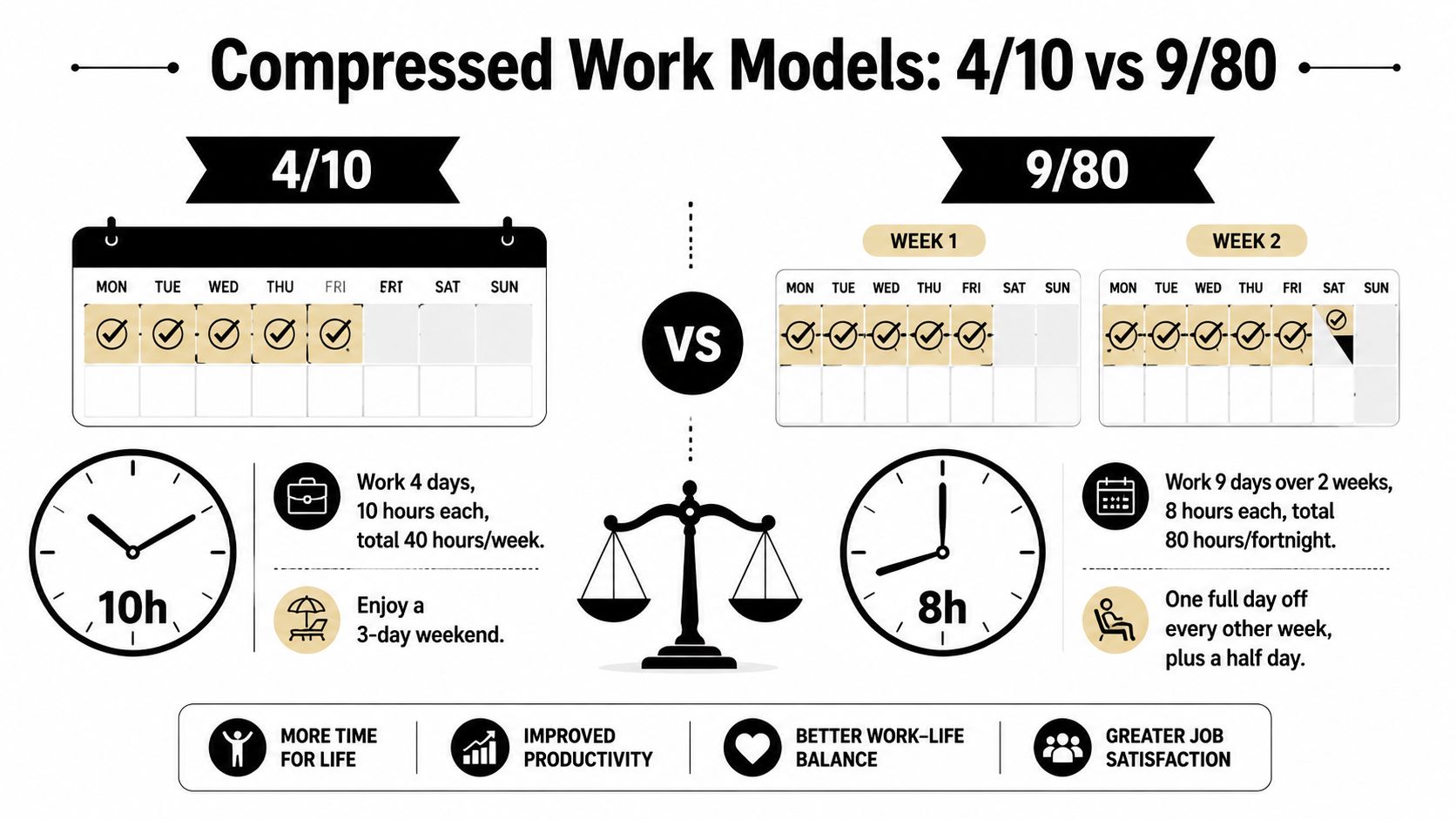
The 4/10 schedule is straightforward. You work four days, ten hours each day, for a total of forty hours in one week. In most settings, that creates a weekly three-day weekend.
The 9/80 model runs across two weeks. You complete eighty hours over nine workdays instead of ten. In practice, that usually means one full day off every other week, often paired with a shorter day elsewhere in the pay period depending on how the employer structures it.
| Feature | 4/10 Schedule (Four 10-Hour Days) | 9/80 Schedule (80 Hours over 9 Days) |
|---|---|---|
| Basic structure | 40 hours in 4 days | 80 hours in 9 days |
| Time off pattern | One extra day off every week | One extra full day off every other week |
| Weekly feel | More intense daily rhythm | Closer to a standard workday cadence |
| Best fit | Roles with clean clinic blocks and predictable handoffs | Roles needing steadier weekday continuity |
| Main trade-off | Longer individual days | More payroll and scheduling complexity |
What each model feels like in real clinical life
A 4/10 schedule gives you a true recurring nonclinical day. That's useful for primary care, psychiatry, psychology, telehealth, ambulatory specialty clinics, utilization review, and many remote roles where continuity can be maintained without daily physical presence.
A 9/80 arrangement often works better when a team needs more weekday overlap. It preserves a more familiar daily pace while still creating periodic recovery time. For clinicians in collaborative outpatient practices, infusion settings, or administrative-medical hybrid roles, that can be easier to operationalize.
The right model depends less on preference than on where your work accumulates. If your tasks pile up at the end of each day, 4/10 can feel heavy. If your tasks pile up across the week, 9/80 may be easier to sustain.
Questions to ask before choosing
- How is charting time handled: Is documentation expected inside the scheduled block or after it?
- What happens on your off-day: Are you fully off, or are you still expected to monitor messages?
- Who covers urgent results and refills: The answer determines whether the schedule is real or cosmetic.
- How are meetings scheduled: A compressed model fails fast when your “off” day becomes the default meeting day.
For clinicians, the most important distinction isn't 4/10 versus 9/80. It's whether the operating model matches the math.
Clinical Impact and Patient Care Considerations
Longer shifts always change clinical performance. Sometimes the change is manageable. Sometimes it isn't.
The mistake is assuming all compressed work week schedules carry the same clinical risk. They don't. A ten-hour outpatient telepsychiatry day is not the same as a twelve-hour inpatient nursing shift. The cognitive load, physical demands, handoff patterns, and margin for fatigue-related error differ.
Where the evidence draws a line
One clear caution comes from nursing. European nurses working at least 12-hour shifts under compressed schedules reported lower care quality, more care left undone, and higher burnout rates compared with those on 8-hour schedules, according to the Scandinavian Journal of Work, Environment & Health.
That matters even if you're not a nurse. It establishes a practical threshold. As shifts get longer, fatigue can start to interfere with quality and task completion in ways that are clinically visible.
For physicians, NPs, PAs, psychologists, and pharmacists, the direct lesson is simple. Longer days can work. Excessively long days in high-intensity settings can become unsafe.
The real risks in clinician schedules
Compressed schedules tend to break down in familiar ways:
- End-of-day decision fatigue: The final hours of a long clinic can be where callbacks, inbox judgment, and chart accuracy slip.
- Charting debt: Ten scheduled hours can become twelve actual hours if the visit template leaves no documentation margin.
- Handoff ambiguity: If no one clearly owns urgent results, off-days stop being off.
- Patient continuity gaps: Some specialties tolerate this well. Others don't.
A psychologist with longer therapy blocks may benefit from fewer transition days. A primary care PA managing same-day access and refill volume may find the off-day creates message congestion unless the team redesigns coverage. A pharmacist in a high-throughput environment may tolerate compressed scheduling only if staffing remains stable across the longer shift.
Longer days are safest when the schedule includes fewer decisions at the margins. That means tighter templates, cleaner handoffs, and fewer “one more thing” add-ons after the session should be done.
What actually protects care quality
Compressed work week schedules work best clinically when employers redesign workflows rather than just stretching hours.
Three moves matter most:
- Build explicit handoffs. Labs, urgent messages, and refill rules need named coverage, not informal goodwill.
- Protect admin time inside the shift. If all documentation is displaced to home hours, the model isn't compressed. It's hidden overtime.
- Match intensity to specialty. High-acuity procedural or hospital work usually has less tolerance for long-day fatigue than structured ambulatory care.
The safest compressed schedule is usually the one with the least ambiguity, not the one with the most enthusiasm.
Navigating Legal Payroll and Contract Complexities
Compressed schedules sound simple until payroll and contract language get involved.
Legally, the structure matters. Under the U.S. Federal Employees Flexible and Compressed Work Schedules Act, a compressed schedule is defined as a full-time employee completing an 80-hour biweekly requirement in fewer than 10 workdays, as discussed in this Georgetown legal review of federal compressed scheduling rules. That federal definition doesn't answer every private-sector question, but it's a useful baseline because it shows that compressed scheduling is not an informal handshake concept. It's a schedule architecture with legal consequences.
Exempt versus non-exempt changes the risk
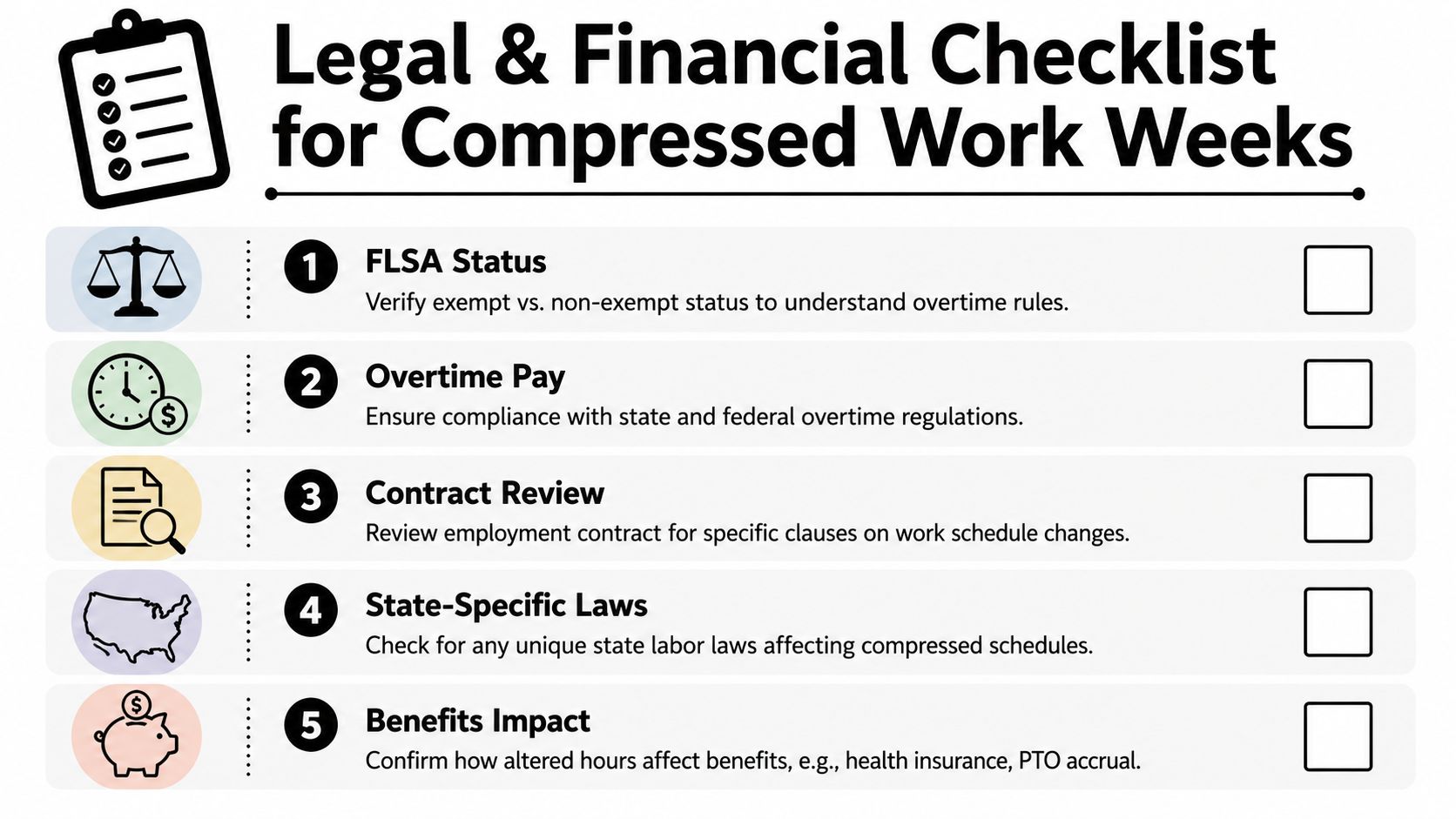
Most employed physicians are exempt. Many NPs, PAs, psychologists, and pharmacists may be exempt too, but not always. If you're non-exempt, compressed work week schedules can create overtime problems quickly if the employer doesn't define the workweek carefully and track hours accurately.
That's why the contract language matters more than the recruiting conversation. If the offer says “four ten-hour days” but leaves after-hours charting, mandatory meetings, training time, or cross-coverage undefined, you may be agreeing to a schedule that exceeds the intended structure without clear compensation.
Clinicians reviewing offers should scrutinize:
- The defined workweek: Payroll systems need a precise week boundary.
- Hours expectations: “Approximately” is often where trouble starts.
- Meeting and admin obligations: If they sit outside scheduled hours, they still count.
- Coverage obligations on off-days: The contract should state whether you are expected to monitor anything.
Contract terms that need to be explicit
When I review compressed arrangements, I look for operational clauses before I look at lifestyle promises. You want the employment agreement to answer who covers urgent patient needs, how schedule changes can be made, and whether your “off” day can be unilaterally reassigned.
A useful starting point is this guide to employment agreement terms, especially if you're trying to identify vague language around duties, scheduling authority, and compensation triggers.
Contract lens: If your extra day off exists only in the clinic template and not in the signed agreement or policy language, it's fragile.
Why legal review matters in practice
State law and wage rules can complicate compressed scheduling, especially for non-exempt clinicians and multi-site employers. Groups that want to implement these models well usually involve counsel early because schedule errors often become pay disputes later. For a practical example of how employers think about protecting businesses from wage disputes, wage-and-hour guidance can be instructive even from the employee side. It shows where sloppy scheduling and timekeeping usually lead.
The compressed schedule that looks elegant on a whiteboard can become expensive and contentious if nobody defines the hours with precision.
The Impact on Clinician Burnout and Financial Independence
There's a reason clinicians keep revisiting compressed schedules even after the novelty wears off. Done well, they can change both your fatigue curve and your financial options.
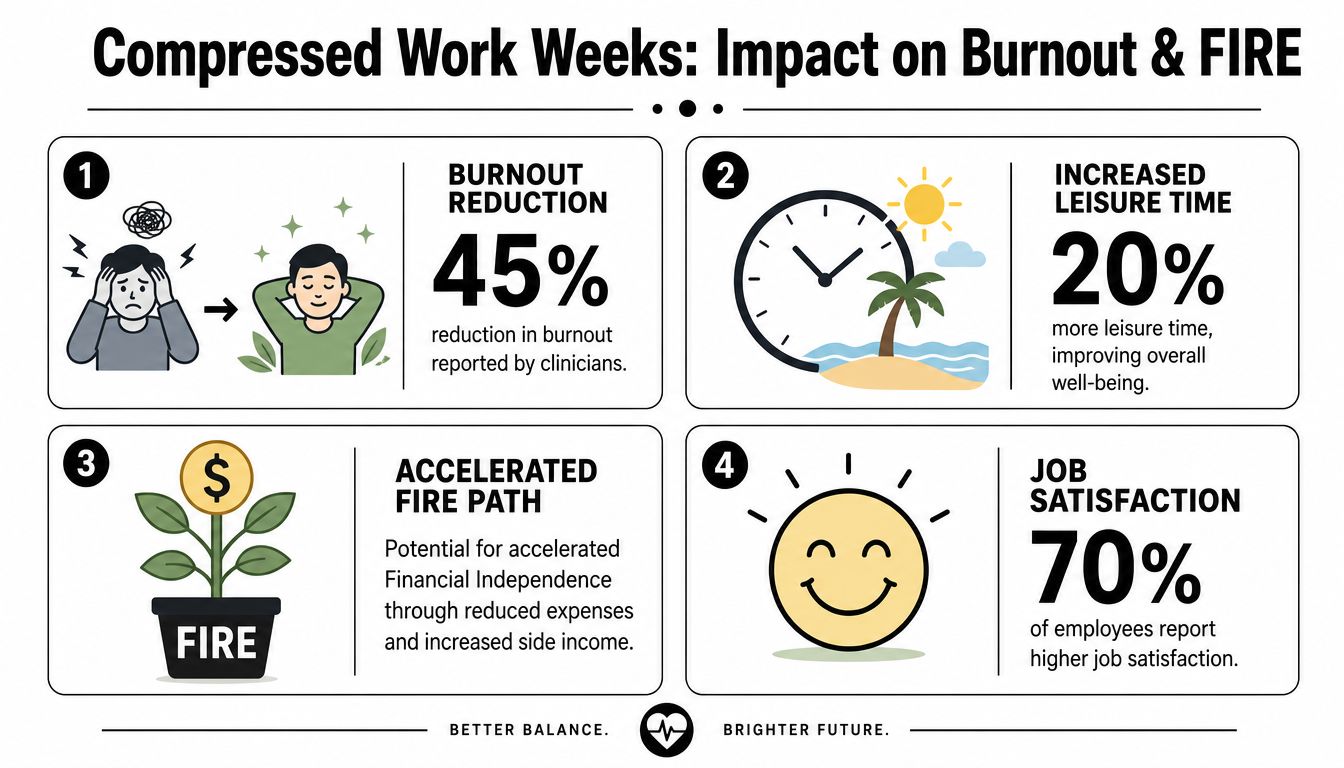
The strongest evidence isn't that people become magically more productive. It's that the schedule can improve how work feels without reducing output. In longitudinal data, perceived productivity remained stable while fatigue (λ = −.31, p < .001) and time pressure (λ = −.39, p < .001) decreased after adoption of a compressed schedule, provided employees had medium-to-high expectations of benefit, according to this longitudinal analysis of compressed scheduling outcomes.
Why burnout can improve without lower productivity
That pattern makes sense clinically. Burnout isn't just about total hours. It's about fragmentation, unpredictability, and the feeling that every day contains a little unfinished work.
A compressed schedule can help by creating fuller recovery periods and cleaner boundaries. For some clinicians, one protected weekday off is more restorative than spreading the same strain over five partially interrupted days.
The qualifier matters. The benefit depended on expectations. In practice, that means clinicians who understand how the schedule works, prepare for longer days, and protect deep work inside those days are more likely to do well than clinicians pushed into the arrangement without operational support.
The financial angle most people miss
Compressed work week schedules can also support a FIRE strategy, though not because they directly increase pay.
They can improve the economics of your week in several ways:
- Fewer commute days: Less driving, parking, transit, and incidental spending.
- Better control of paid help: Some clinicians can reduce childcare or household outsourcing on a protected weekday.
- More usable time for side income: Consulting, medicolegal work, teaching, telehealth moonlighting, or content work becomes easier when you have a recurring block of time.
- More space for financial admin: Insurance review, tax planning, and portfolio maintenance are easier when they don't get pushed to exhausted weekends.
If FIRE is part of your long-range plan, schedule design matters. A clinician with slightly less fragmented time often makes better decisions than a clinician with nominally similar income but no recoverable bandwidth.
A solid primer on that framework is how to achieve financial independence.
The clinicians who benefit most aren't the ones chasing a trendy four-day week. They're the ones using schedule design to reduce friction across work, money, and recovery.
What doesn't work
Compressed scheduling won't help if the employer treats your off-day as overflow capacity. It also won't help if longer clinic days convert into evening charting at home.
The model supports burnout reduction and financial flexibility only when the off-day is protected and the longer days are engineered, not improvised.
Sample Schedules and How to Negotiate for Them
The easiest way to judge compressed work week schedules is to look at how they run.

What these schedules look like in practice
An outpatient psychiatrist might work Monday through Thursday with longer visit blocks and protected admin time late in the day, keeping Friday fully off for recovery, family, or consulting work.
A primary care PA might prefer a 9/80 structure in a larger group where every-other-Friday off creates breathing room without losing continuity with the care team.
A psychologist doing telehealth may tolerate a 4/10 schedule well if sessions are deliberately paced and documentation is closed inside the day. A pharmacist in ambulatory care might accept a compressed model only if refill coverage and inbox ownership are clearly reassigned on the off-day.
What separates workable examples from bad ones is operational maturity. Teams that already use formal handoffs, shared protocols, and predictable staffing can absorb compressed schedules far better than teams that rely on informal rescue behavior.
Some employers also use dedicated workforce systems to manage hospital staff shifts and related coverage logistics. That doesn't solve every problem, but it tells you the organization may be thinking about scheduling as an operational process rather than a favor.
How to negotiate a compressed schedule
Don't pitch this as “I want Fridays off.” Pitch it as a controlled pilot with measurable guardrails.
Use a framework like this:
- Start with role fit: Explain why your specialty and patient flow can support a compressed model.
- Name the coverage plan: Identify who owns urgent results, refills, same-day messages, and cross-coverage.
- Define success metrics: Patient access, chart closure, patient complaints, RVU consistency, and team burden are all fair operational checkpoints.
- Set a review window: A pilot period works better than an indefinite ask.
- Ask for written terms: Verbal flexibility disappears when staffing pressure rises.
A good companion before any negotiation is how to evaluate job offers, because the schedule only matters if the underlying role is sound.
Here's a useful walkthrough on the broader idea of compressed scheduling and four-day work structures:
The script that usually works best
Keep it concrete. Try something like this:
I'd like to propose a compressed schedule pilot for this role. The goal is to preserve productivity and patient access while improving schedule sustainability. I'm proposing explicit coverage rules for urgent items, protected documentation time within scheduled hours, and a defined review point after the pilot.
That framing reassures leadership that you're solving for continuity, not just personal convenience.
Is a Compressed Schedule Right for Your Career
Compressed work week schedules are rarely neutral. They either fit the shape of your clinical work, or they expose every weak point in the job.
They tend to work well for clinicians in structured outpatient settings, telehealth-heavy roles, utilization management, consulting, and practices with disciplined team coverage. They tend to work poorly where acuity is high, handoffs are loose, meeting creep is constant, or documentation already spills into the evening.
Before you say yes, test the schedule against a short checklist:
- Can your specialty tolerate longer days without quality slipping?
- Is your off-day protected from clinical work?
- Are coverage rules explicit, not assumed?
- Does the contract define the schedule with enough precision to protect pay and boundaries?
- Will you use the extra time in a way that improves your life, finances, or recovery?
The right compressed schedule can reduce fatigue, improve control, and create room for a more durable career. The wrong one just concentrates the stress.
That's why schedule design should be part of career strategy, not an afterthought buried in onboarding.
WeekdayDoc helps clinicians find roles built around work-life protection, including remote, hybrid, and in-person jobs with clearer boundaries around call, weekends, and schedule intensity. If you're evaluating compressed work week schedules, use WeekdayDoc to compare roles through a burnout-conscious lens instead of relying on vague promises in a recruiter email.