Clinicians' Guide: How to Achieve Financial Independence By
Clinicians: Learn how to achieve financial independence in 2026. Optimize income, manage debt, and find burnout-friendly roles. Practical, no-fluff strategy.

You finish a long clinic day, open your pay stub, and feel two things at once. Your income is high enough that financial independence should be possible, but your schedule makes it hard to imagine sustaining this pace for another decade.
That tension is the primary clinician money problem. For physicians, NPs, PAs, psychologists, and pharmacists, the question isn't only how to save more. It's how to protect the earning engine in the first place. If your job structure pushes you toward burnout, your highest-value asset, your ability to earn a strong income for years, is under threat.
Beyond the Paycheck Financial Independence as Career Longevity
A lot of clinicians treat financial independence as an exit plan. I think that's too narrow. Used well, it becomes a pressure-relief valve. It gives you options before you need to quit, not after you've already hit the wall.
That matters because burnout isn't theoretical. The AAMC 2025 workforce survey reports that 42% of resident and early-career physicians are considering leaving clinical practice within five years due to burnout, and 68% of those cite excessive call schedules and weekend shifts as primary drivers. If you're building a financial plan while ignoring schedule design, you're planning around the wrong variable.
Income matters, but durability matters more
A clinician who earns well for a long stretch in a sustainable role often ends up in a stronger position than someone who chases a bigger paycheck inside a role they can't tolerate. The common mistake is comparing jobs only on headline compensation.
The better comparison looks like this:
| Job factor | Higher-burnout role | Burnout-friendly role |
|---|---|---|
| Schedule | Call-heavy, weekends, unpredictable | Predictable weekdays, clearer boundaries |
| Career risk | Higher chance of reducing hours or leaving | Better odds of staying clinically engaged |
| Financial effect | Income may look stronger on paper | Income may be easier to sustain |
| Life outside work | Often reactive | More room for planning and recovery |
I've seen clinicians underestimate the cost of chronic schedule friction. Missed recovery time leads to bad financial choices. People spend reactively, cut back hours unexpectedly, delay contract review, and stop managing their money because they don't have the bandwidth.
Financial independence isn't only about replacing your paycheck. It's about gaining enough control that one bad schedule, one bad administrator meeting, or one bad quarter doesn't trap you.
What actually works
The clinicians who make progress usually do three things at the same time:
- Protect earning capacity: They choose roles they can stay in, not just survive.
- Keep fixed expenses reasonable: They avoid building a lifestyle that requires constant overtime.
- Automate the core plan: They don't rely on willpower after a twelve-hour day.
What doesn't work is building your entire strategy on heroic effort. If your plan requires endless extra shifts, permanent sleep debt, and no margin for family or health, it isn't a financial independence plan. It's a short-term income maximization plan.
For clinicians, how to achieve financial independence starts with a career design question. Can you keep earning well without sacrificing your health, relationships, or ability to continue practicing? If the answer is no, the math won't save you.
Calculate Your Financial Independence Number
Financial independence gets easier once you stop treating it like a vague dream and turn it into a number. The foundational shortcut is the 4% Withdrawal Rule. William Bengen established it in 1992, and the basic idea is straightforward: a portfolio of 25 times your annual expenses gives you a target that can support annual withdrawals of 4% to cover living costs without depleting principal, according to the financial independence overview summarizing the 4% rule.
Start with spending, not salary
Most clinicians guess their FI number from income. That's backward. Your FI number comes from spending.
If your annual household spending is $120,000, your rough FI number is $3,000,000. If your annual spending is $200,000, your rough FI number is $5,000,000. The same profession can produce very different targets because lifestyles differ more than salaries do.
Use this sequence:
- Pull real spending data: Review checking, credit card, and mortgage or rent transactions.
- Separate fixed from flexible costs: Housing, insurance, childcare, debt payments, travel, and discretionary spending need different treatment.
- Estimate post-work life realistically: Don't assume you'll suddenly become austere.
- Account for transitions: A move, growing family, or shift to part-time work changes the number.
A rough formula is useful, but a personalized calculator is better. If you want a clinician-focused walkthrough, this guide on how to calculate your FIRE number is a practical next step.
Your number should match your actual life
Clinicians often miss in one of two directions. Some inflate the target by assuming every current expense lasts forever. Others understate it by pretending they can live on a resident-style budget after years in practice.
A better standard is "stable and sustainable." Include the life you actually want, but strip out noise spending that only exists because your current job is exhausting.
Practical rule: Calculate the version of retirement or semi-retirement you could realistically live with, not the fantasy version built on either deprivation or denial.
If you want broader context on retirement planning trade-offs, Wealth Collective has a helpful overview of strategies to fund retirement that complements the FI-number exercise well.
The key point is simple. You don't need a perfect forecast to start. You need a defensible target, reviewed regularly, with enough honesty to reflect your real household spending.
Optimize Your Income with Burnout-Friendly Roles
The most expensive belief in medicine is that the "best" job is always the one with the biggest gross pay. That logic ignores longevity, recovery, and the way exhaustion distorts every other financial decision.
According to the MGMA 2025 Physician Compensation Report summary, the average annual salary for a U.S. physician is $388,000, while NPs and PAs have median compensation of $125,000 and $135,000 respectively. That headline matters, but the more useful point is that flexible roles often produce higher effective income because overhead is lower.
Compare effective income, not just annual pay
A role with slightly lower annual compensation can still be financially superior if it gives you:
- Predictable hours: You can plan childcare, exercise, admin time, and side income.
- Lower friction costs: Less commuting, fewer late cancellations at home, and fewer recovery-day expenses.
- Longer career durability: You can keep earning without constantly plotting your escape.
- More optionality: Locums, telehealth, consulting, chart review, expert work, or teaching fit more easily around a stable schedule.
This is especially relevant for clinicians evaluating weekday outpatient, telehealth, hybrid, and procedural roles. I've watched colleagues leave ostensibly premium jobs because the schedule took too much from the rest of life. Once they moved into more stable structures, their finances often improved because they stopped leaking money and energy.
The trade-off most people miss
A call-heavy job can look dominant on a spreadsheet for one year. Over a full career, the comparison shifts.
Consider the practical differences:
| Decision lens | Call-heavy role | Burnout-friendly role |
|---|---|---|
| Pay visibility | Often easier to market as "top pay" | May appear lower at first glance |
| Hour-to-hour control | Lower | Higher |
| Recovery burden | Higher | Lower |
| Ability to add strategic side income | Often limited | Often easier |
| Likelihood of staying in role long enough to compound savings | Less predictable | More predictable |
That last line is the one people ignore. A financially strong career isn't only about maximized annual pay. It's about building an earning pattern you can sustain.
If you're exploring where that balance exists across specialties and settings, this roundup of in-demand medical jobs is useful because it frames opportunity beyond the default hospital track.
The right role doesn't just pay you. It preserves the bandwidth required to use that pay intelligently.
What usually fails is chasing prestige compensation while accepting a schedule that makes you want to leave medicine altogether. What works is choosing a job structure that supports consistency. Financial independence grows faster when your career doesn't have to be rebuilt every few years.
Prioritize High-Impact Debt and Automate Savings
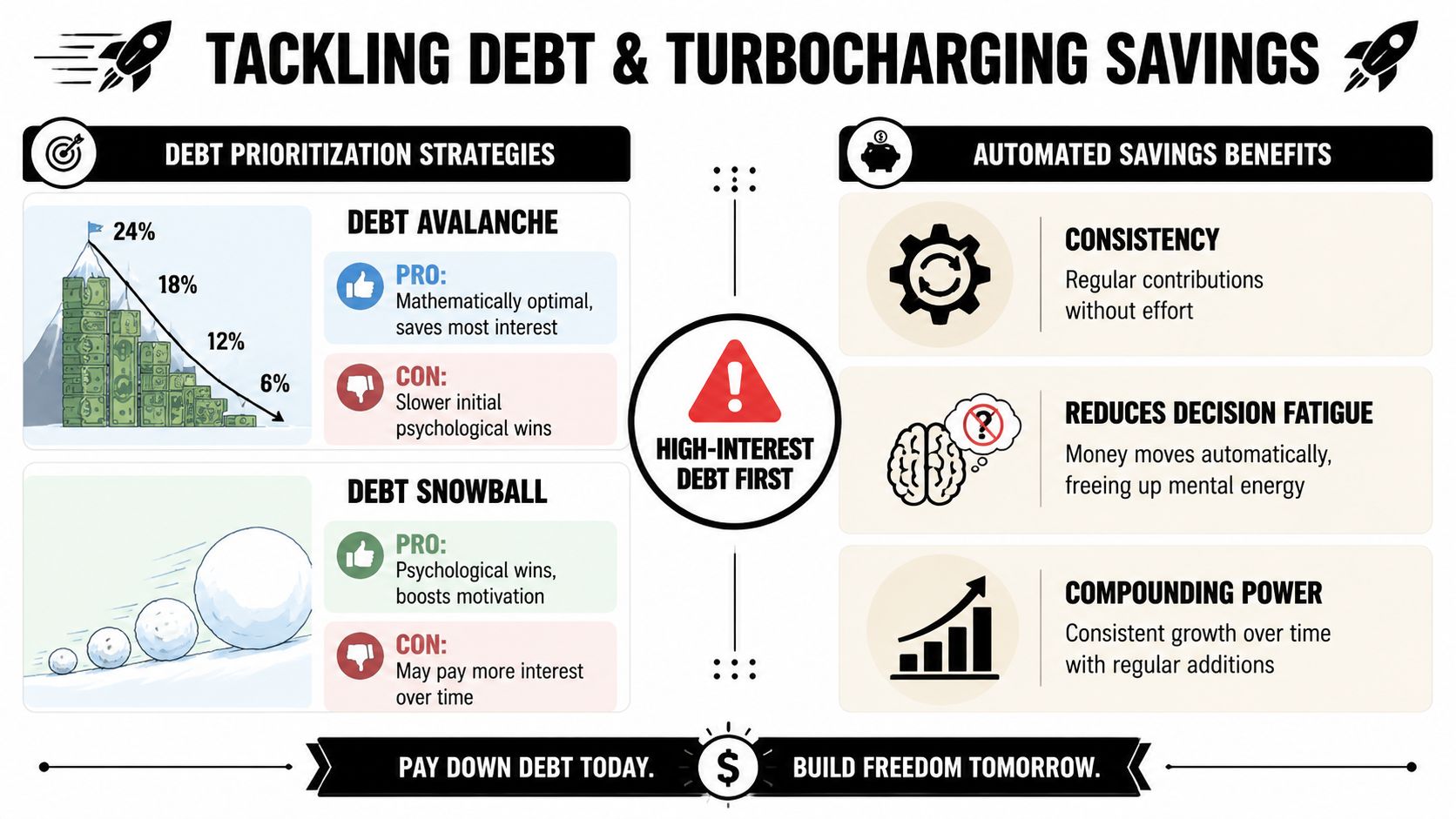
Most clinicians don't need more debt advice. They need a decision system. The core question isn't "Should I pay off loans or invest?" It's "Which use of my next dollar improves my balance sheet and my resilience the most?"
That decision gets harder when income fluctuates. A Medical Group Management Association report indicates that 68% of clinician compensation is now variable, which makes standard FI calculators built around a smooth W2 paycheck a poor fit for many clinical careers, as discussed in this WeekdayDoc resource on clinician income variability and compensation structure.
Use a two-bucket system for variable pay
If your earnings include productivity bonuses, shifts, locums, or 1099 work, stop treating every paycheck as identical. Build two buckets.
- Core income bucket: This covers mortgage or rent, insurance, groceries, minimum debt payments, childcare, and recurring investing.
- Variable income bucket: This handles extra debt payoff, taxable investing, large quarterly tax reserves, and one-time spending.
That structure keeps your baseline plan intact even when monthly pay moves around. It also stops the common cycle where a strong month triggers lifestyle upgrades and a weak month creates panic.
A simple workflow helps:
- Set your fixed monthly lifestyle from conservative baseline income.
- Automate retirement and brokerage transfers from that base.
- Route bonus or shift-based income by percentage, not emotion.
- Review quarterly, not every time a paycheck hits.
Pay down the debt that keeps costing you options
Not all debt deserves the same urgency. High-interest consumer debt is a genuine emergency because it compounds against you fast and eats cash flow. Student loans are more nuanced. The right strategy depends on rate, forgiveness path, tax status, and how close you are to practice stability.
If you're sorting through that decision, this guide on medical student loan strategy for clinicians is a solid place to pressure-test your approach.
The psychological side matters too. Some clinicians stay heavily indebted because they avoid looking directly at the numbers. Others throw everything at debt and neglect retirement accounts entirely, which can also slow long-term progress.
Decision rule: Automate the minimum investing you won't compromise, then direct extra dollars intentionally. Don't decide from scratch every month.
For households balancing debt reduction with childcare, insurance, and estate basics, Coveredly offers a practical resource on how to secure your family's financial future without treating those priorities as separate from the FI plan.
What works in real life is boring. Minimums on every required obligation. Automated investing on every pay cycle. Aggressive extra payments where the math or stress load justifies it. What doesn't work is waiting until life feels calmer. In clinical careers, that day often never comes.
Build Your Tax-Efficient Investment Portfolio
Once your cash flow is under control, investing should get simpler, not more complicated. Busy clinicians lose time and money when they chase stock picks, overtrade, or keep changing strategy after market headlines. A plain, repeatable system usually wins because you'll stick with it.
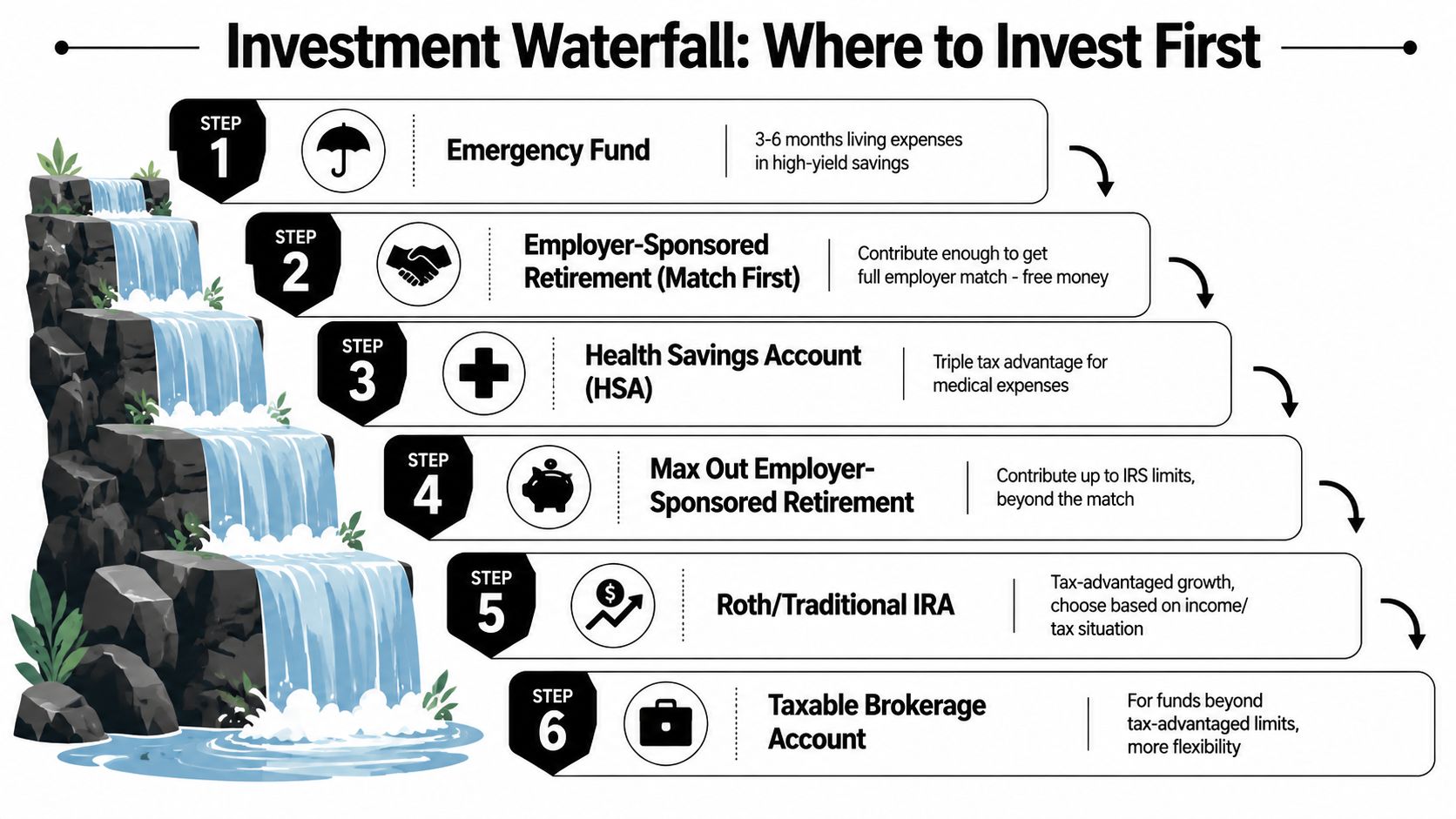
One useful lens is account priority. Put each dollar where it gets the best combination of tax benefit, employer support, and long-term flexibility.
Follow an investment waterfall
Here's the order I generally like for clinicians:
- Emergency reserve first: Keep cash for the kind of disruption medicine often creates, credentialing delays, contract gaps, unexpected moves, family leave, or a sudden desire to leave a bad job.
- Employer match next: If your 401(k) or 403(b) includes a match, take the full match before doing much else.
- HSA if you're eligible: For the right plan design, an HSA is one of the cleanest tax shelters available.
- Then complete retirement contributions: Go back and keep funding the workplace plan.
- IRA after that: Use the Roth or traditional route that fits your income and tax picture.
- Taxable brokerage last: Flexibility grows here once tax-advantaged space is filled.
That structure reduces decision fatigue. Instead of wondering where to invest each month, you already know the next account in line.
Keep the portfolio boring on purpose
The portfolio itself doesn't need to be exotic. Low-cost index funds and target-date funds remain practical choices for clinicians who'd rather spend cognitive bandwidth on patients, family, or recovery than on market timing.
The important part is consistency. AMGA data indicates that clinicians in burnout-friendly roles maintain a 22% higher annual savings rate, averaging 18% versus 14.5% over a 10-year period, which directly affects how much they can contribute to investment accounts. I won't repeat the source link here because the compensation-structure point was already cited earlier, but the lesson is clear: sustainable work makes consistent investing easier.
A simple comparison helps:
| Approach | Likely result |
|---|---|
| Constant strategy changes | More friction, less consistency |
| Automated broad-market investing | Higher odds of staying invested |
| Overconcentration in one idea | More stress and more regret risk |
| Account-priority system | Cleaner tax treatment and fewer mistakes |
Most clinicians don't need a more sophisticated portfolio. They need a system they'll still follow after a brutal week on service.
The best investment plan is the one that survives real life. That means automation, low-cost funds, and enough career stability that you don't keep interrupting the process.
Your Action Plan for the Next 6 to 24 Months
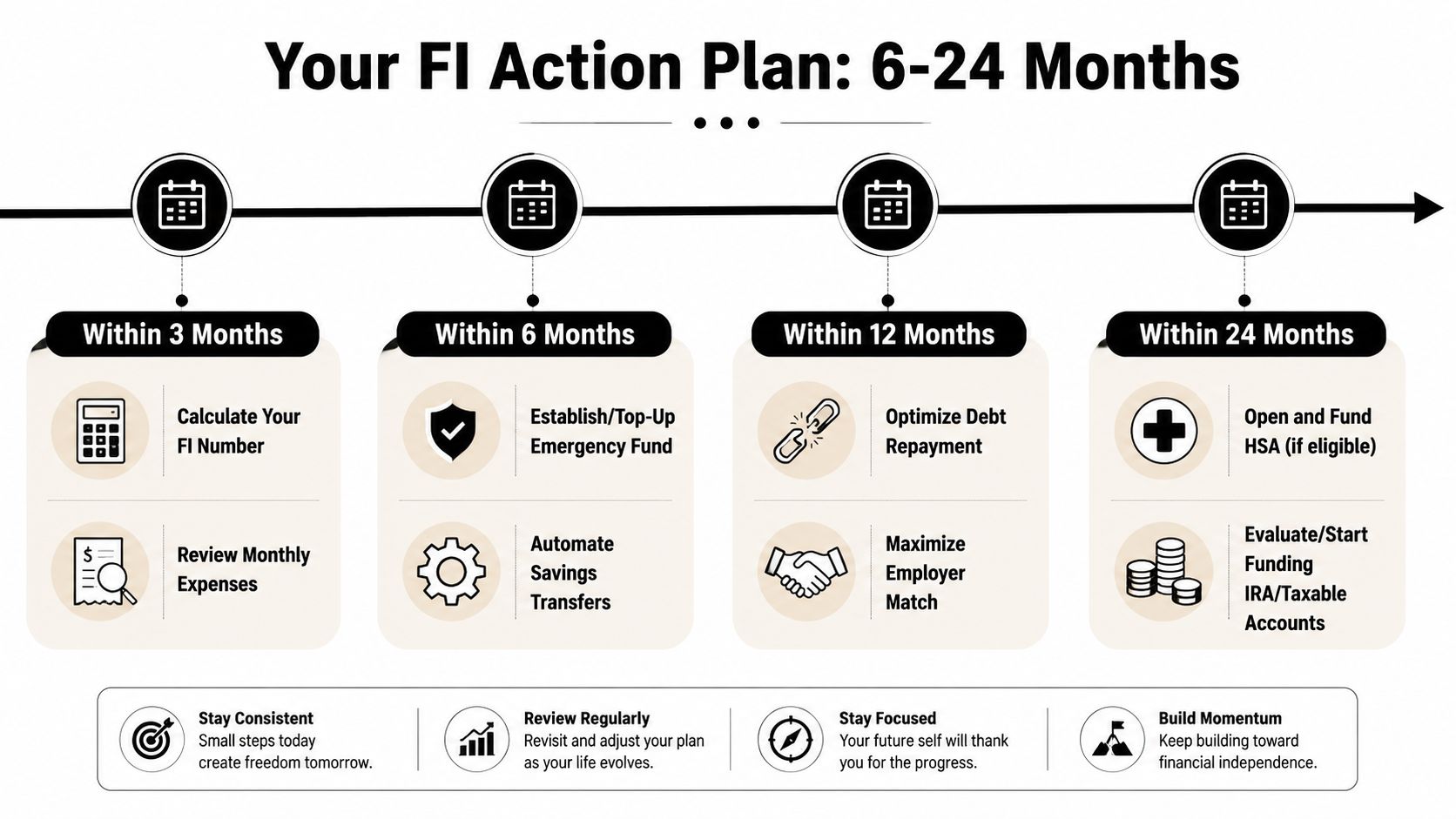
Financial independence rarely arrives through one big decision. It comes from a series of repeatable moves that lower friction and increase control. If you're serious about how to achieve financial independence, put dates on the work.
Within the next 6 months
Start with clarity. Calculate your FI number from actual spending, not assumptions. Review your current role and ask whether your schedule supports a durable career or just a decent paycheck.
Then clean up cash flow:
- Audit monthly expenses: Identify what reflects your real values and what merely compensates for exhaustion.
- Set one automatic transfer system: Retirement first, then brokerage or debt reduction.
- Build or refill emergency reserves: Career flexibility depends on liquidity.
Within 12 months
Most progress becomes visible at this stage. Tighten the structure around debt, taxes, and benefits.
A few high-value moves:
- Max the employer match: If you've been leaving matching dollars on the table, fix that first.
- Review contract terms carefully: Compensation, call burden, tail coverage, and restrictive clauses all affect your true runway.
- Standardize variable income handling: Bonus, locums, or 1099 pay should follow preset rules.
If you want a more disciplined monthly system, Fintrack has a practical piece on building a budgeting plan with AI insights. The value isn't the software hype. It's the reminder that visibility and categorization matter when your work schedule makes financial review easy to postpone.
Within 24 months
By this point, your plan should influence career choices, not just account balances. Reassess whether your current path is compatible with the life you're trying to build.
Use tools that make the decision more concrete:
- Compare compensation carefully: A role can look attractive until you adjust for taxes, schedule, and nonclinical time. A detailed salary calculator for clinicians helps you pressure-test offers.
- Review the contract before you sign: A contract scanner like the clinician contract review tool can flag terms worth a closer legal look.
- Evaluate productivity-based pay: If RVUs are part of the offer, use an RVU calculator for clinician compensation instead of relying on recruiter shorthand.
- Track market shifts: For broader compensation and hiring context, review the clinician market pulse page.
The clinicians who reach financial independence usually don't wait for a perfect season. They make their career more sustainable, automate the mechanics, and keep tightening the gap between what they earn and what they need.
If you're ready to find a role that supports both financial progress and a life outside the hospital, WeekdayDoc helps clinicians evaluate burnout-friendly jobs with clear schedule markers, salary context, and practical tools for long-term planning.