8 Work Life Balance Strategies for Clinicians
Discover 8 work life balance strategies for clinicians, from contract negotiation to job design. Build a sustainable career with less burnout in 2026.

If your clinic day keeps sliding past dinner, your inbox follows you home, and your schedule changes after you've already arranged child care, the problem usually isn't willpower. It's the job design. The strongest work life balance strategies for clinicians start with the contract, the schedule, and the support structure, because burnout rarely comes from one bad week, it comes from repeated friction that nobody wrote down.
That's also why the job search has to be more specific than “good culture” or “flexible.” Workers clearly want employers that support mental health, autonomy, and boundaries, and a major APA survey found 92% said that was important, while 32% said they didn't have enough flexibility and 26% said their employer didn't respect personal boundaries (APA workplace health and well-being survey). For clinicians, that means balance isn't a perk you negotiate after you're exhausted. It's part of the role you accept.
The best roles make the hard parts visible before you sign. The worst ones hide call, caseload, documentation, and schedule churn behind vague language. Use that difference to your advantage.
1. Scheduled Hours and Call Coverage Audit
A schedule can look reasonable on paper and still drain people once nights, weekends, and spillover work are assigned. For clinicians, call frequency and shift patterns are often the first hidden drivers of exhaustion, so I'd start with a hard audit before discussing signing bonuses or RVUs. If the employer cannot tell you exactly when you are expected to work, you do not have a real work life balance strategy yet, you have a guess.
Force the conversation into specifics. Ask for the exact rotation, the actual number of weekends, and whether “call” includes virtual triage, portal messages, or only in-person escalation. A one-week sample schedule tells you more than a recruiter's “typical week” language ever will, and the last 12 months of actual coverage from current staff tells you even more.
Practical rule: If call cannot be removed, get call-back time or comp days in writing before you sign.
Some telehealth-first psychiatry groups remove call entirely, and some urgent care chains separate roles into “No Call, Clinic Hours Only” versus shared coverage with rotating weekends. That kind of clarity matters because it turns work life balance from a promise into a line item. WeekdayDoc's compressed work week schedule guidance is useful here because it reflects the same principle, roles labeled “No Call” or “No Weekends” should only exist after hours and coverage have been explicitly verified.
The biggest mistake is accepting “some call, but it's manageable” without asking what manageable means. If the employer will not document the rotation, the burden usually lands on you later.
2. Remote and Hybrid Role Structure with Defined In-Person Days
A real hybrid role is built with a schedule that names which work happens remotely and which work happens on-site. If the employer only says you can “work from home when possible,” the arrangement is still vague, and vague arrangements usually shift the burden back onto the clinician. Clear remote days, fixed office days, and written expectations around where documentation, meetings, and patient-facing work happen reduce commute strain and make childcare or elder care planning more workable.
Some clinicians do best in fully remote telehealth roles. Others want a mixed setup, such as two clinic days and the rest remote, or one office day reserved for team meetings, supervision, and complex cases. Those models can work well, but only if the employer protects remote days from last-minute in-person requests and does not treat them as optional.
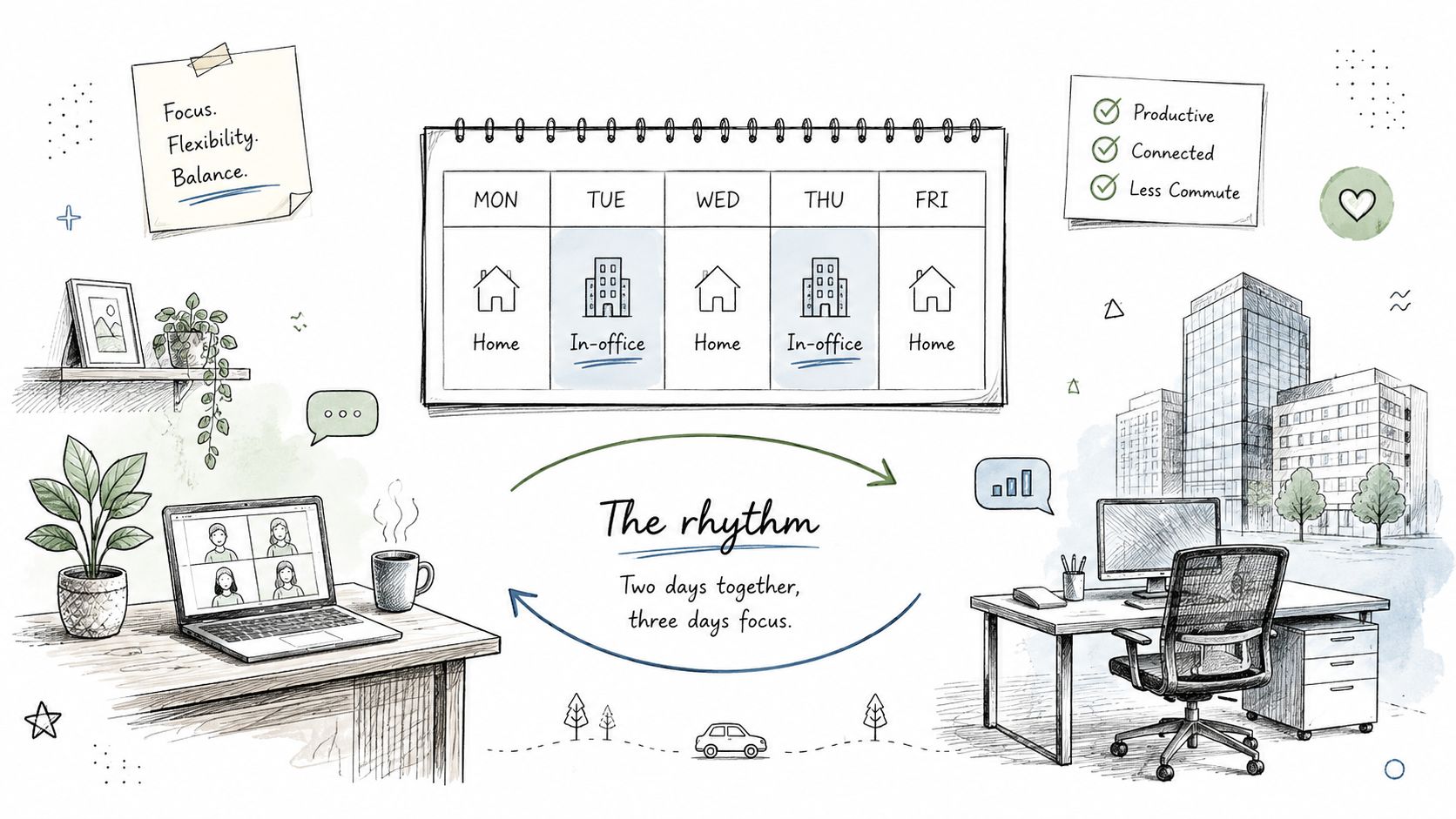
The point is not whether people like flexibility in the abstract. It is whether the role gives real control over time and place. The APA workplace health and well-being survey shows that workers report strong satisfaction with schedule control and with how, when, and where they work, but it also points to persistent gaps in flexibility and boundary respect. Clinicians feel that same tension in hybrid jobs, where a role can look flexible on paper and still be unpredictable in practice.
WeekdayDoc's remote healthcare jobs resource is useful here because the remote and hybrid filters focus on role structure, not polished job ads. Use that kind of screen before you accept a “flexible” job that still expects repeated short-notice trips to the office.
Before you sign, test the setup. Ask about EHR access, telehealth reliability, home-office HIPAA requirements, and the exact in-person days. A good hybrid job lowers friction by design. A weak one just moves the disruption from the parking lot to your kitchen table.
3. Panel Size and Patient or Caseload Limits with Overflow Protections
A reasonable caseload is only useful if it's written down and enforced. Otherwise, “reasonable” becomes the employer's escape hatch whenever volumes rise, someone resigns, or a service line gets busy. For clinicians, especially in primary care, psychiatry, psychology, and employee health, the question is not whether the panel feels manageable in a good week. It's what happens when it doesn't.
In stronger systems, caseload is tied to overflow rules. A primary care panel cap may be paired with nurse care coordinators. A psychology practice may protect a clinician's billable contact hours so documentation and consultation don't spill into the evening. The point is to create a boundary around patient-facing work and then design backup around it.
When the employer can't define “active patient” or “active case,” scope creep usually shows up as unpaid evening work.
Ask for historical data, not best-case projections. Request 12 months of caseload numbers for the exact role, then ask how overflow is handled when the panel fills. Is there a standing referral network? Is there backfill staffing? Or do patients just wait while your inbox grows?
The sector differences matter too. In the 2024 sectoral study, IT & Software showed 85% adoption of work-life-balance policies, while Healthcare was at 65%, Manufacturing at 50%, and Retail at 40% (sectoral work-life-balance policy study). That gap tells you healthcare still has room to improve workload design, which is exactly why you should insist on measurable limits instead of vague assurances.
For clinicians evaluating jobs, a panel cap is not just an operations detail. It's a retention signal. If the employer can't protect the load, it's asking you to absorb the overflow personally.
4. Transparent Compensation Model with Guaranteed Base and Performance Guardrails
Many clinicians think they need to choose between income and balance. In reality, the structure of the pay plan often decides whether the job pushes them toward speed, volume, or stability. A safer model usually starts with a guaranteed base and adds modest performance upside, not a productivity formula that rewards overextension.
That matters because compensation can nudge behavior in ways that look efficient on paper and feel miserable in practice. If a role depends heavily on RVUs without real guardrails, the clinician who documents carefully, spends time on counseling, or manages complex cases can end up penalized for doing the harder work well. A transparent model should make the bonus formula easy to explain and easy to audit.
The current market is also telling us what matters most to workers with ongoing jobs. JLL's 2025 Workforce Preference Barometer reports that work-life balance has overtaken salary as the leading priority with a current employer for 65% of office workers globally (JLL Workforce Preference Barometer). For clinicians, that doesn't mean pay stops mattering. It means salary alone won't fix a role that burns through your time and energy.
The cleaner offers tend to separate quality from speed. Some employer health clinics and integrated systems use flat salaries with small bonuses for outcomes or satisfaction. The best version is one where quality metrics are genuine gates, not decorative language in the contract. Ask whether a metric is required for the bonus or merely “considered,” because those are very different things.
Negotiation should focus on the base if the bonus ceiling is low. You also want quarterly RVU checks with billing, so the employer can't shift the math midyear. A strong compensation plan supports work life balance because it lets you do the job without needing to race the clock to stay whole financially.
5. Structured Administrative Time and Documentation Support Systems

A clinic can look manageable on paper and still chew up your evenings if documentation is left to the end of the day. The visit is only part of the job. The note, prior authorization, inbox cleanup, and unsigned orders are what often follow you home. If a role does not protect admin time, it is usually pulling that time out of your personal life.
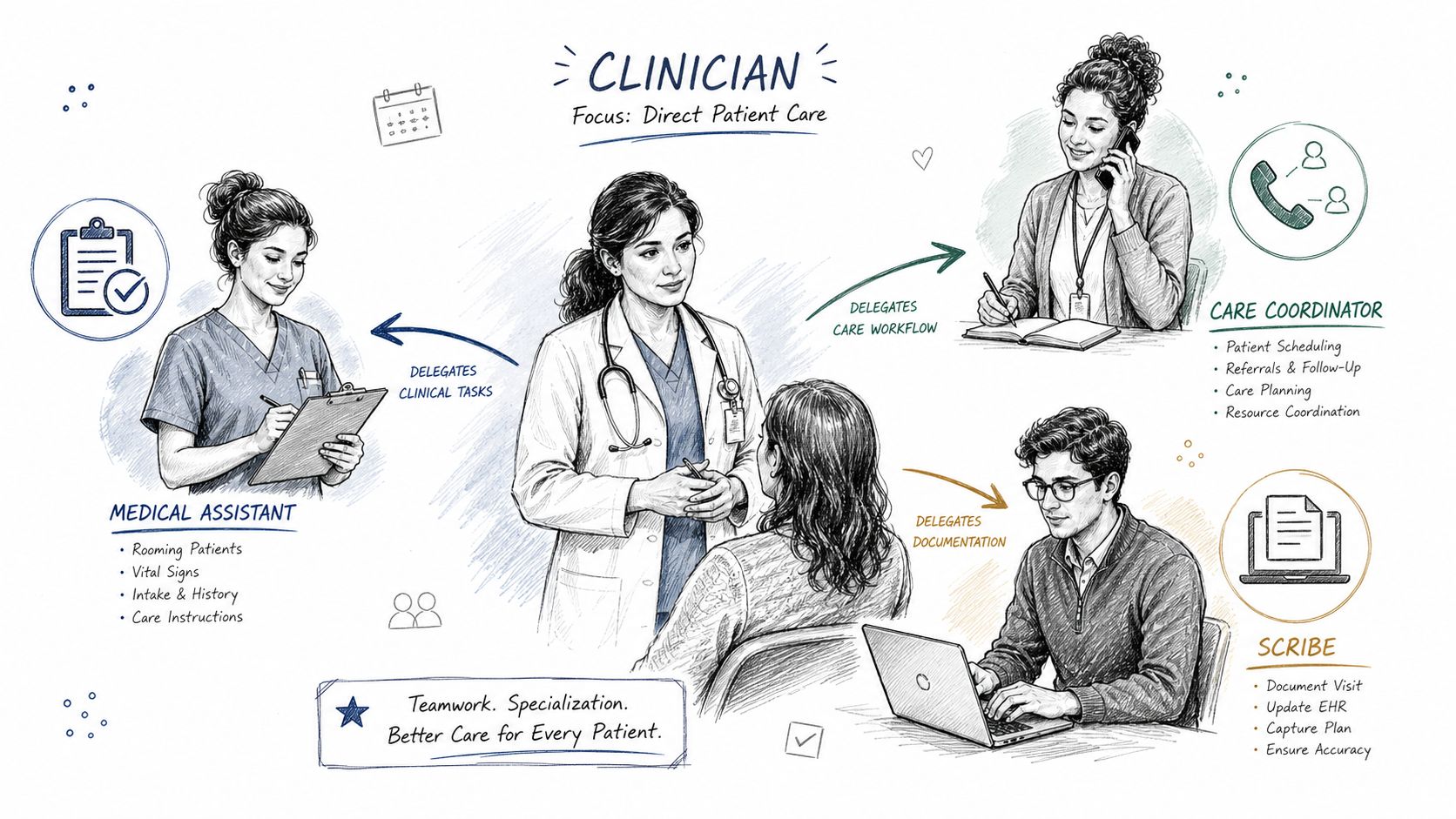
The strongest setups are built into the workflow. Scribes, care coordinators, medical assistants, AI-assisted note tools, and protected charting blocks all reduce the amount of work that spills past the scheduled day. A digital illustration showing a doctor using a remote scribe for protected documentation time to reduce burnout. Ask whether the role includes actual support, or whether the clinician is expected to absorb charting into lunch breaks and after-hours time.
In one policy study, organizations with 3 or more work-life-balance policies reported stronger retention and lower turnover intention, along with higher employee satisfaction (2024 work-life-balance policy study). That finding matters here because documentation support is not a perk, it is part of the role design. When the system gives people time, templates, and help, the work stays inside the workday more often.
Ask to shadow a full day if you can. Watching the actual charting load will tell you more than a recruiter summary ever will. Also ask whether after-hours charting is merely discouraged or actively tracked, because a soft expectation rarely changes behavior.
Watch the bottleneck: If the practice has no scribe coverage or weak template support, your “efficient” schedule will usually expand at home.
WeekdayDoc's clinical documentation improvement guide is a practical companion for screening this part of the job. For another angle on reducing charting drag, explore speech to text medical and compare how much time the tool can realistically save in your setting.
This is one of the clearest work life balance strategies because it changes the structure of the job itself. In daily practice, it determines whether you finish on time or keep typing after everyone else has started dinner.
6. Predictable Scheduling and Schedule Control Policies
Unpredictability is its own form of workload. Even if your total hours are reasonable, a schedule that changes constantly makes it hard to plan appointments, child care, sleep, and recovery. For clinicians, schedule control is not a luxury, it's a core part of staying functional over years instead of months.
The best versions publish schedules far enough ahead that life can happen around them. Some union-represented hospitals use 30 to 90 day publication windows, and some systems require mutual consent for changes. Urgent care chains sometimes publish weekly schedules, which is better than constant surprise, but still leaves more planning pressure on the clinician than longer lead times.
The APA guidance on healthy workplaces emphasizes setting clear availability and protecting recovery time, rather than relying only on generic self-care advice (APA healthy workplaces guidance). That advice maps directly onto scheduling. If the employer can't tell you when your time is yours, your boundaries are already negotiable.
A practical negotiation tactic is to ask for the last 12 weeks of actual schedules from current staff. Compare those to whatever “typical schedule” you were shown. Then ask how often unplanned changes happen and what counts as an emergency. The answer will tell you whether the published schedule is real or just aspirational.
If you need certain protected blocks, name them before hire. A Tuesday or Thursday off arrangement is much easier to defend when it's written into the role than when you're trying to create it after onboarding. For clinicians who are evaluating multiple offers, schedule control often matters more than a small pay bump because it changes the shape of every week, not just the size of one paycheck.
7. Flexible Time-Off and Unlimited Paid Leave Policies with Enforcement
Leave policies can be generous on paper and useless in practice. The difference is whether the organization expects people to use them. In healthcare, the strongest time-off policies combine adequate PTO, flexible sick leave, and a culture that doesn't punish clinicians for stepping away.
That's the part many employers miss. Unlimited leave can work, but only if there's a minimum expectation and real coverage handoff. Otherwise, the “unlimited” label can make clinicians hesitate more, not less, because nobody wants to be the person who takes too much. The better model is specific, visible, and normalized by senior staff.
Mayo Clinic and Cleveland Clinic both use time-off structures that emphasize essential time away, and some academic centers add sabbatical options beyond standard PTO. Smaller telehealth groups sometimes give unlimited leave with a minimum expectation, which is a healthier version of the concept because it prevents hoarding and guilt.
The key question is simple. Ask how much leave people in the role take, not just what the handbook says. Then ask what happens to your panel or inbox while you're out, because real leave only works if the workload doesn't boomerang back twice as hard.
True balance requires managers who treat time off as part of the compensation package, not as a favor.
If the employer won't commit in writing to how extended leave is covered, you're likely buying future stress with current flexibility. That's especially risky for caregivers, clinicians recovering from burnout, or anyone anticipating a major life transition.
8. Role Specialization and Task Delegation to Non Clinician Support Staff
The quickest way to weaken work life balance is to ask clinicians to handle work that does not require clinician judgment. Intake, scheduling, referral follow-up, benefit questions, prior authorization, and routine care coordination all consume attention when they sit on the clinician's desk. Strong roles separate medical decision-making from administrative work, so the day is not filled with avoidable interruptions.
That separation usually comes from staffing design. Primary care groups that use care coordinators, psychiatry practices that send routine requests to support staff, and telehealth platforms that centralize intake all protect clinician time. The role still depends on judgment, but it does not require the clinician to act as the scheduler, message sorter, and insurance liaison at the same time.
Ask one direct question in every interview. Who does what each day when the schedule gets busy? If the answer stays vague, keep pressing for specifics. Staffing ratios matter here, and fewer than 1 FTE of support per clinician is usually a warning sign unless the workflow is unusually simple.
A clinician with family responsibilities or a demanding life stage feels this difference quickly. A role that removes administrative noise can be the difference between a workable day and a draining one. That is why role specialization keeps appearing in burnout-resistant practices, it protects the highest-skill work by preventing everything else from landing on the same person.
Use WeekdayDoc's salary and market page together with the salary calculator pro if you are comparing pay against staffing structure, because a well-paid role with weak delegation can still cost more in time than it returns in income. If you are also reviewing productivity assumptions, the RVU calculator can help you see how much pressure is built into the compensation model.
The strongest work life balance strategies do not depend on squeezing more recovery into an overloaded role. They start with a job design that keeps the clinician from needing recovery just to stay functional.
Work-Life Balance Strategies: 8-Point Comparison
| Approach | Implementation Complexity | Resource & Infrastructure | Expected Outcomes | Ideal Use Cases | Key Advantages |
|---|---|---|---|---|---|
| Scheduled Hours and Call Coverage Audit | Medium, policy, contract review, enforcement | Low–Medium, documentation and scheduling records | Clear reduction in surprise call-related burnout; retention gains | Hiring negotiations, telehealth hires, urgent-care roles | Removes hidden call expectations; enables direct role comparison |
| Remote and Hybrid Role Structure with Defined In‑Person Days | Medium–High, policy + coordination + culture work | High, secure EHR access, video, connectivity, IT support | Significant commute/time recovery and focus time; variable clinical quality impact | Telehealth, primary care with admin work, specialties amenable to virtual care | Reduces commute, expands candidate geography, supports caregiving |
| Panel Size and Caseload Limits with Overflow Protections | High, contract caps, audit systems, referral protocols | Medium–High, EHR analytics, backfill staffing, triage resources | Preserves documentation quality and clinician capacity; lowers long-term burnout | Primary care, psychiatry, clinics prioritizing continuity and safety | Prevents panel creep; measurable employer accountability |
| Transparent Compensation Model with Guaranteed Base & Guardrails | Medium, pay formula design, legal review, monitoring | Medium, payroll systems, performance tracking, accounting | Reduces income volatility; discourages overutilization; supports planning | Systems shifting from pure productivity pay; ACOs, integrated health systems | Financial predictability; quality-tied incentives; reduces productivity spiral |
| Structured Administrative Time & Documentation Support Systems | High, workflow redesign, tool integration, staffing | High, scribes/MA, AI tools, EHR optimization, training | Large decrease in after-hours charting and cognitive load; improved note quality | High-documentation specialties, busy primary care, emergency medicine | Protects evenings, improves safety and chart timeliness |
| Predictable Scheduling & Schedule Control Policies | Medium, scheduling policy, software, enforcement | Medium, scheduling tools, admin time to manage preferences | Greater personal planning, lower anxiety, improved retention | Shift-based care, unionized settings, clinics needing family-friendly predictability | Enables advance planning; reduces last‑minute disruption |
| Flexible Time‑Off & Unlimited Paid Leave with Enforcement | Medium, policy + cultural modeling + coverage planning | Medium–High, backfill costs, coverage systems, transparency | Better recovery and lower burnout when enforced; risk of underuse without norms | Organizations prioritizing well‑being, larger systems that can backfill | Normalizes rest; improves retention when minimums enforced |
| Role Specialization & Task Delegation to Support Staff | High, role design, protocols, training, supervision | High, hiring MAs, coordinators, scribes; ongoing training | Increased clinician focus and productivity; reduced after‑hours work | PCMH, ACOs, FQHCs, specialty practices that can fund support FTEs | Shifts routine tasks from clinicians; improves safety and throughput |
Build a Career That Fits Your Life
True work life balance isn't a myth, it's the result of deliberate, strategic career choices. The clinicians who stay well over time usually aren't the ones with the most grit, they're the ones who asked hard questions about call, schedule control, documentation, delegation, and leave before they accepted the job. That's a more durable approach than trying to out-hustle a broken structure.
The APA survey makes the point plainly, workers want mental health support, schedule autonomy, and boundary respect, and too many still don't get all three (APA workplace health and well-being survey). Clinicians feel that gap sharply because the consequences show up at home, in sleep, and in patient care. If your current role keeps pushing you past your limits, the answer usually isn't better coping alone. It's a better-designed job.
Use your priorities as filters, not as afterthoughts. If you need no call, a hybrid structure, predictable time off, protected documentation time, or stronger support staff, make those requirements explicit in your search. The best offers will survive that scrutiny, and the wrong ones will expose themselves fast.
WeekdayDoc can help you compare those structural differences across roles, especially if you're trying to line up burnout-conscious work with income planning and long-term stability. For clinicians managing work and family responsibilities, the article on how carers can protect their well-being is also a useful companion read because balance needs change as life stages change.
If you're ready to look for a role that fits your schedule instead of fighting it, WeekdayDoc is built for that search. You can filter for no call, no weekends, remote or hybrid work, and role types that protect your time. Start there if you want your next job to support your life, not crowd it out.