Just in Time Scheduling in Healthcare: A Clinician's Guide
Learn how just in time scheduling works in healthcare, why it drives burnout, and what burnout-conscious alternatives look like for clinicians in 2026.
Two in five wage and salary workers over age 15 know their schedules less than one month in advance Brookings. In clinical jobs, that isn't just an inconvenience, it's a systems problem that can decide who picks up a child, who covers an overnight message, and who walks into clinic already behind. Just in time scheduling started as a manufacturing method to reduce waste, but in healthcare it often shifts uncertainty onto the clinician while preserving flexibility for the employer.
What Just In Time Scheduling Means
A hospitalist gets the schedule on Friday for the following Monday. An NP is told a float shift may turn into a full clinic day, depending on volume. A PA sees the appointment template tighten at noon because the “expected” census never showed up, and the team is still asked to absorb the same workload.
That is just in time scheduling in plain English. It means labor, appointments, or supplies are released only when demand is confirmed or expected to be immediate, instead of being buffered by a stable plan. In manufacturing, the logic is straightforward, keep inventory and output lean, then pull from upstream only as needed.
In clinical work, the model shows up in two different ways. One is labor scheduling, where the system relies on short-notice shifts, mid-shift swaps, or per-diem coverage. The other is supply or inventory scheduling, where pharmacy, lab, or procedural teams replenish only when needed. The patient experiences both, but staff feel the labor version most directly, because the uncertainty lands on their calendars, commutes, childcare, and recovery time.
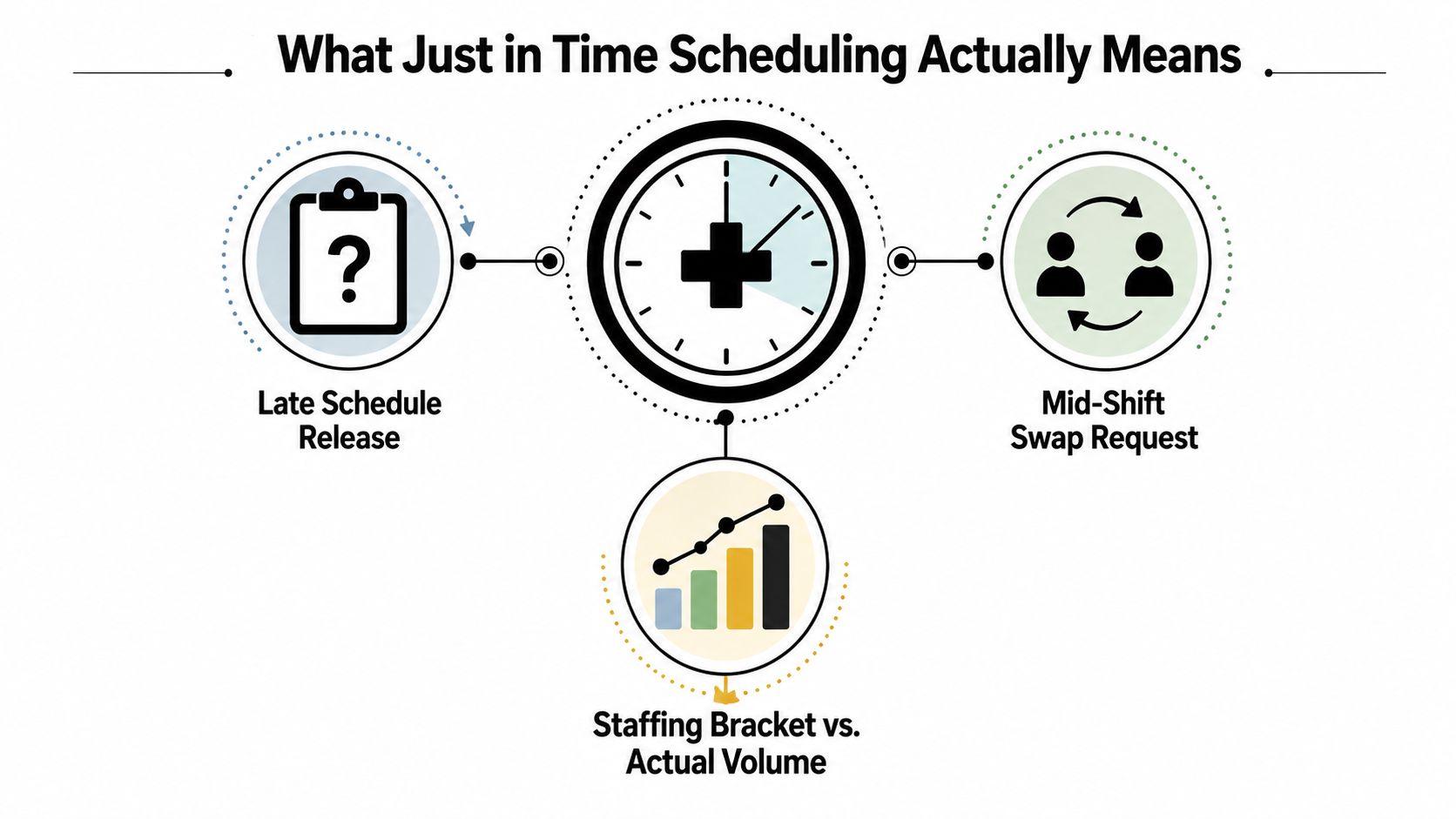
Practical rule: If the schedule cannot be trusted a week out, the institution is using a just in time model, even if nobody calls it that.
Toyota's original version was built around synchronized flow, minimal inventory, and demand-triggered replenishment Toyota history. Applied to humans, that same logic does more than reduce slack. It transfers volatility from the organization to the clinician, which is why the model looks efficient on paper and feels exhausting in real life.
Clinicians and employers who want a better staffing model can start with a more explicit baseline. The healthcare staffing solutions resource is useful for comparing approaches that preserve coverage without making every shift a moving target.
Where the Model Came From and Why It Migrated to Healthcare
JIT began as a manufacturing answer to a hard constraint, limited inventory and uneven demand. Toyota's production history shows that Kiichiro Toyoda first proposed JIT when operations began at the Koromo Plant, and that the approach was later expressed through the supermarket method and kanban, where downstream processes pull only what they need from upstream processes. Toyota's JIT production history That is a production rule, not a generic efficiency slogan. It assumes the system can be stabilized if every step receives only the amount needed, exactly when it is needed.
The model spread because manufacturers saw it as a way to reduce slack without losing control of flow. Cambridge's Institute for Manufacturing notes that JIT had been used in practice in many Japanese manufacturing organizations since the early 1970s, and that broader English-language attention followed in 1977 and through the 1980s adoption wave Cambridge IFM. That history matters because healthcare did not invent its own version from first principles. It imported a manufacturing logic and applied it to staffing, scheduling, and supplies.
Hospitals and medical groups adopted the idea because it promises tighter alignment between demand and resources. Leaders looking at labor cost, census swings, and variable supply use often see JIT as a clean optimization problem, with the schedule, the shift, and the order form treated as parts of the same system. The appeal is obvious. Fewer idle hours, less stored inventory, and more visible control over throughput.
The problem is that clinical work is not a parts stream. Toyota's system synchronizes components and signals. Clinical operations synchronize people, and people carry fatigue, childcare, commute time, and patient responsibility with them.
JIT works best when variability is low and failures are rare. Clinical care includes interruptions, uneven demand, and high stakes, so the fit is partial at best.
That is why the operations-research lens is more useful than the usual staffing language. In that literature, JIT is handled as a constraint-driven sequencing problem, where feasibility depends on what can happen in order, not just on what is due by the end of the day operations research paper. For employers, that means staffing cannot be reduced to matching volume on a spreadsheet. For clinicians, it means one upstream change can disrupt the rest of the schedule. The logic also explains why some organizations start searching for contingent workforce sourcing and integration once they realize the core issue is variability, not just headcount.
Clinicians who want a better model should ask for staffing approaches that preserve coverage without making every shift a moving target. A practical place to start is a comparison of healthcare staffing solutions for clinical teams, especially when the goal is to reduce schedule volatility instead of shifting it onto staff.
How JIT Scheduling Works in a Clinical Setting
In clinical operations, just-in-time scheduling shows up as a way to keep staffing, patient flow, and supply use tightly matched to near-term demand.
Staffing JIT
A service line builds the schedule around projected patient volume, then fills the gaps with floats, per-diem staff, or last-minute coverage. On paper, that looks efficient. In practice, it shifts uncertainty onto the clinician who gets the call, the swap request, or the added session, while the system avoids paying for unused capacity.
Patient flow JIT
Outpatient groups use the same logic with visit templates. They open same-day slots, stack late add-ons, or overbook to keep utilization high. If demand runs higher than expected, the clinic runs hot. If demand is lower, the same staff still has to absorb the cancellations, rescheduling, and patient dissatisfaction that follow.
Supply-chain JIT
Pharmacy, lab, and OR teams often use pull-based ordering for the same reason. In healthcare, that can reduce excess stock and waste, and a 2023 review of JIT in healthcare supply chains notes that it can also shrink storage space and improve cash flow, while increasing vulnerability when deliveries are delayed or demand spikes. That trade-off is familiar to anyone who has watched a small delay turn into a larger operational failure.
The operations-research literature makes the underlying logic plain. JIT scheduling in the job-shop literature treats feasibility as a chain of precedence constraints, where teams isolate the smallest causal chain of infeasibility and solve it step by step JIT schedule paper. In a clinic, that means a late lab result, a missing procedure room, or a no-show can cascade into overtime, delayed discharge, or a squeezed handoff. The same constraint logic is why employers that rely heavily on variable labor often turn to contingent workforce sourcing and integration, because the problem is not just filling seats, it is coordinating handoffs, onboarding, and escalation paths when the schedule shifts.
Clinicians who want a better model should ask for staffing approaches that preserve coverage without making every shift a moving target. A practical place to start is a comparison of healthcare staffing solutions for clinical teams, especially when the goal is to reduce schedule volatility instead of merely shifting it onto staff.
What the Evidence Says About Burnout, Patient Care, and Cost
Burnout starts with schedule uncertainty
Schedule volatility is not a minor inconvenience. It changes sleep, commute planning, child care, and recovery time between shifts, which is why clinicians often feel the strain before anyone notices a drop in output. The broader labor evidence shows why this pattern is predictable rather than surprising.
A Brookings report on unpredictable work hours and volatile incomes notes that two in five wage and salary workers over age 15 know their schedules less than one month in advance. That is a workforce design problem, not just a staffing preference. In clinical settings, the same uncertainty can leave physicians, NPs, PAs, and psychologists planning their lives around a schedule that may change after they have already arranged care, transportation, and recovery time.
Family life absorbs part of that burden. The Zero to Three study on infant care impacts explains that infants and toddlers need stable caregiving routines, and irregular work schedules make that harder to sustain. For clinicians with young children, the operational impact is immediate. A late schedule change can mean losing reliable pickup coverage, rearranging backup care, or absorbing the cost of instability at home.
Patient care absorbs the downstream disruption
The same constraint logic that makes just in time scheduling fragile in manufacturing shows up in care delivery. Short-notice changes, cancellations, and clopening patterns increase handoff risk because they compress the time available for preparation and coordination. Once clinicians are reworked midstream, continuity thins out, and patients feel it as delays, repeated explanations, or rushed transitions.
Brookings also describes what this looks like in the labor market more generally. Workers can have shifts changed or canceled at the last minute, and some can be sent home without pay if demand falls after arrival, according to the Brookings report on unpredictable work hours and volatile incomes. Healthcare uses different terminology, but the mechanism is similar. The schedule is being used as a live demand-management tool, and the cost is pushed into handoffs, fatigue, and fewer stable points of contact for patients.
That is why burnout is not just an individual resilience problem. When a clinic treats staffing as a constantly adjustable input, clinicians carry the coordination burden even when the work itself does not change.
The physician burnout statistics and role signals page is a useful reminder that physician burnout shows up as more than job dissatisfaction. It is tied to role strain, workload pressure, and the mismatch between professional expectations and the conditions built into the schedule.
Cost shows up outside payroll
The visible cost is wage volatility, but the larger cost is logistical. Child care, second jobs, school pickup, elder care, and shared transportation all become harder when notice is short and hours swing. That burden falls hardest on parents and lower-wage staff, which is why a “flexible” schedule often means the organization is flexible and the worker is absorbing the risk.
The strongest business case for predictability is not sentimental. A Brookings analysis of predictable scheduling laws and firm performance argues that well-designed predictability rules can help workers and firms' bottom lines. For employers, that points to a practical conclusion. If the schedule minimizes unused labor at every moment, volatility can look efficient. If the schedule keeps staff intact, reduces churn, and makes coverage easier to sustain, predictability becomes an operating advantage rather than a concession.
That is the decision makers often miss. A clinic can squeeze the schedule harder and call it efficiency, or it can design staffing around continuity, recovery, and fewer last-minute disruptions. The second approach usually costs more discipline upfront, but it is the one that aligns better with retention, patient experience, and long-term operating stability.
Legal, Ethical, and Contract Risks Clinicians Should Understand
Scheduling risk is a contract risk before it becomes a staffing problem. In many health systems, the clause that looks operational on paper can shift income, hours, and control over a clinician's week in practice. State and local predictability rules increasingly address notice, rest between shifts, and predictability pay in sectors built on low-margin labor and rapid staffing changes, and healthcare often absorbs those ideas before its policies catch up.
The legal exposure for clinicians usually sits in the fine print. Open-ended scheduling language, mandatory low-need days, and cancellation clauses can let an employer reassign work or drive pay down to zero when volume falls. Physicians, NPs, PAs, and psychologists often overlook those terms because the title and salary look acceptable, then discover the operational burden after the offer is signed.
Ethics do not disappear because a schedule is lawful. A volatile roster can still be poor clinical design if it creates coverage gaps, rushed handoffs, or repeated turnover that patients experience as fragmented care. That problem is sharper when the same organization expects stable communication, careful follow-up, and high-quality decisions from clinicians whose own working hours keep shifting.
Employment risk more broadly follows the same pattern. The guide to EPL risks is useful if you want to see how workplace decisions turn into liability, because scheduling disputes often sit close to discipline, discrimination, and retaliation claims. Unclear rules leave room for uneven enforcement, and uneven enforcement is where many disputes begin.
Watch the clause, not the title. “Flexible” can mean supportive, or it can mean the employer can move labor around with almost no notice.
The strongest contract review habit is to treat scheduling terms as part of compensation. A role with a good base salary can still be weaker overall if the employer keeps the right to change hours, cancel shifts, or expect constant availability without clear limits. Before accepting that trade-off, use a practical clinician employment contract review to check whether the schedule, pay structure, and cancellation language match the job description.
There is also an operations lesson here. Employers that depend on last-minute labor shifts often describe the system as efficient, but the hidden cost shows up in retention, consistency, and supervision load. For clinicians, the right question is not whether a schedule is legal in the narrow sense, but whether it creates a setting where care quality and professional stability can hold up over time.
Reading a Job Posting Like a Burnout Analyst
Start with the scheduling language, not the specialty. If the posting buries call expectations, leaves weekend coverage vague, or describes “flexibility” without a notice period, that's a warning sign. The same goes for FTE structure, session length, and whether volume targets are stated clearly or hidden behind “team-based coverage.”
What to scan for first
| Signal in the Posting | What It Tells You |
|---|---|
| Clear call, weekend, or overnight language | The role may rely on non-weekday coverage, even if the rest of the ad sounds balanced |
| Explicit notice period for schedules | The employer respects predictability and household planning |
| Per-diem or float pool described as support | Coverage is built into the model rather than used as a patch |
| Per-diem or float pool described as the backbone | The schedule likely depends on constant reshuffling |
| Defined clinic volume per session | The employer is willing to state workload expectations up front |
| Vague “flexibility” with no detail | You may be absorbing operational instability without compensation clarity |
The best jobs make the trade-offs legible. If the ad says “no call” and “no weekends” but then asks for open availability, read the second clause, not the first. If the schedule sounds stable but the template is built on late add-ons, you're looking at JIT under a cleaner label.
Use the contract scanner and compensation tools to pressure-test the offer. A role can look strong on salary and still be weak on lifestyle if the schedule is volatile, and that volatility has a real financial cost when you account for commute time, lost childcare flexibility, and burnout drag.
Three questions cut through the noise fast. Ask when the schedule is released, how often shifts are canceled or changed last minute, and whether low-need days are paid. If the answers are vague, the job probably is too.
Clinician-Friendly Alternatives Worth Asking About
The point isn't to ban demand-based scheduling. It's to replace pure JIT with something that respects both demand and human limits.
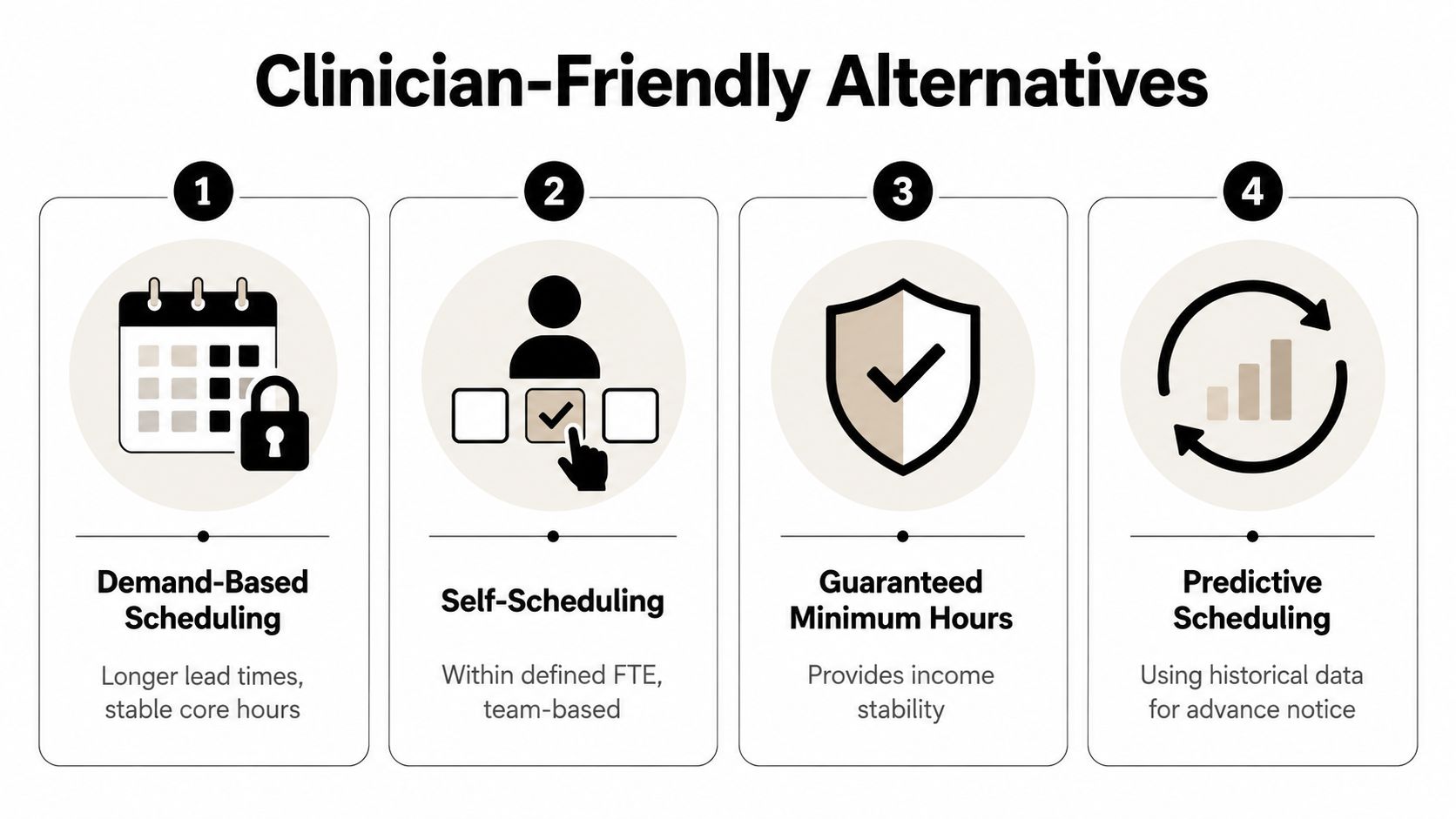
Four models worth naming in an interview
Demand-based scheduling with stable core hours works well when leaders use historical demand to shape coverage but keep start times, end times, and notice periods stable. It fits many outpatient and telehealth settings because clinicians still match patient need without living in constant uncertainty.
Self-scheduling within a defined FTE gives teams control over their own coverage patterns. It works best when the group is small enough for peer coordination and when leaders protect the boundaries, so self-scheduling doesn't become unpaid admin work.
Block scheduling anchors the week around predictable sessions, procedure blocks, or clinic sessions. That model is especially useful in hospitals and specialty practices where handoffs and room utilization can be mapped cleanly.
Outcome-based scheduling focuses on panel size, relative productivity, or service goals instead of time seated in a chair. It fits better in roles where output is meaningful and where the employer trusts clinicians to manage pace.
| Model | Best Fit | Burnout Implication |
|---|---|---|
| Demand-based with stable core hours | Outpatient, telehealth, urgent care | Lower volatility, clearer recovery time |
| Self-scheduling within FTE | Group practices, hospital teams | More control, but only if boundaries are real |
| Block scheduling | Hospitals, specialties, procedural settings | Predictable rhythm and better handoff planning |
| Outcome-based scheduling | Panel-based or productivity-driven roles | Less seat-time pressure, more autonomy |
The practical move is to ask which model the employer uses, not which one they admire in theory. If you want to compare offers side by side, filter for roles that already signal stability, then use the posting language to see whether the schedule is built around predictability.
A Practical Path Forward for Clinicians and Employers
Just-in-time scheduling starts as an operations fix, then becomes a personal finance problem for clinicians. If the schedule can shift without much notice, the cost shows up in childcare, commuting, moonlighting, and the ability to plan recovery time. The first task is to put a dollar value on that instability, then decide whether the role still clears your threshold for stress, income, and control.
Review the contract before you rely on the verbal pitch. Look for cancellation language, scheduling notice, and any clause that lets the employer change your hours without compensation. If those terms are vague, treat the vagueness itself as a risk factor.
- Clinicians should: use a salary calculator, run a FIRE scenario, and scan the contract before interview fatigue sets in.
- Clinicians should: ask for the schedule release date, cancellation frequency, and low-need pay policy.
- Clinicians should: treat “flexibility” as a clause to define, not a benefit to assume.
Employers should read the problem the same way they would read any other constraint-driven workflow issue. Predictable scheduling is not just a morale gesture, it can affect retention, continuity, and how much time managers spend patching holes in coverage. Brookings has argued that predictable scheduling can support both workers and firm performance, which is one reason schedule stability belongs in staffing strategy, not in the perks column Brookings.
A short pilot is more useful than another round of internal debate. Test longer lead times, guardrails on swaps, and clear pay rules for low-need shifts, then compare what happens to fill rates, continuity, and turnover pressure. If the schedule is still chaotic after that, the model is the problem, not the people trying to work it.
If you're redesigning staffing, find strategies for staff retention and compare them with your scheduling policy. The strongest retention plan is usually the one that reduces uncertainty first, because clinicians can tolerate hard work more easily than they can tolerate constant disruption.
Shortlist roles that protect your time first, then negotiate from there. Employers should do the same analysis internally, starting with whether the current scheduling system is absorbing too much friction and pushing good clinicians out.