Telehealth Physician Salary: A 2026 Guide by State
Discover the 2026 telehealth physician salary by state and specialty. Get detailed compensation data to guide your career decisions.

In 2026, telehealth physician pay clusters around $232,000 to $242,000 annually, with the 90th percentile near $290,000. That average hides three very different arrangements: salaried W-2 employment, hourly 1099 contracting, and per-visit 1099 production pay.
The headline number matters less than what reaches your bank account per hour of clinical and administrative time. A virtual role can remove nights, weekends, commuting, and office overhead, yet still disappoint if unpaid charting, patient messages, licensing costs, no-shows, or weak patient flow consume the schedule. The right question isn't, “What is the telehealth physician salary?” It's, “What will this offer pay me after the workday, tax structure, benefits, and FIRE timeline are fully accounted for?”
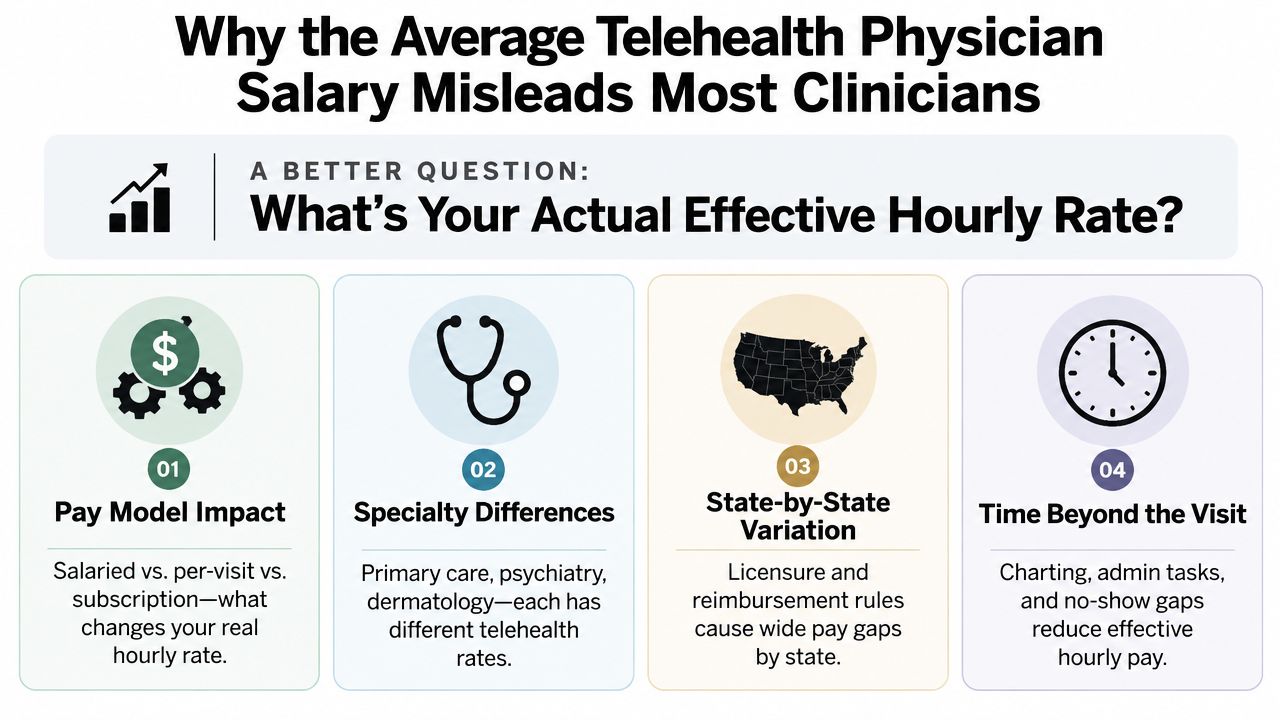
Why the Average Telehealth Physician Salary Misleads Most Clinicians
Two major 2026 salary benchmarks place the average U.S. telehealth physician salary at $241,748 and $239,485 annually. The first estimate lists an hourly equivalent of $116, a typical range from $227,068 to $266,942, and a 90th percentile of $289,880. The second reports most salaries between $212,000 and $318,500, with top earners reaching $320,000. You can review the underlying benchmark in Salary.com's telehealth physician salary data.
Those figures are useful for orientation, but they aren't an offer comparison. A W-2 clinician receives a package that may include health insurance, retirement contributions, paid time off, malpractice coverage, and a predictable schedule. An independent contractor may see a higher stated rate while paying for benefits, taxes, tail coverage, licenses, unpaid leave, and gaps between visits.
The number that belongs in your spreadsheet
Start with effective hourly compensation, not annual gross pay. Add clinical visits, charting, inbox work, prior authorizations, meetings, credentialing tasks, and time spent waiting for patients. Then subtract the value of unpaid time and contractor expenses.
A $240,000 salaried job with protected weekday hours may produce a better life than a nominally higher per-visit contract that requires constant volume management. The reverse can also be true for a clinician with a full panel, efficient documentation, and a strong tolerance for variable income.
Practical rule: Never compare an annual W-2 salary with a 1099 rate until you've priced benefits, taxes, unpaid time, malpractice, licensing, and actual patient flow.
Specialty and geography add another layer. Psychiatry, primary care, urgent care, dermatology, and specialty consultations don't create the same visit length, demand, documentation load, or reimbursement opportunity. State licensing rules also affect where you can see patients and how much administrative friction your employer or platform transfers to you.
A historical comparison reinforces the change in the market. One 2020 estimate placed average telehealth physician pay at $192,454, while later benchmarks moved to $241,251 in January 2025 and $232,320 in July 2026 for telemedicine physician roles, according to the historical discussion at Wheel's telehealth physician salary analysis. The direction suggests that virtual care compensation has become more established, but it doesn't eliminate variation between contracts.
Before signing, run the offer through a salary and FIRE calculator for clinicians. The output you want isn't only annual pay. It's the estimated after-tax income, effective hourly rate, savings capacity, and number of additional working years required to reach your target.
Telehealth vs In-Person Physician Pay in 2026
The available 2026 market data suggests telehealth compensation often sits close to comparable in-person physician compensation, rather than forming a uniformly lower-paid niche. One market summary places telehealth compensation within 5% to 15% of equivalent in-person pay, while also noting higher patient-volume expectations and asynchronous workflow metrics. That comparison is more useful than assuming remote work automatically means either a discount or a premium. See the 2026 telehealth compensation comparison for the stated pay-model ranges.
The economic trade-off is usually hidden in the schedule. An in-person role may include commuting, room turnover, clinic delays, facility constraints, and call. A telehealth role may remove those burdens but add inbox work, technical interruptions, cross-state licensing, and productivity targets. A physician who works fewer total hours can accept somewhat lower gross pay and still improve the value of each hour.
| Specialty | In-Person Total Comp | Telehealth Total Comp | Telehealth % of In-Person | Weekly Hours | Call Burden |
|---|---|---|---|---|---|
| Primary care | Not consistently specified in the verified data | Often salaried or contract-based | Not reliably quantifiable | Depends on contract | Must be confirmed |
| Psychiatry | Not consistently specified in the verified data | Often competitive in established virtual roles | Not reliably quantifiable | Depends on visit model | Must be confirmed |
| Urgent care | Not consistently specified in the verified data | Often hourly or per-visit | Not reliably quantifiable | Depends on session design | Must be confirmed |
| Hospital medicine | Not consistently specified in the verified data | Limited comparability with outpatient telehealth | Not reliably quantifiable | Depends on clinical model | Must be confirmed |
This table is intentionally conservative. The supplied evidence doesn't provide verified 2026 compensation, workload, or call figures for each specialty in both settings, so assigning precise side-by-side values would create false precision.
Compare the whole compensation package
For W-2 employment, inspect health coverage, retirement match, paid leave, malpractice terms, productivity incentives, and whether administrative work is included in the expected schedule. For 1099 work, calculate quarterly tax obligations, professional liability, retirement contributions, health insurance, licensure, equipment, and unpaid cancellations.
A headline salary also isn't the same as take-home pay. Clinicians with equity or restricted stock in a health technology employer may need a separate framework for tax withholding, vesting, and liquidity. A practical companion is this guide to take-home pay with RSU context, especially when a virtual employer presents base pay alongside equity.
Medicare policy can affect the stability of certain patient populations and billing arrangements. Telehealth flexibilities were extended through January 30, 2026, including home as an originating site, no geographic restrictions, audio-only reimbursement for non-behavioral visits, and virtual direct supervision in applicable circumstances, as summarized by Quarles' Medicare telehealth update. That policy environment supports access, but clinicians should still ask which payer rules apply to the actual role and patient mix.
The Three Pay Models Behind Every Telehealth Offer
Every telehealth offer eventually reduces to one of three economic structures. The legal label matters, but the operational details matter more.
| Pay Model | Typical Rate Range | Benefits Included | Schedule Control | Best Fit Clinician |
|---|---|---|---|---|
| Salaried W-2 | About $180,000 to $280,000 annually | Usually includes some employer benefits, exact package varies | Moderate | Clinician prioritizing stability and benefits |
| Hourly 1099 | About $90 to $150 per hour | Generally excluded unless separately negotiated | High, but patient availability must be verified | Clinician seeking flexibility and control |
| Per-visit 1099 | About $35 to $75 per consultation | Generally excluded | Potentially high, with income tied to volume | Clinician with reliable demand and efficient workflow |
These ranges come from an independent 2026 market summary of compensation structures, not from a universal national fee schedule. The same source notes salaried W-2 virtual roles around $180,000 to $280,000, per-visit 1099 work around $35 to $75 per consultation, and hourly 1099 work around $90 to $150 per hour. Treat them as comparison anchors, then verify the exact contract and patient-flow assumptions.
W-2 stability has a price
A salaried role generally makes budgeting easier. You can value paid time off, employer health coverage, retirement contributions, and malpractice protection before deciding whether the salary is competitive. The trade-off is less control over templates, assigned hours, productivity expectations, and organizational changes.
Ask whether messages, refills, forms, and chart completion happen inside paid hours. A “weekday-only” job can still create evening work if the employer measures visits but ignores the inbox.
1099 flexibility transfers risk
Hourly 1099 work can suit a physician who wants a defined session schedule or a gradual transition toward part-time practice. The stated hourly rate may look attractive, but it only works if the platform pays for cancellations, provides consistent demand, and limits unpaid administrative duties.
Per-visit pay offers the most direct production relationship. It rewards speed and volume, but it exposes you to no-shows, empty calendars, payer mix, documentation time, and fluctuating demand. The clinician who can maintain a full panel may outperform a salaried colleague on gross revenue, while another may earn less after idle time and business expenses.
Operational compliance matters across every model, especially when a platform handles protected health information across jurisdictions. For a practical review of privacy obligations, consult CloudOrbis Inc.’s PHIPA compliance guide for telehealth. It won't replace legal advice, but it highlights why technology and documentation responsibilities belong in the offer discussion.
Telehealth Physician Salary by Specialty
The national average becomes less useful as soon as you compare specialties. Telehealth doesn't erase differences in visit complexity, patient demand, documentation, or the proportion of work that can happen asynchronously.
Psychiatry often fits virtual care naturally because treatment depends heavily on conversation, longitudinal follow-up, and scheduled video visits. That doesn't mean every psychiatric contract pays a premium. The actual economics depend on appointment length, panel ownership, medication management, follow-up expectations, and whether messages are included without separate compensation.
Primary care offers a broader mix. Virtual visits can support access and continuity, but clinicians may inherit inbox work, refills, forms, lab review, and care coordination. A salaried primary care offer can therefore look modest beside a per-visit contract while delivering more predictable income and fewer business responsibilities.
Specialty comparison without invented precision
The verified market evidence doesn't provide a defensible 2026 specialty-by-specialty table for W-2 annual pay, per-visit rates, and effective hourly compensation across all requested fields. Filling the gaps with numbers from unrelated surveys would mislead clinicians comparing real contracts.
| Specialty | W-2 Annual | 1099 Per-Visit | Effective Hourly |
|---|---|---|---|
| Primary care | Requires role-specific offer data | Requires contract-specific data | Calculate from total paid time |
| Psychiatry | Requires role-specific offer data | Requires contract-specific data | Calculate from visit and message time |
| Urgent care | Requires role-specific offer data | Requires contract-specific data | Calculate from scheduled and idle time |
| Endocrinology | Requires role-specific offer data | Requires contract-specific data | Calculate from visit complexity |
| Dermatology | Requires role-specific offer data | Requires contract-specific data | Calculate from procedure and evaluation mix |
| Pediatrics | Requires role-specific offer data | Requires contract-specific data | Calculate from visit and coordination time |
Urgent care can produce strong gross revenue under per-visit or hourly arrangements when patient demand is steady. That advantage disappears if the platform advertises flexibility but can't fill the schedule. Dermatology may support efficient virtual evaluations in suitable cases, while endocrinology often depends on longitudinal management and data review. Pediatrics can carry substantial parent communication and coordination that an offer may not compensate separately.
Read the specialty offer line by line
Ask four questions before comparing the rate:
- What counts as paid work? Confirm whether charting, messages, refill requests, forms, and follow-up calls are included.
- Who owns the panel? A clinician with no control over patient attribution may not be able to build reliable income.
- How does complexity affect pay? A flat rate can underpay lengthy or medically complicated visits.
- What happens during ramp-up? Determine whether the employer guarantees salary, an hourly floor, or nothing while volume develops.
The specialty advantage comes from matching clinical work to the payment unit. If your work is mostly scheduled conversation, hourly or per-visit pay may track effort reasonably well. If your work generates substantial invisible coordination, a salary with protected administrative time may be safer.
State-by-State Differences That Change the Effective Rate
State affects telehealth economics through licensing, payer rules, patient location, taxes, housing costs, and employer demand. The important distinction is between where you live, where the patient is located, and which state licenses you need. A remote arrangement doesn't automatically remove state-practice obligations.
The supplied evidence doesn't provide verified 2026 state averages, cost-of-living indices, parity percentages, or adjusted hourly rates for California, Texas, Florida, New York, or a specific Midwest state. Those columns therefore can't be populated with invented figures.
| State | Avg Telehealth Salary | COL Index | Adjusted Hourly |
|---|---|---|---|
| California | Not established in the verified data | Not established in the verified data | Must be calculated from the offer |
| Texas | Not established in the verified data | Not established in the verified data | Must be calculated from the offer |
| Florida | Not established in the verified data | Not established in the verified data | Must be calculated from the offer |
| New York | Not established in the verified data | Not established in the verified data | Must be calculated from the offer |
| Midwest state | Not established in the verified data | Not established in the verified data | Must be calculated from the offer |
Use a state-adjusted worksheet
Start with gross compensation. Subtract federal, state, and self-employment taxes where applicable, then subtract health insurance, retirement costs, malpractice, licensing, and unpaid leave. Divide the result by total annual work hours, not just scheduled video time.
Next, compare purchasing power. Housing, childcare, commuting, and local taxes can change how much of your income becomes investable. A lower salary in a lower-cost location may create more savings capacity than a higher salary in an expensive market, even before considering schedule quality.
Medicare billing details also matter to employers and practices. CMS guidance distinguishes POS 02 for telehealth outside the patient's home from POS 10 for telehealth in the patient's home, with home telehealth paid at the nonfacility rather than facility rate, as described in CMS telehealth place-of-service guidance. Ask whether the organization understands and manages these billing distinctions or expects clinicians to absorb the consequences.
For location-specific opportunities, compare listings by state using WeekdayDoc's location-based job search. The practical goal isn't to find the state with the highest advertised salary. It's to identify the combination of license portability, patient demand, living costs, and schedule control that leaves you with the highest usable savings rate.
FIRE Projections for Burnout-Friendly Telehealth Roles
A physician's FIRE timeline depends on savings, spending, taxes, investment returns, and working hours. Gross salary is only the starting point.
For a simple planning model, use a 4% withdrawal rate, a 7% real return, and a target equal to 25 times annual retirement spending. These assumptions are planning tools, not guarantees. A household targeting $120,000 in annual retirement spending would need a portfolio target of $3,000,000 under the 25-times framework.
The hardest part is estimating annual take-home pay without inventing tax assumptions. The verified data provides gross compensation and pay structures, but not a standardized tax profile for a married family, state, filing status, insurance plan, or retirement contribution strategy. The table therefore shows the comparison framework rather than fabricated take-home figures.
| Role | Annual Take-Home | Hours/Week | Years to FIRE |
|---|---|---|---|
| Weekday telehealth psychiatrist | Must be calculated from gross offer and household taxes | 40 in the comparison scenario | Depends on current portfolio, spending, and savings |
| In-person internist | Must be calculated from gross offer and household taxes | 55 in the comparison scenario | Depends on current portfolio, spending, and savings |
| Part-time telehealth clinician | Depends on contract and tax profile | Defined by chosen schedule | Depends on savings rate and spending |
| Salaried virtual primary care clinician | Depends on benefits and tax profile | Defined by employer | Depends on savings rate and spending |
The comparison scenario uses a $260,000 telehealth psychiatrist salary and a $245,000 in-person internist salary, with weekly schedules of 40 and 55 hours respectively. Those figures are scenario inputs, not verified market averages. The point is the denominator: the telehealth clinician earns more gross income in the example while working fewer hours, but the FIRE result still depends on actual household spending and savings.
Convert income into investable dollars
A clinician targeting $120,000 in retirement spending doesn't reach FIRE by maximizing salary alone. They reach it by creating a durable gap between income and spending, then investing that gap consistently.
Telehealth may widen that gap by removing commuting costs, reducing schedule creep, and making part-time work easier. It can also narrow the gap if a contractor pays for multiple licenses, purchases private coverage, absorbs unpaid cancellations, or works extra sessions to compensate for inconsistent demand.
Use a worksheet to estimate your retirement target, as shown in this guide to estimate your retirement expenses. Then calculate two versions of the job: one with the advertised schedule and another that includes documentation, inbox work, meetings, and downtime.
The most valuable telehealth benefit may be the ability to stop working earlier, not the ability to earn more during every working hour.
Call burden deserves its own line in the analysis. A no-call weekday role can protect the time you use for family, exercise, sleep, or a second income stream. That time has financial value if it lets you avoid burnout, maintain clinical capacity, or save aggressively without adding shifts. WeekdayDoc's Burnout Index can be one input when you evaluate that trade-off, alongside the contract's actual workload terms.
Which Telehealth Path Fits Your Career and Life
The right role depends on what you're optimizing. A physician pursuing maximum stability shouldn't evaluate an offer the same way as a clinician building a flexible bridge to retirement.
| Clinician Archetype | Best Pay Model | Top Specialty Fit | Preferred State Strategy | Primary Trade-Off |
|---|---|---|---|---|
| Primary care physician seeking predictable weekdays | W-2 salary | Primary care | Favor licensure portability and manageable living costs | Less control over templates and volume |
| Psychiatrist with strong demand and panel discipline | Per-visit 1099 or hourly 1099 | Psychiatry | Maintain licenses where patient demand supports a full schedule | Variable income and administrative exposure |
| Urgent care physician optimizing sessions | Hourly 1099 | Urgent care | Choose markets with reliable patient flow | No benefits and possible idle time |
| Specialist approaching semi-FIRE | Part-time W-2 or hourly 1099 | Suitable consultative specialty | Minimize licensing complexity and fixed expenses | Lower total income and possible loss of benefits |
| Clinician who values benefits above upside | W-2 salary | Any compatible specialty | Compare total package, not just base pay | Reduced schedule autonomy |
A primary care physician who wants a compact-friendly state and a 32-hour workweek may prefer W-2 employment, even if the contractor rate looks higher. The psychiatrist with an established referral stream may prefer production pay, provided the contract clearly defines cancellations, messages, documentation, and malpractice coverage.
Urgent care physicians often think in sessions rather than panels. Hourly contracting can align better with that preference, but only if the employer guarantees paid time or demonstrates dependable scheduling. A specialist using telehealth as a semi-FIRE bridge may value a smaller clinical commitment, benefits continuity, and the ability to preserve professional identity without rebuilding a full-time practice.
Four questions usually expose the fit:
- How much income volatility can you tolerate? W-2 employment reduces uncertainty, while 1099 work offers more control but shifts costs and risk to you.
- How much schedule control do you need? A stated weekday schedule isn't enough. Confirm start times, meeting requirements, coverage expectations, and whether the employer can change templates.
- What liability follows you across state lines? Ask who covers licensing, credentialing, malpractice, and tail coverage when the patient is located elsewhere.
- How close are you to financial independence? A higher salary may matter less than a role that lets you keep working without call, nights, or weekends.
The most overlooked criterion is paid time outside the visit. A telehealth offer that compensates every encounter but leaves charting, inbox work, no-shows, and licensing overhead unpaid can produce a lower effective rate than a smaller salary with protected administrative time.
WeekdayDoc curates remote, hybrid, and in-person clinician roles with salary information, work-style filters, and explicit markers for no-call and no-weekend schedules. Compare telehealth opportunities, evaluate the workload behind each offer, and visit WeekdayDoc to find a role that supports both your work-life balance and FIRE plan.