Pay Cut for Work-Life Balance: Is It Worth It?
Considering a pay cut for work-life balance? Compare clinician pay, hours, call, commute, benefits, and burnout risk before accepting a lower-paying role.

Many clinicians eventually consider trading a higher salary for a more sustainable schedule. Deciding if a pay cut for work life balance makes financial sense requires measuring exactly what you give up against what you gain. You need to compare guaranteed compensation, actual hours worked, call expectations, commute times, and benefits across both roles.
How to Measure the Trade-Off Between Salary and Schedule
Define the Life You Are Buying
Work-life balance means more than the number of scheduled clinical hours on your calendar. A predictable forty-hour week feels completely different from a thirty-six-hour week plagued by sudden schedule shifts, coverage gaps, and unpredictable patient volumes. For healthcare professionals, balance includes the frequency of nights and weekends, the volume of home or in-house call, and the time required for after-hours charting, inbox management, administrative tasks, and commuting.
The Centers for Disease Control and Prevention identifies long and often unpredictably scheduled hours, unexpected double shifts, unpredictable intensity of on-call work, and little control over schedules as risk factors for healthcare worker stress. So evaluate those schedule and on-call demands alongside the advertised pay before judging the job's overall value.
Replace a Percentage Rule With a Break-Even Test
The Agency for Healthcare Research and Quality links time pressure, chaotic work environments, and low control over work pace to physicians' dissatisfaction and burnout. These are work conditions to measure, so assess a new offer by its schedule, workload, and control over work pace before weighing the salary.
Universal percentage rules often fail in practice. A ten percent limit is an unverified benchmark that ignores your monthly cash flow, student loans, and family expenses, so replace those arbitrary limits with a clear break-even test. A pay cut becomes financially rational only when the role buys measurable time, predictability, and control while still supporting your necessary spending and savings.
Screen the Job’s Actual Work Conditions Upfront
Before building a detailed spreadsheet comparison, you can use WeekdayDoc as an initial screening layer. The platform helps you look beyond salary to check call expectations, schedule flexibility, and administrative burden upfront. Reviewing work-life scores and visible workload requirements helps you filter out jobs that offer lower pay without improving your schedule.

Calculate Comparable Annual Compensation
Separate Guaranteed Cash From Variable Pay
Start your compensation formula by calculating the cash you can rely on regardless of patient volume. Adding your base salary, hourly rates, guaranteed minimums, call stipends, and shift differentials yields your guaranteed cash.
Treat relative value unit formulas, productivity thresholds, quality bonuses, and partnership distributions separately because variable pay introduces risk. If the new employer uses an RVU conversion rate that can change, or a quality bonus depends on metrics outside your control, do not assume you will receive the maximum amount. A realistic payout history from the employer gives you a better basis than an optimistic target.
Value Benefits and Paid Time
Health insurance, retirement contributions, disability coverage, and malpractice insurance add hard financial value to an offer. An employer covering your licensing, board fees, professional dues, and continuing medical education costs can easily offset a lower salary.
Count vacation, sick leave, holidays, and CME days only when clinical coverage makes them usable. If taking a week of vacation means working double shifts to clear an overloaded inbox upon your return, that paid time off carries a steep hidden cost. Furthermore, IRS rules stipulate that tax treatment differs across fringe benefits. Since a high theoretical benefit limit does not equal spendable cash, value these items using the actual employer contribution or the out-of-pocket replacement cost.
Subtract Costs and Contract Exposure
Deduct employee-paid premiums, parking, commuting costs, and self-funded benefits from the offer. Family health coverage premiums alone can vary by thousands of dollars between employers, directly reducing your take-home pay.
First-year transition costs matter, so factor in repayment obligations for a previous sign-on bonus or relocation package. You should also flag claims-made malpractice policies that require you to buy tail coverage upon departure. Tail coverage can cost tens of thousands of dollars, turning a seemingly comparable compensation package into a severe financial loss.
How to Measure Your Total Time Commitment
Add Work Beyond the Scheduled Shift
Nominal scheduled hours often hide the real time commitment of a clinical job. Build a measured annual-hours total by adding your clinical work, charting, administrative tasks, and active call time for a typical week, then multiply that weekly total by your working weeks. Add your commute and any required travel between sites.
Hidden work expands your day because documentation, prior authorizations, refill approvals, patient messages, and mandatory credentialing consume significant time. Be sure to include the hours spent answering messages or coordinating care while you are technically off duty.
Measure Call and Restricted Time Separately
Measure your role-specific burdens based on your specialty and setting:
- Physicians and specialists evaluate rounds, call shifts, chart completion, RVU expectations, meetings, and patient volume.
- Nurse practitioners and physician assistants examine template density, panel size, same-day access, supervision requirements, and refill protocols.
- CRNAs and registered nurses verify shift length, staffing ratios, mandatory overtime policies, and break coverage.
- Psychologists and therapists count caseloads, session notes, cancellation handling, unpaid coordination, and supervision duties.
- Pharmacists and allied clinicians assess staffing levels, verification quotas, holiday rotations, and multi-site travel.
- Medical directors separate leadership meetings, quality reports, and after-hours escalations from their clinical schedules.
- Remote and telehealth clinicians measure asynchronous messaging, time-zone requirements, and home-office setups.
While you should not count an entire home-call night as twenty-four working hours, you cannot ignore it either. Separate active work time from restricted time, which occurs when you must remain available, stay within a specific radius of the hospital, or abandon personal plans.
Account for Commute, Predictability, and Recovery
Record post-call recovery and schedule disruption as distinct burdens rather than assigning an arbitrary dollar value to every hour of availability. Commuting adds hours to your week that you cannot spend with family or use for rest, while predictability determines whether you can schedule appointments, arrange childcare, or plan a weekend away. If a role pays less but offers a firm schedule with zero restricted time, the time you regain is entirely yours.

Turn the Comparison Into Decision Numbers
Compute Hourly Value and Time Regained
Instead of relying on annual salary alone, run calculations that reveal the exact price of your time. Calculate your effective cash compensation per measured hour by dividing annual guaranteed cash by your measured annual hours. Next, determine your fully loaded compensation per measured hour by dividing your comparable annual value by those same measured hours.
Calculate annual time regained by subtracting the new measured hours from your current measured hours, then determine the compensation traded per hour regained by dividing the difference in comparable value by the annual hours regained. When the schedule data supports it, you can also track recovered weekends, call blocks, or predictable evenings as tangible decision aids, rather than treating them as an objective price for personal time.
Run Conservative, Expected, and Best-Case Scenarios
A single set of numbers rarely survives first contact with a new job, so build a few basic models. A conservative model assumes no bonus, higher health premiums, full expected administrative time, and realistic call interruptions, while the expected scenario uses the most likely workload and compensation based on current staff feedback.
The best-case scenario includes a target bonus only when the assumptions are documented and credible. A new role should never require you to hit an optimistic productivity target just to match the financial value of your current position.
Compare Monthly Cash Flow and Long-Term Effects
Evaluate your take-home cash against debt payments, savings, retirement contributions, and standard spending. Testing the decision over one, three, and five years allows you to account for lost employer matches, student-loan progress, skill development, and leadership opportunities.
If you plan to explore physician consulting roles or other alternative paths, you need a firm grasp of your baseline cash requirements. WeekdayDoc reduces the initial research burden by placing salary context, burnout scores, call frequency, and contract signals alongside job listings. Because the score functions as a screening tool, you still need to verify the underlying terms with the employer.
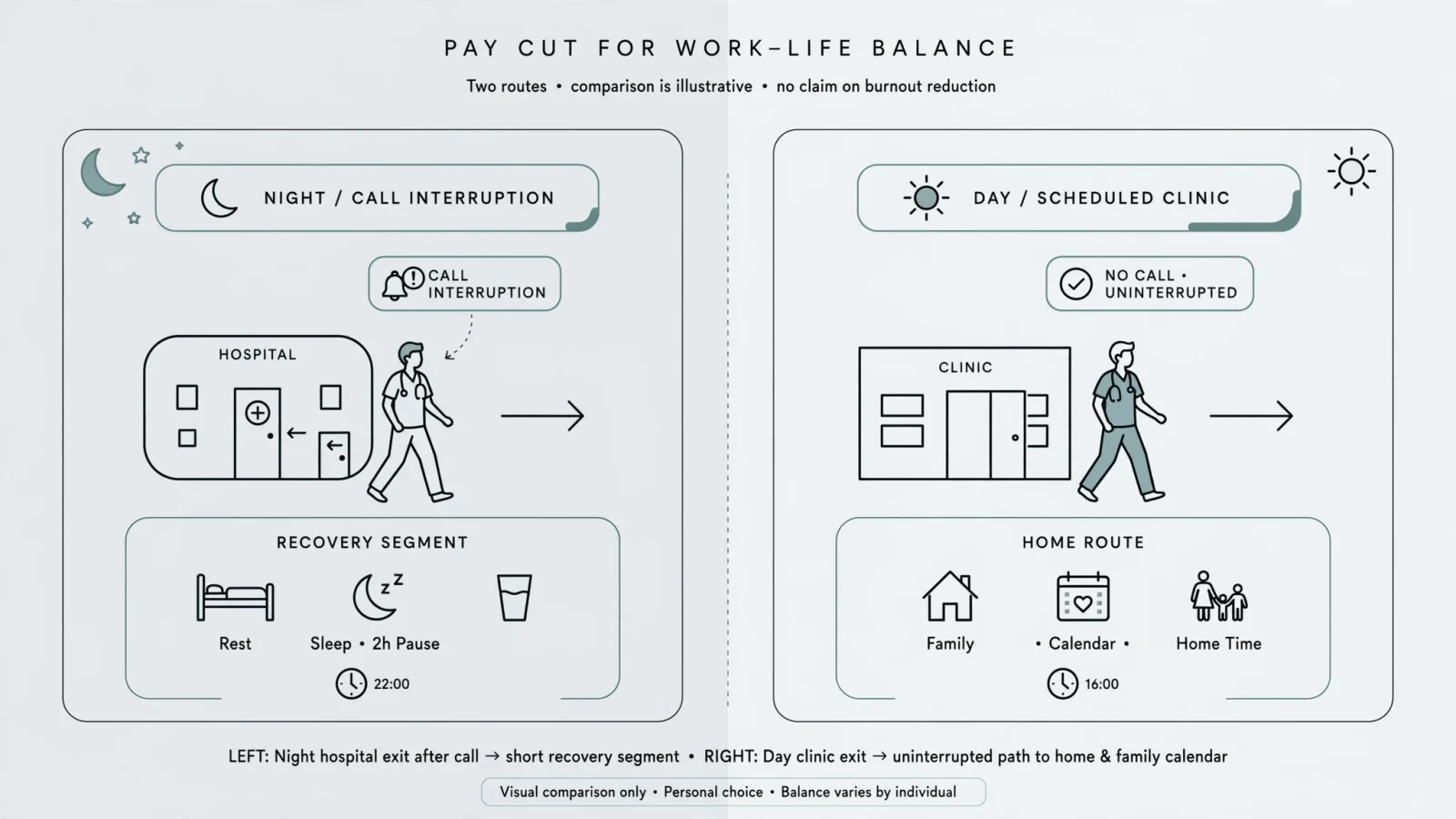
See How the Math Works in a Clinician Example
Compare the Hypothetical Roles
Consider a baseline example to see how scheduled hours mislead. The current role pays $320,000 with $35,000 in employer-paid benefits, requiring 60 work hours per week for 48 weeks, alongside a 50-minute commute each way, five days per week.
The new role pays $285,000 with $22,000 in benefits. It requires 44 work hours per week for 48 weeks, plus a 20-minute commute each way, three days per week.
Calculate the Price of Time Regained
The current role totals 2,880 annual work hours and 400 annual commute hours, producing 3,280 measured annual hours. The new role totals 2,112 annual work hours and 96 commute hours, resulting in 2,208 measured annual hours. In this scenario, the $35,000 drop represents a 10.9 percent nominal salary reduction.
| Metric | Current role | New role |
|---|---|---|
| Annual salary | $320,000 | $285,000 |
| Employer-paid benefits | $35,000 | $22,000 |
| Work hours per week | 60 | 44 |
| Working weeks | 48 | 48 |
| Commute | 50 min each way, 5 days/week | 20 min each way, 3 days/week |
| Annual work hours | 2,880 | 2,112 |
| Annual commute hours | 400 | 96 |
| Measured annual hours | 3,280 | 2,208 |
| Cash compensation per measured hour | $97.56 | $129.08 |
| Comparable compensation per measured hour | $108.23 | ~$139.04 |
Cash compensation per measured hour rises from $97.56 in the current role to $129.08 in the new role, and comparable compensation per measured hour moves from $108.23 to approximately $139.04.
You give up $35,000 in salary and $13,000 in annual benefits, but you regain roughly 1,072 measured work and commute hours. The salary-only trade costs about $32.65 per hour regained. Including the benefits gap, the trade sits at about $44.78 per hour regained. Under these specific assumptions, approximately $217,000 in salary plus $22,000 in benefits would match the current role’s comparable compensation per measured hour.
Stress-Test What the Example Leaves Out
This specific table excludes call, hidden inbox work, after-hours charting, retirement differences, and taxes, all of which could materially change the result. Tracking physician call pay independently helps you measure the burden of uncompensated interruptions. If the new role introduces heavy home call without a stipend, the measured annual hours will rise, which lowers the hourly compensation.
Verify the Offer Before You Sign
Ask About Schedule, Call, and Hidden Work
Talk to the employer and at least one current clinician about the actual schedule over a typical four-week period. Ask how often nights, weekends, and holidays are assigned. Confirm whether call is home-based or in-house, and request the average number of pages per call shift. Also ask whether clinicians work normal hours the day after an overnight call.
Check for policies on short-notice schedule changes, mandatory overtime, and as-needed coverage to determine how much protected time exists for notes and inbox work. Ask who handles prior authorizations, forms, refills, and patient messages. Finally, confirm whether committee meetings count toward the stated workweek and whether productivity targets use clinical time or total time.
Compare Benefits, Compensation, and Contract Terms
Verify which compensation components are guaranteed and what percentage of clinicians earn the advertised bonus. Check if the RVU conversion rate can change at the employer's discretion, and ask how the practice pays for call, holidays, and ramp-up periods.
Confirm your premiums, deductibles, and retirement contributions alongside malpractice coverage, CME budgets, licensing reimbursement, and professional dues. Look for repayment terms attached to sign-on bonuses or relocation funds, and identify non-competes or post-employment restrictions. Because state law and contract language vary widely, secure a professional contract review.
Negotiate Boundaries Before Salary
Lower compensation with firm boundaries beats a higher salary with vague flexibility. You can ask for a four-day schedule, a reduced full-time equivalent status with a defined workload, or fewer weekend call shifts. Request a post-call recovery day, protected documentation time, and clear patient-volume or caseload caps.
Negotiate for guaranteed remote days, a higher retirement contribution, or paid malpractice tail coverage. You might also ask for guaranteed ramp-up pay, a compensation review at six months, written administrative limits, and clear after-hours response expectations. Ultimately, a pay cut for work life balance makes no sense if the employer retains the right to expand your workload without limits.
Make a Sustainable Decision With Better Job Data
Treat Career Longevity as a Scenario
Evaluating whether a new role helps you stay in practice is more useful than treating longevity as a promised financial return. Assess whether the job preserves your clinical skills, opens leadership opportunities, or allows you to increase hours later. Do not assume a specific pay cut will extend your career by a set number of years; instead, map out the probability of avoiding an early exit entirely. Whether you are seeking a new attending role or making a career change from nursing, long-term survival depends on sustainable daily workloads.
Use WeekdayDoc to Screen Real Trade-Offs
WeekdayDoc provides the data you need to compare clinician jobs by compensation and work-life factors. You can review salary context, call expectations, schedule flexibility, and burnout-related job details before you apply or sign.
For employers: Transparent job listings attract clinicians prioritizing sustainable careers. State your call, nights, weekends, administrative expectations, schedule flexibility, and compensation structure clearly. WeekdayDoc formats your existing job description or URL with work-life and market context to reach the right candidates.
Common Questions About Salary and Schedule Trade-Offs
Confirm that the lower income still supports your monthly obligations and savings targets. Ensure your measured-hour assumptions are credible and that call and recovery expectations are written into the contract. You can run through these common questions to finalize your decision:
Is taking a pay cut for work life balance worth it?
Accepting a pay cut proves worthwhile only after you compare total compensation, measured hours, call, commute, benefits, and cash flow across both positions.
How much of a pay cut is worth better work-life balance?
There is no universal percentage. Calculate the compensation traded for each hour, weekend, or call block regained to test whether the lower income still supports your essential spending and savings goals.
How do I calculate hourly pay for a clinician job?
Add clinical work, charting, administrative work, active call time, commuting, and required travel, then divide comparable annual compensation by the total measured hours.
Can better benefits make up for a lower salary?
Health insurance, retirement contributions, paid leave, malpractice coverage, and CME can offset a lower salary when valued at their actual employer contribution or replacement cost.
How do I know whether a “no-call” job is really no-call?
Ask who handles nights, weekends, inboxes, refills, urgent messages, and coverage gaps, and confirm those expectations in the written offer or contract.
Compare clinician jobs by compensation and work-life factors on WeekdayDoc. Review salary context, call expectations, schedule flexibility, and burnout-related job details before you apply or sign.