Physician Administrative Time: Protect It From Clinic Overflow
Learn what physician administrative time should include, how to measure the workload, and how to keep clinic overflow and after-hours work from consuming it.
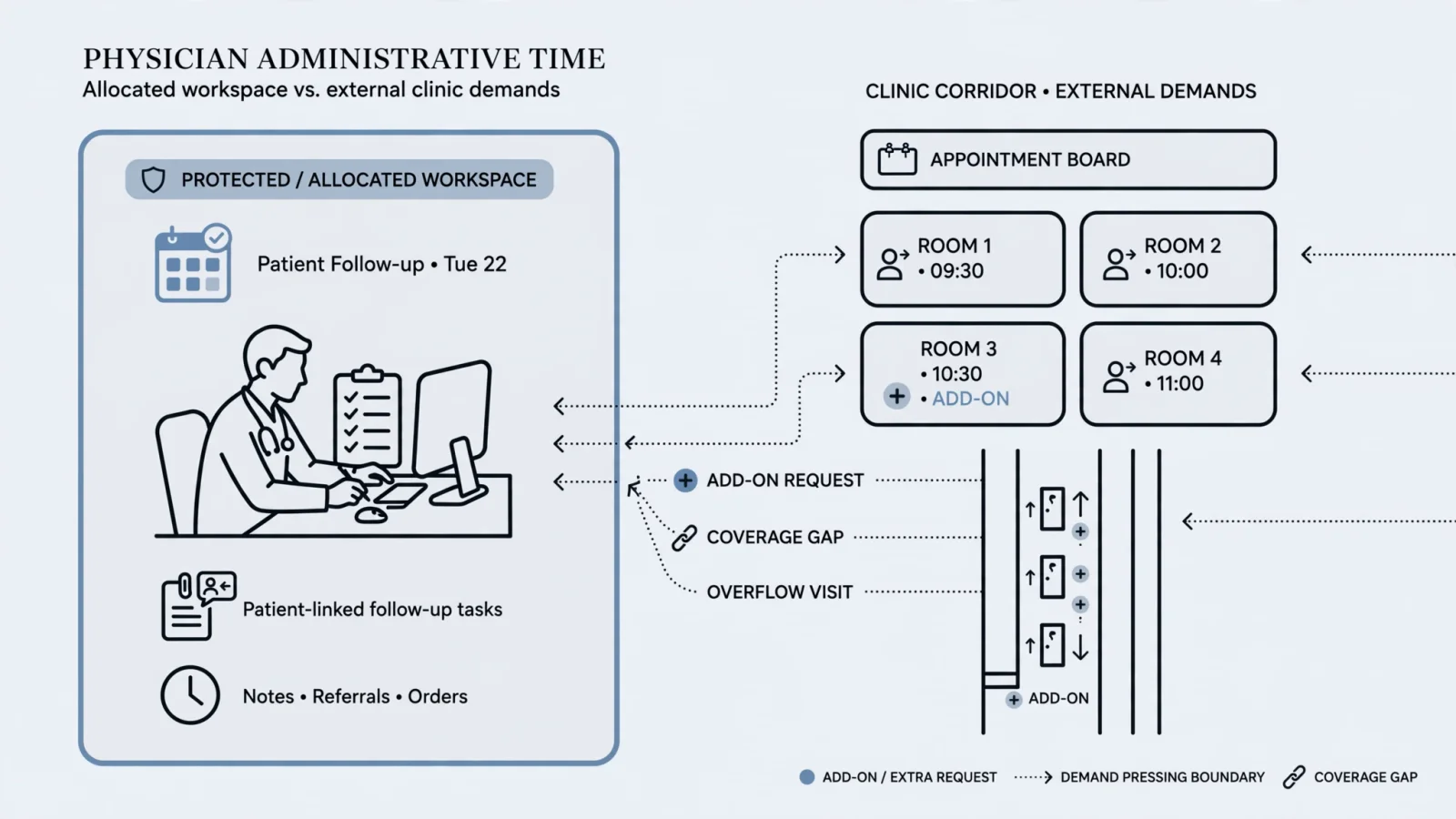
Protected physician administrative time is paid, scheduled, non-patient-facing capacity removed from the clinical template for defined clinical, operational, leadership, or academic work. An empty appointment slot or an unpaid hour at the end of the day to catch up on charts does not qualify. A flexible schedule block waiting to absorb walk-ins and clinic overflow also falls short of the definition. When a healthcare organization treats administrative work as invisible, the cost shifts to you through after-hours charting, delayed responses, and eventual burnout.
Defining Protected Non-Visit Time
The Concept in Practice
Formalizing hidden effort creates a compensated, structured part of the workday that protects your schedule from silent expansion. Protected administrative time involves a specific block on the schedule in which the patient-care template is turned off, allowing a clinician to complete expected non-visit duties. Many physicians in high-volume environments mask a poorly designed schedule by working through lunch, answering portal messages between exam rooms, or logging back into the system from the kitchen table at night.
How Visit-Based Metrics Obscure the Workload
A role that measures performance solely by visits, procedures, or relative value units obscures the underlying workload. A 2016 Sinsky study on ambulatory practice observed 57 physicians across four states and 430 hours of office work. Physicians in the study spent 27 percent of their office time in direct clinical face time and 49.2 percent on electronic health record and desk work. The 21 physicians who kept after-hours diaries reported one to two additional hours of work each night. While these numbers reflect high-performing, self-selected practices rather than a universal allocation benchmark, they prove that non-visit work consumes a massive portion of the clinical day.
The Four Components of Protected Time
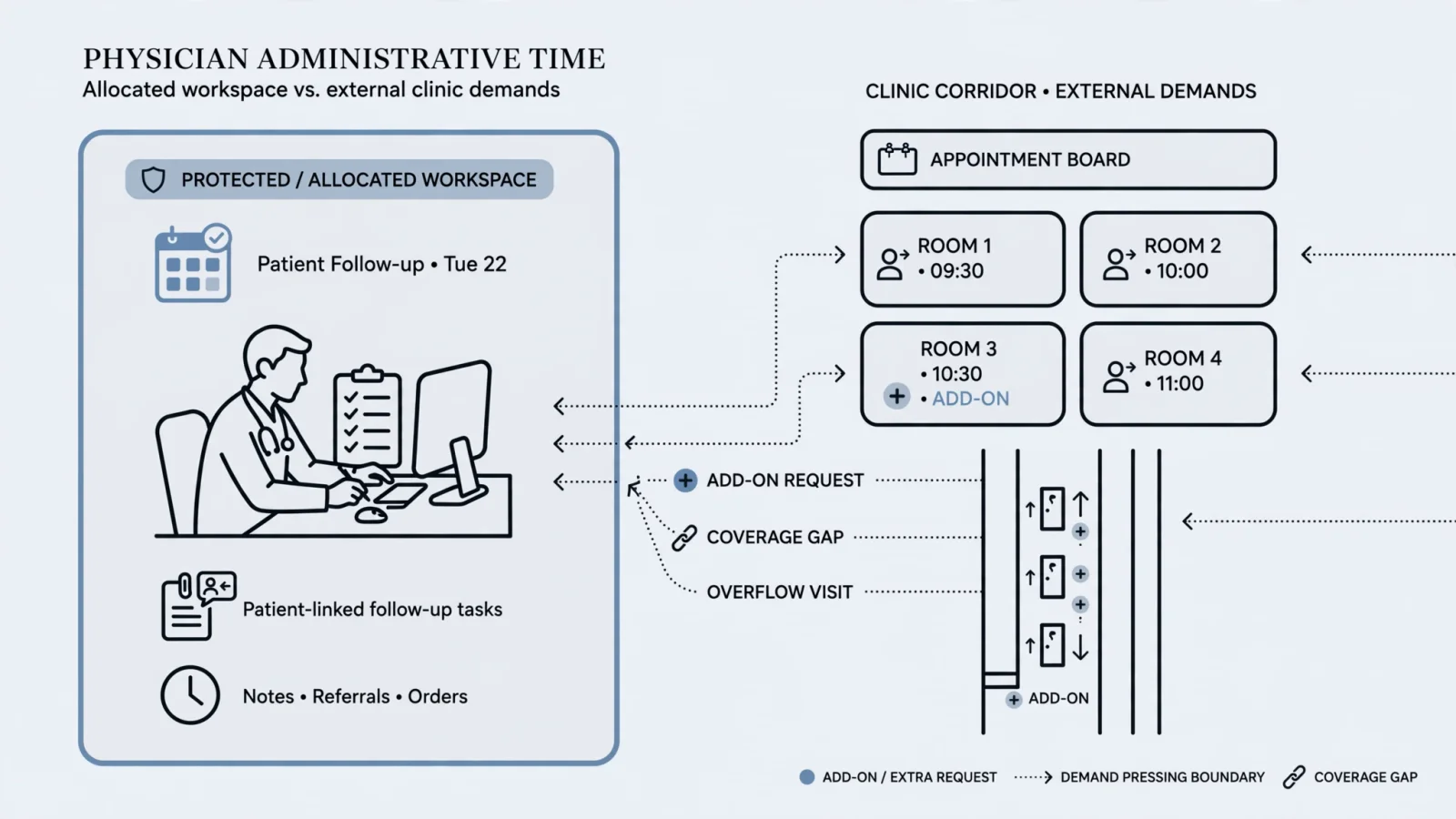
Meaningful protected time passes four distinct tests. Scope defines which tasks belong in the allotted block, while capacity dictates how many paid hours or what percentage of the role is allocated. Calendar protection determines the rules that prevent visits, add-ons, and coverage gaps from consuming the time. Finally, accountability establishes a formal remedy for when the daily workload consistently exceeds the scheduled allocation.
WeekdayDoc provides a clear way to evaluate a healthcare role's total schedule, workload, compensation, and contract expectations rather than judging an opportunity by salary alone. The platform assigns listings a work-life score, giving you a structured way to handle the demands of clinical practice by comparing burnout risks before signing a contract.
Mapping Tasks to the Protected Block
Patient-Linked Clinical Work
Building a clear task taxonomy prevents operations from grouping every non-visit duty into a single bucket. Patient-linked clinical work connects directly to an individual patient or an active episode of care. This category includes chart preparation, clinical documentation, reviewing results, placing orders, answering patient-specific messages, and managing referrals. It also covers clinically complex prior authorizations, such as approvals for specialty biologics or advanced imaging, and forms requiring medical judgment, like disability paperwork. This work requires licensed-clinician expertise and cannot be delegated as clerical routing.
Operational, Leadership, and Coverage Duties
Practice and operational work improves or manages the clinic itself. You might participate in team huddles, quality improvement initiatives, patient-panel management, peer review, safety incident evaluations, and protocol development. Staff supervision, utilization review, schedule redesign, and recruiting also fall into this operational category. Leadership and academic duties such as a medical directorship, teaching, research, and enterprise committee participation require their own separate time allocations when they form a recurring part of the job description.
Coverage and transition work creates another distinct demand on your time. Cross-covering a colleague's inbox, reviewing another clinician's results, managing backlogs after leave, executing handoffs, and coordinating temporary coverage all take away from direct patient care. These coverage responsibilities need a named owner, a defined scope, and a strict workload limit.
Delegating Routine Inbox and Clerical Work
Not every electronic health record task deserves space in your protected block. Routine appointment scheduling, record-copy requests, insurance-status checks, and standard refill processing covered by existing protocols belong to the broader care team. Automating or delegating routine inbox sorting and staff-completable forms reduces the administrative burden on the provider. Shifting this burden relies on training, staffing, and clear authority for nurses, medical assistants, and pharmacists to act within their scope. Adding physician hours to an inefficient inbox workflow only masks the underlying operational failure.
| Category | Examples | Primary Owner |
|---|---|---|
| Patient-Linked Clinical Work | Complex prior authorizations, results review, clinical documentation | Physician / APP |
| Practice & Operational Work | Quality improvement, protocol development, peer review | Medical Director / Committee |
| Delegable Routine Work | Standard refills, record requests, insurance checks | RN, MA, or Centralized Staff |

Calculating Required Non-Visit Capacity
Define the Paid Denominator
A local measurement method works better than a broad industry standard. First, define the paid denominator by clarifying whether your role is measured by total paid hours, a clinical full-time equivalent, scheduled clinic sessions, patient-facing shifts, patient-panel size, or a specific contract period. Making the treatment of part-time and hybrid work explicit ensures administrative time scales correctly with your clinical expectations. If a contract hires you for a 1.0 clinical full-time equivalent position but expects ten hours of committee work and inbox management outside those clinical hours, you are working a 1.25 position for 1.0 pay.
Inventory and Measure the Work
Next, inventory the specific tasks by grouping patient-linked clinical work, inboxes, results, orders, prior authorizations, meetings, quality initiatives, and coverage duties. Assigning an owner to each task, whether the owner is the physician, a nurse, a pharmacist, a care manager, a centralized team, or practice administration, prevents an organization from counting team-delegable work as physician work by default.
System data provides the most accurate measurement of demand. Review electronic health record audit logs, message categories, physician-touch rates, documentation data, referral volume, and meeting calendars. A 2017 study by Arndt and colleagues examining 142 family medicine physicians in one Wisconsin health system found an average of 355 minutes spent in the electronic health record during an 11.4-hour workday. This time included 157 minutes of clerical and administrative work and 85 minutes managing the inbox. While limited to one specialty and system, this methodology shows that organizations can quantify the workload with objective metrics.
Convert Demand Into Protected Capacity
With that data in hand, convert the measured demand into protected capacity by adding patient-linked clinical work, operational work, leadership commitments, and defined coverage obligations. The resulting administrative allocation ratio is your paid protected administrative hours divided by your total paid hours. Spillover consists of the work you complete outside protected blocks, scheduled hours, days off, or approved leave. To keep the calculation accurate, count each task once, avoid double-counting system activity, and test whether the schedule preserves your assigned blocks.
Preventing Schedule Erosion
Keep the Block Off the Visit Template
A nominal administrative allocation provides little value if the time disappears whenever the clinic gets busy. Structural guardrails keep daily overflow out of your protected space. The designated time stays entirely off the routine visit template. Assigning this scheduled block a published purpose explicitly excludes routine follow-ups, new visits, standard add-ons, walk-ins, schedule backfill, and nonurgent coverage.
Set Rules for Conversion, Cancellation, and Leave
When operations initiate an emergency conversion, clinic policy defines who can authorize the override, and the lost time is then rescheduled, credited, or compensated through a defined internal process. Clear rules govern canceled blocks, repeated conversions, and staffing shortages, while approved leave includes a named coverage model. Routine work has no place in a scheduled vacation, medical leave, or conference attendance. Being asked to monitor an inbox from a hotel room means you are actively working during paid time off.
Design the Inbox Around the Team
A collaborative care team owns the inbox design rather than relying on the physician as the sole gatekeeper. Expert guidance on balancing the physician inbox emphasizes setting up centralized workflows, protocol-managed categories, and explicit physician-escalation criteria. A sustainable process defines the inbox owner, the first reviewer, the urgent pathway, and the expected response times, alongside a formal overflow rule directing leadership to review staffing, delegation, template capacity, and compensation when measured work routinely exceeds the allocated block.
WeekdayDoc helps you see these workflow details before you commit to a new position. The platform makes paid administrative allocation, inbox ownership, results workflows, prior-authorization responsibility, PTO coverage, and clinic-overflow policy visible. Evaluating these operational realities across different jobs provides the data to prepare specific negotiation questions.
Documenting the Administrative Allocation
Match Time to Scope and Productivity
A verbal promise about schedule flexibility offers no protection once clinical volumes spike, so include the arrangement in your offer letter or employment agreement. The documented protected time aligns with the scope of work and the required clinical productivity. Relying on an open-ended phrase like "other duties as assigned" permits an employer to add medical directorship tasks, quality committees, and enterprise recruitment to your plate without adjusting clinical expectations. When protected time reduces your patient-facing capacity, your clinical productivity targets decrease accordingly so you do not receive nominal administrative hours while facing a fully clinical relative value unit target. For advanced practice providers, a thorough Nurse Practitioner Contract Negotiation Guide emphasizes quantifying these exact duties before signing.
Use a Written Protected-Time Clause
A written protected-time clause serves as a foundation for negotiation. This clause states the specific paid hours or full-time equivalent percentage reserved for the work while clearly listing the covered duties. It also details the exclusion from the routine visit template and describes the expected team workflow. Documenting the conversion approval process, the rescheduling or compensation remedy, and the named leave coverage provides a strong framework for your role. Since this acts as a discussion template, employment counsel can adapt the language to your specific classification, practice structure, and state law.
Review and Rebalance the Arrangement
Periodic reviews help rebalance the arrangement over time. Tracking the hours spent, unfinished queues, after-hours work metrics, message volume, and physician-touch rates measures the true demands of the job. Staffing changes, new clinical programs, and patient-panel growth alter your administrative burden, meaning an agreement that looks fair on paper fails quickly if a clinic loses two medical assistants and expects the physician to absorb the administrative shortfall indefinitely. Conducting a regular workload review ensures the contract continues to match the daily reality of the practice.
Adapting Expectations by Specialty
Primary Care and Specialty Practice
The same structural framework produces different time allocations depending on your specialty and setting, so tailor the analysis to the role. In primary care, attention turns to messages, results, referrals, prior authorizations, forms, chronic-care coordination, panel management, and complex documentation. A central metric is whether a robust team workflow intercepts and resolves routine items before the work reaches the physician queue.
Medical and surgical specialties demand a different breakdown, separating imaging or pathology review, preoperative planning, postoperative communication, procedure decisions, peer-to-peer reviews, and coding from operating-room preparation, rounding, and direct care. These tasks often bleed into the evening if the clinic schedule leaves no room for surgical case review.
Shift-Based, Remote, and Leadership Roles
For shift-based fields like hospital medicine and emergency medicine, clarify exactly when non-clinical work occurs. Determine whether discharge summaries, handoffs, utilization review, quality and safety work, and department meetings take place during the shift, after the shift, or in separately paid time. Structuring Physician Call Pay: Price Every Call Type involves similar boundary-setting to ensure that coverage obligations and administrative wrap-up do not consume your unpaid time. A hospitalist managing a census of eighteen patients relies on a clear understanding of when family care coordination and complex discharge summaries take place.
Remote and telehealth roles do not automatically eliminate non-visit work, as clinicians often face intense pressure to clear queues rapidly, making scheduled administrative pauses necessary to maintain clinical focus. The job description outlines expectations for documentation, portal coverage, results management, prior authorizations, and response windows. Framing the continued burden of non-visit electronic health record work as a predictable reality of the role keeps visible administrative blocks as standard as they are for on-site positions.
Part-Time, Locum, and Allied-Clinician Roles
Leadership and academic roles benefit from explicitly stated deliverables, meeting expectations, reporting lines, paid time equivalents, staff support, and replacement coverage. For allied clinicians in part-time, locum, and per diem roles, this framework involves spelling out inbox, results, forms, and post-assignment follow-up expectations without copying physician-specific statistics onto a different workflow.
Interview Strategies for Schedule Transparency
Questions That Reveal the Real Workload
Asking specific questions during the interview process reveals the operational health of a practice. Dig past the salary figures and uncover the expected workload by using these questions to evaluate the daily schedule:
- Exactly how many paid hours, or what percentage of your full-time equivalent role, is reserved for administrative work?
- Is this time visible on the schedule and fully protected from routine visits?
- Which specific tasks fall under this block, and which tasks are handled by centralized teams?
- Who covers the queue during your vacation or approved leave?
- Are clinical productivity targets adjusted downward to reflect the nonclinical allocation?
Red Flags in the Offer
Several immediate red flags in an offer warrant caution. A promise of flexible administrative time with no calendar block usually translates to doing the work between patients. Vague shared coverage arrangements, unrestricted clauses covering unlisted duties, and full clinical targets combined with heavy leadership work guarantee rapid burnout. A remote role with unpaid follow-up expectations or an employer unwilling to document the overflow policy warrants serious renegotiation. Protecting your well-being means avoiding agreements that leave your daily schedule entirely to the discretion of a clinic manager who is incentivized solely by visit volume.
Compare the Whole Arrangement Before Signing
Healthcare employers and recruiters share responsibility for this balance as well. Clinics build healthier environments by implementing work elimination, automation, delegation, and clear measurement before hiring. Documenting staffing levels, converted block policies, after-hours task identification, and adjusted productivity treatments in the written terms clarifies expectations for everyone.
WeekdayDoc allows you to compare total compensation with the total expected work time, schedule flexibility, call and weekend obligations, inbox burden, and contract risks. Evaluating the lifestyle and financial trade-offs of a role helps you assess whether an opportunity supports a sustainable career and prepares you with strong negotiation questions. Understanding these operational details protects your time, your income, and your ability to practice medicine on your own terms. For further context on contract risks and obligations, review how policies like Physician Tail Coverage: Who Pays, How It Works fit into the broader employment agreement.
Visit WeekdayDoc to search clinician jobs by work-life score, evaluate schedule flexibility, and use AI-powered contract scanning tools to negotiate a fair, sustainable career.