9 Outpatient Physician Jobs with No Call
Compare 9 outpatient physician jobs by specialty, salary, remote options, Burnout-Friendly Score, and no-call or no-weekend fit.

Outpatient physician jobs aren't automatically low-stress, but the strongest options usually trade clinical complexity against schedule control, compensation, and administrative load. The outpatient setting includes approximately 71% of professionally active U.S. physicians, compared with 15% in hospitals, so the best fit depends on how the role handles time, inbox work, productivity, and patient responsibility, not just whether the listing says “no call.”
The No-Call Promise Is Only the First Filter
Outpatient care is the dominant work setting for U.S. physicians. HRSA's workforce report counts 933,788 professionally active physicians, including 800,355 patient-care practicing physicians, and places approximately 71% in office-based patient care settings, compared with 15% in hospitals (HRSA workforce data). That scale makes outpatient physician jobs central to the labor market, not a narrow lifestyle niche.
A weekday schedule still leaves important questions unanswered. A role can advertise no call and no weekends while assigning a demanding visit quota, same-day add-ons, refill work, prior authorizations, result notifications, and unfinished notes after departure. The comparison is between scheduled hours plus administrative work, after-hours EHR activity, calls, and message burden, a workload framework described by WeekdayDoc's clinician work-life-balance resource.
This roundup evaluates nine outpatient paths by work setting, specialty fit, compensation information supplied in listings, remote or hybrid potential, explicit no-call and no-weekend structure, and WeekdayDoc's Burnout-Friendly Score. You can review WeekdayDoc's outpatient physician listings and compare the advertised schedule against the work that happens after the final appointment.
The most useful interview questions are direct:
- Who owns inbox messages, refills, and results?
- What happens when the schedule runs late?
- Are weekends excluded, or merely excluded from formal call?
- Is compensation salary-based, productivity-based, or capped?
- What staffing protects the physician from administrative spillover?
For broader healthcare workplace context, readers can also review healthcare industry solutions, but the job itself deserves the closest scrutiny.

1. Urgent Care Physician
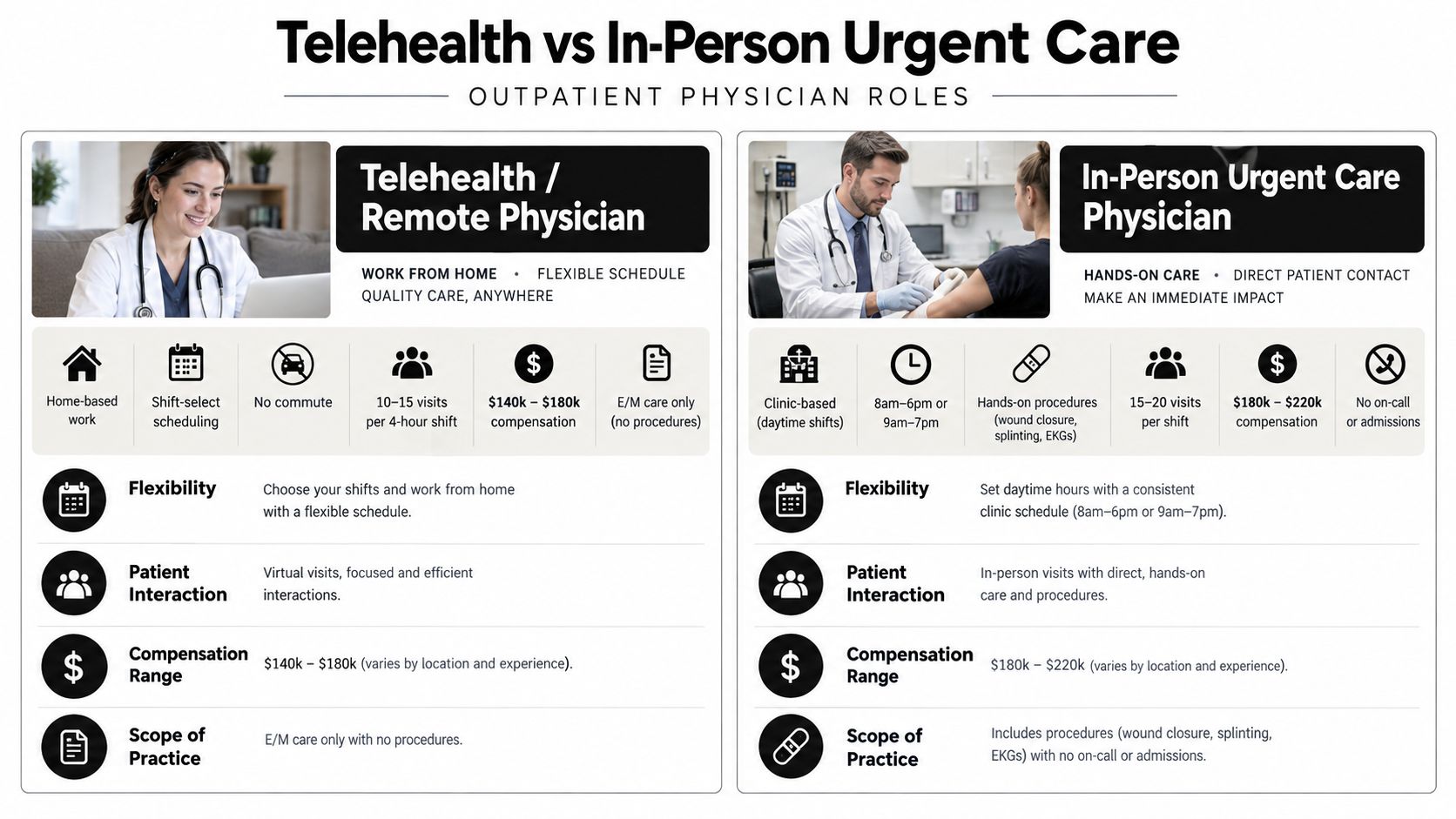
Urgent care is one of the clearest matches for clinicians who want defined shifts rather than longitudinal ownership. Physicians commonly treat minor fractures, infections, lacerations, sprains, and other non-emergency conditions, then discharge patients without hospital admission responsibilities.
The work can be clinically varied. Wound closure, splinting, basic ultrasound, and EKG interpretation create more procedural range than a standard office visit, while the absence of inpatient rounds keeps the workday bounded. Hourly or per-shift compensation can also be easier to understand than a primary care contract built around panel growth and wRVUs.
Where the boundary breaks
The principal risk is throughput. An urgent care job may have no formal call schedule but still feel relentless if the employer expects rapid room turnover, accepts walk-ins late in the day, or uses productivity targets. Corporate ownership can add scripts, standardized workflows, and pressure to maintain a particular pace.
The role works best when the listing confirms:
- Shift limits: The start and end times are fixed, with no expectation that documentation continues at home.
- Clinical scope: The center has clear escalation rules for conditions beyond urgent care capability.
- Staffing support: Nurses, medical assistants, and radiology resources match the patient mix.
- Compensation method: The contract explains whether pay is hourly, per shift, or tied to volume.
A no-call urgent care job can protect personal time better than many hospital-based roles, but it may exchange call burden for intensity during the scheduled block. Review WeekdayDoc's burnout-friendly outpatient listings and look beyond the schedule label for visit expectations, late-patient policies, and documentation ownership.
2. Primary Care Physician, Outpatient-Only
Outpatient-only primary care removes the disruption that comes from hospital rounds, admissions, and inpatient follow-up. The physician can focus on preventive care, chronic disease management, care coordination, and relationships that develop over time.
That continuity is the role's main advantage and its main workload risk. Patients don't disappear after discharge. They generate refill requests, abnormal results, prior authorizations, specialist coordination, and messages that can accumulate after clinic closes.
The compensation trade-off
Primary care compensation often combines a guaranteed base with a productivity component. A contract can appear stable while still requiring a patient panel and visit pace that make the advertised hours unrealistic. Before comparing salaries, determine whether the employer provides team-based inbox coverage, protected administrative time, and support for payer-related tasks.
Outpatient settings generally have a better work-life profile than hospital-based practice. A 2021 multivariate analysis of internists found that outpatient physicians had significantly better work-life balance and more favorable results across all three burnout dimensions, while hospital-based physicians reported higher exhaustion, cynicism, and total burnout (the internist work-life-balance analysis).
That finding doesn't make every outpatient primary care job sustainable. It means the setting removes some structural stressors. The individual practice still determines whether the physician leaves with a finished chart or carries the clinic into the evening.
Interview question: “When I leave the office, who is responsible for unresolved messages, refills, and test results?”
The best outpatient-only primary care role pairs weekday scheduling with realistic panel expectations, adequate nursing support, and a written policy for after-hours work. Without those protections, “no call” may only mean that the physician isn't answering a hospital switchboard.
3. Telehealth and Remote Physician
Remote outpatient work offers the strongest control over location, but not necessarily over workload. Video, phone, and asynchronous messaging can remove commuting and reduce physical interruptions, while shift-based platforms may allow clinicians to select blocks or scale part-time work.
Telehealth's adoption has been uneven. A 2019 industry survey reported overall outpatient telehealth use at approximately 44%, with adoption around 55% in hospital-owned practices and 37% in nonhospital-owned practices. The same survey reported two-way video or webcam use among physician practices, health clinics, and ambulatory surgery centers rising from 45% in 2018 to 68% in 2019 (the telehealth adoption survey).
Remote does not mean invisible work
Technology can improve schedule control, but it also creates boundary problems. A remote clinician may finish a shift at home yet remain tempted to respond to messages, accept extra work, or complete notes outside the scheduled block. Isolation can also reduce informal consultation and collegial support.
A 2024 study of providers using telemedicine found that 25% experienced at least one burnout symptom, with difficult patient cases and a reduced sense of personal achievement identified as important contributors (the 2024 telemedicine burnout study).
Screen the role for:
- Modality mix: Video-only work has different demands from asynchronous messaging and chart review.
- Shift closure: The employer should define what happens to unfinished encounters.
- Licensure responsibility: Multistate practice can create administrative obligations for the clinician.
- Clinical limits: Remote evaluation cannot replace hands-on examination or procedures.
For current remote options, review WeekdayDoc's remote healthcare jobs and confirm whether “flexible” means genuine schedule control or broad availability expectations.
4. Occupational Medicine Physician
Occupational medicine offers a particularly clean separation between clinical hours and personal time. The work centers on workplace injuries, exposure assessment, fitness-for-duty evaluations, pre-placement examinations, spirometry, return-to-work planning, and related employer health services.
The scheduled nature of these visits reduces the unpredictability found in urgent care and general primary care. There are no hospital admissions, and the clinic model usually avoids overnight coverage and traditional on-call responsibilities.
The clinical trade-off
This specialty exchanges broad longitudinal medicine for a focused regulatory and occupational scope. Physicians need to understand workers' compensation processes, OSHA requirements, disability considerations, and the ethical tension that can arise when the employer funds the service but the employee is the patient.
That tension matters more than many job descriptions acknowledge. A role can be calm in schedule design but difficult in professional judgment, particularly when fitness-for-duty conclusions or return-to-work restrictions affect employment.
The best candidates will ask how the organization handles:
- Confidentiality: What information reaches the employer, and what stays in the medical record?
- Clinical independence: Can the physician make recommendations without pressure from management?
- Regulatory support: Who handles compliance interpretation and documentation?
- Volume design: Are appointments scheduled realistically, or are add-ons common?
Occupational medicine can suit clinicians who value predictable clinic hours and focused encounters more than extensive disease continuity. It may be less satisfying for physicians seeking complex diagnostic breadth or a traditional specialty identity.
5. Retail and Pharmacy-Based Clinic Physician
Retail and pharmacy-based clinics prioritize standardization and accessibility. Physicians manage minor acute illness, vaccinations, basic preventive care, and selected chronic disease monitoring within protocols designed for relatively low-complexity encounters.
The schedule is often easier to understand than a traditional practice. There are no hospital rounds, admissions, or overnight coverage obligations, and part-time or per-diem work may be available. That makes the setting relevant to clinicians testing a reduced schedule, combining clinical work with another role, or returning after time away.
Predictability can conceal intensity
Standardized protocols reduce variation, but they also limit autonomy. A physician may have less ability to customize care, and the retail environment can introduce interruptions that don't appear in a clinical schedule. High throughput can make a supposedly simple day feel compressed.
The key question isn't whether the clinic closes on time. It's whether the employer protects the time between appointments and gives the physician authority to escalate patients whose needs exceed the protocol.
Evaluate:
- Protocol authority: Can the clinician depart from standing pathways when clinical judgment requires it?
- Triage design: Which patients reach the physician, and which are redirected?
- Retail interruptions: Do pharmacy operations affect room flow or patient privacy?
- Career fit: Is the role a long-term practice choice or a bridge to another position?
This path can work well for clinicians who value routine and clear limits. It's a weaker fit for those who need procedural variety, diagnostic complexity, or control over treatment design.
6. Urgent Care Telehealth and Virtual Urgent Care Physician
Virtual urgent care combines acute-care decision-making with remote delivery. The physician handles non-emergency complaints through video or phone, often in discrete shifts, without admissions or procedure responsibilities.
The clinical boundaries are clear. There's no wound closure, splinting, imaging interpretation based on a physical examination, or hands-on assessment. That limitation can reduce physical fatigue and setup time, but it also creates uncertainty when the patient's story doesn't provide enough information.
The real advantage is shift containment
Virtual urgent care is strongest when the platform treats the shift as a closed unit. Coverage rotates to another clinician, the organization defines who handles follow-up, and the physician isn't expected to monitor the queue after signing off.
Technology failures are part of the job design, not an occasional nuisance. Internet problems, video-platform interruptions, and inadequate home equipment can turn a short encounter into a longer administrative event. Multistate licensure may also require continuing attention from the clinician, even if the employer provides some support.
Ask for written answers about:
- Queue ownership: Who handles patients who are waiting when the shift ends?
- Follow-up responsibility: Does the original clinician receive messages after the encounter?
- Escalation: How does the platform manage patients who need in-person evaluation?
- Home-work boundaries: Can the clinician decline extra shifts without informal pressure?
Virtual urgent care suits physicians who prefer acute encounters without procedures and want location flexibility. It's less suitable for clinicians who rely on physical examination, hands-on treatment, or sustained patient relationships.
7. Outpatient Specialty Clinic Physician
Non-procedural specialty clinics offer the most compelling clinical trade-off on this list. Rheumatology, endocrinology, medical oncology, infectious disease, and selected nephrology roles can provide complex diagnostic work and longitudinal relationships without hospital rounds or inpatient admissions.
Compensation in ambulatory care is substantial. The Bureau of Labor Statistics reported 427,530 physicians employed in ambulatory health care services in May 2023, with an annual mean wage of $291,550 and a median hourly wage of $140.17 (BLS ambulatory health care employment and wages). For physicians in outpatient care centers under NAICS 621400, BLS reported a mean annual wage of $269,210, with psychiatrists at $289,100 and physicians, all other, at $264,090 (BLS outpatient care center wage data).
Complexity moves into the inbox
Specialty work can be intellectually rewarding, but complex patients require detailed documentation, test coordination, medication authorization, and communication with other clinicians. A no-call contract doesn't eliminate that work. It shifts the risk from nighttime emergencies to evening catch-up.
Productivity design deserves close review. MGMA compensation materials support comparisons using annual compensation, daily rate, weekend rate, holiday rate, hourly rate, and on-call coverage type (MGMA provider compensation data). An HFMA physician contract example also describes compensation capped at the MGMA 90th percentile each contract year (HFMA physician contract example).
A specialty clinic can offer protected weekends and still create burnout if the physician owns every authorization, result, and unfinished note.
This path is strongest for clinicians who want diagnostic depth without inpatient life. Check the Burnout-Friendly Score, support staffing, patient complexity, and productivity threshold together rather than treating salary as the deciding variable.
8. Concierge and Direct Primary Care Physician
Concierge and direct primary care models reduce dependence on insurance billing and can give physicians greater control over appointment length, panel design, and clinical style. That autonomy is attractive to clinicians who want continuity without the compressed pace of conventional primary care.
The model also changes the meaning of “no call.” Some practices protect evenings and weekends, while others promise access that effectively makes the physician continuously available by phone, email, or text. A smaller panel doesn't help if patients expect immediate personal access.
Membership structure determines the lifestyle
A physician evaluating this path should separate an employed role from ownership. Employment may offer a clearer salary and schedule. Ownership can offer more control but introduces business, retention, staffing, and revenue risk.
Review:
- Access promise: Does the membership model require same-day responses outside clinic hours?
- Coverage plan: Who responds when the physician is away?
- Administrative work: Which tasks remain after insurance billing is reduced?
- Financial exposure: Who carries the cost of staffing, rent, technology, and patient acquisition?
Direct care can be highly satisfying when the physician controls access expectations and protects time away from work. It can also recreate traditional primary care burnout in a more personal form if every patient believes the physician is always reachable.
The right contract should specify response windows, vacation coverage, after-hours communication, and whether clinical messages are included in the role. A membership model is not burnout-friendly. The boundary design decides that.
9. Corporate and Occupational Health Medical Director
Corporate medical director and wellness clinic roles combine clinical work with program management. The physician may advise on occupational surveillance, exposure management, employee wellness, fitness-for-duty evaluations, and health policy while spending a substantial portion of the week in meetings, analysis, and documentation.
This is a different kind of no-call position. The calendar may be predictable, but administrative work can dominate. A role that looks like part-time clinical medicine may function more like corporate leadership with a clinical component.
Measure authority, not just hours
The important questions concern influence and confidentiality. Does the physician set clinical policy, or only implement risk-management decisions? Can the physician protect employee privacy when executives want operational information? What percentage of time is clinical, and what percentage is meetings, reporting, and program administration?
A strong interview should clarify:
- Clinical allocation: How is patient care separated from program management?
- Decision rights: Which recommendations can the physician make independently?
- Confidentiality: What information can executives access?
- Performance measures: Are incentives tied to clinical quality, utilization, attendance, or corporate outcomes?
This role may suit an experienced clinician seeking leadership, public health work, or a gradual move away from full-time patient care. It's less appropriate for someone seeking deep specialty practice or frequent peer-based clinical learning.
Explore WeekdayDoc's medical director jobs and compare the stated clinical percentage with the actual meeting and reporting expectations described during interviews.
Outpatient Physician Jobs: 9-Role Comparison
| Role | Implementation complexity | Resource requirements & efficiency | Expected outcomes | Ideal use cases | Key advantages |
|---|---|---|---|---|---|
| Urgent Care Physician | Moderate, protocol + procedural workflows, shift logistics | Clinic space, nursing staff, basic imaging/ultrasound; efficient per-shift throughput | Rapid resolution of low-acuity issues; reduces ED load; predictable volume | Daytime-focused clinicians seeking acute-care work without nights/call | Predictable schedules, procedural variety, no on-call |
| Primary Care Physician (Outpatient‑Only) | Moderate–High, panel management, longitudinal workflows | Multidisciplinary team (MAs, RNs), robust EHR, care coordination resources | Improved chronic disease control and preventive care; sustained patient continuity | Physicians prioritizing long-term care relationships and steady weekday work | Deep continuity, stable salary floors, lower inpatient burden |
| Telehealth / Remote Physician | Low–Moderate, tech workflows + licensure/regulatory tasks | Reliable internet, teleplatform/EMR access, multistate licensure support | Flexible access for patients; reduced commute; variable visit throughput | Clinicians needing geographic flexibility, part‑time work, or home-based practice | High schedule flexibility, commute elimination, easier part‑time scaling |
| Occupational Medicine Physician | Moderate, regulatory/OSHA expertise required | Employer contracts, testing equipment, reporting systems, modest clinic setup | Improved workplace safety/compliance; predictable occupational outcomes | Employer-based clinics, industrial sites, corporate health programs | Stable daytime hours, focused scope, strong work-life balance |
| Retail / Pharmacy‑Based Clinic Physician | Low, standardized protocols and high-throughput workflows | Retail space integration, standing orders, nursing triage; high patient flow | Fast treatment of minor acute conditions and vaccinations; consistent access | Part‑time clinicians or those wanting fixed shifts in retail environments | Absolute schedule certainty, easy part‑time work, high throughput |
| Urgent Care Telehealth / Virtual Urgent Care Physician | Low–Moderate, triage protocols plus synchronous tech | Telehealth platform, reliable home setup, multistate licensure; lower visit density | Remote acute care access with longer visit times; lower per-hour volume | Clinicians supplementing income or preferring remote urgent-care shifts | Remote shifts, shift flexibility, no procedures/no call |
| Outpatient Specialty Clinic Physician (Non‑Procedural) | High, complex diagnostics, coordination, specialty workflows | Specialty staff, advanced diagnostics access, robust EHR templates | High-quality chronic disease management and specialty outcomes; higher RVUs | Specialists wanting outpatient-only practice, academic or complex care focus | Higher compensation, intellectual engagement, protected clinic hours |
| Concierge / Direct Primary Care Physician | High, business model setup and patient acquisition | Office infrastructure, membership management, marketing; lower panel size improves efficiency | High continuity, longer visits, reduced admin burden; revenue tied to panel growth | Entrepreneurial physicians in affluent or employer-sponsored markets | Clinical autonomy, longer visits, superior patient access and continuity |
| Corporate / Occupational Health Medical Director / Wellness Physician | High, hybrid clinical + administrative leadership | Analytics, cross-functional teams, program budgets, reporting systems | Measurable employee health metrics, programmatic ROI, policy implementation | Physicians seeking leadership roles blending clinical care and population health | Predictable hours, leadership opportunities, stable compensation |
Turn a Listing Into a Work-Life Decision
“No call” is a useful filter, not a final decision. The evidence supports a meaningful outpatient advantage, but the advantage comes from the setting's design. Outpatient physicians had better work-life-balance and burnout scores than hospital-based physicians in the internist analysis cited earlier, while telemedicine research shows that remote work can still carry burnout symptoms and difficult-case stress.
Start with the schedule you can sustain. On WeekdayDoc, filter by clinician type, specialty, remote or hybrid work style, and explicit No Call and No Weekends markers. Then compare the listing's salary information with its Burnout-Friendly Score and state-specific FIRE projection. Those tools force a more useful question than “What's the highest salary?” They ask whether the compensation supports the life the schedule is supposed to protect.
Use the Salary and FIRE Calculator, the Burnout Index, and the RVU Calculator to test the role's financial and productivity assumptions. If the employer uses wRVUs, calculate the production required to reach the stated compensation. If the contract includes caps, thresholds, or quality modifiers, model the base case rather than relying on the advertised maximum.
A contract review should verify the operational details:
- Call language: Does “no call” exclude informal phone coverage, result review, or cross-coverage?
- Weekend coverage: Are Saturdays, Sundays, and holiday messages assigned to another team?
- Visit quotas: What happens when patient demand exceeds the scheduled template?
- Inbox ownership: Who handles refills, prior authorizations, results, and patient messages?
- Support staffing: Which tasks belong to nurses, medical assistants, pharmacists, or centralized teams?
- Licensure: Who pays for and manages multistate licensing in remote roles?
- Benefits: How do paid leave, retirement contributions, health coverage, and malpractice protection affect the offer?
- Productivity thresholds: Is compensation tied to wRVUs, collections, daily volume, or a contract cap?
Use WeekdayDoc's contract scanner to identify provisions that deserve clarification, and compare market context through the WeekdayDoc Market Pulse. For compensation modeling, the Salary Calculator Pro can help separate headline pay from the financial value of time, benefits, and location.
The strongest fit depends on the clinician. Occupational medicine and carefully screened remote roles may suit someone prioritizing schedule containment. Outpatient specialty clinics may be better for physicians who want higher clinical complexity and compensation. Outpatient-only primary care can preserve continuity, while urgent care and retail clinics offer clearer shift boundaries but may increase pace or reduce autonomy.
Treat every listing as a hypothesis. Confirm who owns the work after the appointment ends, what the employer measures, and whether the contract protects the time the job promises to protect.
WeekdayDoc offers curated remote, hybrid, and in-person clinician roles with explicit no-call and no-weekend markers, salary information, Burnout-Friendly Scores, and state-specific FIRE projections. Visit WeekdayDoc to compare outpatient physician jobs by specialty, work style, compensation, and the workload details that determine whether a role is sustainable.