Physician Recruitment Costs: A Channel-by-Channel Guide
Compare physician recruitment costs across job boards, agencies, vacancy time, onboarding, and turnover to choose a durable-hire channel.

The first sign a healthcare organization is miscalculating its hiring budget is an intense focus on job-board invoice prices while ignoring the lost revenue from empty exam rooms. An employer might save a few thousand dollars by relying solely on organic website traffic, only to leave a high-revenue specialty role open for an extra six months. The true expense of bringing a clinician on board requires accounting for every phase of the transition, from the initial sourcing hours to the final credentialing delays. WeekdayDoc helps organizations control these variables by matching transparent role designs with targeted candidates, removing the friction that extends vacancy times. Measuring these options requires a complete framework for calculating physician recruitment costs.

Start With the Total Open-Position Cost
Many organizations search for a single national benchmark to set their annual hiring budgets because a flat dollar amount simplifies financial planning. This calculation fails when rural neurosurgeon searches operate under different economics from urban pediatric openings. Differences in specialty, geography, practice model, and reimbursement structure alter the final price tag.
An industry estimate puts the total cost of recruiting a physician between $180,000 and $250,000. That total includes in-house recruiting staff salaries, marketing, interview expenses, relocation assistance, sign-on bonuses, and retention investment.
Direct channel costs are easier to isolate. A predictable marketplace like WeekdayDoc offers fixed pricing for its network, listing a Standard post at $197 monthly or $1,970 annually. A Featured plan allowing three active posts costs $397 monthly or $3,970 annually, providing steady external marketing inputs. The listing price remains only one fraction of the total accounting, and advertising alone cannot guarantee a specific time-to-fill or retention rate.
A reliable budget separates the direct recruitment expense from the total open-position cost. Direct expenses cover the advertising, labor, and travel spent finding the candidate. The total position cost adds the lost revenue, temporary coverage, and delayed start times that accumulate before the new hire sees their first patient.
Break Down the Six Costs Behind a Hire
Dividing the expense of an open position into six distinct categories reveals where a slow channel drains practice resources.
Sourcing
Sourcing covers the internal labor required to generate a qualified candidate pool. This calculation includes recruiter salaries, benefits, allocated overhead, and the hours medical directors spend interviewing applicants. The sourcing bucket also captures referral bonuses, direct candidate research, and software tools like applicant tracking systems. Unpaid channels rarely exist, as an employer website with zero media cost still requires administrative labor to maintain, update, and monitor.
Advertising
Advertising encompasses the external marketing spend. Job board subscriptions, sponsored placements, specialty association fees, and targeted social campaigns fall under this category. The design of landing pages and the analytics tracking candidate attribution also add to the final marketing total.
Agency and Search-Firm Fees
Outside search firms introduce a different variable. Contracts may ask for retainers paid at engagement, fixed placement fees, or compensation-based percentages. Additional agency expenses often involve candidate travel, exclusive ownership clauses, and restart fees if a candidate withdraws. Reviewing the exact contract terms helps employers understand the financial exposure if the hired clinician leaves within the first year.
Vacancy
Vacancy costs represent the operational impact of the missing clinician. Empty appointment slots, canceled procedures, and delayed service-line expansion reduce the available contribution margin. Overtime premiums, additional call coverage, and locum tenens invoices attempt to bridge that gap while the search continues.
Onboarding
AAPPR's research page lists a Physician Credentialing Report and a Physician and Clinician Onboarding Research Report. The onboarding report evaluates onboarding practices within healthcare organizations and captures the experiences and sentiments of physicians and providers.
Turnover
Turnover nullifies the initial investment. When a hire fails early, the organization absorbs sunk recruiting spend alongside new temporary coverage premiums. Broad replacement-cost claims often generalize outpatient panel economics across all specialties, but specific environments vary. A 2022 Journal of Hospital Medicine study found direct turnover costs of $6,166 per incoming hospitalist at one large integrated health system. National-wage simulations in the same study estimated mean costs of $56,943 per hire when replacing a single hospitalist, dropping to $30,382 per hire at higher replacement volumes. The direct financial impact depends heavily on whether the organization can spread fixed infrastructure across many hires.
Compare Recruitment Channels by Total Cost
Every sourcing method presents a trade-off between upfront spend, internal labor, and speed. Hiring teams achieve better results by selecting channels based on the specific role rather than applying one tool to every opening.
Employer Websites, Referrals, and Job Boards
Internal channels offer high conversion rates alongside limited reach. The AAPPR's 2024 metrics guidance identifies employer websites, referrals, and internet job boards as leading sources for filling positions. While the report advises tracking stage-to-stage conversions to identify bottlenecks, employer sites work well for established regional brands while struggling to attract passive candidates from outside the immediate market.
General job boards generate high application volumes, which require hundreds of internal recruiter hours to screen. A low-cost listing on a broad platform becomes expensive if the hiring team spends a month filtering unqualified resumes while the vacancy continues to drain clinical revenue.
Specialty Marketplaces and Direct Outreach
Specialty marketplaces align the audience with the specific demands of the role. WeekdayDoc focuses on schedule transparency, creating an effective environment for remote, telehealth, hybrid, part-time, leadership, and alternative-career positions. The platform's fixed pricing supports predictable financial modeling. If an employer attributes three filled roles to a $3,970 annual Featured plan, the subscription component equals roughly $1,323 per filled role before internal labor and onboarding expenses. This arithmetic illustrates the cost advantage of a targeted platform, provided the employer supplies competitive compensation and clear schedule details to convert the visiting clinicians.
Direct outbound recruiting bypasses the active job seeker to reach passive clinicians. Cold outreach requires personalized messaging and a substantial investment of internal recruiter time. The response rate remains low in most markets, yet the candidate quality can be exceptional when a specific subspecialty is required.
Agencies and Locum Tenens Bridges
Agencies charge a premium for their networks, buying speed in difficult markets or executive searches where internal teams lack capacity. A search firm might justify a heavy upfront retainer if it produces a qualified slate of candidates for a rural surgical role that has sat empty for a year.
Temporary locum tenens providers act as a bridge to preserve clinical capacity while the permanent search remains open. Tracking the cost per covered day alongside the avoided lost margin helps determine whether the temporary premium is financially viable.
| Channel | Best Fit | Cost Advantage | Hidden Risk | Key Metric |
|---|---|---|---|---|
| Employer Website | Known regional brands, evergreen hiring | Low incremental media spend | Weak passive-candidate reach | Source-to-interview rate |
| Internal Referrals | Community practices, highly engaged staff | High retention probability | Referral bonuses, limited volume | First-year retention |
| General Job Boards | Broad visibility, high-volume roles | Predictable listing price | Heavy internal screening burden | Cost per qualified applicant |
| WeekdayDoc | Roles requiring schedule transparency | Fixed subscription, targeted audience | Requires competitive job terms | Cost per retained hire |
| Search Agencies | Hard-to-fill markets, executive roles | Outsources sourcing labor | High external fees, contract limits | Days to qualified slate |
| Locum Tenens | Immediate revenue preservation | Avoids lost procedure margin | High daily rates, continuity loss | Cost per covered day |
Measure Vacancy Time, Start Time, and Hire Quality
Documenting the exact duration of a recruitment cycle separates theoretical budgets from operational reality.
Calculate Vacancy and Coverage Cost
Begin the calculation with the avoidable monthly contribution margin. This metric reflects the revenue the practice loses minus the variable expenses it avoids by not having the clinician on site. Gross charges distort the financial picture, making net contribution margin the more accurate baseline.
Divide the avoidable monthly contribution margin by the expected clinical days per month to find the daily vacancy cost, then multiply that daily figure by the total vacancy days. The next step adds the cost of temporary coverage, overtime premiums paid to existing staff, and any identifiable downstream losses, such as reduced referrals to the imaging department.
The scale of these losses varies by specialty. A 2023 Medical Group Management Association (MGMA) provider compensation report highlighted examples where a six-month vacancy represented approximately $1.15 million in lost revenue for noninvasive cardiology, $1.4 million for gastroenterology, and $1.6 million for ophthalmology. While these figures serve as specific illustrations rather than universal rules, they demonstrate how a prolonged search overshadows initial marketing savings.
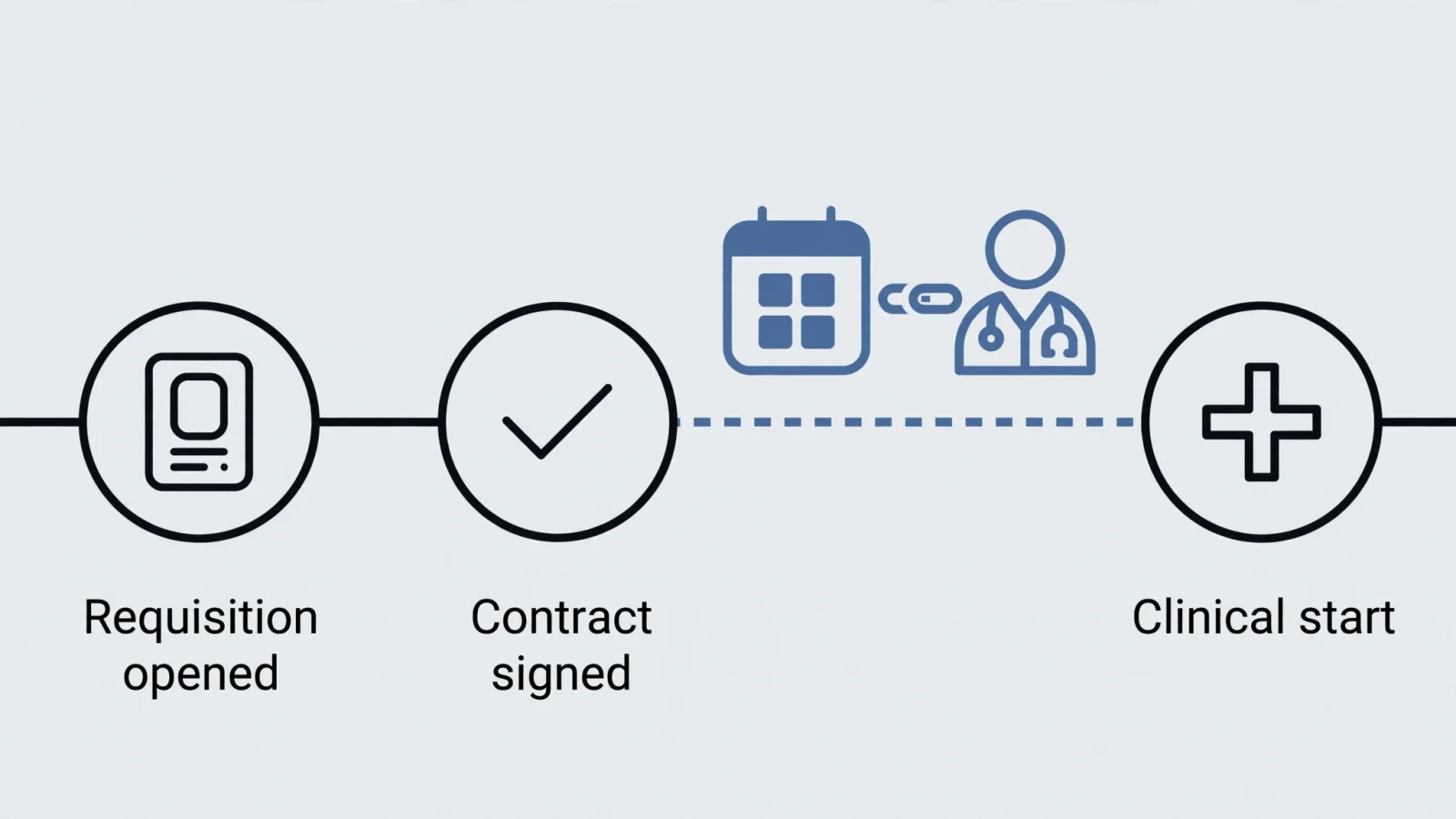
Separate Time-to-Fill From Time-to-Start
Opening a requisition, signing a contract, and starting clinical work represent three different dates. A 2024 AAPPR benchmarking report noted a median time-to-fill of 118 days for physicians and 332 days for oncology searches. Because time-to-fill usually stops when the candidate signs the contract, the metric fails to capture the full delay.
The 112-day average gap between contract signing and clinical start means temporary coverage invoices will continue for months after the recruiter secures a placement. Modeling the total timeline helps practice administrators secure adequate bridge coverage without unexpected budget overruns.
Track Cost Per Durable Hire and ROI
The standard cost per hire adds sourcing, internal labor, interview travel, agency fees, relocation, and credentialing into one sum. The total position cost takes that sum and adds the vacancy losses alongside any temporary coverage premiums.
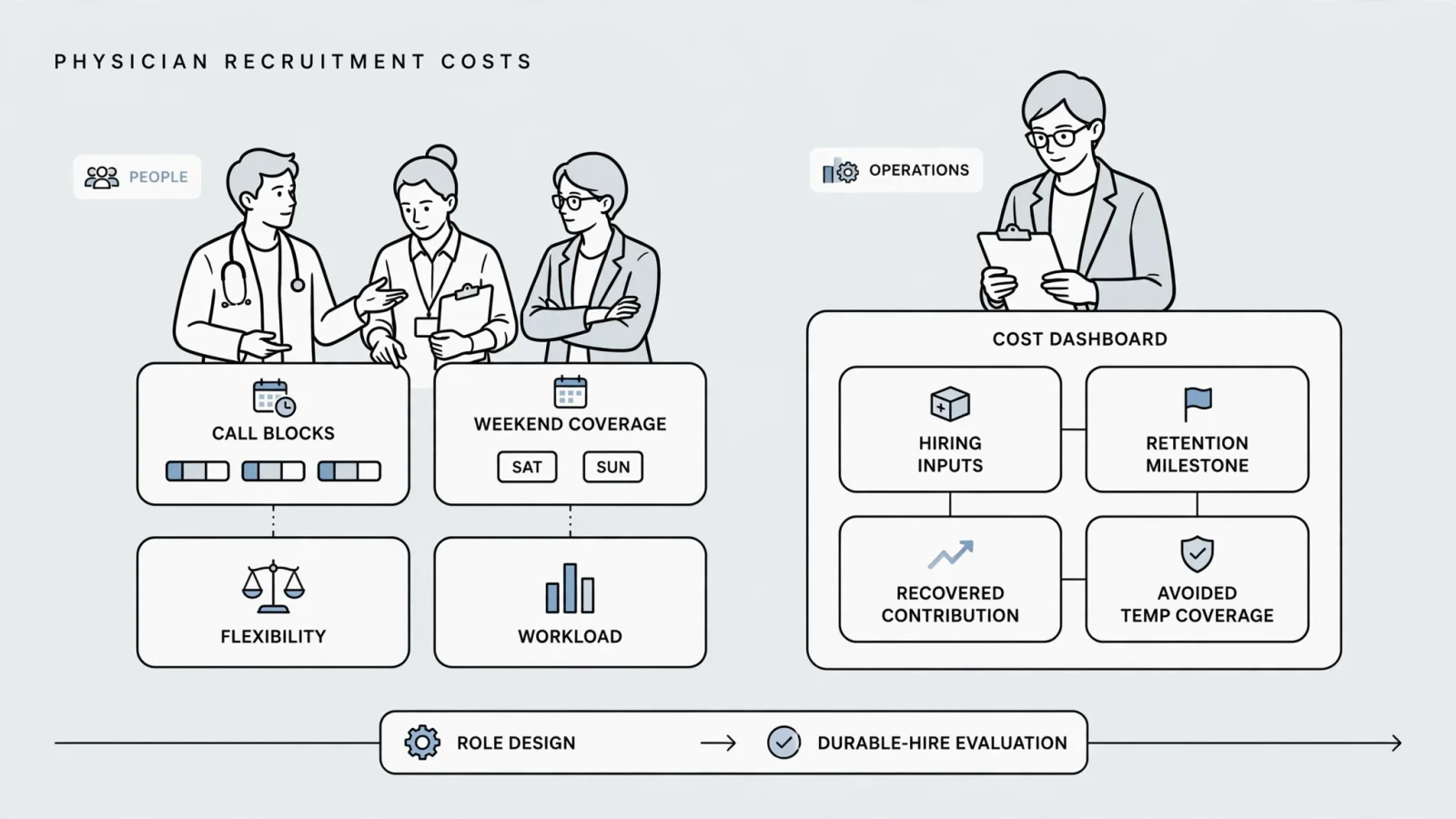
Evaluating cost per durable hire introduces retention into the equation. Dividing the total spend by the number of hires retained through a specific milestone, such as the end of the first contract term, penalizes channels that produce fast hires who quit within six months. Practice leaders calculate channel ROI by comparing the recovered contribution margin and the avoided temporary coverage costs against the total channel spend.
Treat Role Design as a Recruitment Cost Variable
Channel economics connect directly to the role being marketed. A broken job description will generate expensive vacancies regardless of where the hiring team posts it.
Price Schedule, Workload, and Support
Candidates evaluate the operational reality of the practice before they accept an offer, meaning a role demanding frequent weekend call will take longer to fill than a predictable outpatient schedule. The 2023 MGMA report noted a psychiatric search where a seven-days-on, seven-days-off schedule helped the organization fill the vacancy in 90 days, compared with an 8.4-month specialty average. That single example highlights how schedule adjustments accelerate candidate conversion.
Documenting the call frequency, night obligations, holiday rotations, block schedules, and remote limitations before posting the job creates a stronger pitch. Defining the administrative workload, clinical autonomy, protected time, and expected panel size provides transparent expectations that reduce the mismatch risk causing early turnover. WeekdayDoc uses work-life scoring to make these schedule factors visible, helping employers attract candidates who understand the exact demands of the position.
Use Transparent Expectations to Improve Fit
Clinicians calculate the true value of an offer by looking past the base salary to weigh total compensation against RVU thresholds and productivity requirements. A high base salary loses its appeal if the required patient volume is unsustainable or the administrative burden consumes evening hours.
Candidates also scrutinize sign-on repayment clauses, relocation obligations, restrictive covenants, and tail coverage responsibilities. These terms can dictate whether a physician feels trapped in a role or supported by the organization. Burying these details until the final contract stage risks losing the candidate after the employer sinks thousands of dollars into site visits and interviews. Honest role design acts as a primary retention tool, ensuring the recruitment budget produces a durable hire.
Turn the Model Into a Channel Decision
Comparing recruitment options requires building a complete financial model of the open position.
Complete the Employer Cost Worksheet
Before committing to a search strategy, hiring managers document these variables for the specific specialty and location:
- Average daily contribution margin for the vacant role.
- Expected days to fill the position.
- Expected days from contract signing to clinical start.
- Monthly temporary coverage premiums.
- Internal recruiter and physician interview hours required.
- Candidate travel and relocation budgets.
- Referral bonuses or agency fees.
- Licensing, privileging, and credentialing expenses.
- First-year or contract-term turnover rate for the department.
- Total cost of a failed search.
These inputs determine the cost per qualified applicant, the cost per start, and the ultimate cost per retained hire.
Ask for Comparable Vendor Terms
When evaluating a search firm against a direct marketplace, hiring teams can ask about the agency's fee structure and payment timing, which clarify the cash flow impact. The practice also needs to identify the compensation base used to calculate percentage fees, whether the search is exclusive, and how long candidate ownership lasts. A check on the replacement guarantee reveals whether it covers a candidate who fails to start and whether the vendor offers a full refund, a partial credit, or merely a new search. A final review shows which travel, licensing, and advertising expenses the retainer covers.
FAQ: The Five Cost Questions Employers Ask
Is there a standard cost to recruit a physician? The expense varies widely by specialty, location, and the practice model. An employed hospitalist requires different infrastructure from an independent orthopedic surgeon, so administrators need local market data and internal margin calculations to build a budget.
Are search agencies always more expensive than job boards? An agency charges higher external fees while shifting the sourcing labor off the internal team. If a $2,000 job board post leaves a high-margin role vacant for an extra year, the lost revenue dwarfs the cost of a $30,000 agency placement. Evaluating the total cost of the vacancy provides the true comparison.
Where do credentialing costs belong in the budget? Credentialing, privileging, and state licensing fall under direct onboarding costs. Because these processes delay the clinical start date by an average of three to four months, they also extend the vacancy and temporary coverage expenses.
Should monthly vacancy cost use gross charges or contribution margin? Calculations rely on avoidable contribution margin. Gross charges misrepresent the actual revenue collected, and they ignore the variable supplies and staff costs the practice saves while the clinician is absent.
How do we calculate recruitment ROI for a specific channel? Organizations compare the recovered margin and the avoided temporary coverage costs against the total channel spend. Reviewing these results by specialty and location reveals nuances, as a channel that works for telehealth therapists may fail entirely for pediatric surgeons.
Stop guessing at the true cost of an open position. Comparing a transparent, targeted clinician marketplace against the full expense of an agency search highlights the value of avoiding extended vacancies and failed hires. Post your next permanent, part-time, or remote role on WeekdayDoc to reach clinicians actively seeking sustainable careers and clear schedule expectations.