Healthcare Employer Branding: How to Prove a Clinician-Friendly Workplace
Build a credible healthcare employer brand with evidence on schedule, call, safety, support, compensation, and clinician career growth.

Clinicians experience a healthcare employer brand through the schedule, call calendar, staffing model, inbox burden, compensation formula, and contract terms they live with every week. Because a sustainable career depends on these operating details, hospitals and private practices can build their reputations on transparency rather than polished advertising. Sharing exact working conditions before a candidate applies signals respect for their time and well-being.
How Healthcare Employer Branding Translates to Lived Experience
Distinguishing the Employer Brand From Recruitment Marketing
Recruitment teams often mix up the concepts of brand, value proposition, and marketing. Healthcare employer branding represents the way an organization communicates and delivers what it is like to work there, serving as the lived and perceived employment experience. This perception exists whether administrators manage it or not, because daily realities like patient volume and administrative support shape it continuously.
An employer value proposition clarifies the specific exchange between the organization and the clinician. It outlines what the hospital or practice offers, such as base pay, schedule control, clinical autonomy, and professional development, alongside what it expects in return. Recruitment marketing then turns that proposition into job-specific communication designed to help a candidate decide whether to apply. If this marketing misrepresents the actual value proposition, the resulting reputation suffers.
Proving the Employment Experience Upfront
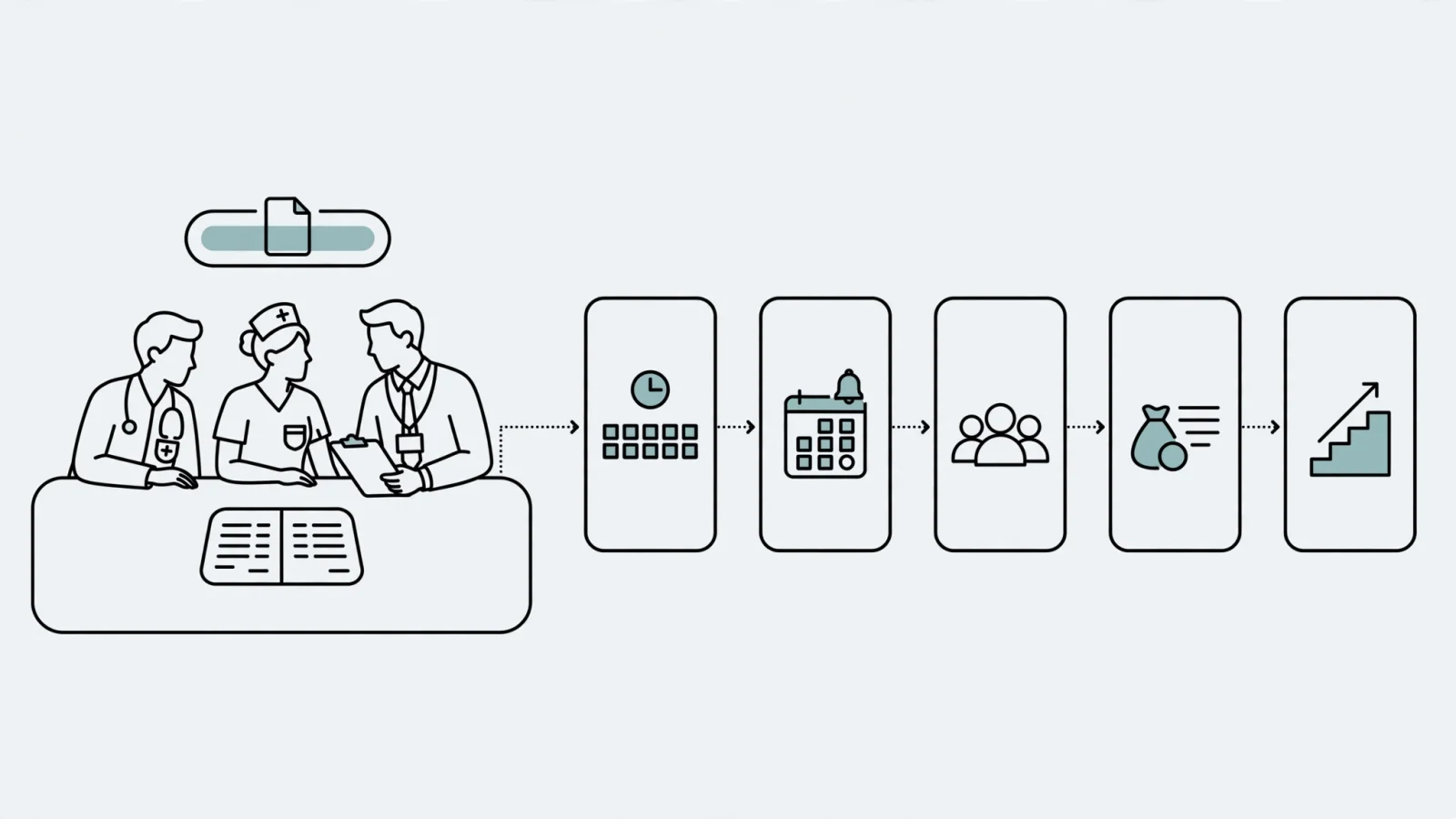
The operational details of a job send the strongest messages to potential hires. A broad statement about work-life balance carries no weight if the actual role requires unpredictable weekend coverage and extensive unpaid charting. Administrators build trust by presenting a verifiable operating model upfront, answering questions about how the team handles unexpected absences, who owns medication refills, and whether the schedule accommodates childcare planning.
WeekdayDoc operates as a marketplace for sustainable healthcare careers by treating these practical realities as the primary focus of the job search. The software turns buried job-description details into structured decision data, allowing candidates to evaluate compensation, call requirements, and schedule quality alongside the role. Presenting clear trade-offs helps hiring managers attract applicants who understand the specific demands of the position.
Backing Up Recruitment Claims With Evidence
Work Design Shapes Clinician Well-Being
Administrators can treat burnout as a systems issue, because the National Academy of Medicine says individual-focused strategies do not sufficiently address clinician burnout on their own. It points to workload, workplace culture, organizational policies, and resources as factors shaping clinician well-being. Because structural issues shape well-being, a benefits page is no substitute for a daily schedule that matches its advertised promises.
Dissatisfaction is strongly associated with workplace conditions. The Agency for Healthcare Research and Quality identifies time pressure, chaotic environments, and low control over work pace as work conditions strongly associated with dissatisfaction, stress, burnout, and intent to leave. It also reports that fully mature electronic health record systems, especially with shorter visits, were associated with physician stress, burnout, and intent to leave. When a health system builds its recruitment message on autonomy and support, leadership must prove that the daily workflow reinforces those concepts.
Safety, Teamwork, and Leadership Build Trust
Safety and teamwork form a core part of the employment story because they directly affect the daily risks clinicians face. Federal injury data from 2021 and 2022 indicates that healthcare workplace violence caused 14 nonfatal injuries involving days away from work per 10,000 full-time equivalents, compared with 4.3 per 10,000 across all industries. Hiring managers can address these realities by explaining reporting procedures, security responses, and incident review processes during interviews.
A healthy safety climate correlates closely with better retention and well-being. A 2024 cross-sectional study of 968 practicing U.S. physicians found that each one-point increase in safety-climate score was associated with 19 percent lower odds of burnout, while a similar increase in teamwork-climate score yielded 20 percent lower odds. These associations demonstrate that specific escalation pathways and clinical backup systems carry more weight with a candidate than generic claims about a supportive culture.
Contextualizing Burnout Data in Recruitment
While transparency builds trust, recruitment teams should contextualize burnout statistics carefully. The American Medical Association reported that 41.9 percent of responding physicians experienced at least one burnout symptom during 2025, based on nearly 19,000 responses across 106 participating health systems. Although that dataset provides helpful context for understanding physician stress, it does not represent a live census of every medical professional nationwide.
Referencing these industry challenges allows health systems to explain why they prioritize transparent scheduling and staffing, rather than making unrealistic guarantees. A four-day schedule or a new safety policy cannot eliminate stress entirely. Publishing verifiable evidence supports informed choices and sets accurate expectations, preventing the false promise of a frictionless workplace.

Evaluating Roles Through Operational Proof Points
Schedule, Call, and Workload
The strongest schedule disclosures use operational language to define clinical hours, full-time equivalency, and shift patterns. Candidates evaluate start and end times alongside any expected early arrival or late stay requirements, noting how far in advance the department posts the schedule. Separating scheduled hours from expected total work time gives applicants a clearer picture of the inbox and documentation load built into the workday.
On-call expectations demand similar specificity, meaning a description of "minimal call" offers no usable information. A credible listing discloses the exact call frequency, distinguishes between home and in-house duty, explains the weekend and holiday rotation, and identifies available backup. Outlining the post-call relief policy shows candidates exactly what happens after they manage a difficult overnight shift.
Staffing, Safety, and Autonomy
Clinicians judge total workload by examining team composition and the division of administrative tasks. An honest job description details patient volume, average visit length, and the protocol for absorbing work when a colleague takes leave. Before accepting an offer, candidates seek to understand who handles medication refill requests, who manages prior authorizations, and how the department responds to sudden staffing shortages.
Safety protocols and clinical autonomy also factor heavily into employment decisions, so candidates benefit from clear explanations of workplace violence prevention measures, incident reporting procedures, and protections against retaliation. Clear autonomy disclosures distinguish clinical decision rights from operational independence, giving candidates concrete examples of their influence. This transparency might include a formal process for clinicians to provide input on practice protocols alongside a visible feedback loop where leaders report back on changes.
Compensation, Contracts, and Career Growth
Financial clarity prevents wasted interviews and mismatched expectations by separating guaranteed base pay from variable components like productivity targets, quality incentives, call stipends, and shift differentials. Candidates require details about the relative value unit methodology, the benefits package, the employment classification, and the financial assumptions tied to advertised maximum earning potentials. Additionally, contract terms regarding tail coverage responsibility, repayment clauses, restrictive covenants, and termination notice requirements belong early in the screening process.
Career growth details complete the picture by defining what happens after the onboarding period ends. Job listings perform better when they identify mentorship programs, protected time for continuing medical education, and formal leadership paths. Experienced professionals look for opportunities to dedicate time to teaching, research, or specialty development, while confirming whether part-time clinicians remain eligible for advancement. Even candidates evaluating remote healthcare data analyst jobs or telehealth positions need clarity about licensure, work hours, supervision, and technology requirements.
Translating Vague Claims Into Verifiable Proof
Replace Marketing Adjectives With Operating Facts
Recruitment materials often rely on adjectives that sound appealing but carry no enforceable meaning. Claiming that a job offers a flexible schedule provides little value until the practice defines the exact shifts, the schedule-posting timing, the swap rules, and the call obligations. Auditing public language allows a health system to replace these marketing phrases with specific operating facts that candidates verify during an interview.
Proving a claim of competitive compensation requires publishing a base range, an incentive formula, the assumptions behind any bonus, and separate rates for call coverage. Similarly, a supportive team translates into a named staffing model detailing how medical assistants, nurses, and administrative staff divide the daily workload. By converting a vague promise of a clinician-led culture into a documented list of specific decision rights and committee access, the organization forces itself to stand behind its daily operations.
Publishing an Evidence-Based Role Summary
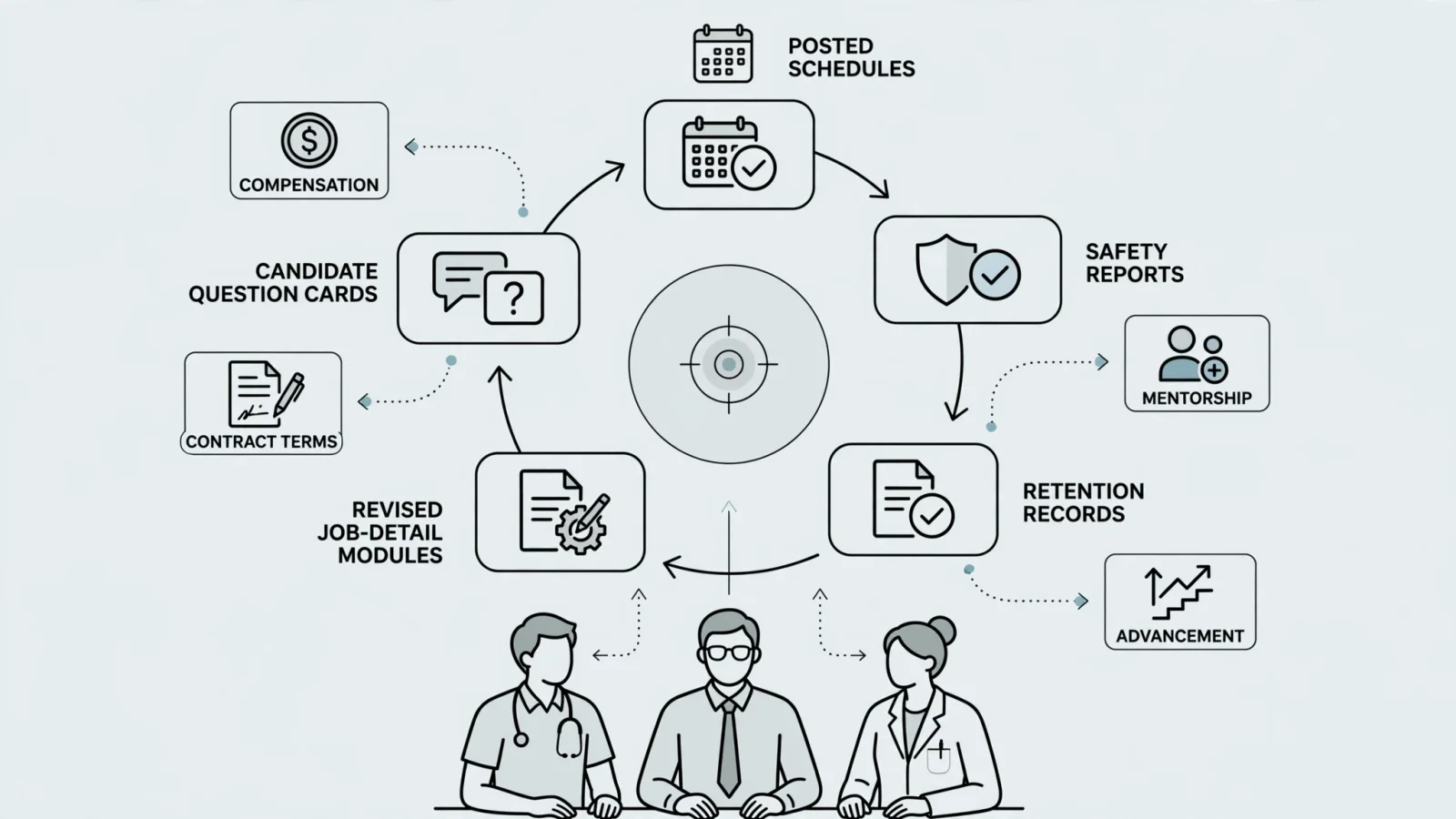
Organizing operational details into a repeatable role summary makes the employment experience easier to compare across different practices. This standardized section covers the clinical setting, typical schedule, workload assumptions, support structure, compensation range, and growth opportunities. Including the date the details were last reviewed and the title of the person confirming their accuracy builds immediate credibility.
For candidates, the most useful evidence sits at the job level. Broad, organization-level outcomes like retention rates or satisfaction scores require a defined population, a measurement date, and a specific survey instrument to hold weight with an applicant. Process documentation offers a more immediate layer of verification, allowing hiring teams to upload sample schedules, redacted call calendars, staffing models, compensation examples, and onboarding plans directly to the listing. Testimonials add value only when they identify the speaker's exact role, tenure, and the realistic trade-offs they navigate daily.
Show Trade-Offs and Keep the Record Current
A credible reputation clarifies exactly who the job fits rather than implying every position is perfect. An honest fit statement might explain that a role offers high clinical autonomy alongside regular weekend coverage, or that it features no overnight call but carries higher patient volumes and productivity-based compensation. Building a transparent healthcare recruitment strategy around these trade-offs filters out candidates who would ultimately leave the position early.
Maintaining this accuracy requires an ongoing review process between clinical leaders and human resources. As departments change their staffing models or adjust their relative value unit targets, recruitment teams must update the public job descriptions to match. Otherwise, a candidate who accepts an offer based on a four-day schedule will lose trust immediately upon discovering a five-day expectation during orientation.
Verifying Operational Claims During the Interview
Ask About Schedule, Workload, and Safety
Approaching the application and interview process as a diligence exercise protects a clinician's long-term career satisfaction. During initial conversations, candidates benefit from determining how many call shifts occur in a typical month and whether that duty requires an in-house presence. Obtaining details about call-back frequencies, weekend rotations, and formal post-call relief policies clarifies the true time commitment.
Direct questions about workload and safety help uncover hidden administrative burdens. Evaluating a position involves asking how often current clinicians finish notes, manage their inboxes, or complete prior authorizations after scheduled hours end. Exploring escalation pathways for unsafe assignments reveals what happens when a unit runs short-staffed, while questions about clinical backup and leadership responses to disruptive behavior test the system's safety culture.
Test Pay, Contract Terms, and Career Claims
Thorough financial diligence requires separating guaranteed income from variable pay models. Applicants need to know how productivity is calculated, whether incentives rely on work performed versus actual collections, and what happens to compensation during low-volume months. Confirming whether the position operates as a W-2 employment arrangement or a 1099 independent contractor agreement remains critical, as that status completely changes tax liabilities and benefit eligibility.
Contract terms demand careful scrutiny prior to signing any agreement. Key points to clarify include who pays for tail coverage upon departure, any repayment provisions tied to sign-on bonuses, and restrictive covenants that dictate future geographic practice limits. Additionally, reviewing whether the organization funds continuing medical education and protects time for leadership duties validates any claims about long-term career advancement.
Compare Roles With WeekdayDoc
WeekdayDoc provides tools that make this diligence process faster and more uniform across opportunities. The software converts an existing job description or a URL into a formatted listing in approximately 60 seconds. By surfacing a 0-to-10 listing-based work-life score drawn from available evidence, the system helps candidates spot roles that disclose call, weekend, and schedule expectations explicitly. The interface also displays salary comparisons, market percentiles, and dollar-per-RVU context wherever data permits.
Clinicians use WeekdayDoc to evaluate permanent, locum, part-time, remote, telehealth, hybrid, and on-site opportunities, accessing negotiation scripts and an AI contract scanner that flags issues like non-competes and tail coverage. The 0-to-10 score serves strictly as a listing-based decision aid, depending entirely on the transparency of the provided job information rather than acting as a workplace certification. Because the score measures disclosure rather than guaranteeing working conditions, applicants confirm the schedule, call burden, compensation, and contract terms directly with the hiring manager before committing.
Reconciling the Public Reputation With Daily Reality
Audit the Promise Before Publishing
Measuring recruitment success involves using operational accountability frameworks rather than treating listings as a copywriting exercise. Auditing recent job descriptions, recruiter scripts, interview materials, and offer letters exposes unsupported language like "flexible," "collaborative," "patient-centered," and "work-life balance." Replacing these abstract terms with exact performance metrics defines the role accurately. Leaving vague claims unchecked often inflates physician recruitment costs, causing new hires to leave within the first year when the daily work fails to match the original promise.
Thorough audits require cross-functional review, bringing together a practicing clinician, the recruiter, the department leader, the scheduling coordinator, and human resources to reconcile the actual experience. This group identifies operational contradictions, such as a position advertised as having no call that secretly relies on an informal after-hours backup text thread. Finding these gaps before the listing goes live protects the facility's overall credibility.
Track Candidate Clarity and Work-System Outcomes
Recruitment metrics demonstrate whether public communications align with applicant understanding. Tracking listing-detail completeness reveals what percentage of job postings successfully include salary, schedule, call, workload, support, and location facts. By asking applicants if the description accurately explained the role, organizations measure candidate clarity and monitor whether transparent details attract better-fitting professionals through higher offer acceptance rates.
Operating metrics reveal whether the practice keeps its scheduling and workload promises. Comparing posted shifts with the hours clocked calculates schedule variance, while monitoring the after-hours burden shows how much documentation bleeds into evenings and weekends. Following 90-day and 12-month retention rates helps verify that new hires stay once they experience the physical working environment. Additionally, tracking psychological safety scores and safety-response times ensures the clinical climate supports the initial marketing claims.
Close the Loop and Make the Work Visible
Tracking these outcomes requires established categories such as job stress, satisfaction, intent to leave, and feeling valued to guide the reporting. Every organization-level result gains credibility by identifying the population measured, the specialty, the site, the date, the sample size, and the exact survey instrument used. Generalizing a small department's positive survey results to an entire health system creates a false impression, one that attentive candidates will eventually uncover.
The strongest healthcare employer brand supplies clinicians with enough specific, current information to decide whether the work is financially fair and operationally livable. This approach replaces marketing phrases with concrete call schedules, relative value unit formulas, and defined staffing models. By committing to operational transparency, practices attract professionals who understand the specific challenges of the role and have the skills required to thrive within it.
Make your job details comparable and evaluate your next career move with evidence. Visit WeekdayDoc to search clinician opportunities, review work-life scores, check market salary percentiles, and access contract review tools built for sustainable healthcare careers.