Family Medicine Work-Life Balance in 2026: Call, Weekends and Nights by the Numbers
Family Medicine work-life data from live postings: 36.9% say no weekends, 28.3% say no call, and median advertised salary is $136,750.

For Family Medicine postings in 2026, the schedule signal is clearest on weekends: 36.9% of live listings say no weekends. Call is less commonly removed, with 28.3% of live listings saying no call.
The numbers below use WeekdayDoc’s live listings as of November 5, 2026, so they describe posted job terms rather than clinician-reported experiences. Salary figures are advertised salary midpoints when a listing gives a range.
How often do Family Medicine jobs say no call, no weekends or no nights?
Among live Family Medicine listings, no-weekend language is more common than no-call language. No-night language appears in 13.8% of live listings, so nights are less often explicitly removed than weekends or call.
Remote work is present, but it is not the main schedule pattern in Family Medicine postings. Remote listings account for 6.3% of live listings, while 38.2% of scored listings reach 7+ on WeekdayDoc’s listing-based work-life scale.
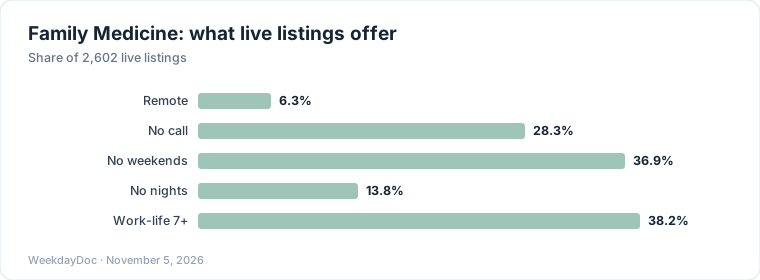
For clinicians comparing schedules, the wording matters. A posting may mention outpatient clinic hours, but that is different from saying no call, no weekends or no nights. The schedule chart separates those explicit phrases from broader work-life scoring; for the broader index, see the Burnout Index.
How much posted salary comes with these Family Medicine schedules?
The live national median advertised annual salary for Family Medicine is about $137k. The 25th percentile is $125k, and the 75th percentile is about $150k among live listings that state an annual salary.
Pay transparency is incomplete. Annual salary appears in 39% of live Family Medicine listings, based on 1,016 priced listings out of 2,602 live listings.
Remote roles show a slightly higher listed median than on-site roles in the live postings. The remote median advertised salary is about $142k, while the on-site median is about $137k. For a broader pay-only view, see the Family Medicine salary guide and the Family Medicine pay by state.
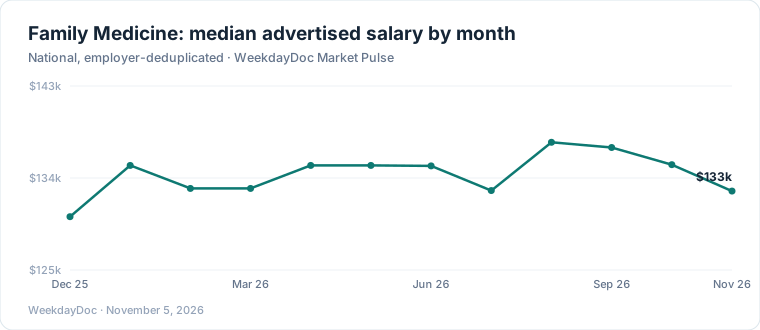
The longer salary series shows a median advertised salary of $132,500 across the last 12 months of postings, based on 1,925 salary observations. The monthly trend moved from $130,000 in 2025-12 to $132,500 in 2026-11, and the quarter-over-quarter change is 1.9%; see the Market Pulse for the continuing series.
Which states show stronger Family Medicine work-life scores?
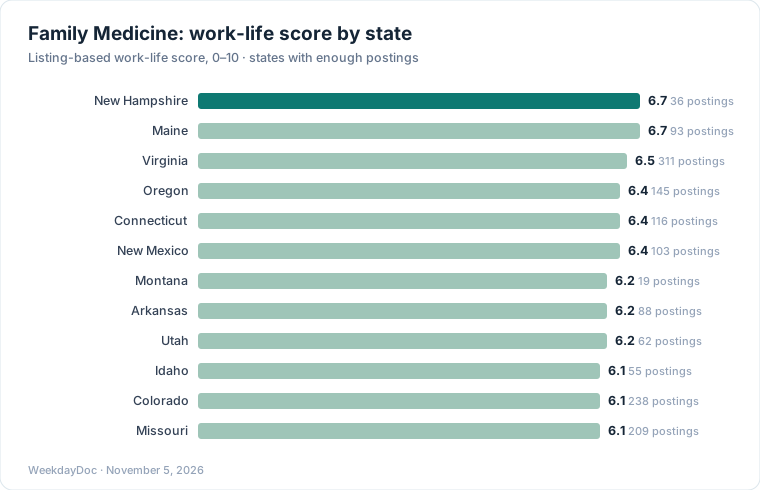
WeekdayDoc scores work-life from posting language on a 0–10 scale. New Hampshire has the highest Family Medicine work-life score at 6.7/10, while the District of Columbia has the lowest measured score at 4.9/10.
Maine also posts a 6.7/10 work-life score. Virginia follows at 6.5/10, while Oregon, Connecticut and New Mexico each show 6.4/10.
| State | Work-life score | Median advertised salary | Salary observations | Postings |
|---|---|---|---|---|
| New Hampshire | 6.7/10 | $145,820 | 11 | 36 |
| Maine | 6.7/10 | $144,778 | 22 | 93 |
| Virginia | 6.5/10 | $131,789 | 93 | 311 |
| Oregon | 6.4/10 | $163,872 | 47 | 145 |
| Connecticut | 6.4/10 | $153,181 | 40 | 116 |
| New Mexico | 6.4/10 | $138,053 | 17 | 103 |
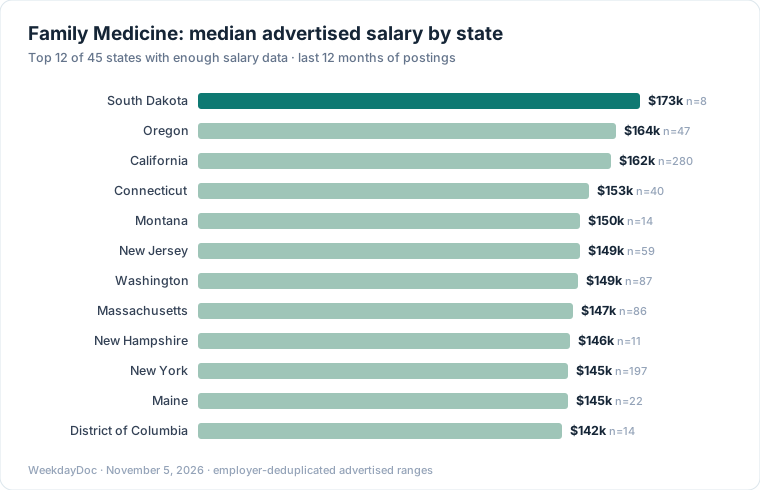
State salary and work-life do not move in the same order. South Dakota has the highest state median advertised salary at about $173k and a work-life score of 5.9/10. The median of state medians is about $134k across 45 states with enough salary data to compare.
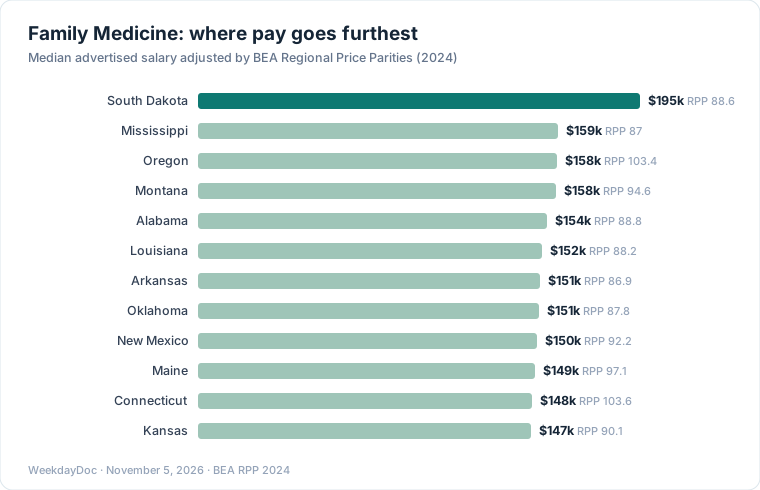
Cost of living can change the pay read. South Dakota has the highest cost-of-living-adjusted median at about $195k, using a regional price parity of 88.6. Florida has the lowest cost-of-living-adjusted median at about $127k, using a regional price parity of 103.4.
Which employers have the most live Family Medicine openings?
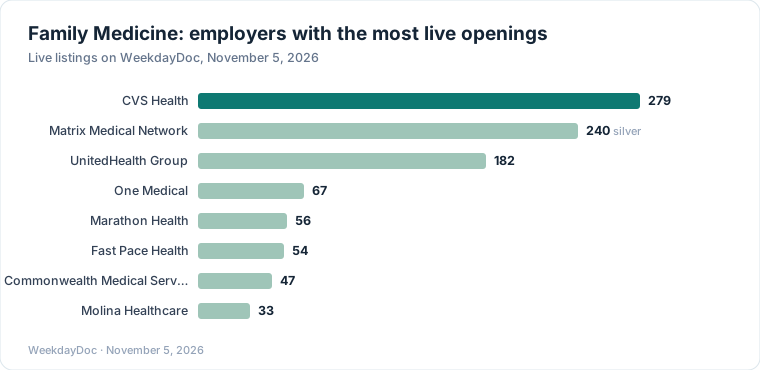
Employer mix affects call, weekends and nights because the same specialty can be posted by retail clinics, medical groups, home-based assessment organizations and health plans. CVS Health has 279 live Family Medicine openings, Matrix Medical Network has 240, and UnitedHealth Group has 182.
The next listed employers by live openings are One Medical with 67, Marathon Health with 56, Fast Pace Health with 54, Commonwealth Medical Services with 47 and Molina Healthcare with 33. For employer-level context, see the Top Employers index.
What benefits and contract terms appear with Family Medicine work-life postings?
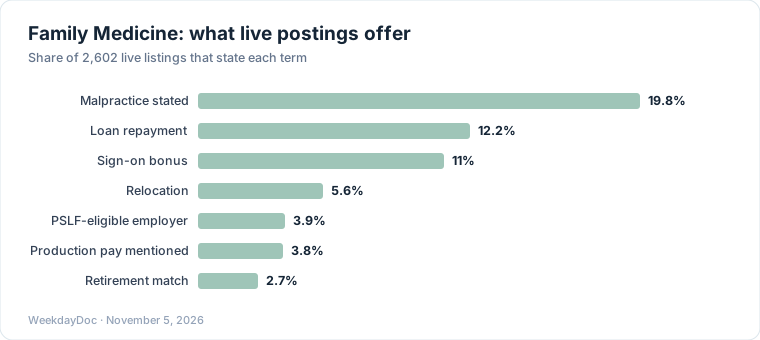
Some postings describe money or benefits that are separate from base salary. A sign-on bonus appears in 11% of live listings, with a median stated amount of $10,000 among listings that state an amount.
Loan repayment appears in 12.2% of live listings, relocation assistance in 5.6%, and PSLF-eligible employers in 3.9%. Malpractice coverage is stated in 19.8% of live listings.
Time off and education allowances are less often quantified. Median stated PTO is 22 days among listings that state PTO, and the median stated CME allowance is $2,500 among listings that state CME. Flexible-schedule wording appears in 2.4% of live listings.
Do production pay and work RVUs change the work-life read?
Production language is not common in live Family Medicine postings. Listings that mention wRVU or production pay make up 3.8% of live listings, and their median advertised salary is about $134k among priced listings.
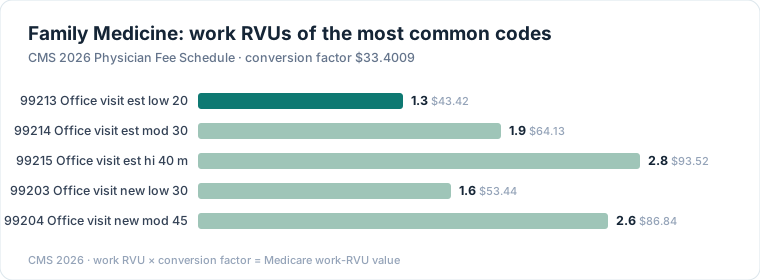
For RVU context, CMS assigns work RVUs to each code and sets the CMS conversion factor. The CMS conversion factor for 2026 is $33.4, while WeekdayDoc’s median Family Medicine $/wRVU benchmark is $50; that benchmark is a WeekdayDoc compensation estimate, not a licensed survey.
The common-code view is included because production language can affect how a schedule feels even when a listing does not mention call, weekends or nights. The 5 most common Family Medicine codes in WeekdayDoc’s specialty code set sum to 8,530 typical annual work RVUs, with implied production compensation of about $427k at the median $/wRVU estimate.
How should a Family Medicine clinician read these numbers?
The most direct schedule terms are no weekends, no call and no nights. In this market, no-weekend language is the most common of those terms, and no-night language is the least common.
The work-life score gives a broader read because it uses listing language beyond a single phrase. It should be read next to advertised salary, pay transparency and employer type rather than as a stand-alone judgment about a role.
For Family Medicine clinicians comparing offers, the most useful screen is a short set of posted facts: whether the job states pay, whether the schedule removes weekends, whether call is included, and whether nights are named. The live listings show that those details are not consistently disclosed, even in a large national market with 2,602 active listings across 52 states.
How we measured this
This analysis uses the WeekdayDoc live listing index for 2,602 Family Medicine listings as of November 5, 2026. Live salary metrics use 1,016 active listings that state an annual salary, with the midpoint of the stated range used for each listing.
Market trend metrics come from WeekdayDoc Market Pulse, using the last 12 months of employer-deduplicated advertised salaries. State salary comparisons use states with at least 10 listings and at least 8 salary observations in the last 12 months.
Cost-of-living adjustment uses BEA Regional Price Parities from 2024. Work-life scores use WeekdayDoc’s Top Employers work-life index and listing language. Work RVUs and the CMS conversion factor come from the CMS 2026 Physician Fee Schedule, while $/wRVU benchmarks come from WeekdayDoc compensation estimates.
Frequently asked questions
How common are no-weekend Family Medicine jobs?
No-weekend language appears in 36.9% of live Family Medicine listings.
How common are no-call Family Medicine jobs?
No-call language appears in 28.3% of live Family Medicine listings.
How common are no-night Family Medicine jobs?
No-night language appears in 13.8% of live Family Medicine listings.
Which state has the highest Family Medicine work-life score?
New Hampshire has the highest listed work-life score at 6.7/10.
What is the live median advertised Family Medicine salary?
The live median advertised annual salary is $136,750.
How common are remote Family Medicine listings?
Remote roles make up 6.3% of live Family Medicine listings.
Sources: WeekdayDoc live listing index (2,602 Family Medicine listings, November 5, 2026); CMS 2026 Physician Fee Schedule (work RVUs, conversion factor); WeekdayDoc $/wRVU compensation estimates (not a licensed survey); WeekdayDoc Market Pulse (12 months of advertised salaries, employer-deduplicated); BEA Regional Price Parities (2024); WeekdayDoc Top Employers work-life index. Figures are advertised (posted) salaries and listing attributes, not survey income; percentiles and shares, not grades. Updated November 5, 2026.