A Clinician's Guide on How to Evaluate Job Offers
Learn how to evaluate job offers like a pro. Our clinician's guide covers compensation, culture, and contract red flags to help you find a balanced career.
When a job offer lands in your inbox, the temptation is to jump straight to the salary number. But focusing only on base pay is a classic mistake. The factors that truly make or break a clinical career—the ones that lead to long-term satisfaction instead of burnout—are almost never just about the money.
A great offer is about more than a paycheck; it’s a strategic choice that needs to align with your financial goals, your personal life, and your well-being.
Look Beyond the Offer Letter
That official offer letter is a huge milestone, but it's really just the starting line for a much deeper evaluation. We've all seen colleagues take high-paying jobs only to become completely overwhelmed by an impossible schedule or a toxic work environment.
This framework is built to help you look past the initial excitement and analyze the details that will shape your day-to-day reality for years to come. It’s about ensuring your next career move is a sustainable one.
A Holistic Evaluation Framework
The key is to view the entire offer as a complete package, weighing the financial upside against the quality-of-life downside. This means digging into the company's full Employee Value Proposition (EVP)), which covers everything from benefits and culture to opportunities for growth.
I think about it in terms of three core pillars:
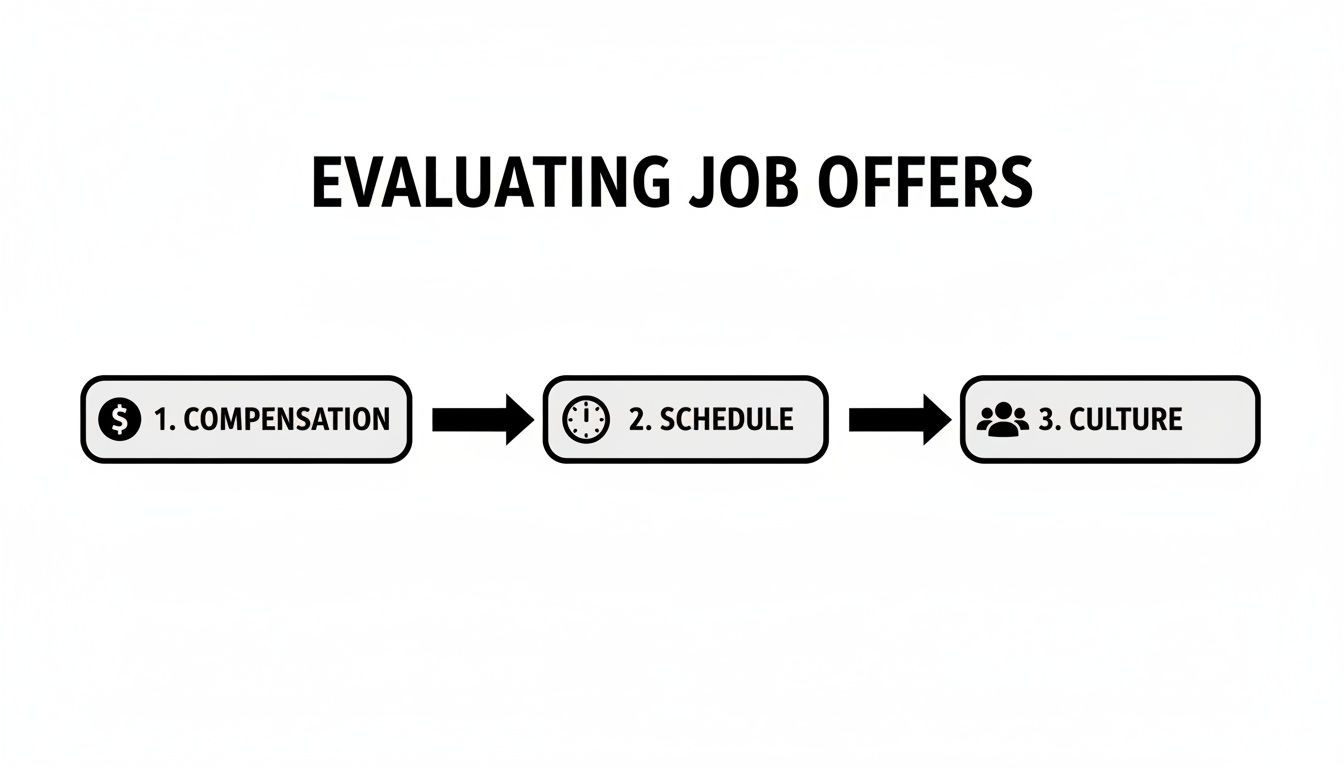
These three elements—compensation, schedule, and culture—are completely interconnected. A weakness in one can easily cancel out the strengths of the others, leaving you in a role that just isn't a good long-term fit.
Making a Sustainable Career Choice
The goal isn't just to find a new job. It's to find the right job—one that supports your financial health and protects your mental well-being.
By carefully scrutinizing the schedule, the on-call demands, and the team dynamics, you shift from being a passive recipient of an offer to an empowered decision-maker actively designing your future.
Remember, the best job offer is one you can thrive in for years, not just tolerate for a high salary. Your time and energy are finite resources that must be protected.
This guide gives you the playbook to make that choice confidently, ensuring your next step is toward a professional life that’s both rewarding and sustainable.
Calculate the True Value of Your Compensation
That six-figure salary on the offer letter looks great, but it’s rarely the whole story. To really know what a job is worth, you have to dig deeper than the base number and map out the entire financial picture.
Trust me, a slightly lower salary with fantastic benefits can easily beat a higher-paying job that leaves you covering thousands in out-of-pocket costs. The goal is to translate every single financial component into one concrete number: your total annual compensation. That’s the only way to make a true apples-to-apples comparison.
Beyond the Base Salary
Let's start with the most obvious numbers. A sign-on bonus feels like a huge win, but remember, it’s a one-time payment. If Offer A has a $20,000 sign-on bonus but Offer B comes with a $10,000 higher annual salary, Offer B is the clear financial winner after just two years.
Performance bonuses need a close look, too. Is it a guaranteed payout tied to clear, achievable metrics? Or is it a fuzzy, discretionary bonus that might never actually appear? A guaranteed $15,000 bonus is far more valuable than a vague promise of "up to $30,000" based on subjective team performance.
Relocation assistance is another area to clarify. Some employers offer a lump sum, which gives you flexibility. Others reimburse documented expenses, which can be restrictive. A $10,000 lump sum is often better than a reimbursement plan with a long list of rules, so always ask for the policy details in writing.
Uncovering the Hidden Financial Perks
This is where many clinicians accidentally leave money on the table. Benefits that seem small at first can quietly add tens of thousands of dollars in value, completely changing the math on competing offers. These aren't just "perks"—they are a core part of your compensation.
Think about the real-world costs your employer might cover:
- Continuing Medical Education (CME) Allowance: A $3,000 to $5,000 annual stipend is pretty standard, but some roles go higher. This is tax-free money for your professional growth.
- Licensing and Board Fees: State license renewals, DEA fees, and board certification can easily top $1,500 per year. Getting this covered is a direct financial gain.
- Retirement Plan Matching: This is literally free money. A 4% match on a $200,000 salary adds an extra $8,000 to your retirement account every single year. Skipping a good match can cost you hundreds of thousands over a career.
- Health and Disability Insurance Premiums: Pay close attention to the monthly premiums and deductibles. A plan that costs you $200 a month versus one that costs $800 creates a $7,200 annual difference right there.
When you evaluate job offers, your calculation isn't complete until you've assigned a dollar value to every single benefit. An offer that covers all your professional fees and offers a generous 401(k) match could be worth $15,000 more per year than it appears at first glance.
To help you organize all these moving parts, here’s a checklist to compare offers side-by-side and calculate their true financial value.
Comprehensive Compensation Analysis Checklist
| Compensation Component | Offer A Details | Offer B Details | Notes & Questions |
|---|---|---|---|
| Base Salary | |||
| Sign-On Bonus | One-time or paid over time? | ||
| Performance Bonus | Guaranteed or discretionary? | ||
| Relocation Assistance | Lump sum or reimbursement? | ||
| Retirement Match (%) | Vesting schedule? | ||
| Annual CME Allowance | Rollover policy? | ||
| Health Insurance Premium | Monthly cost to you. | ||
| Disability Insurance | Employer-paid? Own-occupation? | ||
| Licensing/Board Fees | What's covered? | ||
| Malpractice Insurance | Tail coverage included? | ||
| Student Loan Repayment | Amount and duration? | ||
| Paid Time Off (Days) | Includes vacation, sick, holidays. |
Filling this out for each offer will give you a much clearer picture of what you’re actually being paid.
Benchmarking Your Total Compensation
Once you have your total compensation figure, how do you know if it's competitive? Benchmarking against reliable data is key. While national averages are a decent starting point, the real assessment comes from connecting compensation with work-life factors.
Recent workforce reports, like the 2025 Health Care Workforce Scan, show that flexibility, respect, and a safe environment are now top drivers of clinician job satisfaction—sometimes even more than pay.
For clinicians, this means you have to evaluate your total compensation alongside intangibles like a no-call schedule or protected administrative time. This holistic view is the only way to align your next job with both your financial goals and your long-term personal well-being.
To make this easier, we built a tool specifically for this. Our Salary & FIRE Calculator is designed for clinicians to project long-term wealth based on different salary and work-life balance scenarios. It helps you make a data-driven decision that supports a sustainable, fulfilling career.
Assess Your Schedule and Workload Demands
After you run the numbers, it's time to shift your focus to the one resource you can never get back: your time. This is where you look past the compensation package and really start to picture what your day-to-day life will be like in this new role. A great salary on paper means very little if you’re too drained to actually enjoy it.
The daily schedule and workload are, without a doubt, the biggest predictors of long-term career satisfaction and burnout. A seemingly perfect offer can turn into a nightmare if it means an overwhelming patient load, constant after-hours calls, or zero time for administrative work. You have to get specific here.

Deconstruct the On-Call Schedule
Few things in a contract are as vague—and as important—as "on-call responsibilities." An offer letter might have a single, simple line about it, but the reality can be wildly different from one job to the next. Getting this right is non-negotiable.
Don’t let yourself be swayed by phrases like "equitable call distribution" or "light home call." These are essentially meaningless without hard data to back them up. It's on you to dig in and find out what you’re really signing up for.
Here are the exact questions you need answers to:
- Frequency: How many nights a month and weekends a year am I actually on call?
- Intensity: What’s a typical call night like? How many phone calls do you usually get? How often do people actually have to go into the hospital?
- Type of Call: Is this home call, or does it require me to be physically in-house?
- Post-Call Policy: Am I expected to run a full clinic the day after being on call all night? Is there a guaranteed, protected post-call day off?
The difference between a home-call schedule with one phone call per night and one with ten is the difference between a sustainable career and a fast track to burnout. Your goal is to quantify the true time commitment.
Analyze the Daily Workload
Beyond call, your daily grind matters just as much. The expected patient volume and admin burden will directly impact your stress levels and your ability to practice good medicine. A job that looks great financially can become miserable if you're constantly running behind with no time for charting.
To get a real feel for the day-to-day, you need to understand both the clinical and the non-clinical expectations.
Key workload questions to clarify:
- Patient Load: What’s the expected number of patients per hour or day? How much time is blocked for new visits versus follow-ups?
- Admin Time: Is there dedicated, protected time for charting, reviewing labs, and clearing my inbox? Or is this all "pajama time" work I'm supposed to do from home?
- Support Staff: What’s the ratio of support staff (MAs, nurses) to clinicians? Will I have real help managing patient flow and messages?
- Ramp-Up Period: Do new hires start with a reduced patient load for the first few months to get used to the EMR and patient population?
Getting these details is crucial. A job offering slightly less pay but guaranteeing an hour of protected admin time every day might be far more valuable for your long-term sanity. For clinicians serious about controlling their schedule, exploring options like part-time physician jobs can also be a game-changer.
Putting It All Together for a Realistic Preview
Once you have this information, map out a "mock week." Seriously, grab a piece of paper or open a calendar and block out what a typical week would look like in this role. Factor in clinic hours, admin time, on-call nights, and any post-call recovery.
This simple exercise cuts through the recruiting promises and shows you whether the work-life balance they're selling is actually real. This deep dive into your time and energy is every bit as important as the financial analysis—it’s how you choose a job that will support a long, fulfilling career.
Investigate Workplace Culture and Burnout Risk
A great salary with a terrible team isn't a great job. While you can quantify compensation and benefits, culture is something you feel. Learning how to look past the recruiting pitch to see the day-to-day reality is one of the most critical skills you can develop in your job search.
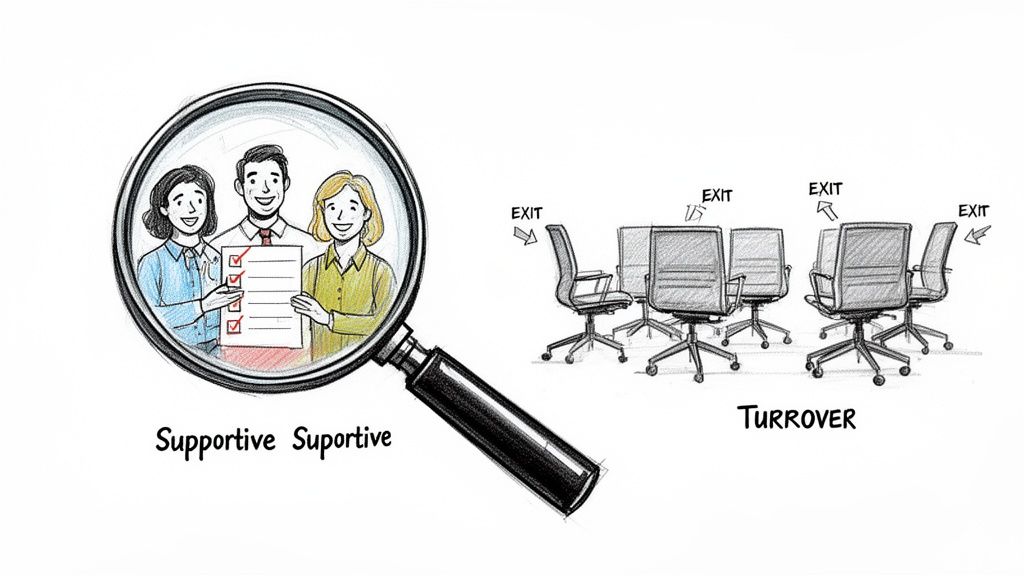
A supportive team that trusts its leadership creates an environment where you can build a sustainable career. A toxic one is a fast track to exhaustion and burnout. Your goal is to figure out which one you’re walking into.

Tactical Questions That Reveal the Truth
Generic questions like "What's the culture like?" will only get you polished, generic answers. You need to ask questions that force people to tell a story. When you talk to your potential future peers, try these instead.
- "Walk me through what happens on a high-stress day when the schedule is completely slammed." You're looking for signs of mutual support. A healthy team talks about pulling together, re-prioritizing, and having each other's backs. A toxic one will hint at an "every person for themselves" mentality.
- "What’s the single biggest challenge this team is facing, and how is leadership helping you solve it?" This question cuts right to the level of trust and transparency between clinicians and management. A good answer is honest and focuses on collaborative solutions, not blame.
- "What has the clinician turnover rate been in this department over the last two years?" Don’t be shy about asking this directly. A high number is a huge red flag. Just as telling is how they answer—or if they avoid answering at all.
These questions shift the conversation from vague descriptions to concrete examples of how the team actually operates under pressure.
Finding the Data on Burnout and Turnover
While culture feels intangible, its effects are measurable. Digging into burnout and turnover data gives you a hard look at a job's long-term viability. Burnout is still a massive problem in medicine. A recent Vivian Healthcare Work Report noted that 76% of clinicians feel their burnout is the same or worse than last year.
Turnover, while slightly down from pandemic highs, is still sitting at 18%, according to Press Ganey. You should be looking for a role with a turnover rate well below that benchmark. You can get more details in the 2025 healthcare workforce report.
Be wary of any organization that is hesitant to share its turnover or physician satisfaction data. Transparency about these metrics is a strong sign of a healthy, self-aware culture that is actively working to support its team.
The Physicians Foundation found that while 54% of physicians experience burnout, a staggering 73% also feel there’s a stigma around seeking mental health care. This makes it even more important to find a workplace that actively minimizes burnout risk. If you're concerned about your own levels, our burnout calculator can help you assess your current risk factors.
The best employers are upfront about addressing the key drivers of burnout, listing things like "No Call" and "No Weekends" right in the job description so you know what you're getting into before you even apply.
Trust Your Gut During the Interview
At the end of the day, pay close attention to how you feel during your interactions. The interview process is your first real glimpse into how an organization runs.
Red Flags to Watch For:
- Chaotic Communication: Are they constantly rescheduling? Slow to respond? It often points to a disorganized internal environment.
- Vague Answers: If they can't give you a straight answer about the call schedule or team challenges, they might be hiding something.
- Disrespectful Comments: Listen carefully to how interviewers talk about their colleagues, support staff, and even patients. Any hint of negativity is a serious warning sign.
Your intuition is a powerful tool. If something feels off, it probably is. A slightly lower-paying offer in a supportive, well-organized environment will almost always lead to a happier career than a top-dollar offer in a place that burns you out.
Navigate the Fine Print in Your Employment Contract
The offer letter is just the highlight reel. The real details—the ones that can make or break your next few years—live in the dense, legalese-filled employment contract.
Treat this document with the respect it deserves. It’s not just paperwork; it’s the binding agreement that defines your professional life, from your daily duties to your exit strategy. Overlooking a single clause now can lead to massive headaches and financial pain later.
Unpacking Restrictive Covenants
First up is the non-compete clause, a section that dictates where you can (and can't) work after you leave. These typically specify a geographic radius (like 15 miles) and a time period (often one to two years).
An aggressive non-compete can feel like a professional cage, forcing you to uproot your family or face a brutal commute if you want to take another job in the area. Make sure the terms are reasonable and won't hamstring your career down the road.
Termination Clauses Explained
You absolutely need to understand how the relationship can end. Contracts will distinguish between being terminated "with cause" versus "without cause."
- Termination With Cause: This is for major issues—think gross negligence or losing your license. The consequences are usually swift and severe.
- Termination Without Cause: This is far more common. It means the employer can let you go for almost any non-discriminatory reason. The crucial detail here is the notice period they must give you.
Look for a minimum notice period of 90 days. Anything less, like 30 days, is a huge red flag. It leaves you scrambling to find a new role while your income disappears. Understanding your rights and potential breach of contract remedies is crucial before you sign anything.
The Million-Dollar Question of Malpractice Tail Coverage
If your job offers a "claims-made" malpractice policy, you’ll need insurance to cover claims filed after you leave for care you provided during your employment. This is called tail coverage, and it’s notoriously expensive—we’re talking tens of thousands of dollars out of pocket.
Your contract must state, in no uncertain terms, who pays for it. Ideally, your employer covers 100% of the cost after you’ve been there for a set time, like two or three years. If the contract shifts this massive liability onto you, you need to factor that into your total compensation analysis.
Do not accept a verbal promise on tail coverage. This is a non-negotiable item that must be explicitly detailed in writing within your employment contract.
Why You Must Hire a Healthcare Attorney
Let’s be clear: you are not qualified to review a physician employment contract on your own. The language is intentionally dense, and state laws vary dramatically.
Hiring a healthcare attorney isn’t an expense; it’s a critical investment. For a few hundred dollars, an expert can spot predatory clauses, translate the legalese, and give you the specific language you need to negotiate better terms. This small upfront cost can save you from a five- or six-figure mistake.
Checklist for Your Attorney Review
Walk into your attorney meeting with a clear agenda. Make sure you get answers to these questions:
- Non-Compete Clause: Is the geographic scope and time limit reasonable for my specialty and this specific market?
- Termination Notice: Is the "without cause" notice period at least 90 days?
- Tail Coverage: Who pays, when, and are there any loopholes?
- Duties and Responsibilities: Are my clinical and administrative duties clearly defined and protected from scope creep?
- Compensation Details: Does the contract’s language on salary, bonuses, and benefits perfectly match what’s in the offer letter?
Never let an employer rush you into signing. Taking the time to get a professional legal review is the single smartest move you can make. It’s how you start a new job with confidence, knowing you’re fully protected.
Craft Your Negotiation Strategy with Confidence
You’ve done the hard work of analyzing the schedule, the pay, and the culture. Now it’s time to turn that evaluation into action.
Let's be clear: negotiation isn't a confrontation. It’s a completely normal, expected conversation about mutual value. A lot of clinicians get anxious at this stage, but having a clear game plan makes all the difference. You're not making demands; you're starting a dialogue to make sure this job is a great long-term fit for everyone involved.
Prioritize Your Asks
First things first: you can't negotiate everything. Pick your battles. Based on your deep dive into the offer, figure out what your top one or two priorities are. Asking for more money, more vacation, a bigger bonus, and a better call schedule all at once is a surefire way to get shut down.
So, what's most important to you?
- Is it the money? Maybe the base salary is a little under market rate, or you need a sign-on bonus to cover moving expenses.
- Is it your time? You might want to push for an extra week of PTO or get it in writing that you won't be expected to cover weekends.
- Is it in the fine print? A non-compete clause that’s too restrictive or the lack of tail coverage could be your deal-breaker.
Honing in on your top priorities shows you’re a serious, thoughtful candidate. It shifts the conversation from a laundry list of wants to a focused, professional discussion about what it will take to get you to sign.
How to Start the Conversation (Without Being Awkward)
Kicking off the negotiation is often the hardest part. The trick is to be gracious, enthusiastic, and direct. You want to make it clear you’re excited about the role while also signaling that you have a few things to discuss.
Here’s a simple, professional script you can use for an email or a phone call:
"Thank you so much for the offer to join your team. I am very excited about this opportunity and the possibility of working with you. After reviewing the details, I’d like to schedule a brief call to discuss a few components of the offer to ensure we find the best possible fit."
This wording is polite and collaborative. It frames the negotiation as a joint effort to finalize a deal that works for both sides—exactly the tone you want. From there, you can present your counter-offer, always tying it back to the market data you’ve gathered and the personal priorities you’ve already defined.
What if They Rescind the Offer?
This is the number one fear, but let me put your mind at ease. It is extremely rare for an employer to pull an offer after a reasonable, professional counter-offer.
Think about it this way: if a potential employer reacts poorly to a standard business conversation, what does that say about their culture and leadership? It’s a massive red flag.
When you're evaluating a job, you're also evaluating the organization's stability and leadership. The data on this is telling. According to one national survey, only 32% of healthcare workers feel 'very satisfied' with their jobs. Dig deeper, and you see that confidence in leadership is a huge factor: just 35% of unsatisfied workers feel confident in their leaders, compared to 72% of satisfied workers. This is exactly why assessing leadership trust is so critical for your long-term happiness. You can read more about these healthcare workforce satisfaction trends.
An organization that can't handle a simple negotiation is showing you its cards. Consider it a valuable piece of data in your final decision.
Frequently Asked Questions
Even with a solid framework, you're bound to run into specific questions when you're staring at an offer letter. Here are some quick, practical answers to help you handle the trickiest parts of the decision.
How Much Should I Expect to Negotiate on a Salary Offer?
Aiming for a 5-10% increase over the initial offer is a reasonable starting point, but only if your market research backs it up. Getting this right is less about asking for more and more about knowing your worth.
But don't get tunnel vision on the base salary. Think about what truly moves the needle for your quality of life. Is an extra week of PTO or a guaranteed call-free schedule more valuable than a few extra thousand dollars? If so, lead with that. Always anchor your requests to the value you bring and hard market data, not just what you want.
What Are the Biggest Red Flags in an Employment Contract?
There are three big ones that should make you pause and immediately consult a healthcare attorney. Don't skim these sections.
- An overly broad non-compete clause. If it dramatically restricts your ability to work in a large geographic area for years, that’s a major problem.
- A "without cause" termination clause with less than 90 days' notice. Anything shorter puts you in a financially precarious position if things don't work out.
- Vague language around malpractice tail coverage. This is a potential five-figure expense that can get quietly shifted to you when you leave. Make sure it's crystal clear who pays for it.
An employer’s reaction to discussing these points tells you everything you need to know. If they're unwilling to have a reasonable conversation, consider it a huge warning sign about their culture.
Is It Better to Take a Higher Salary or Better Work-Life Balance?
This is a personal calculation, but my philosophy always leans toward long-term career sustainability. A massive salary tied to a soul-crushing job is a recipe for burnout, which will torpedo any short-term financial gains.
A role with great work-life balance might come with a slightly lower paycheck, but it gives you back your time and energy. That’s the currency you need to enjoy your life, explore other interests, and—most importantly—avoid the immense personal and financial cost of burnout. Over the long haul, a sustainable career almost always leads to greater lifetime earnings and a much happier life.
Ready to find a job that actually respects your time and well-being? WeekdayDoc curates burnout-friendly clinical roles with no call, no nights, and no weekends. Start your search for a sustainable career today at https://www.weekdaydoc.com.