Retirement Planning for Physicians: Your 2026 Guide
A definitive guide to retirement planning for physicians. Explore tax-advantaged accounts, withdrawal strategies, and FIRE options.

A small majority of physicians retire before 65, while many expect to work longer and assume a far later finish line. That mismatch changes the job of retirement planning.
For physicians, retirement planning is career planning under financial pressure. The core goal is to build enough margin to cut back before burnout makes the decision for you. That can mean dropping call, moving from full-time to part-time, leaving private practice for employed work, or taking a lower-paying role that is sustainable.
High income helps, but it does not solve the structural problem on its own. Physicians start earning later than many other professionals, often carry student debt well into their highest-earning years, and face tax complexity as soon as income ramps up. Add burnout risk, reimbursement pressure, and expensive lifestyles that grow fast, and a high earner can still feel stuck.
I see the same pattern often. Physicians who make strong retirement progress treat financial independence as a tool for professional flexibility. They save aggressively, choose accounts in the right order, and evaluate jobs based on what they do to both cash flow and energy. A larger paycheck can delay retirement if it comes with a contract, call burden, or schedule that is hard to sustain.
That is why career decisions belong inside the retirement plan. A physician comparing two roles should look beyond compensation and ask what each option does to savings rate, tax exposure, longevity in practice, and day-to-day strain. Tools like WeekdayDoc can help surface opportunities that fit those priorities earlier, before burnout or a bad contract forces a rushed move.
The physicians who do this well do not treat retirement as a single date. They treat it as the ability to choose how they practice, how long they keep practicing, and under what terms.
The Physician's Retirement Paradox
A surprising number of physicians leave practice earlier than they once expected, even after spending years assuming they would work well into their 60s. The pattern is common for a reason. High income arrives late, burnout risk is real, and the job often becomes harder to sustain before the portfolio is ready.
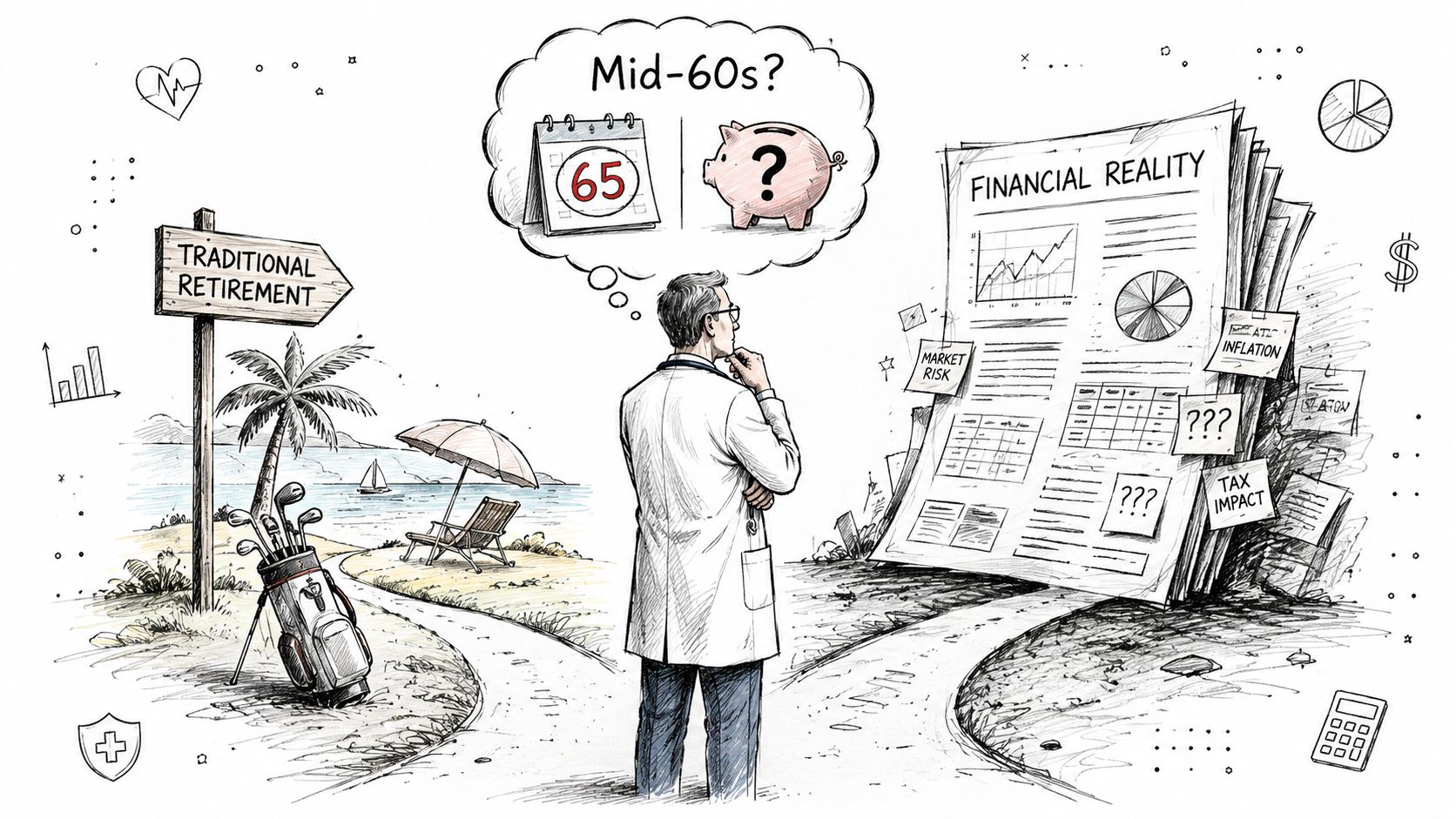
Why the gap matters
A physician who assumes another 10 to 15 full earning years will make different choices today. Savings can get delayed. Risk can stay too concentrated in one practice, one employer, or one compensation model. A bad contract can look tolerable if retirement still feels far away.
Then the true constraints show up. Call wears people down. Administrative work expands. Productivity targets rise. Family needs change. In procedure-heavy or physically demanding specialties, stamina and injury risk start to matter in a way they did not at 35.
I plan around that reality, not around the idealized retirement age.
Practical rule: Build a retirement plan that still works if full-time clinical practice ends earlier than expected, whether by choice or by necessity.
That shift changes the goal. The target is not only a large account balance by a certain birthday. The target is enough financial strength to reduce call, change employers, step into telehealth, teach, consult, or move to part-time work without forcing a financial crisis.
Retirement planning is career planning
This is the part many physicians miss. Retirement planning for physicians is tied directly to job design and professional endurance. A doctor with a high savings rate and no control over schedule may still be one bad year away from an exit they did not plan. A doctor earning less in a better role may preserve both income and longevity by staying in practice longer on workable terms.
That is why I treat financial independence as a tool for sustainability. It gives you room to say no to a contract that will burn you out. It gives you room to leave a toxic group before your health pays the price. It also makes job evaluation sharper. Compensation matters, but so do call burden, benefits, tax structure, commute, staffing support, and whether the role is realistic for the next decade.
Used that way, retirement planning becomes option planning:
- Build assets in the right accounts so future income does not depend entirely on continued clinical volume.
- Lower the pressure on your current paycheck so every contract decision is not made from a position of financial strain.
- Preserve career flexibility so you can change roles before exhaustion makes the choice for you.
This is also where a job search tool can fit into a retirement strategy. A platform like WeekdayDoc is not just about finding the next opening. It can help physicians compare roles through a longer lens: which job supports saving, lowers burnout risk, and gives you the best chance of practicing on your own terms for as long as you want.
The Physician Retirement Account Stack
Physicians often reach peak earning years later than other high-income professionals. That delay raises the cost of poor account selection. The right retirement stack does more than cut taxes. It creates room to change jobs, reduce call, or shift to a lower-burnout role without putting your long-term plan at risk.
Retirement accounts work as a sequence, not as isolated buckets. The sequence depends on how you are paid and what kind of flexibility your career may need over the next 5 to 15 years.
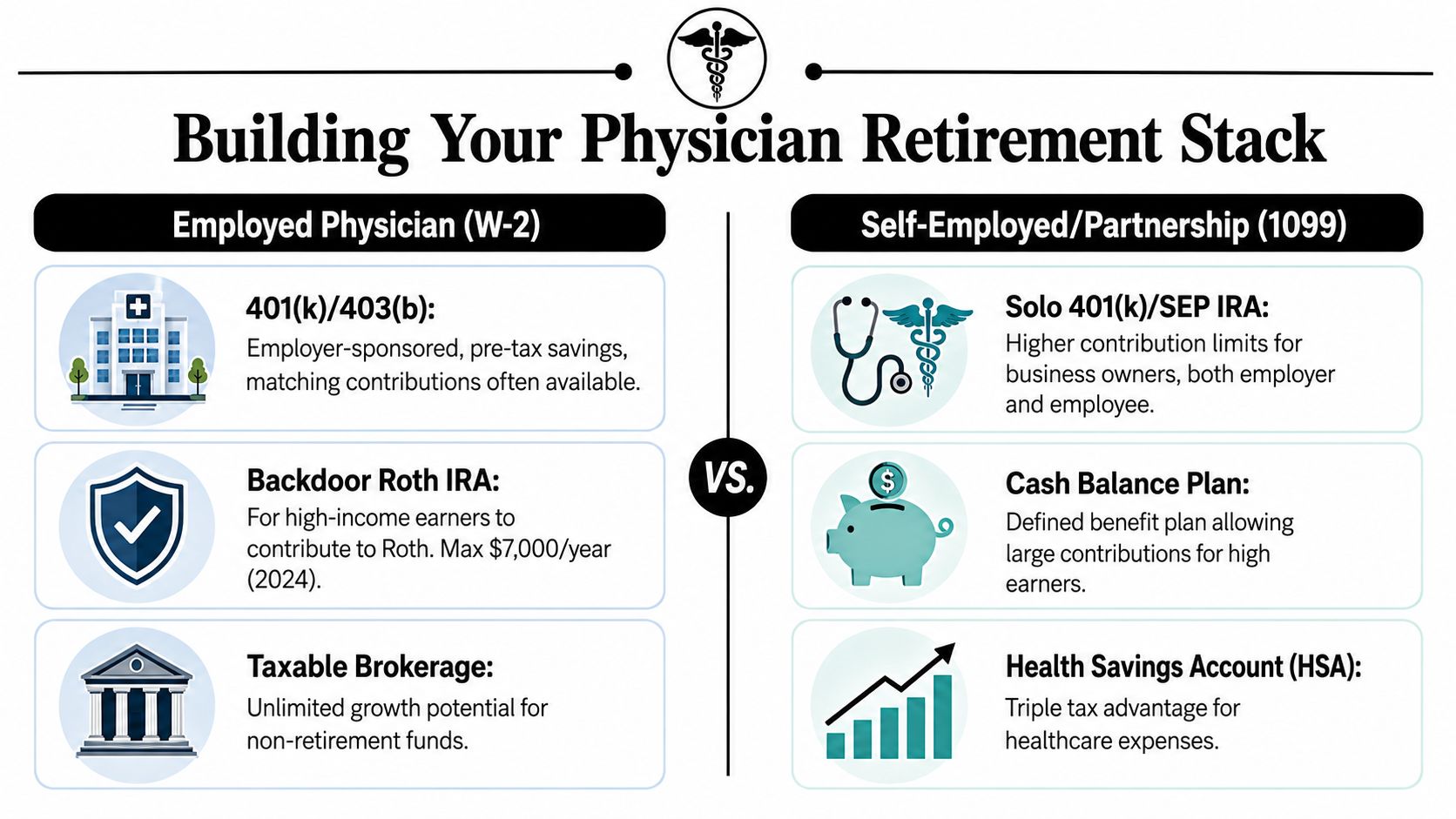
The core limits that matter
Annual contribution limits shape how much income you can defer, how aggressively you need to save in taxable accounts, and whether a job's benefits package is pulling its weight. Physicians under 50 can contribute more than many realize to workplace plans, catch-up rules increase that room later in career, and self-employed physicians often have even more contribution capacity through a Solo 401(k) or practice plan.
Those numbers matter because many physicians are trying to solve several problems at once. They want tax relief today, optionality before age 65, and a path that does not require full clinical pace forever.
How employed physicians should think
A W-2 physician usually starts with the employer plan. Max the 401(k) or 403(b) if cash flow allows. Study the match, vesting schedule, investment menu, and whether the employer also offers a 457(b).
The 457(b) question deserves more attention than it gets. A governmental 457(b) can be valuable because it creates another tax-deferred bucket and often allows earlier access after separation from service. A nongovernmental 457(b) can still help, but it carries creditor and employer-risk issues that need review before you defer large sums into it.
Job choice matters here. Two offers with similar salary can produce very different long-term results if one has a weak match, expensive funds, no 457(b), and poor schedule control. I often tell physicians to compare the retirement plan and the call burden in the same meeting, because both affect how long they can realistically stay in the role. Resources on financial planning for medical professionals can help frame that comparison before you sign.
How 1099 physicians should think
Independent contractors get more control, but they also have to build the system themselves. A Solo 401(k) is often the first account to consider because it combines employee deferrals with employer profit-sharing contributions.
That structure works well for locums physicians, moonlighters, and specialists mixing W-2 income with contract work. It also gives physicians a way to turn irregular income into steady retirement savings if they set contribution rules before the year gets busy.
The trade-off is administration. Someone has to open the plan, track deadlines, coordinate payroll or owner compensation, and avoid contribution mistakes across multiple income streams. Good flexibility on paper means little if the account is still not established in December.
How owners and partners should think
Practice owners have the widest menu and the highest complexity. A basic 401(k) may be enough in some groups. In others, a cash balance or defined benefit design can make sense if income is high, staffing is stable, and the owners want larger deductible contributions.
This is also where retirement planning connects directly to business planning. An owner with a strong tax deduction but a fragile practice has not solved the underlying issue. If the group depends too heavily on one physician, has weak succession options, or cannot recruit well, the retirement plan is only part of the picture.
I look at owner plans through two lenses at once. First, how much tax shelter does the plan create? Second, does the business support a sustainable career and an eventual exit?
A practical comparison
| Physician setup | Primary accounts | Best use | Main trade-off |
|---|---|---|---|
| W-2 employed | 401(k) or 403(b), possible 457(b), Backdoor Roth, taxable brokerage | Payroll-based saving with employer support | Plan quality and investment choices are controlled by the employer |
| 1099 independent | Solo 401(k), Backdoor Roth, taxable brokerage | High contribution flexibility and strong tax control | Setup, compliance, and cash management fall on you |
| Practice owner | Practice retirement plan, possible defined benefit approach, Backdoor Roth, taxable brokerage | Broadest tax planning range | More administration, staff considerations, and business-exit risk |
Judge an offer by salary, schedule, retirement plan quality, and how easily your finances can survive a job change.
What works and what doesn't
Good account stacks are usually boring. Automatic deferrals. Planned increases after each raise. A written funding order. Taxable investments alongside retirement accounts so early flexibility does not depend on penalties or complicated workarounds.
What fails is the physician habit of waiting for life to settle down first. Income rises, spending rises with it, and the years with the highest savings capacity disappear faster than expected.
A solid stack should answer three questions:
- Where does the next dollar go first?
- How much of current income is protected from taxes this year?
- How much freedom do you have to cut back clinically before traditional retirement age?
If those answers are unclear, the account stack still needs work.
Advanced Tax and Investment Strategies
Physicians in their peak earning years can still feel financially trapped. The usual cause is not income. It is a mismatch between tax decisions, account structure, and the kind of career flexibility they will want later if burnout, call burden, or family needs force a change.
Tax planning should support career flexibility
I advise physicians to judge every tax move by two standards. Does it reduce lifetime taxes, and does it preserve options if clinical work needs to change before traditional retirement age?
That matters more in medicine than in many other fields. A surgeon cutting back call, a hospitalist moving to locums, or an employed specialist leaving a poor-fit group may see income change fast. Tax strategy should make those transitions easier, not trap too much of the balance sheet in places that are hard to reach.
Use Roth space with a clear reason
Roth dollars are valuable, but they are not automatically the right answer. The core question is whether paying tax now improves the long-term outcome compared with taking the deduction today.
For some physicians, Roth 401(k) contributions make sense during lower-income years, after a temporary drop in earnings, or when future required distributions are likely to be large. Backdoor Roth contributions can still fit well for high earners who are blocked from direct Roth IRA contributions. Mega Backdoor Roth planning can also be useful, but only if the employer plan allows it and the cash flow is steady enough to support it without starving taxable savings.
For a physician-specific framework that ties savings choices to job design and long-term planning, financial planning for medical professionals shows how retirement strategy and career decisions fit together.
Asset location changes after-tax results
Many physicians focus on picking investments and ignore where those investments sit. That leaves money on the table each year.
A cleaner setup usually looks like this:
- Tax-deferred accounts: Holdings that throw off more taxable income
- Taxable brokerage accounts: Low-turnover index funds and ETFs
- Roth accounts: Assets with the strongest long-term growth potential
This approach will not make a portfolio more exciting. It can make it more efficient, easier to manage, and more useful if you want the option to reduce clinical hours before full retirement.
One guide for physicians highlights the value of early automation, tax-aware Roth use, and tax-efficient investing across account types in its retirement planning guide for doctors.
Complexity does not make a portfolio effective. Coordination does.
Mistakes that show up repeatedly
The patterns are predictable.
- Pursuing tax ideas without fixing spending: High income can hide weak savings habits for years.
- Putting too much into illiquid deals: Flexibility matters if you want the option to leave a draining job, cut back, or fund a transition.
- Skipping the taxable account: Retirement accounts help later. Taxable assets often fund the years when a physician wants more control sooner.
- Ignoring plan quality when changing jobs: A new role with better retirement plan features can improve long-term results, even if headline pay is similar.
This is one reason I view financial independence as a burnout management tool, not only a retirement goal. Physicians who build tax-aware, flexible portfolios are often better positioned to use platforms like WeekdayDoc to compare roles, negotiate from strength, or move into work that fits their life before they are forced to.
Redefining FIRE for Clinical Practice
Traditional FIRE thinking can be too rigid for clinicians. Many physicians don't want to quit medicine completely. They want the freedom to stop practicing in a way that's harming them.
That distinction matters. Financial independence isn't only about leaving work. In clinical practice, it's often about gaining the freedom to choose better work.
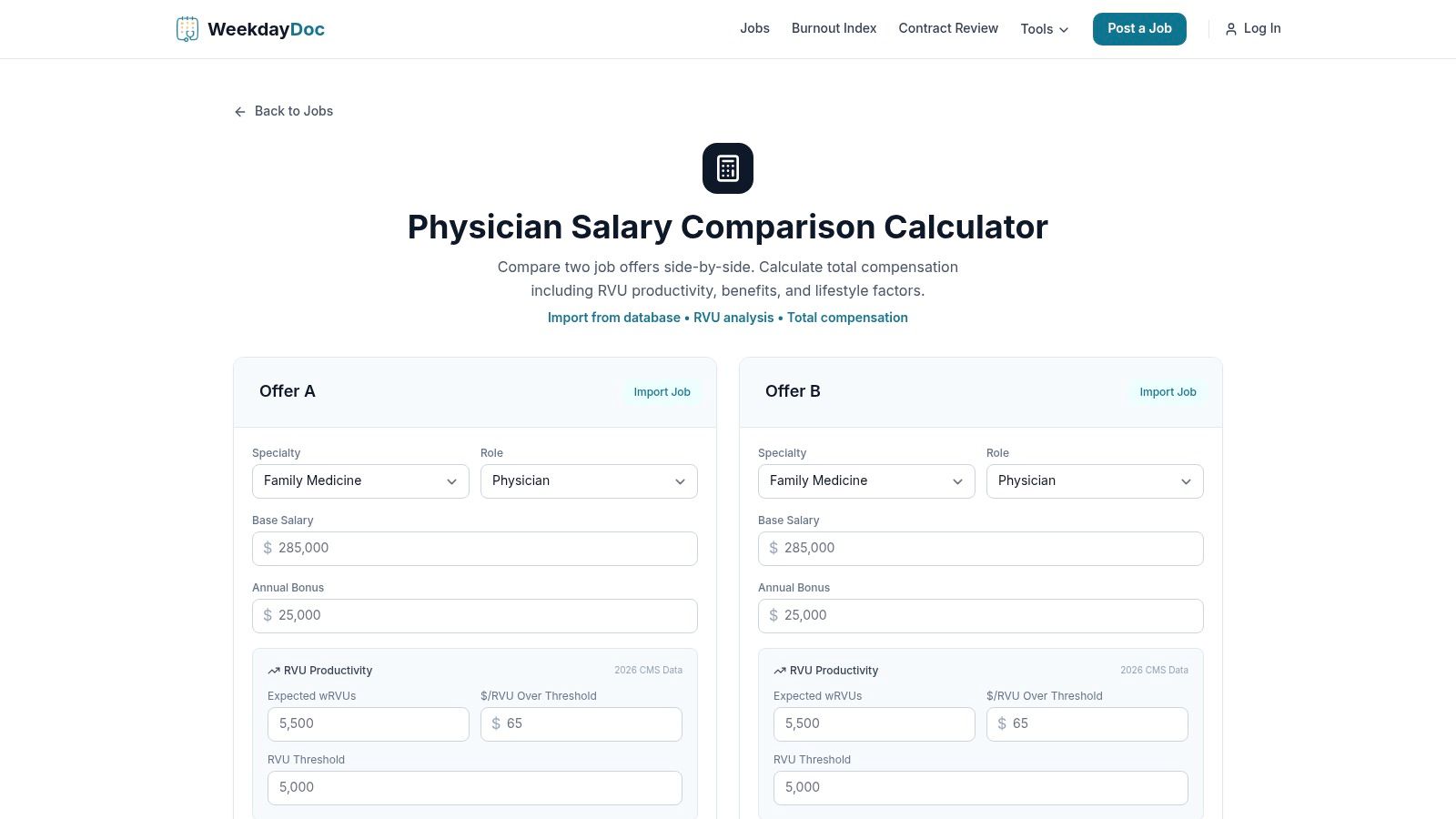
Financial independence, practice optionally
For physicians, a better model is financial independence, practice optionally. That means building enough assets and enough margin that clinical work becomes a choice, not a survival requirement.
The practical versions are familiar even if the labels aren't.
- Coast-style planning: Save aggressively early, then allow compounding to do more of the later work while you shift to a less intense role.
- Part-time bridge planning: Keep some earned income to cover living costs while preserving retirement accounts.
- Role redesign: Move from high-stress acute work into a setting with fewer nights, less call, or more administrative predictability.
None of that is failure. It's a better fit for what many clinicians want.
Why this is more realistic for physicians
Medicine isn't a normal profession. Income starts late. Burnout risk is high. Identity is tightly wrapped around work. A clean “retire early and never work again” story often doesn't match how physicians think or live.
What works better is optionality. If your portfolio can support a lower earned-income target, you can negotiate harder. You can reject bad schedules. You can choose a role that protects sleep, family time, and physical stamina.
A useful starting point is how to calculate your FIRE number as a clinician. The value isn't the number by itself. The value is seeing how different spending levels and job designs change your runway.
The goal isn't always to leave medicine early. Often the goal is to stop needing the most punishing version of medicine.
Model the middle path
Many clinicians underestimate how powerful a middle path can be. You may not need full retirement assets to change your life. You may only need enough capital, enough lower-fixed-cost living, and enough reduced schedule income to break dependence on an unsustainable job.
That's where modeling helps. Compare your current full-time role against a lower-intensity option. Test what happens if you cut shifts, eliminate call, or move into remote or weekday-only work. Small changes in spending and schedule can create outsized psychological relief even before traditional retirement.
A short explainer is worth watching if you're trying to think about this beyond generic FIRE slogans:
What FIRE gets wrong for many clinicians
The weakest version of FIRE assumes work is the problem and non-work is the answer. Physicians know that's too simplistic. Work can be meaningful. Bad work is the problem.
That's why retirement planning for physicians should include role design now, not just withdrawal strategy later. If you can move into a job that preserves income while removing the elements pushing you toward burnout, you extend both career sustainability and financial stability.
The right question isn't “How fast can I get out?” It's “How soon can I stop being trapped?”
Navigating the Final Approach to Retirement
About one-third of physicians report at least one symptom of burnout in recent national surveys. In practice, that matters for retirement timing because many doctors do not leave on a clean, chosen date. They cut back abruptly after a bad call cycle, a contract change, or a stretch of fatigue that stops feeling temporary.
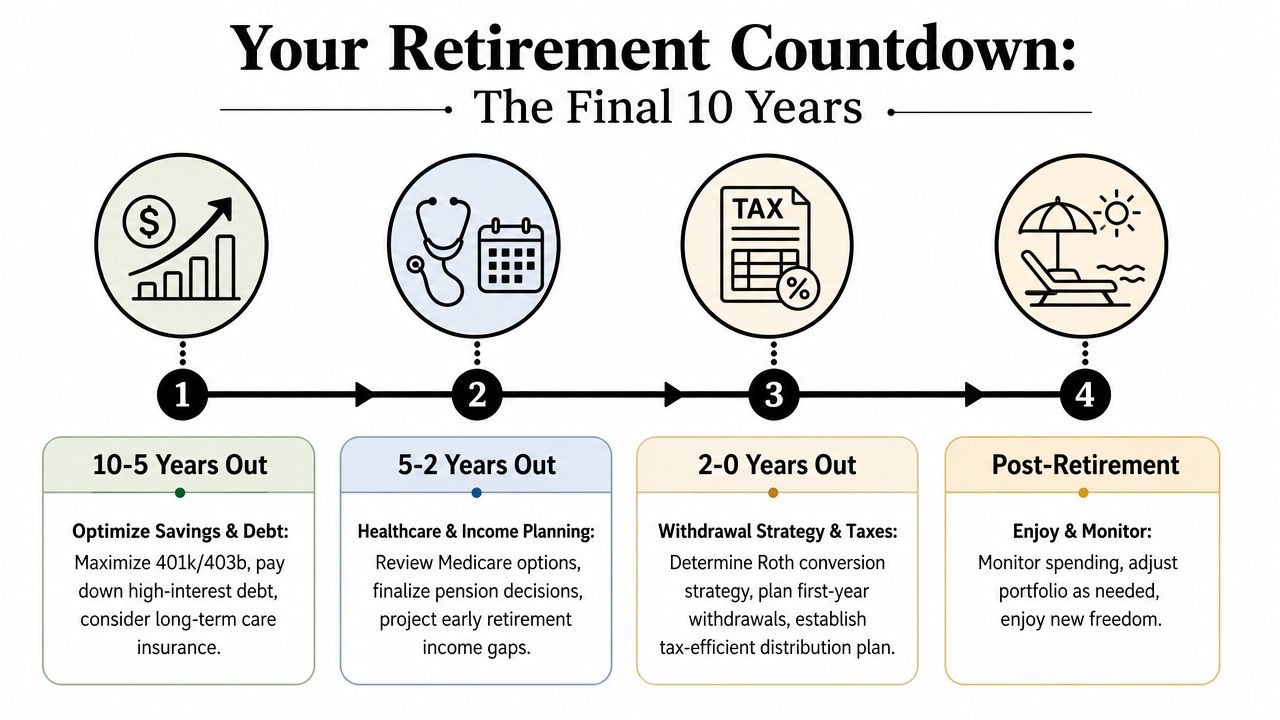
The final approach to retirement needs to be planned like a phased clinical transition, not a vague target on a spreadsheet. The physicians who handle this well usually start by asking a practical question: what has to be true for work to become optional, flexible, or easier before it fully stops? That framing supports better career decisions and lowers the odds of making an expensive exit under pressure.
Tail insurance can reshape the timing
Tail insurance deserves its own line item years before retirement or a major cutback in clinical hours. Toberman Becker explains that tail coverage can cost up to 200% of an annual malpractice premium. For a physician under a claims-made policy, that expense can hit at the same time salary falls.
I tell physicians to review the malpractice setup well before they give notice, sell a practice, or shift to locums or part-time work. If an employer is supposed to cover tail, get that language confirmed in writing. If you are responsible for it, fund it in advance rather than forcing a portfolio withdrawal at the wrong time.
Build a retirement runway, not just a retirement date
The last five to ten years often work better when viewed as a series of decisions instead of a single event. That includes schedule design, coverage decisions, tax timing, and the kind of work you still want to do.
A practical countdown usually includes these items:
- Confirm malpractice exit terms: Re-read the contract and verify who pays for tail, how notice works, and whether part-time status changes coverage.
- Map healthcare before and after Medicare eligibility: The bridge years can be expensive, so use time while you still have income to compare retirement health plans and test whether retiring earlier, later, or into part-time work changes the math.
- Test spending before the transition: Run a six to twelve month trial budget that reflects retirement reality, including travel, hobbies, family support, and healthcare.
- Coordinate withdrawals across accounts: Distribution order affects taxes, Medicare premiums, and how long taxable assets last.
- Stress-test your preferred work option: A reduced schedule, telemedicine role, or weekday-only position may support both income and recovery better than full retirement.
That last point matters more than many physicians expect. I have seen doctors delay retirement because they needed income, and I have seen others retire too early because they thought the only alternative to burnout was to stop working altogether. A better job can be a retirement planning tool. Platforms like WeekdayDoc can help physicians compare roles by schedule, call burden, location, and practice model, which makes the final years of practice easier to shape intentionally.
Distribution rules still matter, but timing matters more
Required minimum distributions begin later than many physicians assume, as noted earlier in the article. That gives some households a useful window after full-time clinical income drops and before mandatory withdrawals start.
Those lower-income years can be valuable for Roth conversions, capital gains planning, and managing Medicare-related income thresholds. The right move depends on your account mix, filing status, pension income, real estate cash flow, and whether you still earn income from consulting or part-time medicine. Generic withdrawal rules are usually too blunt for this stage.
Practice owners need an exit plan that a buyer can understand
For practice owners, retirement planning includes the business itself. A buyer pays for transferable revenue, stable operations, and a practice that can function without your constant presence.
That requires clean financials, documented workflows, and realistic assumptions about goodwill. If collections drop sharply whenever you step away, the practice may be worth less than expected. Owners who want flexibility later usually start building it years earlier by delegating, standardizing, and reducing dependence on personal production.
Protecting Your Nest Egg Estate and Insurance Planning
A large portfolio without protection is unfinished planning. Physicians know risk clinically, but many tolerate unnecessary personal financial risk because the urgent work of practice always comes first.
That's backwards. Once assets accumulate, preservation becomes part of retirement planning for physicians, not an optional legal add-on.
Estate documents are basic equipment
Every physician household needs the core documents done correctly and updated after major life changes. At minimum, that usually means a will, durable powers of attorney, healthcare directives, and beneficiary reviews across accounts.
For many families, a revocable living trust also improves administration, privacy, and continuity. The point isn't to collect documents. The point is to make sure the right people can act quickly and legally if something happens before or during retirement.
A useful overview of the issues appears in this guide to estate planning for retirement, especially for physicians who've focused heavily on asset growth and postponed the legal side.
Insurance protects the plan while you're building it
Physicians often spend more time discussing investments than disability coverage. That's a mismatch. During working years, your earning power is usually the largest asset in the plan.
The insurance review should focus on whether coverage still matches your life and work structure.
- Own-occupation disability insurance: If your specialty income drives the plan, specialty-specific protection matters.
- Term life insurance: Often the cleanest tool when the goal is income replacement, debt coverage, or family protection.
- Umbrella liability coverage: Especially relevant once assets and home equity rise.
- Malpractice terms: Even if employment handles the policy, you still need to understand consent, exclusions, and exit obligations.
What physicians get wrong
Some common errors show up repeatedly.
| Mistake | Why it hurts |
|---|---|
| Relying only on employer documents | Employer benefits don't replace a full estate plan |
| Letting old beneficiaries remain in place | Assets can transfer in ways that conflict with current intent |
| Buying permanent insurance without a clear purpose | High cost can crowd out more useful savings |
| Ignoring disability coverage details | A weak definition of disability can break the income plan |
Protecting wealth isn't pessimistic. It's what responsible planning looks like after years of hard-earned income.
Preservation needs coordination
Investment accounts, legal documents, account titling, and insurance policies should fit together. If they don't, families end up sorting through avoidable confusion during illness, incapacity, or death.
That work is not glamorous, and that's exactly why many physicians delay it. Still, this is one area where delay creates almost no upside. The best time to organize protection is when nothing is wrong.
Aligning Your Career with Your Financial Goals
A physician's retirement plan is shaped long before retirement. It's shaped by contracts, scheduling burden, compensation model, commute, call structure, and whether your current role is sustainable enough to keep doing without resentment.
That's why career decisions belong inside retirement planning for physicians. The job itself can either strengthen your long-term position or steadily undermine it.
Burnout is a financial planning variable
In 2024, 27% of medical groups reported a physician retiring early or departing due to burnout, according to MGMA reporting on physician burnout and early retirement. That's not just a workforce issue. It's a planning issue.
If administrative burden and operational stress push physicians out earlier than intended, then a “higher-paying” job can be financially worse if it shortens your career or forces a reactive exit.
Better work often beats maximal pay
Physicians tend to evaluate offers through salary first. That's understandable, but incomplete. A role with cleaner hours, lower call burden, and a workable pace can be more valuable than a nominally higher-paying role that drives spending, stress, and burnout.
A useful career lens includes:
- Schedule sustainability: Can you see yourself doing this for years without physical or emotional deterioration?
- Benefits quality: Retirement plan design, malpractice terms, and healthcare access change total value.
- Income predictability: Stable compensation can support stronger automated saving.
- Exit flexibility: If you need to leave, can you do it without financial panic?
For clinicians thinking more broadly about this intersection, how to achieve financial independence is a good starting point for connecting career design with long-term autonomy.
Use planning to gain leverage, not just escape
The most durable plans don't treat financial independence as an escape hatch from a broken system. They use it as an advantage inside the system. A physician with cash reserves, disciplined savings, and a clear target can negotiate differently. That physician can decline bad call, reject poor contracts, or move into a lower-intensity setting before damage accumulates.
That's the practical end point of this entire discussion. Financial independence supports professional sustainability. It lets you stay in medicine on terms that are healthier, narrower, and more deliberate.
Retirement planning works best when it starts with a blunt question: does your current role help you build a life you can keep living? If the answer is no, the plan needs to address the job, not just the portfolio.
If you're rethinking how your current job fits your long-term financial life, WeekdayDoc helps clinicians find remote, hybrid, and in-person roles built around work-life balance. You can review curated opportunities with clear schedule markers, compare market context through WeekdayDoc's analysis of active listings, and use tools that support both immediate job decisions and long-range planning.