Can I Borrow from My 403b? a Clinician's Guide
Can I borrow from my 403b? Learn the IRS limits, repayment rules, tax risks, and smarter alternatives before tapping your retirement savings as a clinician.
Yes, you can borrow from a 403(b) if your employer's plan allows it, but the IRS caps loans at the lesser of 50% of your vested balance or $50,000. If you default, the unpaid balance can become taxable income, plus a 10% penalty if you're under age 59½.
The popular advice says a 403(b) loan is harmless because you're “paying yourself back.” That's incomplete. I've seen clinicians change hospitals, lose payroll deductions, and discover that a manageable loan became a tax problem during an already stressful job transition. The central question isn't just “Can I borrow from my 403(b)?” It's whether your plan permits the loan, whether your career can absorb the repayment risk, and whether the cash need justifies interrupting retirement compounding.
Why Borrowing From Your 403b Is Not as Simple as It Sounds
A 403(b) loan isn't a harmless withdrawal from a personal savings account. It's a regulated transaction inside a retirement plan, and the plan itself decides whether you can use that feature. The IRS explains that 403(b) plans may allow loans but aren't required to offer them, so your hospital, university, public school, or nonprofit employer may prohibit borrowing altogether or impose tighter terms than federal rules.
Congress created Section 403(b) in 1958, and the first detailed IRS regulations arrived on July 23, 2007, more than 43 years later, according to the IRS history and loan guidance. That long administrative evolution helps explain why older annuity-based arrangements can have different procedures, recordkeepers, and restrictions. Your plan document, not a generic internet calculator, controls the practical answer.
The plan document is the real gatekeeper
Before thinking about loan size, ask the plan administrator for the summary plan description and loan policy. Look for:
- Eligibility rules: Some plans limit borrowing to particular account sources or employment statuses.
- Fees: Origination, processing, and maintenance charges can reduce the value of a supposedly inexpensive loan.
- Consent requirements: Some plans may require spousal consent or additional documentation.
- Loan restrictions: The plan may limit the number of outstanding loans, set a lower maximum, or restrict permitted purposes.
The tax structure also deserves blunt treatment. The original contribution generally entered the account on a pretax basis, while loan repayments come from after-tax income. The interest portion can then be taxed again when you eventually take taxable retirement distributions. That isn't a second tax on every dollar in the same legal sense, but economically, the repayment structure creates a double-taxation problem on interest.
Practical rule: If you're treating your 403(b) like an emergency checking account, stop before applying. It's a retirement vehicle, and removing invested capital during peak earning years has a cost even when the loan never defaults.
Clinicians often have compressed earning careers. A physician may spend years in training, reach peak income later, and then prioritize reduced call, part-time work, or early retirement after burnout. The account's compounding engine matters precisely because the high-saving window may be shorter than expected. The broader financial planning guidance for medical professionals should begin with liquidity outside retirement accounts.
The next question is concrete: how much can you access?
IRS Loan Limits and What You Can Actually Borrow
The federal framework is simple, but clinicians routinely overestimate their available amount. A compliant loan generally cannot exceed the lesser of 50% of your vested account balance or $50,000, as outlined in the IRS retirement-plan loan rules. The key word is vested. Employer contributions subject to a vesting schedule may appear in your account but may not count toward your borrowing capacity.
| Vested Account Balance | 50% of Balance | IRS Maximum Loan | Limiting Factor |
|---|---|---|---|
| $30,000 | $15,000 | $15,000 | 50% of vested balance |
| $120,000 | $60,000 | $50,000 | IRS dollar cap |
| $400,000 | $200,000 | $50,000 | IRS dollar cap |
A resident with $30,000 vested generally reaches a maximum loan of $15,000, assuming the plan allows loans and no other rule reduces the amount. An attending with $120,000 vested doesn't get access to half the account. The federal ceiling is $50,000. A senior physician with $400,000 vested faces the same federal ceiling, despite having a much larger balance.
The smaller-balance exception
The IRS framework includes a special rule that can allow a participant to borrow up to $10,000, even when that exceeds 50% of the vested balance. That exception matters for smaller accounts, but it doesn't turn every low-balance account into a $10,000 borrowing opportunity. The plan must apply the rule correctly, and the participant still needs to satisfy the plan's own eligibility and documentation requirements.
Outstanding loans can shrink the amount further. The federal calculation takes into account the highest outstanding loan balance during the prior 12 months, so serial borrowing can trap clinicians who repay one loan and immediately seek another. The headline $50,000 limit isn't a fresh $50,000 allowance every time you need cash.
Employer rules can be stricter. A health system may cap loans at $25,000, permit only one concurrent loan, or exclude certain investment sources. Your total account value also isn't enough. Review the vested balance shown by the recordkeeper, then verify how the plan calculates available funds.
What to verify before assuming the number is real
- Check vesting. Separate your own contributions from employer contributions that haven't vested.
- Review prior balances. Ask how any outstanding or recently repaid loan affects the calculation.
- Read the plan's cap. The employer's limit may be below the federal maximum.
- Confirm the purpose. A primary-residence loan can have different repayment terms, but the plan must permit that treatment.
Federal rules establish the boundary. Your plan's document determines whether you can approach it.
403b Loans Versus Hardship Withdrawals
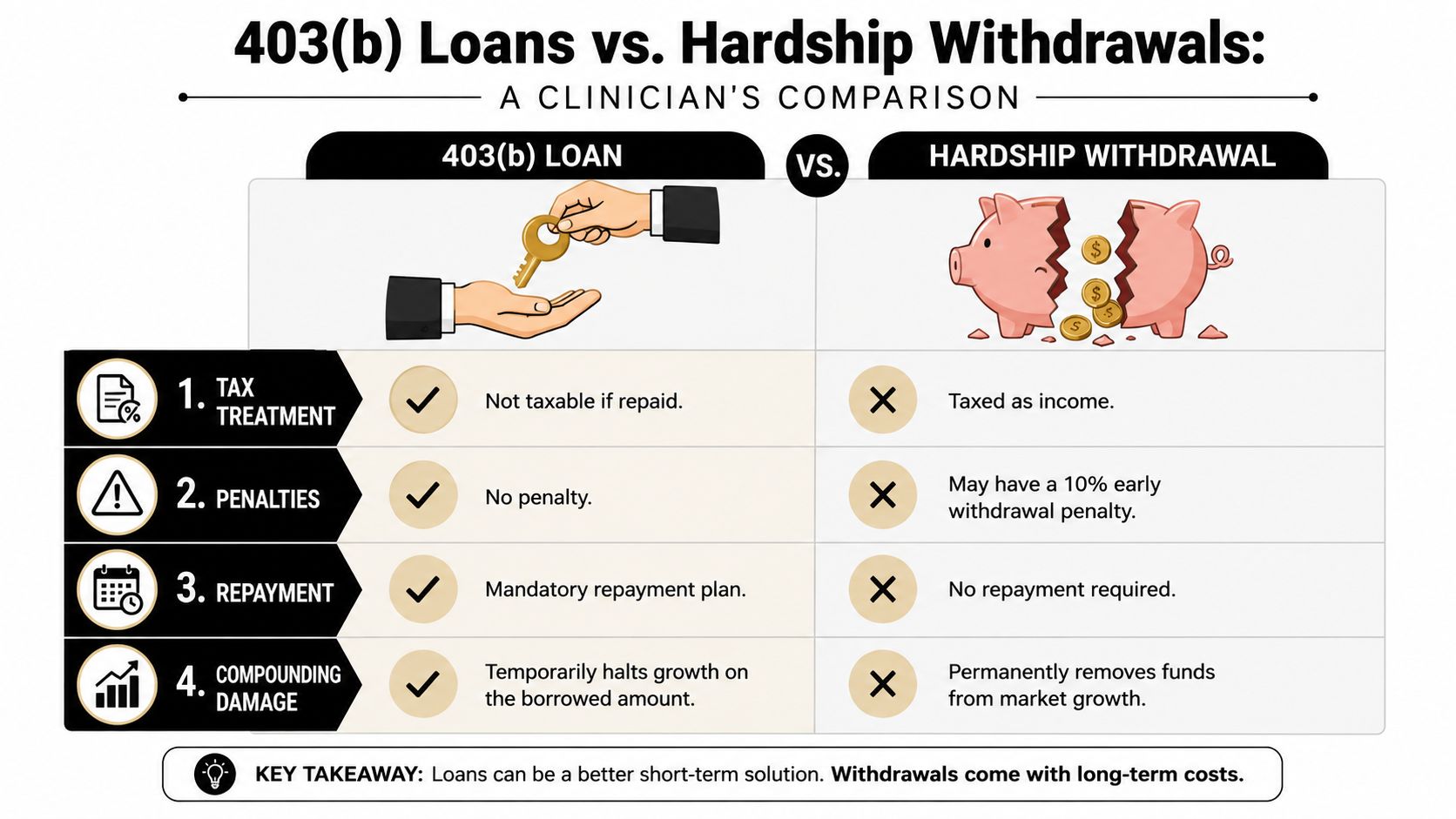
A 403(b) loan and a hardship withdrawal solve a cash problem in opposite ways. A compliant loan creates a repayment obligation. A hardship withdrawal permanently removes money from the retirement account and generally creates an immediate tax bill.
The IRS describes 403(b) loans as permitted only when the plan satisfies the applicable requirements. If you repay on schedule, the loan proceeds generally aren't treated as a current taxable distribution. A hardship withdrawal, by contrast, is generally included in ordinary income, and a person under age 59½ may also face the 10% early-distribution penalty, subject to applicable exceptions and plan rules.
The side-by-side decision
| Consideration | 403(b) loan | Hardship withdrawal |
|---|---|---|
| Tax treatment | Generally not currently taxable if repaid under the plan's terms | Generally taxed as ordinary income |
| Penalty exposure | No early-distribution penalty while the loan remains compliant | May include a 10% penalty before age 59½ |
| Repayment | Mandatory scheduled repayments | No repayment is allowed |
| Investment effect | Borrowed funds aren't invested during the loan period | Withdrawn funds permanently leave the account |
| Plan availability | Only available if the plan offers loans | Only available if the plan offers hardship distributions and your need qualifies |
Hardship withdrawals typically require an immediate and heavy financial need, such as qualifying medical expenses, foreclosure prevention, or tuition. The plan administrator applies the documentation rules, and the IRS requires the distribution to be necessary for the need. Don't assume that a large bill automatically qualifies.
The long-term difference can be severe. A $40,000 hardship withdrawal at age 38 could cost over $300,000 in lost growth by age 65 at a 7% annual return, based on the example specified for this analysis. That figure is an illustration, not a guaranteed investment outcome. Actual results depend on returns, fees, contributions, taxes, and the timing of the withdrawal.
A loan avoids the immediate distribution tax if it stays compliant, but it still has an opportunity cost. The borrowed funds miss market exposure while they're outside the account, and repayments may pressure your budget enough to make you reduce future contributions. A hardship withdrawal is usually the more damaging choice, but a loan that you can't maintain is not a safe alternative.
A hardship withdrawal is permanent. A loan is conditional. The condition is that your employment, payroll, bank account, and monthly cash flow all keep cooperating.
Some plans offer one option but not the other. Confirm both features before deciding.
Repayment Logistics and the Hidden Risk of Default
Payroll deduction makes a 403(b) loan feel automatic. That convenience creates the most dangerous illusion in the process, because the repayment system depends on an active payroll relationship and accurate administrative instructions.
For a standard purpose, repayment is generally required within 5 years. A loan used to purchase a primary residence may qualify for a repayment period of up to 15 years, according to IRS loan guidance on repayment requirements. The longer period can reduce the paycheck impact, but it also keeps retirement assets outside the market for longer and extends exposure to sequence-of-returns risk.
The job-change problem clinicians underestimate
Consider a physician with a $40,000 outstanding balance who leaves one health system for another midway through the year. The old employer may stop payroll deductions and require the balance to be repaid under the plan's separation terms. The physician now has to coordinate repayment while managing credentialing, onboarding, insurance changes, relocation, or a delayed first paycheck.
If the balance isn't repaid on schedule, it can become a taxable distribution. For a borrower under 59½, the unpaid amount may also face the 10% early-distribution penalty, as described by 403bWise's explanation of loan defaults and taxation. The clinician loses retirement capital and may owe taxes at the same time that a job transition has disrupted cash flow.
The operational risk is the investment risk. A loan can be affordable on the day you sign the paperwork and unmanageable after a resignation, payroll error, or bank-account change.
The University of California illustrates how different plan administration can be. In 2026, UC told borrowers that 403(b) loan repayments must move to automatic ACH debits by May 20, 2026, and that failing to establish the debits could jeopardize the loan's standing, according to the UC borrower notice. That's a reminder to read institution-specific notices instead of assuming payroll will handle everything.
Build a repayment failure plan
Before borrowing, identify the payment method after separation, the deadline for changing bank information, and the person or department responsible for confirming payments. Ask whether the loan can continue through manual payments, whether a new employer can accept a rollover, and what happens if your final paycheck is insufficient.
A new hospital job doesn't automatically transfer the loan. A move into private practice or locum work can make payroll deduction disappear entirely. If you can't explain exactly how payments will continue after leaving, don't borrow.
Alternatives to Tapping Your Retirement Savings
A 403(b) loan should sit behind other liquidity options, not ahead of them. Start with cash reserves in a high-yield savings account. A dedicated emergency fund covering 3 to 6 months of expenses can absorb a job gap, relocation, medical bill, or practice transition without taking invested retirement money offline.
The emergency-fund guide for clinicians is a better starting point than a loan application. Keep this money separate from checking so you don't mistake an available balance for discretionary spending.
Use the least damaging source first
- Emergency savings: No retirement tax consequence and immediate access, although using the reserve requires a rebuilding plan.
- Roth IRA contributions: Contributions were made with after-tax dollars and can generally be withdrawn tax-free and penalty-free, subject to the account's ordering rules. This applies to contributions, not necessarily converted or investment earnings.
- Reduced 403(b) contributions: Temporarily lowering contributions can improve cash flow without creating debt or triggering a distribution. Check whether doing so costs an employer match.
- Taxable brokerage assets: Selling investments can create tax consequences, but the account doesn't carry the same loan-default risk or payroll dependency.
- Physician mortgage financing: For a home purchase, compare a 403(b) loan with physician mortgage products that may offer low down payments without private mortgage insurance. The right choice depends on rate, fees, underwriting, and your broader debt plan.
The opportunity cost remains central. A $30,000 loan at age 35 could cost over $200,000 in lost growth by retirement age, depending on the assumed return and repayment pattern. That's an illustration, not a forecast, but it captures why “I'm paying myself interest” doesn't settle the decision.
| Alternative | Tax Impact | Accessibility | Retirement Growth Impact |
|---|---|---|---|
| Emergency savings | No retirement-account tax | High | None |
| Roth IRA contributions | Generally tax-free and penalty-free for contributions | High, subject to ordering rules | Reduces Roth assets available for future growth |
| Pausing contributions | No loan or distribution tax | Immediate cash-flow relief | May reduce future growth and any available employer match |
| Taxable brokerage | Possible tax on realized gains | High | Retirement account remains invested |
| 403(b) loan | Generally no current tax if compliant | Plan-dependent | Borrowed funds miss market growth and repayments strain cash flow |
If bankruptcy is part of the picture, get jurisdiction-specific legal advice rather than assuming retirement assets and loan obligations receive identical treatment. A resource on Utah bankruptcy 401k loan rules can help frame the questions, but it isn't a substitute for advice from a qualified attorney familiar with your case.
Decision Checklist Before You Borrow
Treat the application like a contract review, not a quick payroll election. Work through each item before you request funds.
- Confirm the plan permits loans. Read the summary plan description and ask the administrator for the current loan policy. Don't rely on what a colleague at another hospital was allowed to do.
- Calculate the actual available amount. Use the vested balance, account for prior loan balances, and apply the plan's own cap. The online recordkeeper estimate may not explain every limitation.
- Read the separation clause. Find out what happens after resignation, termination, reduced hours, leave, or a move to a related health system. Ask how manual or ACH payments work after payroll ends.
- Stress-test the paycheck. Add the proposed deduction to mortgage, student loans, childcare, insurance, and recurring household costs. If the payment only works while you take extra shifts, the plan is fragile.
- Price the opportunity cost. Use a compound-growth estimate with conservative assumptions, then compare that loss with the cost of alternatives. Don't treat repayments as a perfect replacement for uninterrupted market exposure.
- Check your career stability. A probationary position, contract renewal, planned fellowship, private-practice launch, or likely move within the repayment period raises default risk.
- Exhaust safer liquidity. Review emergency savings, Roth IRA contributions, taxable assets, spending reductions, and appropriately structured outside financing.
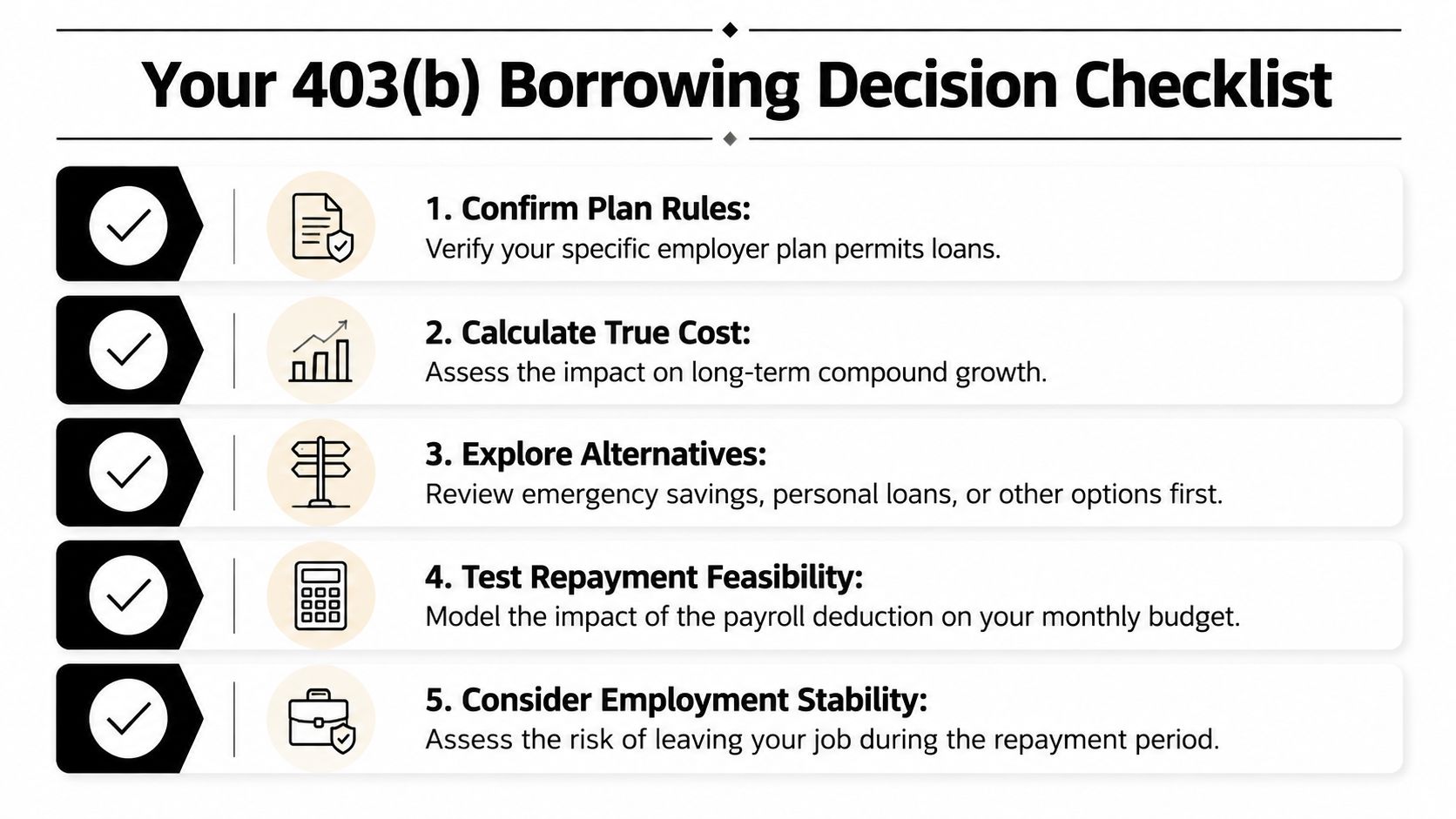
Use this framework for the decision, not just the amount. If more than two red flags appear, treat the loan as a likely mistake and return to the alternatives above. A large balance doesn't compensate for unstable employment or a repayment plan that fails after separation.
Protecting Your Financial Future as a Clinician
A 403(b) loan trades long-term retirement growth for short-term liquidity. That trade can be defensible during a genuine emergency, but it isn't automatically smart because the money came from your account. The IRS permits loans within defined limits, yet your plan rules, payroll system, employment status, and bank information determine whether the arrangement survives real life.
Clinicians need to think beyond the current paycheck. A career may contain a residency, several hospital changes, a move into private practice, reduced clinical hours, or an early exit from medicine. Every transition increases the value of liquidity that sits outside retirement accounts. It also increases the danger of borrowing against an account that was designed to compound through those transitions.
Your retirement savings strategy as a clinician should include parallel systems: emergency cash, accessible Roth IRA contributions, and taxable investments. Those accounts won't eliminate every financial shock, but they reduce the chance that a temporary problem becomes a taxable retirement distribution.
Your 403(b) isn't a bank. Protecting it means preserving the compounding engine that can fund financial independence, flexible work, and the option to step away from burnout. Borrow only when the need is serious, the plan permits it, your job is stable, and the repayment process still works if payroll stops.
WeekdayDoc helps clinicians evaluate jobs with clearer information about work style, compensation, and burnout risk, including roles designed around fewer call, weekend, and overnight demands. Visit WeekdayDoc to find opportunities that support a more sustainable career and a stronger long-term financial plan.