Remote Part Time Nurse Practitioner Jobs: 2026 Telehealth Opportunities
Discover remote part time nurse practitioner jobs in 2026: flexible telehealth roles, high pay, and a sustainable NP career path.
What if you could deliver great patient care without sacrificing your personal life or constantly teetering on the edge of burnout? For many nurse practitioners, this isn't a pipe dream anymore. It’s a reality, thanks to a huge surge in legitimate remote part-time nurse practitioner jobs that offer real flexibility.
The Rise of the Remote Part-Time Nurse Practitioner
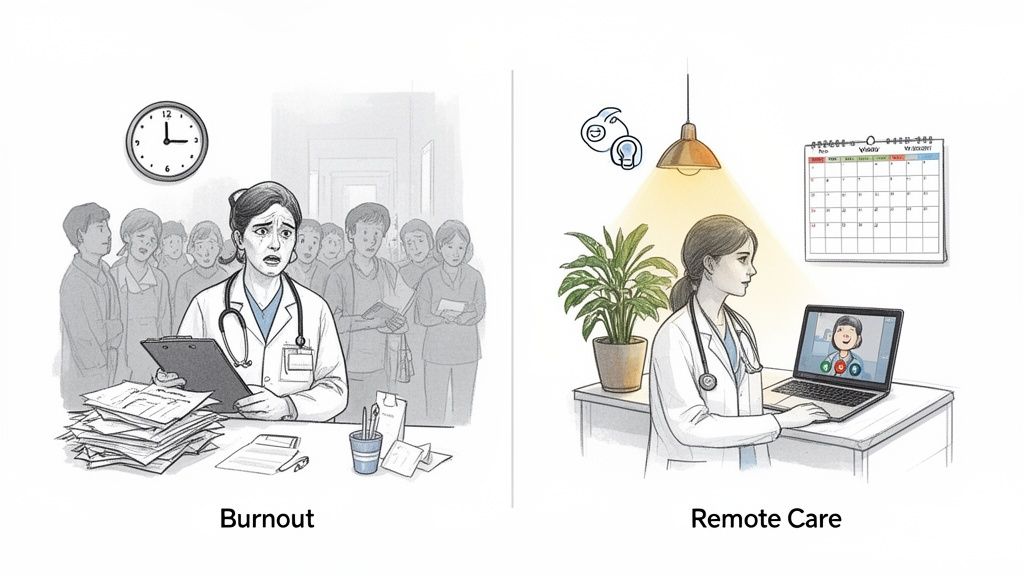
Let's be honest: the traditional clinic setting is breaking people. The packed waiting rooms, the mountain of paperwork, the rigid 9-to-5 (that's really 7-to-7)—it all grinds you down. That constant pressure chips away at the passion that got you into medicine in the first place.
Remote, part-time roles are the counter-movement. They represent a fundamental shift toward a more sustainable way to practice medicine, and it's all being driven by two powerful forces.
The Telehealth Boom
The biggest driver has been the explosion of telehealth. What used to be a niche service is now a core part of how we deliver care. This has opened up a flood of opportunities for NPs to connect with patients from anywhere, completely untethered from a physical clinic.
The growth has been staggering. Just look at the numbers. A few years ago, you'd be lucky to find a handful of these roles. Today, a quick search reveals over 760 part-time remote NP positions available in Texas alone. You can dig into the current job market trends to see just how fast this is growing.
This isn't a temporary fad. It's a real restructuring of healthcare delivery. For nurse practitioners, this means you finally have a say over your schedule and work environment.
A New Focus on Clinician Well-Being
At the same time, healthcare organizations are finally waking up to the massive cost of burnout. They're starting to realize that running their clinicians into the ground is bad for everyone—providers, patients, and their bottom line.
This has pushed them to create roles designed for actual work-life balance, not just roles that pay lip service to it.
This guide is your roadmap to finding one of these jobs. We'll cut through the noise and show you how to land a role that gives you your life back. We'll cover:
- Defining Your Ideal Schedule: How to figure out the hours and days that actually work for you.
- Knowing Your Worth: Setting realistic salary goals and understanding your financial options.
- Vetting Every Opportunity: Using practical tools like WeekdayDoc's Burnout-Friendly Score to spot the good jobs from the bad ones.
By the end, you’ll have the game plan and the confidence to find a job that fits your life, not the other way around.
Defining Your Perfect Remote Work-Life Balance
Before you even glance at a job board, the most critical first step is figuring out what an “ideal” role actually looks like for you. Think of this as your personal blueprint for a sustainable career—without it, you’re just scrolling blindly.
It’s far too easy to accept a job that looks great on paper, only to find yourself right back in the same cycle of burnout you’re desperate to escape. A better work-life balance is likely the main reason you're looking for a part-time remote role in the first place. So, let’s get specific about your non-negotiables.
Synchronous vs. Asynchronous Care
First, you need to understand the two main ways remote care is delivered. These models create vastly different workdays, and one will almost certainly fit your personality and lifestyle better than the other.
Synchronous Care: This is real-time, face-to-face patient care. Think scheduled video visits or phone calls. You and the patient are interacting simultaneously, which is perfect for building rapport and doing direct clinical assessments.
Asynchronous Care: This is "store-and-forward" care that doesn't happen in real time. Picture managing a secure messaging portal where you review patient charts, answer questions, and handle prescription refills on your own schedule (within a required window, like 24 hours).
Many remote part-time nurse practitioner jobs are a blend of both. The key is knowing which you prefer. Do you thrive on the energy of direct patient interaction, or do you do your best work with the quiet, deep focus of chart reviews?
Mapping Your Ideal Work Week
Once you know your preferred care model, it’s time to nail down the logistics. Don't be vague. Get out a piece of paper and write down concrete answers to the following questions.
The point isn't to find a fantasy job that checks every single box. It’s to build a strong filter that instantly disqualifies roles that are a fundamentally bad fit for your life and well-being.
Your answers become a powerful checklist for vetting job posts and a script for your interviews.
Your Personal Job Criteria Checklist
- Hours Per Week: What’s your magic number? Is there a minimum you need to hit financially? More importantly, what’s the absolute maximum you’ll work to protect your sanity?
- Days and Times: Are you looking for weekday-only work, period? Do you need certain days off for kids' activities or personal appointments? Are you a morning person who wants to be offline by noon, or do evening shifts fit your life better?
- Specialty Focus: Are you passionate about a niche like mental health, dermatology, or women's health? A role that aligns with your clinical interests will feel far less like a job and more like a calling.
- Patient Load: What is a realistic number of patients you can see or charts you can close per hour while still delivering safe, high-quality care? This is a non-negotiable question to ask in an interview. A high patient load is a huge red flag for burnout.
- Administrative Support: How much backup will you have? Who handles scheduling, billing, and—critically—IT issues? A lack of solid administrative support is one of the fastest ways a great remote job turns sour.
By defining these terms upfront, you shift from passively scrolling through jobs to conducting a targeted mission. You’ll know exactly what you’re looking for and be empowered to find a role that truly serves your career goals and your personal life.
Understanding Your Remote Earning Potential
Let's get straight to it and talk about the money. Discussing compensation can feel a bit taboo, but if you're serious about finding a remote part-time nurse practitioner job, you need a realistic grasp of what you can earn. This isn't just about paying the bills—it's about valuing your clinical expertise and making a career move that actually supports your financial goals and well-being.
Pay in telehealth isn't one-size-fits-all. It's a mix of factors: your specialty, years of experience, the state you’re licensed in, and whether you're a W-2 employee or a 1099 contractor. This variability is actually great news. It means there’s a wide range of opportunities at different pay scales, so you can find a role that fits your specific financial needs.
Cracking the Code on Part-Time Rates
For most NPs, going part-time and remote is about getting your life back. The good news is you don't have to take a massive pay cut to do it. Telehealth roles are often surprisingly competitive.
The average telehealth NP earns around $130,295 annually, which works out to about $63 per hour. In-demand specialties like psychiatry can command much more, with some hourly rates pushing past $200. Even for more general part-time contract roles, you'll typically see rates between $50 to $75 per hour. You can explore a full breakdown of typical NP pay ranges for various specialties on WeekdayDoc.
Think about it: a part-time role at 10-12 hours per week paying $68-$75 per hour can add an extra $35,000 to $45,000 to your annual income. That's a significant boost, all while keeping your schedule flexible.
Below is a quick overview of what you can expect for different remote specialties.
Typical Hourly Rates for Remote Part-Time NP Specialties
This table breaks down the common hourly pay ranges for various remote nurse practitioner roles, helping you set realistic salary expectations.
| NP Specialty | Typical Part-Time Hourly Rate | Notes |
|---|---|---|
| Psychiatry (PMHNP) | $90 - $200+ | Highest demand, especially for medication management. |
| Family (FNP) | $60 - $85 | Wide range of opportunities in primary and urgent care. |
| Dermatology | $70 - $110 | Often asynchronous (store-and-forward) roles. |
| Women's Health (WHNP) | $65 - $90 | Focus on contraception, wellness, and specific conditions. |
| Urgent Care | $65 - $95 | Typically synchronous video visits for acute issues. |
| Weight Management | $75 - $125 | Growing field with both synchronous and asynchronous models. |
As you can see, your specialty plays a huge role in your earning potential. A PMHNP will almost always command a higher rate than a generalist FNP in the remote world.
Connecting Your Career to Financial Freedom
A part-time remote NP job is more than just a side gig—it can be a powerful tool for hitting major financial milestones, including FIRE (Financial Independence, Retire Early). The FIRE movement isn't just about quitting work in your 40s; it’s about having enough income from investments to live on, freeing you from having to work for money. It's about creating options.
Think of a part-time remote job as your FIRE accelerator. It lets you dramatically increase your savings rate without the burnout that comes from picking up extra shifts in a high-stress hospital.
Let's make this real. Imagine you’ve paid down your student loans and are looking to supercharge your investments. A flexible, 15-hour-per-week remote job could let you funnel an extra $50,000+ per year straight into your retirement accounts. This one move puts your financial goals on the fast track.
Here’s how that could work in practice:
- Your Goal: Increase your savings rate by 15%.
- Your Action: Take on a remote, asynchronous role reviewing patient charts for 10 hours a week.
- The Result: That extra income, earned with minimal disruption to your life, goes directly into your investment portfolio.
This strategy proves you don't have to sacrifice your current well-being for your future financial security. You can have both. This is why we built the integrated Salary & FIRE Calculator into WeekdayDoc—so you can project your earnings and see exactly how a burnout-friendly part-time role can accelerate your path to financial independence. It empowers you to see a job offer not just as a paycheck, but as a strategic step toward the life you actually want to live.
The way you work also affects how you're paid. Synchronous roles (live video calls) are usually hourly, while asynchronous work (chart reviews) might be compensated per chart.
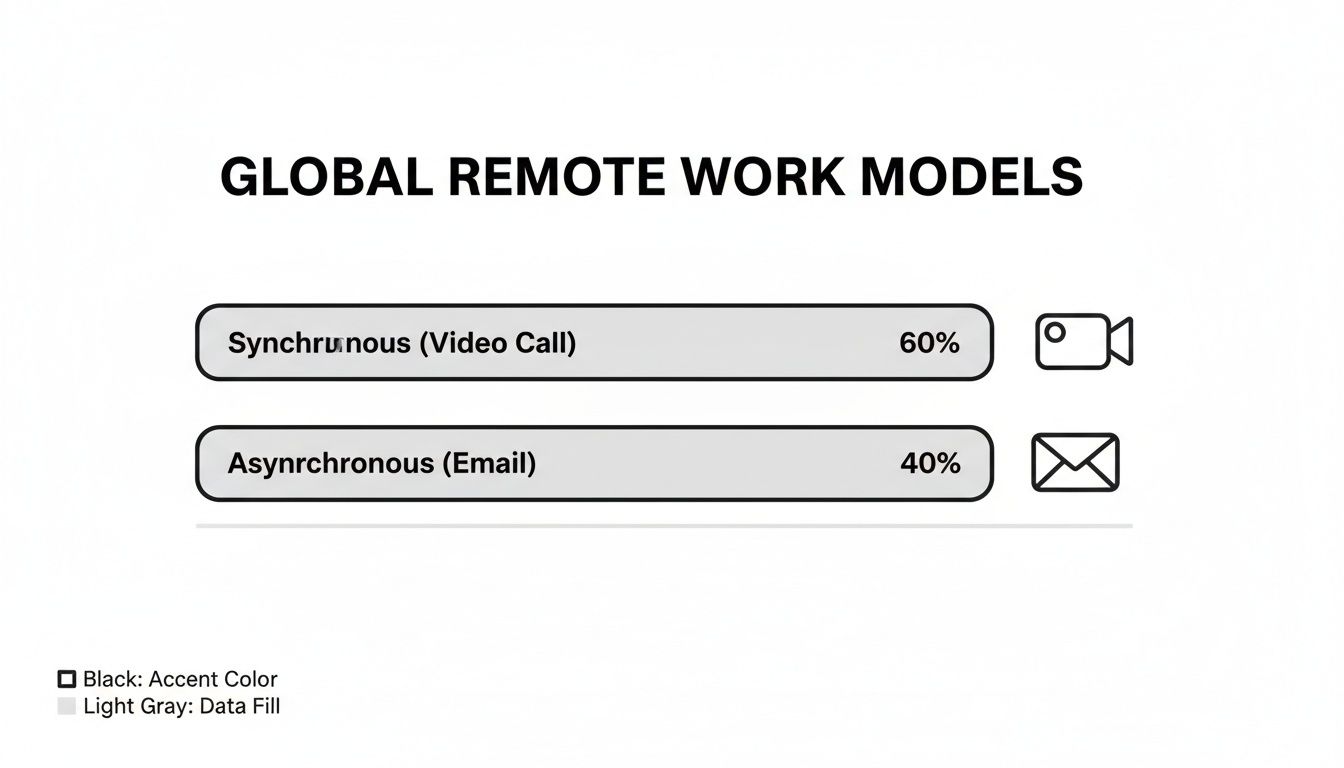
Understanding these models is key, as synchronous roles (the 60%) often pay per hour or per encounter, while asynchronous work (the 40%) might be compensated per chart review or on a flat-rate basis. Your preferred work style will directly influence your compensation structure.
Navigating Telehealth Licensing and Regulations
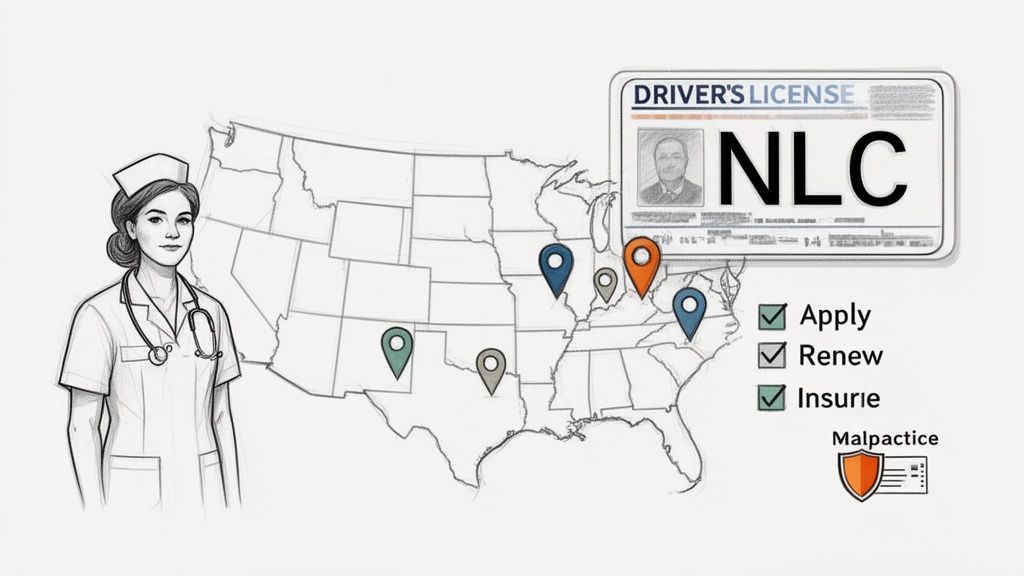
Going remote opens up a world of opportunity, but it also introduces some logistical hurdles—chief among them, licensing. Here's the number one rule you have to get right: the patient's physical location determines which state license you need, not where you are.
This means if you want to land the best remote part-time nurse practitioner jobs, you’ll likely need licenses in more than one state. Don't let that intimidate you. It's much more manageable than it sounds, especially with the right strategy.
The Nurse Licensure Compact: Your Golden Ticket
Think of the Nurse Licensure Compact (NLC) as your fast pass for telehealth. It's an agreement that lets you practice—in person or remotely—in every participating state using just one multistate license. Holding an active NLC license makes you an incredibly attractive candidate, instantly qualifying you for roles that serve patients across dozens of states.
The NLC is the single most powerful tool for an NP building a remote career. It cuts down on the paperwork, cost, and headaches of expanding your practice area, putting you at the top of the list for employers hiring for multistate roles.
To get a multistate license, your primary state of residence (PSOR) just needs to be an NLC member. If it is, you can apply to upgrade your existing single-state license, and just like that, your professional reach expands massively.
Getting Licensed in Non-Compact States
But what if a fantastic job requires a license for a state outside the NLC? You'll just have to apply for a single-state license directly with that state's board of nursing. It’s more legwork, but it’s a standard process if you stay organized.
Here's a quick rundown of what that looks like:
- Check the State's Requirements: Every state has its own application, fees, and background check process. Start at their Board of Nursing website.
- Get Your Documents Ready: You'll need the usual suspects: proof of graduation, your national certification, and verification of any licenses you already hold.
- Fill Out the Application Carefully: Even small mistakes can cause major delays, so double-check every entry before you submit.
- Track Everything: I recommend a simple spreadsheet to track application dates, fees, and follow-up reminders. It saves a lot of stress.
Getting a handle on licensing is a must, whether you're practicing telehealth across state lines or even considering something like working as a nurse in a foreign country.
Malpractice and Prescribing Rules
Licensing is the biggest piece of the puzzle, but there are two other areas you can't afford to overlook.
First, your malpractice insurance. Don't just assume you're covered. Many standard policies don't automatically include telehealth or practice in multiple states. You need to call your provider and get confirmation in writing, or find a new policy that explicitly covers your telehealth work in every state you’re licensed in.
Second, you have to know the state-specific prescribing regulations, especially for controlled substances. Some states have very strict rules about how a patient relationship must be established before certain medications can be prescribed remotely. We touch on these evolving standards in our guide to remote healthcare jobs. Always, always verify the rules for each state you practice in to stay compliant and protect your license.
Finding and Vetting Burnout-Friendly Job Openings
Alright, you know what you want in a job. Now, where do you actually find it? If your first instinct is to head to the giant, one-size-fits-all job boards, I’d suggest you pause.
Endlessly scrolling through those sites is a recipe for frustration. Most listings are just digital noise, not designed for clinicians like us who are actively trying to find sustainable, well-balanced roles. We need a more targeted strategy.
This means shifting your search away from the massive aggregators and toward platforms that are built with clinician well-being at their core. Instead of just listing every job under the sun, these curated sites focus on the quality of the role itself. This is where you'll find the remote part-time nurse practitioner jobs that truly respect your time and skill.
Using Smart Filters to Pinpoint Your Ideal Role
The best job platforms don't just let you search; they give you powerful tools to zero in on what really matters. Instead of only filtering by specialty, you can apply filters that instantly weed out roles that don’t align with your work-life goals. Think of them as your non-negotiables, turned into a one-click search.
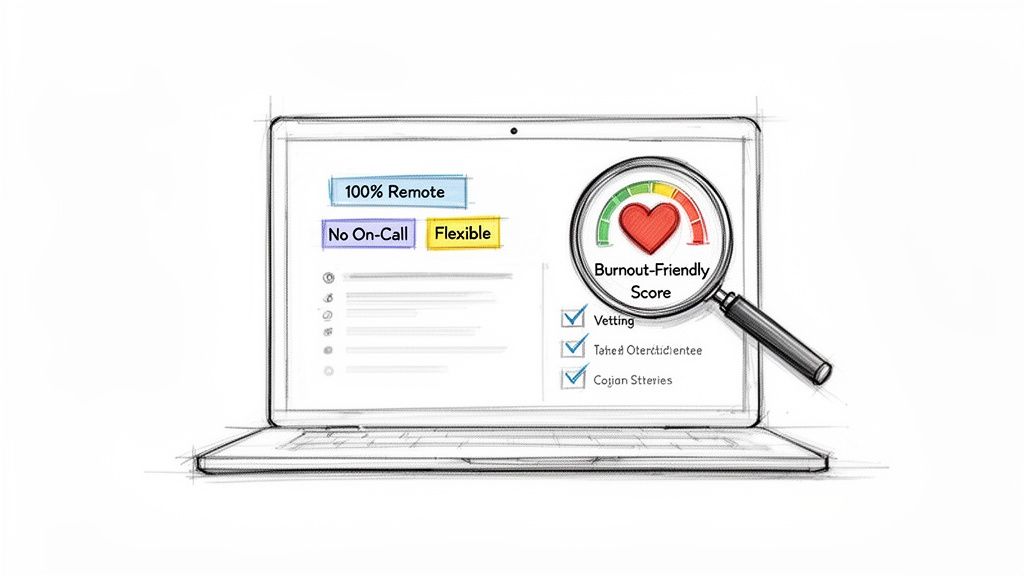
On a platform like WeekdayDoc, for instance, you're not just scrolling—you're strategically targeting. You can apply filters for the criteria that make a real difference:
- 100% Remote: This eliminates any hybrid surprises or roles with vague "occasional travel" requirements.
- No On-Call: Instantly removes jobs that threaten to bleed into your evenings, weekends, or personal time.
- Flexible Schedule: Highlights opportunities that offer asynchronous work or give you control over your own hours.
Using filters like these can save you countless hours. More importantly, it prevents the disappointment of getting halfway through an interview process only to discover a dealbreaker. It puts you in the driver's seat right from the start.
The Power of the Burnout-Friendly Score
Beyond basic filters, how can you gauge the true health of a work environment? It's a huge challenge. We've all seen job descriptions packed with positive buzzwords, only to find out the culture is toxic.
That’s exactly why we created the Burnout-Friendly Score at WeekdayDoc. It’s a proprietary rating we assign to every single job posting, based on factors that directly impact clinician well-being.
Think of the Burnout-Friendly Score as a nutrition label for a job. It gives you an at-a-glance assessment by analyzing patient load expectations, administrative support, schedule flexibility, and on-call duties to give you a clear, objective metric before you even apply.
A high score, highlighted in green, is an immediate signal that the role has been vetted for sustainability. It lets you focus your limited time and energy on the most promising and truly burnout-friendly job opportunities. This simple visual cue helps you quickly separate the top-tier positions from the ones that could lead right back to another cycle of burnout.
Your Universal Vetting Checklist
Whether you're using WeekdayDoc or another site, you absolutely need a personal vetting checklist. Once you land an interview, it's your turn to ask the tough questions and investigate the company’s culture and the real-world demands of the role.
Don't be shy about it—your well-being is on the line. Get direct answers to these questions:
- Patient Load: "What is the expected number of patients per hour or charts per day? Is that number a hard target or a flexible average?"
- EMR & Tech: "Which EMR system do you use? How much paid time is dedicated to training, and what is the typical daily time spent on documentation?"
- Admin Support: "Who handles patient scheduling, billing inquiries, and tech support? Is there a dedicated team for these administrative tasks, or does that fall on the clinician?"
- After-Hours Expectations: "How are urgent patient messages or emergencies handled after my shift ends? Am I expected to be available or on standby?"
The answers to these questions will reveal far more than any job description ever could. By being a proactive and informed job seeker, you take control and find a role that doesn't just pay the bills but actively supports a healthy, long-term career.
Crafting an Application That Gets You Hired
Once you've found a job that looks promising, the real work begins. Your application is the first—and often only—chance you get to make your case. For competitive remote part-time nurse practitioner jobs, a generic resume and cover letter will get you nowhere fast. You have to tailor every single piece to show why you're the right fit for telehealth.
This isn’t just about listing your clinical skills. It's about proving you're adaptable, comfortable with technology, and can build real human connection through a screen. Think of your application as the first diagnostic test you're running; it tells the hiring manager if you truly get what it takes to succeed in remote care.
Customizing Your Resume and Cover Letter
Your resume needs to be more than just a list of past jobs; it's a marketing document that sells your telehealth potential. The key is to translate your in-person experience into skills that matter for a remote role. Stop listing duties and start highlighting specific, measurable accomplishments.
For example, don't just write "managed a panel of patients." That tells them nothing.
Instead, frame it with data: "Successfully managed a panel of 200+ patients using a mix of synchronous video visits and asynchronous messaging, maintaining a 95% patient satisfaction rate." See the difference? One is a task, the other is a result.
The cover letter is where you bring it all together. The best remote employers aren't just filling a seat; they're looking for NPs who are genuinely committed to their model of sustainable, high-quality care. This is your chance to show you're on the same page.
Your cover letter should tell a story. Explain why you are pursuing a remote, part-time role—not just for your own sanity, but because you believe it allows you to be a more present, effective, and empathetic clinician.
Before you submit, it's a good idea to run the job description through a quick mental checklist. Is this opportunity setting you up for success, or is it a burnout trap in disguise?
I've put together a simple table to help you quickly spot the difference between a genuinely good role and one that's waving a dozen red flags.
Red Flags vs Green Flags in a Remote Job Listing
Use this checklist to quickly evaluate whether a remote part-time NP job opportunity aligns with a sustainable, burnout-friendly career path.
| Attribute | Red Flag (Warning Sign) | Green Flag (Positive Sign) |
|---|---|---|
| Schedule | Vague terms like "flexible hours" with no specifics; mentions "as needed" or "variable" shifts. | Clearly defined hours (e.g., "Mon-Thurs, 9am-2pm EST"); protected admin time mentioned. |
| Patient Load | Unspecified patient volume; uses high-pressure language like "fast-paced environment." | Mentions a specific or capped number of patients per day/hour (e.g., "3-4 patients per hour"). |
| Technology | No mention of the EMR or platform; requires you to use your own non-secure tools. | Names the specific EMR and telehealth platform (e.g., "AthenaHealth," "Doxy.me"). |
| Support | No mention of a supervising physician, team collaboration, or administrative support. | Clearly states there is a support team, dedicated MA, or a collaborative care model. |
| Compensation | "Competitive pay" with no numbers; productivity-only models (100% RVU-based). | Provides a clear hourly rate or salary range; transparent bonus structure. |
| Onboarding | Implies you'll "hit the ground running" with minimal training. | Describes a structured training and onboarding process, including EMR training. |
Think of this table as your first line of defense. If you're seeing more red flags than green, it’s probably best to keep scrolling. Your long-term well-being is worth more than a poorly structured job.
Acing the Virtual Interview
The virtual interview is your live demo. It's where you prove you have both the clinical and interpersonal skills to thrive in a remote setting. Preparation is non-negotiable.
Your Pre-Interview Checklist:
- Professional Setup: Your background needs to be clean and non-distracting. Make sure your face is well-lit, and for goodness' sake, test your microphone and camera beforehand. Technical glitches look unprofessional.
- Demonstrate Tech-Savviness: Be ready to talk about the EMRs, telehealth platforms, and secure messaging apps you've used. This isn't about being a tech wizard; it's about showing you can handle the basic tools of the trade.
- Answer Key Telehealth Questions: You'll get questions you'd never hear for an in-person job. Practice your answers to things like, "How do you build patient rapport without being in the same room?" or "Describe a time you handled a technical issue during a virtual visit."
When you answer these questions with confidence, you're showing you’ve already thought through the realities of remote care. It proves you aren't just looking for a convenient gig—you're ready to be an excellent remote NP.
Negotiating Your Part-Time Offer
Getting the offer doesn't mean the conversation is over. For part-time roles, many of the most important details are still on the table. Knowing what to ask for is critical to landing a deal that truly works for you.
Don’t just focus on the hourly rate. You need to look at the entire package.
Key Negotiation Points for Part-Time Roles:
- Malpractice Insurance: Will they provide "claims-made" or "occurrence" coverage, or are you expected to get your own? If they provide it, confirm it covers you in all the states where you'll be licensed to practice for them.
- CME Stipend: Just because it's part-time doesn't mean you don't need continuing education. Many great part-time roles still offer a CME allowance, but you often have to ask.
- Licensing Fees: If the job requires new state licenses, this can cost thousands. It is standard and reasonable to ask if they will reimburse you for the application and renewal fees.
By putting in the effort to craft a thoughtful application, nailing the interview, and negotiating the terms that matter, you signal that you're a serious, high-value candidate. This is exactly how you land one of the best remote part-time NP jobs out there.
Your Questions About Remote NP Careers Answered
Even when you're ready for a change, a few questions always linger. It's completely normal. Let's clear up some of the most common concerns NPs have when looking at remote, part-time roles.
Think of this as the final checklist to give you the clarity and confidence to take that next step.
What Kind of Technology Do I Really Need?
This is a big one, but the answer is simpler than you might think. You don't need a high-tech command center to work in telehealth.
For most remote part time nurse practitioner jobs, the requirements are surprisingly basic:
- A reliable, high-speed internet connection: This is the only non-negotiable. Stable video calls are a must for patient care.
- A modern computer: Any decent laptop or desktop with a working webcam and microphone will do the trick.
- A private, quiet workspace: This is less about tech and more about ensuring HIPAA compliance and maintaining a professional environment for your patients.
Your employer will almost always provide secure access to their Electronic Medical Record (EMR) and telehealth platforms. They aren't looking for IT gurus, just clinicians who are comfortable with basic computer skills.
Is There Real Job Security in Remote Roles?
Many clinicians worry that remote jobs are just a passing trend or less stable than a traditional hospital role. While any job market has its ups and downs, the data shows telehealth is now a permanent, integral part of healthcare delivery.
The proof is in the investment. Major healthcare systems are building entire departments around virtual care. Some are actively hiring 70-80 nurse practitioners at a time for remote teams, with established programs that have already trained over 11,000 nurses in remote care protocols. You can see how these jobs are spreading by checking out the national distribution of remote NP jobs.
The shift to remote care isn't temporary. It's a fundamental change in how patients get help, creating durable career paths for NPs who are ready to adapt.
Can I Still Grow My Career in a Part-Time Remote Role?
Absolutely. Career growth just looks a little different when you're not physically climbing a clinical ladder. In remote work, advancement often means specialization, mentorship, or leadership.
Many telehealth companies offer clear pathways to become a lead clinician, a trainer for new virtual providers, or a subject matter expert in a niche like teledermatology or remote psychiatry.
Plus, working part-time frees up the time and mental energy to pursue new certifications or an advanced degree, which can open even more doors. The key is to find an organization that actively invests in the professional development of its remote staff.
Finding a role that protects your well-being and advances your career is exactly what WeekdayDoc was built for. We screen and curate burnout-friendly jobs so you can build a sustainable career you love. Start your search for a better work-life balance today at https://www.weekdaydoc.com.