How to Find a Remote Nurse Practitioner Job in 2026
Learn how to find and land a high-paying remote nurse practitioner job in 2026. This guide covers resume writing, interview prep, and salary negotiation tips.
Landing a remote nurse practitioner job isn't about luck—it's about a smart strategy. In a field this competitive, just scrolling through job boards won't cut it. This guide gives you the practical, real-world steps to find a telehealth role that truly delivers on the promise of flexibility and a sustainable career.
Why Your Next Job Should Be in Telehealth
The entire healthcare landscape has shifted. What was once a niche offering is now a core part of care delivery, and this has created a massive wave of opportunity for NPs looking for something different. Healthcare organizations now rely on remote clinicians for everything from chronic disease management to urgent mental health support.
This isn't a temporary trend. It's a fundamental change in how medicine is practiced. That means a remote nurse practitioner job is more within reach than ever. Companies are actively seeking NPs for virtual consults, asynchronous care, and specialized telehealth services, opening up career paths far beyond the traditional clinic walls.
The Soaring Demand for Remote NPs
Patients have made their preferences clear. They want the convenience of managing their health from home, especially for follow-ups and ongoing conditions. This patient-driven shift, paired with better and more secure technology, has made it possible for clinicians to provide excellent care from anywhere.
The numbers back this up. The job outlook for nurse practitioners is nothing short of explosive, with a projected 46.3% increase in opportunities between 2023 and 2033. That translates to roughly 135,500 new positions, cementing the NP role as the No. 1 job in America, according to a recent analysis by Nurse.org.
This is your chance to break free from the constraints of a physical clinic, fight burnout on your own terms, and build a career with real autonomy and work-life balance.
How to Position Yourself for a Remote Role
To seize these opportunities, you need to present yourself as the ideal candidate for a virtual world. This goes beyond your clinical expertise. It’s about proving you can build rapport through a screen, manage your time effectively without direct supervision, and navigate the unique demands of telehealth.
As you start looking, remember that the right role is out there. It’s the one that can reignite your passion for medicine by giving you back control over your life and career.
A great first step is to see what’s out there right now. Take a look at the current remote healthcare jobs to get a feel for what employers are looking for in top candidates.
Preparing for a Successful Remote NP Career
Making the leap to a remote nurse practitioner job is an exciting prospect, but success requires more than just solid clinical skills. To really stand out in the telehealth world, you need a specific blend of licenses, tech-savviness, and a polished "webside manner."
Getting this groundwork in place before you start applying is what separates the top candidates from the rest of the pack. It shows telehealth companies you’re serious and ready to hit the ground running.
Mastering Multi-State Licensure
Your ability to practice across state lines is the single biggest factor determining how many job opportunities are open to you. Most large telehealth companies serve patients nationwide, and they need clinicians who are legally able to do the same. This is where your licensure strategy becomes a huge competitive advantage.
The Nurse Licensure Compact (NLC) is an absolute game-changer. If you're licensed in one of the member states, you can get a single multi-state license that allows you to practice—in-person and via telehealth—across dozens of other compact states. This instantly expands your job search from a local market to a national one.
If you’re in a non-compact state, it’s a bit more legwork. You’ll have to get licensed by endorsement in each individual state where a potential employer needs you to see patients. It sounds daunting, but many larger companies have dedicated credentialing teams to help with the paperwork. Even better, they often cover the fees.
Pro Tip: Always ask about the company’s policy on licensure support and reimbursement during your interviews. This can easily save you thousands of dollars and countless hours of administrative work.
This visual shows the typical career path for an NP moving into virtual care. It all starts with that core clinical experience and builds from there.
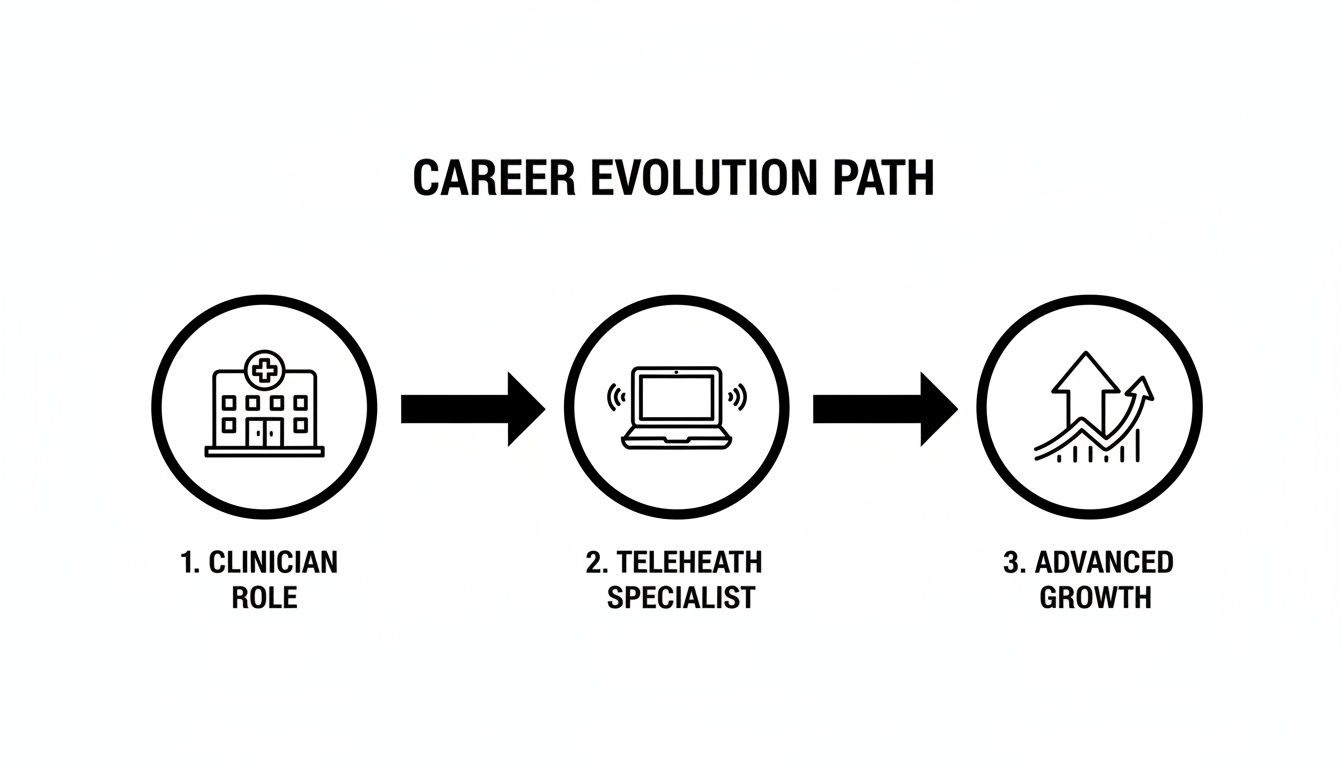
As you can see, a solid clinical foundation is the launchpad for a long and successful career in the telehealth space.
Building Your Telehealth Skill Set
To truly excel in a remote role, you'll need to sharpen a few key skills that go beyond your licenses. To get you started, here’s a quick-reference table summarizing what top telehealth employers are looking for in 2026.
Essential Credentials and Skills for Remote NPs
| Requirement | Description | Pro Tip |
|---|---|---|
| Multi-State License | An NLC license is the gold standard, giving you access to jobs in 41+ participating states. | If you’re in a non-compact state, start by getting licensed in high-population states like California, Texas, and Florida to maximize your options. |
| Webside Manner | The ability to build rapport, show empathy, and communicate clearly through a screen. It's the virtual equivalent of bedside manner. | Record yourself doing a mock patient encounter. Watch for your tone, eye contact with the camera, and whether you appear engaged and empathetic. |
| Tech Proficiency | Comfort using various EMRs, secure video platforms (like Doxy.me or Zoom for Healthcare), and digital communication tools. | Mention specific EMRs you've used (Epic, Cerner, Athenahealth) on your resume. This is a concrete skill employers look for. |
| HIPAA-Compliant Workspace | A private, dedicated home office that ensures patient confidentiality. | During video interviews, ensure your background is professional and uncluttered. This demonstrates you understand the importance of a proper virtual clinic environment. |
Having these credentials and skills ready to go proves you understand that a remote NP role is a serious clinical position demanding professionalism, autonomy, and a deep respect for patient privacy.
Your physical workspace, in particular, is a critical piece of the puzzle. It’s not enough to just find a quiet room.
You must set up a dedicated, HIPAA-compliant home office. This means having:
- A private room with a door that closes to ensure conversations can't be overheard.
- A secure, password-protected Wi-Fi network. Don't use public or shared networks.
- A professional, neutral background for all video calls.
- A computer with up-to-date antivirus and security software.
When you can show an employer you’ve already sorted out your licenses, mastered the tech, and built a professional home clinic, you’re not just another applicant. You're a prepared professional ready to deliver high-quality care from day one.
Crafting a Resume That Stands Out to Telehealth Recruiters
 Your resume for a remote nurse practitioner job can't just be a copy-paste of your clinical CV. It needs to tell a very specific story: that you have the clinical chops, tech fluency, and self-direction to thrive without someone looking over your shoulder.
Simply listing your bedside skills won't cut it. You have to actively translate your hands-on experience for the virtual world.
First things first, your resume has to make it past the robots. Most large telehealth companies use Applicant Tracking Systems (ATS) to filter candidates. Before a human ever sees your application, a machine scans it for keywords and proper formatting. It's a frustrating reality, but you can learn to beat it. Check out these ATS-friendly resume tips to make sure you’re not getting screened out before you even start.
Once your resume is in a recruiter’s hands, the language you use is everything. You need to reframe your clinical background to highlight your readiness for a digital health role.
Translate Your Experience for Telehealth
Go through your current resume, line by line. Think about how your day-to-day tasks prove you're ready for a remote position. Don't just list what you did; frame it with telehealth-specific keywords and, whenever possible, quantifiable results.
For instance, a standard resume bullet point probably looks something like this:
- Before: Provided patient education on chronic disease management.
That’s fine for a hospital job, but it’s invisible to a telehealth recruiter. Let’s rephrase it to highlight your virtual skills:
- After: Conducted virtual patient education sessions for individuals with diabetes and hypertension, improving medication adherence by 15% through secure video consultations.
See the difference? The "after" version proves you can get measurable results in a remote setting. It’s specific and powerful.
Your resume should act as a bridge between your hands-on clinical background and the specific demands of virtual care. Every bullet point is an opportunity to show you’re not just a great NP, but a great telehealth NP.
Weaving in Keywords and Key Qualities
Recruiters use specific keywords to find qualified candidates for a remote nurse practitioner job. You need to sprinkle these terms throughout your resume to show you speak the language.
Here are a few high-impact phrases to work in:
- Asynchronous Care Management: This is a big one. It describes managing patient cases via secure messaging or patient portals—without a live interaction. It shows you can work efficiently.
- Digital Health Platform Proficiency: Don't just say you're "tech-savvy." List the specific EMRs, telehealth platforms (like Doxy.me or Teladoc), and communication tools you’ve actually used.
- Remote Patient Monitoring: If you have any experience tracking patient vitals from a distance using connected devices, make sure that’s front and center.
Finally, your cover letter is your chance to connect the dots. This is where you can show your personality and explain why you're drawn to virtual care. Talk about your passion for new care delivery models or your desire for better work-life integration. It shows you're not just looking for any job, but the right job.
For a deeper dive into what employers are looking for, explore the different types of telehealth nurse practitioner jobs available. Understanding the landscape will help you tailor your application even more effectively.
Finding Remote Jobs That Align With Your Life
Finding the right remote nurse practitioner job isn’t just about the salary or title. It's about finding a role that actually fits into your life, supports your well-being, and helps you hit your financial targets.
This means your search strategy needs to be less about casting a wide net and more about surgical precision. Generic job boards just don't cut it—they bury you in roles that are a terrible fit, wasting your time and energy. Specialized platforms built for clinicians are where you can finally filter for what actually matters.
Using Advanced Filters to Pinpoint Your Ideal Job
Imagine being able to instantly screen out every job that requires on-call hours or weekend shifts. It's a game-changer. On WeekdayDoc, you can use dedicated filters like "No Call" and "No Weekends" to cut through the noise and focus only on positions designed for a better work-life balance.
This is what that looks like in practice.
Notice you can select your preferred work style, like "Remote," right alongside those crucial lifestyle criteria. This level of control means you stop sifting and start applying to jobs that are a real possibility.
To get a feel for the market, you can search for available remote NP jobs and see what employers are currently offering. But the key is to make these platforms work for you by using specific filters to narrow the field.
Looking Beyond the Job Description
A job listing is just the highlight reel. To figure out if a role will protect you from burnout, you need more than a simple description. This is where objective data comes in.
Metrics like WeekdayDoc's proprietary Burnout-Friendly Score are invaluable. This score assesses a role’s potential impact on your well-being before you even apply, giving you a crucial data point that a standard job post will never provide.
When you can assess burnout risk and salary potential upfront, you shift from being a reactive job seeker to a proactive career strategist. You're no longer just applying; you're making a calculated decision based on clear data.
This strategic approach is just as important for your financial goals. Demand for remote NPs varies wildly across the country, with certain markets offering far more competitive salaries.
For instance, California is a top state for nurse practitioners, boasting an average NP salary of $173,190 and around 2,500 annual job openings. The beauty of telehealth is that you can often serve patients in high-demand states while living in a lower-cost area, optimizing both your income and your quality of life.
Using platforms that offer transparent salary data and state-by-state comparisons gives you the leverage to find roles that meet your financial needs. Armed with this information, you can negotiate with confidence and secure a position that truly supports the life you want to live.
You can explore more roles with a strong work-life balance on our platform.
Mastering the Virtual Interview and Salary Negotiation
 So your resume landed you an interview. Congratulations. Now for the hard part—acing a telehealth interview, which is a completely different beast than meeting in person.
It’s no longer just about what you say. It's about how you project confidence, empathy, and clinical authority through a camera lens.
Think of your screen as the new exam room. Your background needs to be clean and professional. Your lighting should be bright and clear, and your audio crisp. These aren't just technical details; they’re a direct signal to employers that you understand how to create a professional virtual care environment.
Beyond the tech, your "webside manner" is everything. This is the new bedside manner. It means looking directly into the camera to make eye contact, using active listening cues like nodding, and speaking with clarity. Interviewers are watching to see if you can build rapport and trust without being in the same room.
Preparing for Telehealth-Specific Questions
Interviewers need to know you can handle the unique challenges of a remote nurse practitioner job. They will ask questions designed to test your autonomy, problem-solving skills, and clinical judgment in a virtual setting.
Get ready to field questions like these:
- How do you manage a patient encounter when their internet connection is unstable and you need to assess a physical symptom?
- Walk me through a time you had to build trust with a patient who was skeptical of a virtual visit.
- What’s your system for staying organized and managing your schedule while working from home?
The trick is to use the STAR method (Situation, Task, Action, Result) to frame your answers as compelling stories. Don't just say you're an excellent communicator. Tell them about a challenging virtual consult you navigated successfully. This gives them concrete proof of your abilities.
Your interview is your first real chance to prove you can operate as an independent, tech-savvy clinician. Every answer should reinforce your capacity to deliver top-tier care without someone looking over your shoulder.
Negotiating Your Worth with Confidence
Once the offer comes through, the conversation turns to compensation. This is where you need to come prepared with solid data—it’s your single biggest advantage.
The market for remote NP roles has become extremely competitive, and salaries reflect that.
As of 2026, the latest salary figures show remote NPs pulling in an average of $130,295 per year. And if you’re in a specialized field, that number climbs even higher. Remote clinical research NPs, for example, earn an average of $151,807 annually. You can dig into more of these trends with recent ZipRecruiter data.
When you have these numbers in hand, you can negotiate from a position of strength. But don't stop at the base salary. A strong negotiation should also cover the total package:
- Sign-on bonuses: This is especially relevant if you already hold multiple state licenses that the company needs.
- Licensure reimbursement: The company should cover costs for any new state licenses they require you to get.
- Continuing education funds: Essential for maintaining your credentials and staying current.
- Home office stipend: A must-have to cover internet, equipment, and other remote work expenses.
By treating the salary negotiation like a data-driven business discussion, you position yourself to secure a package that truly reflects your market value and sets you up for financial success.
Your Questions About Remote NP Careers Answered
Even after you've decided a remote NP role is the right move, a dozen new questions can pop up. It’s completely normal to have some lingering "what ifs" before making a big career change.
Let's cut through the noise and tackle the most common questions I hear from NPs ready to go remote.
Can I Get a Remote NP Job as a New Graduate?
This is the big one, and the honest answer is: it’s tough, but not impossible. Most remote employers want to see 1-2 years of direct clinical experience. They need to know you have the confidence and independent clinical judgment to work without someone down the hall.
That said, the landscape is shifting. Some larger telehealth companies are finally building out remote residency and fellowship programs. These are specifically designed to give new grads the structured mentorship they need to succeed virtually.
If you’re a new grad aiming for a remote role, your application has to be flawless. Here's how to stand out:
- Lean into your preceptorships. Go into detail about any experiences that involved virtual patient communication or required you to make autonomous decisions.
- Emphasize your tech fluency. List every single EMR, telehealth platform, and digital health tool you’ve ever touched.
- Show you've done the homework. Use your cover letter and interview to prove you understand the telehealth model and are genuinely passionate about its potential.
Your best bet as a new grad is to target those bigger telehealth organizations that have the infrastructure to support new clinicians.
How Do I Handle State Licensing for a National Company?
Navigating state licensing feels daunting, but it’s manageable if you have a clear plan. Your first step is always getting licensed in your home state. After that, your single most valuable credential is a multi-state license.
If you live in a Nurse Licensure Compact (NLC) state, getting your compact license should be your #1 priority. It immediately qualifies you to practice in all other NLC states, making you a top-tier candidate for national companies.
For NPs in non-NLC states, you’ll have to apply for licensure by endorsement for each state where a potential employer needs coverage. It sounds like a mountain of paperwork, but many companies have teams that walk you through the entire process.
Better yet, a good number of them will cover all the associated fees as part of your hiring package. Make sure to ask about this during your negotiation.
What Are the Biggest Challenges of Working Remotely?
A remote nurse practitioner job offers incredible freedom, but it comes with its own set of challenges. The issues I see most often are professional isolation, the difficulty of building rapport through a screen, and the slow creep of work into your personal life.
The key is to be proactive from day one.
- Build Your Virtual Water Cooler: Don't wait for community to find you. Actively join online NP forums, find professional groups on social media, and participate in any company-sponsored social channels.
- Master Your Webside Manner: Building patient trust virtually is a skill. Practice your on-camera presence, learn to read non-verbal cues through a screen, and be intentional about creating a connection.
- Draw Hard Lines: A dedicated office with a door you can close is non-negotiable. So are firm start and end times for your workday. This is the single most important thing you can do to protect yourself from burnout.
Are Part-Time or Flexible Remote NP Jobs Available?
Absolutely. In fact, this is one of the biggest draws of telehealth. The rise of asynchronous care (like chart reviews and patient messaging) and on-demand virtual urgent care has created a huge market for flexible work.
Many companies now build their entire staffing model around part-time, per-diem, and non-traditional schedules. When you're searching, use specific keywords like "part-time," "flexible schedule," or "asynchronous" to zero in on these roles.
Ready to find a job that respects your time and expertise? WeekdayDoc is built for clinicians like you. We filter out the burnout and show you only the roles that fit your life, complete with salary data and "No Call" markers. Start your search for a better career today at https://www.weekdaydoc.com.