Physician Curriculum Vitae for Work-Life Balance
Craft a physician curriculum vitae that highlights your value for remote, no-call, and burnout-conscious roles. Get expert tips, examples, and templates.

53% of physicians reported burnout, and 62% named long hours and administrative burden as top drivers according to a 2023 Medscape survey cited in the University of Cincinnati medical CV workshop resource. That same resource notes 2025 data showing 40% growth in telehealth job postings explicitly advertising "no weekends/no call". The problem is obvious. Most physician curriculum vitae advice still trains doctors to market themselves for academic prestige, not sustainable work.
https://med.uc.edu/docs/default-source/medical-student-education/medical-student-research-imgs/uccom-medical-cv-workshop.pdf?sfvrsn=79bcae3e_0
If you're trying to move into remote, hybrid, telehealth, outpatient, or no-call work, your CV can't read like a tenure packet. It has to show that you deliver excellent care efficiently, reliably, and without needing chaos to prove your worth.
I've seen this repeatedly in career transitions. Good physicians undersell the exact traits that balanced employers value most. They list publications, committees, and every training detail, then bury the facts that matter for modern roles: telehealth competence, documentation efficiency, patient communication, workflow design, cross-state licensure, schedule stability, and mature judgment in lower-drama settings.
A strong physician curriculum vitae should help you get a better job and a better life. Not just another badge of endurance.
Why Your Academic CV Is Hurting Your Job Search
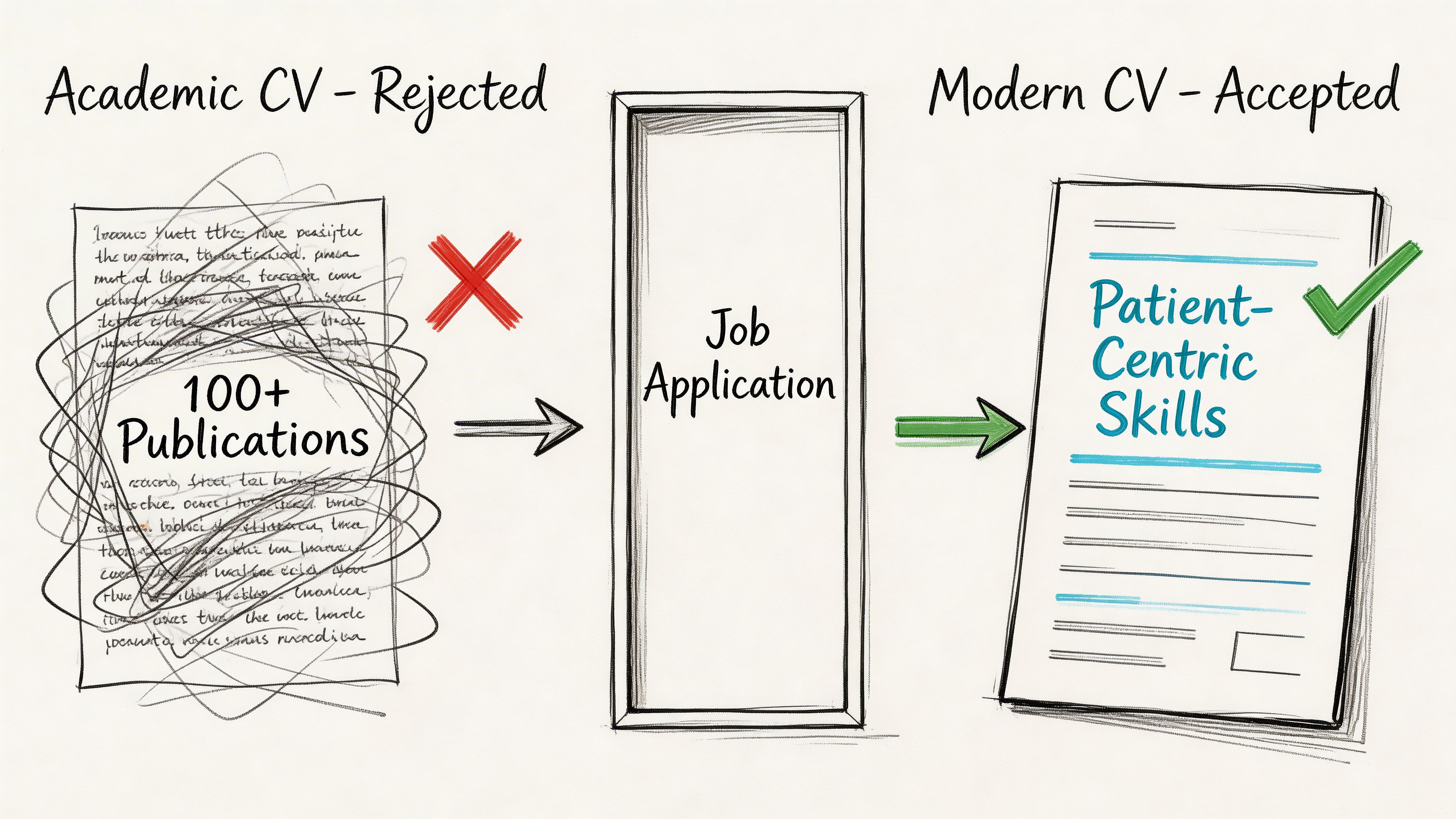
A traditional academic CV sends one message very clearly: I can take on more.
That works when a department chair wants grants, publications, lectures, and committee labor. It works far less well when a medical group wants a physician who can manage a clean outpatient panel, communicate well on video, document efficiently, and preserve team stability without needing constant heroics.
The signal most balanced employers read
Many physicians assume "more detail" always helps. It doesn't.
For weekday-only, no-call, and remote-friendly roles, a bloated CV can imply the wrong fit. Recruiters may read it as:
- Academic-first identity rather than patient-flow practicality
- Prestige orientation rather than operational reliability
- General busyness rather than focused value
- Poor prioritization if key strengths are buried under low-relevance detail
That mismatch matters because the market has changed. The University of Cincinnati medical CV workshop resource highlights both the burnout reality and the growth of telehealth postings that explicitly advertise schedule protection. Standard CV guidance still doesn't explain how to frame a career around reducing those pain points.
https://med.uc.edu/docs/default-source/medical-student-education/medical-student-research-imgs/uccom-medical-cv-workshop.pdf?sfvrsn=79bcae3e_0
Your CV shouldn't say, "I survived the worst system." It should say, "I know how to practice well in a sustainable one."
What traditional CV advice misses
Classic physician CV advice is built around academic progression. That's useful if you're applying for faculty appointments, fellowship, grants, or research-heavy roles.
It's incomplete if you're pursuing telemedicine, hybrid care, locums with schedule control, or outpatient jobs designed to avoid call and weekend creep. Those employers often care more about consistency than prestige.
They want evidence that you can:
- Work independently without becoming isolated
- Use digital tools well instead of fighting them
- Communicate clearly across remote teams
- Maintain quality without glorifying overwork
- Fit the work style of a calmer practice model
If you're early in training, a resource on building a medical school CV can help with the fundamentals. But once you're pursuing lifestyle-aligned physician jobs, you need a different lens.
For physicians actively exploring better-fit roles, this guide to the physician job search is useful: https://www.weekdaydoc.com/resources/physician-job-search
The old flex isn't the new fit
Academic CVs reward accumulation. Balanced employers reward relevance.
That's the shift. Stop writing a physician curriculum vitae that proves you can do everything. Start writing one that proves you can do the right work, in the right setting, without burning out yourself or the team.
The Burnout-Conscious CV Framework
The cleanest physician curriculum vitae usually wins the first review. Not because it's simplistic, but because it respects how recruiters read.
Experts recommend a core structure of up to 19 categories, including personal information, education, USMLE scores, honors, experience, publications, and certifications. They also recommend excluding personal details such as Social Security Number, age, or marital status for professionalism.
https://resources.nejmcareercenter.org/article/creating-a-physician-cv-that-shines/
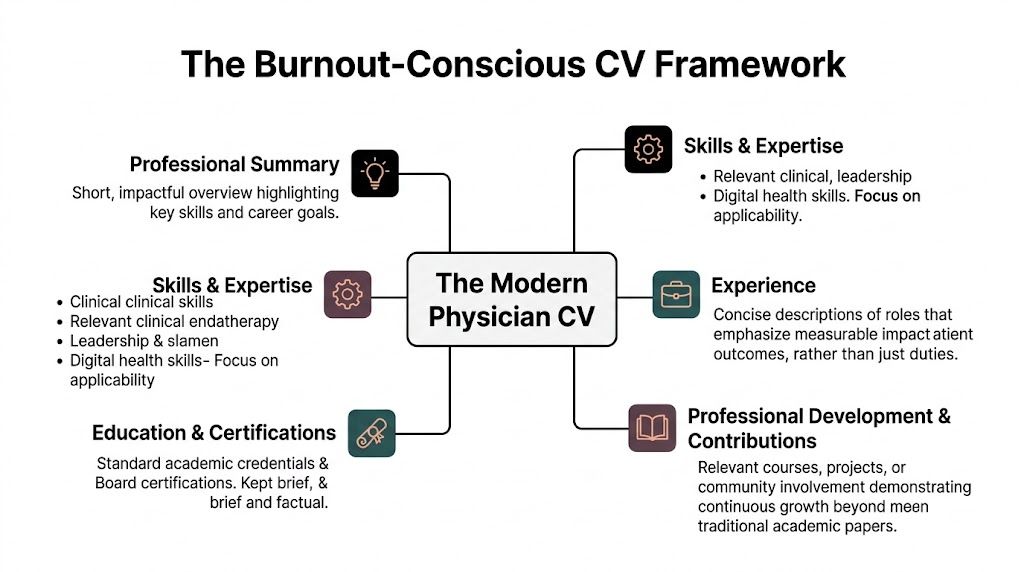
Start with a modern top block
Your header should be plain, professional, and fast to parse.
Include:
- Name and credentials such as MD, DO, PA-C, NP, PsyD, or PhD
- Phone and professional email
- City and state
- Licensure footprint if multi-state practice is relevant
- LinkedIn or professional profile only if it's current and polished
Leave out anything that invites bias or wastes space. Your birthdate, marital status, photo, and SSN don't belong there.
Add a professional summary that screens for fit
Here, a burnout-conscious CV differs.
Most physician summaries are vague. They say things like "dedicated physician with extensive experience in patient care." That tells the reader almost nothing.
A better summary identifies your clinical scope, work style, and operational strengths in a few lines. For example:
Board-certified physician with outpatient and telehealth experience, strong EHR workflow discipline, and a track record of patient-centered care in structured, no-overnight settings. Licensed in multiple states and comfortable collaborating across distributed teams.
That doesn't sound academic. That's the point.
Use sections that support scannability
You don't need every possible category in every application. You need the categories that prove fit.
For non-academic and work-life-balance roles, this structure usually performs well:
- Professional Summary
- Licensure and Board Certification
- Clinical Experience
- Telehealth and Digital Skills
- Education and Training
- Selected Leadership, Teaching, or QI Work
- Publications and Presentations only if relevant
- Languages, volunteer work, or professional memberships if they strengthen the application
What to compress and what to feature
Many physicians struggle with this.
A publication list may matter. It usually doesn't need to dominate page one for a telehealth role. Committee service may matter. It usually shouldn't appear before the reader sees your actual patient-care impact.
Use this rule set:
- Feature first what helps the employer imagine you in the role
- Compress legacy material that proves pedigree but not fit
- Cut anything that adds volume without helping the hiring decision
Practical rule: If a section doesn't help someone say "yes" to your target role, shorten it or move it down.
Formatting choices that help, not distract
A physician curriculum vitae should look calm.
That means:
- Readable font such as Arial
- Consistent spacing
- Clear section headings
- Bullet points with parallel structure
- PDF export before sending
White space matters. Dense blocks make a strong candidate look disorganized.
For most non-academic roles, shorter is usually stronger. Experienced physicians may still need more room, but length should come from relevant substance, not from repeating every historical detail.
Reframe Your Experience Section by Section
The fastest way to improve a physician curriculum vitae is to rewrite experience bullets so they show judgment, efficiency, and outcomes instead of workload theater.
In a competitive market with over 20 applicants per opening, a standout CV matters. The ACOG resource also notes that physicians can differentiate themselves by showing quantifiable impact, including examples such as a 21% decrease in surgeries through treatment plans or 99% patient satisfaction scores.
https://www.acog.org/news/news-articles/2019/11/your-cv-3-tips-and-suggestions-for-writing-one-that-stands-out
Rewrite duties into value
Most physicians describe jobs the way credentialing paperwork does. That's safe, but it's weak.
A hiring team already knows what a primary care doctor, psychiatrist, internist, or urgent care physician is supposed to do. They want to know how you practice.
Compare these:
- "Provided patient care in outpatient clinic."
- "Delivered outpatient care with a focus on continuity, medication simplification, and reduced escalation to procedural care."
The second version tells them something about your style.
Your experience section needs three layers
Each role should answer three questions:
| Layer | What it shows | Example direction |
|---|---|---|
| Scope | What kind of work you handled | outpatient follow-up, telehealth visits, chronic disease management |
| Method | How you worked | efficient documentation, multidisciplinary coordination, protocol design |
| Result | What changed because of your work | satisfaction, workflow improvement, reduced unnecessary escalation |
If one of those layers is missing, the bullet usually feels flat.
Before and after examples
Clinical experience
Before
- Managed patient panel in internal medicine clinic
- Saw follow-up and new patients
- Used EHR for documentation
After
- Managed a longitudinal internal medicine panel with a focus on continuity, preventive care, and medication optimization
- Balanced new and follow-up visits while maintaining a patient-centered communication style
- Built reliable EHR workflows that reduced after-hours charting and improved visit-day efficiency
That last line matters because balanced employers don't just want a good clinician. They want someone who won't generate avoidable friction.
Quality and improvement work
Before
- Participated in quality improvement projects
- Worked with staff to improve clinic processes
After
- Led quality-improvement efforts that improved care pathways and reduced unnecessary procedural escalation
- Coordinated with nursing and administrative staff to streamline clinic operations and improve patient flow
If you have true numbers, use them. If you don't, keep it qualitative and specific.
Patient-centered outcomes
The ACOG examples are useful because they show what "quantifiable impact" can look like in a physician CV.
You might write:
- Developed treatment plans associated with a 21% decrease in surgeries in a relevant patient population
- Maintained 99% patient satisfaction scores in survey feedback
Only include metrics you can support from your own records or formal reporting.
Hiring teams notice when a physician can connect clinical choices to measurable outcomes. They also notice when every bullet sounds generic.
Education and training should support, not dominate
Training matters. But once you're beyond early career, your education section shouldn't crowd out your actual work style.
Keep education factual:
- Degree
- Institution
- Dates
- Residency and fellowship
- Honors if meaningful
Don't pad this section with course descriptions or low-value details. If you're applying for a telehealth-heavy role, your current practice methods matter more than an old anatomy distinction.
Skills should look like practice, not personality
A weak skills section says "team player," "hardworking," and "excellent communicator."
A strong one identifies operating strengths. For example:
- Telehealth platforms and virtual visit workflow
- EHR optimization
- Asynchronous patient communication
- Medication management
- Cross-functional collaboration with APPs, nursing, and care coordinators
- Multistate licensure readiness
- Language fluency
These are easier for recruiters to map to real jobs.
Publications and presentations need triage
For academic roles, publication depth can be central.
For no-call outpatient, hybrid, or telehealth positions, a long publication section can be reduced to "Selected Publications" unless the employer explicitly values scholarship. You aren't erasing your history. You're prioritizing relevance.
A comparison table for real rewrites
CV Entry Transformation Traditional vs. Burnout-Conscious
| Traditional Entry | Burnout-Conscious Entry |
|---|---|
| Managed high patient volume in outpatient clinic | Managed outpatient care with an emphasis on continuity, visit efficiency, and sustainable documentation habits |
| Performed telemedicine visits | Delivered virtual care in a structured telehealth setting with clear follow-up and strong patient communication |
| Participated in multidisciplinary care | Coordinated with behavioral health, nursing, and care management to support lower-friction patient care plans |
| Used EHR for daily documentation | Built repeatable EHR workflows that improved documentation efficiency and reduced after-hours charting |
| Served on wellness committee | Contributed to physician wellness efforts and workflow discussions that supported team sustainability |
| Worked locums assignments | Adapted quickly across practice settings while maintaining continuity standards, communication discipline, and schedule flexibility |
Don't hide balance-oriented achievements
Many physicians leave out the exact work that makes them attractive for sustainable roles.
Include achievements like:
- Process redesign that made care delivery cleaner
- Mentorship that stabilized teams
- Technology adoption that improved workflow
- Patient education systems that reduced repeat confusion
- Wellness or scheduling initiatives that improved team function
Those are differentiators. They signal maturity.
What doesn't work
Some patterns almost always weaken a physician curriculum vitae for balanced roles:
- Exhaustive duty lists that could describe anyone
- Prestige stacking without relevance
- Hero language about being available at all times
- Unexplained shifts in setting or scope
- Soft claims like "compassionate leader" with no evidence
A good test is simple. If your bullet could belong to five hundred other physicians, it's too generic.
Showcasing Telehealth Hybrid and No-Call Expertise
Physicians often assume telehealth or reduced-call work looks less serious on paper. That's backwards. It usually requires tighter communication, cleaner documentation, and more deliberate boundaries than traditional hospital-based work.
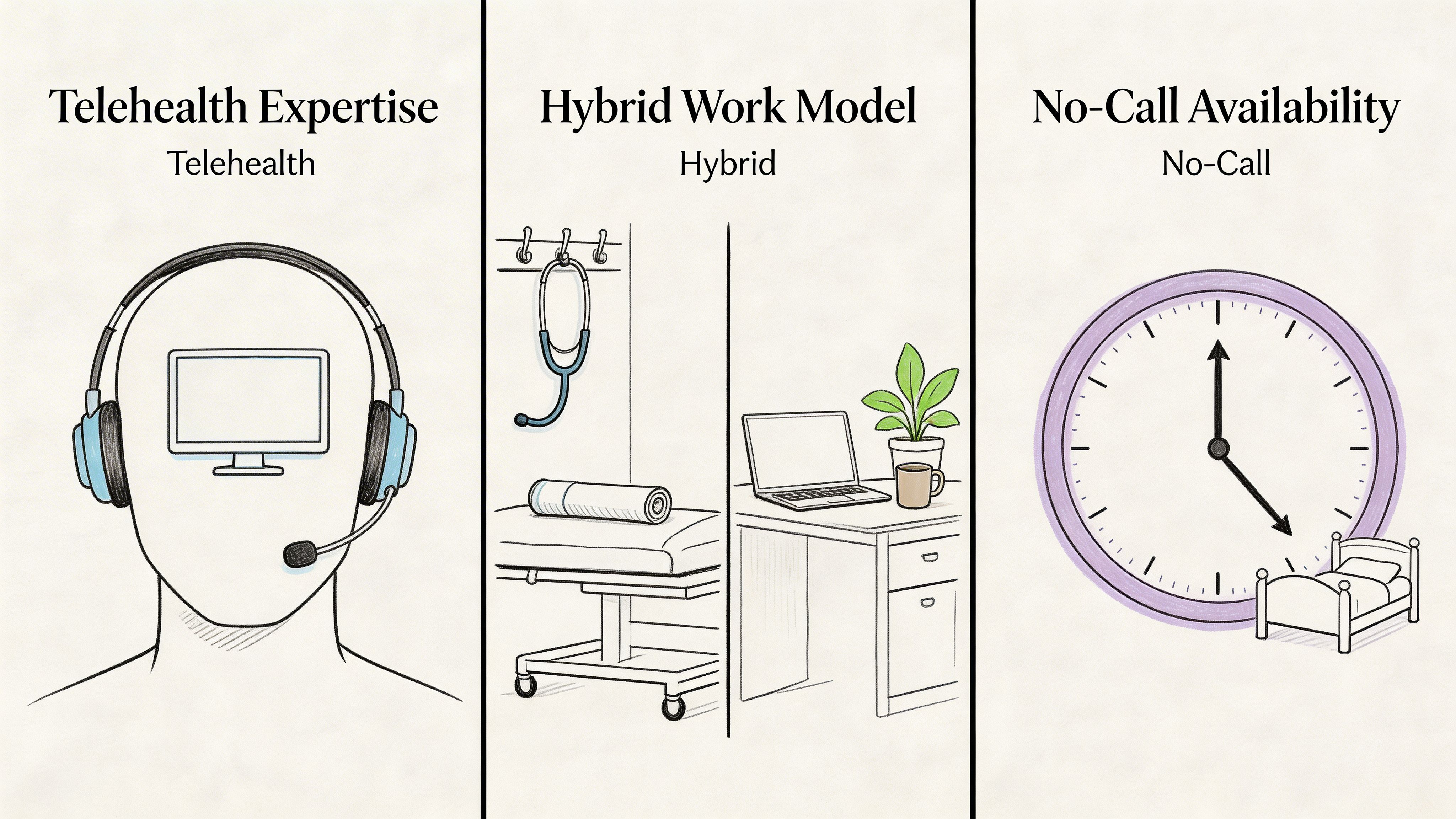
When detailing experience, account for every year and include quantifiable metrics. The ACOEM guidance gives examples such as "Managed 25 PPD in telehealth primary care, optimized EHR reducing documentation time 20%". It also states that properly formatted and detailed CVs can increase interview callbacks by 40-60%, while incomplete or vague documents lead to a 70% upfront rejection rate.
https://careers.acoem.org/blog/oem-explore-resources-2/the-five-most-important-components-of-your-physician-cv-70
A telehealth role should sound operationally strong
Many doctors write telehealth entries too thinly:
- Conducted virtual visits
- Managed remote patients
- Worked from home
That language sounds casual. The work isn't.
A stronger version shows structure:
- Managed 25 PPD in telehealth primary care while maintaining clear escalation pathways and consistent follow-up
- Optimized EHR workflows, reducing documentation time by 20%
- Collaborated with remote clinical and administrative teams to maintain continuity across virtual care episodes
That kind of wording tells the reader you weren't just present on video. You practiced effectively in that model.
Hybrid work needs framing, not apology
Hybrid experience can look fragmented if you don't explain it.
Say what the split looked like in functional terms. For example:
- Outpatient physician in hybrid role combining in-person follow-up, virtual medication management, and asynchronous patient communication
- Coordinated care transitions between clinic-based and remote encounters to reduce duplication and preserve continuity
That shows intentionality. It doesn't read like you drifted between formats.
No-call experience should be positioned as discipline
Some physicians worry that "no call" sounds less committed. It doesn't when you frame it correctly.
No-call work often signals:
- Better boundary management
- Stronger handoff discipline
- Better alignment with outpatient continuity
- Lower risk of chronic schedule disruption
Write it in terms of care design, not lifestyle preference alone.
Balanced work isn't evidence of lower standards. It's evidence that the role and the physician are matched well.
A useful reference point for clinicians exploring this path is this guide to telemedicine roles for doctors: https://www.weekdaydoc.com/resources/telemedicine-jobs-for-doctors
Locums and career shifts can be assets
A gap, locums period, or reduced-hours stretch often scares physicians more than recruiters.
What matters is whether you explain it with confidence and specificity.
A locums entry can highlight:
- Adaptability across systems
- Fast integration into new workflows
- Broad EHR exposure
- Independent judgment
- Deliberate career recalibration
A career break can be framed around caregiving, relocation, health recovery, further training, consulting, volunteer work, or intentional transition planning. Keep it brief. Keep it factual.
This walkthrough is worth watching before you finalize those entries:
Add a dedicated telehealth and work-style subsection
If you're targeting remote, hybrid, or structured outpatient jobs, create a subsection that makes those competencies impossible to miss.
Use bullets like:
- Telehealth operations: virtual intake, medication follow-up, chronic disease management, escalation protocols
- Digital workflow: EHR efficiency, inbox management, asynchronous communication, remote documentation discipline
- Practice style: no-call outpatient care, team-based coordination, continuity-focused scheduling
- Logistics: multi-state licensure, home office readiness if relevant, comfort across distributed teams
This is especially useful if your main experience section was built in a more traditional era and doesn't naturally highlight modern practice modes.
Passing the ATS and Recruiter Review
A polished physician curriculum vitae can still fail if the system can't parse it or the recruiter can't find the answer fast enough.
Many excellent candidates lose momentum at this stage. Not because they lack qualifications, but because they make the document harder to read than it needs to be.
ATS doesn't reward creativity in formatting
Applicant Tracking Systems prefer standard structure.
If you use unusual columns, graphics, text boxes, or overdesigned templates, key information may get scrambled or missed. Healthcare hiring systems are especially unforgiving about this.
Use standard headings like:
- Professional Summary
- Licensure and Certifications
- Clinical Experience
- Education and Training
- Skills
If you want a non-medical explanation of the basics, this primer on creating an ATS Compliant Resume is helpful for understanding how these systems read documents.
Recruiters scan for fit, risk, and clarity
A human reviewer usually isn't reading every line first. They're checking for three things very quickly:
| What they scan for | What they want to confirm | What hurts you |
|---|---|---|
| Fit | specialty, setting, schedule alignment, licensure | generic summary, wrong emphasis |
| Risk | unexplained gaps, inconsistent dates, vague scope | missing years, messy chronology |
| Clarity | easy formatting, visible outcomes, clean headings | dense text, long paragraphs, clutter |
If you're applying to a no-call telehealth role, but page one leads with old research abstracts, you've made the recruiter work too hard.
Keyword use should be literal and accurate
For ATS screening, use the language employers post.
That may include terms like:
- telehealth
- telemedicine
- outpatient
- remote patient care
- hybrid
- board certified
- multi-state licensure
- behavioral health integration
- EHR
- quality improvement
Don't stuff terms unnaturally. Put them where they are true.
The mistakes that trigger fast rejection
These are the common failures I see in physician CVs for modern roles:
- Dates that don't line up and leave obvious gaps
- Vague job descriptions with no scope or result
- Too much legacy detail ahead of current relevance
- Missing practice-style clues for remote or balanced roles
- Formatting inconsistency across headings, bullets, or spacing
- Poor file naming such as FinalCV2reallyfinal.pdf
A recruiter shouldn't have to infer that you're a good fit for a structured, sustainable role. Your document should make that obvious.
For a useful checklist of what employers ask for, review physician job requirements here: https://www.weekdaydoc.com/resources/physician-job-requirementsweekdaydoc.com/resources/physician-job-requirements
Your file should answer the first five questions
Before sending your CV, confirm that page one answers these:
- What kind of clinician are you?
- What setting do you work in best?
- Are you licensed and current?
- What outcomes or strengths make you useful?
- Why are you relevant for this specific role?
If any answer is buried, revise.
Physician CV FAQs and Your Next Steps
A physician curriculum vitae doesn't need to be louder. It needs to be clearer.
The best version shows your capability and your judgment about where you work well. That represents a major shift for physicians trying to protect their time, energy, and longevity in practice.
How do I handle a non-clinical career gap on my CV
Name it briefly and directly.
Use a simple line with dates and a factual description such as consulting, caregiving, relocation, health leave, education, or transition planning. If you maintained licensure, CME, volunteer work, or part-time clinical activity, include that.
Don't write a defensive essay. Don't leave the period blank either.
Is a one-page CV ever acceptable for a physician
Sometimes, but usually only for very early-career clinicians or for highly targeted applications where a shorter resume-style document is specifically requested.
Most physicians need more than one page because training, licensure, and experience take space. Still, brevity matters. If your document runs long, make sure every section earns its place.
Should I include salary expectations or FIRE goals
Not on the CV.
Compensation goals belong in later conversations, application fields, or negotiation. Personal financial goals definitely don't belong in the document, even if they are guiding your search.
Your CV should show the kind of work arrangement where you perform well. It shouldn't read like a personal finance memo.
Do I need publications if I'm leaving academia
Only if they strengthen the application.
For many outpatient, telehealth, hybrid, and no-call jobs, a short selected list is enough. If publications aren't helping the hiring decision, reduce them.
Should I mention that I want work-life balance
Not as a slogan.
Show it through fit signals:
- sustainable outpatient work
- telehealth operations
- efficient documentation
- strong handoffs
- no-call or limited-call environments
- long-term continuity
- team stability
That reads as professional judgment, not as avoidance.
What should I do today if my current CV is a mess
Start with a practical reset:
- Cut first: remove outdated, repetitive, or low-value material
- Reorder second: move relevant clinical and telehealth evidence higher
- Rewrite third: turn duties into outcomes and methods
- Check chronology: account for every year
- Export cleanly: save as a PDF with a professional filename
If you use tools during your search, keep them simple. A plain document editor, Grammarly for surface cleanup, and a trusted colleague for review are usually enough. If you're evaluating actual roles, WeekdayDoc provides a physician-focused job platform with remote, hybrid, and in-person listings marked for work style such as no call and no weekends, along with salary data and FIRE projections.
The real next step
Don't wait until you're desperate to fix your CV.
A strong physician curriculum vitae provides an advantage before burnout gets worse. It helps you apply selectively, interview from a position of clarity, and move toward work that fits your life instead of consuming it.
If you're ready to turn your CV into a tool for a more sustainable career, browse WeekdayDoc for burnout-conscious roles and practical job-search resources built for clinicians who want protected time, clearer schedules, and work that still feels worth doing.