Finding Telemedicine Jobs for Doctors a Guide to Flexible Roles
Explore top telemedicine jobs for doctors. Learn about specialties, licensing, pay, and how to find flexible, burnout-friendly remote physician roles.

For doctors feeling the squeeze of traditional practice, telemedicine isn't just a trend—it's a lifeline. It represents a fundamental shift away from the rigid, high-pressure environments that have become the norm, offering a chance to practice medicine on your own terms. These roles let physicians care for patients from anywhere, often reclaiming control over their schedules and dramatically cutting down on the administrative grind.
The New Era of Medicine and What It Means for Doctors
The demand for virtual care has absolutely exploded, creating a whole new job market for physicians who are tired of the old way of doing things. This isn't just about cool new technology; it's a direct answer to the burnout crisis that's pushing so many talented doctors to their limits. Physicians are actively hunting for roles that let them love their work again, without sacrificing their personal lives.
This massive need for sustainable careers has carved out a new niche for burnout-friendly jobs. These aren't just remote positions; they are intentionally designed to support a healthier work-life balance. For most doctors, that boils down to a few key things:
- More Control: The power to decide your own hours or work entirely from home.
- Reduced Stress: Saying goodbye to a soul-crushing commute and the constant chaos of a busy clinic.
- Focused Patient Care: Actually spending your time on medicine—diagnosing and treating patients—instead of drowning in paperwork.
The appeal is obvious. A career in telemedicine is a chance to get your autonomy back, to align your professional life with your personal well-being. It’s a complete reimagining of what a fulfilling, long-term medical career can look like.
Before we dive into the specifics of finding a great telemedicine role, here's a quick overview of what the landscape looks like for physicians today.
Telemedicine Job Landscape at a Glance
This table breaks down the key aspects of telemedicine roles, from the types of jobs available to compensation and licensing, so you can quickly get a sense of the opportunities.
| Aspect | Key Details | Why It Matters for Doctors |
|---|---|---|
| Job Types | Full-time, part-time, locum tenens, and hybrid models are all common. | Offers flexibility to match your career stage, from a full-time role to a side gig. |
| Specialties | High demand in Primary Care, Mental Health, Urgent Care, and Dermatology. | You can often find a role that fits your existing specialty and clinical interests. |
| Licensing | Typically requires a license in the state(s) where patients are located. | State compacts (like the IMLCC) are making multi-state licensing much easier. |
| Compensation | Competitive salaries, often with hourly or per-consult payment models. | You can maintain or even increase your income while improving your quality of life. |
| Schedule | Often asynchronous (chart review) or synchronous (live video calls) with flexible hours. | This is the key to escaping the rigid 9-to-5 and eliminating nights, weekends, or on-call. |
The Financial and Career Advantages
Putting lifestyle benefits aside for a moment, the numbers are compelling. The market for remote physician jobs is not just growing; it's financially rewarding. Average annual salaries have hit $239,485, with top earners clearing $320,000 a year. It's clear that a move to virtual care doesn't mean taking a pay cut.
This guide will walk you through everything you need to know to find your footing on this modern career path. We'll cover all the essentials, from licensing and malpractice to compensation models and, most importantly, how to spot the burnout-friendly jobs that will truly fit your life. For a deeper dive into the basics, it's also worth reading up on the fundamentals of telemedicine.
A Day in the Life of a Telemedicine Doctor
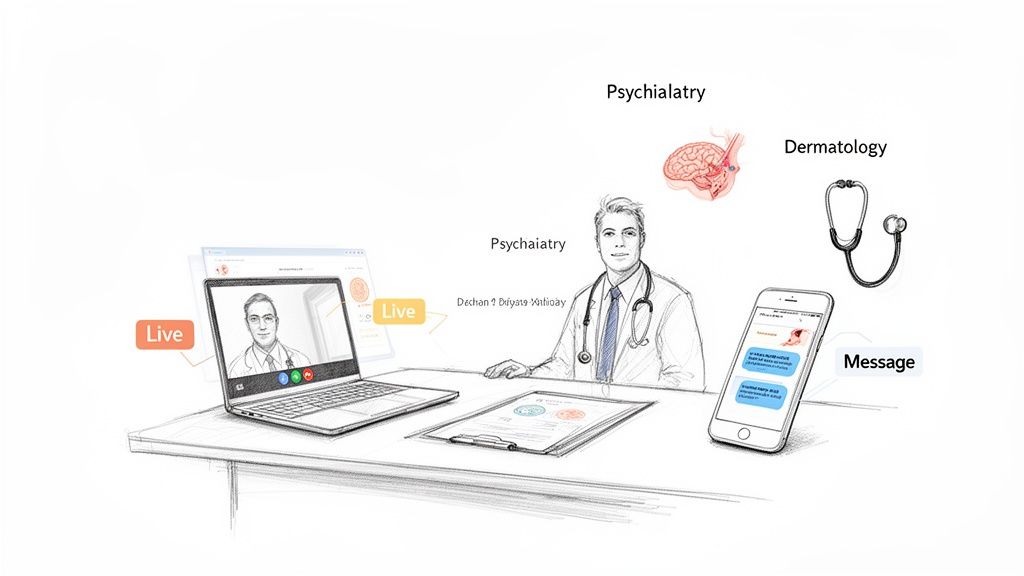
The dream of practicing from a home office is powerful, but what does it actually look like day-to-day? The reality is that telemedicine jobs for doctors aren't a monolith. Your daily workflow hinges entirely on the type of care you provide and how you're employed.
Think of it like being a TV personality. You could be a live talk show host, reacting in real-time, or a meticulous documentary editor, piecing together a narrative on your own schedule. Both require deep expertise, but the rhythm and energy are worlds apart.
Your day will usually fall into one of two buckets, each with a feel that attracts different personalities and clinical styles.
Synchronous vs. Asynchronous Care
When most people hear "telemedicine," they picture synchronous care. This is the live show. It’s real-time video or phone calls that directly replace a traditional office visit. This model is perfect for consultations where seeing a patient's expression or having a quick back-and-forth is critical.
The alternative is asynchronous care, which works more like a secure, high-stakes messaging app. Patients submit their history, symptoms, and photos through a portal. You then review their case and send back a diagnosis and treatment plan when it works for you. This "store-and-forward" approach is incredibly efficient for specialties where a live chat isn't always necessary.
It's really just the difference between a phone call and an email. Synchronous care is the phone call—immediate, interactive, and happening right now. Asynchronous is the email—it lets you be thoughtful and flexible, responding when you have the time to focus.
Top Specialties for Virtual Practice
While almost every field is finding ways to incorporate virtual care, some specialties are a near-perfect fit for the screen. These fields tend to lean heavily on patient history, visual exams, or counseling, making the jump from clinic to laptop feel surprisingly natural.
- Psychiatry: Therapy and medication management work exceptionally well over video, giving patients much-needed privacy and convenience.
- Dermatology: With high-resolution smartphone photos, many common skin conditions can be accurately diagnosed asynchronously, saving everyone a trip to the office.
- Primary Care & Urgent Care: A huge chunk of cases—from triage and prescription refills to follow-ups for stable conditions—can be handled effectively with a video call.
- Radiology: Teleradiology has been the standard for years. It was one of the original "work from anywhere" physician gigs.
Employment Models from Full-Time to Flexible
Your daily routine is also shaped by your employment contract. A full-time, salaried telemedicine job often mirrors a traditional practice. You'll have set clinic hours and a schedule of patients you see via video from your home office.
On the other hand, many physicians are drawn to the freedom of locum tenens or per-consultation gigs. These roles are often built around asynchronous work, letting you log in and clear your patient queue whenever you want—early in the morning, late at night, or between your kid's soccer games. It gives you the ultimate control to ramp your work up or down to meet your own financial and personal goals.
Navigating Licensing and Malpractice with Confidence
The freedom to practice from literally anywhere is one of the biggest draws of telemedicine, but that freedom comes with a few logistical hurdles. Before you can see patients across state lines from your home office, you have to get the rules of the road down for licensing and medical malpractice.
Getting this stuff right isn't just bureaucratic box-checking; it’s about protecting your career and practicing with total peace of mind.
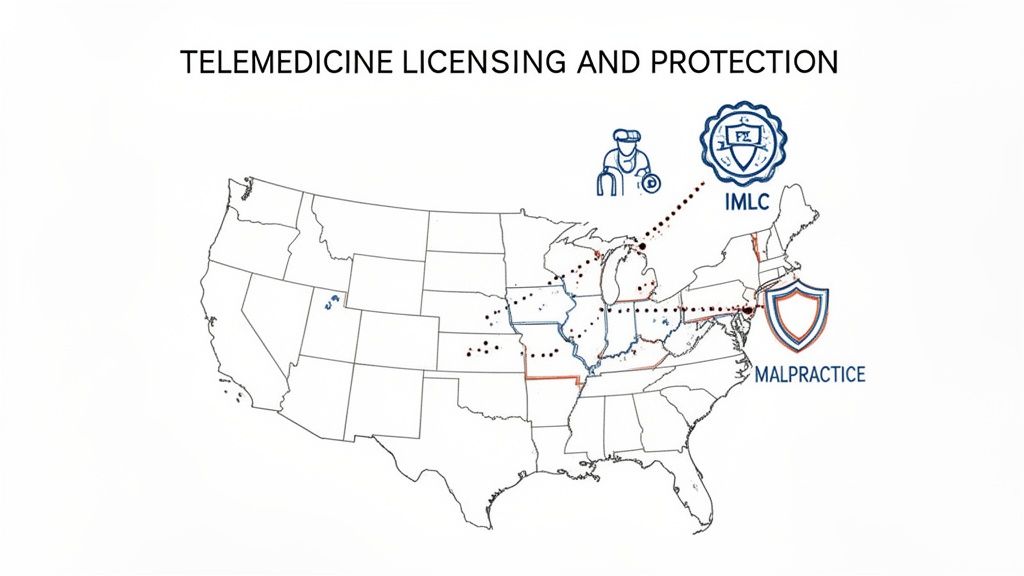
The number one rule is simple: you must be licensed in the state where your patient is physically located during the consultation. At first glance, this sounds like a nightmare of paperwork, making you think you’ll be buried in applications just to practice in a few different states.
Fortunately, it's gotten a whole lot easier.
Streamlining Your Licenses with the IMLC
Think of the Interstate Medical Licensure Compact (IMLC) as a kind of fast-pass for getting medical licenses. It’s an agreement between participating states designed to chop down the time and paperwork for qualified doctors.
If you already have an unrestricted license in one of the 36+ member states, you can use the IMLC to get licensed in other compact states much, much faster than going the traditional route.
This compact is an absolute game-changer for telemedicine. Instead of spending months on individual applications, you can get licensed to practice across a huge geographic area in a fraction of the time. This opens up a far wider pool of job opportunities.
Once your licenses are in hand, the next step is credentialing. This is just the process where a telehealth company verifies your qualifications—your licenses, your training, your work history. It’s the virtual equivalent of getting privileges at a new hospital, but for most telehealth platforms, it's a quicker, all-digital affair.
Protecting Yourself with the Right Malpractice Coverage
This is where you need to pay close attention. Your malpractice policy from a brick-and-mortar practice likely won't cover virtual care, especially if you're seeing patients in multiple states. You absolutely must confirm your coverage is built for telehealth.
When you're evaluating a telemedicine job, get clear answers to these questions about their malpractice insurance:
- Who provides the coverage? Will the company cover you under their policy, or are you on the hook for finding your own? Most large telehealth platforms provide it for their physicians.
- What type of policy is it? Is it a "claims-made" policy, which only covers claims filed while the policy is active? Or is it an "occurrence" policy, which covers any incident that happened during the policy period, no matter when the claim is filed?
- Does it include tail coverage? This is non-negotiable for claims-made policies. If you leave the job, tail coverage protects you from claims that pop up later for care you delivered while you were employed there.
Nailing down these three pillars—licensing, credentialing, and malpractice—is the first real step to building a secure and successful career in telemedicine. It ensures you’re not just compliant, but fully protected as you step into a new way of practicing medicine.
Understanding Telehealth Compensation and Scheduling
Let's get into what really drives the search for telemedicine jobs for doctors: income and lifestyle. The idea of working from home is great, but you need to know how these roles actually measure up financially and how they're structured to fight the burnout so rampant in traditional medicine.
The pay structures in telehealth can be much more varied than a standard hospital salary. It’s a bit like being a freelance writer versus a staff journalist—one offers a predictable paycheck, while the other ties your earning potential directly to your output. Neither is automatically better; it just depends on what you’re looking for.
Common Telemedicine Compensation Models
You'll run into a few main ways of getting paid, each with its own set of trade-offs. Knowing these will help you spot the opportunities that actually fit your financial goals and lifestyle needs.
To make it easier, here’s a quick breakdown of the most common models you'll see.
Common Telemedicine Compensation Models Compared
| Model Type | Typical Structure | Pros | Cons |
|---|---|---|---|
| Salaried | Fixed annual salary with full benefits. | Maximum stability and predictability. Common in full-time roles. | Lower ceiling on earning potential; less flexibility. |
| Hourly Rate | Paid for every hour you're logged in and available for patients. | Great for roles with unpredictable patient flow. Less pressure to hit volume targets. | Pay is capped by hours worked, not efficiency. |
| Per-Consultation Fee | Paid a flat fee for each patient encounter completed. | Highest earning potential for efficient physicians who can manage volume. | Income can be variable and less predictable. Requires consistent patient demand. |
Understanding these models is key. Many physicians find a sweet spot by blending them—for example, taking on some per-consultation work as a way to explore different part-time physician jobs without giving up the security of a primary role.
The Connection Between Scheduling and Sustainability
This is where telemedicine really starts to look like a lifeline for burned-out physicians. The relentless grind of traditional medicine is a huge reason why 55% of U.S. healthcare workers are looking for a new job, with exhaustion and inflexible hours topping the list of complaints. The constant weight of on-call duties and unpredictable schedules just isn't sustainable long-term.
Telemedicine is designed to dismantle that very structure. By its nature, many telehealth roles completely eliminate on-call, nights, and weekends. Your work is contained within your scheduled hours, which means when you log off, you’re actually off.
This predictability isn’t just a nice perk; it's a feature that can save a career. When you regain control over your schedule, you get back the autonomy that’s so often the first thing to go in a demanding clinical job. This control lets you build a practice that supports your life, not one that constantly takes away from it. By choosing jobs with clearly defined hours, you can create a sustainable career that feels rewarding instead of draining.
How to Find and Vet Burnout-Friendly Telemedicine Jobs
Knowing the different pay models is a great start, but finding a role that actually protects your well-being takes a different kind of skill. You have to learn how to read between the lines on job descriptions and ask the right questions to get a real sense of a company's culture.
A genuinely burnout-friendly job is more than just a "No Call" tag. It’s a whole ecosystem built around reasonable patient loads, tech that works for you (not against you), and solid administrative backup. Vague language in a job post is almost always a red flag. If they can't be clear about patient expectations or scheduling, it often signals chaos or a high-pressure environment you want to avoid.
This flowchart can help you map out your job search depending on what you value most right now—be it the security of a steady paycheck or the freedom of a flexible schedule.
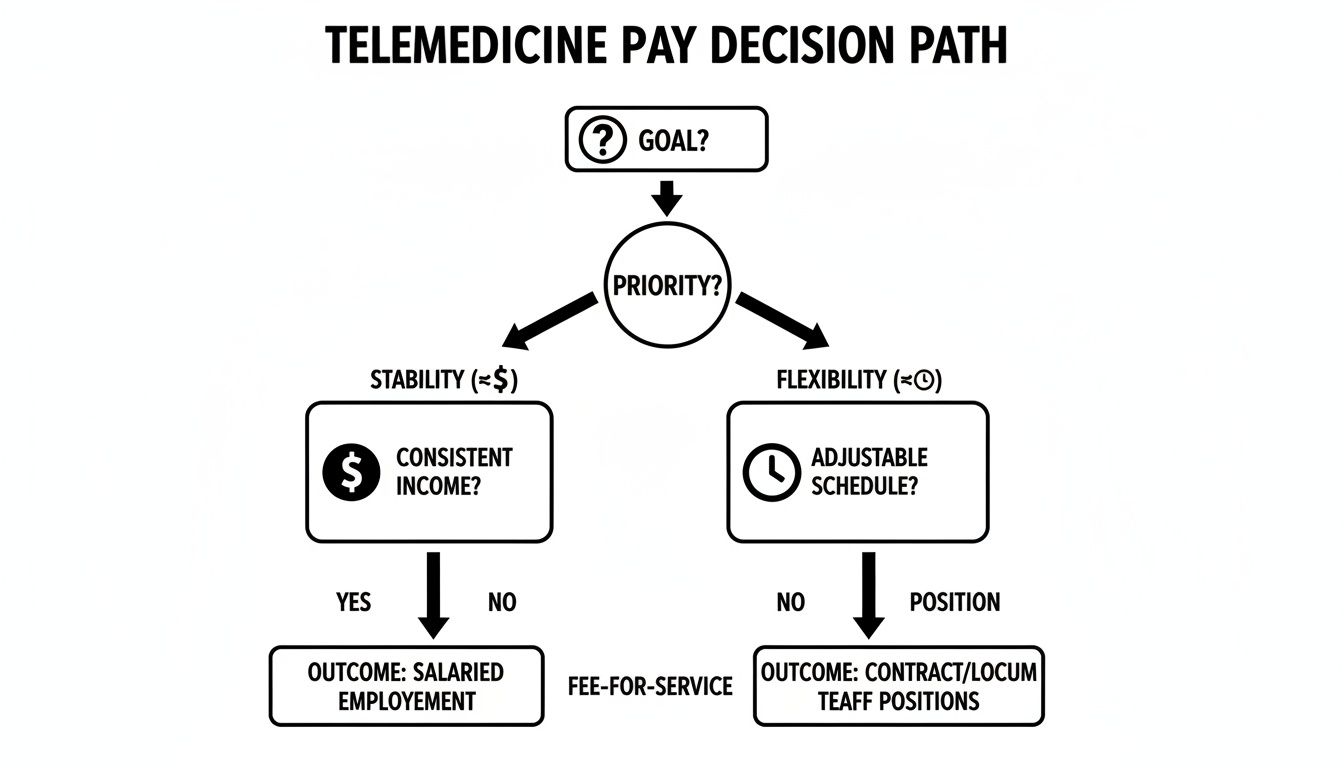
The main takeaway here is simple: let your personal priorities drive your strategy. That’s what will guide you toward the right fit, whether it's a salaried role for stability or per-consult gigs for complete autonomy.
Identifying Green Flags and Red Flags
As you start browsing listings for telemedicine jobs for doctors, you need to train your eye to spot the signals of a healthy work environment versus one that’s a burnout factory in disguise.
Green Flags to Look For:
- Specific Patient Loads: Language like "15-20 patients per day" or "2-3 consults per hour" shows they're transparent and have realistic expectations.
- Dedicated Support Staff: Any mention of MAs, nurses, or tech support who handle the admin grunt work is a huge plus.
- Modern and Integrated EMR: A description that highlights a user-friendly and efficient tech stack means they value your time.
- Protected Admin Time: When a job explicitly states that time is blocked off for charting and follow-ups, they respect that it’s part of the work.
Red Flags to Avoid:
- Vague Responsibilities: Phrases like "manage a high volume of patients" without any numbers attached are a classic warning sign.
- Unclear Scheduling: No mention of hours, on-call duties, or weekend expectations? They’re either disorganized or hiding something.
- Bring Your Own Everything: If they expect you to use your own EMR or provide your own malpractice insurance without reimbursement, it's a bad sign.
A job description is a window into a company's values. If it prioritizes physician well-being with clear, transparent language, that’s a strong sign. If it’s vague and demanding, proceed with caution.
Key Questions to Ask During Your Interview
The interview is your chance to turn the tables and vet them. Don’t be shy about asking direct questions that get to the core of the day-to-day reality. Since these are almost always virtual, it’s a good idea to master virtual interview preparation so you can make a sharp, confident impression.
Here are the questions I always recommend asking:
- Onboarding and Training: What does the training process look like for your platform and EMR? How long is the ramp-up period?
- Patient Volume: What is the average—and maximum—number of patients a physician is expected to see per shift?
- Support Systems: Who handles patient scheduling, technical issues, and prior authorizations? Is that support readily available?
- Performance Metrics: How is my performance measured? Is it based on volume, patient satisfaction, clinical quality metrics, or something else?
Focusing on these practical details helps you build a clear picture of what you’re actually signing up for. It’s also a smart move to see how their roles stack up against a data-driven tool like the WeekdayDoc Burnout Index. This gives you an objective way to evaluate opportunities, making sure your next move is one that will actually last.
The Future of Your Career in Telemedicine
Let's be clear: the shift to virtual care wasn't just a temporary reaction to a crisis. It's a fundamental, permanent evolution in how we practice medicine. For any physician thinking about their next career step, understanding this trajectory is the key to making a smart, durable choice.
The demand for telemedicine jobs for doctors isn't just growing; it's accelerating. The telehealth market is on track to hit $175 billion by 2026, a massive jump from just $45 billion in 2019. Already, 78% of U.S. physicians are part of practices that offer telehealth services. The writing is on the wall.
Emerging Trends Shaping Your Future
So what does this explosion in growth actually mean for your day-to-day practice? It means your future career is going to be far more dynamic and integrated with technology—in some pretty exciting ways.
- Artificial Intelligence in Diagnostics: We're already seeing AI tools that help analyze images and interpret data, giving physicians a powerful assistant to make faster, more accurate diagnoses from anywhere in the world.
- Expansion into New Specialties: Virtual care is breaking out of its traditional urgent care box. Specialties like cardiology, endocrinology, and even post-op follow-up are leveraging remote patient monitoring, opening up incredible new opportunities for specialists.
This isn't just a trend; it's the new foundation of a sustainable medical career. Telemedicine offers more than just another job—it provides a real, tangible way to practice medicine on your own terms, with unmatched flexibility, strong earning potential, and a clear escape route from burnout.
By exploring what this field has to offer, you're not just looking for a new role. You are actively building a more fulfilling, future-proof medical career that finally puts you back in control.
Your Top Questions About Telemedicine Doctor Jobs, Answered
Even after mapping out a game plan, a few practical questions always pop up. Let's tackle the common ones I hear from physicians thinking about making the leap to telemedicine.
What Kind of Tech Setup Do I Need?
You'd be surprised how straightforward the tech requirements are. Most companies expect you to have the basics covered: a reliable, high-speed internet connection, a reasonably modern computer, a decent webcam, and a quiet, private room for seeing patients. They’ll handle the specific software, but you’re responsible for the core hardware.
Can I Do This Job From Another Country?
This is a huge question, and the answer is almost always a firm no. It all comes down to licensing—you must be licensed in the state where your patient is physically located. Beyond that, most malpractice policies and telehealth platforms forbid providing care from outside the U.S. due to a minefield of legal and security risks. Always, always check the company’s policy before you even think about booking a flight.
Think of it this way: your medical license is geographically locked. Even if your patient is in California, practicing medicine while you're physically in Spain puts you outside the legal boundaries of both your license and your insurance coverage.
How Much Experience Do I Actually Need?
Telemedicine isn't really an entry-level gig. The vast majority of reputable companies are looking for board-certified physicians with at least a couple of years of clinical practice under their belt post-residency. They need to trust your clinical judgment to manage patients confidently without a hands-on physical exam, which makes that real-world experience non-negotiable.
Ready to find a telemedicine job that respects your time and keeps burnout at bay? WeekdayDoc filters for the best remote and hybrid physician roles with a simple promise: No Call and No Weekends. Start your search and discover a better way to practice medicine at https://www.weekdaydoc.com.