Interstate Medical Licensure Compact: Your 2026 Guide
Your guide to the Interstate Medical Licensure Compact (IMLC). Learn about eligibility, the application process, costs, and how it enables telehealth careers.

You're probably here because a single state license is starting to feel like a career bottleneck.
Maybe you found a remote telehealth role that looks ideal, but the patient panel spans several states. Maybe a locums assignment across the border would fit your schedule and income goals, except the licensing timeline kills the opportunity. Maybe your family wants to move, but your work setup still depends on one state board, one set of applications, and one slow administrative lane.
That's where the Interstate Medical Licensure Compact becomes useful. Not as a policy talking point, but as a career tool. For the right physician, it can make telehealth, locums, and selective no-call work much easier to build into a sane, sustainable practice. For the wrong physician, it can become another fee, another renewal stack, and another set of licenses you barely use.
The important question isn't just what the compact is. It's when it's worth using, why it changes your options, and when you're better off skipping it.
The End of Being Tethered to One State License
A lot of physicians hit the same wall at roughly the same moment in their career. They've built enough experience to know what they want less of. Less call. Less weekend coverage. Less geographic rigidity. Less dependence on whatever happens to be available inside one state border.
Then reality shows up as paperwork.
A psychiatrist wants to add telehealth sessions from home but can only see patients in one state. A hospitalist wants to shift into occasional weekday locums without relocating. An internist wants to move for a spouse's job and keep income stable during the transition. None of those plans are clinically complicated. The licensing is what turns them into a project.
That's why the Interstate Medical Licensure Compact matters. It doesn't create freedom by itself, but it removes one of the biggest administrative frictions that keeps physicians tied to a narrower practice footprint than they prefer.
Practical rule: If your career plan depends on being able to say yes to work in more than one state, licensing stops being a background task and becomes a strategic asset.
The compact is especially relevant if you're trying to shape your work around your life, instead of the other way around. That can mean building a telehealth panel that gives you control over your day. It can mean taking short locums blocks without signing up for a full relocation. It can mean preserving income while changing jobs, changing cities, or changing practice style.
What changes once you think about licensure this way is simple. You stop treating extra licenses as a bureaucratic trophy and start treating them like inventory. Useful inventory earns its keep. Unused inventory just creates maintenance.
What the Interstate Medical Licensure Compact Is and Is Not
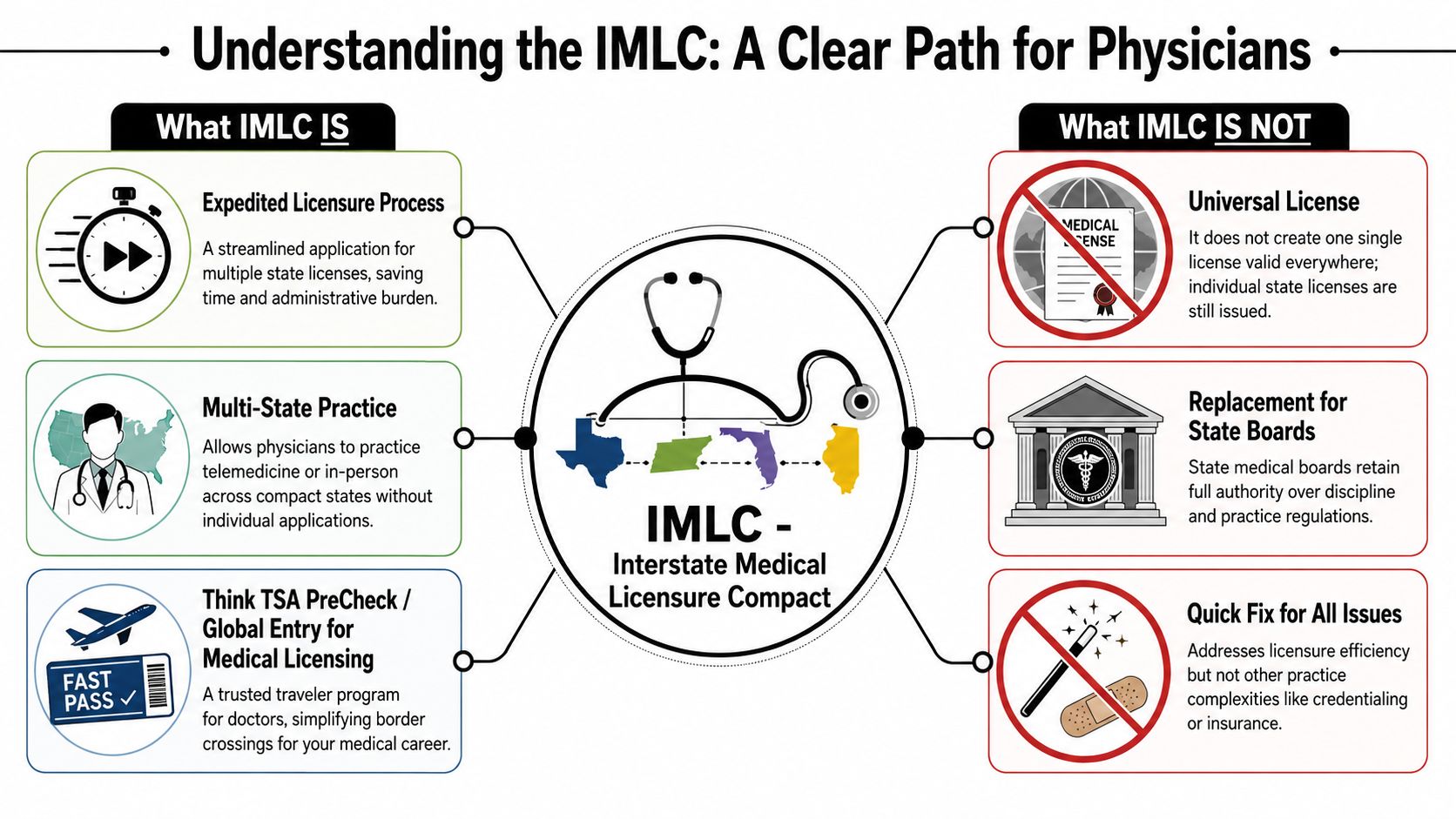
The Interstate Medical Licensure Compact acts as a license-portability layer, not a single national license.
What it is
For a physician trying to build telehealth across state lines, pick up selective locums shifts, or create a no-call mix of work, that distinction matters. The compact gives you a faster administrative route to multiple state licenses if you qualify. You still end up holding separate licenses in each state where you want to practice.
That sounds technical, but it changes the ROI calculation. If your plan depends on adding two, three, or five states in a short window, the compact can save enough time and repeated paperwork to justify the fees. If you only need one extra state and do not expect to expand further, the compact may be more convenience than strategy.
The process runs through your State of Principal License, or SPL. That is the participating state tied to your license and your professional or personal connection. Once that state confirms you meet the compact requirements, you can use that verification to apply for licenses in other participating states without rebuilding the same file from scratch each time.
In practical terms, the compact is a repeatable path for physicians with clean, straightforward licensing files. It is often useful for doctors who want flexibility quickly and who expect that flexibility to produce either more control over schedule, more income options, or both.
If you want a broader primer on how this differs from other pathways, WeekdayDoc's guide to medical license reciprocity is a useful companion.
What it is not
The compact does not create a national license, and it does not replace state medical boards. Every state still issues its own license and keeps authority over renewals, scope questions, discipline, and board oversight.
That is where some physicians misjudge the value. The IMLC can reduce the front-end friction of getting licensed in several states. It does not reduce the back-end work of staying compliant in several states.
Here is what still stays on your plate:
- Employer onboarding: Hospitals, groups, and staffing companies still run their own credentialing and privileging reviews.
- Payer enrollment: Insurance contracting remains separate and can take longer than licensure.
- State practice rules: Telehealth standards, prescribing rules, supervision requirements, and documentation expectations still vary by state.
- Renewal and compliance: You may end up tracking different renewal dates, CME requirements, and fees across multiple boards.
This is the trade-off physicians should understand early. The compact helps when access to more states is likely to produce real professional value. It is less compelling if the extra licenses will sit unused while you keep paying renewal fees and handling maintenance tasks.
Used well, the IMLC is a career tool. Used casually, it becomes another stack of renewals.
Are You Eligible for the IMLC Pathway
A common scenario looks like this: a physician lines up a telehealth contract in two new states, starts pricing out locums options, then realizes the whole plan depends on whether the compact route is available. That is the right time to pause. Eligibility is not just a box to check. It determines whether the IMLC will save you time and create options, or turn into extra fees and paperwork with little return.
The practical question is simple. Will compact eligibility help you get licenses fast enough, in enough useful states, to justify the cost?
For physicians building a multistate telehealth panel, adding selective locums work, or creating a no-call income stream, the answer is often yes. For a physician who expects to stay employed in one state and has no near-term plan to practice across borders, the compact can be an unnecessary carrying cost.
The fast self-check
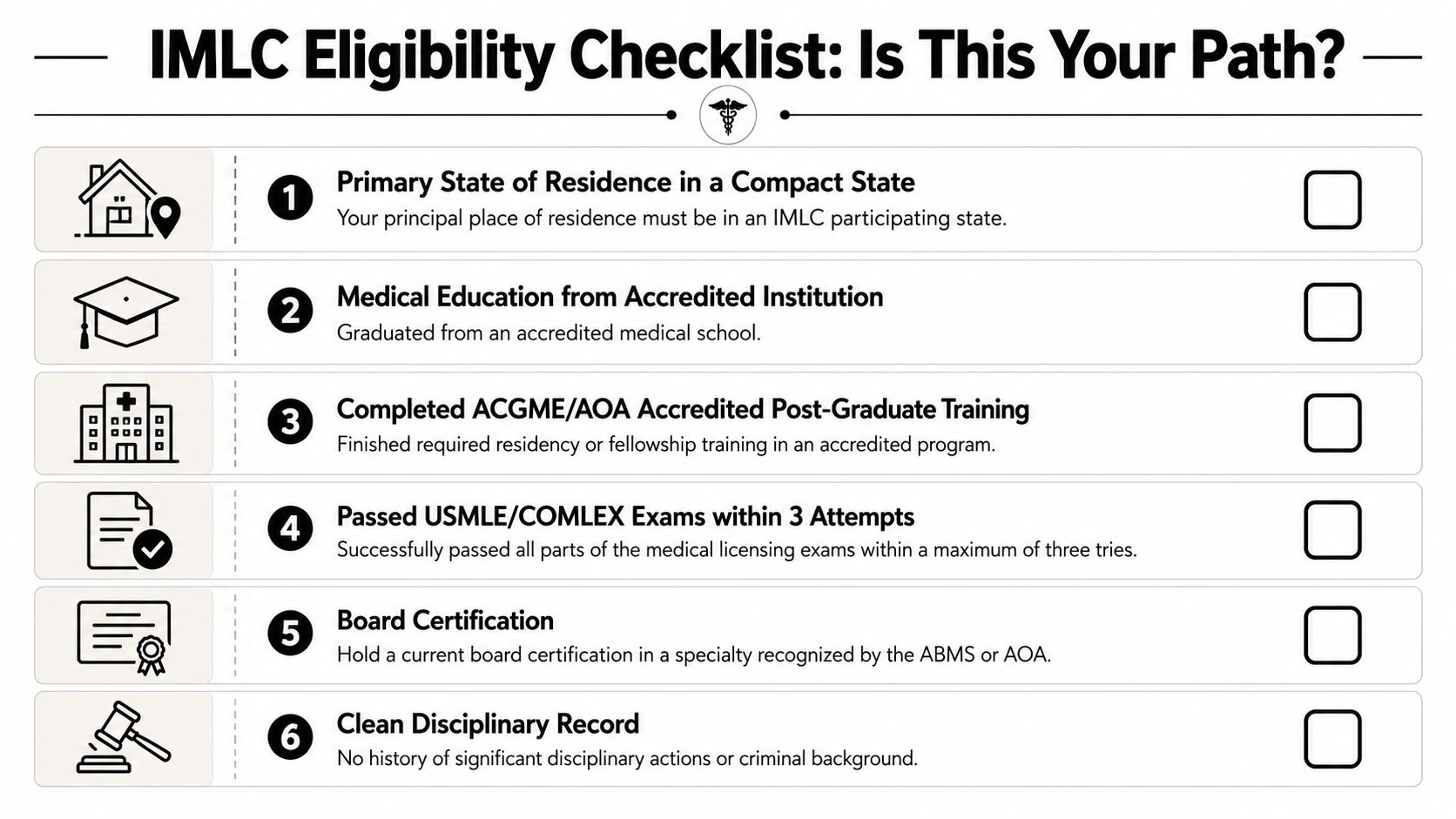
Start with your file, not your enthusiasm. The compact pathway generally fits physicians whose licensing history is straightforward and whose State of Principal License, or SPL, is easy to document.
A quick screen looks like this:
- You hold a full, unrestricted medical license in your SPL.
- Your SPL is a participating state.
- You have a real connection to that SPL through residence, practice, employer location, or federal income tax purposes.
- Your education, training, and exam history support standard licensure review.
- Your record does not include problems that trigger closer scrutiny, such as major disciplinary history or certain criminal issues.
Physicians usually know where the weak point is. It is often the SPL, not the clinical résumé.
I have seen colleagues assume they qualify because they are in good standing clinically, only to get slowed down because their residence, employer, and tax home pointed in different directions. That does not always kill the application, but it does mean the paperwork has to be consistent.
Your SPL is the strategic decision
If you split time across states, work remotely, or changed jobs recently, choose the SPL carefully. The IMLC is faster when the state connection is obvious on paper.
Here is the practical way to assess it:
| Issue | Why it matters |
|---|---|
| Where you live | Residence can support an SPL if that state participates in the compact |
| Where you practice | A meaningful clinical presence may support the SPL designation |
| Where your employer is located | Employer location can establish the required connection |
| Where you file taxes | Federal income tax residence can also support the SPL choice |
This matters more than many physicians expect. If your goal is to pick up telehealth work in three states next quarter, a clean SPL setup improves the odds that the compact will be worth the application fees. If your life is in transition, the better move may be to wait until your residence or employment situation is settled.
Later in your review, it helps to hear the rules explained aloud:
When waiting is the smarter move
Sometimes the highest-ROI decision is not to apply yet.
Hold off if you are about to relocate, change employers, or you cannot clearly support one SPL with clean documentation. The same goes for physicians who are only vaguely considering out-of-state work. Extra licenses only pay for themselves if they create real income, scheduling flexibility, or a credible exit from a high-burden job.
That is the key filter. Use the IMLC when it supports a defined plan, such as building a telehealth footprint, getting access to better locums markets, or setting up lower-call work across state lines. Skip it for now if the licenses will sit unused while you track renewals and keep paying fees.
Your Step-by-Step IMLC Application Guide
A common scenario goes like this. You line up a telehealth role that covers two or three nearby states, or a locums group asks whether you can add another market within a month. At that point, the IMLC works well if you have already decided which licenses will produce income or buy you schedule control. It works poorly if you apply first and hope a use case appears later.
Treat the application like credentialing. Gather documents early, confirm that your name matches across records, and decide in advance which states fit your actual plan. If you are still comparing options, it helps to review the medical licensing requirements by state before you start adding licenses that may not earn their keep.
Step one through three
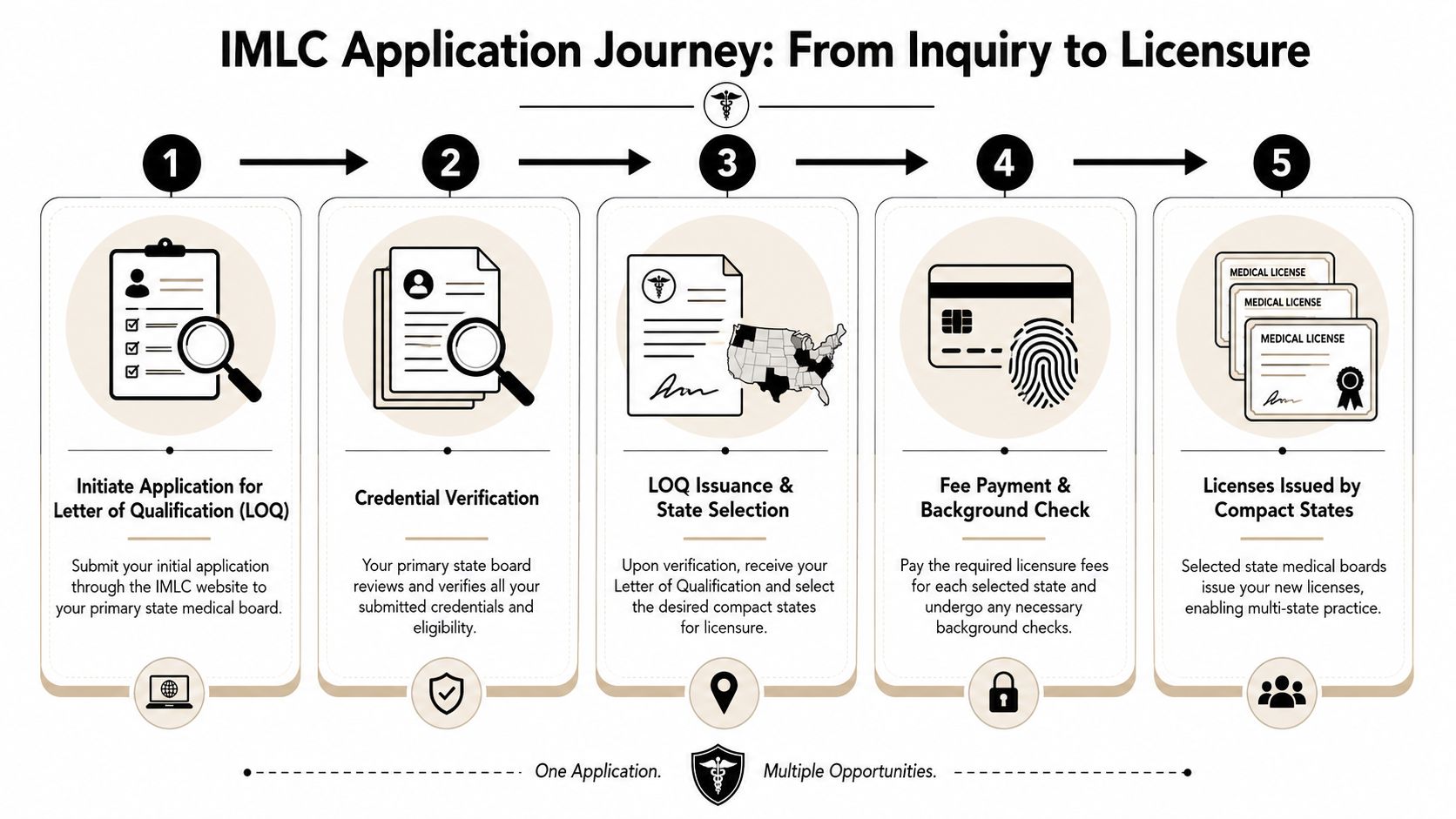
Apply for the Letter of Qualification through your SPL
This is the formal entry point into the compact pathway. Your State of Principal License reviews your eligibility and acts as the verifying state.Complete the verification process
This is usually where avoidable delays show up. Name variations, incomplete records, expired documents, and unresolved background items can slow the review more than the compact itself.Receive the Letter of Qualification and select your states
Once approved, you choose the participating states where you want licenses issued. This is the strategic moment. Choose states tied to a signed or likely telehealth contract, a locums corridor you expect to work repeatedly, or a relocation plan with a real timeline.
The speed advantage is real, but it should not be treated like an emergency shortcut. As noted earlier, many physicians receive licenses faster through the compact than through separate state-by-state applications. Even so, it still takes planning, accurate paperwork, and some patience.
Step four and five
After the Letter of Qualification is active, the process becomes more administrative.
- Select target states with a business case: Ask what each license is for. Telehealth volume, recurring locums demand, or access to lower-call jobs are good reasons. Curiosity is not.
- Pay each state's licensing fees: The compact creates a faster path, but each license is still issued by an individual state board.
- Finish any state-specific items: Some states may require additional administrative steps before the license is fully active.
- Track each license as its own obligation: Renewal dates, CME expectations, and maintenance tasks do not disappear because the license came through the compact.
I have found that physicians get the best return when they apply for a tight group of states they can use within the next six to twelve months. That usually produces one of three outcomes: more telehealth sessions, better access to locums assignments, or a cleaner transition into work with less call.
Where physicians lose time
Most delays are self-inflicted.
Common trouble spots include:
- Identity mismatches: A missing middle name, prior surname, or inconsistent credential listing can trigger manual review.
- Late decision-making: Waiting to choose states until a contract is nearly finalized creates pressure you do not need.
- Applying too broadly: Extra licenses create future renewals and fees, even if the work never materializes.
- Ignoring maintenance from day one: The IMLC helps with issuance. It does not simplify the long-term admin burden of holding multiple state licenses.
A practical rule is to work backward from your first realistic start date. If you want telehealth revenue by the fall, or you want locums options before your current call schedule becomes intolerable, start early enough that licensing is not the rate-limiting step.
How to think about timeline expectations
Use the IMLC as a career tool, not a reflex.
It has strong ROI for physicians building multi-state telehealth work, keeping several locums markets open, or creating an exit path into no-call or lower-burden jobs. It is a weaker investment if you only need one extra state, are about to change your home base, or have no defined plan to use the licenses soon. The application itself is manageable. The decision is whether the flexibility will pay you back in income, time, or relief from a schedule you no longer want.
IMLC Costs Documents and Participating States
This is the section physicians often skip until they've already decided the compact sounds appealing. That's backwards. The financial and administrative burden should be part of the first-pass decision, not an afterthought.
The basic fee structure is simple. The initial IMLC application fee is $700, and that's before individual state license fees are added, as described in this LocumTenens.com IMLC cost overview. Whether that's a smart investment depends less on the sticker price and more on how you'll use the licenses.
When the math makes sense
The compact tends to make sense in a few recurring scenarios:
- Telehealth across several states: If your clinical model depends on patient reach, faster multi-state licensing can justify the upfront spend.
- Locums with recurring regional demand: A few strategically chosen states can keep more assignments available.
- Career transition planning: If you're moving, reducing call, or building a mixed portfolio of work, licensing flexibility can buy time and options.
It's less compelling when you only need one extra state and don't expect that need to continue. In that case, the compact may still be worthwhile for convenience, but convenience alone isn't always enough to justify the total cost.
The document side is manageable if you prepare early
You'll generally want your identifying information, current licensure details, and supporting records organized before you start. The physicians who experience the least friction are usually the ones who already keep a clean credentialing file.
A simple prep list helps:
- Identity records: Make sure your legal name is consistent across your documents.
- Licensure details: Confirm your current unrestricted SPL license status.
- Training and certification records: Have them easy to retrieve if a board or employer asks.
- Practice planning notes: Know which states you want and why.
If you need a broader planning reference, a state-by-state overview of medical licensing requirements by state helps when you're comparing compact strategy with direct state application.
Participating states are not politically permanent
This is the trade-off many physicians underestimate. State participation isn't guaranteed forever. The same LocumTenens.com review notes that Michigan's membership was recently at risk because of a sunset clause before legislation kept it in the compact. That matters because some physicians build work plans as if compact participation is static.
Multi-state practice is easier with the compact, but it still sits on top of state politics.
So don't build your whole clinical model around the assumption that every current participating state will remain unchanged indefinitely. If a role depends heavily on one or two specific states, keep an eye on those jurisdictions rather than assuming the compact solves the issue permanently.
How the IMLC Enables Burnout-Friendly Careers
The true value of the compact isn't paperwork reduction for its own sake. It's what reduced friction lets you build.
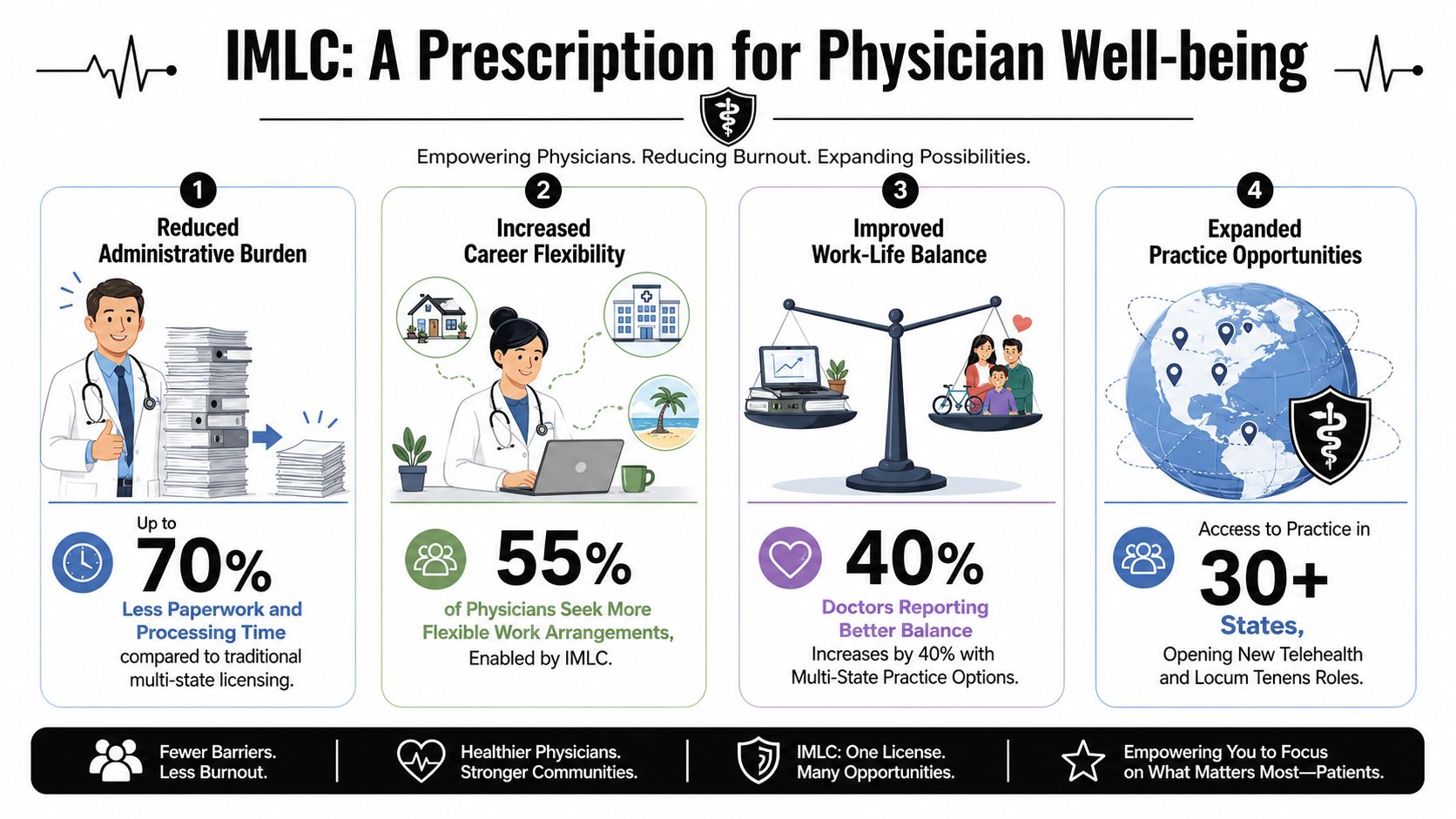
The strongest use case is telemedicine. The compact's primary value is compressing licensing time, which directly supports telemedicine expansion. The AMA's FSMB issue brief says the compact was adopted in 42 states plus Washington, D.C., and Guam, and that it accounted for more than 60,000 licenses issued in 2023–2024, while also improving the sharing of investigative and disciplinary information among member boards, as noted in the AMA issue brief on the IMLC.
Telehealth and no-call structure
If you want weekday-only remote work, multi-state licensure alters your advantage. A physician licensed in one state can only match with a narrow slice of employers and patient demand. A physician licensed across multiple participating states can fit a much broader range of telehealth models.
That matters because many remote roles aren't built around one state alone. They're built around coverage maps.
In practical terms, the compact can support:
- A larger telehealth patient base
- More selective scheduling
- Better odds of finding outpatient, no-call work
- Less dependence on one local employer
For physicians searching that market, resources such as remote healthcare jobs can help map where multi-state licensing is useful rather than just theoretically attractive.
Locums and selective income
The compact is also strong for physicians who want extra income without a full return to a high-intensity schedule.
That can mean weekday locums blocks, seasonal coverage, or a small number of high-fit assignments that don't require uprooting your life. The key is selectivity. The compact creates range, but range only helps if you use it to choose better work, not just more work.
Geographic arbitrage and family logistics
A less discussed benefit is flexibility around where you live.
Some physicians want to live near family, in a lower-cost area, or outside a dense clinical market while still accessing opportunities connected to other states. The compact doesn't guarantee that arrangement, but it makes the licensing side less obstructive.
A good multi-state licensing strategy can support both income goals and lifestyle goals. That's different from simply collecting licenses because they seem useful.
For employers, this matters too. Groups hiring remote physicians can recruit across a wider clinician pool when compact-based licensure is available. For clinicians, that often translates into more options that fit real life instead of forcing life to fit the nearest hospital system.
IMLC FAQs and Your Next Steps
A few practical questions usually come up after physicians understand the basic model.
How are compact-issued licenses renewed
They are still state licenses. That means renewal remains a state-level obligation even if the compact helped you obtain them. Keep your records organized and don't assume one renewal event covers every state.
Do CME requirements change if you hold several licenses
What changes is the administrative burden, not the underlying principle. You still need to comply with each state's renewal framework. Multi-state practice rewards physicians who keep a disciplined compliance system.
Is the compact worth it for only one extra license
Sometimes yes, often no. If one additional state opens up a durable telehealth role, a recurring locums lane, or a cleaner transition between jobs, it may be worth it. If you only need occasional coverage and don't expect repeated use, direct single-state licensure may be more sensible.
Why so many physicians keep using it
Demand has stayed strong. The compact became operational in April 2017 and by May 2025 had received 95,593 letters of qualification applications and 152,755 license requests, including 4,396 license requests in May 2025 alone, according to Weill Cornell's policy review of Interstate Medical Licensure Compact utilization. Physicians keep using it because modern careers increasingly depend on mobility.
If the compact fits your situation, treat it like a tool, not an identity. Apply for the states you'll use. Maintain the licenses that support your goals. Let the rest go.
If you're ready to turn multi-state licensure into a better job setup, WeekdayDoc helps clinicians search remote, hybrid, and in-person roles with clear work-style filters such as no call and no weekends, plus salary data, burnout-friendly scoring, and state-based planning tools.