Medical License Reciprocity: A Clinician's 2026 Guide
Understand medical license reciprocity in 2026. Learn about the IMLC, endorsement, and how to get licensed in multiple states for remote, no-call roles.
You find a role that looks almost custom-built for the life you want. Remote follow-up visits. Predictable weekday schedule. No nights, no weekends, no call. Then you get to the licensing line and realize the patients are in a state where you can't practice.
That's the moment medical license reciprocity stops feeling like an abstract regulatory topic and starts feeling like a career bottleneck.
For many clinicians, a single-state license restricts every professional avenue. It limits which telehealth jobs you can accept, which locums assignments you can structure around family life, and which hybrid roles let you earn well without being tethered to a hospital call schedule. If you care about burnout prevention, flexibility, or building toward financial independence, licensing strategy matters more than is commonly recognized.
Why Your Single-State License Is Limiting Your Career
A single-state license made sense when most care happened inside one building, in one city, under one medical staff office. That's not how many clinicians work anymore. Remote care, hybrid specialty coverage, and outpatient-first practice models have changed the map. Your license hasn't necessarily kept up.
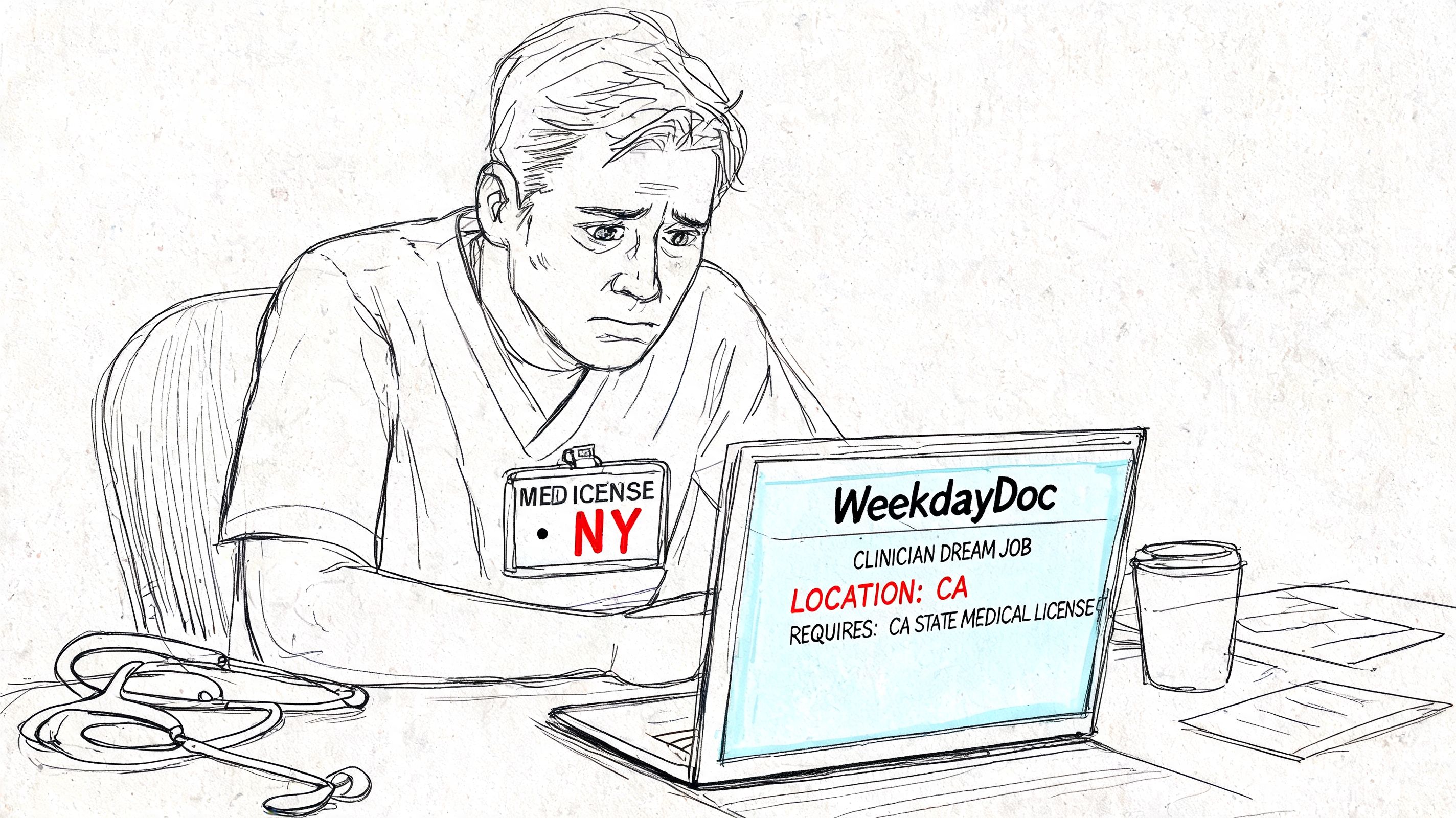
I've seen the same pattern repeatedly. A physician or advanced practitioner wants out of a draining schedule, starts looking for telehealth or outpatient roles, and discovers that the best-fit jobs aren't necessarily in their home state. They're in states with stronger demand, cleaner workflows, or a payer mix that supports a narrower, more sustainable scope.
What the bottleneck actually looks like
The problem usually isn't a lack of jobs. It's a mismatch between where you're licensed and where the opportunities are.
That mismatch shows up in a few practical ways:
- Remote jobs get ruled out fast: If a telehealth group serves patients in several states, they often prefer clinicians who are already licensed in more than one jurisdiction.
- Negotiating power drops: When you can only work in one state, employers know your options are narrower.
- Schedule quality suffers: The best burnout-friendly roles often go to clinicians who can onboard quickly and cover a broader patient footprint.
- FIRE planning gets harder: Geographic flexibility helps clinicians compare jobs not only by salary, but by tax burden, lifestyle, and scheduling structure.
Clinicians in other licensed professions run into the same reality. If you want a useful parallel, this breakdown of remote law job salaries and platforms shows how licensing and jurisdiction shape remote work options outside medicine too.
The license is no longer just permission to practice. It's leverage.
Why this matters for burnout
Burnout isn't only about volume. It's also about lack of control. If your current license forces you to choose among local jobs with call, weekends, inpatient obligations, or rigid clinic templates, you're not making a clean career decision. You're choosing from an artificially small menu.
Medical license reciprocity, or the broader set of pathways people mean when they use that phrase, gives you room to be selective. That doesn't guarantee a perfect job. It does let you stop applying only where you happen to be licensed and start applying where the work fits your life.
The Three Paths to Multi-State Medical Practice
Most clinicians use “medical license reciprocity” as a catch-all term. In practice, there are three different pathways, and mixing them up creates a lot of wasted time.
A simple way to think about them is travel. One path is like visa-free entry. One is a traditional work visa. One is a trusted-traveler lane for people who meet specific criteria.
True reciprocity
This is the version people hope exists. One state recognizes your existing license and more or less waves you through.
That's rare.
According to the Ohio Medical Board's overview of license reciprocity, true medical license reciprocity, meaning automatic license honoring, affects less than 5% of interstate moves. If you're planning a relocation or trying to start telehealth across state lines, assume this won't be your path unless a specific board says otherwise.
Endorsement
This is the old-fashioned route. You already hold a valid license, and another state reviews your credentials, training, exam history, and disciplinary status before issuing its own license.
It works, but it's slow and repetitive. You still deal with primary source verification, state-specific paperwork, and board-specific requirements. If you're targeting a non-compact state, endorsement is often the default.
Practical rule: If the state isn't in your profession's compact, start by assuming you'll need endorsement and then look for exceptions.
Interstate compacts
Compacts are the closest thing medicine has to a fast lane. They don't create one national license. They create an efficient route to obtain multiple state licenses through a shared framework.
For physicians, the big example is the Interstate Medical Licensure Compact. Other professions have their own compact structures, with different levels of adoption and different rules.
Here's the simplest comparison:
| Path | How it works | Best use case | Main drawback |
|---|---|---|---|
| True reciprocity | One state largely accepts another state's license | Rare state-specific situations | Uncommon |
| Endorsement | You apply to each state with full credential review | Non-compact states, complex cases | Slow and paperwork-heavy |
| Compact | You use a streamlined multi-state process if eligible | Telehealth, locums, flexible multi-state work | Only available in participating states and professions |
The key mistake is waiting to figure this out after you find a job. Licensing path determines your timeline, your admin burden, and sometimes whether a role is realistic at all.
A Deep Dive into Interstate Medical Compacts
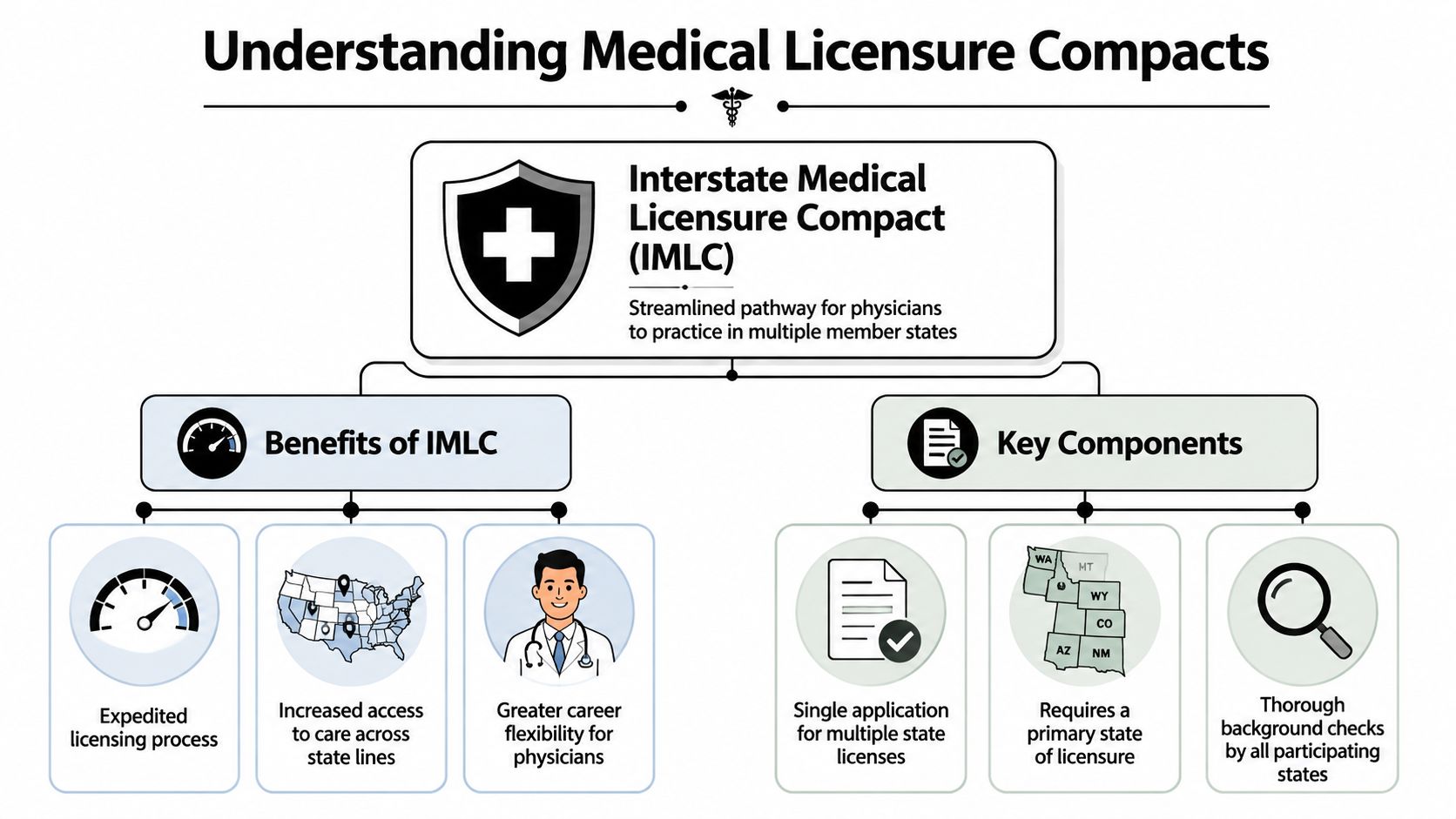
If you want faster access to multi-state practice, compacts are where the action is. For physicians, the dominant compact is the Interstate Medical Licensure Compact, or IMLC.
As of 2026, the IMLC includes 42 states, the District of Columbia, and Guam, with an average processing time of 19 days and a 90% approval rate, according to the AMA's Interstate Medical Licensure Compact numbers. Those numbers explain why clinicians pursuing flexible remote or multi-state work pay attention to it.
How the IMLC actually works
The compact doesn't issue one national physician license. Each member state still issues its own license. What changes is the path you use to qualify.
The key concept is the State of Principal License, often shortened to SPL. That's the state that confirms your eligibility and serves as the launching point for your compact application. Once that state verifies your qualifications, other participating states can rely on that verification instead of rebuilding the same file from scratch.
If you want a more practical explainer on the physician workflow, this guide to a compact medical license is a useful companion.
Why physicians like this route
The compact helps most when your career is broader than one local market.
That includes:
- Telehealth physicians who need legal authority to treat patients in multiple states
- Locum tenens clinicians who want more assignment options without repeating the same credentialing process over and over
- Outpatient specialists trying to build a no-call or low-call practice structure across several markets
- Physicians relocating slowly who want options before making a full move
The design is simple. Pre-vet once through the compact process, then add participating states more efficiently than you would through separate endorsement applications.
What about nurses, psychologists, NPs, and PAs
The compact story is stronger for some professions than others.
For physicians, the IMLC is well established. For advanced practitioners, the map is much less uniform. The licensing environment for NPs and PAs is more fragmented, and some clinicians still have to rely on slower bilateral endorsement systems rather than one broadly adopted compact framework, as discussed in this policy overview of the interstate medical licensure compact and related compact issues.
Psychologists have their own compact framework in many settings, and nurses have their own multi-state model. But the practical lesson is the same across professions: don't assume that because physicians have a path, your role has the same one.
If you're not an MD or DO, check your own profession's compact status before you build your job search around cross-state telehealth.
Where compacts help most
Compacts are most valuable when speed matters and your work style depends on access to more than one state. They're less important if you plan to stay local for years and only need one additional license in a non-compact state.
The clinicians who benefit most are usually the ones who treat licensing as infrastructure. Not an afterthought. Not a compliance chore. A career tool.
Your Step-by-Step Guide to Getting Another State License
Once you know which path applies, the process becomes much less mysterious. Most delays happen because clinicians start gathering documents after they've already found a role they want. The smarter move is to build the file first.
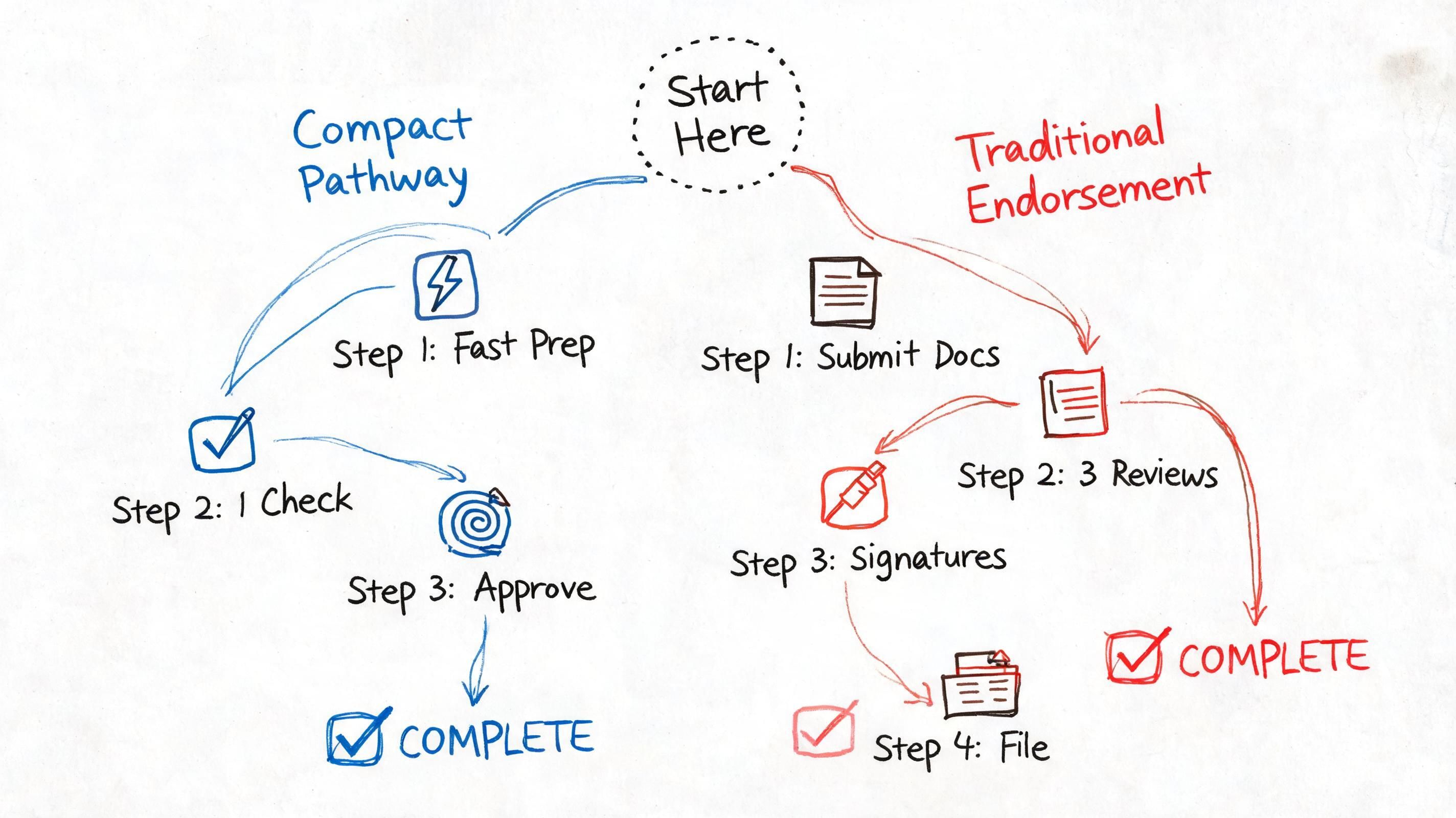
The two practical workflows are the compact pathway and the traditional endorsement pathway.
The compact pathway
For eligible physicians, the compact route is usually the fastest way forward. Weatherby Healthcare's explanation of the Interstate Medical Licensure Compact notes that the IMLC reduces administrative burden by an estimated 70%, with physicians obtaining licenses in 15 to 30 days versus the 3 to 6 months common with traditional state-by-state endorsement.
A practical sequence looks like this:
Confirm your eligibility
Check whether you qualify through a valid State of Principal License and whether your background fits the compact criteria.
Request your Letter of Qualification
This is the gate-opening document. Your principal state verifies your credentials and confirms you can use the compact pathway.
Choose your target states
Be strategic. Apply where you're most likely to use the license, not just where you think you might one day practice.
Pay close attention to identity and credential details
Small mismatches across names, training dates, or prior licenses create unnecessary back-and-forth.
Track every state board communication
Even in a simplified system, you still have individual state licenses at the end of the process.
For clinicians organizing core data before filing, having your NPI online application details and credential identifiers in one place helps avoid duplicate entry errors.
The endorsement pathway
If your target state isn't in the relevant compact, endorsement is still the reliable route. It just requires more patience.
This usually involves:
- Creating or updating an FCVS portfolio: Centralize your education, exam history, and verification documents if your state board uses FCVS.
- Requesting primary source documents early: Medical school transcripts, training verification, prior board verification, and any specialty documentation can take time.
- Checking for state add-ons: Some boards want extra attestations, jurisprudence steps, fingerprinting, or state-specific forms.
- Submitting one state at a time, unless you have support: Parallel processing is possible, but only if you can keep the documentation organized.
Start with the state that gives you the most job options first, not the state that seems emotionally satisfying to add.
A realistic timeline mindset
The compact route is built for speed. Endorsement often isn't. That matters if you're trying to pivot out of a draining role quickly.
A simple comparison:
| Pathway | Best if | What slows it down |
|---|---|---|
| Compact | You're eligible and targeting participating states | Incomplete credential history, SPL issues |
| Endorsement | You need non-compact states or profession-specific approval | Verification delays, state-specific add-ons |
The biggest mistake I see is applying too broadly too early. Every extra license means renewal obligations, fees, and compliance tracking. Get the licenses you can use in the next phase of your career. Add the rest later.
State Nuances and Red Tape to Watch For
Many clean licensing plans become complicated at this stage. Clinicians often assume that once they understand medical license reciprocity in principle, the rest is administrative detail. It isn't. State-by-state nuance is the whole game.
Non-compact states can reset your timeline
If you want access to a state outside your profession's compact structure, you may be back in full endorsement territory. That means separate applications, separate board review, and separate delays.
This matters most when a job search is built around one attractive state. If that state has slower processing or extra requirements, your entire transition can stall. The answer isn't to give up. It's to plan around reality and avoid building your search around a licensing timeline you don't control.
State-specific extras still matter
Even when your credentials are strong, boards can require additional steps that feel minor until they aren't.
Watch for issues like:
- Jurisprudence requirements: Some states want proof that you understand their laws and board rules.
- Board form quirks: A missing date, old training address, or incomplete explanation for a prior issue can trigger a return.
- Renewal complexity: Once you hold multiple licenses, tracking compliance gets harder.
- Telehealth compliance: Licensure gets you in the door, but privacy, documentation, and state practice rules still apply.
If you're moving into remote care, it's worth pairing licensure planning with operational compliance. A practical checklist for CloudOrbis for HIPAA risk management is useful because telehealth problems often come from workflow gaps, not just licensing gaps.
NPs and PAs need a different level of caution
Physicians sometimes assume advanced practitioners can follow the same roadmap. Often they can't.
The licensing environment for advanced practitioners is more fragmented than for MDs. While some states have joined the APRN and PA compacts, many still require NPs and PAs to use slower bilateral endorsement agreements, a major consideration for multi-state telehealth work, as described in these medical licensing requirements by state.
Don't treat “compact eligible” as a generic phrase. It has to match your profession, your state, and the actual role you want.
A smart licensing strategy isn't just about speed. It's about avoiding false assumptions before they cost you months.
How Licensing Unlocks Burnout-Friendly Careers
The clinicians with the most control over schedule usually have one thing in common. They can say no.
They can say no to inpatient call, no to weekend-heavy contracts, no to geographically inconvenient jobs, and no to employers who expect immediate coverage without offering a sustainable structure. Multiple licenses don't create that advantage on their own, but they expand your option set enough that advantage becomes real.

More licenses mean a better filter
When you can work across several states, you can screen jobs by the things that protect your life:
- No call
- No weekends
- Remote follow-up care
- Part-time or hybrid structure
- Outpatient-only scope
- Compensation that fits your long-term plan
That's where medical license reciprocity becomes strategic. It's not about collecting credentials for their own sake. It's about creating enough choice that you don't have to accept a schedule that burns you out.
Not every fast-entry license leads to a good job
This is the part many people miss. A provisional or alternate pathway license can open a door, but it may open the wrong door for the life you want.
Texas is a good example of that trade-off. While provisional licenses can create pathways into medicine, they're often tied to underserved settings and roles with mandatory call. A 2025 AMA survey found 68% of physicians in such programs report mandatory call, which cuts against the goal of finding a burnout-friendly role, according to the Texas Medical Association discussion of alternate paths.
That doesn't make those pathways bad. It means they aren't automatically aligned with a weekday-only or no-call plan.
The best licensing path is the one that matches the job you actually want to live with, not just the first one that gets approved.
The FIRE angle is practical, not ideological
Clinicians talk about FIRE in different ways. Some want to retire early. Some just want enough margin to stop taking bad shifts. Either way, licensing portability helps because it lets you compare opportunities across a wider map.
With multiple state licenses, you can prioritize roles that offer cleaner schedules, more autonomy, and a better fit for your long-term financial life. Sometimes that means higher income. Sometimes it means fewer hours with less emotional spillover. Often it means both are finally on the table.
Your Medical License Reciprocity Action Plan
If you want this process to help your career instead of draining your time, keep it simple.
Start with the role, not the paperwork
Define the work you want. Remote psychiatry. Hybrid outpatient primary care. Part-time telehealth. Locums without call. If you don't know the target, you can't choose the right states.
Match the role to the right licensing path
Use a short decision sequence:
- Pick your target states based on job fit
- Check whether your profession has a compact route there
- Confirm whether you qualify for that compact
- If not, map the endorsement path
- Build your credential file before you apply for jobs aggressively
Keep your strategy tight
A focused plan works better than a sprawling one.
- Choose a small set of high-value states: Go where the jobs fit your schedule goals.
- Centralize your documents: Training verifications, exam history, prior licenses, and identifiers should be easy to pull.
- Expect friction: Delays happen. Build around them instead of reacting to them.
- Think in career stages: Your first extra license should enable the next role. The second and third should expand influence.
Medical license reciprocity isn't a magic shortcut. It's a practical tool. Used well, it gives you room to build a career that's more flexible, more durable, and much less dependent on saying yes to work you already know you don't want.
If you're looking for roles that reward the work of getting licensed in multiple states, WeekdayDoc is built for that search. It helps clinicians find burnout-friendly jobs with clear no-call and no-weekend filters, along with salary and FIRE context by state, so your licensing strategy can support a better schedule instead of just more paperwork.