PA Jobs in Maryland: A 2026 Salary & Lifestyle Guide
Explore PA jobs in Maryland for 2026. Get data on salaries, top employers, licensing, and how to find burnout-friendly roles with no call or weekends.

The headline number in Maryland isn't the number of openings. It's the spread between stable employed work and high-paid temporary work. Recent Maryland locum tenens listings show average pay of $212,000 per year, with a range of $198,000 to $234,000 according to AMN Healthcare's Maryland PA locum listings. That kind of pay gets attention fast. It should.
But if you've worked long enough as a PA, you already know the actual question isn't just what pays more. It's which jobs you can still tolerate in two years.
Maryland has plenty of PA demand. What it doesn't have is a clean divide between roles that are merely available and roles that are sustainable. Many postings bundle together day shifts, PRN coverage, rotating schedules, inpatient support, specialty call, and weekend expectations under the same broad title. If you search casually, the market looks rich. If you filter for predictable hours, low call burden, and a workable patient load, the field narrows quickly.
I've seen too many clinicians chase the biggest number first and only ask lifestyle questions after the offer shows up. That's backwards. A higher rate can absolutely make sense, especially if you're using short-term work to accelerate savings or bridge a career transition. But if you're trying to protect family time, reduce burnout, or build toward financial independence without wrecking your schedule, you need a tighter process. General healthcare job guides can help you structure a search, but for Maryland PA roles you need to read beyond the headline salary and into how the job is staffed.
The Real Story Behind Maryland's PA Job Market
The strongest signal in Maryland isn't that jobs exist. It's that compensation structure tells you a lot about lifestyle risk.
A locums posting paying far above an employed role usually means the employer is solving a coverage problem. Sometimes that's fine. Sometimes it's a short-term opening caused by leave coverage, rapid service-line growth, or a hard-to-fill geography. Other times it means churn, schedule instability, or a role that permanent candidates keep rejecting for good reason.
What the pay gap usually means
When you see Maryland locum rates materially above salaried positions, look for the operational reason first.
- Coverage urgency: The employer may need immediate help for a service line that can't safely go understaffed.
- Schedule burden: Nights, weekends, rotating shifts, or scattered site coverage often sit behind premium rates.
- Credentialing friction: Some roles stay open longer because onboarding is messy or specialty requirements are narrow.
- Temporary flexibility: For some PAs, the higher pay is worth it if the assignment has a clear end date and a defined scope.
Practical rule: If a job pays far more than nearby employed roles, assume you're being paid for disruption until the employer proves otherwise.
The Maryland market rewards clinicians who ask operational questions early. How many sites will you cover. Who handles inbox spillover. How often are "day shifts" pulled into late add-ons. Is the role replacing a departing PA or filling a new slot. Those answers matter more than the marketing copy.
Sustainable doesn't always mean low-paying
A burnout-friendly role isn't automatically a low-compensation role. Some outpatient and specialty jobs offer solid pay with a schedule you can plan around. The catch is that these roles are usually less obvious in broad search results because they get mixed in with urgent care, hospitalist, surgery, and PRN coverage under the same job-title umbrella.
That creates the challenge in PA jobs in Maryland. You aren't sorting jobs by title. You're sorting them by whether the work pattern fits the life you want.
Maryland PA Job Market A 2026 Snapshot
153,400. That is the number of PA jobs the U.S. Bureau of Labor Statistics counted nationwide in 2023, and the profession is still projected to grow 20% from 2024 to 2034, with about 12,000 openings per year and a 2024 median wage of $133,260, as summarized by the University of Maryland career outlook page.
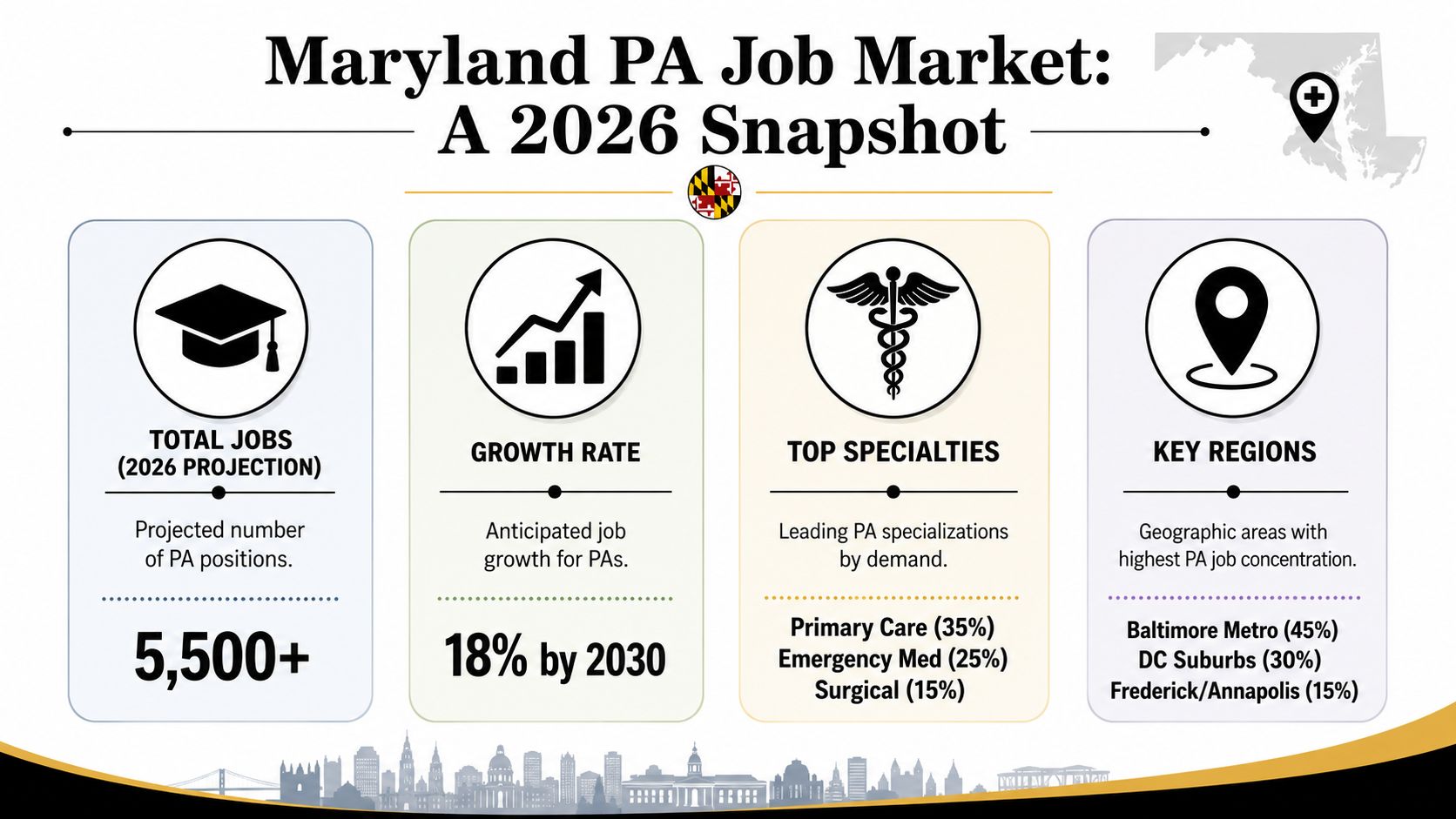
Maryland benefits from that national tailwind, but clinicians can get misled if they treat raw posting volume as proof of a good market. High volume means employers are hiring. It does not mean the jobs are stable, well-staffed, or set up for a sustainable week.
The same University of Maryland summary noted 16 PA jobs in Maryland at Johns Hopkins Medicine and 157 statewide openings on one job board. A separate Glassdoor Maryland PA jobs page showed 514 open PA roles. Those are useful signal numbers. They also include duplicate listings, evergreen recruiting posts, PRN roles, and jobs that stay open because the schedule is hard to keep staffed.
That distinction matters in Maryland more than many applicants expect. Large health systems in the Baltimore corridor generate real opportunity, but the market also stretches into smaller regional employers, multisite groups, and outpatient practices that may post the same need across several platforms. The result is a market that looks bigger on a screen than it feels once you filter for weekday-only schedules, consistent staffing, and manageable call expectations.
I have seen colleagues make this mistake. They count postings instead of counting roles they would keep for three years.
A better read of the market is to separate availability from sustainability. If you want a broad comparison point before drilling into Maryland-specific offers, this physician assistant salary by state guide helps frame how Maryland sits relative to other markets PAs commonly cross-shop.
What current demand actually means
| Market question | Practical interpretation |
|---|---|
| Are there PA jobs in Maryland? | Yes. Hiring activity is strong enough that most specialties and practice settings show regular openings. |
| Does a high posting count mean plenty of good options? | No. A meaningful share of listings are duplicates, PRN positions, hard-to-fill shift work, or roles with broad coverage expectations. |
| Is the market limited to Baltimore? | No. Baltimore is the biggest hub, but statewide demand extends into smaller cities and regional systems. |
| What should experienced PAs focus on first? | Schedule design, staffing ratios, turnover, panel expectations, and whether the role is built to last. |
The headline for 2026 is straightforward. Maryland has plenty of PA openings. The smaller group, and the one worth your time, is the set of jobs that pay fairly without burning through clinicians every 12 to 18 months.
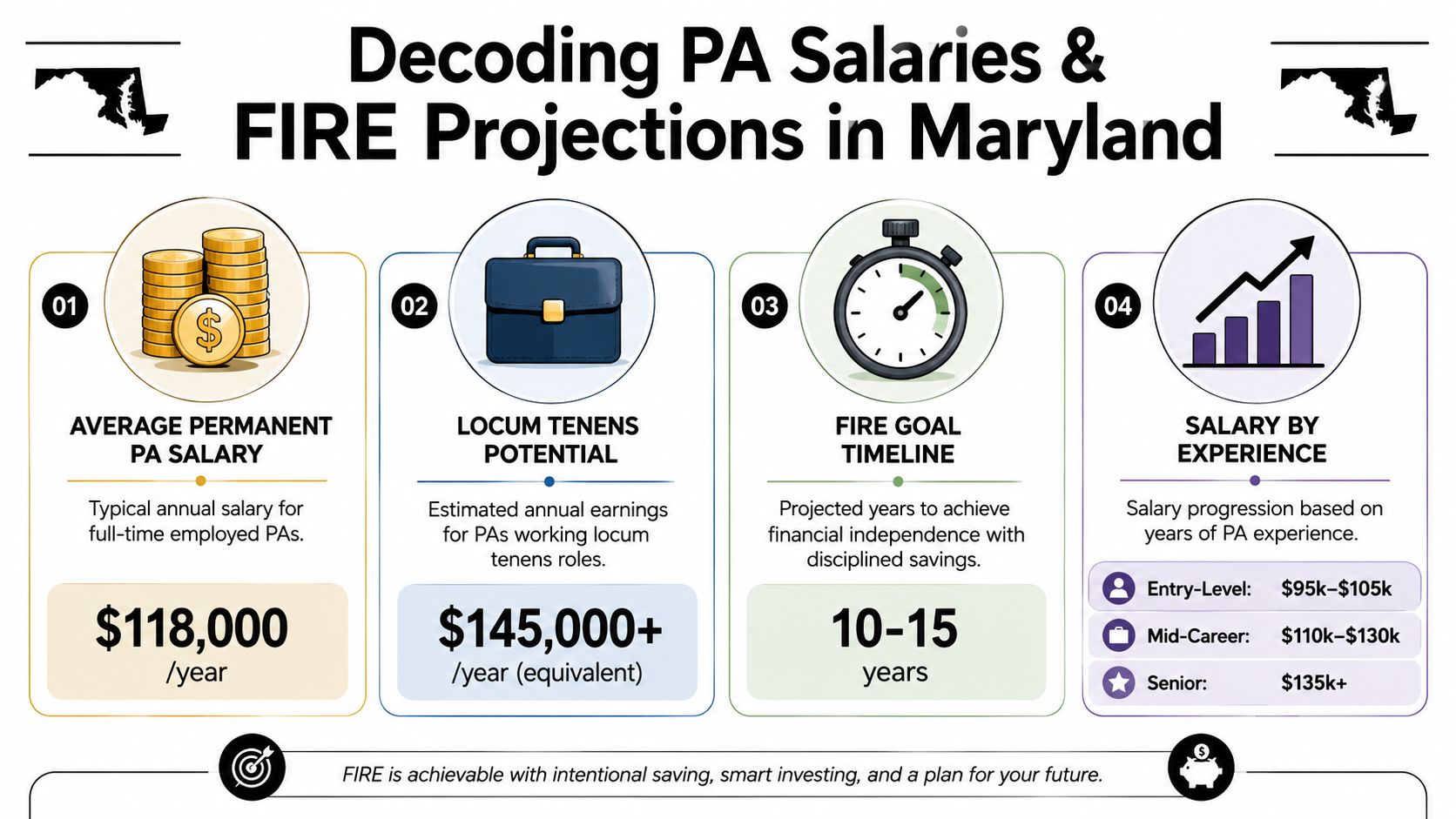
Decoding PA Salaries and FIRE Projections in Maryland
Most salary discussions around PA jobs in Maryland are too shallow. They quote one number and stop. That doesn't help you compare an employed outpatient role against a locums assignment, or a W2 package against a higher nominal rate with more instability.
Maryland is a good example of why you need a side-by-side approach.
The two salary tracks most PAs are comparing
Barton Associates cites a Maryland PA average salary of $117,280 from BLS, while its Maryland locum tenens pay summary reports an average of $212,000 annually for the last year of posted locum PA jobs in the state, with listed rates ranging from $198,000 to $234,000 and top weekly earnings up to $4,830, according to Barton Associates' Maryland PA jobs page.
That spread is large enough that it can distort judgment if you don't unpack it.
| Employment model | What stands out |
|---|---|
| Permanent employed role | Lower headline pay, but often more predictable scheduling and less interruption between assignments |
| Locum tenens | Higher advertised pay, but more uncertainty around assignment length, benefits structure, and workflow consistency |
The salary math isn't hard. The hard part is valuing predictability correctly.
What matters for FIRE planning
If you're pursuing financial independence, a higher earning year can be useful. A short locums stretch may help you wipe out loans faster, build reserves, or fund a down payment. But FIRE planning works only if the income is durable enough to save consistently and the work doesn't force you into burnout spending, prolonged recovery time, or abrupt career pivots.
The fastest path to financial independence isn't always the highest annualized rate. It's the plan you can repeat without breaking your health or your home life.
Three questions make the comparison cleaner:
- How stable is the income stream? A premium rate means less if there are gaps between assignments.
- What are you absorbing yourself? Benefits, retirement structure, time off, and admin burden can shift the actual value.
- What does the schedule do to the rest of your life? Weekend recovery after every block of shifts has a cost, even when the paycheck looks strong.
For a broader benchmark, it helps to compare Maryland against a physician assistant salary by state reference before you negotiate. Not because the state average should determine your offer, but because it helps you spot when a supposedly premium role is only premium on paper.
What usually works
The best financial strategy for many PAs isn't choosing one model forever. It's sequencing.
- Early-career or transition phase: Short-term higher-paid work can make sense if your exit criteria are clear.
- Mid-career stability phase: Many clinicians do better with predictable W2 income and a schedule they can defend.
- Selective supplemental work: If you already have a stable base job, occasional extra shifts can be more sustainable than full-time temporary coverage.
Pay matters. But in Maryland, the salary number only becomes useful after you attach it to a real schedule, a real staffing model, and a real plan for your next three years.
Maryland Physician Assistant Licensing and Credentialing
If you're moving into Maryland, licensing isn't the place to improvise. Delays here can cost you a start date, and in some systems the credentialing queue moves slower than the recruiter implies.
The safest approach is to treat state licensure, hospital credentialing, payer enrollment, and internal onboarding as separate tracks. They overlap, but they don't move at the same speed.
What to line up first
Start with the essential requirements and gather every document before you apply anywhere aggressively.
- Core identity and education records: Keep your license history, certification documents, transcripts, and work history organized in one folder.
- Work chronology: Make sure your CV month-to-month timeline is clean. Credentialing teams notice unexplained gaps quickly.
- Reference readiness: Some employers move fast on interviews, then stall because professional references aren't reachable.
If you're rusty on the sequence, this credentialing guide for physician assistants is a practical refresher on what employers usually need and where delays tend to happen.
What trips people up in Maryland moves
Out-of-state PAs often focus on getting the offer first and assume the rest will sort itself out. That's where timelines slip. A recruiter may say the team is eager, but eagerness doesn't accelerate board processing, committee review, EHR access, or payer approval.
Treat "we'd like you to start soon" as a recruiting statement, not an operational timeline.
You also need to verify the supervision and practice setup in plain language. Don't settle for vague answers like "standard collaborative structure." Ask who signs off, how escalation works, how chart review is handled, and whether your day-to-day function matches what was described in the posting.
A clean licensing workflow
A simple sequence works best:
- Confirm role fit before paperwork explodes. Don't spend weeks on a role if the schedule details already look wrong.
- Submit state items early. State-level requirements can become the bottleneck.
- Push credentialing documents immediately after offer acceptance. Every day you wait adds friction.
- Track every step yourself. Never assume HR, medical staff, and the department are all synchronized.
Maryland employers vary widely in how organized they are. The PA who gets started on time is usually the one who manages the process personally instead of hoping the system will carry it.
How to Find Burnout-Friendly and Weekday-Only PA Roles
A large share of Maryland PA postings look workable on first pass. A much smaller share will still look good after you pin down call, inbox load, cross-coverage, and whether "weekday" means five predictable clinic days.
That gap matters. Maryland has plenty of PA openings, especially across outpatient groups, hospital systems, surgical services, urgent care, and specialty clinics, as shown in Maryland PA postings tracked on DocCafe. The problem is volume. High posting volume creates the illusion of choice, but many roles hide the same burnout drivers under different titles.
Start with schedule design, not specialty loyalty. I have seen good clinicians talk themselves into a "dream field" role, then leave within a year because the actual job included late charting, inbox work at home, and weekend spillover that never showed up in the posting.
Roles that are more likely to hold up
No setting guarantees a sustainable job. Some settings do give you better odds.
- Outpatient primary care: Better fit when panel size is reasonable, support staff are stable, and someone covers results and patient messages when you are off.
- Procedure-light specialty clinics: Dermatology, allergy, sleep, endocrine, rheumatology, and similar clinics can offer cleaner weekday schedules if templates are controlled and add-ons are limited.
- Clinic-heavy surgical positions: These can work well for PAs who like perioperative care but want fewer overnight demands. The role only stays sustainable if call frequency, first-assist expectations, and rounding duties are spelled out.
- Hybrid and remote follow-up work: Some triage, chronic care follow-up, and asynchronous care models reduce commute burden and physical clinic friction. Review the practical limits of telemedicine for physician assistants before you apply, because many "remote" jobs still require onsite sessions, fixed coverage blocks, or after-hours message management.
Short version. Protect your time before you chase title or prestige.
Posting language that usually signals trouble
Certain phrases deserve scrutiny before you spend time on an application.
| Posting language | What it often means in practice |
|---|---|
| "Flexible scheduling" | The employer shifts your hours to cover demand |
| "PRN with pathway to full-time" | Unclear volume, weak income predictability, limited control |
| "Shared call" | A small team absorbing frequent backup coverage |
| "Varied settings" | Floating between sites, inconsistent workflow, extra commute time |
| "Fast-paced clinic" | High visit volume without enough staffing or admin support |
If weekends, call, patient volume, or inbox expectations are missing from the posting, ask early. Do not wait until the final interview.
Broader reading on understanding supplemental health careers can also help if you are weighing part-time, PRN, or hybrid work against a traditional full-time role. That question comes up often for Maryland PAs trying to reduce burnout without taking a major pay cut.
A search sequence that works better
Use a three-step screen.
- Set hard limits first. No weekends, no call, one site, clinic-only, capped patient load, or protected admin time.
- Choose the care model second. Outpatient specialty, primary care, hybrid follow-up, employer health, student health, or selected surgical clinic roles.
- Compare compensation after the schedule passes review. A higher salary does not fix a job that runs into your evenings every week.
One practical option is WeekdayDoc, a platform which lets clinicians filter roles by work style, including no-call and no-weekend structures. That saves time because broad job boards often group sustainable weekday roles together with PRN coverage jobs, rotating shifts, and postings that stay vague on schedule details.
The strongest Maryland searches are disciplined. You are not looking for the highest number of openings. You are looking for the smaller set of roles that still make sense after the actual workload is exposed.
Evaluating Top Maryland Employers for Work-Life Balance
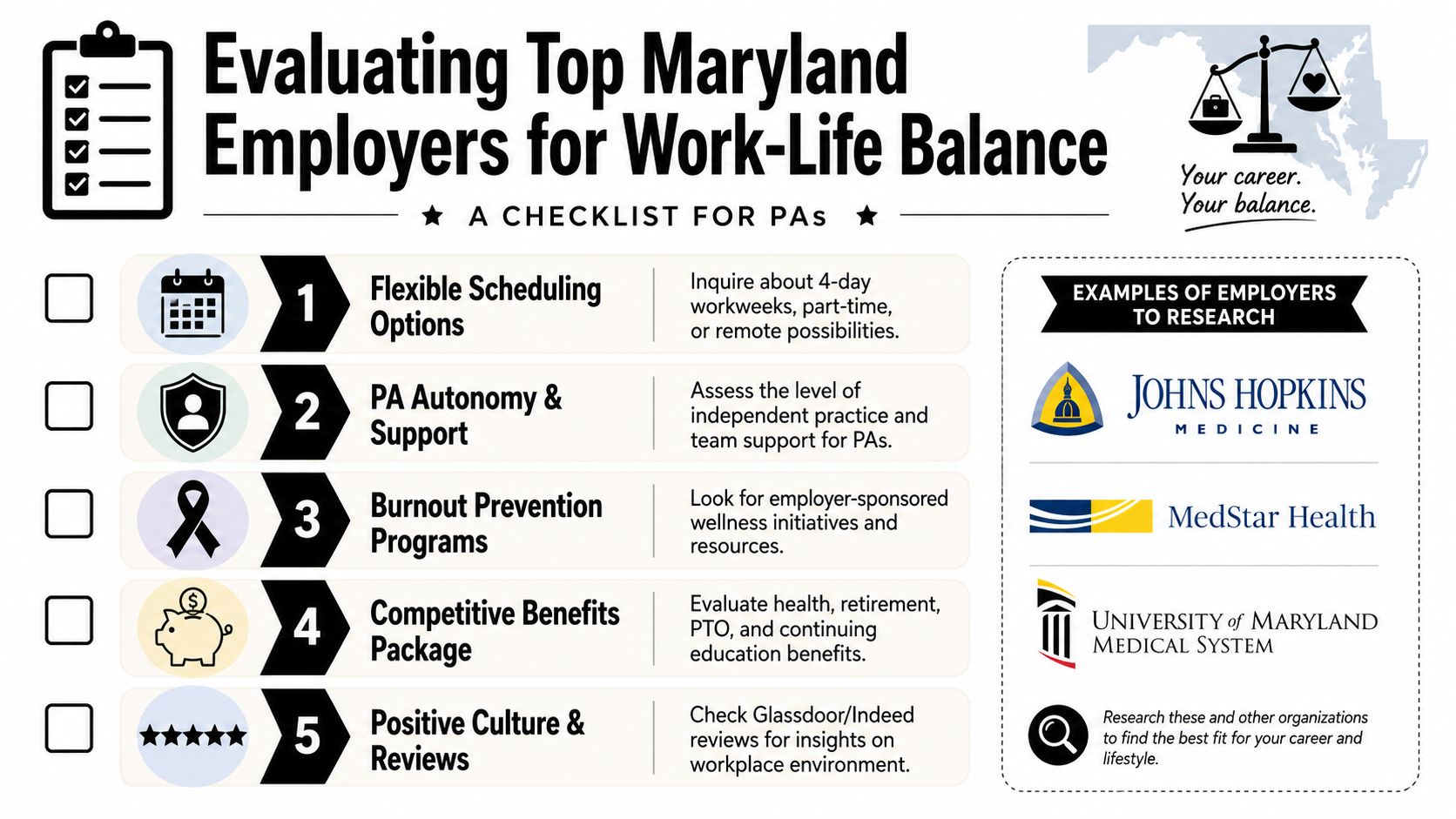
A large health system can post dozens of PA openings at a time. Only a fraction of those jobs hold up once you examine call, panel management, inbox coverage, and staffing stability. That gap matters more than employer prestige.
In Maryland, I would screen Johns Hopkins, MedStar Health, and the University of Maryland Medical System the same way I would screen a smaller private group or regional clinic. Brand name can mean strong onboarding, better specialty exposure, and cleaner referral pathways. It can also mean higher patient volume, more committee layers, and less control over schedule creep. Smaller employers may offer steadier weekday structures, but they can also run thin on coverage when a clinician leaves.
Openings outside the Baltimore and DC corridor deserve a hard look too. As noted earlier, Maryland's PA market is not confined to the largest metro employers, and some of the more sustainable roles sit in less crowded hiring lanes. If you are comparing systems and independent groups, reviewing public career openings can help you see how employers describe schedule, specialty mix, and setting before you invest time in interviews.
Questions that expose the real job
Ask these before the final round. A sustainable job should survive direct scrutiny.
- Who owns the inbox when I'm off? Shared coverage, RN triage, and clear refill protocols protect your days off. Vague answers usually mean the work waits for you.
- What is the actual patient template? Ask for booked visits, same-day add-ons, procedure slots, and how often the schedule runs over.
- How does call work in practice? Get the frequency, the response expectations, and what happened on the last few call weekends.
- What happens when a PA or physician is out? Stable teams have a coverage plan. Strained teams redistribute work to whoever is still standing.
- How much admin time is protected on the calendar? If charting, prior auths, and result review happen after hours, the weekday-only label does not mean much.
Contract terms worth reading closely
The contract often shows the employer's real operating model.
| Contract area | Why it matters |
|---|---|
| Call language | Broad wording gives the employer room to add call later, even if the interview sounded reassuring |
| Site assignment | "Primary site" does not prevent routine floating unless the language is specific |
| Productivity targets | RVU pressure can turn a reasonable clinic into a nightly charting problem |
| PTO coverage | Time off is less restorative if inboxes, labs, and messages still come back to you |
| Exit terms | Notice periods and restrictive covenants affect how quickly you can leave a poor fit |
One more point. Watch how leaders answer ordinary workflow questions. Employers with healthy staffing models usually answer clearly and fast. Employers with chronic burnout problems often get evasive once you ask who handles overflow, late patients, or uncovered clinic sessions.
A workable Maryland PA job is not just a job with decent pay and a known name. It is a role where the daily workload stays inside the paid schedule often enough that you can keep doing it for years.
Application Strategy and Your Next Steps
Once you've identified the right kind of PA jobs in Maryland, the application should reflect that strategy. Don't send the same resume to a trauma-heavy inpatient role, an outpatient specialty clinic, and a hybrid follow-up position. Maryland employers want a clinician who can solve their specific workflow problem.
Tighten your resume to the role
Your resume should make three things obvious within seconds:
- Setting fit: outpatient, inpatient, urgent care, surgical, specialty clinic
- Scope comfort: procedures, follow-up care, new patient evaluations, care coordination
- Schedule reliability: if you've handled autonomous clinic flow, cross-coverage, or multi-site workflows, state it clearly
If you're pursuing burnout-conscious roles, emphasize continuity, patient communication, and operational steadiness. Hiring managers for sustainable clinic jobs often care less about broad intensity and more about whether you can keep a service line running without drama.
Interview like someone protecting a career, not chasing an offer
A lot of PAs get tentative in interviews because they don't want to seem difficult. That's a mistake. Professional, direct questions are part of due diligence.
Ask about:
- Actual weekly schedule, not the recruiter summary
- Call mechanics, including backup and escalation
- Admin time, inbox work, charting expectations, and late-day add-ons
- Support staff stability, especially MAs, RNs, and front-desk turnover
One useful way to prepare is to review outside examples of physician group career openings and compare how organizations describe scheduling, support, and scope. Not because those openings define Maryland, but because they help you spot when a posting is transparent versus when it's mostly branding.
A simple decision filter
Before you accept any offer, run it through this filter:
| Question | If the answer is weak |
|---|---|
| Can I describe my weekly schedule clearly? | Keep digging |
| Do I know who covers me when I'm off? | Assume poor boundaries |
| Is the compensation structure easy to understand? | Expect surprises |
| Would this job still appeal to me without the employer name? | If not, reconsider |
The best Maryland PA job for you may not be the most prestigious system or the highest posted rate. It may be the one with a clean weekday schedule, decent support, clear expectations, and enough compensation to let you build a real life outside work.
That's the standard worth using.
If you're sorting through PA jobs in Maryland and want roles screened for work-life fit, browse WeekdayDoc for clinician-focused listings built around schedule clarity, burnout awareness, and long-term sustainability.