Mastering Telemedicine for Physician Assistants in 2026
Your 2026 guide to telemedicine for physician assistants. Explore state laws, salary, no-call jobs, and burnout-friendly careers with telehealth.

The inbox is full before clinic starts. Two refill requests need chart review. One patient is late, another wants “just a quick question,” and the template already looks impossible by lunch. Most PAs don’t burn out because they stopped caring. They burn out because the workday keeps expanding around the patient care they trained for.
That’s why telemedicine for physician assistants matters. Not because video visits are trendy, and not because every problem belongs on a webcam. It matters because virtual care can be a career design tool. Used well, it can cut commute time, shrink the chaos around rooming and turnover, and create a schedule that leaves enough energy for family, health, and long-term financial goals.
The profession has already made that shift. Prior to the COVID-19 pandemic, only 9.2% of certified PAs utilized telemedicine. By June 2020, that number had risen to nearly 66%, with over 75% of those adopters having no prior experience. By 2022, sustained participation was 40.3%, according to NCCPA and AAPA figures summarized here. That tells you two things. First, telemedicine is no longer niche. Second, a lot of clinicians learned it on the fly, which explains why some telehealth jobs feel smooth and sustainable while others feel like a digital version of the same old grind.
A balanced telemedicine role still requires judgment, boundaries, documentation discipline, and a high tolerance for occasional tech nonsense. But for the right PA, it can be the difference between surviving work and building a life around it.
Some fields also show how mature remote care has become. If you're looking at behavioral health or neuropsychology-adjacent work, it helps to see how established programs structure virtual assessments and patient experience. A useful example is learn about Sachs Center's telehealth evaluations, which shows how specialized services can be delivered remotely when the workflow is designed well.
Introduction Beyond the Webcam
A telemedicine career starts with an honest question: what parts of your clinical work translate well through a screen, and what parts absolutely do not? The answer isn’t “everything virtual” or “video can’t replace medicine.” It’s narrower and more useful than that.
Most PAs who thrive remotely build around repeatable visit types, clear triage boundaries, and a specialty where history, visible findings, and follow-up carry a lot of weight. That’s why some telehealth roles feel efficient and safe, while others leave you second-guessing every disposition.
Where virtual care works best
Primary care remains the clearest entry point. The AAPA reports that primary care PAs lead telemedicine adoption at 76%, and broader physician data found that 76.7% of primary care physicians viewed telemedicine quality as comparable to in-person care to some extent or greatly for many routine situations, as described in the AMA's review of telehealth use by specialty. That fits what many of us see in practice. Medication follow-ups, chronic disease check-ins, review of home readings, uncomplicated URI discussions, contraception counseling, and stable mental health follow-up can work well virtually.
Other common telemedicine-friendly lanes include:
- Dermatology review: Rashes, acne follow-up, medication tolerance, and image-based reassessment can work when photo quality is good and the patient has clear return precautions.
- Behavioral health support: Medication monitoring, symptom review, and care coordination often translate naturally to video.
- Low-acuity urgent care: Select complaints like simple refill needs, minor allergy issues, or initial triage for urinary symptoms may fit, depending on the employer’s protocols and local rules.
- Chronic care follow-up: Hypertension, diabetes, asthma, and thyroid medication follow-up can be effective when data is available from home logs, labs, or connected devices.
What still belongs in person
Some visits should move out of telemedicine quickly. That’s not failure. That’s good medicine.
A patient with chest pain, focal neurologic symptoms, significant shortness of breath, testicular pain, acute abdominal pain, severe dehydration, or a wound you can’t assess adequately from video needs hands-on evaluation. The same goes for complaints where the key data point is tactile, procedural, or dependent on a complete physical exam.
Practical rule: If your plan depends on a maneuver you can’t perform, a finding you can’t verify, or a risk you can’t safely rule out remotely, the visit has already crossed into in-person territory.
Gray-zone complaints are where telemedicine skill really develops. Ear pain in a child. A red eye. Back pain with vague severity. Pelvic symptoms with limited history. In those cases, strong virtual practice means making a disposition decision early instead of dragging the visit along and hoping the answer appears.
Build a personal triage filter
Telemedicine for physician assistants gets easier when you stop thinking in terms of diagnoses and start thinking in terms of visit suitability.
Use three questions at the top of every encounter:
- Can I get the key history remotely?
- Can I assess the important visual or home data points well enough?
- If this turns out to be the dangerous version of the complaint, can I catch it in time?
If the answer to any of those is no, redirect early. Patients usually tolerate that well when you explain the why clearly. They lose confidence when a clinician keeps circling, delays, and then refers them anyway.
That confidence piece matters. A sustainable telehealth PA isn’t the person who tries to force every complaint into a virtual template. It’s the clinician who knows where the lane is, stays in it, and documents the decision-making cleanly.
Navigating Licensure Supervision and Liability
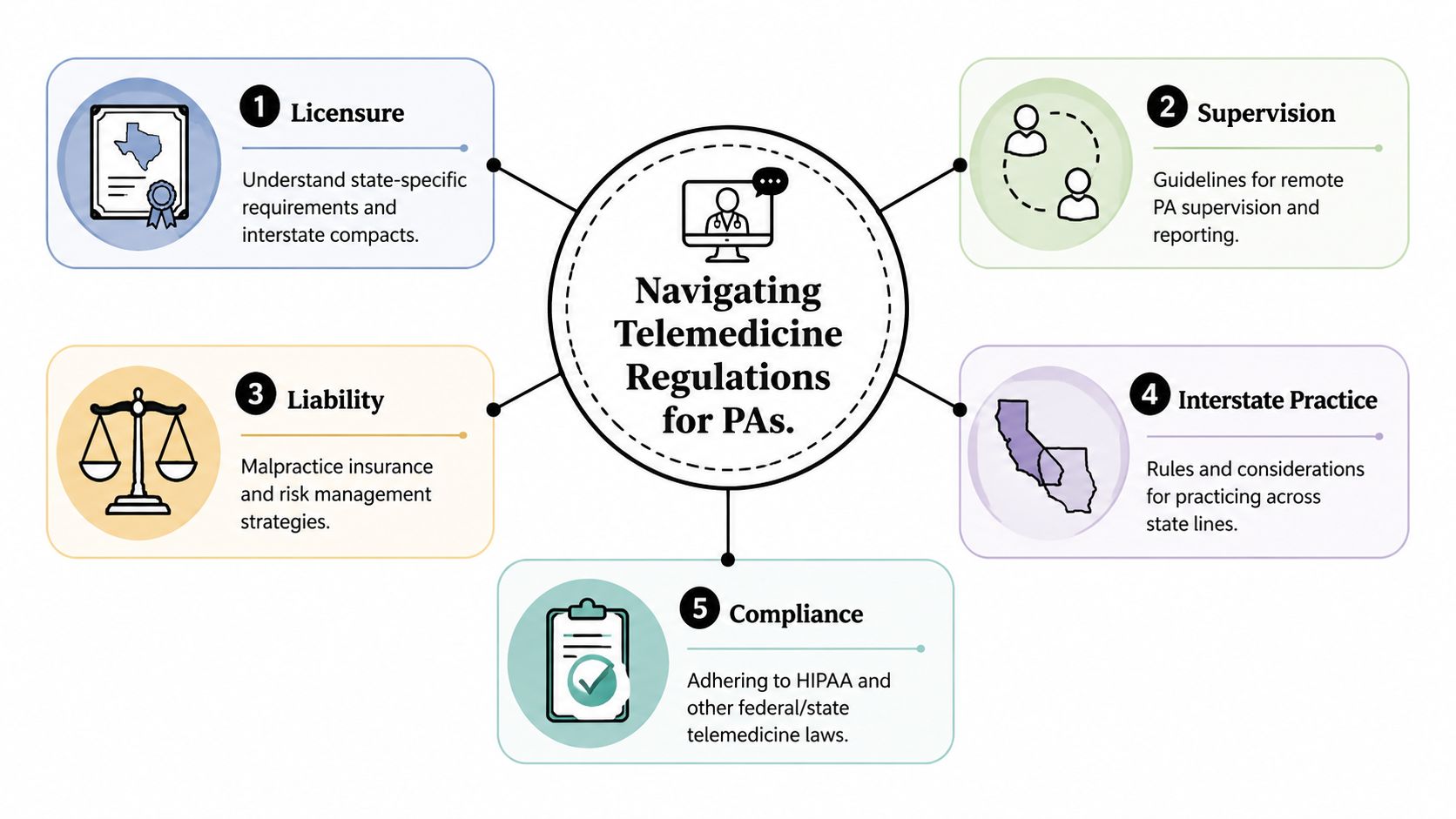
Regulation is where many good telehealth plans stall out. Not because PAs can’t do the work, but because the rules vary enough that people freeze, delay applying, or pass on jobs they might have been qualified for. That hesitation is common. Licensing uncertainty has led 35% of PAs to abandon remote opportunities, and only 22% of licensed PAs currently hold multi-state credentials, according to this overview of telemedicine entry barriers for PAs.
Those numbers match practical friction. The job listing looks remote. The recruiter says “multi-state preferred.” Then you start digging into where the patient is located, what supervision arrangement applies, who signs what, and whether your malpractice policy covers telemedicine across jurisdictions. That’s where a lot of clinicians back away.
The first rule of remote practice
For most telemedicine encounters, the relevant location is the patient’s location at the time of the visit, not where you happen to be sitting. That means a remote PA job can be legally simple in one state and much more complicated the moment the employer markets to patients elsewhere.
This is the practical workflow that keeps things clean:
- Verify patient location at check-in: Staff or platform prompts should capture the patient’s physical location before the visit starts.
- Match every state to your license list: Don’t assume “nationwide platform” means nationwide authority.
- Confirm the employer’s supervision model: Some organizations know their state-by-state structure cold. Others expect the PA to figure it out.
- Read your malpractice language: You want telemedicine coverage, not broad verbal reassurance from a recruiter.
If you want a starting point for checking local rules, state by state references like medical licensing requirements by state are useful for narrowing where to apply and what questions to ask.
Supervision is a workflow issue, not just a contract issue
Many telehealth employers mention physician collaboration but don’t explain how it works on a busy day. That’s a problem. In a virtual setting, poor supervision design shows up fast. You need to know who is available for escalation, how quickly they respond, whether chart review is retrospective or real time, and what kinds of cases require immediate attending involvement.
A good telemedicine setup answers practical questions such as:
| Question | What you want to hear |
|---|---|
| Who is supervising me during live sessions? | A named clinician or clearly assigned coverage structure |
| How do I escalate complex cases? | A direct workflow through chat, call, or same-day review |
| Are there standing protocols? | Written protocols for common complaints and referral thresholds |
| Who handles emergencies or unsafe disconnections? | A defined emergency process with staff responsibilities |
| What gets reviewed afterward? | A predictable QA process instead of random hindsight criticism |
When these answers are vague, the legal risk and emotional burden both land on the PA.
The safest telehealth jobs don't rely on “use your judgment” as the whole supervision plan.
Liability and HIPAA need specifics
Remote care changes your risk profile. You’re practicing without a hands-on exam, often across a broader geographic footprint, through a platform that may or may not be tightly managed. That means your malpractice review can’t be casual. Ask for the actual policy details, not a summary slide.
Separate from malpractice, video workflow needs privacy discipline. If your employer is still cobbling together consumer tools and loose workarounds, pause. For teams reviewing vendors or internal processes, this guide on ensuring HIPAA compliance for video calls is a useful way to frame what secure telehealth communication should include.
A simple compliance checklist
Before accepting a telemedicine role, confirm these points in writing:
- Licensure coverage: Every state where patients will be seen.
- Supervision structure: Who is available, when, and for what.
- Malpractice scope: Telemedicine included, states included, tail coverage clarified if applicable.
- Prescribing rules: Especially if the role touches controlled substances or high-risk medication classes.
- Documentation and consent: Employer workflow for telehealth consent, emergency contact, and patient location.
Regulatory work isn’t glamorous, but it’s what turns telemedicine from a side hustle fantasy into a durable career move.
A Day in the Life Telehealth Workflows and Technology
The daily reality of telemedicine depends less on your specialty title and more on the workflow model. Two remote jobs can both say “PA telehealth” and feel completely different by the end of the week.
One role is live, face-to-face, and paced like clinic. The other is more asynchronous, with image review, messages, and short bursts of decision-making between blocks of documentation. If you’re trying to build a lower-friction career, that distinction matters as much as compensation.
Synchronous days feel familiar
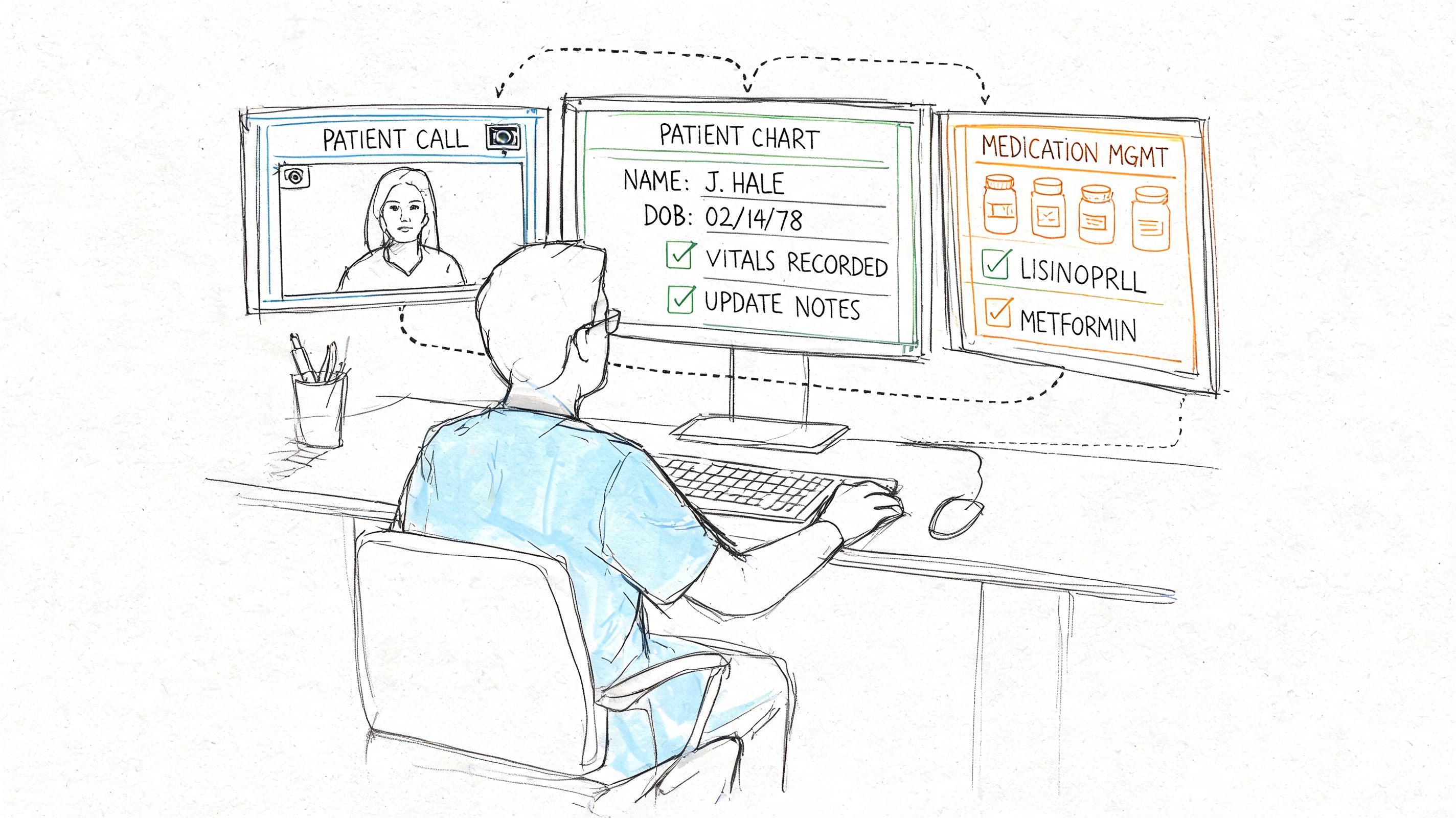
A synchronous telehealth primary care day usually starts with a schedule full of back-to-back video visits. You log in, review charts, confirm patient location, and move through medication follow-ups, chronic disease check-ins, symptom triage, and referrals. It’s clinically straightforward when the employer has good pre-visit intake, clear templates, and staff support.
It becomes draining when every visit starts with troubleshooting audio, reconciling meds from scratch, and manually documenting in a separate system. That’s the difference between “remote” and “burnout-friendly.”
Integrated systems matter. Physicians in groups of four or more were twice as likely to use telemedicine platforms integrated with their EHR, according to HealthIT.gov’s 2021 data brief. For a PA, that usually means fewer duplicate clicks, easier prescribing, faster chart completion, and less memory strain during a packed day.
Asynchronous roles change the rhythm
Store-and-forward work, common in some dermatology and protocol-driven services, shifts the pace. Instead of live conversations all day, you may review patient-submitted histories, images, lab context, or device-generated data in batches. The upside is less performance fatigue from continuous on-camera work. The downside is that weak intake systems can leave you hunting for missing information and sending multiple follow-up messages before you can make a decision.
Here’s the clean comparison:
| Workflow model | Typical strengths | Common friction points |
|---|---|---|
| Live video visits | Better rapport, easier clarification, familiar clinic rhythm | More screen fatigue, schedule delays, repeated tech troubleshooting |
| Asynchronous review | Flexible pacing, fewer real-time interruptions, focused decision blocks | Incomplete histories, variable image quality, more back-and-forth messaging |
A lot of clinicians discover they don’t hate telemedicine. They hate bad telemedicine infrastructure.
This short overview gives a decent visual sense of how virtual visit operations can look in practice:
The tech stack that actually helps
The tools themselves aren’t exotic. What matters is whether they talk to each other. In a workable setup, your video platform, scheduling, documentation, e-prescribing, lab ordering, secure messaging, and patient intake all connect with minimal manual patching.
Look for signs of maturity such as:
- Single sign-on access: Fewer logins usually means less friction.
- Auto-populated note fields: Better than copying and pasting visit basics repeatedly.
- Embedded prescribing and orders: You shouldn't need separate browser gymnastics.
- Reliable support paths: If the camera fails, someone other than you owns the fix.
Remote patient monitoring can add another layer. As described in this review of telemedicine systems and remote monitoring workflows, connected devices and dashboards can support more proactive care, but they also add technical and cognitive demands. That trade-off is real. A good system reduces unnecessary live contact time. A bad one creates another inbox.
Getting Paid Telehealth Billing and Documentation
A telehealth visit can be clinically solid and still create reimbursement problems if the billing setup is sloppy. Most PAs don’t need to become coders, but you do need enough operational literacy to recognize when a role is set up correctly and when your work is likely to get denied, downcoded, or pushed back for rework.
The key point is simple. Telemedicine billing is not “just bill it like clinic and add video somewhere.” The claim has to match the service type, the payer’s rules, the documented medical necessity, and the virtual format used.
What to clarify before your first shift
Ask the employer who owns coding decisions and payer updates. In some organizations, coding staff handle this well and train clinicians on what matters. In others, the PA gets a vague onboarding document and is expected to remember modifier rules by memory while seeing patients.
Your practical checklist should include:
- Place of service rules: Know which POS the organization expects for telehealth claims and whether that varies by payer.
- Modifier use: Ask when the practice uses common telehealth modifiers such as 95 or GT, and who audits for errors.
- Audio-only handling: Some employers support it selectively. Others don’t want clinicians using it except under narrow circumstances.
- Parity expectations: Don’t assume telehealth is paid the same as in-person across all plans.
- No-show and late policies: These affect daily volume and your income if compensation is productivity-based.
If an interviewer can’t answer any of this, billing confusion will eventually land on your desk in the form of chart edits and denied claims.
Documentation has to do different work
A virtual note has to show why telemedicine was appropriate, what information you were able to gather, what you could not examine directly, and how that limitation affected your decision-making. Good telehealth documentation is concise but explicit.
Include elements like:
- Patient location and identity verification
- Visit modality used
- Consent for telemedicine if required by employer workflow
- Relevant remote findings, including visible exam observations or home data
- Clear disposition, especially when you redirect to urgent or in-person care
Documentation habit: If the lack of a physical exam changed your threshold for referral, say so plainly in the assessment.
That protects the patient and supports the billing story. It also protects you from hindsight criticism. Telemedicine notes often fail not because they’re too short, but because they leave out the reasoning that explains why the virtual visit was still medically appropriate.
What efficient documentation looks like
The best telehealth organizations use templates without turning clinicians into robots. A strong template prompts for patient location, modality, consent, visible exam findings, and escalation steps. A weak one creates bloated notes full of irrelevant auto-text.
For PAs, the sweet spot is a template that supports speed without erasing judgment. If you can finish most notes close to the visit end, your telemedicine job may buy back time. If every chart requires major cleanup after hours, the role is remote only in geography.
How to Find a Burnout-Friendly Telemedicine PA Job
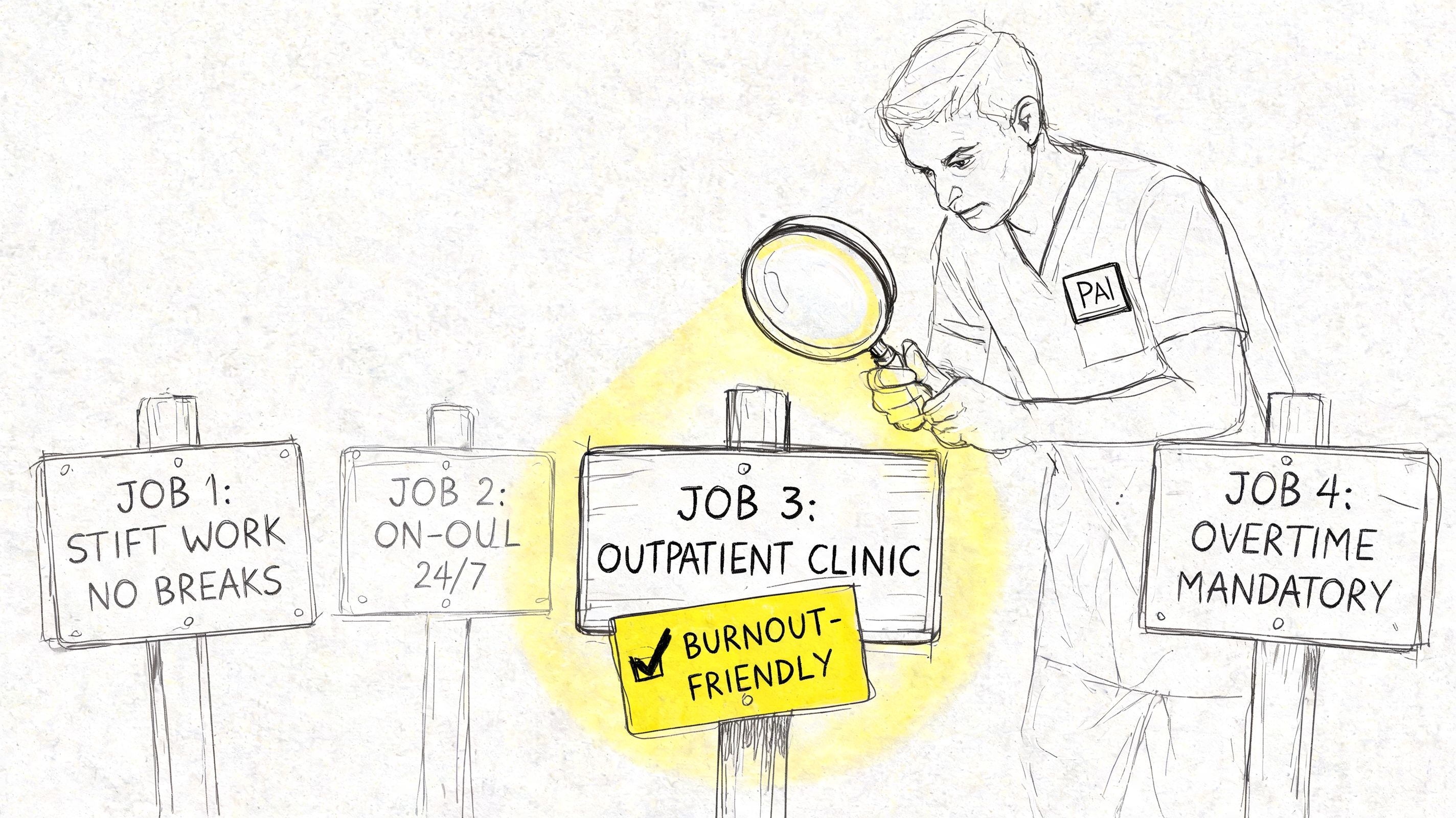
The biggest mistake in this market is taking the first remote offer and assuming all telehealth roles improve balance. Some do. Some are just high-volume production jobs with fewer windows and worse boundaries.
That matters because telemedicine itself doesn’t prevent burnout. Recent data shows 42% of telemedicine PAs report higher burnout from tech issues and isolation. Hybrid models have been shown to reduce this burnout by 25%, and 52% of PAs prefer them, according to this UWorld PA review of telemedicine job realities. The lesson isn’t “avoid telehealth.” It’s “screen the role as hard as the employer screens you.”
What to highlight on your resume
Even if you haven’t held a formal telemedicine title, you probably already have transferable skills. Focus on what proves you can practice safely with less hand-holding.
Useful experience to surface includes:
- Independent triage judgment: Urgent care, primary care, same-day access, or inbox-heavy roles all count.
- Clear digital communication: Portal management, patient education, follow-up messaging, and concise documentation.
- Protocol fluency: Standing orders, escalation pathways, and collaborative care structures.
- Comfort with tech: EHRs, e-prescribing, virtual workflow tools, and troubleshooting basics.
Keep the wording concrete. “Managed high-volume ambulatory follow-up with independent disposition decisions” is stronger than “excellent communicator and team player.”
Interview for the schedule you actually want
A sustainable role reveals itself in the operational details. Ask direct questions and listen for specificity.
Try questions like these:
- How many patient encounters are expected per shift, and how is complexity accounted for?
- Who handles tech failures during visits?
- Am I expected to answer inbox messages outside scheduled hours?
- What percentage of my day is synchronous video versus asynchronous work?
- Who triages inappropriate visits before they reach me?
- How often am I on call, if at all?
- What support exists for escalation, behavioral emergencies, or patients needing in-person evaluation?
If the answers sound polished but vague, keep pushing.
A remote job with undefined after-hours messaging is still a call job. It just doesn't call itself one.
Red flags and green flags
Here’s a useful side-by-side view:
| Red flag | Green flag |
|---|---|
| “You can work from anywhere” but no clear licensure plan | Specific states, credentialing support, and patient-location workflow |
| Productivity pressure with little mention of acuity screening | Front-end triage and visit appropriateness standards |
| Separate systems for video, charting, prescriptions, and scheduling | Integrated workflow with real training |
| “Flexible hours” paired with loose after-hours expectations | Protected schedule blocks and explicit no-call boundaries |
| Minimal team contact | Regular case review, supervisor access, and peer connection |
If you’re actively looking, curated platforms can help narrow options faster. For example, remote physician assistant jobs can be filtered by work style and schedule traits, which is more useful than a generic job board search for “telehealth PA.”
The role should fit your life, not just your license
A lot of clinicians chase remote work because they’re exhausted, then accept a job that reproduces the same exhaustion in a different format. Don’t let “work from home” distract you from the key question: does this role protect your time?
For many PAs, the answer ends up being a hybrid arrangement, a lower-acuity specialty, or a telehealth employer with narrower scope and stronger operational support. That may sound less glamorous than a national virtual startup. It often feels much better on a Tuesday afternoon.
Telemedicine Salary and Your FIRE Number
Telemedicine becomes more strategic when you stop viewing it as a perk and start viewing it as part of your financial plan. The salary matters, but the hidden gains matter too. A weekday-only remote or hybrid role can reduce commuting costs, lower incidental spending, and make it easier to protect time for side income, family logistics, or plain old recovery.
That’s where telemedicine for physician assistants intersects with FIRE. Financial independence usually comes from consistent savings behavior over time, not dramatic lifestyle hacks. A role that preserves energy and schedule control can make disciplined investing easier to sustain.
Income is only one part of the equation
When comparing offers, don’t just ask what the annual pay is. Ask how the work is structured.
A lower-friction W2 role with predictable daytime hours may support your long-term plan better than a higher-rate contract role with unstable volume, unpaid admin time, and constant credentialing headaches. Likewise, a hybrid position that reduces burnout may protect your earning power better than a fully remote job you can’t tolerate for more than a year.
Use salary research as a planning tool, not just a negotiation tool. State-by-state differences can meaningfully affect take-home value, especially when you factor in taxes, housing, and how much schedule autonomy a role gives you. For that comparison, physician assistant salary by state is a practical place to benchmark location against lifestyle goals.
A workable FIRE lens for telehealth jobs
When reviewing telemedicine offers, think in terms of these questions:
- Does this schedule let me avoid burnout-related career disruption?
- Will I still have enough cognitive bandwidth to manage my finances well?
- Can I live in a lower-cost area without giving up a solid clinical role?
- Is the employer reducing friction, or just shifting it into unpaid time?
The best telehealth roles don’t just pay you. They preserve your capacity to keep earning, keep saving, and keep living like a person outside medicine. That’s a much more durable advantage than novelty.
If you’re searching for a telemedicine role that supports balance instead of draining it, WeekdayDoc is built around that filter. The platform curates clinician jobs with clear schedule signals such as no call, no weekends, and remote or hybrid work options, alongside salary and FIRE-focused planning tools that help you compare roles beyond the headline pay.