Physician Locum Jobs: The 2026 Guide to Pay & Balance
Explore physician locum jobs in 2026. This guide covers pay, scheduling, contracts, and how to find burnout-friendly roles for a sustainable career.

If you're reading this after another overbooked clinic day, you're probably not wondering whether you're capable of doing more. You're wondering how much longer you can keep doing this version of medicine without paying for it with your sleep, relationships, or attention.
That point matters. A lot of physicians don't need motivation. They need a workable alternative that doesn't require blowing up their career.
Physician locum jobs can serve that purpose. Not as a last resort, and not as a vague promise of flexibility, but as a practical way to reset your schedule, rebuild income strategy, and choose work that fits the life stage you're in.
Is It Time for a Career Reset
The pattern is familiar. You stay late to finish charts. Your inbox repopulates faster than you clear it. A "normal" week includes extra call, a staffing gap somebody assumes you'll absorb, and just enough time at home to recover before doing it again.
Most physicians I talk to don't frame the problem as burnout at first. They say they're tired of the pace, tired of the committee work, tired of losing control of their calendar. Then they start asking a more useful question: what would medicine look like if the job fit me better?
That's where physician locum jobs stop being "temp work" and start becoming a career tool. Locum tenens is no longer a fringe option. The AMA reports that an estimated 52,000 physicians, roughly 7% of the U.S. physician workforce, work temporary assignments each year, and locum tenens was used as a fill-in for 16.4% of physician searches in 2024, up from 9.2% in 2023 according to AAPPR data cited by the AMA in its overview of specialties most likely to use locum tenens.
That should change how you think about it. This isn't a side alley in medicine. It's part of how hospitals and groups keep coverage in place when permanent hiring stalls.
What a reset actually looks like
A reset doesn't always mean quitting your current role tomorrow. For some physicians, it means taking occasional assignments to regain control. For others, it means leaving a rigid employed model and rebuilding around fewer nights, less call, or blocks of work that are easier to recover from.
Locums works best when you use it intentionally. It's much less useful when you treat it as an escape without defining what you're escaping from.
The physicians who benefit most usually know their nonnegotiables before they sign anything. They know whether they need weekday-only work, a bridge between jobs, extra income for a defined goal, or a lower-friction way to stay clinically active without going back into a full-time employed grind.
Signs you're ready to look seriously
You don't need to be in crisis. You probably need to explore physician locum jobs if any of these feel uncomfortably accurate:
- Your schedule owns you: You can't predict evenings, weekends, or call burden with any confidence.
- The wrong work is consuming the day: Administrative tasks and internal politics are taking more energy than patient care.
- You're financially motivated, but not enough to stay stuck: More income matters, but so does control.
- You want medicine to fit a season of life: Parenting, caregiving, recovery from burnout, semi-retirement, or relocation all change what a good job looks like.
A career reset isn't always dramatic. Sometimes it's just the first smart contract.
Decoding the Different Types of Locum Jobs
Think of a locum physician less like a temp and more like a skilled consultant. A facility has a defined coverage problem. You step in for a specific period, under specific terms, to keep care moving safely.
That framing helps because it puts the focus where it belongs. The question isn't "Should I do locums?" It's "Which locum model matches the way I want to work?"
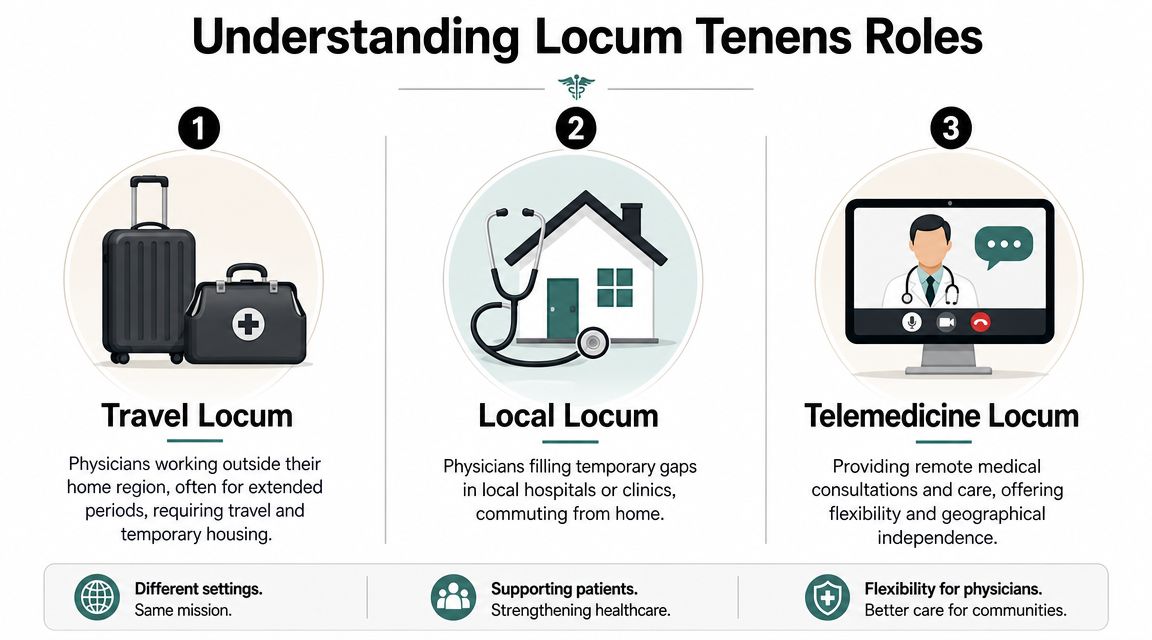
The three common models
Some physician locum jobs are built for short bursts. Others function almost like an interim staff role. A third group is fully remote and strips out travel entirely.
| Locum Type | Typical Duration | Common Use Case | Best For Physicians Who... |
|---|---|---|---|
| Short-term onsite | Weeks to a few months | Vacation coverage, sudden vacancy, seasonal demand, leave coverage | Want flexibility, variety, or supplemental work without a long commitment |
| Long-term onsite | 6 to 12+ months | Extended staffing gaps, slow permanent recruitment, service line stabilization | Want predictable income and schedule without committing to a permanent job |
| Telemedicine locum | Varies by contract | Remote follow-up care, outpatient coverage, behavioral health, asynchronous or scheduled virtual care | Want geographic flexibility, home-based work, or less travel friction |
Short-term assignments
Short-term work is often the easiest entry point. You test whether you like the locum model, learn how quickly you adapt to new systems, and get a feel for what kind of facility support you need.
The upside is variety and control. The downside is more frequent transitions. If you hate repeated onboarding, repeated badge setups, and learning a new workflow every few months, short-term assignments can get old fast.
Practical rule: If you're burnt out from instability, don't assume the shortest contract is the most restorative one.
Long-term assignments
A long-term locum role can be the sweet spot for physicians who want freedom without constant churn. You still avoid a permanent hire commitment, but you get enough runway to settle into a service, understand the staff, and stop feeling like the new person every week.
That model works particularly well during relocation, after leaving a difficult employed job, or when you're deciding whether a specialty shift or practice setting change is sustainable.
For a concise primer on terminology and fit, this locum job overview for clinicians is useful.
Telemedicine locums
Telemedicine locum work changes the equation if your biggest stressor is not the medicine itself but the logistics around it. No airport. No hotel. No credentialing for a physical facility badge and parking maze.
That said, remote doesn't automatically mean easy. You still need clarity on visit volume, inbox work, documentation expectations, technical support, and whether the role is genuinely bounded or subtly spills into unpaid administrative time.
Later, if you're comparing opportunities beyond the U.S., it's also worth taking time to explore UK psychiatry job market trends, especially if psychiatry or telehealth practice models are part of your longer-term plan.
A brief video can help if you're still deciding whether the model fits your career stage.
Understanding the Financial Landscape of Locum Work
A physician can leave a draining employed job on Friday, start a locums assignment a few weeks later, and see a cleaner pay structure right away. That clarity matters if your goal is not just to earn more, but to stop trading every extra dollar for exhaustion.
Locums pay is often stronger than physicians expect once you price the whole assignment instead of the posted hourly rate. One locum tenens salary by specialty guide reports average hourly compensation around $239, with annual earnings for full-time locums varying widely by specialty and market.
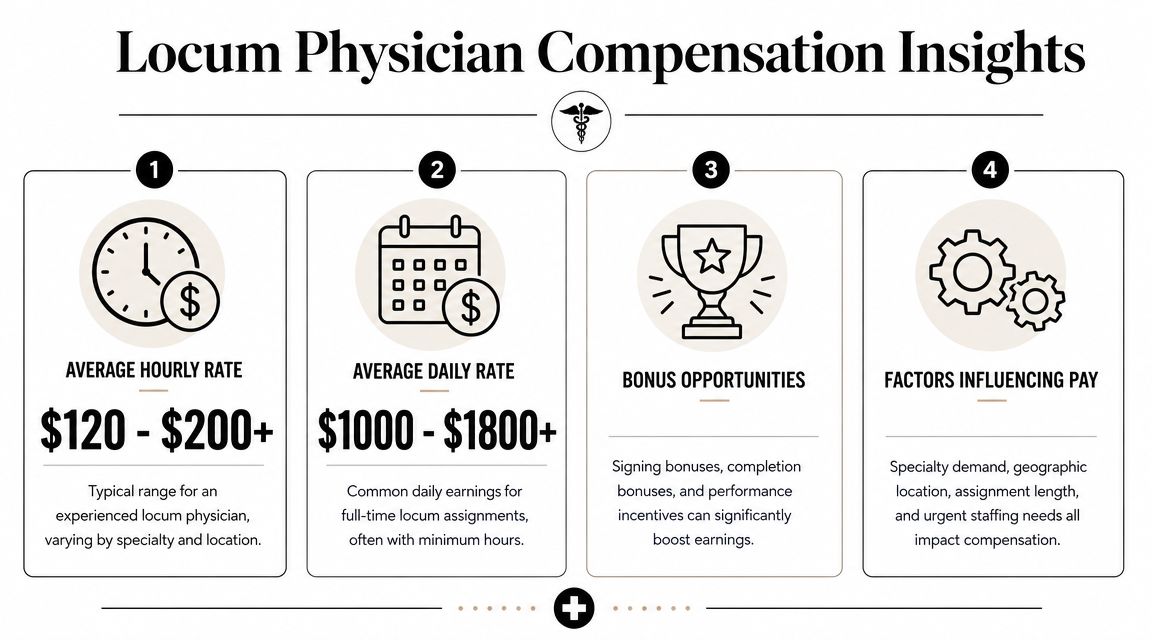
Hourly rate is only the starting point
I never judge a locums offer by rate alone. A high number can hide a rough schedule, unreliable hours, or enough travel friction to make the assignment a poor deal.
A fair review of physician locum jobs should include:
- Base clinical pay: Confirm whether payment covers scheduled hours, patient-facing time only, or a daily guarantee.
- Guaranteed minimums: If the census drops or cases fall off, ask whether your pay drops too.
- Travel and lodging: Covered flights, hotel, rental car, or housing stipends can materially change the value of the contract.
- Malpractice coverage: Included tail or claims-made coverage saves money and administrative work.
- Work intensity: A premium rate loses its appeal if every shift is overloaded or the call burden wrecks your recovery days.
The same salary guide notes that rural and underserved assignments often command higher rates than urban ones. In real terms, included housing, travel, and malpractice can shift the value of an offer by far more than many physicians first assume.
Focus on net value, not just gross pay
The question is not whether one job pays more on paper. It is whether the contract helps you hit your financial goals without pushing you back toward burnout.
That trade-off is where locums becomes a career tool instead of a stopgap. A role with predictable hours, paid travel, and limited call may outperform a nominally higher-paying staff job once you factor in unpaid admin time, commute burden, and the cost of being chronically depleted. Physicians who are using locums strategically often care as much about protected recovery time and income predictability as they do about top-line compensation.
If you are benchmarking against employed compensation, a comprehensive hospitalist salary guide helps put permanent offers in context.
What usually drives locums earnings
Four factors shape compensation more than anything else:
Specialty demand
Coverage gaps are not evenly distributed. Specialties with persistent shortages usually have more negotiating room.Geography
Harder-to-staff locations tend to pay more. The trade-off may be travel time, licensing hassle, or time away from home.Schedule design
Daytime clinic work, nocturnist blocks, weekend call, and procedural coverage should never be priced as if they carry the same burden.Operational friction
Slow credentialing, poor scheduling, and disorganized onboarding can erode the value of an otherwise solid assignment.
For physicians building a longer-term contract strategy, this guide to healthcare contract jobs for physicians and other clinicians is a useful next read.
A strong locum offer pays well, and it gives you a work pattern you can sustain.
How Locum Jobs Reshape Your Schedule and Lifestyle
The biggest lifestyle advantage in locums isn't freedom in the abstract. It's control over the shape of your work.
That matters more than many physicians realize until they've spent years in jobs where every extra meeting, call shift, and "quick favor" lands on the same people. If your current role has blurred the line between professional obligation and permanent availability, physician locum jobs can rebuild that line.
Why physicians choose locums for sustainability
Physicians increasingly use locum work for career sustainability, not just extra cash. The top reasons include more schedule control and flexibility, supplementing income, bridging career gaps, keeping skills sharp, avoiding overwork and burnout, and transitioning into retirement, according to this summary of why locum tenens works for physicians.
That's the key shift. Locums isn't one kind of job. It's a framework you can use differently depending on what you're solving.
What better schedule control actually looks like
A better schedule usually comes from contract boundaries, not good intentions. If the agreement defines the clinic days, the patient care setting, and the call expectations, you have a far better chance of protecting your time.
Burnout-conscious physicians tend to prioritize roles with features like these:
- Defined weekly structure: Predictable days make recovery possible.
- No-call or low-call design: This matters more than a slightly higher rate for many clinicians.
- Finite assignment windows: A contract with an end date gives you a natural reassessment point.
- Choice in pacing: Some physicians want blocks of intense work followed by time off. Others want consistent weekday rhythm.
When physicians say they want flexibility, they usually mean they want fewer surprises.
The trade-offs to admit honestly
Locums can reduce one kind of stress while introducing another. Travel can be tiring. New EMRs can be annoying. Temporary work can feel less socially anchored than a permanent practice where you know everyone and know where everything is.
But for many physicians, those stressors are cleaner. They are visible, bounded, and often easier to plan around than the chronic drain of an employed role that keeps taking more without renegotiating anything.
If you're trying to recover from burnout, don't chase flexibility as a vague ideal. Chase specifics. Weekday-only. No weekends. No overnight call. Limited inbox. Defined patient volume. That's where locums becomes sustainable instead of being different.
Navigating Contracts Credentialing and Taxes
This is the part many physicians underestimate. Physician locum jobs can improve your schedule and finances, but the paperwork side doesn't reward improvisation.
A bad contract, delayed credentialing packet, or sloppy tax setup can turn a promising assignment into an administrative mess. The cleanest locum careers usually come from physicians who get methodical early.
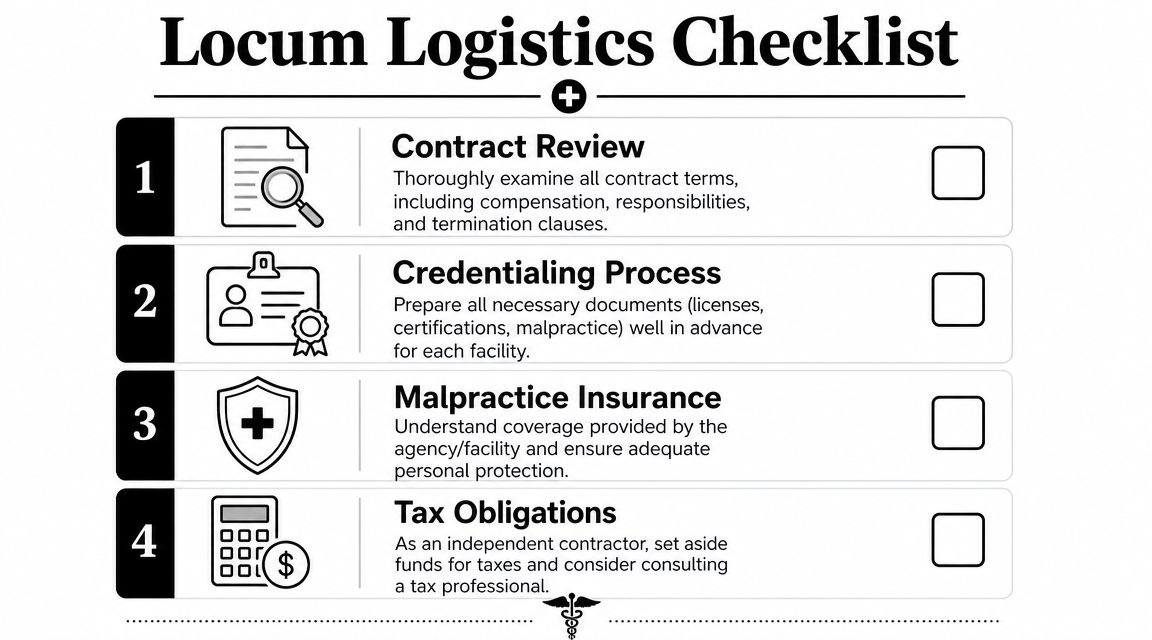
Contract points that deserve close reading
Most contract problems are predictable. The issue is that busy physicians often review terms when they're already exhausted and eager for a change.
Read slowly, and pay attention to these items:
- Scope of work: Your clinical duties should be specific. If the role includes clinic, inpatient coverage, procedures, call, or supervision, each should be explicit.
- Schedule language: Look for exact days, shift length, and who can change the schedule once you're booked.
- Cancellation terms: You need to know what happens if the facility cuts shifts or ends coverage early.
- Payment mechanics: Confirm when invoices are submitted, when you're paid, and whether travel time or call availability is compensated.
- Malpractice details: "Covered" isn't enough. Ask what policy is provided and whether any tail obligation could land back on you.
Credentialing is slow until it isn't
Shortage-area work often comes with extra logistical complexity. A study of assignment data from July 2022 to June 2024 found that 71% of locum physician worksites were in HPSA zip codes, which helps explain why many assignments involve facilities with urgent staffing needs and uneven local infrastructure, as described in this analysis of locum work in shortage areas.
That has practical consequences. Rural and underserved placements may be highly worthwhile, but they often require more patience with onboarding details, travel planning, and local workflow adaptation.
Bring your own organized credentialing file. Don't rely on memory when every hospital wants the same information in a slightly different format.
A good packet usually includes current license documents, board certification, DEA if relevant, immunization records, references, procedure logs if needed, and a CV that's updated before anyone asks for it.
For a step-by-step reference, this physician credentialing guide is worth bookmarking.
Taxes and business habits
Many locum physicians are paid as independent contractors. That changes how you should think about taxes, retirement contributions, and cash flow. If you've spent most of your career as a W-2 employee, this is one area where guessing gets expensive.
Keep the approach simple:
Separate business and personal money early
A dedicated account makes tracking cleaner.Set aside taxes from the first payment
Don't wait to "see how the year goes."Track every reimbursable or deductible item carefully
Travel, licensing, and professional expenses need documentation.Use a CPA who understands physician contract work
General tax help isn't always enough.
The physicians who do locums well treat the admin side like part of the job, because it is.
How to Find and Evaluate Burnout-Conscious Roles
You finish a clinic day that was supposed to end at 5:00. It is 7:10, the inbox is still full, and a recruiter texts about a high-paying locums assignment that starts next month. The rate looks good. The schedule description is two lines long. That is where many bad locums decisions start.
Most physician locum jobs are sold on urgency and compensation. Neither tells you whether the assignment will preserve your energy, protect your time off, or reduce the kind of friction that drives burnout. If your primary goal is a career reset, better income with fewer hidden costs, or more control over your week, your screening process has to be stricter than the recruiter's.

Look past the rate first
A systematic review on locum recruitment and retention found that pay matters, but schedule flexibility and career factors also shape whether physicians take and keep these roles.
That matches what many of us see in practice. A burnout-conscious role is defined less by headline pay and more by how the workday is built. Clear start and stop times. Limited call or no call. Adequate support staff. A patient volume that fits the setting. A handoff process that does not leave you cleaning up preventable chaos.
A well-paid assignment can still cost you more than it gives back if every shift runs over, the charting follows you home, and nobody can tell you who covers when census spikes.
Questions that expose the job behind the pitch
You do not need a dramatic negotiation style. You need questions that force specificity.
Ask these early:
- What does a normal day look like, hour by hour? Get details on patient volume, acuity, staffing, documentation, and what commonly delays departure.
- How often does the schedule change after booking? Frequent changes are one of the fastest ways to turn flexible work into chronic stress.
- What call responsibilities exist, and what does "light" call mean here? Ask for callback frequency, overnight interruptions, and post-call expectations.
- What work is not listed in the job description? Inbox coverage, supervision, committee tasks, and chart completion all count.
- Who is available when the unit gets busy or a case goes sideways? Lack of backup is a burnout issue, not just an operations issue.
- Why is this role open? Expansion, leave coverage, and chronic turnover create very different working conditions.
One answer rarely tells the whole story. Patterns do.
What burnout-conscious roles have in common
The assignments worth serious attention usually share a few traits. The scope is defined. The facility can explain the workflow without hedging. The schedule is stable enough that you can plan your life around it. The team understands what the locums physician is there to do, and what falls outside that lane.
That last point matters more than many physicians expect. Burnout often comes from role sprawl. A reasonable clinic load becomes unreasonable when you also inherit inbox cleanup, understaffed triage, and vague supervisory duties.
Where curated job filters can help
Traditional agencies still have value, especially in specialties where speed and licensing support matter. But if you are trying to use locums strategically instead of reactively, broad job boards can waste a lot of time. You end up sorting through assignments that pay well but carry the same call burden, scheduling instability, or administrative drag you were trying to leave.
WeekdayDoc is one physician-founded platform that focuses on burnout-conscious roles and surfaces schedule details such as no call and no weekends, along with compensation data and a Burnout-Friendly Score. That kind of filtering is useful because it screens for work design, not just open shifts.
If a recruiter cannot explain the schedule clearly in two minutes, the job is probably less controlled than it sounds.
A practical screening checklist
I sort locums roles into three groups.
Pursue now if the schedule is defined, the scope is narrow, the support structure is clear, and the assignment solves a specific problem for you, such as income goals, recovery time, geographic flexibility, or fewer nights and weekends.
Investigate carefully if the pay is strong but the workflow is vague, support staffing is uncertain, or the facility minimizes call without quantifying it.
Walk away if the facility wants a fast yes before answering basic questions. The same applies when you hear phrases like "everyone helps with everything" or "we will sort out the details on arrival." Those are not small warnings. They usually predict a role with fuzzy boundaries and a higher stress load.
Good locums work should do more than fill open dates. It should give you back control.
Frequently Asked Questions About Locum Jobs
How should I handle taxes and retirement if I'm a 1099 contractor
Treat locums income like a small business from day one. Open a separate checking account, move a set percentage of every payment for taxes, and do not wait until spring to find out what you owe. A CPA who works with physician contractors can help you plan quarterly payments, track deductions cleanly, and choose a retirement setup that fits your mix of locums income, W-2 work, and long-term savings goals.
Do I need my own malpractice insurance
Sometimes. Many assignments include coverage, but the details matter more than the label. Ask whether the policy is claims-made or occurrence-based, whether tail coverage is included, and whether moonlighting, procedures, or supervision are excluded.
I have learned to get those answers before signing anything. Malpractice problems rarely start with a missing policy. They start with vague assumptions about what the policy covers.
How far in advance should I start looking
Start earlier than you think you need to. Licensing, privileges, and payer enrollment can drag out the process, even for jobs described as urgent.
If you are using locums as a career reset, a financial strategy, or a way to step down your stress load, early planning gives you better choices. Waiting until you are exhausted usually leaves you choosing from whoever needs coverage fastest, not from roles that fit your life well.
Can I work with multiple locum agencies at once
Yes, and many physicians do. Keep tight records so the same hospital does not get your file from two recruiters. A basic spreadsheet is enough if it includes the recruiter, facility, specialty, pay terms, travel terms, submission date, and current credentialing status.
Organization saves more headaches than negotiation does.
Are physician locum jobs a good fit if I want less burnout, not more travel
Often, yes. Locums does not have to mean airports every week. Some of the best assignments for burned-out physicians are local weekday coverage blocks, telemedicine work, or short-term roles with narrow scope and predictable hours.
The trade-off is that you need to screen for work design, not just rate. A high-paying assignment with frequent call, weak support, and open-ended expectations can wear you down faster than a lower-paying role with clean boundaries.
Is locums only for doctors between permanent jobs
No. Many physicians use locums that way, but plenty of us use it more strategically. It can help you pay down debt, test a new region, cut back on nights and weekends, preserve clinical income while recovering from burnout, or build a semi-retired schedule.
The better question is whether a given assignment moves you toward the kind of practice and life you want now.
What's the fastest way to tell if a role is wrong for me
Listen for fuzzy answers. If the facility or recruiter cannot explain the daily schedule, patient volume, support staff, documentation load, and call expectations in plain terms, expect friction.
That mismatch is where burnout gets worse. A good locums role should lower strain, improve control, or serve a clear financial goal. If it does none of those, pass.
As noted earlier, some physician-focused platforms make this screening easier by highlighting schedule structure and burnout-related filters before you spend time on another call.