What Is a Locum Job? A Clinician's Guide for 2026
Wondering what is a locum job? Our 2026 guide explains pay, contracts, and how to find burnout-friendly locum tenens roles with better work-life balance.

You're probably not asking “what is a locum job” out of pure curiosity.
You're asking because your current setup may be grinding you down. The inbox fills overnight. Prior auths and charting swallow the part of the day that used to belong to patients. Call spills into evenings. Weekends stop feeling like recovery. A lot of clinicians reach the point where they don't need a motivational speech. They need a different structure.
That's where locum tenens can become useful. Not as a desperate fallback, and not as random temp work, but as a deliberate way to regain control over schedule, workload, and career direction. A locum job is a temporary clinical assignment where a physician or advanced practice provider fills in for another clinician who is absent. The term comes from Latin for “to hold the place of.” In practice, it can mean covering clinic sessions, hospital shifts, procedure days, telehealth blocks, or a defined service line for a set period.
This path is no longer fringe. In the U.S., CHG Healthcare's 2025 State of Locum Tenens Report says about 57,000 doctors, roughly 8% of physicians, were currently accepting temporary assignments, and locum tenens has grown every year since 2021, making it the only temporary healthcare staffing segment to do so over that period, according to CHG Healthcare's 2025 State of Locum Tenens coverage on Locumstory. The same source notes that a 2023 NIH review found nearly 10,000 physician locum jobs listed with one agency alone.
Those numbers matter because they change the question. The question isn't whether locums is “real medicine.” It is. The better question is whether you can use it strategically to build a more sustainable version of practice.
Introduction
Burnout rarely announces itself dramatically. More often, it shows up as quiet dread before Monday clinic, resentment when a “light” admin day disappears into messages, and the sense that your calendar belongs to everyone except you.
A lot of clinicians look at locums only after a resignation, a move, a family change, or a bad contract. That's too late. The more useful way to think about a locum job is as a career reset button you can press before exhaustion hardens into cynicism. Temporary work can create breathing room. It can let you test a new setting, cut back call, stack clinic-only weeks, or rebuild your finances while you decide what long-term practice should look like.
I've seen colleagues make two opposite mistakes. One assumes locums is chaotic side work for people in transition. The other assumes it automatically fixes burnout. Neither is true. A good locum arrangement offers an advantage. A bad one moves your stress to a different building.
What makes locums worth serious attention now is that the market has enough depth to support selective decision-making. You don't have to say yes to every opening. You can look for work that matches an actual goal: fewer nights, fewer politics, a cleaner handoff after each assignment, or a more predictable month.
Burnout-friendly work isn't always less work. Often it's work with clearer boundaries, fewer hidden obligations, and a schedule you actually chose.
That's the main appeal. If you approach locum tenens as a strategy instead of an escape hatch, it can help you keep practicing medicine without letting medicine consume the rest of your life.
What a Locum Job Really Means for Clinicians
A textbook definition won't help much unless it explains how locums functions in the actual labor market.
Locum tenens means temporarily holding a clinical role for someone else. Functionally, that role exists because a facility has a gap it can't leave uncovered. The gap may come from vacation, illness, parental leave, retirement, an unfilled position, seasonal demand, or a permanent search that is taking too long.

It's important to understand that locums isn't just ad hoc shift filling. It has become part of how healthcare organizations maintain service lines. The AMA cited a 2022 AMN Healthcare survey showing nearly 90% of hospitals, medical groups, and other facilities used locum tenens hiring while permanent searches were underway, as noted in the AMA's overview of locum tenens for physicians.
Why facilities rely on locums
Facilities use locums because patients still need care when staffing plans fail. In that sense, a locum clinician is not an extra. You're often the staffing bridge that keeps access open.
That has several practical consequences:
- You're being hired to solve a defined problem. That usually means the schedule, site, and scope should be spelled out more clearly than in vague “opportunity” language.
- You may enter a strained environment. If a group needs urgent coverage, there may be workflow problems, staffing shortages, or operational friction behind the opening.
- You have a negotiating advantage when the role is hard to fill. That advantage is most useful when you know your absolute must-haves before the first call with a recruiter.
For clinicians who want a fuller primer on the basic concept, this explanation of locum tenens meaning is a useful companion.
What locums is and isn't
Locums is temporary by design, but temporary doesn't mean unserious. Many assignments are structured contracts with credentialing, orientation, defined duties, and specified coverage windows. In other words, the work may be short-term, yet the planning around it can be extensive.
It also isn't automatically lifestyle-friendly. A locum role might be clinic-only and beautifully contained. It might also involve weekend call in a site that has burned through permanent staff. The label “locum” tells you the employment model. It doesn't tell you whether the daily life is sane.
A smart locum search starts when you stop asking, “Is it temporary?” and start asking, “What exact problem am I being hired to solve?”
That mindset protects you. It also turns locums from a loose category into a decision tool.
Common Locum Assignment Models
When clinicians first hear “temporary assignment,” they often picture isolated shifts and constant travel. That's only one version. In practice, locum work tends to fall into a few recognizable models.
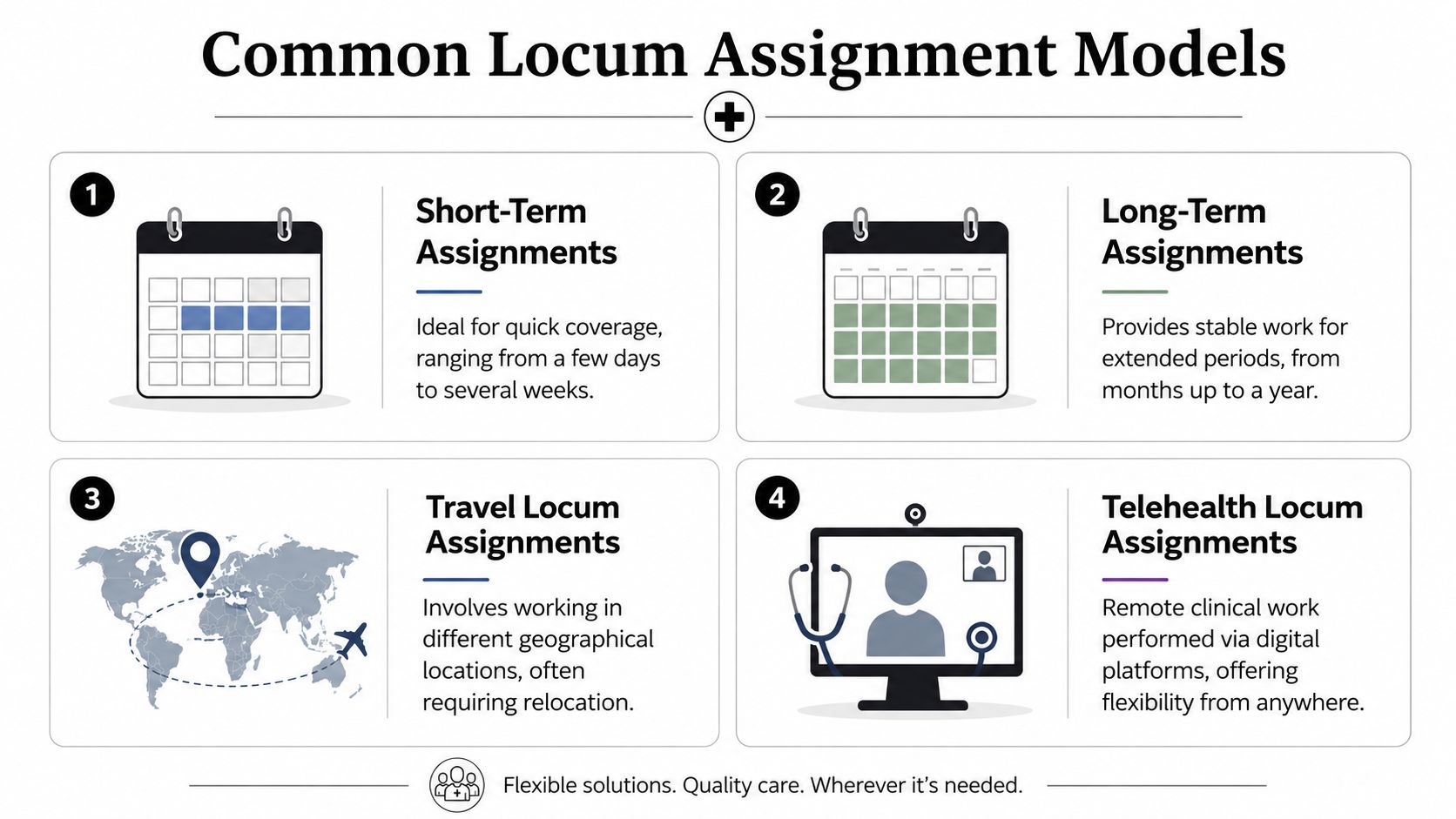
Short-term assignments
These are the classic gap-fill jobs. A clinician covers for a vacation, leave, conference period, or a brief staffing hole. They can work well if you want flexibility without a long commitment.
Short assignments suit clinicians who want to sample different environments or add income around another role. The downside is that frequent onboarding can become tiring. If every new assignment means new logins, new workflows, and a fresh learning curve, the flexibility can start to feel expensive.
Long-term assignments
Some locum jobs stretch across months and can continue up to a year in some cases. These often exist because a service has a durable vacancy or because a permanent search hasn't closed.
For many burnout-conscious clinicians, this is the sweet spot. You get more continuity and a steadier schedule without locking yourself into a permanent contract too early. The trade-off is that a long assignment can start to resemble a permanent role operationally, except you still need to manage contractor realities on your own side.
Travel locum assignments
Travel assignments involve working away from home, sometimes regionally and sometimes across the country. They can be appealing if you want variety or if your specialty has better conditions in other markets than in your local one.
Travel expands your options, but it adds friction. Airports, rental cars, temporary housing, and being the new person repeatedly can wear people down faster than they expect. A travel assignment only helps burnout if the schedule improvement is large enough to justify the logistical load.
Telehealth locum assignments
Remote locum work can be the most practical option for clinicians who want control without constant relocation. These assignments may involve scheduled virtual visits, behavioral health work, follow-up care, or other defined remote services.
Telehealth can remove commute and travel stress. It doesn't automatically reduce workload. A remote role with unrealistic visit volume, uncompensated inbox work, or poor support can be just as draining as an in-person one.
Locum Tenens Assignment Models Compared
| Assignment Model | Typical Duration | Common Setting | Best For |
|---|---|---|---|
| Short-Term Assignments | A few days to several weeks | Hospital coverage, urgent clinic gaps, leave coverage | Clinicians who want flexibility or occasional supplemental work |
| Long-Term Assignments | Several months up to a year | Ongoing service gaps, extended leaves, delayed permanent hiring | Clinicians who want stability without permanent commitment |
| Travel Locum Assignments | Varies by contract | Rural sites, underserved facilities, distant hospital systems | Clinicians open to relocation for stronger fit or better scheduling |
| Telehealth Locum Assignments | Varies by contract | Virtual clinics, behavioral health, remote follow-up care | Clinicians prioritizing location freedom and reduced commute burden |
How to choose the right model
The right fit depends less on specialty than on tolerance for unpredictability.
- If you need maximum control, short-term or telehealth assignments may fit best.
- If you want income continuity, long-term placements are usually easier to build around.
- If geography is your main constraint, telehealth or local short-term work is safer than travel-heavy roles.
- If you're trying to recover from burnout, avoid confusing novelty with rest. A new setting isn't always a lighter setting.
A workable locum plan usually mixes these models over time. You might use one long-term assignment to stabilize finances, then shift into selective short-term or remote work once you've rebuilt margin.
Navigating Pay Contracts and Logistics
Locum jobs transition from a concept to a business arrangement. If you don't understand the contract structure, the headline pay can mislead you.

A key distinction is that locum clinicians are commonly treated as independent contractors rather than employees, according to Weatherby Healthcare's explanation of locum tenens contractor structure. That matters because contractor pay is built differently. Since you typically don't receive traditional employer benefits, hourly or daily rates are often set above salaried equivalents to offset self-employment tax, benefit replacement, and the cost of flexibility. Agencies may also cover travel, housing, licensing, and credentialing logistics in the same model.
What the pay rate does and doesn't tell you
A strong rate is only a starting point. It doesn't tell you your effective net income after taxes, unpaid travel time, assignment gaps, retirement contributions, and health insurance.
When evaluating offers, look at the whole package:
- Compensation method whether hourly, daily, shift-based, or session-based
- Guaranteed hours or lack of them
- Travel and housing support and whether the agency books it or reimburses you
- Malpractice details including who carries the policy
- Cancellation terms so you know what happens if the facility changes plans
- Credentialing timeline because delays can leave you with dead weeks and no revenue
If you're comparing contract-based roles more broadly, this guide to healthcare contract jobs helps frame the issues beyond just rate shopping.
Practical rule: Never compare a locum offer to a salaried job using gross pay alone. Compare the total workload, time cost, tax burden, and benefit replacement burden.
Benefits you now have to build yourself
The freedom of locums comes with administrative responsibility. If you're a 1099 contractor, you usually need your own approach to health insurance, disability coverage, retirement savings, and tax planning.
That doesn't make locums a bad deal. It means you need systems.
A simple checklist helps:
- Set aside taxes from the first payment. Don't wait until year-end.
- Open dedicated business banking. Separation makes bookkeeping cleaner.
- Choose a retirement vehicle early. The best option depends on your situation and your advisor's guidance.
- Review your insurance setup before the first assignment starts. Coverage gaps are easy to miss when you're focused on credentialing.
For clinicians sorting through coverage options outside traditional employment, Pounds Health Insurance's 2026 independent contractor guide is a practical resource.
What a good agency relationship looks like
A recruiter can save you time or create work you didn't know you were signing up for.
Useful agency partners are specific. They answer direct questions about schedule, patient mix, support staff, EMR, orientation, and malpractice. Weak ones stay vague, oversell flexibility, and treat every opening as interchangeable.
Ask blunt questions before you sign:
- Who is handling credentialing and state licensure logistics?
- Is housing booked centrally or reimbursed later?
- What call, if any, is attached to the assignment?
- How often has this site used locums before?
- What happened with the last clinician in the role?
If the answers stay fuzzy, assume the assignment will be harder than advertised.
The Real Pros and Cons of Locum Tenens
Locums has real upside, but it's not a cure-all. It works best when you use it to solve a specific problem.
One clear advantage is schedule control. CHG Healthcare's 2025 report says approximately 29% of physicians choose locum tenens specifically to control their own schedules and better balance work with personal life, and 56% of locum physicians begin locums within 10 years of entering practice, according to CHG Healthcare's 2025 State of Locum Tenens Report. The same report notes that healthcare organizations' actual locum utilization in 2024 was 25% higher than projected.
Where locums can help
The biggest benefit for many clinicians is boundary control. You can choose work that narrows your role to the part of medicine you still like doing. That might mean procedure days, outpatient blocks, consult coverage, or telehealth sessions with clearer start and stop times.
Other advantages often include:
- Reduced exposure to internal politics because you're not tied into every committee, policy conflict, or leadership shift
- Variety of practice settings which can sharpen judgment and help you see what kind of environment fits you
- Potentially stronger cash flow when rates are favorable and downtime is managed well
- A lower-friction exit path if a site isn't a good match
For some clinicians, that combination is enough to make medicine feel tolerable again.
Where locums can disappoint
The downsides usually show up in the spaces between assignments and around the edges of each contract.
You may have:
- No traditional employer benefits
- Variable income from month to month
- Travel fatigue or housing disruptions
- Professional isolation, especially if you're frequently the outsider
- Less influence over operations even when you clearly see what isn't working
The flexibility people want from locums and the stability they need from work are not the same thing.
That distinction matters. If what's burning you out is constant unpredictability, a loosely structured locum life can make things worse. The answer isn't “more flexibility” in the abstract. The answer is selective flexibility, with enough continuity to protect your mental bandwidth.
The strongest clinicians in locums usually know what they're optimizing for. Some want freedom. Others want a bridge to a permanent role. Others want a cleaner, no-call practice model for a few years. Problems start when people chase a higher rate without deciding what kind of life they're trying to build.
How to Find Burnout-Friendly Locum Roles
The right locum job is not the highest-paying job. It's the job whose structure protects your energy well enough that you can keep practicing without hating your week.

A common misunderstanding among clinicians concerns the nature of locum tenens work. It can range from a few days to several months, and some facilities use locums to cover vacations, sabbaticals, or sudden surges in demand. That means a locum role is not automatically weekday-friendly or low-stress. The schedule depends heavily on the contract and site needs, as explained in this guide to domestic locum tenens scheduling realities.
Start with non-negotiables, not opportunities
Before you talk to recruiters, write down what would reduce burnout for you.
For example:
- No call if nighttime interruption is your main problem
- No weekends if family time is what keeps collapsing
- Clinic-only work if inpatient throughput has become the issue
- Predictable session blocks if constant add-ons are draining you
- Limited travel radius if time away from home defeats the purpose
A lot of bad fits happen because clinicians start with “What's available?” instead of “What am I protecting?”
Ask questions that reveal the real workload
The contract may say temporary coverage. That tells you almost nothing about the lived experience.
Ask for operational detail:
- What does a typical day look like?
- How many patients are booked, seen, or rounded on?
- Who handles inbox messages, prior auths, and refill requests?
- Is there protected admin time or are you expected to catch up after hours?
- Are weekends technically optional but socially expected?
- Is “no call” no call, or is there backup phone responsibility?
One sharp question often reveals more than ten generic ones: Why did this role become open? If the answer is evasive, be careful.
Some assignments offer flexibility. Others offer volatility dressed up as flexibility.
That difference is often visible in cancellation terms, notice periods, and how confidently the site describes workflow.
Screen for schedule stability
If your goal is sustainability, schedule stability matters as much as rate.
Look closely at:
- Assignment length because short contracts can create frequent re-entry stress
- Notice requirements so you aren't left with an empty month unexpectedly
- Shift clustering if you prefer compressed work over scattered obligations
- Orientation quality because chaotic onboarding predicts chaotic practice
- Administrative support since understaffed clinics often push hidden work onto physicians and APPs
This is also where tools can help. WeekdayDoc lets clinicians filter for roles with No Call and No Weekends markers and review role details through a Burnout-Friendly Score, which is useful when you're trying to narrow options based on schedule design instead of broad specialty labels.
A short video can help you think through the decision process more concretely.
Build your contractor life so it supports your clinical life
Burnout doesn't only come from patient care. It also comes from preventable financial chaos.
If you're using locums as a sustainable model, set up the basics early:
Health insurance plan Don't leave this until after your first contract. Losing employer coverage can create rushed decisions.
Retirement workflow Automate contributions if possible. Otherwise, the money tends to stay in checking.
Tax system Save records as you go. A messy year of 1099 income creates stress that can erase the emotional benefits of schedule control.
Recovery time Leave white space between assignments when travel or onboarding is heavy. Back-to-back contracts look efficient on paper and feel awful in real life.
The clinicians who do best in locums usually treat schedule design as part of preventive medicine. They don't just ask whether they can do the assignment. They ask whether the assignment supports the kind of doctor, partner, parent, or person they want to remain.
Use WeekdayDoc for Your Locum Search
If you want locum work that actually helps with burnout, generic job search methods are often too blunt. You end up sorting through roles that are technically temporary but practically unworkable.
A more effective approach is to search with filters tied to the life you want. WeekdayDoc's locum tenens physician jobs board is built around that idea. You can review locum roles with schedule details, work-style context, and markers such as No Call and No Weekends, which matter more than a broad specialty label when you're trying to protect recovery time.
The platform also includes tools that fit the contractor reality. Salary views and FIRE projections help you think past the posted rate. The Burnout-Friendly Score gives you a quicker way to evaluate whether a role looks sustainable before you spend time in recruiter calls. That's useful whether you're planning a full locum transition or just looking for a cleaner bridge role while you step away from a draining permanent job.
Use the search like a filter for your future, not a catalog of every opening. The goal isn't to find any locum job. It's to find one that leaves enough of you intact to keep doing good work.
If you want a simpler way to find no-call, no-weekend, and burnout-conscious locum roles, explore WeekdayDoc.