Physician Moonlighting: A Practical Guide to Pay & Rules
Learn about physician moonlighting, including pay rates, regulations, and tips to avoid burnout. A practical guide for doctors seeking extra income.

You've finished clinic, signed the last note, and your phone lights up with a text about a weekend urgent care shift. That's how most physician moonlighting decisions start, not with a grand plan, but with a tired doctor doing the math on time, cash flow, and how much more work they can absorb without wrecking next week.
The right question isn't, “Can I pick up extra shifts?” It's, “Is this side work a smart job-design choice, or am I buying short-term cash with long-term exhaustion?” That distinction matters because moonlighting can be a real income tool, but it can also become a contract problem, a malpractice problem, or a burnout problem if you treat it like a casual extra.
What Physician Moonlighting Actually Means
Physician moonlighting means paid clinical work you do outside your primary job, usually on an hourly or per-shift basis, while you stay employed elsewhere. In plain English, it's side clinical work layered on top of your main role, not a replacement for it.
That's different from locum tenens, where you temporarily fill a primary staffing gap for a defined period. It's also different from simple per-diem work if the per-diem slot is really just an extension of your main employment, since moonlighting usually means you're taking on an additional, separate job. The practical distinction matters because the contract, liability, and tax treatment can change a lot depending on which bucket the work falls into.
The people who moonlight are not all the same. In residency, moonlighting often shows up in senior trainees where program rules allow it, and the data show how program policy shapes behavior. In a survey of Brazilian medical residents, 1,140 of 1,419 residents, 80.3%, reported moonlighting, with an average workload of 14.1 ± 9.4 hours per week, and 99.5% said the compensation was not fair or adequate, which tells you how closely side work has historically been tied to coverage gaps and income pressure in training environments (Brazilian resident survey).
Practical rule: If the work sits outside your main employment, is paid separately, and depends on your own license and coverage, treat it like moonlighting until proven otherwise.
That's the working definition I use when I review an offer. If it's extra paid clinical work on top of your main job, it's moonlighting, even if the recruiter uses softer language. If it temporarily replaces your primary role, it's closer to locums. If it's just an extra shift inside the same employer structure, read the contract carefully before you call it anything.
The Five Main Types of Moonlighting Work
Hospital, ED, and per-diem coverage
The most familiar format is hospitalist, emergency department, or inpatient per-diem coverage. This usually means you're plugging a staffing hole, covering a census spike, or taking an overnight or weekend block that the core team can't absorb.
This model is attractive because the work is concrete and the scope is familiar, but it can get ugly fast if the EMR is clunky or the sign-out culture is weak. The pay-to-effort ratio can be good, but only if you know the system and the shifts stay within your stamina.
Telehealth and remote overnight coverage
Telehealth moonlighting is the cleanest option for physicians, NPs, PAs, psychologists, and pharmacists who want to avoid commute time and physical drain. The upside is obvious, you can work from home, but the core question is whether the role's documentation burden stays bounded.
Remote work can be deceptively tiring because it looks easy on paper and eats the same cognitive bandwidth as an in-person shift. If the role asks for endless inbox management or asynchronous follow-up that bleeds into your off-hours, the hourly rate starts to look worse.
Locum tenens blocks
Locum tenens usually pays more on the surface because you're filling a true gap, often for a weekend block, vacation coverage, or a short assignment. The hidden cost is administrative drag, credentialing, travel, unfamiliar workflows, and sometimes more complex malpractice arrangements.
If you're comparing a local moonlighting shift with a locums block, don't just compare hourly pay. Compare the amount of time you'll lose to onboarding, travel, and recovery afterward.
Urgent care and retail clinic work
Urgent care and retail clinic shifts are a different animal. They're often higher volume, lower acuity, and more protocol-driven, which can feel efficient if you like fast turns and predictable complaints.
The trade-off is repetition and pace. Some clinicians find the flow energizing. Others feel flattened by endless sore throats, minor injuries, and inbox tasks that never fully stop.
Mixed weekday and weekend side gigs
Some side gigs blend formats, like a weekday telehealth block plus a Saturday in-person shift, or a short stretch of overnight coverage paired with a lighter daytime role. These can work well if you're trying to smooth income without overcommitting to one setting.
The test is whether the mix respects your primary job. If the side gig constantly interrupts sleep, call recovery, or family time, the blended format stops being flexible and starts becoming a trap.
| Format | Typical Shift | Pay Range (USD/hr) | Burnout Load |
|---|---|---|---|
| Hospital or ED per-diem | 6 to 12 hours | Varies by market | Moderate to high |
| Telehealth and remote coverage | 2 to 10 hours | Varies by market | Low to moderate |
| Locum tenens block | Weekend or multi-day | Varies by market | Moderate to high |
| Urgent care or retail clinic | 4 to 12 hours | Varies by market | Moderate |
| Mixed weekday and weekend split | Flexible | Varies by market | Depends on scheduling |
If you want the cleanest personal fit, start with the setting that matches your tolerance for noise, charting, and after-hours fatigue, not the one with the flashiest headline rate.
Contract, License, Malpractice, and Tax Basics
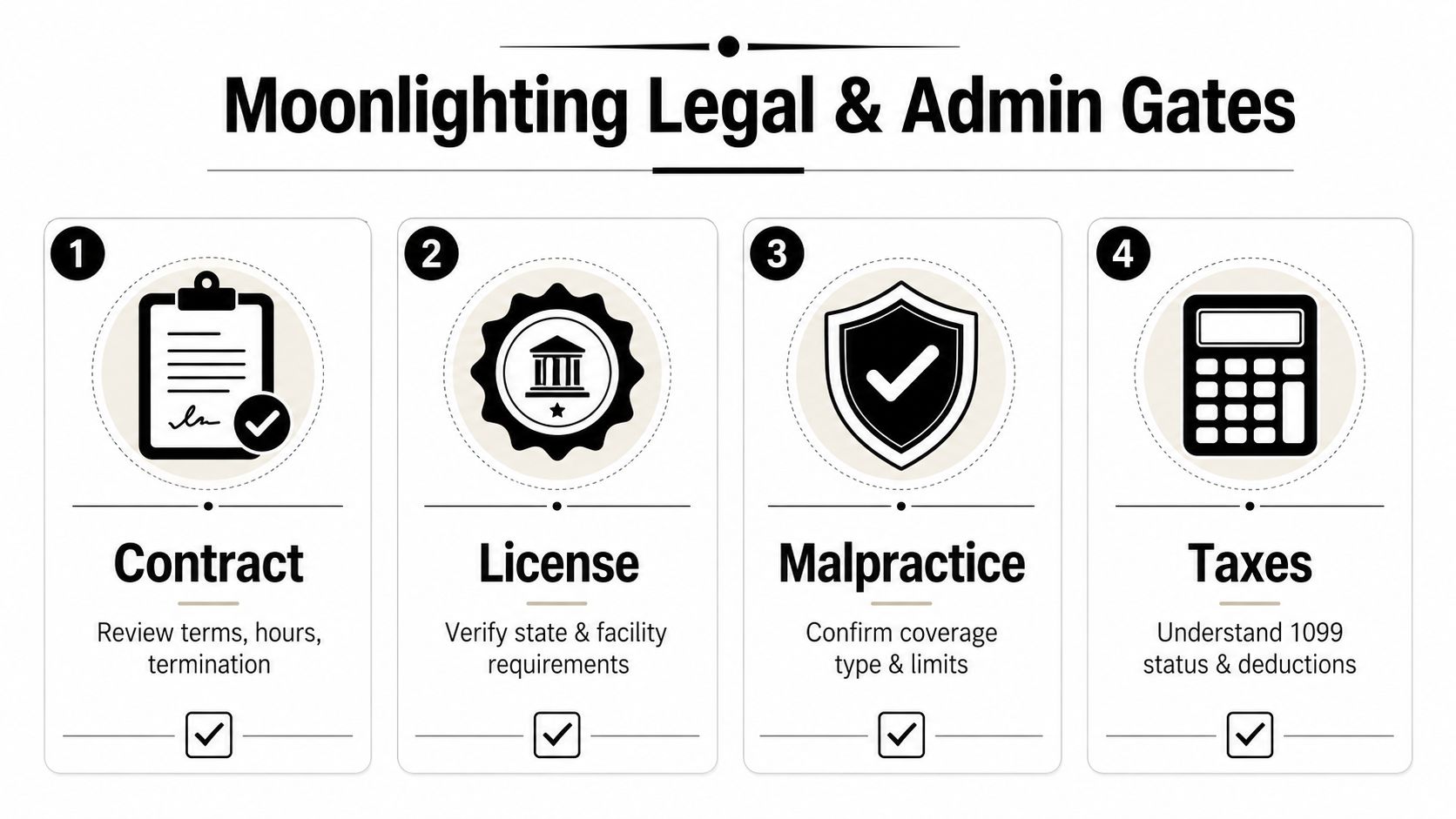
The first mistake people make is shopping for shifts before reading the primary contract. That's backwards. A Doximity survey summary reported that almost 30% of clinicians said they are explicitly barred from moonlighting, and another 24% are allowed only with strict caveats such as a noncompete clause, which means more than half face some form of restriction before they even accept a second job (Doximity summary).
Read the contract before the listing
Look for exclusivity language, outside employment clauses, moonlighting approvals, and noncompete terms. If your main employer wants prior written approval, get it in writing before you work the first side shift. If the contract is vague, assume the employer will read it in the most restrictive way possible if something goes wrong.
Verify license and facility requirements
For telehealth and cross-state work, your license situation matters more than your enthusiasm. A state license, facility credentialing, DEA status where relevant, and any site-specific onboarding rules all need to line up before you show up for a shift. If the employer can't tell you exactly what credentialing they need, that's a red flag.
Check malpractice coverage the hard way
A useful practical resource on coverage questions is the locum doctors umbrella guide, because the same core issues show up when you compare coverage structure, gaps, and liability expectations. For your own review, don't stop at “covered.” Ask whether the policy is occurrence or claims-made, whether tail coverage is included, and whether the moonlighting employer or your primary job is insuring the work.
For a deeper checklist on policy types and common coverage traps, I'd also keep the WeekdayDoc guide to physician malpractice insurance open while you review the offer.
Don't ignore taxes
If the work is 1099, you're running a business for tax purposes whether you like it or not. That means self-employment tax exposure, estimated payments, and cleaner bookkeeping than most clinicians keep by default. If the role is W-2, you still need to understand how the extra income fits with your broader tax picture.
Rule I follow: If a side job can't be explained clearly in one sentence for contract, malpractice, and tax treatment, I don't sign yet.
For a clinical checklist you can run quickly, I'd mark four boxes before accepting anything, contract, license, malpractice, taxes. If one box is fuzzy, fix that before you pick up the shift.
How Much Moonlighting Actually Pays
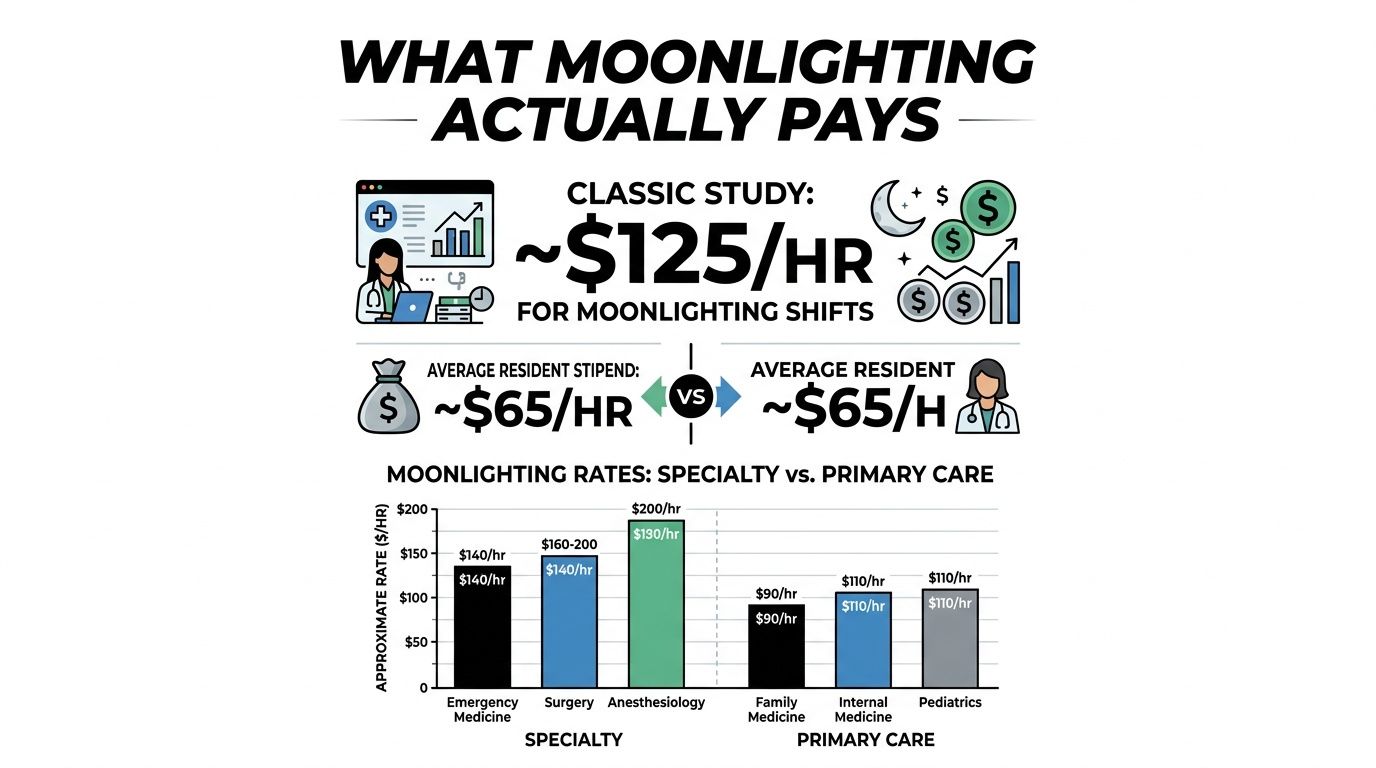
The money is real, but it's not uniform. A classic resident survey found moonlighting salaries generally doubled annual income, and many physicians used the money to pay down student loans and other debt (classic resident survey). That's why moonlighting still pulls hard on clinicians carrying debt or trying to accelerate savings.
Specialty and shift type change the result
The same survey found major specialty differences. Among PGY2 residents, moonlighting participation ranged from 2.8% in general surgery to 33.2% in family practice, 28.7% in emergency medicine, and 23.8% in orthopedic surgery, which tells you the market favors specialties where the work is more substitutable and the coverage need is episodic (classic resident survey). A separate national survey found nearly half, 49%, of emergency medicine residents moonlighted, and a psychiatry survey estimated moonlighting in 44% to 69% of residents at some point during training (resident moonlighting survey).
For current market context, WeekdayDoc's analysis of active listings shows that compensation varies sharply by setting, role, and shift intensity. I'd treat that as market context, not a promise, because the only number that matters is your net after taxes, travel, charting, and recovery time.
Look at effective rate, not the headline rate
A good-looking hourly rate can be mediocre once you count unpaid prep, credentialing, and the extra hour you spend decompressing after a brutal shift. That's why I use an RVU-style mindset even when the role isn't paid on RVUs. The core question is what the hour costs your energy and what it nets after the rest of your life gets billed for it.
If you want to pressure-test the math, the WeekdayDoc RVU calculator is a useful way to compare work output with compensation, especially when you're deciding whether a side gig beats just taking protected rest.
Match the rate to the use case
If the goal is debt payoff, the highest net return usually comes from the least disruptive shift you can repeat. If the goal is FIRE, then consistency and low burnout load matter as much as hourly price, because the point is staying solvent long enough to keep earning. If the goal is just short-term cushion, take the cleanest pay with the least contract risk.
Don't chase the biggest number on the ad. Chase the best combination of net pay, schedule control, and recovery cost.
Burnout Risk and How to Mitigate It
Moonlighting can fix a cash problem and still wreck your energy if you treat it like free money instead of another clinical load. A side shift has a real cost: sleep debt, charting drag, more decision-making, and less room to recover between patient-facing days. I have seen physicians take extra work because the hourly rate looked good, then spend the next week feeling slower, irritable, and less sharp at the main job.
Burnout is not a side issue here. It is the main risk you have to price in before you accept a shift.
Build a cap before you build a schedule
Set a hard monthly ceiling for side work and stick to it. If the side gig can expand every time your bank account feels tight, it will. That is how moonlighting stops being a targeted fix and turns into a second job with no guardrails.
A ceiling also forces better choices. You can use it to protect ICU weeks, busy clinic blocks, and call-heavy stretches, instead of letting the side work swallow your recovery time. I would rather see someone work fewer shifts on purpose than keep adding them until fatigue becomes the default state.
Protect the spacing between jobs
Moonlighting works best when it fits around your primary job, not when it fills every empty slot. Keep demanding clinical days and side shifts far enough apart that your brain can reset. If you can preserve at least one full weekend off each month, do it.
The point is not squeezing the most income out of every open hour. The point is avoiding the slow grind where extra shifts take sleep, attention, and judgment from your main work. If your side schedule starts making you sloppy in either role, the arrangement is broken.
Use the extra money with a purpose
Moonlighting makes sense when it buys you options. That might mean attacking debt, building a runway to leave a toxic position, or shortening the time you need to stay in a bad fit. Those are clear goals. Lifestyle creep is not.
If the money has a job, the work feels different. You stop chasing every open shift and start choosing the ones that fit your contract, your energy, and your long-term plan. That is the right way to think about FIRE math too. The goal is not the biggest hourly number, it is the fastest path to financial independence without burning out before you get there.
If you are already worn down, handle the recovery side with the same discipline you use for your taxes and contracts. A practical reset guide like step-by-step burnout recovery is worth reading if you are deciding whether side work is a bridge out or just another load on the pile.
Track fatigue like a real metric
Before every shift, ask one blunt question, am I sharp enough to do this without becoming the weak link? If the answer is no, skip the shift. That is not softness. It is basic professionalism.
Burnout also shows up in how you feel after a shift, not just before it. If you are consistently coming home depleted, less patient, or too tired to recover well, the side work is too heavy. Recut the schedule, lower the volume, or walk away from the offer if it keeps demanding more than it returns.
The work should fit the life, not consume it. That is the standard.
Evaluating and Negotiating a Moonlighting Offer
The best moonlighting offer is not the one with the flashiest rate, it's the one with clear terms. Start by reading the offer like a contract lawyer, not a hopeful clinician. Rate, cancellation policy, payment timing, malpractice, termination, and any noncompete or exclusivity language all need to be plain enough that you can explain them back to the employer.
Questions I ask before I sign
- How is pay structured? Hourly, shift-based, or RVU-based changes the whole risk profile.
- What happens if the shift is canceled? You need to know whether you're paid, rescheduled, or just left hanging.
- Who handles malpractice coverage? Ask directly whether it's occurrence or claims-made, and whether tail is included.
- Do any restrictions conflict with my main job? If the side role can trigger a breach of your primary contract, it's not worth the drama.
- What is the termination clause? If either side can end the arrangement quickly, you need to know the notice terms.
If the employer dodges those questions, that's your answer.
When to push back
Push back when the job asks for more control than it pays for. That includes hidden call expectations, vague chart completion requirements, or on-paper flexibility that turns into constant off-hours work. If you need a better rate, ask for it directly and tie the ask to the actual burden, not your personal finances.
Practical negotiation line: “I'm interested, but I need the coverage terms, malpractice structure, and cancellation policy clarified before I can accept.”
That sentence keeps the relationship professional and makes it hard for the other side to pretend the details don't matter. If they respect the ask, the job is probably worth continuing to discuss.
Where to Find Burnout-Friendly Moonlighting Shifts
If you want side work that doesn't chew up your week, start with channels that let you screen for schedule quality before you commit. Locum agencies usually offer the highest friction and sometimes the best compensation, but you pay for that with travel, paperwork, and less control. Direct health system portals can be smoother, though they often trade convenience for a lower rate.
Curated clinician platforms can save time if they let you filter for what matters. On WeekdayDoc, that means looking for roles with No Call and No Weekends markers, then checking salary and FIRE projections before you decide whether a shift is worth it. The burnout-friendly job listings page is useful when you want a quick pass at roles that are designed to fit into a real life, not consume it.

The red flags are usually obvious once you know what to look for. Vague malpractice language means trouble. Off-hours EMR expectations mean hidden labor. Listings that never disclose shift intensity usually expect you to find out the hard way.
A cleaner search strategy is simple. Filter for roles that match your actual bandwidth, compare the net effect on your week, and reject any listing that asks you to gamble on coverage clarity. Moonlighting should be a tool you control, not a second job that starts controlling your calendar.
If you want to compare moonlighting options without guessing about schedule pain, start with roles that are built around clarity, not chaos. WeekdayDoc surfaces burnout-conscious clinical listings, salary context, and FIRE-oriented projections so you can judge whether a shift helps your plan. Visit WeekdayDoc and use it to screen for side work that fits your contract, your recovery time, and your long-term finances.