Credentialing Physician Assistants: 2026 Process Guide
Master the 2026 process for credentialing physician assistants. Efficiently handle state licenses, DEA, CAQH, and payer enrollment to accelerate onboarding.

You accepted the offer. The schedule is exactly what you wanted. No call. No weekends. No overnight surprises. Then the email arrives from medical staff services with a document list, a portal invite, and a start date that suddenly feels less real than it did an hour ago.
That moment is where a lot of physician assistants go from excited to irritated. The job is yours, but it isn't yours until the organization, the payers, and sometimes the facility board finish checking every credential that supports your license and scope. If you've been through it before, you already know the feeling. If you haven't, the volume of paperwork can make it seem far more chaotic than it is.
Credentialing physician assistants is tedious, but it's not mysterious. It's a repeatable process with predictable friction points. The PAs who start on time usually aren't luckier. They're more prepared, more organized, and quicker to treat small requests like urgent ones.
The Final Step to Your Burnout-Friendly Job
A common scenario looks like this. A PA lands a position that finally fixes the parts of practice that were draining them. The role is structured, the team is stable, and the schedule protects personal time. Then credentialing begins, and the first week is spent hunting for old addresses, prior employers, and training records instead of getting ready for the job itself.
That's where perspective matters. Credentialing isn't separate from career strategy. It's the last operational step between you and the kind of role that keeps you in practice without burning you out. If you want more control over your schedule, your compensation, and your work style, you have to get good at this part.
The profession is large and still expanding. The number of board-certified PAs grew 87% between 2013 and 2023, reaching 178,708 according to the NCCPA 2023 statistical profile of board-certified physician assistants. In a market that crowded, credentialing is no longer back-office trivia. It's a mobility skill.
A smooth file does three things. It protects your start date. It reduces the stress of a job transition. It helps you say yes to stronger opportunities faster, including remote physician assistant roles that depend on clean documentation and multi-system approvals.
Credentialing feels administrative, but the consequence is deeply personal. Delays don't just affect forms. They affect income, momentum, and your ability to leave a role that's no longer sustainable.
What experienced PAs learn early
- The offer letter is not the finish line. It's the trigger for verification, enrollment, and privileging work that can decide when you see patients.
- Fast responses matter. Many delays start with a missing date, a stale profile, or a reference who didn't answer.
- Burnout prevention starts before day one. A role with good hours can still become stressful if your onboarding is disorganized and your first months begin with uncertainty.
The useful mindset is simple. Treat credentialing physician assistants as part of professional practice, not as an annoying side task. The paperwork is what turns a good opportunity into an active job.
Laying the Groundwork for a Smooth Process
The easiest credentialing file is the one you started building before anyone asked for it. Readiness beats scrambling every time.

Keep the non-negotiables continuously current
Start with the items that define whether your file is viable at all.
- NCCPA certification: Keep it active and easy to verify. If there's any lapse, fix that before you apply broadly.
- State license awareness: Don't wait until after an interview to learn what a specific state requires for PA practice, supervision, or controlled-substance authority.
- CAQH ProView maintenance: Many otherwise strong files fall apart here because the profile exists, but the dates, work history, or attachments are stale.
The difference between a manageable process and a miserable one is often maintenance. A clean, current record shortens every follow-up cycle because the credentialing specialist isn't sending repeated emails for the same missing item.
Your CAQH profile should feel boring
That's a compliment. Boring means complete, current, and internally consistent.
The credentialing process typically takes 90 to 180 days, and an incomplete CAQH profile causes an estimated 35% of credentialing delays, according to Raintree's overview of the provider credentialing process. If you only improve one thing before your next job search, improve this.
A strong CAQH profile usually includes:
- Accurate practice history: Month and year for every role. No unexplained gaps.
- Current attachments: License, DEA if applicable, malpractice information, and any other routinely requested documents.
- Recent attestation: If you haven't reattested recently, assume someone will ask you to do it when time matters most.
- Matching details everywhere: Name format, addresses, graduation dates, and employer names should match your CV and applications.
Practical rule: If your CAQH profile and CV tell slightly different stories, credentialing will stop until someone figures out why.
Handle documents like protected clinical information
A lot of credentialing delays come from something less dramatic than missing licensure. Documents are sent to the wrong place, uploaded in the wrong format, or faxed through insecure channels and then resent.
When you're sharing licensing records, IDs, or employment forms, it helps to follow SendItFax recommendations for HIPAA compliance. The point isn't to add more process. It's to avoid preventable back-and-forth when a team can't accept what you sent the first time.
Know the state before you chase the job
Some PAs apply first and research later. That works until the role is in a state with practice rules, delegated duties, or filing requirements that slow everything down. If you're targeting a new market, learn the practical questions early.
Ask:
- Can you obtain the license quickly enough to match the employer's timeline?
- Will the role require a supervising or collaborating physician arrangement that takes separate paperwork?
- Will the employer support enrollment and privileging actively, or are you expected to drive the process?
The PAs who move smoothly between jobs usually don't do more work after the offer. They do smarter work beforehand.
Assembling Your Core Credentialing Packet
Once the offer is signed, the process becomes document-driven. Speed is important at this stage, but accuracy is more critical. Sending a file quickly that contains wrong dates, old attachments, or mismatched employment history doesn't help. It creates rework.
For credentialing physician assistants, I tell people to think in terms of a packet, not a pile. A packet is organized, current, and ready to hand off. A pile is twenty PDFs and a promise that you'll find the rest later.
If you trained outside the United States or your school records need formal language support, get that sorted early. In those cases, official document translation by Translators USA can be useful when a facility or payer needs certified academic records in a form they can process.
The documents that usually drive the file
The standard packet usually centers on a few core records:
- NCCPA certification proof
- Active state PA license
- DEA registration, if the role requires prescribing controlled substances
- Up-to-date CAQH profile
- Current CV with complete chronology
- Malpractice history
- Professional references
- Government and sanctions screening inputs, which the organization may run but often needs your disclosure forms to complete
One practical issue gets overlooked: your NPI. If you're early in your career or need to confirm your provider identifiers, this guide to the NPI online application process for clinicians is a useful starting point before the rest of the file depends on it.
Physician Assistant Credentialing Document Checklist
| Document / Information | Where to Obtain / Verify | Pro-Tip |
|---|---|---|
| NCCPA certification | NCCPA records and employer verification workflow | Check that your name matches exactly across certification, license, and CV. |
| State PA license | State licensing board | Download the most current verification or status record before anyone asks. |
| DEA registration | DEA registration records | If the role won't require controlled substances, ask whether the organization still needs the record. |
| CAQH profile | CAQH ProView | Reattest before submission and review every date line by line. |
| Curriculum vitae | Your own master CV | Use month and year for every position. Explain gaps clearly. |
| Malpractice insurance history | Prior carrier, former employer, or your records | If you've never had an individual policy, say that clearly instead of leaving the field vague. |
| Work history | Prior employers and your CV archive | Keep exact start and end months consistent everywhere. |
| Peer or supervising references | Prior supervising physicians, lead clinicians, or department leaders | Contact references in advance so they know forms are coming. |
| NPDB self-query materials | NPDB self-query process | Run this early if you suspect any item may need explanation. |
| DEA or prescribing-related supporting documents | Your registration records and employer instructions | Confirm whether the state and the role require separate controlled-substance paperwork. |
| CME documentation | Your CME tracking records | Keep one folder with certificates in case a file review asks for supporting proof. |
| Government-issued ID and demographic forms | Your own records | Use the same full legal name you use on all licensure paperwork. |
What actually works in practice
A few habits save more time than people expect.
- Build one master folder: Keep PDFs named clearly. “PA License Exp 2027” is better than “scan003.”
- Use one master CV only: Don't maintain multiple versions with different date ranges unless you enjoy fixing avoidable discrepancies.
- Answer every disclosure question directly: If there's a yes answer anywhere, attach the explanation the first time.
- Pre-warn your references: A fast file can still stall when a reference ignores the request.
The best packet is the one a credentialing coordinator can review without emailing you for clarification.
What doesn't work
What fails most often is partial submission. A PA sends the obvious documents, assumes the rest can follow later, and then waits for updates. Meanwhile the file sits in “pending additional information.”
Another common mistake is treating old employment details as close enough. Credentialing teams don't work on “close enough.” They compare dates, names, and status across forms, databases, and primary sources. If your own documents don't agree, the process slows down by design.
Navigating Payer Enrollment and Privileging
Many PAs use “credentialing” as a catchall term for everything after hire. In practice, two tracks matter most once your packet is in motion. Payer enrollment gets you linked to reimbursement. Privileging gives you permission to perform clinical work within a facility or organization's rules.
They often run in parallel. They do not always finish together.
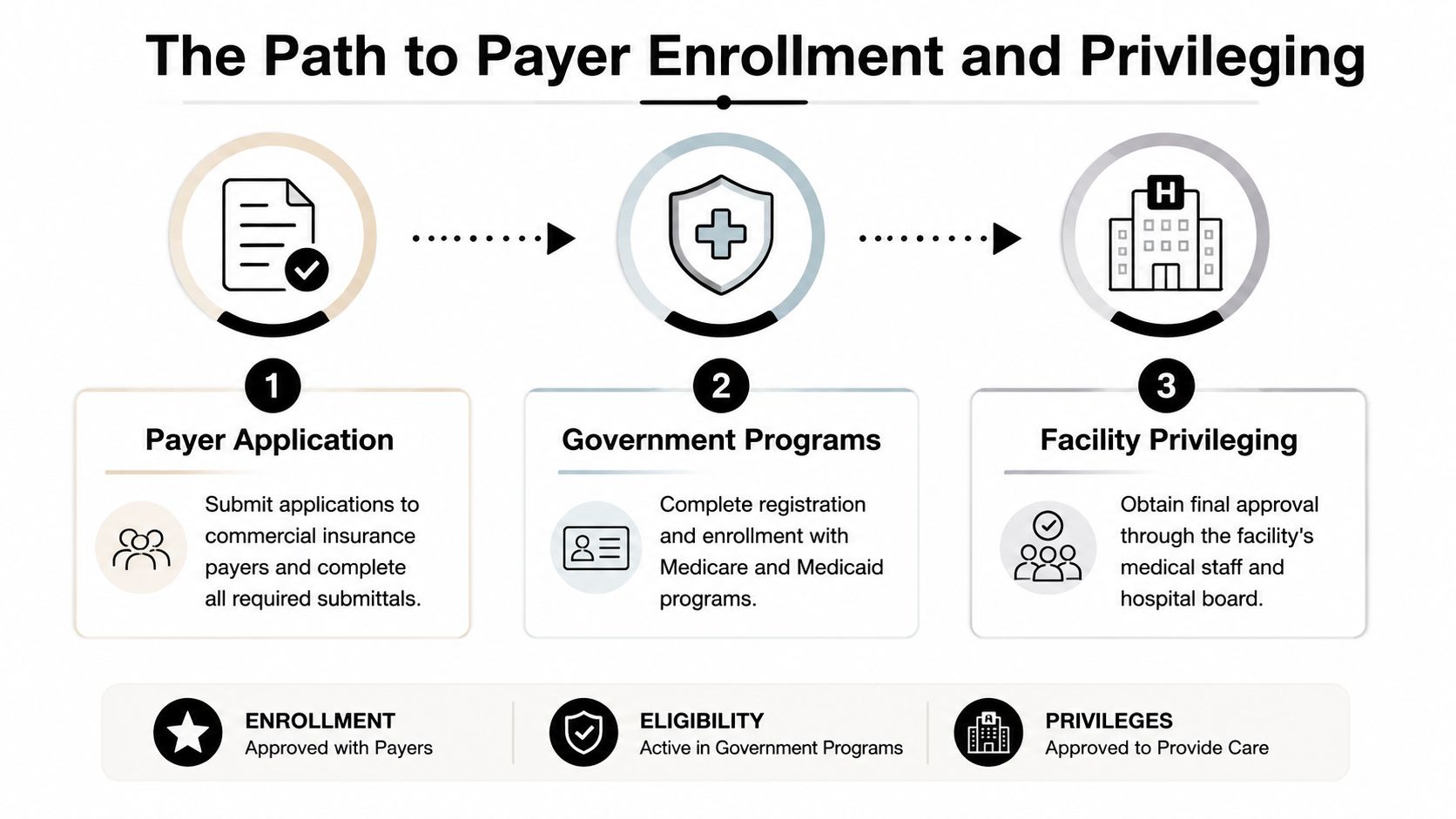
Payer enrollment is about payment
Commercial plans, Medicare, Medicaid, and delegated health plans all have their own workflows. Even when an employer handles the submissions, your file still needs to be complete enough for them to use. Missing signatures, old addresses, and stale CAQH authorizations can stall enrollment before it starts.
If you're employed, ask a direct question early: Which payers is the organization enrolling me with immediately, and which ones can wait? That answer affects how quickly your schedule can fill and whether the practice is willing to start you before every payer file is complete.
Privileging is about permission
Privileging is separate. During this process, the facility or medical group determines what you're allowed to do under its bylaws, policies, and delegation structure. A PA can be fully licensed and still not be permitted to perform certain duties in that setting until the privileging review is complete.
The privilege file usually becomes slower when these items aren't lined up:
- Supervising or collaborating physician forms
- Peer references
- Procedure or competency documentation
- Delineation of privileges paperwork
- Department chair or committee sign-off
Many PAs underestimate how much local politics and internal process matter. A flawless packet doesn't force a committee to meet faster.
Some start-date problems are not paperwork problems. They're meeting-schedule problems, reference-response problems, or internal-signature problems.
Treat them as linked but separate workflows
A useful mental model is this:
| Workflow | Main question | Common friction point | What helps |
|---|---|---|---|
| Payer enrollment | Can the organization bill for your care? | Missing application details or stale CAQH access | Give complete demographic, license, and affiliation data early |
| Privileging | Are you approved to practice within this setting? | Delayed references or committee review | Submit scope, references, and supervising documents promptly |
What works best is coordinated follow-up. Don't ask only “Am I credentialed yet?” Ask where the bottleneck sits. Is it payer enrollment? Is it committee review? Is it a specific reference? That question gets better answers.
A practical way to stay involved without becoming a nuisance
You don't need to email daily. You do need a rhythm.
Try this approach:
- Confirm packet receipt after submission.
- Ask what is still outstanding rather than asking for a general status.
- Respond the same day when a team asks for clarification.
- Escalate politely if a reference or prior employer is the hold-up and you can intervene.
PAs who manage this process well stay visible, but useful. They make it easier for credentialing staff to move the file.
Credentialing for Telehealth and Multi-State Roles
Flexible work sounds simpler on paper than it is in operations. Telehealth, hybrid practice, and multi-state arrangements can be excellent for career sustainability, but they add layers to credentialing physician assistants that many standard guides barely mention.
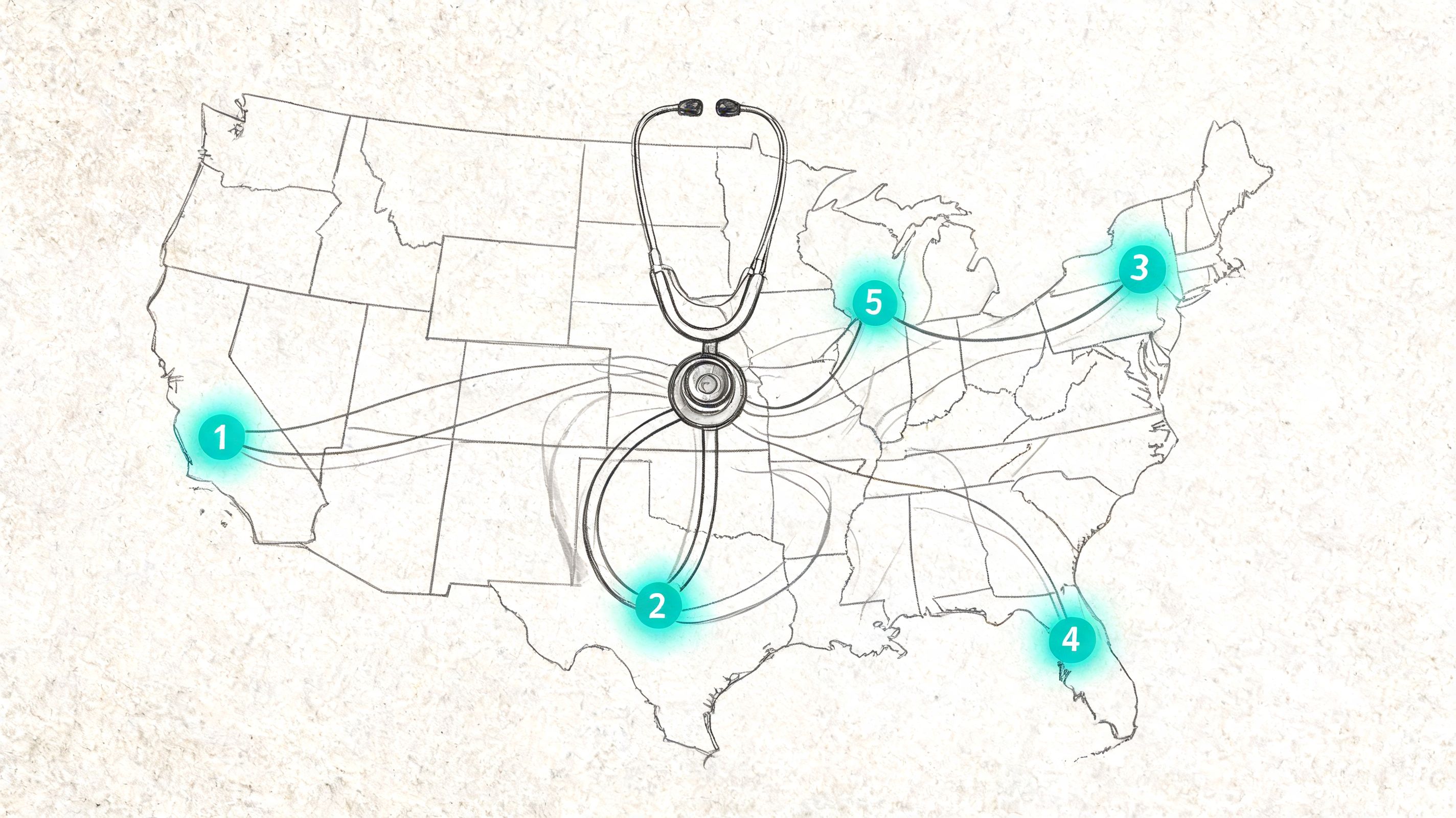
The core rule doesn't change. Privileging for all roles, including telehealth, relies on licensure, NCCPA certification, and physician delegation, with ongoing competency assessments. But specific guidance for remote supervision in telehealth and for PAs working in underserved areas is often lacking, as discussed in this review of how physician assistants improve access to care. That gap is exactly why flexible roles can feel harder to onboard than a traditional clinic job.
Telehealth doesn't erase credentialing
A common misunderstanding is that remote care means lighter oversight. Usually it means different oversight.
For telehealth roles, ask the employer:
- Which state licenses are required for the patient population
- How supervision or delegation is documented
- Whether the organization uses central privileging, local privileging, or both
- How competency is evaluated for remote workflows
- Whether payer enrollment differs for telemedicine services
These questions matter because remote work can hide operational complexity until after you sign.
For a broader career view, this primer on telemedicine for physician assistants is helpful if you're weighing remote roles against hybrid or in-person work.
Multi-state practice creates an administrative load
Holding more than one state license can open better options. It also means more renewals, more disclosure consistency, and more opportunities for a tiny discrepancy to spread across applications.
That's especially true when an employer operates across several states, has recently acquired practices, or is integrating clinicians into different tax IDs or legal entities. In those situations, workforce operations can affect your onboarding timeline almost as much as your individual file. That's why employer-side planning resources, such as these PEO strategies for multi-state M&A, can be relevant if you're joining a fast-changing organization.
A quick visual can help frame the moving pieces.
Where flexible roles usually get stuck
The failure points are often predictable:
- License mismatch: The role advertises “remote” but requires licensure in every state where patients are seen.
- Delegation ambiguity: The employer hasn't finalized how supervising coverage works across locations.
- Facility-specific review: A telehealth PA still needs approval from a hospital, health system, or contracted entity tied to the service line.
- Underserved setting complexity: Rural or shortage-area work may involve local rules, staffing realities, and coverage models that aren't well standardized.
The good news is that these are planning issues. If you ask the right operational questions before your file enters the queue, flexible roles become much easier to evaluate.
How to Troubleshoot Common Delays
A delayed file costs everyone. Healthcare organizations lose an average of $7,500 per provider per day, and for a PA, a 30-day delay against a $133,260 median salary means over $11,000 in lost wages, according to Medwave's credentialing statistics roundup. That's why troubleshooting isn't just administrative neatness. It protects your income and your transition into the new role.
Documentation gaps
This is still the most common and most fixable problem. Missing pages, unexplained employment gaps, outdated attestations, or a CV that doesn't match the application can stop the file cold.
What you can do
- Audit your own packet first: Review every date and every employer name before submission.
- Use one source of truth: Your CV, CAQH, and disclosure forms should match exactly.
- Attach explanations early: If there's a gap, prior issue, or unusual training path, explain it upfront.
How your employer can help
- Send a single checklist: One organized request prevents duplicate asks from HR, credentialing, and medical staff services.
- Assign one point person: Mixed messages from multiple coordinators create avoidable confusion.
References that stall the file
A skilled PA can still sit in pending status because a reference doesn't return a form. This happens more often than people expect.
What you can do
- Contact references before listing them.
- Confirm the best email and phone number.
- Let them know the request may come from a portal or unfamiliar sender.
How your employer can help
- Start reference outreach early: Don't wait until every other item is complete.
- Accept appropriate alternates when policy allows: Sometimes the issue is not unwillingness. It's availability.
If your file has been quiet for days, ask whether references are complete. That single question often uncovers the real bottleneck.
State board and licensing slowdowns
Sometimes your packet is fine and the delay sits with a state board, a verification queue, or another outside entity. You can't force those systems to move, but you can stop losing time on your side.
What you can do
- Submit clean applications the first time: Corrections usually move slower than initial accuracy.
- Monitor status yourself: Don't assume “submitted” means “moving.”
- Keep screenshots and confirmation emails: They help when a board or employer asks for proof of timing.
How your employer can help
- Sequence onboarding realistically: Don't plan orientation around a license that hasn't posted yet.
- Use experienced credentialing staff or a credentialing partner: Complex state requirements reward teams that know where files usually snag.
Payer-specific quirks
Commercial payers and government programs often ask for similar information in slightly different formats. That's enough to create delays if the team is trying to rush.
What you can do
- Answer follow-up requests immediately: Even a minor clarification can reset someone's review clock.
- Ask which enrollments are urgent: Not every payer has to hold up your start if the practice has a phased plan.
How your employer can help
- Run payer enrollment in parallel where possible: Sequential work stretches timelines.
- Tell the PA what is missing in plain language: “Need updated DEA attachment” is better than “pending provider action.”
When to escalate
There's a difference between normal processing time and a stuck file. Escalate when the same unresolved item keeps resurfacing, when no one can tell you what is outstanding, or when your start date is approaching and ownership is unclear.
A good escalation is concise. State what you submitted, what you've already done, and what specific blocker needs resolution. That helps the coordinator act instead of re-reading the whole file.
The career point people miss
Getting credentialed efficiently isn't just about starting one job on time. It's about building a professional operating system you can reuse every time you change roles, add a state, shift to telehealth, or move into a schedule that fits your life better.
That's the durable advantage. PAs who manage credentialing well have more freedom. They can leave bad jobs faster, evaluate good jobs more confidently, and step into sustainable work without losing months to avoidable delays.
If you're looking for a role worth getting credentialed for, WeekdayDoc helps clinicians find burnout-friendly jobs with clear no-call and no-weekend options across remote, hybrid, and in-person settings. It's a practical place to compare roles built for work-life balance before you commit your next round of paperwork.