Part Time Physician Assistant Salary: A 2026 Guide
Decode your part time physician assistant salary in 2026. Learn about hourly rates, total compensation, negotiation, and finding a burnout-friendly PA role.
You might be reading this after another late charting night, after another week where your “three clinic days” somehow turned into inbox management on your off days, refill requests at dinner, and a nagging suspicion that full-time medicine is costing more than it pays. That's usually when the question lands with real weight: can you move to part-time work without blowing up your finances?
For many PAs, the answer isn't hidden in the annual salary number on a job posting. That number can be the most misleading part of the offer.
A part time physician assistant salary only makes sense when you translate it into what you receive for your time. That means looking at the hourly rate, the practical schedule, the admin burden, whether benefits are prorated, and whether the role protects the reason you wanted part-time work in the first place. If you're also considering flexible virtual work, it helps to compare these offers against the broader market for remote physician assistant jobs.
Is a Part-Time PA Career Financially Sustainable
A sustainable part-time career usually starts with a problem, not a spreadsheet. A PA in urgent care drops to fewer shifts because every week feels reactive. A surgical PA wants out of call-heavy work but still wants to keep procedural medicine in the mix. A primary care PA realizes the salary looked fine on paper, yet the unpaid charting, patient messages, and emotional carryover made the job much more expensive than it appeared.
That's why the right question isn't “What annual salary should I expect?” The better question is, “What does this role pay me for the life it asks me to live?”
What makes part-time work feel sustainable
Financial sustainability has two layers. The first is obvious: can the job cover your bills, debt payments, savings goals, and insurance needs. The second is what people skip: can the job reduce enough strain that you can stay in the profession long term.
A role can pay less and still be the stronger financial move if it cuts expensive friction from your life:
- Less burnout spillover: You may spend less on convenience, missed recovery time, or desperate schedule fixes.
- More predictable hours: Stable clinic blocks are easier to budget around than “part-time” roles that regularly bleed into evenings.
- Lower hidden workload: A shorter schedule only helps if inboxes, forms, and callbacks don't keep following you home.
Practical rule: If a practice wants full-time output from a part-time body, the salary number won't save the deal.
The trade-off is real, but so is the upside
Part-time work does come with compromises. Some employers won't offer full benefits. Some will prorate them. Some will keep the hourly rate attractive but strip away PTO, CME, retirement match, or schedule control. That's where many PAs get stuck. They compare a clean full-time annual salary to a messy part-time package and assume part-time can't work.
It can work. But only if you evaluate the offer on terms that match how part-time jobs are built.
A sustainable part-time PA career isn't about earning the same annual total while working fewer hours. It's about protecting your income quality, your time, and your ability to keep practicing without resentment.
Deconstructing Part-Time PA Pay Hourly vs Annual
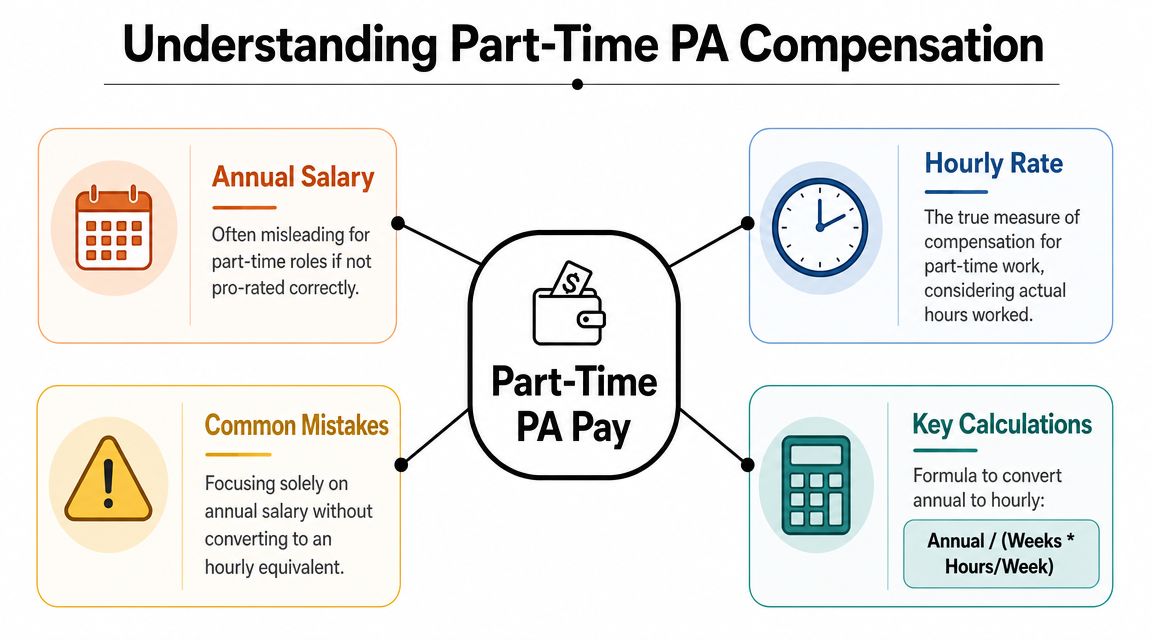
The fastest way to misread a part time physician assistant salary is to think in annual terms first. Annual salary works well for a standard full-time role with a consistent schedule and a familiar benefits package. It breaks down when one job is two long shifts a week, another is five half-days, and a third is technically part-time but expects charting and inbox work outside paid hours.
Hourly pay gives you a cleaner comparison. It's the compensation equivalent of comparing price per ounce at the grocery store. The package size can distract you. The unit price tells you what you're really paying, or in this case, what you're really earning.
Start with the benchmark
The U.S. Bureau of Labor Statistics reported a median annual wage of $130,020 for physician assistants in May 2024, and dividing that by 2,080 hours implies an approximate full-time equivalent of $62.51 per hour according to the BLS physician assistant wage data. That's useful because it gives you a rough market anchor before you start adjusting for specialty, location, or benefits.
That benchmark doesn't tell you what your part-time offer should be. It tells you where the conversation starts.
A simple conversion method
Use this formula when an employer quotes annual pay for a part-time role:
Annual salary ÷ (weeks worked × hours per week) = hourly equivalent
Use the reverse when a recruiter gives you an hourly rate:
Hourly rate × weeks worked × hours per week = annualized gross pay
The key phrase is annualized gross pay. That number helps with planning, but it doesn't mean the role is comparable to a benefited full-time position.
What to watch for in job postings
A posting can look strong until you normalize it. Review these details before you compare offers:
- Hours that drift: A “three-day” job may still include chart review, prior auths, refill work, and patient messages.
- Unpaid admin time: If admin tasks aren't blocked and compensated, your real hourly rate falls.
- Weeks worked: Some part-time schedules are year-round. Others have unpaid gaps, seasonal slowdowns, or coverage fluctuations.
Don't compare annual numbers until you've confirmed actual paid hours, expected admin time, and whether the employer is defining part-time by schedule or by benefits eligibility.
Once you start thinking this way, a smaller annual figure can still be a better deal, and a larger one can turn out to be disappointing.
How Location and Specialty Impact Your Hourly Rate
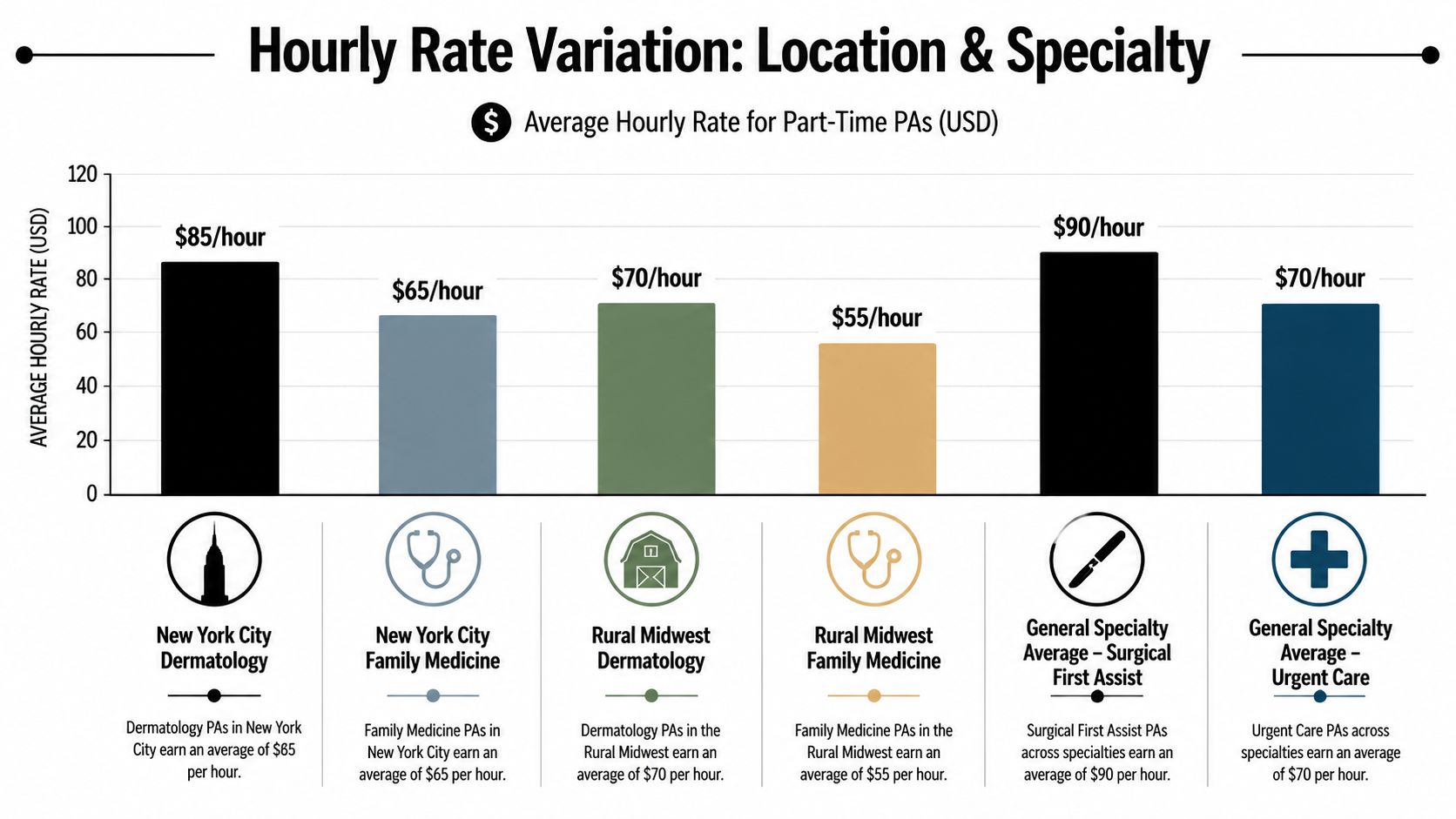
Once you've shifted to hourly thinking, the next question is where your own market sits. A part-time PA in a procedural specialty, in a system trying to fill hard-to-staff clinic time, will often negotiate from a different position than a PA in a lower-paid specialty with a large local applicant pool.
One of the clearest national reference points comes from the Association of American Medical Colleges. The 2024 compensation survey found a median base salary of $133,260, a median hourly base rate of $64.07, and noted that compensation varies by hours worked, practice setting, specialty, and ownership structure, with surgical and procedural settings generally paying more, as shown in the AAMC physician assistant compensation survey.
Specialty changes the ceiling
In real-world negotiations, specialty often matters more than people expect. Roles tied to procedures, throughput, or difficult coverage needs usually have more room on hourly rate. General outpatient roles may offer more schedule predictability but less pay flexibility.
That doesn't make one category better. It changes what you should ask for.
- Procedural roles: Higher pay may reflect intensity, turnover demands, or technical skill.
- Primary care roles: Lower hourly offers may still be workable if schedule quality is strong and the panel is manageable.
- Urgent care and similar models: The hourly number can look attractive, but burnout risk depends heavily on staffing, acuity mix, and pace.
For a broader starting point by geography, it helps to compare your local expectations against a physician assistant salary by state guide.
A short explainer on compensation differences can also help frame what employers are pricing when they hire for flexibility.
Location changes the floor
Geography affects more than cost of living. It changes hiring urgency, competition, payer mix, and whether employers can rely on a steady stream of candidates. Even within one metro, a suburban specialty clinic, a hospital-owned outpatient site, and a rural satellite office may price the same PA skill set very differently.
A few location questions matter more than broad averages:
| Factor | Why it matters for hourly rate |
|---|---|
| Urban versus rural | Harder-to-fill sites may pay more, but commute and support structure matter |
| Health system versus private group | Systems may have more standardized rates, while private groups may have more flexibility |
| In-person versus remote | Remote work can improve schedule quality, but competition can be wider |
| Local saturation | More clinicians in the market can reduce leverage |
If an employer says, “This is our standard rate,” ask whether that standard includes your specialty background, your procedural skill set, and the exact schedule they need covered.
The practical takeaway is simple. You are not negotiating in a generic PA market. You are negotiating in a local, specialty-specific, schedule-specific market.
Beyond the Paycheck Calculating Your Total Compensation
Two part-time offers can have the same posted pay and deliver very different financial outcomes. That's why annual salary alone is a poor way to judge value.
A useful example comes from St. Louis. Indeed shows physician assistant pay around $104,602 per year, while a nearby part-time PA listing can show $30,000 to $75,000 per year, a spread that highlights how much specialty, experience, and included benefits can change the effective value of an offer, based on Indeed salary data for physician assistants in St. Louis. The wide range isn't the interesting part by itself. The interesting part is what's hiding inside the range.
What belongs in your true hourly rate
If you only compare base pay, you'll miss the parts that often determine whether a role is solid or shaky.
Count these items when you evaluate a part time physician assistant salary:
- Health insurance value: If one employer subsidizes premiums and another offers none, the lower-pay job may still win.
- Paid time off: Paid sick time and vacation matter because unpaid time off lowers your effective earnings.
- Retirement contributions: A match or employer contribution can materially change the long-term value of a role.
- CME and license support: Coverage for DEA, state license, board expenses, and CME can reduce out-of-pocket professional costs.
- Malpractice coverage: Claims-made versus occurrence, tail questions, and who pays all matter.
- Schedule quality: No weekends, no call, and protected admin time don't show up neatly on a paycheck, but they change job value.
If you're deciding between employer health coverage and a high-deductible plan, these personal finance tips on HSA accounts are worth reviewing because HSA structure can materially affect how you compare offers.
A worksheet that makes offers easier to compare
Use a simple side-by-side worksheet before you negotiate or accept.
| Compensation Component | Offer A (e.g., 0.6 FTE) | Offer B (e.g., 0.5 FTE W2) | Offer C (e.g., 1099) |
|---|---|---|---|
| Base hourly pay | |||
| Guaranteed weekly hours | |||
| Paid admin time | |||
| Health insurance support | |||
| PTO or sick time | |||
| Retirement contribution | |||
| CME and license reimbursement | |||
| Malpractice coverage | |||
| Call or weekend expectations | |||
| Commute and parking costs | |||
| Estimated true hourly rate |
What usually works and what usually doesn't
A good part-time offer is usually transparent. Hours are defined. Admin work is named. Benefits eligibility is written out. Coverage expectations are specific.
A weak offer usually relies on vagueness. “Flexible” means you're covering holes. “Light admin” means work that follows you home. “Competitive pay” means the employer wants you focused on the headline number instead of the full package.
The best part-time jobs don't just pay for clinic hours. They respect the boundaries that make part-time worth doing.
Projecting Your Financial Future on a Part-Time Salary
A part-time shift often feels risky because the annual income drops faster than the stress does, at least at first glance. That's why broad salary talk doesn't help much. What matters is how the job fits your actual goals over time.
One market summary from 2026 reported a part-time hourly average of about $56 per hour for a 24-hour workweek, which implies roughly $70,000 per year when annualized. The same summary is useful because it shows how a decent hourly rate can still produce a much different annual number once hours are reduced, as described in this 2026 PA salary trends summary.
A more realistic way to model the change
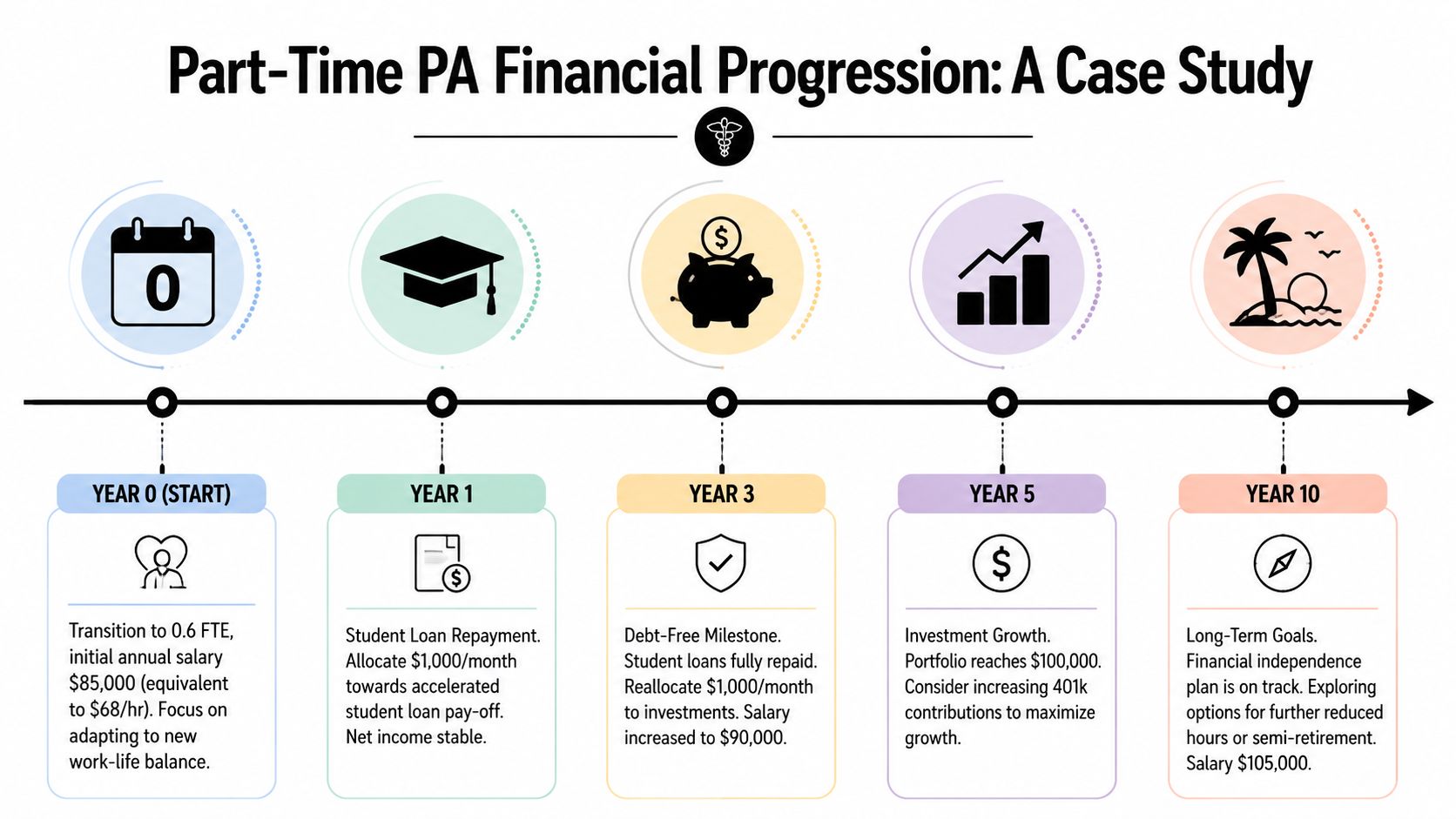
Say a PA cuts back because the full-time version of the job isn't sustainable anymore. The first fear is usually income loss. The more useful exercise is to model both sides of the change.
Some expenses may rise. Others may fall.
- Income pressure: Less gross pay can tighten savings and debt repayment if you don't plan ahead.
- Expense relief: Childcare, commuting, meals out, wardrobe costs, and burnout spending may drop.
- Career durability: A lower-stress role can help you stay employed consistently instead of cycling through exhaustion and job changes.
If you want a structured way to map this over time, a Numeric financial model guide offers a useful framework for building a personal scenario model instead of guessing from rough estimates.
Sustainable planning beats heroic planning
I've seen more clinicians succeed with a realistic part-time plan than with an aggressive “just push through” strategy. A sustainable model usually includes a few decisions made in advance:
- Define the minimum acceptable monthly take-home. That number keeps you from romanticizing flexibility and accepting a weak offer.
- Choose one long-term priority. Student loans, retirement, emergency savings, or family time. Trying to optimize everything at once usually creates regret.
- Recalculate yearly. A part-time setup that works this year may need revision after a move, a new child, or a benefits change.
Projected job growth matters here too. The Bureau of Labor Statistics projected 28% employment growth for physician assistants from 2023 to 2033, which supports the idea that flexible staffing models may continue to exist in a strong labor market, and that outlook is summarized in this PA job growth resource.
Part-time work can fit long-term financial independence planning. It just requires a different philosophy. Instead of asking how to maximize gross income at any cost, ask how to create a career you can still tolerate, and even like, years from now.
Negotiation Strategies for Part-Time PA Roles
Negotiating a part-time role is different from negotiating a standard full-time job. Employers often assume flexibility itself is the benefit, so they expect you to concede on pay, admin time, or benefits. You don't have to accept that framing.
Your advantage improves when you treat the offer like a package instead of a favor.
Use messy market data to your advantage
Part of the challenge in PA compensation is that salary platforms don't always agree. In St. Louis, for example, Glassdoor estimated physician assistant pay at $201,125 per year, while Indeed showed $104,602 per year, and that divergence can help you anchor negotiations because it forces the employer to explain how they're valuing the role, based on the Glassdoor St. Louis physician assistant salary page.
You're not using the higher number to pretend every role should pay that amount. You're using it to show that compensation data varies enough that “this is just the market” isn't a complete answer.
What to negotiate besides the hourly rate
Sometimes the employer has little room on base pay. That doesn't end the conversation.
Ask about:
- Paid admin blocks: If they want inbox coverage, refill management, or chart review, get it written into paid time.
- Benefits buyout options: If you won't use the employer plan, ask whether some value can be redirected.
- Defined schedule boundaries: Clarify patient-facing hours, admin time, and whether charting outside clinic is expected.
- Call and weekend language: Even occasional coverage should be explicit, not implied.
- Review timing: If they can't move now, ask for a written compensation review after you've demonstrated value.
“I'm open to part-time structure. I'm not open to full-time expectations compressed into fewer paid hours.”
A practical script that works
A strong negotiation tone is calm and specific. Try language like this:
- For low hourly pay: “Given the reduced benefits and the expectation for independent clinical productivity, I'd like to discuss a higher hourly rate.”
- For unclear admin expectations: “I want to make sure the schedule reflects all duties, not just patient-facing time.”
- For weak benefits: “If benefits aren't included, I'd like the compensation package adjusted to reflect that difference.”
The goal isn't to win every line item. The goal is to avoid the common trap where a part-time role looks flexible on paper and functions like underpaid full-time work in practice.
Use WeekdayDoc Tools to Evaluate Part-Time Roles
You review two part-time PA jobs after a long clinic day. One posts a higher annual number. The other offers cleaner hours, no call, and protected flexibility. On paper, the first role looks better. In real life, the second may pay more for the time and energy it costs you.
That is the gap WeekdayDoc helps you assess. The platform lets clinicians sort remote, hybrid, and in-person roles and spot schedule details like No Call and No Weekends early, before you waste time on a role that only looks good in a salary field.

What to look at when comparing roles
A useful tool should help you judge the job you will live, not just the rate you will quote.
Focus on a few practical filters:
- Schedule quality: Screen out jobs with vague call coverage, weekend creep, or inconsistent clinic days.
- Role design: Check whether the posting makes room for charting, inbox work, and follow-up tasks instead of hiding them outside paid hours.
- Compensation context: Use salary and FIRE planning tools to see how a part-time role fits your monthly needs, savings targets, and timeline.
I have found that part-time roles become sustainable when the math and the schedule agree. A slightly lower hourly number can still win if it cuts unpaid work, commute strain, and recovery time between shifts.
The better question is not “Which job has the biggest annual salary?” The better question is “Which job gives me the strongest true hourly rate once I factor in schedule quality, prorated benefits, and my long-term financial plan?”
If you're comparing part-time PA roles and want a clearer read on salary, schedule quality, and long-term financial fit, WeekdayDoc is a practical place to start. You can review burnout-friendly listings, filter for no-call and no-weekend roles, and use the platform's compensation and FIRE tools to judge offers on more than a headline salary.