Your Guide to Landing High-Paying Remote Physician Assistant Jobs
Explore top remote physician assistant jobs with our guide. Get expert tips on resumes, interviews, and finding roles that prevent burnout.

The explosion in telehealth has completely changed the game for Physician Assistants, opening up a wave of remote physician assistant jobs that offer a level of flexibility and work-life balance that was once unthinkable. These roles aren't just about answering patient messages; they involve virtual consultations, chronic care management, and even urgent care—all from the comfort of your home office. It's a new frontier for the PA profession, and it's here to stay.
The New Era of Remote PA Careers

The entire healthcare landscape is shifting, and PAs are perfectly positioned to lead this change. What used to be a niche opportunity has rapidly become a mainstream career path, and for good reason. It’s driven by huge patient demand and fundamental changes in how healthcare is delivered.
Today, remote PA jobs offer a powerful solution for clinicians seeking a more sustainable and balanced career. This isn't just a fleeting trend. It reflects a much deeper need for more efficient and accessible medicine. Patients love the convenience, and healthcare systems are finally seeing the value in using technology to expand their reach.
This alignment creates the perfect environment for skilled PAs to build a career that truly fits their life.
What’s Driving the Demand for Remote PAs
So, what's behind this massive growth? A few key factors are making this the perfect time to go remote.
The demand isn’t just growing—it's exploding. The U.S. Bureau of Labor Statistics projects a staggering 20% growth in PA employment from 2024 to 2034, which blows the average for other professions out of the water. That breaks down to about 12,000 new job openings every single year, with a median annual wage of $133,260. A huge chunk of these new roles are being designed specifically for telehealth. You can explore the full PA employment outlook on BLS.gov to see the numbers for yourself.
The main drivers behind this shift include:
- Increased Patient Adoption: Patients now expect virtual care options. It's become the new standard for everything from routine follow-ups to quick urgent care questions.
- Focus on Chronic Disease Management: Telehealth is incredibly effective for the ongoing monitoring of long-term conditions, which is a core skill for most PAs.
- Improved Work-Life Balance: Healthcare organizations are finally waking up to the clinician burnout crisis. They're creating more flexible roles to retain talent, and remote work is one of the best tools they have.
At WeekdayDoc, we see this every day. We specifically curate burnout-friendly, no-call, and no-weekend positions that give you control over your schedule. It’s about building a career that supports your life, not the other way around.
How to Build a Telehealth-Focused PA Profile
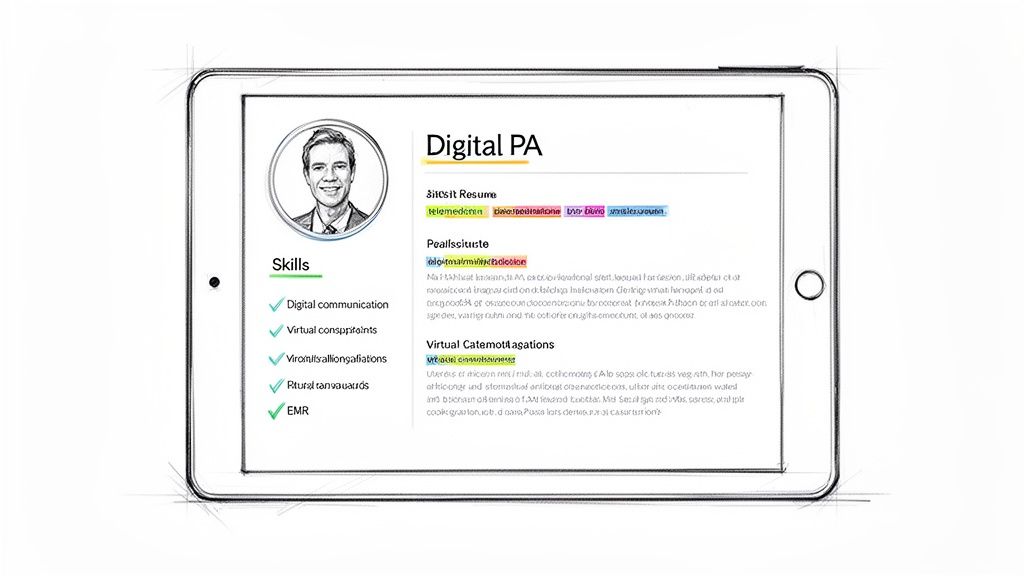
When you're gunning for the best remote physician assistant jobs, your resume can't just be a list of your clinical skills. It needs to scream telehealth.
This means you have to strategically reframe your hands-on experience for a digital-first audience. Your goal is to prove you can deliver exceptional patient care through a screen, and that requires translating your in-person accomplishments into the language of virtual health.
Hiring managers for these roles are looking for specific keywords and measurable results that prove you’re ready for a virtual environment. Think of it as building your digital clinical brand.
Make Your Resume Telehealth-Ready
First things first: you have to get past the bots. Most large healthcare systems use automated applicant tracking systems (ATS) that scan resumes for keywords before a human ever lays eyes on them. No keywords, no interview. It’s that simple.
Go through your experience section and weave in terms that are specific to virtual care. Don’t just tack on a list at the bottom; integrate them directly into your accomplishment statements to show you know what you’re talking about.
Make sure these are included:
- Telemedicine and Telehealth
- Virtual Consultations
- Digital Health Platforms
- Remote Patient Monitoring (RPM)
- EMR/EHR Systems (always mention specific platforms like Epic, Cerner, or others you've used)
- HIPAA-Compliant Communication
This isn't just about gaming the system. It's about immediately signaling to a recruiter that you’re a perfect fit for remote physician assistant jobs.
Essential Skills for Your Remote PA Resume
To give you a head start, here’s a quick breakdown of the hard and soft skills that matter most in a telehealth role. We’ve included examples of how to phrase these on your resume to make them stand out.
| Skill Category | Specific Skills to Emphasize | Example of How to Showcase It |
|---|---|---|
| Technical Proficiency | EMR/EHR expertise (e.g., Epic, Cerner), telehealth platforms (e.g., Doxy.me, Teladoc), remote patient monitoring tools, digital charting. | "Proficient in Epic and Cerner EMRs, utilizing integrated telehealth modules to conduct over 500 virtual patient consultations." |
| Virtual Communication | Clear on-camera presence ("webside manner"), active listening, empathetic verbal skills, ability to build rapport through a screen, concise written communication. | "Maintained a 95% patient satisfaction score for virtual visits by employing active listening and clear communication techniques to build trust remotely." |
| Clinical Decision-Making | Strong diagnostic skills without physical exams, ability to triage effectively, knowledge of virtual care protocols and limitations. | "Accurately diagnosed and managed common acute conditions via telehealth, resulting in a 98% adherence to evidence-based treatment protocols." |
| Adaptability & Autonomy | Self-motivated, organized, comfortable with changing technologies, ability to manage a patient panel with minimal direct supervision. | "Independently managed a remote patient panel of 100+ individuals with chronic conditions, requiring proactive scheduling and follow-up." |
Remember, the goal is to show, not just tell. Back up every skill with a concrete example or, even better, a number.
Show Your Impact with Numbers
"Provided patient care" is a classic resume-killer. To really stand out, you have to connect your actions to outcomes using hard numbers. Sift through your past roles—even if they were mostly in-person—and find ways to quantify your telehealth-related wins.
For instance, don’t just say you "saw patients remotely." That tells a recruiter next to nothing.
Instead, try this: "Managed a panel of 150+ patients through a hybrid telehealth model, improving chronic condition management metrics by 25% via consistent virtual follow-ups and remote monitoring."
This is so much stronger. It shows you can handle a significant patient load and, more importantly, that your virtual work leads to tangible, positive clinical outcomes. That’s what gets you an interview.
Your LinkedIn Profile is Your Digital Handshake
Recruiters live on LinkedIn. It's often their very first impression of you, so it needs to be polished and telehealth-focused from top to bottom.
Start with your headline. "Physician Assistant" is fine, but it’s generic. Try something like, "Physician Assistant | Specializing in Telehealth for Primary Care & Chronic Disease Management". That immediately tells anyone who lands on your profile what you’re all about.
Make sure your headshot is professional, clear, and friendly—no vacation pics. Use the "About" section to tell a short story about your passion for accessible virtual care, sprinkling in the keywords and skills we've talked about. Finally, ask colleagues for recommendations that specifically mention your communication skills or tech-savviness. A well-built profile is a powerful tool for getting noticed for top-tier remote physician assistant jobs.
Finding the Best Remote Physician Assistant Jobs
When you're hunting for a remote physician assistant job, knowing where to look is half the battle. If you've ever spent an afternoon scrolling through the massive job boards, you know how it feels—like searching for a needle in a haystack. The listings are often outdated, irrelevant, or just not a true fit for a clinical role.
To find high-quality, sustainable opportunities, you need a much more focused strategy. It starts with ditching the giant aggregators and shifting your search to niche platforms that actually understand the needs of clinicians. This is where a resource like WeekdayDoc can completely change your search.
Zero In on Burnout-Friendly Platforms
Instead of scrolling endlessly, let the right platforms do the heavy lifting for you. WeekdayDoc, for instance, was founded by physicians specifically to combat clinical burnout. This means you can immediately filter for the things that actually matter for your well-being.
Want to reclaim your personal time? You can filter for:
- No Call: Instantly get rid of jobs that will have your phone ringing after hours.
- No Weekends: Protect your personal time right from the start.
- Remote & Hybrid: Focus only on the work arrangements that fit your life.
This kind of targeted search saves you hours of sifting through job descriptions that were never going to work anyway. It also sends a strong signal—you're only looking at employers who already value work-life balance, which is a huge green flag. When you're ready, you can explore curated telemedicine physician assistant jobs designed with sustainability in mind.
Tap Into Your Professional and Niche Networks
Beyond specialized job boards, your professional network is a goldmine waiting to be tapped. Don't just mindlessly scroll through your LinkedIn feed. Instead, actively engage in targeted groups for PAs in your specialty or communities focused on digital health and telehealth.
Connecting with recruiters who specialize in placing clinicians in remote roles can also give you a serious edge. These folks often have access to incredible opportunities that never even get posted publicly. As you search, it’s also smart to explore various platforms for various virtual healthcare jobs, since so many different services are now operating remotely.
A multi-channel approach is your best bet. By combining a burnout-focused platform like WeekdayDoc with targeted networking, you’re not just finding a job—you’re finding the right job.
The demand for remote PAs is only going up. Projections show healthcare dominating job growth, and remote PA roles are becoming a lucrative niche. The median PA salary is hitting $133,260 annually. And while remote postings currently make up around 2-10% of top healthcare jobs, that figure is climbing fast as PAs continue to prove their value in a virtual setting.
Mastering Your Virtual Interview and Salary Negotiation
The virtual interview is the final gatekeeper between you and that perfect remote PA role. Nailing it isn't just about your clinical knowledge; it’s about showing you can build real patient trust through a screen. Honestly, your preparation here can make or break the offer.
First things first, treat your tech setup like a clinical environment. A stable, high-speed internet connection is non-negotiable—glitches and dropped calls are frustrating for everyone. Find a quiet, private room and check what’s behind you. A simple wall or a tidy bookshelf looks way more professional than a messy kitchen. Good lighting and a decent webcam also make a surprisingly big difference in how you come across.
Navigating Telehealth Interview Questions
Get ready for questions that test your "webside manner." Hiring managers need to know you can handle the unique challenges of virtual care, so they'll move beyond standard clinical scenarios. Be prepared with specific examples from your experience.
You can expect to hear things like:
- "How do you build strong patient rapport when you can't perform a physical exam?"
- "Walk me through a time you had to deliver difficult news to a patient over video."
- "What's your experience with different EMRs and telehealth platforms?"
Your answers need to highlight your communication skills, empathy, and comfort with the digital tools of the trade. Frame your responses around patient safety and clear, efficient workflows.
Pro Tip: Always come with your own questions. Ask about the onboarding process for remote clinicians, the typical daily patient load, and what specific tools the company provides to support its virtual team. It shows you’re thinking like a long-term partner, not just another applicant.
Securing the Compensation You Deserve
Once the offer comes through, the conversation shifts to money. This is your chance to make sure the role aligns with your financial goals and reflects what you're actually worth in the market. Never accept the first number they throw out without doing your homework.
Start by researching competitive salaries for remote PA roles in your state and specialty. Data is your most powerful tool in any negotiation. To get really specific, you can use the WeekdayDoc Salary & FIRE Calculator for state-specific insights that help you build a rock-solid case for your target number.
When you have that number, state your expectations confidently. Cite your research, your experience, and the unique value you're bringing to their team. And remember, negotiation isn't just about the base salary. This is the perfect time to discuss other critical benefits.
Consider asking about things like:
- A home office or tech stipend
- Reimbursement for state licensure fees
- Protected administrative time built into your schedule
When you have that offer in hand, using expert strategies for salary negotiation can make a huge difference in your final package. A thoughtful, data-backed approach to this conversation ensures your compensation truly reflects your skills and sets you up for success.
How to Vet Opportunities with WeekdayDoc Tools
Finding remote physician assistant jobs is one thing. Finding the right one is a whole different ballgame.
It's easy to get drawn in by a promising job description, only to find it hides a culture that runs you straight into the ground. This is where you have to look past the generic job boards and use tools built by clinicians, for clinicians.
WeekdayDoc’s tools are designed to help you slice through the noise and analyze opportunities based on what actually matters for your career and life. It’s about making a smart decision that protects your time, your money, and your sanity from day one.
Decode Sustainability with the Burnout-Friendly Score
One of the most powerful features you'll see is the Burnout-Friendly Score next to every single listing. This isn't just some random number; it's a metric we developed based on the data points that are proven to signal a healthier work environment.
What goes into that score? We look at the big stuff:
- No Call Requirements: Is the job going to demand you stay plugged in after hours?
- No Weekend Shifts: Does the role actually protect your weekends?
- Schedule Flexibility: How much control do you really have over your day?
A high score is your shortcut. It immediately tells you an employer gets it—they prioritize clinician well-being. You can spot the roles that respect your boundaries before you even click to read the full description.
This whole process—from prepping your resume to negotiating the final offer—requires a clear strategy.
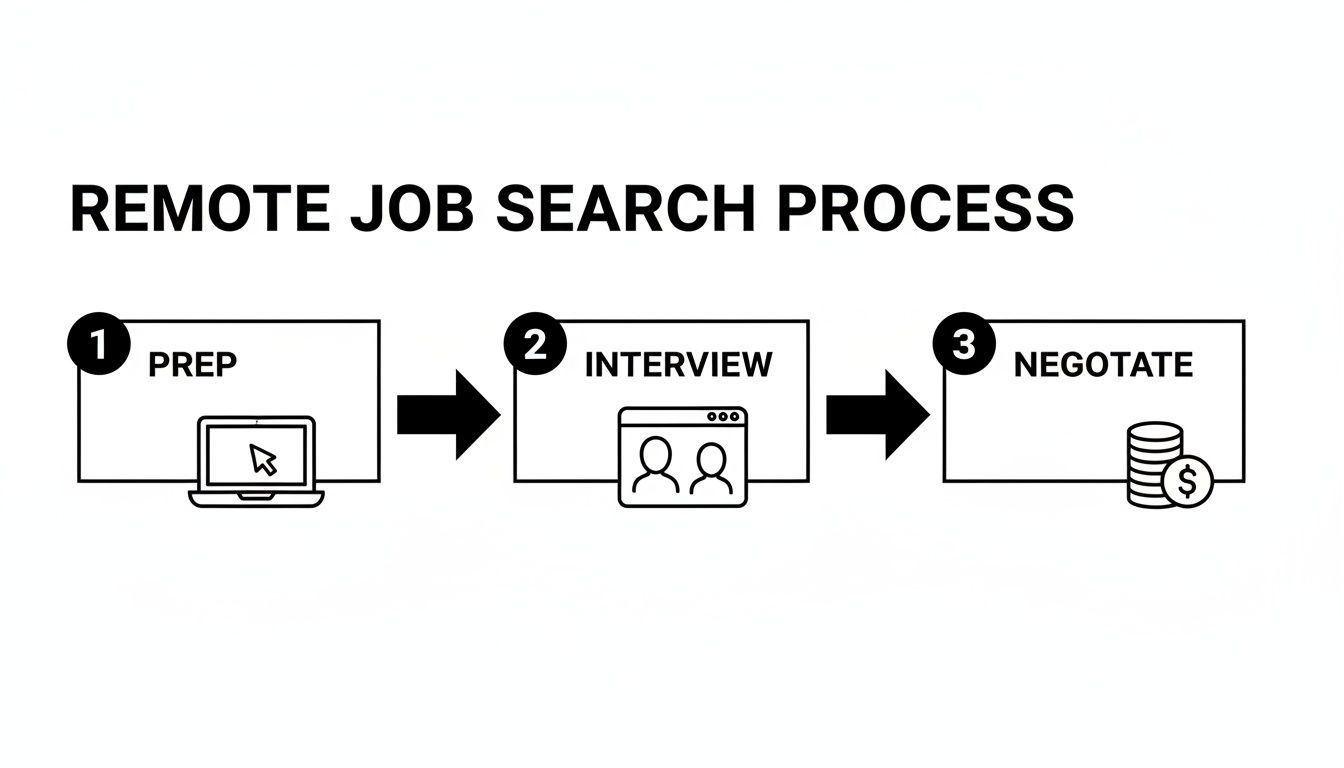
Each of these steps needs a different approach. And when you get to that final negotiation stage, having the right data is what turns a decent offer into a fantastic one.
Map Your Financial Future with the Salary and FIRE Calculator
A job search should always connect back to your long-term financial health. Our Salary & FIRE (Financial Independence, Retire Early) Calculator helps you see an offer not just as a paycheck, but as a concrete step toward your biggest goals.
Think about a real-world example. A PA in Texas with a much lower cost of living could hit their FIRE number years ahead of a colleague earning the exact same salary in California. This tool lets you plug in an offer, automatically adjusts for your state's tax burden and cost of living, and shows you exactly how that specific role speeds up or slows down your financial independence timeline.
It completely changes the conversation from, "What's the salary?" to, "How will this job help me build the life I want?" It’s a game-changer for comparing offers on their real-world value, not just the number on the page.
Clinician burnout is a massive problem, but the explosion in remote PA jobs is a powerful counter-trend. It lines up perfectly with the projected 20% growth for PAs through 2034, with thousands of those openings shifting to virtual care. Tools like our "No Call, No Weekends" filters are built specifically to find these burnout-friendly roles in a crowded market.
Ready to compare offers? Take your data to the next level with the WeekdayDoc Offer Analyzer. It lets you stack up multiple offers side-by-side so you can clearly see which one is the true winner for both your wallet and your well-being.
Your Top Questions About Remote PA Jobs, Answered
Making the leap to telehealth always brings up a few practical questions. As remote care becomes a permanent fixture in medicine, getting the logistics right is the key to a smooth career change. Let's dig into the most common things PAs ask when they're thinking about going virtual.
What State Licenses Do I Need for Remote PA Work?
This is probably the most critical piece of the puzzle. The absolute golden rule of telehealth is this: you must be licensed in the state where your patient is physically located when you see them. It doesn't matter where you are—it's all about them. This is a hard-and-fast legal requirement.
Because of this, you’ll notice many remote healthcare companies are actively looking for PAs with multiple state licenses. It just makes business sense for them, as it broadens their patient pool. The good news? Some employers will even help pay for or handle the paperwork for new licenses, especially if they need to build out their coverage in certain states. Keep an eye out for any mention of the Interstate Medical Licensure Compact (IMLC), as being part of it can seriously simplify getting licensed across multiple states.
The job description is your best friend here. Some remote PA gigs are tied to a single state, but others expect you to come in with a portfolio of licenses. Always get clarity on the company’s licensing expectations—and what support they offer—during the interview process.
Are Remote PA Salaries Competitive?
Let's get straight to it: yes, absolutely. Remote PA salaries are very competitive, often matching or even beating what you’d make in a traditional clinic. The demand for skilled telehealth PAs is high right now, which gives experienced clinicians real leverage at the negotiating table.
When you're looking at an offer, don't just focus on the base salary. Think about the whole financial picture. Working remotely means no more commuting costs (gas, tolls, wear-and-tear), a much smaller budget for work clothes, and other small savings that really add up. While pay will always depend on your specialty, experience, and the specific company, you should not have to take a pay cut just to work from home.
What Kind of Tech and Equipment Will I Need?
Most legitimate telehealth employers know that you need the right tools to provide great care. They get it. You can typically expect them to provide the core technology you'll need to do your job safely and effectively.
That usually includes things like:
- A company laptop with all the necessary security and encryption.
- Secure login access to their Electronic Medical Record (EMR) system.
- A HIPAA-compliant platform for video calls and messaging.
Your end of the bargain is usually providing a reliable, high-speed internet connection and a private, quiet space to work. Patient privacy is paramount. Some of the more forward-thinking companies even offer a home office stipend to help you set up an ergonomic workspace with a good webcam or a noise-canceling headset.
How Do You Actually Maintain Work-Life Balance at Home?
Here’s the great irony of working from home: sometimes it makes it harder to log off. The single most important thing you can do is set firm boundaries to keep your work life from creeping into your personal time.
If you can, create a dedicated workspace. This helps create a mental separation between "work mode" and "home mode." Then, define your work hours and be disciplined about sticking to them. When your shift is over, it’s over. Shut it down. It’s also incredibly important to schedule real breaks, including a full lunch break where you actually step away from your computer. This is exactly why a platform that vets jobs for work-life balance is so valuable—it helps you find roles where those healthy boundaries are already part of the company culture.
Ready to find a remote PA job that actually respects your time? WeekdayDoc filters for burnout-friendly roles with no-call and no-weekend requirements, so you can build a sustainable career you truly enjoy. Start searching for a better work-life balance today.