Physician Assistant Demand: A 2026 Career & Salary Guide
Explore 2026 physician assistant demand. Learn what's driving growth, what it means for your salary, and how to find a sustainable, burnout-friendly PA role.
You may be feeling two things at once right now. Recruiters keep reaching out, job boards stay busy, and everyone says physician assistant demand is strong. At the same time, your actual workday may feel less like opportunity and more like overload.
That contradiction is real. A hot market doesn't automatically create a good career. It can just as easily trap a PA in a role with endless inboxes, a bloated patient panel, surprise call, and the kind of schedule that slowly erodes your off-hours.
The useful question isn't whether physician assistant demand is high. It is. The better question is how to use that demand to build a career that stays clinically satisfying without costing you your health, family time, or financial stability.
The PA Paradox High Demand and High Burnout
A common scenario looks like this. A PA is fully employed, technically well compensated, and getting regular inbound interest from recruiters. But the current job includes late charting, weekend spillover, a supervising structure that feels thin when things get busy, and a patient load that keeps climbing.
From the outside, that clinician looks secure. From the inside, they're one bad quarter away from wanting out.
That's the paradox. Physician assistant demand can be high while day-to-day work quality is poor. Strong hiring demand doesn't protect you from burnout if the role itself is badly designed.
Why the market can feel worse before it feels better
When employers struggle to hire, many ask the existing team to absorb the gap. PAs often become the flexible answer to every operational problem. More same-day access. More refill work. More inbox management. More throughput pressure in clinic, hospital, and urgent settings.
That flexibility is one reason employers value PAs. It's also one reason many PAs burn out.
If you find yourself in this position, it helps to name the problem accurately. You are not failing to “handle stress.” You may be working in a role that depends on overextension to function. That's a design problem, not a character flaw.
For a closer look at the patterns behind this, WeekdayDoc's guide to physician assistant burnout is worth reading.
High demand gives you leverage. Burnout happens when you don't use that leverage early enough.
What actually changes careers
The PAs who build durable careers usually stop evaluating jobs on title and salary alone. They screen for schedule architecture, support, supervision, documentation burden, and whether the employer respects protected time off.
A role with slightly less prestige can be far more sustainable if it offers:
- Predictable hours that don't bleed into evenings
- Clear call expectations instead of vague “shared responsibility”
- Reasonable visit design with enough time for actual clinical thinking
- A support model that doesn't dump every loose task on the PA
The point isn't to leave medicine or avoid hard work. It's to stop treating every open job as equally desirable just because demand is strong. In this market, the better move is to become selective.
The Big Picture Unpacking the Numbers on PA Demand
A PA reviewing job offers in 2025 is not choosing between a handful of openings. In many markets, the main decision is which type of demand is worth your time: high-volume roles that pay for constant availability, or positions structured well enough to support a long career.
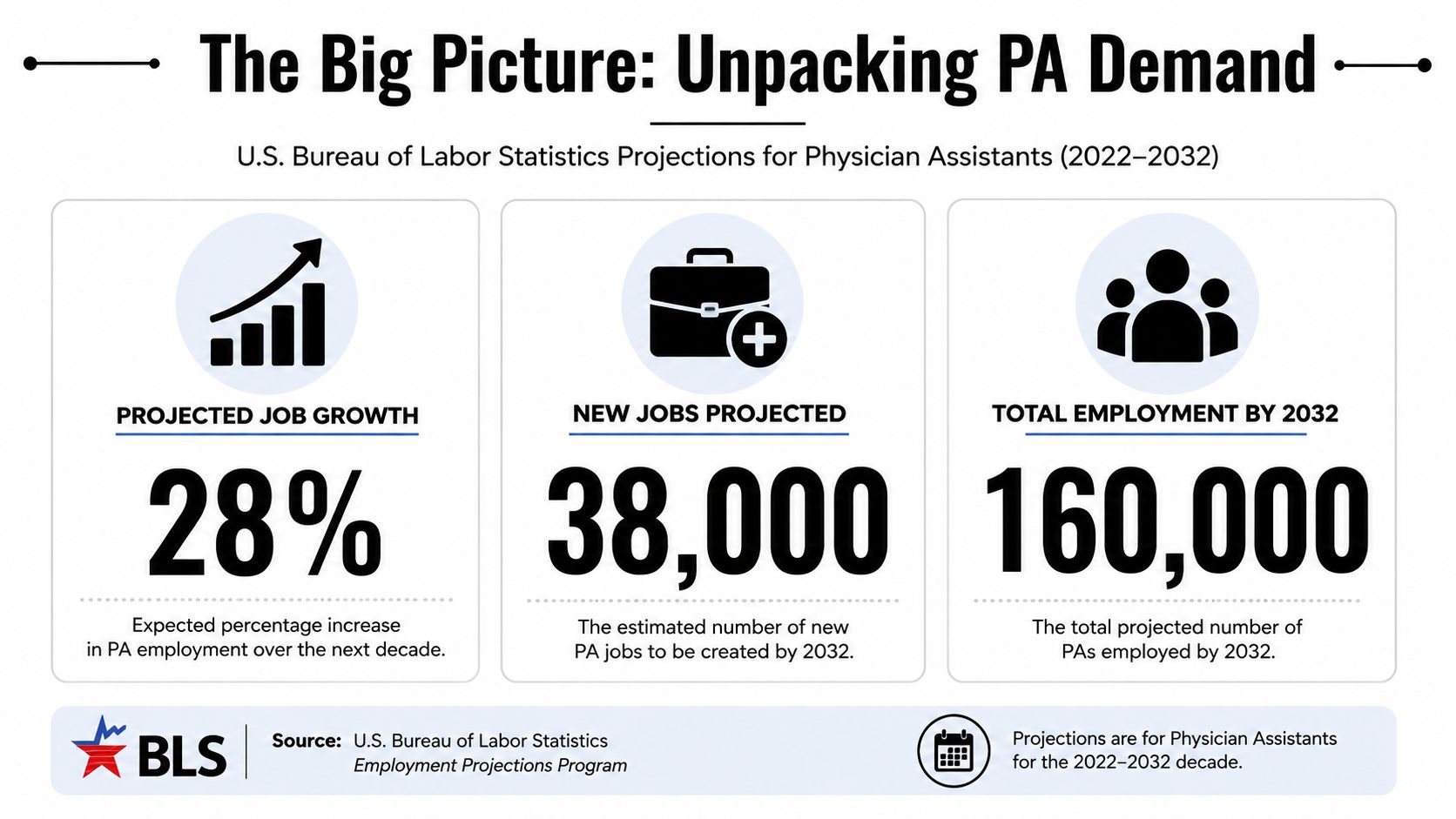
Key projection: The U.S. Bureau of Labor Statistics projects physician assistant employment will grow 20% from 2024 to 2034, with about 12,000 job openings per year on average over the decade, and reported a median annual wage of $133,260 in May 2024 in its physician assistant occupational outlook.
Those three figures matter together. Growth shows the field is expanding. Annual openings show employers keep hiring, not just posting one wave of new roles. Median pay shows organizations are budgeting for PAs as core clinicians, not as a temporary staffing patch.
For career planning, the yearly opening count is often more useful than the growth percentage. About 12,000 openings a year means hospitals, medical groups, surgical services, urgent care chains, and specialty practices are hiring for both new positions and backfill. That creates room to be selective.
Selective matters.
A strong market gives PAs more room to ask harder questions before signing. Is the schedule weekday-only? How often does inbox work spill into evenings? Is call defined in writing? Does supervision fit the state practice environment? If you are comparing offers across states, it also helps to understand how PA practice authority varies by state and setting, because autonomy on paper and day-to-day support are not always the same thing.
The wage figure deserves a practical reading too. A median annual wage of $133,260 is solid compensation, but financial health depends on more than the headline number. A slightly lower salary with predictable hours, no call, lower turnover, and manageable documentation can outperform a higher-paying role that burns through evenings, weekends, and family time.
BLS projections are not a guarantee that every opening is a good one. They do show that PAs have real bargaining power in this market. Used well, that demand can help you build a career with better boundaries, steadier income, and less dependence on white-knuckling through a bad fit.
Whats Driving the Surge in Physician Assistant Jobs
A health system opens a new clinic, adds urgent care hours, or tries to shorten a backed-up specialist schedule. The first staffing question often is not whether they need more clinical capacity. It is whether they can build that capacity fast enough without pushing the existing team closer to burnout. PAs sit in the middle of that decision.
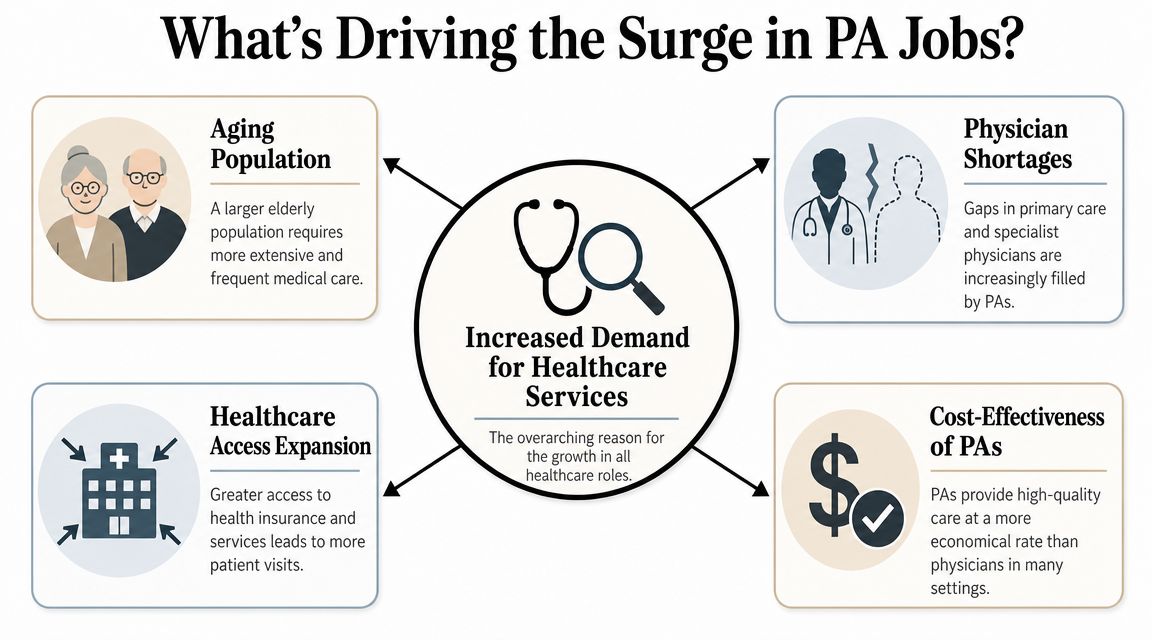
The hiring surge comes from several pressures hitting at once. More patients need longitudinal care. Many physician groups are still short-staffed. Employers also want staffing models that expand access without making every new service line physician-heavy from day one. The American Academy of PAs describes demand through that same mix of access needs, team-based care, and broader use of PAs across settings in its PA profession workforce overview.
More care happens between major events
A lot of demand comes from the work that sits between the dramatic moments.
Patients live longer with diabetes, heart disease, obesity, anxiety, autoimmune conditions, and post-surgical recovery needs that require repeated follow-up, medication adjustment, monitoring, and education. Health systems need clinicians who can keep that care moving. PAs often fill that role because they can manage a broad range of routine and moderately complex visits while keeping escalation pathways clear.
That can create a strong job market. It can also create bloated panels if leadership treats follow-up care as endless overflow.
Physician shortages change how teams are built
Short physician supply affects more than recruiting. It changes role design, clinic flow, and what a PA is expected to own day to day.
In well-run practices, that means defined clinical lanes, standing protocols, reliable collaborating physician access, and enough administrative support to keep inbox work from swallowing evenings. In poorly designed jobs, it means a vague promise of autonomy that turns into constant add-ons, hidden call, and supervision that exists on paper but not in real time.
Scope rules still shape how usable a job really is. If you are comparing offers across states or settings, this guide on how PA practice authority differs across care environments is a practical starting point.
Employers want capacity that is financially workable
Hospitals and medical groups are under pressure to see more patients, preserve margin, and reduce delays. PAs help them do that if the role is built correctly.
A PA can improve throughput, protect physician time for higher-acuity care, and expand access in outpatient clinics, hospital services, surgical programs, and procedural specialties. From an employer's side, that is a staffing decision. From a PA's side, it should be read as a design question. Are you being hired into a system with boundaries, support staff, and a schedule that can hold, or into a patch for chronic understaffing?
That distinction matters for career durability.
Standardized care models create the best and worst PA jobs
Demand stays high in settings where care can be organized around clear workflows. Hospital medicine, pre-op and post-op care, dermatology, GI, orthopedics, cardiology follow-up, and many outpatient chronic care models all rely on repeatable clinical patterns handled by skilled clinicians who know when to escalate.
These jobs can be excellent. They often offer weekday-heavy schedules, cleaner role definitions, and enough predictability to protect life outside work.
They can also become assembly-line medicine if volume targets outrun staffing and documentation support.
The opportunity in this market is not just getting hired. It is choosing roles where demand works for you. The strongest PA jobs right now are often the ones that pair real clinical need with disciplined scheduling, limited call, and a care model that does not treat endurance as the main qualification.
Navigating Demand by Location and Specialty
National demand is useful. Your actual bargaining power shows up in a narrower place: a specific market, a specific specialty, and a specific employer's staffing pain.
That's where many PAs make career decisions too quickly. They assume demand is uniformly strong everywhere and end up choosing from titles instead of choosing from operating models.
A better approach is to ask where employers most need a PA who can work at the top of scope. Workforce forecasting research projected the clinically active PA workforce would reach about 204,243 to 214,248 by 2035, while noting that employers are in the strongest position in markets and specialties where PAs can practice at the top of scope, especially in outpatient medicine and hospital-based services in the peer-reviewed workforce forecast.
Location changes your negotiating power
The same specialty can feel completely different in two job markets. In one region, the employer has a deep candidate pool and can be rigid on schedule. In another, they need coverage badly enough to negotiate weekday-only hours, reduced call, or a narrower clinical lane.
What usually creates an advantage?
- Underserved communities often need stable clinical coverage and may offer broader responsibility.
- Fast-growing suburban markets can create steady outpatient demand with more predictable scheduling.
- Hospital-dependent regions may produce stronger demand in inpatient and procedural support roles.
- Dense metro areas can offer more specialty choice, though some employers there are less flexible because applications remain steady.
None of those are universal rules. They're screening lenses.
Specialty matters as much as geography
Some specialties naturally create more schedule strain. Others are easier to shape into a sustainable role. Demand can be strong in both, but the lifestyle implications are very different.
Here's a practical comparison framework.
| Specialty | Demand Level | Common Setting | Key Driver |
|---|---|---|---|
| Primary care | High | Outpatient clinic | Ongoing chronic disease management and access expansion |
| Hospital medicine | High | Hospital-based service | Need for daily patient throughput and continuity on service |
| Urgent care | High | Walk-in outpatient centers | Same-day access and volume-based care delivery |
| Surgical subspecialties | High | Hospital and specialty practice | Procedural support, perioperative care, and service efficiency |
| Psychiatry | High | Outpatient behavioral health, hybrid care | Expanded need for medication management and follow-up access |
| Dermatology | Moderate to high | Office-based specialty practice | High patient demand with repeatable outpatient workflows |
| Occupational medicine | Moderate to high | Employer clinics, outpatient centers | Protocol-driven evaluations and weekday-heavy operations |
| Telehealth-oriented follow-up roles | Moderate to high | Remote or hybrid care models | Standardized follow-up, access, and convenience |
What works for burnout prevention
If your goal is a durable career, don't just ask which specialty is hot. Ask which specialty and setting combination gives you the best chance of controlled hours.
The strongest burnout-resistant combinations often have these features:
- Outpatient-first workflow with defined start and end times
- Lower call intensity or no call at all
- Repeatable clinical patterns that don't create constant emotional whiplash
- Adequate support staff for prior auths, refills, and patient messages
A high-demand specialty is only a good move if the setting lets you recover between workdays.
Hospital-based and procedure-oriented roles can be excellent fits for some PAs, especially if they like acuity and teamwork. But if your energy is already frayed, a weekday outpatient role may be a smarter move than another high-intensity job with a slightly higher paycheck.
How High Demand Shapes Your Career and Salary
Demand becomes useful when you convert it into terms. That includes compensation, but it also includes time, flexibility, and protection from the kind of workload creep that ruins otherwise attractive jobs.
The compensation trend is clear. BLS-based reporting noted a 2023 median annual wage of $126,010, and the 2026 AAPA salary report showed median compensation rising to $140,000 in 2025, a 4.5% year-over-year increase, according to this summary of physician assistant job outlook and pay trends.
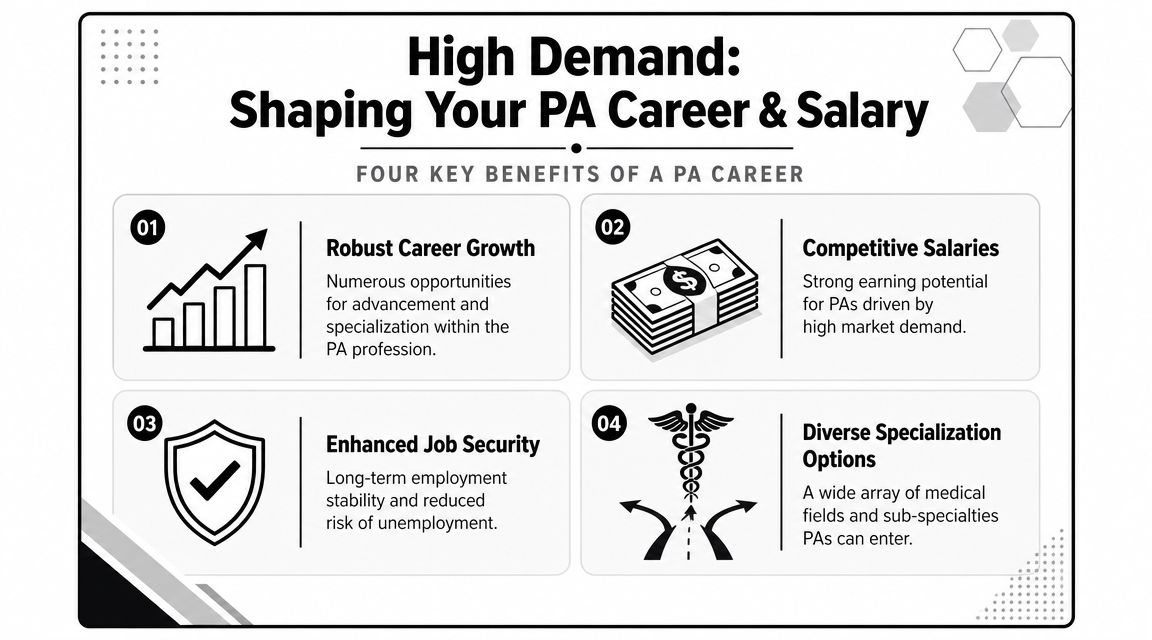
Salary is only one form of leverage
Most PAs underuse the current market because they negotiate only on base pay. That leaves a lot on the table.
If an employer is having trouble hiring, your value isn't limited to what they can pay. It also includes what they are willing to redesign to secure and keep you.
That can mean:
- Schedule control such as four-day weeks, weekday-only hours, or fixed clinic sessions
- Call protection through a no-call clause or a clearly capped shared call structure
- Documentation support with better MA coverage, scribe support, or realistic admin time
- Role clarity so inbox work, refills, and triage expectations don't expand without limits
Those terms directly affect your financial life too. A slightly lower salary in a no-call weekday role may produce a better real outcome if it cuts childcare costs, preserves your health, and lowers the chance that you'll need to make another move in a year.
Strong markets reward selectivity
When physician assistant demand is high, you can be more disciplined about fit. That's especially important if you're already feeling thin.
Use interviews to test operational reality. Ask who covers messages after hours. Ask what happens when a physician is out. Ask how often PAs stay late for documentation. Ask whether “occasional weekends” means a real rotation or a constant staffing patch.
A candidate-driven market gives you permission to be direct.
Practical rule: If a group becomes evasive when you ask about call, inbox burden, or schedule drift, believe the evasiveness.
Compensation and lifestyle should be evaluated together
A rising median tells you the profession is valuable. It doesn't tell you whether a specific job is a good deal.
One of the most useful habits is to compare offers on three tracks at once:
Cash compensation
Base salary, bonus design, CME support, retirement match, and benefits.Time economics
Commute, charting spillover, call burden, weekend requirements, and PTO usability.Career durability
Can you still see yourself doing this version of the job in a few years without resentment?
If you're comparing markets, a state-level pay view can help frame those decisions. This guide to physician assistant salary by state is useful as a starting point, especially when paired with your own cost-of-living and schedule priorities.
A key win in a high-demand market isn't just earning more. It's building a role where your income, energy, and personal life stop working against each other.
Practical Strategies for PAs and Employers
High demand gives both sides more room to shape a better job. It also exposes weak roles faster. A PA who asks clear questions can avoid stepping into a schedule that looks fine on paper and drains them six months later. An employer who defines the job accurately will usually hire faster and keep that clinician longer.
For PAs pursuing a better role
State your practice range in concrete terms
Make it easy for a hiring team to picture you in the workflow. List patient populations, procedures, EMR systems, visit volume, inpatient or outpatient mix, and the parts of care you manage with minimal ramp-up.Screen for burnout risk before the second interview
Ask for the actual schedule, not the recruiting version. Clarify call, weekends, inbox ownership, admin time, onboarding support, and what happens when staffing runs short. If you want a weekday-only, no-call role, say that early. Strong employers will answer directly.Negotiate the job structure with the salary Base pay matters. So do charting time, visit expectations, cross-coverage, and PTO you can take. A practical script is: “I'm looking for a role I can sustain long term, so I want to review weekday structure, call expectations, and protected admin time along with compensation.”
Use job filters that match the life you want
In a market like this, applying broadly is less useful than choosing carefully. If your goal is to prevent burnout, focus on roles with clearly defined hours, limited after-hours spillover, and stable coverage expectations.Treat recovery as part of career planning
Burned-out clinicians often make rushed job decisions just to escape the current one. That can lead to the same problems in a new setting. This resource on how to deal with burnout can help you steady your energy and make a cleaner decision about your next move.
For employers trying to hire and retain PAs
Write job posts like an operations document
If the role is Monday through Friday, say so. If there is no call, say so. If call exists, define frequency, backup, and whether messages spill into personal time. Specificity attracts candidates who want that exact job and filters out poor fits early.Build retention into the workflow
Compensation gets attention, but daily friction drives turnover. PAs notice inbox volume, MA support, same-day add-ons, charting after clinic, and whether physician coverage is reliable when the day goes sideways. Fix those issues before recruitment, not after a resignation.Show how supervision works in practice
Candidates want to know who is available for curbside questions, who reviews complex cases, and what happens when a supervising physician is out. A credible answer lowers anxiety and makes the role feel safer and more sustainable.Use flexibility as a concrete hiring advantage
Many PAs will choose a slightly lower salary for predictable hours, fewer weekends, protected time off, and less schedule drift. For clinicians with kids, elder-care duties, or simple burnout fatigue, that trade-off is rational, not secondary.
The PAs who come out ahead in this market are not the ones who chase every opening. They choose roles that support income, recovery, and a life outside the clinic. Employers who understand that will fill jobs with stronger candidates and keep them.