Emergency Medicine Locums: A 2026 Clinician's Guide
Explore emergency medicine locums in 2026. This guide covers pay, contracts, burnout, and finding sustainable roles to reclaim your work-life balance.
You finish a run of shifts already tired, then stay late for charts, inbox noise, committee leftovers, and another schedule that ignores how emergency medicine hits the body. The problem usually isn't one terrible shift. It's the accumulation. Nights stacked too tightly. Crowded departments with weak backup. A calendar that makes recovery impossible.
That's where a lot of physicians start looking at emergency medicine locums.
Not because locums is a fantasy escape. It isn't. A bad locums setup can burn you out just as efficiently as a bad employed job. But a well-chosen locums practice can give you something many permanent roles subtly take away over time: autonomy. This applies to your schedule, your income, your location, and the clinical environments you're willing to tolerate.
I've seen clinicians make two opposite mistakes. One is dismissing locums as temporary patchwork beneath a “real” emergency medicine career. The other is chasing the highest hourly rate and discovering too late that they bought themselves worse shifts, weaker support, and more chaos. The useful middle ground is to treat locums as a career tool. Used well, it can help you reduce burnout, protect family time, and build financial breathing room. Used poorly, it becomes expensive fatigue with airline miles.
Is Emergency Medicine Locums Your Next Move
At the end of a hard ED month, most physicians ask the wrong question. They ask, “Can I make more doing locums?” The better question is, “What part of my current job is wearing me down, and would locums actually fix that?”
For some, the answer is schedule control. For others, it's escaping a department where every shift feels under-resourced. Sometimes it's simpler than that. You may just want time to think before signing another long contract.
A common scenario goes like this: an attending is still clinically solid, still likes emergency medicine, but dreads the machinery around it. The medicine isn't the main problem. The problem is loss of control. A fixed template with nights, weekends, holidays, mandatory meetings, and administrative creep leaves no room to recover. In that situation, locums can work as a pressure-release valve.
When locums helps
Emergency medicine locums makes sense when you need flexibility with a purpose. That might mean:
- Creating recovery time: Working in blocks, then taking real time off instead of scattered post-shift days that don't restore you.
- Testing a transition: Using a temporary assignment while leaving a permanent role, relocating, or figuring out whether you want to stay full-time in the specialty.
- Reducing politics: Some physicians don't need less patient care. They need fewer meetings, less committee work, and less exposure to local dysfunction.
- Buying financial runway: Higher gross pay can help you build savings fast enough to make later career choices from a calmer position.
Practical rule: If your main problem is lack of control, locums may help. If your main problem is that you no longer want to practice emergency medicine at all, locums usually won't solve that.
When locums won't help
Locums is a poor fix if you hate uncertainty, need a highly predictable monthly routine, or already feel overloaded by paperwork. Temporary work replaces one kind of stress with another. If every new badge, login, workflow, and credentialing packet makes you miserable, you need to be honest about that.
If you're still clarifying the basics, this primer on what a locum job is is a useful place to start before comparing offers.
The point isn't to flee your current role blindly. It's to decide whether emergency medicine locums can move you toward a more durable version of your career.
Understanding the Locums Model in Emergency Medicine
Emergency medicine locums isn't fringe work anymore. About 8% of eligible U.S. physicians, roughly 57,000 doctors, were working locum tenens as of May 2024, and another 27% had done so in the past. That puts direct locum experience at about one-third of physicians, according to CHG Healthcare's State of Locum Tenens Report.
That matters because it changes how you should think about the model. Locums isn't a fallback. It's a mainstream staffing structure.
What “holding a place” means in the ED
In emergency medicine, a locum physician is usually not joining to build a panel, grow service lines, or help run the department. You're there to fill a defined operational need. Nights no one can cover. Seasonal surge periods. A staffing hole after departures. A rural hospital trying to keep safe physician coverage on the schedule.
The best analogy is not “temporary employee.” It's clinical contractor with immediate operational value. The facility needs someone who can arrive, function safely, and keep throughput stable without a long runway.
That changes the job in a few ways:
| Aspect | Permanent role | Locums role |
|---|---|---|
| Primary identity | Team member and employee | Independent clinician filling a coverage need |
| Nonclinical duties | Often includes meetings, committees, metrics work | Usually narrower and assignment-specific |
| Time horizon | Long-term integration | Defined block, shift series, or temporary contract |
| Leverage | Stability through employment | Flexibility through selective acceptance |
The mindset shift
A physician who succeeds in locums usually stops thinking like an employee and starts thinking like a professional service provider. That doesn't mean being detached. It means being clear about scope.
You need to know what you're walking into before you say yes. What's the shift mix? Who handles admissions? Is there backup? How much autonomy do APPs have? How are transfers handled? Those questions aren't secondary details. They define the work.
In a good locums assignment, the job is clear before your first shift. In a bad one, you discover the real expectations after you arrive.
If you're actively searching, browsing current locum tenens physician jobs can help you see how widely assignments vary in schedule, setting, and support.
Emergency medicine rewards adaptability. Locums rewards adaptability plus selectivity.
The Burnout Equation Weighing Pros and Cons
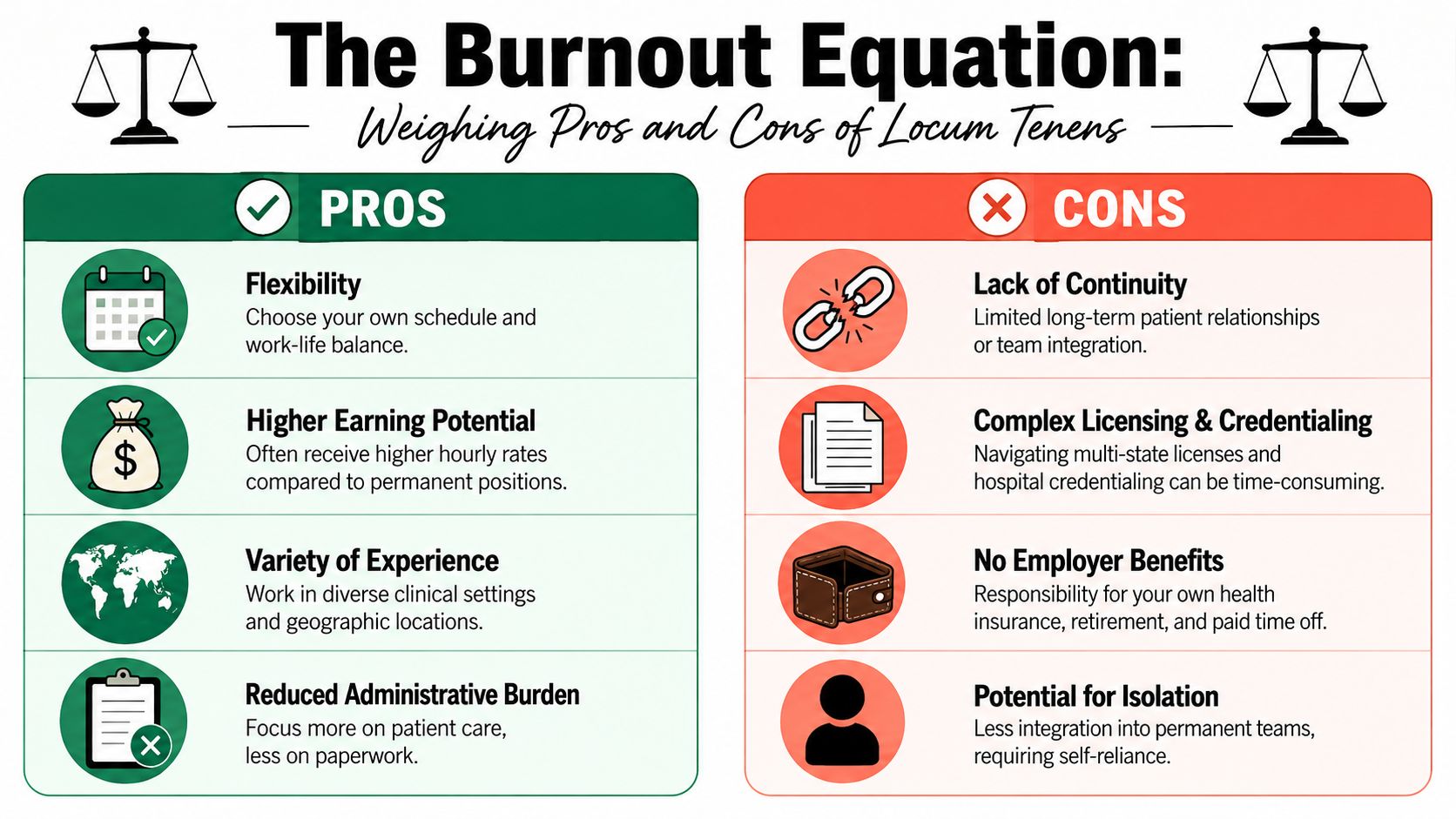
Burnout doesn't respond to slogans. It responds to actual changes in workload, autonomy, recovery time, and financial pressure. Emergency medicine locums can improve those variables, but it can also create fresh ones.
What tends to help
The biggest benefit is control. You can often choose when to work, how much to work, and which environments are worth your time. For physicians who are burned out by rigid staffing templates, that alone can be enough to improve life.
There's also a cleaner relationship between effort and compensation. You know what the shift pays. You know the schedule. You're less likely to spend unpaid time absorbed by departmental obligations that have little to do with patient care.
Another benefit is distance from local politics. Many employed emergency physicians are less exhausted by chest pain and sepsis than by bad leadership, endless initiatives, and pressure from multiple directions. Locums can remove a lot of that.
What tends to hurt
The hidden costs are administrative fragmentation and instability. You may trade committee meetings for licensing packets, repeated onboarding, contract review, and travel coordination. That's still work. It just looks different.
You also lose the infrastructure of employment. Benefits, retirement plan matching, paid time off, and predictable systems are no longer automatic. Some physicians find that liberating. Others discover they miss having a single institution absorbing all the background friction.
A side-by-side burnout test
Use this comparison fairly:
- Flexibility helps if your current burnout comes from overscheduling.
- Higher rates help if financial strain is forcing you to work too much.
- Less politics helps if your department culture is the problem.
- Variety helps if one environment has become chronically toxic.
But the same model can backfire:
- Irregularity hurts if uncertainty itself stresses you out.
- Credentialing hurts if paperwork drains your energy.
- Isolation hurts if you rely on a stable team for professional support.
- Travel hurts if home disruption matters more than schedule freedom.
| Burnout driver | Locums may improve it | Locums may worsen it |
|---|---|---|
| Schedule overload | More control over dates and volume | Income gaps may tempt you to overbook |
| Hospital politics | Less exposure to internal bureaucracy | Less influence over local decisions |
| Financial pressure | Higher gross earning potential | No built-in benefits or paid leave |
| Clinical fatigue | Ability to choose better-fit sites | New systems and unfamiliar workflows add strain |
Don't evaluate a locums job by rate alone. Evaluate whether the assignment leaves you more recovered after a month, not just better paid after a pay period.
What works in real life
The most sustainable physicians use locums selectively. They build a stable base, then choose assignments that fit an intentional life design. That might mean fewer nights, clustered shifts, limited travel radius, or a cap on how many chaotic departments they'll tolerate in a year.
What doesn't work is using locums as a way to outrun burnout while keeping the same self-destructive habits. If you say yes to every premium shift, every holiday opening, every understaffed site, you'll recreate the same exhaustion under a different tax form.
Decoding Pay Benchmarks and Regional Demand
Compensation matters, but gross pay is only one line in the decision. Emergency medicine locums often pays more than employed work, and the premium can be meaningful. The mistake is treating the quoted rate as the whole story.
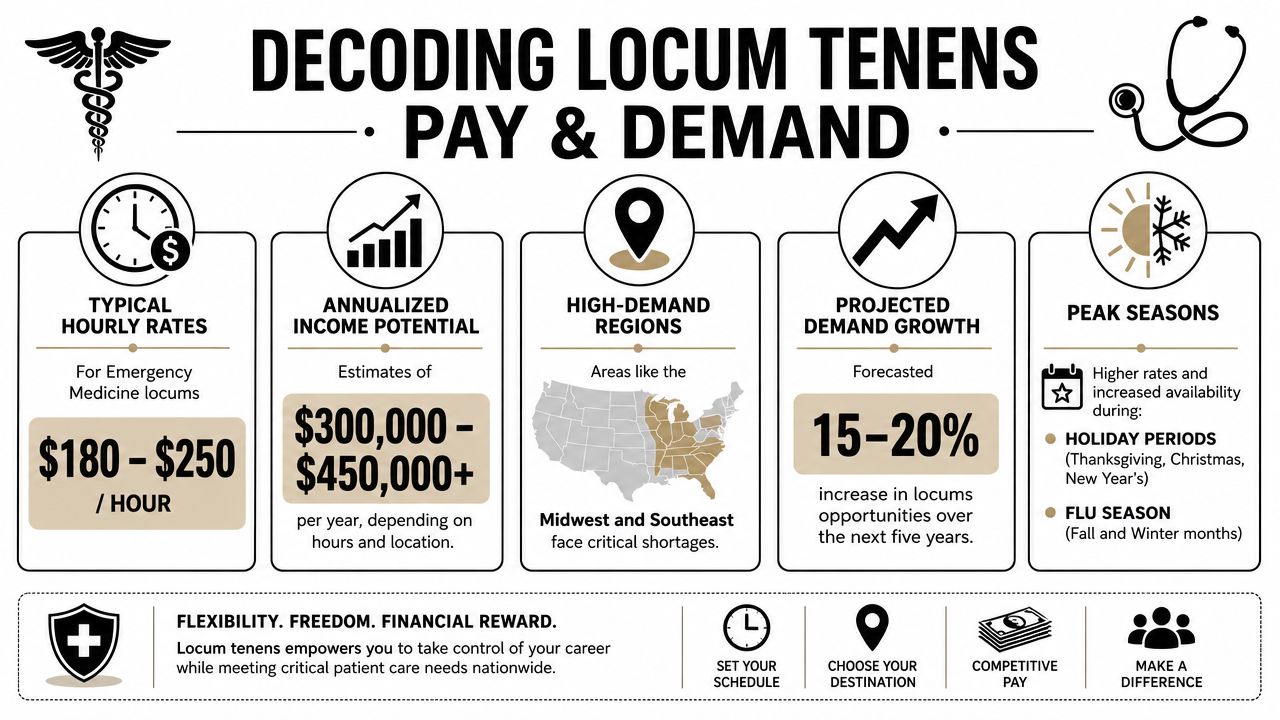
The baseline comparison is straightforward. The U.S. Bureau of Labor Statistics lists emergency medicine physicians at a mean annual wage of $306,640 and a mean hourly wage of $147.42 in May 2023, with employment services averaging $152.20 per hour in its emergency medicine physician wage data. By contrast, the verified market figures available here show locum tenens emergency medicine rates around $225 to $275 per hour, with Florida postings in 2026 averaging about $538,000 annually and current offers around $289 per hour.
That spread explains why physicians pay attention to locums.
What actually changes the rate
Rate variation in emergency medicine usually reflects burden, not generosity. A posting pays more because something about the assignment is harder to staff.
Common drivers include:
- Shift burden: Nights, weekends, holidays, and less desirable sequences usually command more interest only when the rate compensates for the disruption.
- Facility environment: A small community site with thin backup creates a different kind of risk than a larger center with specialty support.
- Geography: Some places have chronic need but a smaller pool of physicians willing to travel there.
- Assignment friction: Repeated travel, awkward scheduling blocks, or difficult credentialing can make a headline rate less attractive in practice.
Here's the practical lens:
| If the offer emphasizes | Ask yourself |
|---|---|
| Very high hourly rate | What is making this hard to fill? |
| Large annualized estimate | How many shifts, what mix, and what travel pattern produce that number? |
| Fast start date | Is the site organized, or just desperate? |
| Flexible scheduling | Flexible for whom, you or the hospital? |
Later in your review process, it helps to hear a recruiter-style overview of how assignments are structured and negotiated:
Urban access, rural need
One of the harder truths in emergency medicine locums is that need and supply don't line up neatly. A Barton Associates article on emergency healthcare and rural locums notes that locum emergency medicine providers are available in larger cities, but there are fewer providers working in rural areas.
That mismatch matters. Rural emergency departments often need coverage the most, yet those jobs can be the hardest to fill because they ask physicians to accept more distance, less backup, or both.
A high-paying assignment in a high-need area isn't automatically a bad job. But it does deserve a longer due-diligence process than a polished urban listing.
The financially smart move is to compare offers by net life impact, not only gross annualized pay.
Navigating Licensing Contracts and Liability
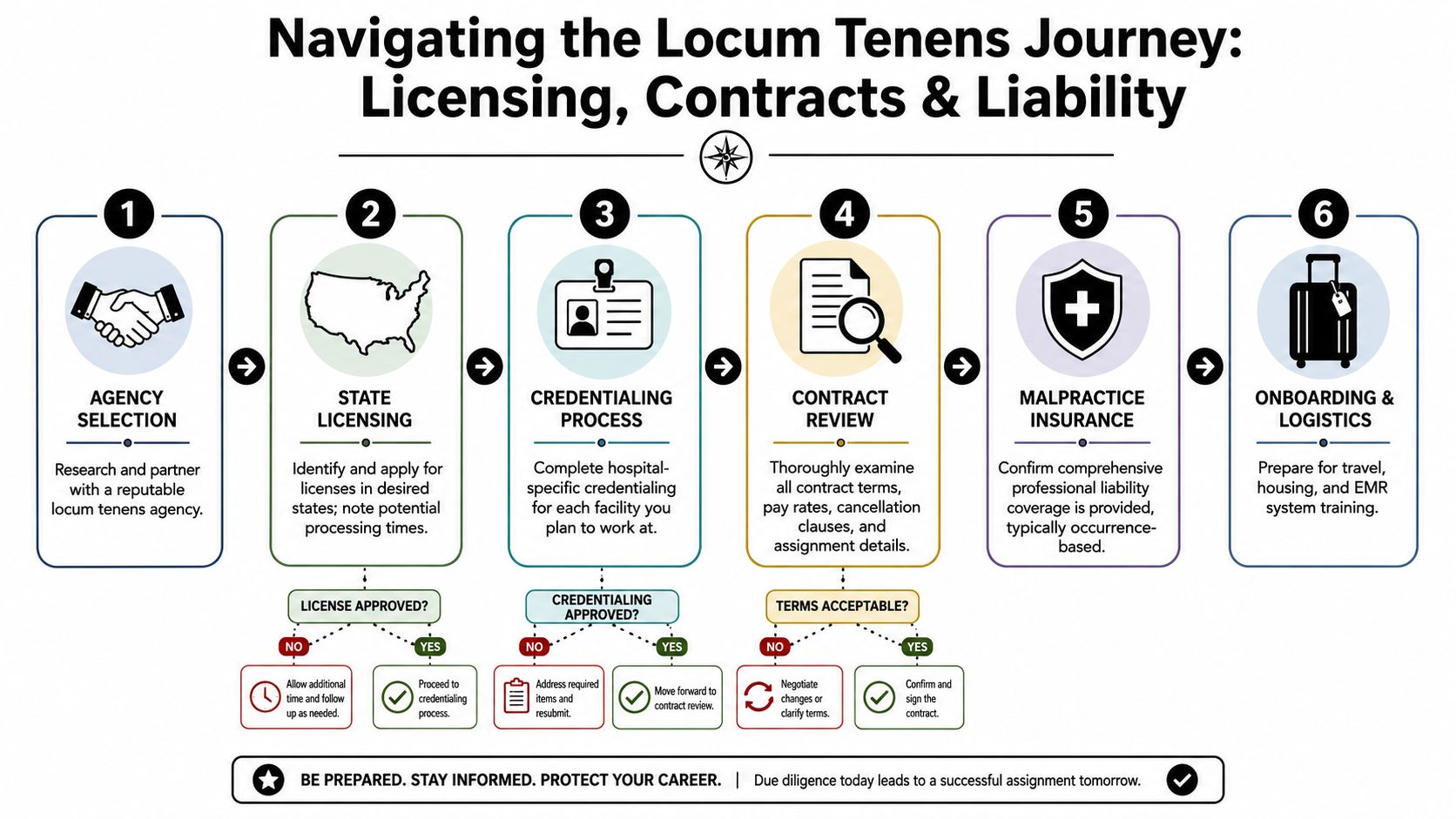
Most physicians worry about the paperwork before they worry about the medicine. That's understandable, but licensing, credentialing, and contracts are manageable if you approach them like a repeatable system instead of a one-time annoyance.
Start with the assignment's operating reality
In emergency medicine, legal and administrative review should begin with clinical operations. Case mix, shift architecture, and documentation standards are core risk variables, not side issues. The O*NET emergency medicine physician profile emphasizes immediate recognition, stabilization, disposition, and rapid interpretation of diagnostic procedures. In plain terms, this is work where delay matters.
That means your contract review should include questions like these:
- Clinical scope: Are you expected to manage high-acuity cases without on-site backup?
- Shift design: Are shifts lengthened, stacked, or scheduled at circadian-breaking intervals?
- Support structure: Who admits, who transfers, who responds when the department spikes?
- Documentation workflow: What EMR is used, how are handoffs handled, and what documentation fields are mandatory?
Contract terms that deserve a red pen
A lot of bad locums experiences could have been prevented by slower contract review. Don't skim.
Focus on these clauses:
- Cancellation language: How much notice can the facility give, and what happens to your travel plans if they cancel?
- Guaranteed work expectations: Are shifts committed, or merely anticipated?
- Exclusivity and non-compete language: Temporary work shouldn't implicitly limit your other options.
- Payment timing: Know when invoices process and what documentation triggers payment.
- Malpractice details: Confirm who carries the policy and what coverage applies after the assignment ends.
A contract that looks simple can still hide most of the risk in the fine print.
Documentation and handoff risk
Emergency medicine locums live or die by information quality. A 2023 analysis of emergency medical services data quality found that most examined data elements were accurate or consistent, but completeness varied by source, with demographic data more complete than clinical data. The authors concluded that routine chart review, staff training, feedback, and dedicated quality assurance can improve emergency-care documentation.
For locums physicians, that translates into one practical lesson: ask how the site handles handoffs before you accept the work.
If the site can't explain its documentation expectations clearly, assume the handoff culture is loose until proven otherwise.
Missing structured data doesn't stay on paper. It shows up in duplicate testing, slow dispositions, and unsafe transfers.
Managing Your Finances as a 1099 Clinician
A higher locums rate can improve your life, but only if you handle it like business income rather than upgraded spending money. The shift from W-2 employee to 1099 contractor is not cosmetic. It changes taxes, retirement planning, insurance, and cash-flow management.
Think like an owner, not a moonlighter
Many emergency physicians start locums as side income and keep thinking like employees. That usually leads to avoidable mistakes. They spend from gross receipts, under-save for taxes, and delay benefit planning because the checks feel large at first.
The fix is simple: separate personal and business thinking early.
A practical setup often includes:
- Dedicated accounts: Keep business income and tax reserves separate from daily spending.
- Expense tracking: Capture licensing, travel, credentialing-related costs, professional fees, and equipment consistently.
- Quarterly tax planning: Don't wait for a painful surprise at filing time.
- Retirement automation: Move money on purpose instead of hoping there's something left over.
Get clear on classification
If you're sorting out contractor status and what it means operationally, this overview of 1099 vs W-2 worker classification is a useful primer. It won't replace a CPA, but it helps frame the difference in responsibility.
That distinction matters because no employer is doing the boring but important work for you anymore.
Build your own benefits package
Locums can support burnout reduction only if your financial structure reduces stress rather than creating it. That means replacing the invisible safety net of employment with your own system.
Your checklist should include:
- Health insurance: Shop deliberately. Don't leave this unresolved because a current short-term assignment feels temporary.
- Disability coverage: Your income depends on your ability to work shifts. Protect it.
- Life insurance: If others rely on your earnings, handle this early.
- Retirement accounts: A SEP IRA or Solo 401(k) often fits 1099 physicians better than vague intentions to “save more later.”
- Emergency fund: Assignment gaps happen. A buffer gives you negotiating power.
Use locums income to buy freedom
The strategic value of emergency medicine locums isn't just that it can pay more. It's that concentrated income can let you work less reactively. You can pay down debt, build cash reserves, fund retirement aggressively, and eventually stop saying yes to jobs that grind you down.
That's the bridge to long-term sustainability. Burnout gets worse when every bad shift feels financially mandatory.
The strongest locums position is having enough cash reserve that you can walk away from a bad assignment without panic.
If you want locums to support financial independence, set a target for what the extra income is supposed to do. Debt payoff. One year of living expenses. Retirement catch-up. A down payment. Pick the objective first. Then let the work serve it.
How to Find Your First Burnout-Friendly Locums Role
Your first assignment shapes how you think about emergency medicine locums. If you choose badly, you'll conclude the whole model is broken. Usually the model isn't broken. The screening was.
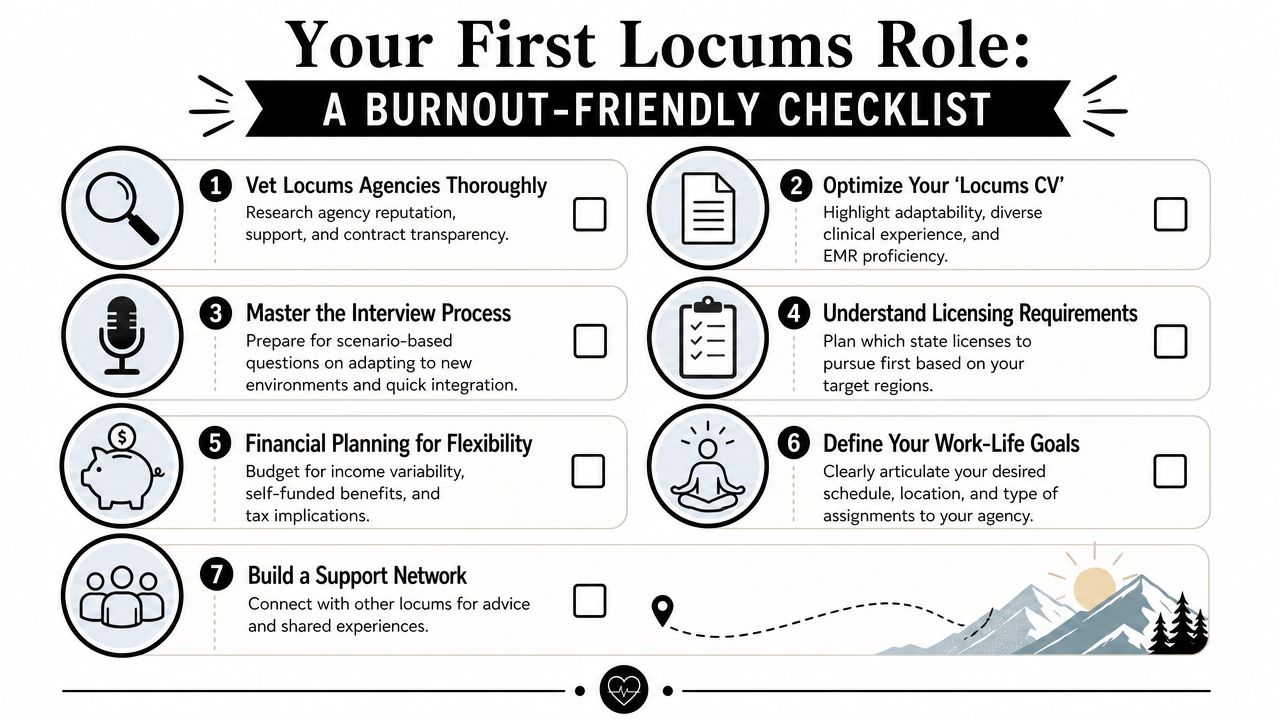
A lot of discussions stop at pay and flexibility. That's incomplete. AMN Healthcare's California locum emergency medicine listings showed average salaries around $523,000 across jobs and about $539,000 for available jobs as of Oct. 27, 2025, but that still doesn't answer whether the work is better for a burnout-conscious physician after travel, licensing, and shift burden are factored in, as shown in AMN Healthcare's California emergency medicine locums listings.
Screen for fit before rate
For a first assignment, lower drama beats maximum pay. You want an environment that lets you learn the locums process without also fighting operational chaos.
Ask these questions in the interview process:
- How many patients arrive during the busiest hours? You don't need invented productivity metrics. You need a realistic description of flow and bottlenecks.
- What backup is on site? Specialty support, APP coverage, nursing stability, and transfer capability all matter.
- What does a typical bad shift look like? Good sites answer this directly.
- How are nights and weekends distributed? “Flexible” means nothing until it's specific.
- How much orientation do locums get? Even one organized onboarding session can make the first shift safer.
Build a locums filter for burnout
A strong first assignment usually checks most of these boxes:
Reasonable scheduling
Clustered shifts can work well. Randomly scattered dates usually don't.Predictable operations
Not easy. Predictable. There's a difference.Competent onboarding
Logins ready, contact numbers clear, transfer pathways explained.Manageable travel burden
Your first job shouldn't feel like a weekly expedition.Clear documentation expectations
If charting rules are vague, problems usually follow.
One practical option while screening roles is the burnout-friendly job board, which lets clinicians filter for work-life factors such as no-call and no-weekend roles. That kind of filtering is useful when you're trying to compare assignments by sustainability, not just pay.
Start smaller than your ego wants
A common mistake is taking the most lucrative assignment available because it feels efficient. For a first locums role, a simpler site close to home may be the better move. Learn the workflow. Learn how agencies communicate. Learn what contract language matters to you. Then expand.
Your first locums assignment should be a good test case, not a heroic stress test.
The physicians who make emergency medicine locums sustainable tend to know their absolute limits. They know how many nights they can realistically tolerate. They know whether travel energizes them or depletes them. They know the difference between productive intensity and chronic dysfunction.
That clarity matters more than enthusiasm.
If you're exploring a more sustainable clinical path, WeekdayDoc is one place to compare physician roles through a burnout lens instead of a hype lens. The platform was built around work-life filters like no call and no weekends, and it includes salary data, a Burnout-Friendly Score, and FIRE-oriented tools that can help you judge whether a role supports the career you want.