Your 2026 Guide to Multi State Medical License
Your expert guide to securing a multi state medical license in 2026. Learn about IMLC, NLC, & PSYPACT to unlock remote jobs & better work-life balance.

A multi state medical license can move faster than most physicians expect. Through the Interstate Medical Licensure Compact, the average wait time is 19 days according to Medicushcs on common IMLC questions. That changes the conversation.
For years, clinicians treated cross-state licensure as a paperwork project for locums or telemedicine moonlighting. That view is outdated. In practice, multi-state licensing is a career design tool. It gives you more control over where you work, how you schedule your time, and which employers get to compete for you.
That matters if you're trying to reduce call, cut weekends, build a telehealth lane, or create enough income flexibility to stop saying yes to every exhausting shift. A physician with one license has one local market. A physician with several has options. Options are what protect you from bad contracts, bad schedules, and bad fit.
The New Calculus of Clinical Practice
Physicians with more than one active state license have a wider set of career options, and that changes how they can shape work around life instead of the other way around.
I treat multi-state licensure as a strategic asset. Yes, it comes with fees, renewals, CME tracking, and more administrative work. It also gives physicians something many burned-out clinicians are missing: credible alternatives.
Why licensing strategy now affects burnout
Burnout usually grows out of constraint. One employer controls the schedule. One group sets the call burden. One local market determines compensation. Once a physician has no practical fallback, poor staffing models and bad contracts get harder to resist.
A broader licensing footprint shifts that balance.
It can help you access telehealth work, compare regional rates, and build a practice mix that fits your goals instead of locking you into a single lane. For physicians pursuing better work-life balance or a FIRE plan, that flexibility has real value. More options can mean fewer overnight calls, fewer weekend shifts, and a better chance to protect income without accepting every exhausting schedule.
I see this most clearly in physicians who want control, not chaos. They are not collecting licenses for appearance. They are creating room to choose.
- Add a second income stream: A few sessions of remote follow-up care or consult work can reduce pressure to depend on one employer.
- Strengthen contract negotiations: Recruiters and medical groups respond differently when you can realistically practice in several markets.
- Target schedule quality: Some of the better long-term roles are built around weekday clinic blocks, virtual care, or limited-call structures.
- Protect against local market weakness: If reimbursement drops or a group becomes unstable, you have more than one place to look.
A physician licensed in multiple states can decline work from a position of strength.
Where this becomes practical
This shows up in everyday career decisions. An internist may want virtual chronic-care follow-up across state lines. A psychiatrist may want a larger telehealth panel without adding a full second job. A cardiologist may evaluate cardiology recruitment via IMLC to compare coverage models and compensation structures in several regions. Physicians exploring lighter, weekday-focused schedules can also review WeekdayDoc's guide to the Interstate Medical Licensure Compact as part of that planning.
There is a trade-off. More licenses mean more renewal dates, more compliance details, and more upfront expense. But for many physicians, those costs are smaller than the financial and personal cost of being trapped in the wrong job.
The more strategic question is simple. Does multi-state licensure give you enough flexibility to reduce burnout, improve your negotiating position, and build a career that supports your life outside medicine? In many cases, it does.
Understanding the Compacts IMLC NLC and More
The easiest way to think about a licensure compact is this. It's similar to a driver's-license framework, but with an important catch. The compact can streamline access across jurisdictions, yet you still remain accountable to each state's rules.
For physicians, the main framework is the Interstate Medical Licensure Compact, which provides an expedited pathway for qualified physicians to obtain separate, unrestricted licenses in 43 participating states plus Washington, D.C. and Guam, as of 2026, as outlined by Weatherby's IMLC overview.
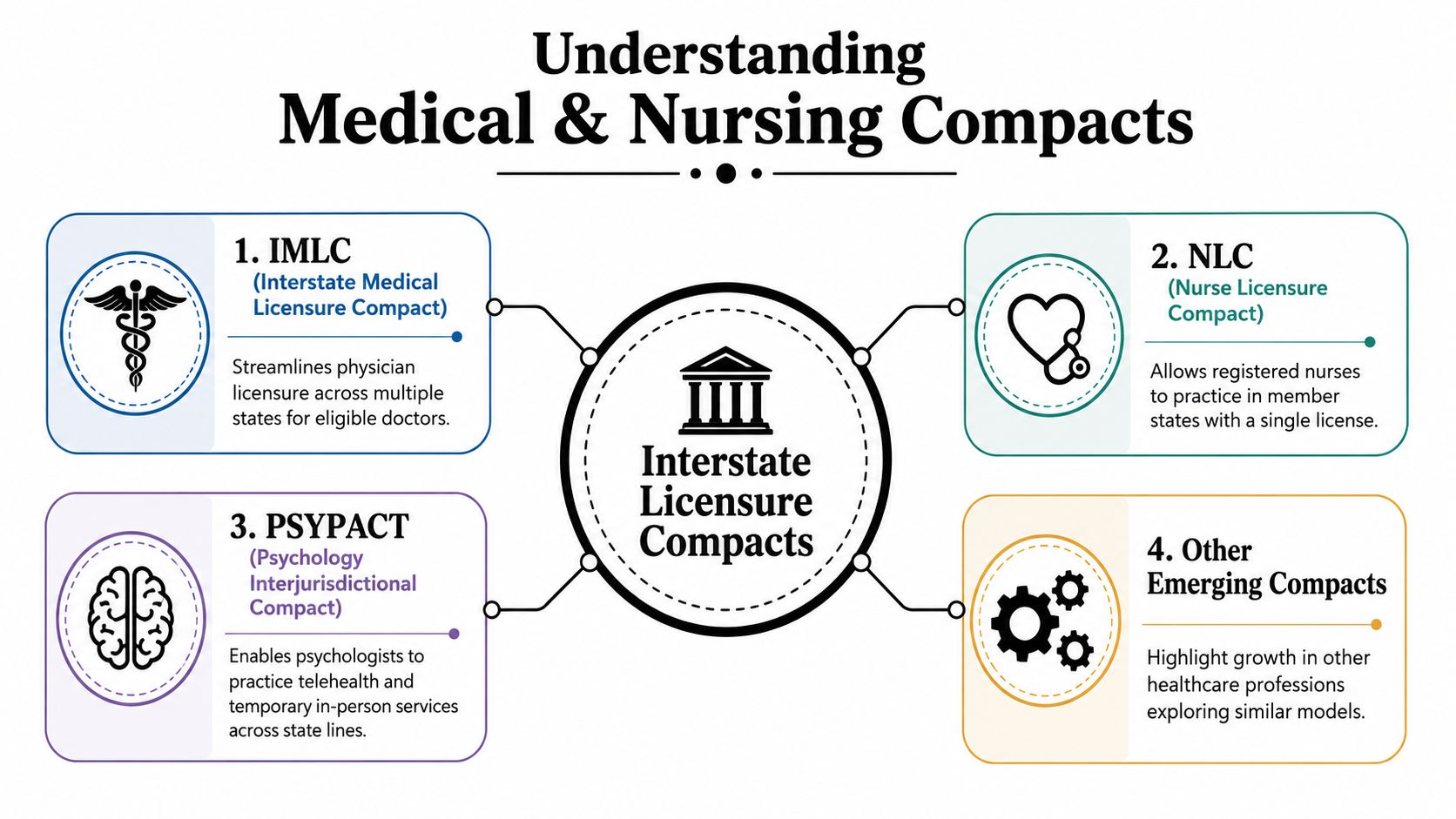
Which compact applies to whom
Here's the situation in plain English.
| Profession | Primary compact or framework | What it generally does |
|---|---|---|
| Physicians | IMLC | Speeds up multi-state physician licensure for eligible doctors |
| RNs and some LPN/LVNs | NLC | Allows practice across participating states under a multistate nursing license |
| APRNs | APRN Compact | Intended to support cross-state advanced practice mobility where adopted |
| Psychologists | PSYPACT | Supports telepsychology and temporary in-person practice across participating jurisdictions |
| Pharmacists, PAs, others | Varies by state and profession | Usually still governed by profession-specific state licensing rules |
What the IMLC is, and what it isn't
For physicians, the IMLC is the most mature path. It doesn't create one national medical license. It streamlines the process of obtaining separate state licenses through a common pathway.
That distinction matters. You still need to follow the laws of each state where you practice. If you're seeing a patient in another state, that state's board, prescribing rules, and telemedicine standards still apply.
If you're comparing practical guidance, WeekdayDoc has a useful explainer on the Interstate Medical Licensure Compact for physicians considering cross-state work. For specialists evaluating how compact participation affects hiring, this overview of cardiology recruitment via IMLC is a worthwhile example of how groups think about access to broader talent pools.
Why this matters beyond physicians
Nurse practitioners, PAs, psychologists, and pharmacists should pay attention even when the exact physician compact doesn't apply to them. The strategic lesson is the same. Administrative mobility expands career mobility.
Practical rule: First identify your profession's governing compact or reciprocity path. Then evaluate jobs only after you know where you're legally portable.
If you're a physician, the IMLC is usually the central mechanism. If you're not, the key question is still identical. What is the fastest lawful route to work across state lines without rebuilding your license file from scratch every time?
Eligibility and Application The Step-by-Step Process
Most physicians overestimate how mysterious the application is. It isn't mysterious. It is administrative, detail-sensitive, and much easier when you treat it like a checklist rather than a side project.
A physician using the IMLC must hold an unrestricted State of Principal License, or SPL, in a member state and meet criteria such as having at least 25% of clinical practice in that SPL state, or having a primary residence or employer there. The application also includes a $700 non-refundable Compact fee and a national criminal background check with fingerprints completed within 60 days, according to MPLT Healthcare's guide to multi-state licensing.
Start with the workflow below, then build your own file system before you submit anything.
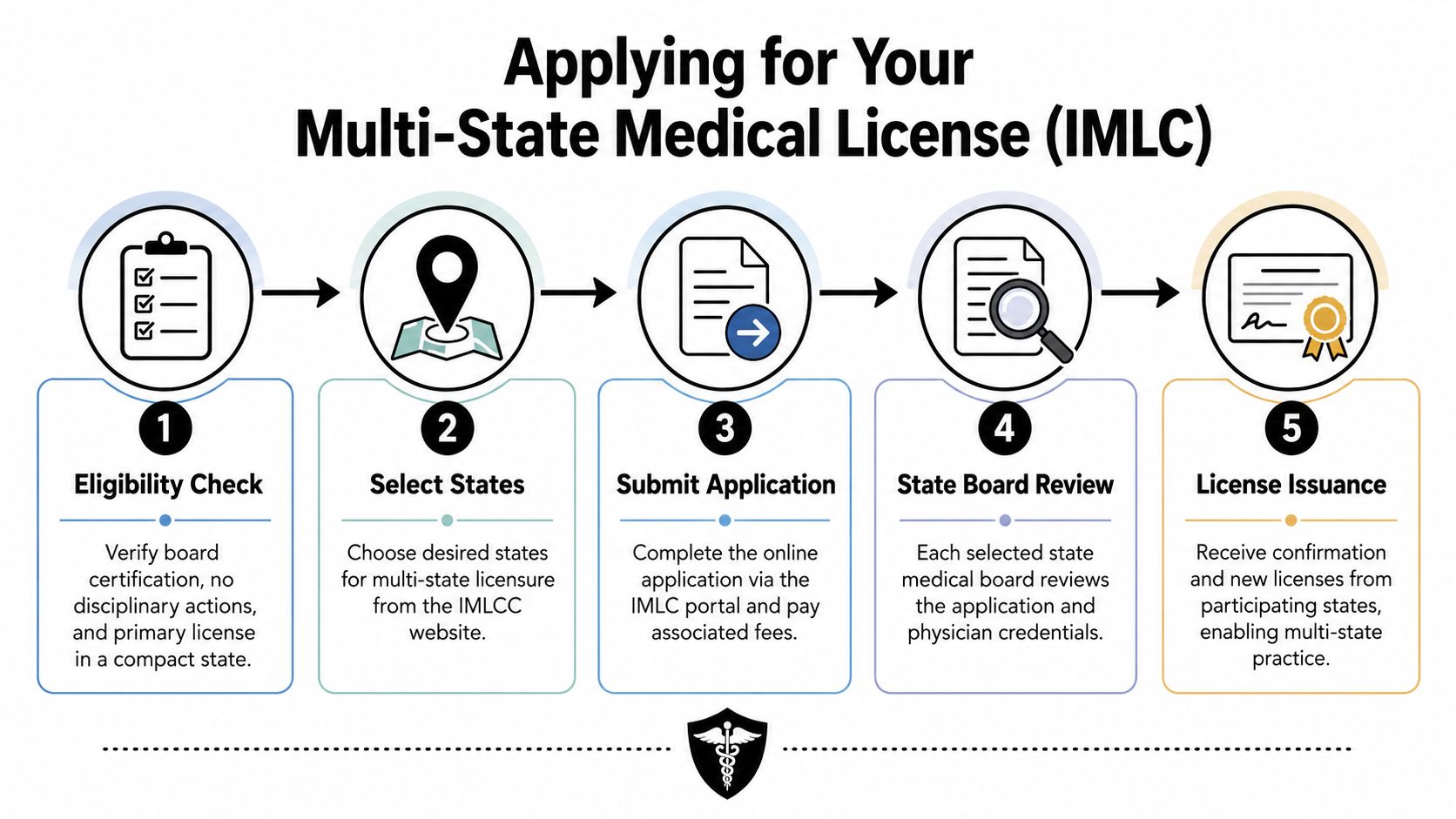
The application sequence that usually works
Confirm your SPL first
Don't start by choosing dream states. Start by confirming the state that can serve as your State of Principal License.Check your record before the portal does
Review your license status, disciplinary history, and board documentation. Small discrepancies create delays.Open the IMLC application and choose states intentionally
Apply for states you can realistically use in the near term. More isn't always better if credentialing, renewal, and payer setup will sit unfinished.Complete fingerprints promptly
The background-check window matters. Miss the timing and you create avoidable rework.
Before you move forward, it helps to understand the credentialing side too. This breakdown on how to speed up provider credentialing is useful because licensure is only one part of becoming billable and operational.
What physicians often underestimate
The application itself is not usually the hardest part. The harder part is organizing your documents and staying responsive after submission.
A few practical habits make a difference:
- Keep one master credentialing file: Include ID documents, board certification records, CV, CME history, malpractice history, and prior licenses.
- Use one naming convention: Messy files slow down everything when states request follow-up documentation.
- Track deadlines externally: Don't rely on memory for fingerprint timing, state responses, or renewal dates.
- Apply with a use case in mind: A telehealth lane, a regional locums plan, or a future relocation strategy all justify different state choices.
If you need only one state for one short-term opportunity, direct state licensure can still make more sense than building a broader compact strategy.
The cost reality you should expect
The fixed Compact fee is only the front end. Each state still charges its own licensure fee. That means your total cost depends on how wide a footprint you need.
For most physicians, the best approach is staged expansion. Apply where you have a near-term revenue plan, then add more states when your scheduling model, contracts, or telehealth pipeline can support them. That keeps your administrative burden proportional to your actual opportunity.
Participating States and Key Exceptions
The right question isn't "Which states are in?" The right question is "Which states are usable for my clinical model right now?"
For physicians, compact participation has broadened considerably, but the status of individual jurisdictions can change. That's why it makes more sense to use live official maps and current state-board resources than to rely on static lists copied into blog posts.
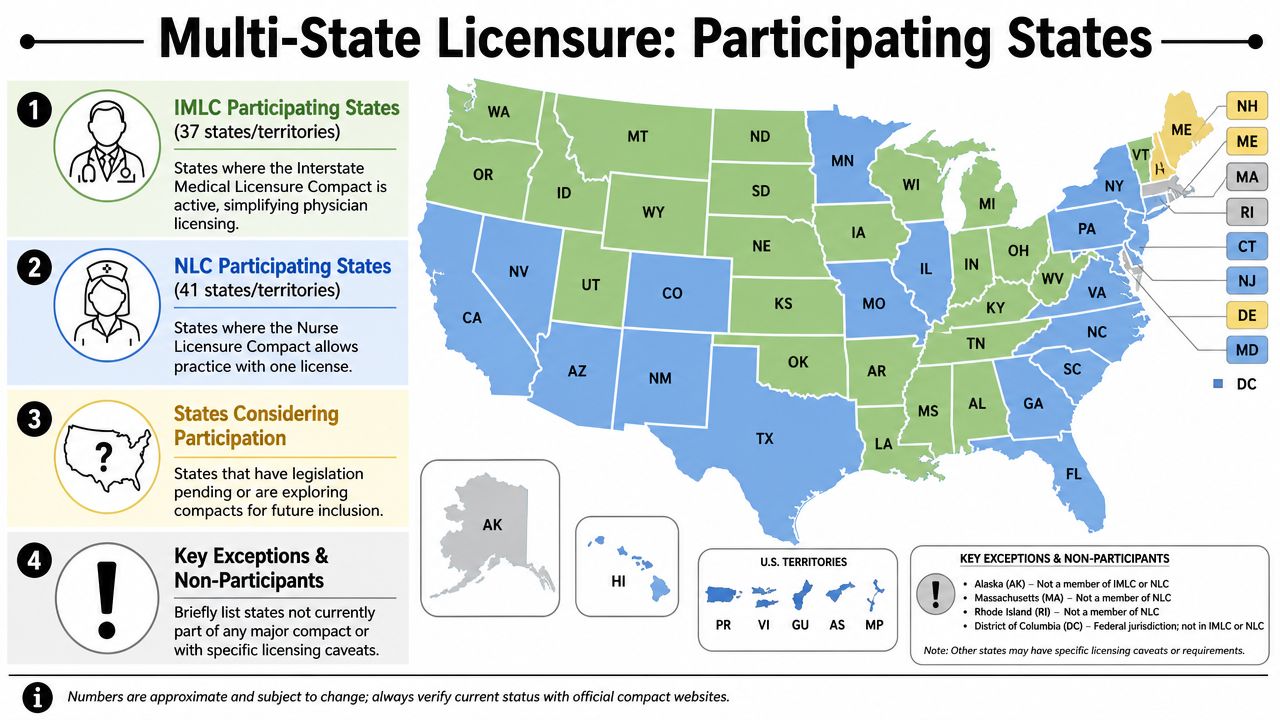
One exception that deserves immediate attention
Michigan is the kind of exception physicians can miss if they're operating on old assumptions. The IMLC commission notes that Michigan participated until March 28, 2026, and withdrew effective that date under MCL 333.16189, meaning licenses issued through the Compact in Michigan may no longer be valid after that withdrawal, according to the official IMLCC site update on Michigan's withdrawal.
That affects more than new applicants. It can affect planning, renewals, and where you expect your compact-based license portfolio to remain active.
How to check your map without making mistakes
Use a current state-by-state reference before you build a licensing budget or start interviews. A practical place to compare requirements is this guide to medical licensing requirements by state, then verify the final status directly with the relevant board and compact commission.
Focus on these questions:
- Can this state serve as your SPL: Some jurisdictions participate but have limitations relevant to application strategy.
- Is the state useful for your practice type: Telehealth, hospital coverage, and outpatient locums don't create the same licensing priorities.
- Has anything changed recently: Withdrawals, implementation phases, and board process changes matter.
- What happens after issuance: Renewal mechanics and state-specific compliance can be just as important as initial approval.
Licensing maps are living documents. Treat them that way.
If you practice across multiple states, don't build your plan once and forget it. Recheck it whenever you add a contract, expand telehealth, or shift your residence or tax footprint.
Navigating Practice Across State Lines
A multi-state medical license starts paying off only after the operational pieces are set up correctly.
The physician who can practice in five states but prescribe in only two, lacks payer enrollment in three, or carries malpractice that excludes telehealth is still boxed in. I see this mistake often. Doctors spend months getting licensed, then discover their true constraint is everything that follows the license.
The hidden cost of going broad
Expansion works best when each added state connects to a specific plan. That might be a telehealth employer, a recurring locums assignment, an employed side gig, or a referral channel you expect to convert into regular revenue. Without that connection, extra licenses turn into renewal fees, CME tracking, and another set of deadlines sitting in your head.
That trade-off matters if your goal is more control over your schedule and income, not more admin. Physicians pursuing better work-life balance or a FIRE-minded career strategy usually benefit more from a focused license portfolio than from a large but underused one.
The compliance stack physicians overlook
Multi-state practice usually requires four separate systems to line up:
- State telemedicine rules: The governing law usually follows the patient's location.
- DEA and prescribing setup: If you prescribe controlled substances, check state-specific requirements early. This guide to DEA registration issues for doctors practicing across jurisdictions is a useful starting point.
- Malpractice coverage: Confirm that each state and each care model you use, including telehealth, is covered.
- Credentialing and enrollment: State approval does not place you on hospital rosters or payer panels.
Any one of these can delay your start date.
Build your map around the life you want
Physicians often ask how many states they should add. The better question is which states give you better choices.
If a license lets you pick up two remote half-days a week, replace a draining call-heavy role, or create backup income before leaving full-time employment, it has strategic value. If it sits unused for a year, it is an expense line and an administrative burden. That distinction matters more than the raw number of active licenses.
A simple filter keeps the decision practical:
| Question | If yes | If no |
|---|---|---|
| Do you have near-term work tied to this state? | Apply | Wait |
| Does it support your long-term practice model? | Put it on the shortlist | Skip for now |
| Can payer or hospital setup happen soon? | Prioritize it | Delay |
| Will it improve schedule control or income stability? | Strong case to add | Weak case to add |
The physicians who use multi-state licensing well are usually building optionality. They want cleaner exits from bad jobs, more negotiating power, and access to remote or hybrid work through platforms like WeekdayDoc. That is where licensing flexibility starts to reduce burnout instead of adding to it.
Finding Burnout-Friendly Jobs with Multi-State Licenses
A physician with one active license is usually shopping in one labor market. A physician with several active licenses can compare multiple markets at the same time, and that changes the burnout equation.
A multi state medical license has value when it improves your ability to choose the structure of your work. It gives you access to remote follow-up care, cross-state telepsychiatry, utilization management, specialty consult work, regional locums, and hybrid employed roles that may offer a more predictable week.
Why this helps with work-life balance
The practical win is not working more hours. It is getting more control over where those hours go.
Physicians who use multi-state licensing well often target roles such as remote physician jobs with fixed clinic blocks, hybrid behavioral health positions that depend on cross-state coverage, part-time specialist work that adds income without another full call schedule, and telehealth-based work that reduces nights, weekends, or commuting. The right role can turn a draining full-time setup into a mixed schedule that is easier to sustain.
That matters for burnout, but it also matters for financial independence. A cleaner schedule lowers the odds of cutting back abruptly or leaving clinical work before you are ready. It can also create room for a second income stream, more consistent investing, or a gradual shift toward FIRE instead of trying to out-earn an unsustainable job.
How to compare opportunities intelligently
Job boards are only useful if they help you compare the terms that shape your life. WeekdayDoc is one example physicians use to sort remote, hybrid, and in-person roles by schedule structure and work style. The point is not to collect listings. The point is to identify jobs that fit the practice model you are trying to build.
I usually tell physicians to compare opportunities across licensed states on four issues:
- Schedule design: call burden, weekend expectations, visit volume, and how much work happens outside scheduled hours
- Income quality: base pay, bonus formulas, unpaid admin time, and whether compensation depends on an unrealistic throughput model
- Geographic flexibility: where you can live, where patients are located, and whether the role gives you more control over family logistics
- Long-term financial fit: whether the position supports debt payoff, investing, emergency savings, or a lower-stress path toward FIRE
The trade-offs are real. More licenses mean more renewal fees, more CME tracking, more compliance work, and more inbox noise from credentialing and payer paperwork. Those costs are worth carrying only if they produce better options on the other side.
Used strategically, multi-state licensing helps you leave the mindset that your current employer sets the limits of your career. It gives you a wider field of choices, and that wider field is often what makes a burnout-friendly job findable in the first place.
Building a Sustainable Career with Licensing Flexibility
A multi state medical license is not glamorous. It won't fix a toxic group by itself, and it won't make a bad contract good. What it does is restore choice.
Choice is what makes sustainable careers possible. Choice lets you compare markets, test telehealth, move toward weekday-only work, diversify income, and stop treating your current employer as your only path forward. For physicians thinking seriously about financial independence, that flexibility matters just as much as compensation. The ability to redesign your schedule often protects your career longer than a marginal pay increase.
Used well, licensing flexibility becomes part of a larger system. Better negotiation position. Better control over geography. Better alignment between work and life outside work.
If you're exhausted, the answer usually isn't "work harder where you are." It's often "expand the number of ways you can practice."
If you're evaluating your next move, start with roles that match the flexibility you've built. WeekdayDoc lets clinicians review burnout-conscious opportunities across remote, hybrid, and in-person settings, with filters for schedule structure, role type, and work style so your licensing strategy can translate into an actual career upgrade.