Your Guide to the Compact Medical License
Unlock multi-state medical practice with our guide to the compact medical license. Learn how it works, if you're eligible, and how to apply.
Think of a compact medical license as your all-access pass for practicing medicine. It's a smart agreement between participating states that lets qualified clinicians practice across borders without having to get a separate license for each and every one. It essentially says, "We trust the vetting your home state did, so you're good to go here, too."
This is a huge departure from the old way of doing things.
Your Fast Pass to a More Flexible Medical Career
For decades, practicing across state lines meant drowning in paperwork. Every new state required its own painstaking application, background check, and fee. It was a bureaucratic nightmare that created massive roadblocks for physicians, nurses, and PAs who wanted to work in underserved areas, take on locum tenens gigs, or practice telehealth.
The compact license system cuts through all that red tape. It's not a single national license, but an interstate agreement built on a simple idea: your primary license state, known as your State of Principal License (SPL), handles the heavy lifting. Once you're vetted there, other member states will recognize that license and grant you a privilege to practice.
This model is a game-changer. It slashes the administrative burden, letting you jump on new opportunities—whether that’s a locum tenens position across the country or a fully remote telehealth role—without waiting months for a new license to clear.
To put it in perspective, here's a quick rundown of what a compact license brings to the table.
Compact License At a Glance
| Feature | Benefit for Clinicians |
|---|---|
| Multi-State Practice | Practice in all participating states with just one primary license. |
| Reduced Paperwork | Eliminates the need for multiple full, separate license applications. |
| Lower Costs | Saves money on numerous application and renewal fees. |
| Faster Turnaround | Get approved to practice in new states in days or weeks, not months. |
| Career Mobility | Unlocks access to telehealth, locum tenens, and hybrid roles nationwide. |
Ultimately, this isn't just about convenience. It’s about building a more sustainable and flexible medical career on your own terms.
Unlocking a Better Work-Life Balance
By breaking down those geographic barriers, the compact license opens up a whole new world of job possibilities that can actually fit your life. It puts you back in control.
For instance, a physician living in a compact state can now easily access:
- Telehealth Opportunities: Provide virtual care to patients in dozens of states from your home office.
- Locum Tenens Roles: Accept short-term assignments in new cities without the typical licensing delays.
- Hybrid Positions: Find unique roles that combine remote work with occasional in-person duties across state lines.
This freedom is empowering. It means you can find a job that helps you avoid burnout and aligns with your professional goals. Searching for flexible, part-time physician jobs becomes radically simpler when your license is as mobile as you are.
It’s about giving you the power to decide where and how you practice medicine—unlocking the career freedom every modern healthcare professional deserves.
How the Compact Medical License Actually Works
A lot of clinicians hear "compact license" and picture a single, national license that works everywhere. The reality is a bit different, but it's actually much smarter. Think of it as an intelligent agreement between states to slash redundant paperwork for trusted physicians.
It’s a lot like having TSA PreCheck for your medical career. Instead of going through the full, painstaking security screening—a traditional state license application—every single time you want to practice in a new state, you complete one thorough vetting process upfront. Once you’re cleared, you get to use the expedited lane in every other participating state.
The Foundation: Your State of Principal License
The entire system is built on one core idea: the State of Principal License (SPL). This is your home base. It’s the state where you already hold a full, unrestricted medical license and meet specific criteria for either residency or where you practice.
Your SPL acts as the verified foundation for everything else. It’s the state that has already confirmed your credentials, run the initial background check, and is essentially vouching for you. This initial, rigorous verification is what gives other states the confidence to trust your qualifications without making you start from scratch.
A compact license doesn't override state authority. Each license you get is still issued by and governed by that specific state's medical board. The compact just creates a streamlined, cooperative pathway to get it.
Once your SPL issues a Letter of Qualification (LOQ), you can then simply select other participating states and receive separate, state-issued licenses much, much faster. You get to skip the most time-consuming steps because your core qualifications have already been proven.
This system isn't just a theory; it's been incredibly effective since it launched. The Interstate Medical Licensure Compact (IMLC) issued its very first license on April 20, 2017. By the end of 2018, it had already processed 3,426 licenses across 26 member states. Better yet, an estimated 80% of U.S. physicians meet the basic eligibility criteria. You can read more about the compact’s early impact from the American Medical Association.
Mapping Out the Compact States
The good news is that the network of participating states keeps growing, opening up more and more opportunities for clinicians who want geographic flexibility.
The map below, provided by the Interstate Medical Licensure Compact Commission (IMLCC), shows you the current landscape.
As you can see, the compact already has extensive reach across the United States, creating a massive, interconnected network that makes multi-state practice a practical reality.
Finding the Right Compact for Your Profession
The term “compact medical license” gets thrown around a lot, but it’s not a one-size-fits-all solution. Think of it less like a single key and more like a set of specialized tools—each compact is built for a specific profession, with its own unique set of rules, participating states, and application quirks.
Picking the right one is your first step. Let's break down the main compacts for clinicians.
The Interstate Medical Licensure Compact (IMLC) for Physicians
This is the big one for physicians (MDs and DOs). The IMLC is a powerful pathway for qualified doctors to get licensed in multiple states without starting from scratch each time. Right now, over 40 states and territories are on board, creating a huge network for telehealth and locum tenens work.
To get in, you need a primary license in a participating state and meet some pretty strict criteria, like having a clean record and being board-certified. The IMLC essentially vets you once, then shares that green light with other member states, which cuts out mountains of redundant paperwork.
Key takeaway: The IMLC doesn't give you a single "national license." It gives you a "Letter of Qualification" that makes you eligible for fast-tracked licensure in other member states. You'll still hold individual licenses for each state you practice in.
The Nurse Licensure Compact (NLC) for Nurses
For Registered Nurses (RNs) and Licensed Practical/Vocational Nurses (LPNs/LVNs), the Nurse Licensure Compact (NLC) is the gold standard. Unlike the physician compact, the NLC offers a true multistate license. Once you have a compact license from your home state, you can practice in any of the 40+ participating NLC states—no extra applications needed.
This model is a game-changer, especially for travel nurses who need to move between assignments without hitting licensing roadblocks. As long as you live in a compact state and keep your license in good standing, you're good to go.
Emerging Compacts for APRNs and PAs
The landscape is also shifting for other key clinicians, though these compacts are still in their earlier stages.
- APRN Compact: This one is designed specifically for Advanced Practice Registered Nurses (NPs, CRNAs, CNSs, CNMs). While the compact is technically active as of early 2026, it needs more states to join before it’s fully operational for multistate practice.
- PA Licensure Compact: Physician Assistants now have their own dedicated compact, finally giving them a path to practice across state lines with less hassle. It’s a huge step forward for PAs who want the same kind of geographic freedom their physician and nurse colleagues have.
These newer agreements are picking up steam as more states recognize the need for a mobile healthcare workforce. They're especially important for clinicians interested in the growing market for specialized physician assistant jobs in telehealth and other flexible roles. As these compacts mature, they'll unlock even more opportunities for sustainable, burnout-resistant careers nationwide.
Qualifying For and Applying to a Medical Compact
Okay, so you get the concept of a medical compact. Now, let’s turn that theory into reality. The application process is much less of a headache than getting individual state licenses, but it still demands that you pay close attention to the details.
While each compact has its own small quirks, the fundamental steps are pretty much the same across the board. We'll use the Interstate Medical Licensure Compact (IMLC) as our main example since it's the most established. The entire system is built on one simple idea: verifying that you're a clinician in good standing.
Confirming Your Eligibility
Before you even think about filling out a form, you need to make sure you meet the basic criteria. Think of this as the gatekeeper step—it’s what keeps the process efficient and trustworthy for everyone.
Here’s what they’re looking for:
- An Unrestricted License: You must have a full, clean license in a participating state. This becomes your State of Principal License (SPL).
- A Clean Professional Record: This is non-negotiable. You can't have any disciplinary actions on any of your licenses or be part of an active investigation.
- Board Certification: For physicians, you’ll need a current specialty certification from an ABMS or AOABOS board.
- Standardized Exam History: You must have passed each part of the USMLE or COMLEX-USA (or an equivalent exam) in no more than three attempts.
These rules aren't just red tape; they ensure that only qualified, thoroughly vetted clinicians get to use this expedited path.
The Application Journey Step by Step
Once you've confirmed you're eligible, the process follows a clear, logical path from that initial verification to holding licenses in multiple states.
This flowchart breaks down the general flow, which is similar for physicians, nurses, and PAs.
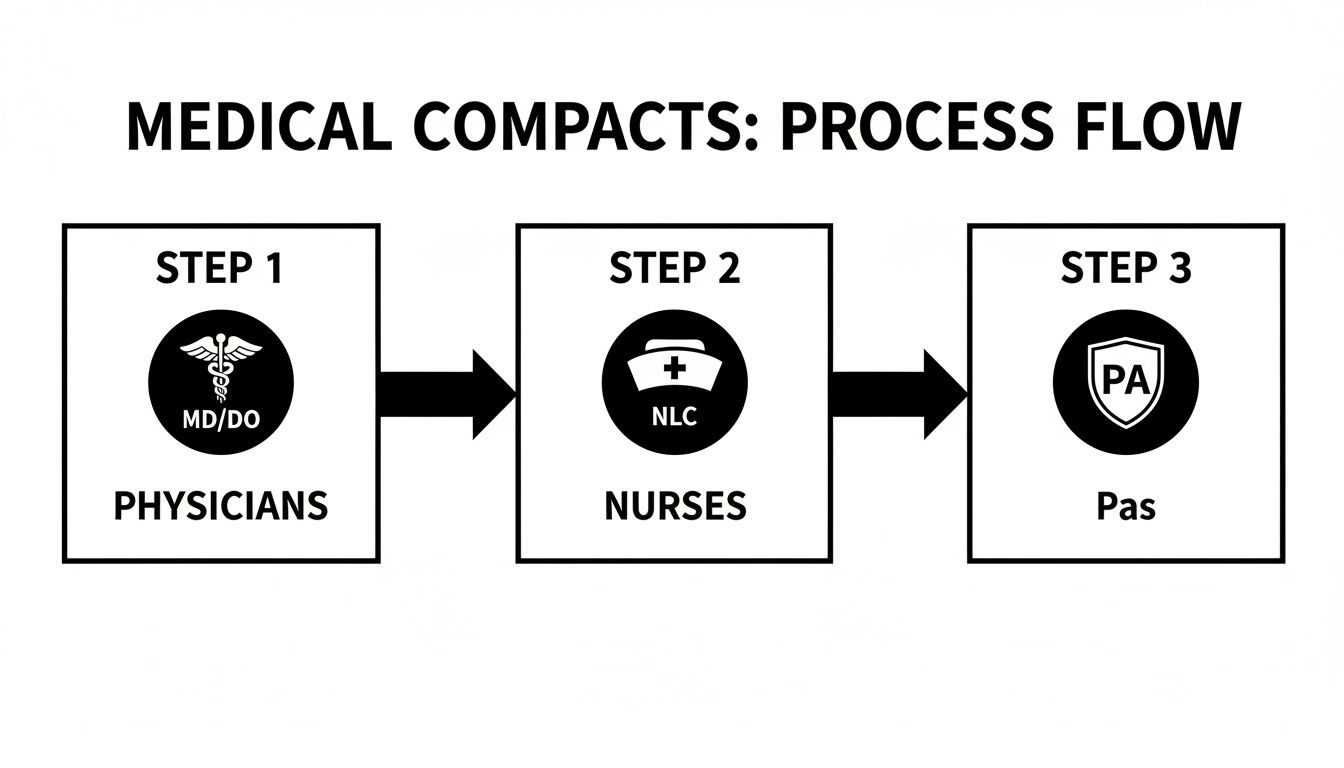
As you can see, it all starts with meeting the strict standards of your profession's compact commission before you can branch out to other states.
Here’s how it works in practice:
- Submit Your Application: You’ll fill out an online application and pay a fee directly to the commission (like the IMLCC for physicians).
- SPL Verification: Your designated State of Principal License takes over from here. They’ll review your credentials and run a criminal background check.
- Receive Your Letter of Qualification (LOQ): Once everything checks out, you get your Letter of Qualification. This is your golden ticket—it confirms you're eligible for the fast lane.
- Select Your States: With your LOQ approved, you log back into the system, pick the additional compact states where you want to practice, and pay each state’s licensing fee.
The demand for this streamlined process is huge. As of May 2025, the IMLC had already processed a jaw-dropping 95,593 letters of qualification applications and 152,755 license requests since it launched in 2017. You can dig into the numbers and growth yourself with these insights from the IMLCC. This isn't just a niche program; it's become a critical piece of infrastructure for building a more mobile and responsive healthcare workforce.
Mapping Your Career Opportunities Across Compact States
A compact medical license doesn't just cut down on paperwork—it completely redraws the map of your career. It turns hard state lines into simple lines on a page, opening up a huge landscape of professional possibilities that were once impractical, if not impossible, to reach.
This geographic freedom is the key to finding a role that truly fits your life.

Holding a compact license means your potential job pool is no longer confined to your immediate driving distance. Instead, you get access to a national marketplace of opportunities. This is a game-changer for clinicians seeking better work-life balance through more flexible work.
The strategic advantage is clear: A clinician licensed in a single non-compact state might see a handful of local telehealth openings. By contrast, a clinician with a compact license can apply for roles serving patients in dozens of states, dramatically increasing their options.
This newfound flexibility allows you to be much more selective. You can target positions in regions with higher pay, more desirable hours, or a lower cost of living—all without having to physically move.
Exploring the Current Compact Landscape
The good news is that the network of states participating in these compacts is constantly growing. For physicians, the Interstate Medical Licensure Compact (IMLC) is especially robust, creating a massive, interconnected territory for multi-state practice.
As of late 2025, the IMLC includes over 40 states and territories. This covers major hubs like Texas, Florida, Illinois, and Arizona, meaning a qualified physician in one member state can efficiently get licensed to practice across most of the country.
It's a similar story for nurses. The Nurse Licensure Compact (NLC) offers RNs and LPNs a multistate license that's valid in over 40 jurisdictions. This broad reach has made it an essential tool for travel nurses and clinicians building careers in telehealth.
The PA Licensure Compact for Physician Assistants is also gaining serious traction, promising to unlock the same kind of cross-border opportunities.
Leveraging Your License for Better Roles
With a compact license in hand, you can start strategically searching for jobs that actually align with your life goals.
For instance, you can actively pursue remote physician jobs that offer no-call and no-weekend schedules, serving patients in states thousands of miles away. This isn't just a job—it's a way to build a sustainable career that puts your well-being first.
Common Questions About the Compact Medical License
Stepping into the world of interstate licensing can feel a little confusing at first. Let's break down some of the most common questions clinicians have when they're considering a compact medical license.
Is a Compact License a Single National Medical License?
No, and this is a really important distinction to make. The compact license isn't a single, universal credential that works everywhere.
Think of it more like an express lane for getting individual state licenses. You still hold separate licenses issued by each state's medical board. The compact just cuts through the red tape, making the process of getting those licenses incredibly fast.
How Much Does It Cost to Get Licensed Through the Compact?
The cost comes in two main parts. First, there's a one-time application fee you pay directly to the compact commission. For the IMLC, for instance, that fee is $700.
Once you get your Letter of Qualification, you then pay the standard licensure fees for each additional state you want to practice in. It’s an upfront investment, for sure, but it often pays for itself by letting you start earning income in new states months sooner than the old way.
While the compact adds an initial fee, the true value comes from the dramatic reduction in administrative time and the accelerated path to practicing—and earning—in new markets. This speed-to-practice is a significant financial and career advantage.
Can I Use the Compact if My Primary License Is Not in a Member State?
Unfortunately, no. This is one of the most critical eligibility rules. Your State of Principal License (SPL) must be in a state that has joined the compact you're applying for.
Your SPL is determined by things like where you live or where the majority of your clinical practice happens. If your home base isn't in a compact state, you'll have to stick with the traditional, state-by-state application process for now.
Does a Compact License Affect How I Renew My Licenses?
Yes, but in a good way—it simplifies things. You are still responsible for meeting the unique renewal requirements, like continuing medical education (CME), for every single state license you hold.
The key, however, is that your eligibility to stay in the compact hinges on keeping your SPL active and in good standing. Maintaining that one primary license is the linchpin for all the other licenses you've obtained through the compact.
Ready to use a compact medical license to find a job that actually respects your time? At WeekdayDoc, we specialize in connecting clinicians with remote, hybrid, and no-call roles that put work-life balance first. Start your search for a burnout-friendly career today.