Part Time Telehealth Nurse Practitioner Jobs A 2026 Career Guide
Explore top part time telehealth nurse practitioner jobs in 2026. Find tips on scheduling, pay, and landing a flexible role that fits your life.
If you're looking for a way to actually achieve work-life balance and sidestep burnout, part-time telehealth jobs for nurse practitioners are a game-changer. These roles offer the scheduling freedom you need with the competitive pay you deserve, creating a career path that’s truly sustainable.
A New Path: Flexible Part Time Telehealth NP Jobs
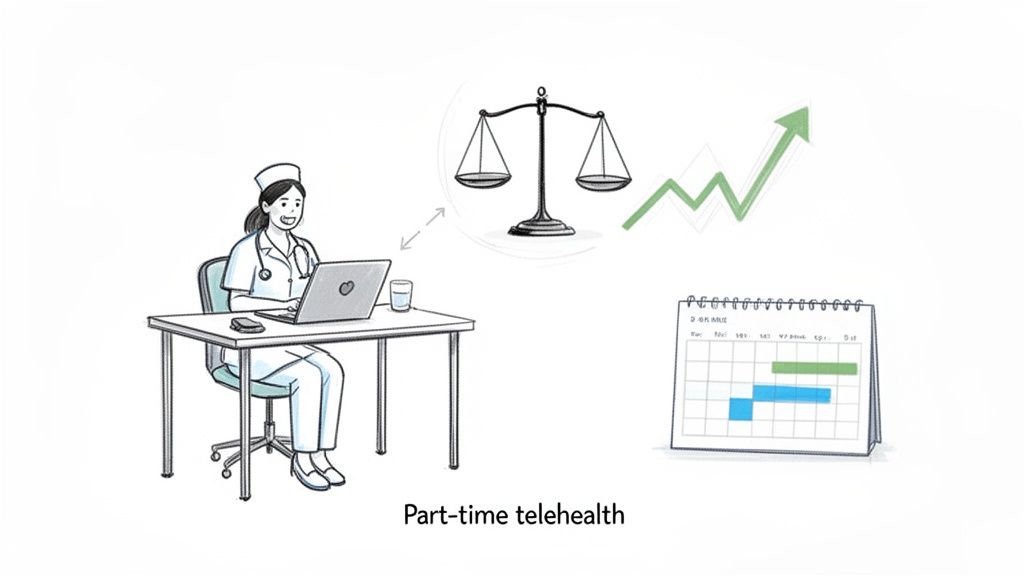
The entire landscape for nurse practitioners has changed. What was once a niche corner of medicine—telehealth—is now a mainstream career, especially for NPs looking for part-time work. This isn't just about the convenience of working from home; it's about taking back control of your schedule and your life.
A few years ago, a part-time remote role might have felt like a career compromise. Not anymore. For many NPs, it's now a strategic move away from the high-stress, high-volume grind of traditional clinical settings. A part-time virtual job can be the perfect antidote to the burnout caused by overwhelming patient loads and endless administrative tasks.
The Market Is Booming for a Reason
The demand for part-time telehealth nurse practitioner jobs isn't a fluke—it’s driven by both patient need and clinician burnout. The numbers don't lie. NP employment is projected to skyrocket by 35% between 2024 and 2034, blowing past the growth rates of most other professions.
A huge part of that growth is in telehealth. Virtual care platforms are finally bridging the gap for patients in rural and underserved areas, and they need skilled NPs to do it. You can dig into more of these trends in the latest surveys from sources like AMN Healthcare.
This creates a win-win. Patients get the accessible care they need, and clinicians get the sustainable careers they’ve been fighting for. Part-time telehealth is where these two critical needs meet.
For many clinicians, a part-time telehealth role is the key to achieving financial independence without sacrificing personal well-being. It reframes your career as a tool to build the life you want, not an obstacle to it.
For NPs interested in this path, it's helpful to know what a typical role looks like. While every job is different, most share a common profile.
Typical Part-Time Telehealth NP Job Profile at a Glance
| Attribute | Common Expectation |
|---|---|
| Hours Per Week | 15–25 hours, often with flexible scheduling |
| Schedule | Typically weekday hours only; no nights or weekends |
| Call Coverage | Almost always no on-call requirements |
| Compensation | Hourly rates ranging from $65–$95+ per hour |
| Licensure | Requires an active, unrestricted license in the state(s) of practice |
| Setting | 100% remote, requiring a private, HIPAA-compliant workspace |
This table gives you a quick snapshot, but the real value is in how these roles let you design your life.
Finding Gigs That Are Actually Burnout-Friendly
The real challenge isn't finding telehealth jobs—it's finding the right ones. Sifting through hundreds of postings on generic job boards to find roles that genuinely protect your time is exhausting.
This is where specialized platforms are making a huge difference. By curating jobs and using clear, non-negotiable filters like “No Call” and “No Weekends,” they do the hard part for you.
Imagine a job search where you're not just hoping for a good fit but are guaranteed one from the start. This focused approach saves you hours of vetting and ensures you're only looking at opportunities that line up with your goal: a balanced career where you can provide great care without sacrificing yourself.
Finding Your Ideal Part-Time Telehealth Role
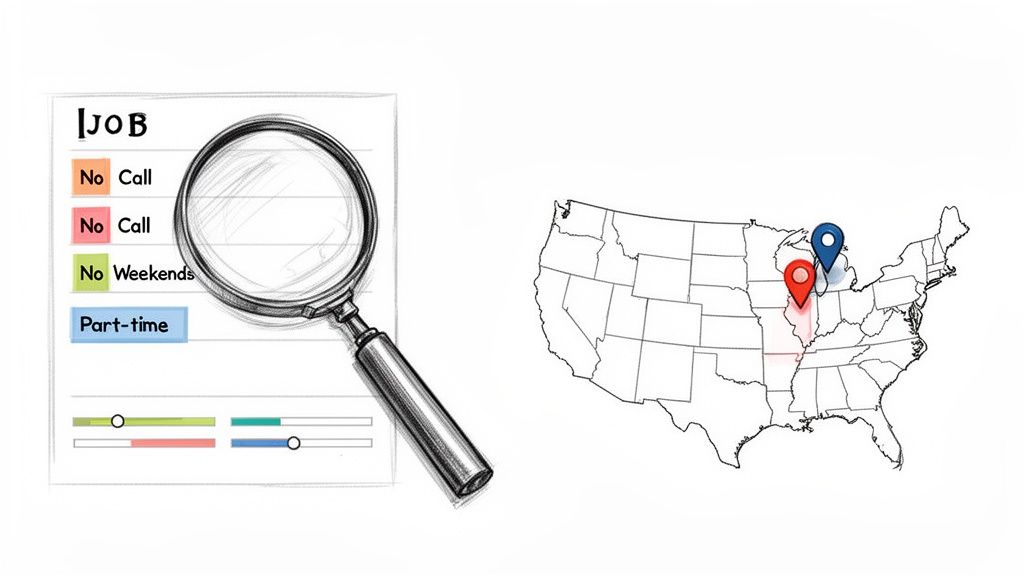
Ready to find a job that actually fits your life? The first step is getting away from the massive, generic job boards. If you want to find the best part-time telehealth nurse practitioner jobs, you have to use platforms that understand what a truly burnout-friendly role looks like.
This means finding niche sites where you can filter for what really matters: schedule, patient load, and call coverage. Forget sifting through hundreds of irrelevant listings. A targeted search lets you specify "No Call" or "No Weekends" and only see jobs that meet your non-negotiables. It’s the difference between a frustrating scroll and a focused hunt.
Where to Look for High-Value Roles
A smart job search isn't just about what you look for, but where. Not all states offer the same level of opportunity or compensation for telehealth NPs.
The demand is definitely there. Projections show a staggering 58.5% job growth for nurse practitioners through 2030. States like Texas are at the forefront, with a projected 60% expansion that translates to over 2,240 new NP openings each year. Many of these are virtual, part-time positions with average salaries hitting $130,930. You can see more data on top states for NPs on PracticeMatch.com.
Focus your search on states with high demand and strong pay, especially if you hold a Nurse Licensure Compact (NLC) license. This strategy alone can dramatically expand your options and boost your earning potential.
Pro Tip: Look beyond the schedule. Actively search for job descriptions that mention protected “admin time” or “charting time.” This is a huge green flag that an employer understands and respects your need to avoid burnout.
How to Read Between the Lines of a Job Description
Remember, a job description is a sales pitch. You have to learn to decode the vague language that often hides undesirable duties. What they don't say is just as important as what they do.
Here’s what to watch out for:
- “Flexible schedule”: Does this mean you set your own hours, or that you’re expected to be available whenever they need you? Get clarification on this during the very first screening call.
- “Shared call duties”: This almost never means "no call." You need to dig in and ask about the frequency. Is it one weekend a year or one week a month? The difference is huge.
- “Handle administrative tasks as needed”: This is a classic catch-all. It could mean five minutes of charting or five hours of unpaid paperwork. Ask them to define a specific percentage of your time dedicated to admin work.
Platforms like WeekdayDoc were built to cut through this noise. Every job listing on our site includes a Burnout-Friendly Score and transparent details about the role, helping you gauge a company’s culture before you even think about applying. Our complete guide to finding the best part time nurse practitioner jobs offers even more strategies for evaluating employers and landing a balanced, rewarding role.
Crafting Your Telehealth-Ready Resume and Profile
Your resume is what gets you in the door for the best part-time telehealth nurse practitioner jobs, but your standard clinical resume just won’t do the trick. To grab a recruiter’s attention, you have to speak their language. That means translating your hands-on experience into the specific skills that prove you’re ready for a remote role.
It’s less about reinventing your experience and more about reframing it. Think about the digital tools you already use every day. A simple shift in how you describe your work can make all the difference.
Translating Clinical Skills for Telehealth
Let’s look at a quick before-and-after. It’s all about showing you’ve done the work, not just telling them you can.
Before: A Traditional Resume Bullet
- Provided primary care services for patients with complex chronic illnesses.
After: A Telehealth-Optimized Bullet
- Managed a panel of complex primary care patients via telehealth, utilizing EMR-integrated video platforms to conduct acute and follow-up visits.
See the difference? The “after” version immediately signals to a hiring manager that you have direct experience with the core functions of a remote NP role. It shows you’re not just clinically competent but also comfortable with the technology.
Highlighting Your Digital and Licensing Advantages
When you update your resume, you need to zero in on the three things telehealth employers value most: your tech stack, your communication style, and your licenses. These are your biggest selling points in the virtual care market.
Technology Proficiency: Don't just write "proficient with EMRs." Get specific. Name the systems you’ve actually used—like Epic, Cerner, or Athenahealth. The same goes for any telehealth platforms, such as Doxy.me or Teladoc.
Webside Manner: This is the new bedside manner. You need to prove you can build rapport through a screen. Use a bullet point that quantifies your success, like: "Maintained a 95% patient satisfaction score by using active listening and clear communication during virtual consultations."
Licensure: Your licenses are gold. If you hold a Nurse Licensure Compact (NLC) license or multiple state licenses, don’t bury this information. Put it right at the top of your resume in its own section.
For a telehealth company, a candidate with multi-state licensure is a huge win. It means you can start seeing patients across a wider geography with almost no administrative delay, making you a more versatile and cost-effective hire right out of the gate.
Finally, make sure your online presence matches your resume. Your LinkedIn profile should be packed with the same keywords and skills. Add terms like "telemedicine," "virtual care," and "digital health" to your headline and summary. Recruiters are searching these terms constantly.
Optimizing your profile to highlight remote care experience is one of the fastest ways to get noticed. For more tips on how to position yourself, check out our complete guide to finding remote nurse practitioner jobs.
Negotiating Your Salary, Schedule, And Contract Terms
You’ve landed the interview and a promising part-time telehealth role is within reach. Now comes the most important part: talking specifics. This is the moment you secure the work-life balance you’ve been aiming for.
A great part-time opportunity is defined by its terms, not just the hourly rate.
Remember, almost everything is on the table. Your exact hours, patient load, even your protected admin time—this is your chance to build a job that actually works for your life. Don't be afraid to ask for what you need.
Benchmarking Your Pay And Setting Your Rate
Before you even think about talking numbers, you need to know your worth. Part-time telehealth nurse practitioner roles command competitive rates because they require a specialized skill set. Your goal is to walk into that conversation armed with a clear, data-backed salary range.
Let's look at the numbers. Current data shows telehealth NPs can earn an average of $130,295 annually, and the top 5% are clearing over $171,000. Even working just 25 hours a week, that could translate to an income of over $80,000 per year.
For a more granular view, check out the latest telehealth NP salary data on ZipRecruiter.com to see what rates look like in your state.
Use this info to establish your target hourly rate. If your goal is $75/hour, you can confidently go into the negotiation saying something like, "Based on my experience and current market rates for this type of role, I am seeking a rate between $70 and $80 per hour."
Protecting Your Time And Schedule
Negotiating your schedule is just as critical as your pay—maybe even more so. This is your number one tool for preventing burnout. You have to be explicit about your availability and the boundaries you need to make the job sustainable.
Here are a few ways to frame your requests to protect your time:
- For patient load: "To ensure I can provide high-quality care, what is the expected patient-per-hour load? I find I'm most effective and thorough at a pace of 2-3 patients per hour."
- For admin time: "Can we build in 30-60 minutes of protected administrative time at the end of each shift? That's crucial for me to complete charting without it spilling into my personal time."
- For schedule: "A four-day week is really important for my work-life balance. I am available to work my 20 hours Monday through Thursday."
Don't settle for vague promises of "flexibility." You need to get these commitments in writing.
A truly burnout-friendly employer won't be surprised by these requests. They get it. They know a respected, well-rested clinician provides better care. If you get major pushback on reasonable boundaries, that’s a huge red flag.
This is where you lock in the details that will make or break your new role. The infographic below shows the key things you should have already highlighted in your resume to set the stage for a strong negotiation.
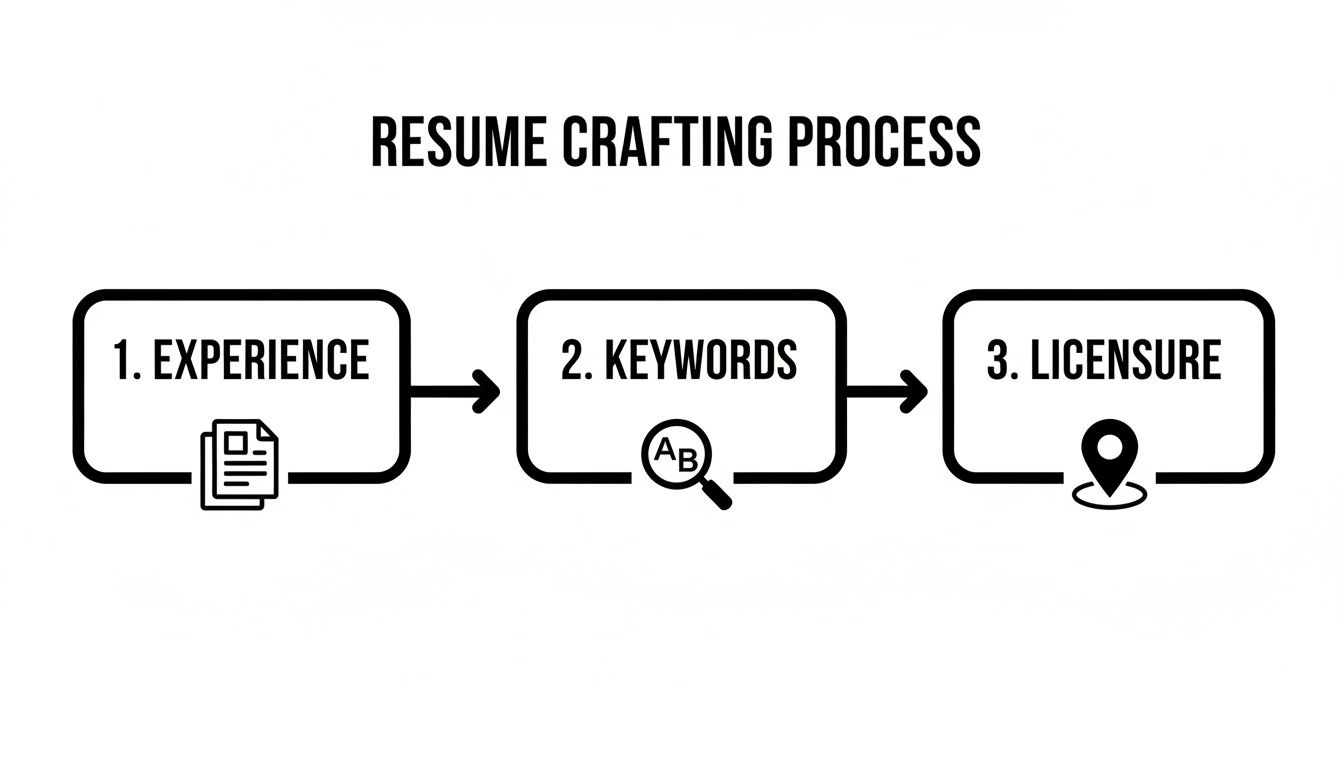
By clearly showcasing your telehealth experience, relevant skills, and multi-state licensure, you've already positioned yourself as a high-value candidate who is worth the terms you’re asking for.
Finalizing The Contract
Once you’ve reached a verbal agreement, make sure every single detail is documented in your written contract. Comb through the fine print, paying close attention to language around on-call duties, weekend expectations, and malpractice coverage.
Be wary of vague phrases like "other duties as assigned." This can be a loophole for piling on unpaid work. Don't be shy about asking for clarification or more specific language. For a deeper analysis of your offer, you might find it helpful to run it through WeekdayDoc's Contract Scanner tool to spot potential red flags.
At the end of the day, your contract is the final word. Make sure it truly reflects the balanced, sustainable role you worked so hard to negotiate.
Your Home Office Tech And Licensure Checklist
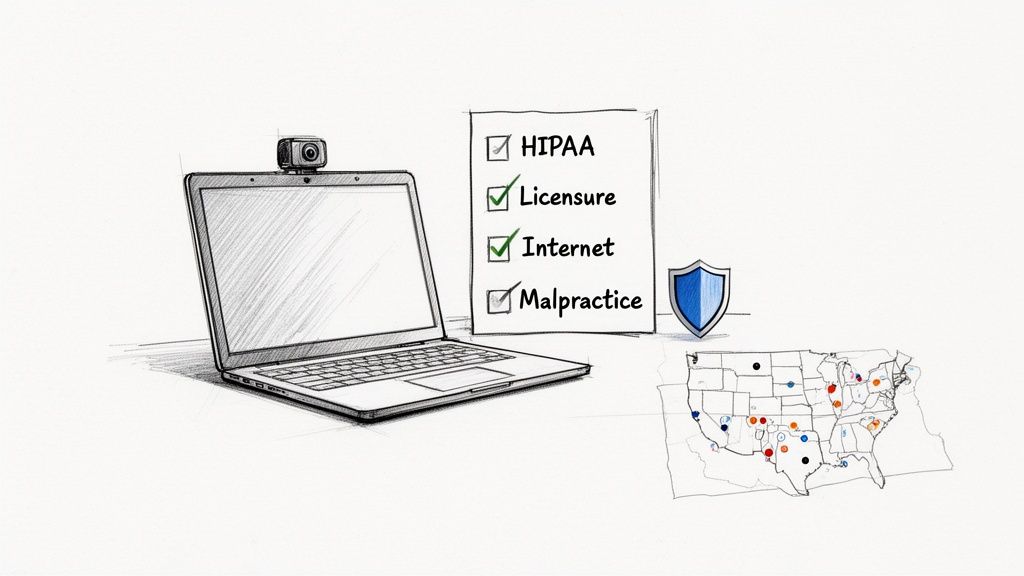 Alright, let's talk logistics. Landing one of the best part time telehealth nurse practitioner jobs is one thing, but being ready to start is another. Your transition to remote work hinges on more than just your clinical expertise—it's about having the right tech, the right licenses, and understanding your legal coverage.
This isn't just about finding a quiet corner in your house. It’s about setting up a professional, secure, and fully compliant virtual clinic. Getting these details right from the start makes you a much more attractive and prepared candidate.
Setting Up a HIPAA-Compliant Home Office
Think of your home office as a clinical exam room. Patient privacy is non-negotiable, and that responsibility now extends to your personal space and your digital setup.
A Secure Physical Space: You absolutely need a room with a door that closes and locks. Patient consults cannot be overheard by family, roommates, or even smart speakers like Alexa.
Rock-Solid Internet: A spotty connection is a deal-breaker. Most telehealth companies insist on a hardwired ethernet connection for stability and have minimum speed requirements, often around 50-100 Mbps download/upload. Run a speed test and be ready to upgrade your internet plan if you don't meet the cut.
Professional Presence: A cluttered background or bad lighting just looks unprofessional. Sit in front of a neutral wall or use a company-approved virtual background. A simple ring light can dramatically improve how you appear on camera.
When it comes to your video software, security is everything. Using one of the many available HIPAA compliant video conferencing platforms isn't just a good idea—it's a legal and ethical requirement to protect your patients.
How to Handle Licensure and the NLC
Your state licenses are your keys to the kingdom of telehealth. The more states you're licensed in, the more valuable you are to employers, especially those with a national footprint.
The Nurse Licensure Compact (NLC) is a massive advantage here. It allows you to practice in all participating states with a single multistate license. If your primary residence is in an NLC state, getting a compact license should be your top priority. It will immediately expand your access to part time telehealth nurse practitioner jobs.
If you're based in a non-compact state, you'll need to be more strategic. Research which states have the highest demand for telehealth NPs in your specialty and focus on getting licensed there first. Don't be afraid to ask about reimbursement—many companies will cover licensing fees for the right candidate.
Always confirm a company's policy on malpractice insurance. W-2 employees are typically covered, but 1099 independent contractors are almost always required to purchase their own policy. This is a critical detail to clarify during contract negotiations.
Your Essential Telehealth Tech Checklist
Beyond a reliable computer, a few key pieces of gear will make your virtual practice run smoothly. Consider these your new digital instruments.
Essential Gear:
- A high-quality webcam (most modern laptop cameras are fine)
- A noise-canceling headset with a built-in microphone
- A secure, password-protected Wi-Fi network (with a separate guest network)
- A second monitor (this is a game-changer for viewing an EMR and the patient feed at the same time)
Sorting out your home office and licenses might feel like a lot of prep work, but it’s a straightforward process. Ticking these boxes shows employers you're a serious, professional candidate who is ready to hit the ground running in a remote role.
Common Questions About Part Time Telehealth NP Jobs
Making the jump to part-time telehealth brings up a ton of questions. It's a huge shift from the traditional clinic or hospital floor, and it's smart to wonder about the financial reality, the necessary skills, and how to protect your time.
Let's cut through the noise and get straight to the answers you actually need. Knowing what to expect helps you build a career that doesn't just pay the bills, but actually fits your life.
Can I Really Achieve Financial Independence With a Part Time Job?
Absolutely. A lot of NPs assume that going part-time means shelving their financial goals, but that’s a huge misconception. With competitive hourly rates often hitting $70 or even $80 an hour, a 20-25 hour work week still adds up to a very solid income.
When you combine that earning potential with some smart financial planning, the path to financial independence (or just a healthier savings account) looks much more realistic. Plus, think of all the money you’ll save on commuting, scrubs, and lunches out. For many NPs, those savings alone make a noticeable difference.
How Do I Spot a Genuinely Burnout-Friendly Job?
Look for employers who put their promises in writing, not just in vague mission statements. A truly supportive company is upfront about expectations because they have nothing to hide.
Keep an eye out for these green flags in job descriptions:
- "No Call" and "No Weekends" are stated explicitly.
- Defined patient loads, like an expectation of 2-4 patients per hour, are specified.
- Guaranteed administrative time is built directly into your schedule.
When you get to the interview, ask direct questions. "What's the policy on after-hours patient messages?" and "How much time is blocked off for charting each day?" A great employer will have clear, firm boundaries in place to protect you.
If a hiring manager gets defensive about patient load questions or seems evasive about burnout, take that as a major red flag. The best companies are proud of how they support their clinicians' well-being.
What Skills Matter Most for a Remote NP Role?
Your clinical expertise is the foundation, but succeeding in telehealth requires a different set of skills focused on autonomy and your "digital presence." Employers need to know you can manage yourself and connect with patients without direct supervision.
These are the skills that will set you apart:
- Webside Manner: This is the new bedside manner. It’s your ability to build rapport and project empathy through a screen. You need to be an expert at active listening to make patients feel seen and heard, even from miles away.
- Tech Proficiency: You have to be comfortable with the tools. This isn't just about general computer skills; it's about showing you can quickly master new EMRs and telehealth platforms.
- Autonomous Work Ethic: As a remote provider, you are your own manager. You have to be self-motivated, organized, and capable of handling your patient panel efficiently without someone looking over your shoulder.
And don't forget to highlight any multi-state licenses you hold. This makes you instantly more valuable to companies with a national footprint.
Do I Need My Own Malpractice Insurance?
It all comes down to your employment status. If you are hired as a W-2 employee, the company will almost always provide and pay for your malpractice insurance.
However, if you're brought on as a 1099 independent contractor, you are your own business, and you'll almost certainly be responsible for getting your own policy. Make sure to clarify this during contract negotiations and confirm that whatever policy is in place—yours or theirs—covers you in every single state where you're licensed to practice.
Finding a telehealth role that truly supports your professional and personal life is everything. At WeekdayDoc, we only list burnout-friendly jobs with clear work-life balance markers like "No Call" and "No Weekends." Start your search for a more sustainable career at https://www.weekdaydoc.com.